Chinese Discourse Relation Recognition
Hen-Hsen Huang
Department of Computer Science and
Information Engineering,
National Taiwan University,
Taipei, Taiwan
[email protected]
Hsin-Hsi Chen
Department of Computer Science and
Information Engineering,
National Taiwan University,
Taipei, Taiwan
[email protected]
Abstract
The challenging issues of discourse relation recognition in Chinese are addressed. Due to the lack of Chinese discourse corpora, we construct a moderate corpus with human-annotated discourse relations. Based on the corpus, a statistical classifier is proposed, and various features are explored in the experi-ments. The experimental results show that our method achieves an accuracy of 88.28% and an F-Score of 63.69% in four-class clas-sification and achieves an F-Score of 93.57% in the best case.
1
Introduction
A discourse relation is the way that two succes-sive arguments logically connected. Recognizing discourse relations attracts much attetions in re-cent years due to many potential applications. In the annotation scheme of Penn Discourse Tree-bank 2.0 (PDTB-2.0), the first level of discourse relations includes four classes such as Temporal, Contingency, Comparison, and Expansion (Pra-sad et al., 2008).
The first challenge of discourse relation recognition is the lack of corpus. To construct a discourse corpus has several difficulties. First, the definition of discourse is unclear and varied over different areas. Thus, finding the clear boundary of a discourse argument is a vexing problem by itself. Second, the relationship be-tween arguments is often difficult to decide and inherently subjective. Thus, the annotation and the evaluation are problematic and labor-intensive.
In recent years, the study of discourse relation recognition is growing in the English domain rapidly. One of the reasons is the availability of English corpora with discourse annotations. The two most popular discourse corpora are the
Rhe-torical Structure Theory Discourse Treebank (RSTDT) (Carlson et al., 2001) and PDTB-2.0. Both of them are based on the Wall Street Jour-nal corpus with human-annotated discourse in-formation. The PDTB-2.0 consists of 36,592 pairs of successive arguments and is tagged with three classes, including Implicit, Explicit, and AltLex, and with the relation types at three levels. Based on these corpora, a number of aspects on discourse relation are explored in these years.
Compared to the English corpora, there is still no Chinese discourse corpus worldwide available. For this reason, the dataset is the first challenge encountered in the study of Chinese discourse relation recognition. To address this issue in this work, we construct a moderate Chinese discourse corpus as a starting point. A supervised statistical classifier is trained and tested on this data set to deal with the problem. Various features are tracted from the corpus and evaluated in the ex-periments.
The rest of this paper is organized as follows. First, we review the related work in Section 2. In Section 3, the Chinese discourse relation prob-lem is illustrated. Our corpus and the details on the annotation work are presented in Section 4. In Section 5, the method and the features are in-troduced. The experimental results are discussed in Section 6, and we conclude this paper in Sec-tion 7.
2
Related Work
Pitler and Nenkova (2009) reported an explicit discourse relation recognizer that achieves an accuracy of 94.15%. On the other hand, the im-plicit discourse relation recognition is much more challenging than the explicit one. The im-plicit discourse relation recognition is to predict the relation of two successive arguments without connectives. In the work of Marcu and Echihabi (2002), the dataset for implicit discourse relation
detection is automatically derived from explicit samples by removing the connectives. Though this approach is efficient to obtain a large corpus, the pseudo implicit corpus does not exactly cap-ture the property in the real world.
Based on PDTB, in which the argument pairs are distinguished between implicit and explicit, Pitler et al. (2009) and Lin et al. (2009) ad-dressed the task of real implicit discourse rela-tion recognirela-tion. In the work of Pitler et al., the implicit discourse relation detection achieves an average accuracy of 62.78% for four-class classi-fication. In the work of Lin et al., the implicit discourse relations are classified into 11 types (selected from the second level tagging in PDTB), and their classifier achieves an accuracy of 40.2%.
From the other aspect, the semi-supervised approach is explored to deal with some relations that are rare in the corpus (Hernault et al., 2010).
3
The Discourse Relation in Chinese
In this work, we adopt the top level classes of PDTB to deal with the Chinese materials.
When two arguments are temporally related, they form a Temporal relation. There are two subtypes of Temporal relation, ordered in time (Asynchronous, as defined in PDTB-2.0 annota-tion manual1) and overlapped (Synchronous). For example, the events in the two arguments in (S1) occur sequentially in time. The event in the se-that the meridian is not only a good conduc-tor of current, but also a good conducconduc-tor of electromagnetic waves.‟
The Contingency relation talks about the situa-tion that the event in one of the arguments casu-ally affects the event in the other argument. In Chinese, the typical compound connective of Contingency is „ 因 為…,所 以…‟
(„Be-is its result. Such a relation („Be-is defined in PDTB-2.0 as Cause, a subtype of Contingency. In sam-ple (S3), the connective „因為…,所以…‟ is removed. Obviously, the relation between the two clauses is still Contingency. This situation is similar to the case of implicit relation in English.
(S2) 因 為颱 風來 襲, 所以 學 校停 止上 課 。 „Because of the typhoon struck, the school has broken up.‟
(S3) 颱風來襲,學校停止上課。 „The typhoon struck; the school has broken up.‟
Condition is another typical subtype of Con-tingency. Condition relation between two argu-ments specifies the situation in which the event in one argument is conditioned on the event in the other argument.
Comparison is used to show the difference be-tween two arguments. A subtype of Comparison is Contrast, where the two arguments share a common predicate or property, and their differ-ence is highlighted.
Expansion, the most common relation, either expands the information for one argument in the other one or continues the narrative flow. In sample (S4), the second argument expands the information to the first argument.
(S4) 伏爾泰是啟蒙運動的領導者,一位偉大
的思想家。 „Voltaire is the leader of the Enlightenment, a great thinker.‟
除此之外,他也是著作等身的作家。 „In addition, he is also a prolific writer.‟
Some words that are usually used as marks to indicate the discourse relations are given in Ta-Expansion 而且 (furthermore)
也 (also) 或者 (or) 例如 (for example) 除了 (in addition)
4
Dataset
To deal with the problem of Chinese discourse relation recognition, we firstly construct a corpus for training and testing. The corpus is based on Sinica Treebank 3.1. Total 81 articles are ran-domly selected from the Sino and Travel sets.
The first issue we encountered is how to seg-ment an article into arguseg-ments. In other words, the issue concerns the determination of the ar-gument boundaries. In PDTB, both the bounda-ries of arguments and the type of discourse rela-tions are annotated by human. In this data set, an argument is not always a sentence. That is, it may be a clause. Sometimes it may be composed of a number of sentences. However, to annotate in such a way is costly and time-consuming. For convenience, we regard an argument as a sen-tence in this work. A sensen-tence is defined to be a sequence of words ended by a full-stop, a ques-tion mark, or an exclamaques-tion mark.
In this way, each article is segmented into sen-tences and shown to three annotators. An annota-tor assigns one of four discourse relations to each pair of successive sentences. Under this scheme, the annotators regard a sentence as a discourse unit and determine how successive sentences relate to each other. Finally, the majority among the three labels are taken. In the case of ties, an additional annotator will be involved in the final labeling.
The shortage of this annotation scheme is that the samples of Contingency are very rare. In Chinese, the Contingency relation usually occurs inside a sentence. In sample (S3), the two argu-ments of Contingency, i.e., “因為颱風來襲” and “所以學校停止上課”, are two clauses within a single sentence. For this reason, only 94 inter-sentence Contingency relations are tagged in our corpus.
The statistics of the corpus are shown in Table 2. Due to the genre of the Sino and the Travel is descriptive writings, the major relation among the corpus is Expansion.
5
Method
The multi-class support vector machine (SVM) is utilized as our classifier2. Due to the unbalance distribution among the four relations, we dupli-cate the samples of Temporal, Contingency, and Comparison in the training sets proportionally to derive balanced training data.
2
http://svmlight.joachims.org/svm_multiclass.html
5.1 Features
Length (Len): This feature includes the word counts of the first argument, the second argument, the first clause in the first argument, the last clause in the first argument, the first clause in the second argument, and the last clause in the se-cond argument.
Punctuation (Pun): The punctuations which end the first and the second arguments are re-garded as features. The possible punctuation is a full-stop, a question mark, or an exclamation mark.
Connective (Connect): Similar to the connec-tives in English, some words are usually used as discourse relation marks in Chinese. We prepare a dictionary that contains 319 single words and 489 word pairs. The number of matching words (word-pairs) and their corresponding relation types are considered as features.
Shared Word (SW): The number of words shared in the first and the second arguments is considered as a feature. Besides, the common hypernyms shared in both arguments are also counted.
Word: The bags of words in the first argument, in the second argument, and in the first clause of the second argument are considered.
Part-of-Speech (POS): The bags of POS in the first argument, in the second argument, and in the first clause of the second argument.
Hypernym (Hyper): The bags of hypernym words in the first argument, in the second ment, and in the first clause of the second argu-ment are considered.
Collocated Word (CW): Collocated words are the frequent word pairs mined from the training set. The first word and the second word in the pair come from the first argument and the second argument, respectively. types are shown in Tables 3, 4, 5, and 6, respec-tively and the overall performance is given in Table 7. All the performances are evaluated by 5-fold cross-validation.
Source #Articles #Sentence Pairs Temporal (#, %) Contingency (#, %) Comparison (#, %) Expansion (#, %) words, these features are complementary for rec-ognizing the Temporal relation. The performance is relatively poor for Contingency relation identi-fication. As discussed in Section 4, our annota-tion does not capture the intra-sentence Contin-gency relation, thus the most representative ex-amples of Contingency are lost.
The feature Connect achieves the highest re-call of 70.53% for Comparison relation labeling. The feature Word, which achieves a recall of 70.05%, has the similar identification capability. With all the features, an F-Score of 61.24% is achieved.
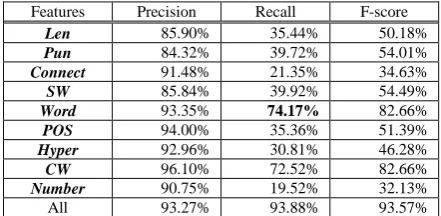
Expansion is the largest class among the four types. The performance of this type is much bet-ter than that of the other three types. Our classifi-er achieves an F-Score of 93.57% for Expansion.
The performance in macro average is shown in Table 7. Overall, our classifier trained with all features achieves an F-Score of 63.69% and an accuracy of 88.28%.
7
Conclusion
In this work, we address the issue of discourse relation recognition in Chinese. A moderate cor-pus sampled from Sinica Treebank 3.1 is labeled with discourse relations. The top-level classes used in PDTB are adopted in the data annotation. The SVM classifier trained with various features recognizes the relations between successive ar-guments automatically. As a result, our classifier achieves an accuracy of 88.28% and an F-Score of 63.69%. In the best case, our classifier achieves an F-Score of 93.57% for the recogni-tion of Expansion relarecogni-tion.
Features Precision Recall F-Score Len 7.36% 45.51% 12.68% Table 3. Performance of Temporal
The poor performance of the Contingency re-lation recognition is due to the lack of repre-sentative training samples. That needs further investigation.
Features Precision Recall F-Score Len 3.71% 17.02% 6.10% Table 4. Performance of Contingency
Features Precision Recall F-score Len 8.33% 21.74% 12.05% Table 5. Performance of Comparison
Features Precision Recall F-score Len 85.90% 35.44% 50.18% Table 6. Performance of Expansion
References
L. Carlson, D. Marcu, and M. E. Okurowski. 2001. Building a Discourse-Tagged Corpus in the Framework of Rhetorical Structure Theory. In Pro-ceedings of Second SIGDIAL Workshop on Dis-course and Dialogue-Volume 16, pages 1-10.
Hugo Hernault, Danushka Bollegala, and Mitsuru Ishizuka. 2010. A Semi-Supervised Approach to Improve Classification of Infrequent Discourse Re-lations using Feature Vector Extension. In Pro-ceedings of the 2010 Conference on Empirical Methods in Natural Language Processing, pages 399-409.
Ziheng Lin, Min-Yen Kan, and Hwee Tou Ng. 2009. Recognizing Implicit Discourse Relations in the Penn Discourse Treebank. In Proceedings of the 2009 Conference on Empirical Methods in Natural Language Processing, pages 343-351.
D. Marcu and A. Echihabi. 2002. An unsupervised Approach to Recognizing Discourse Relations. In
Proceedings of the 40th Annual Meeting on Asso-ciation for Computational Linguistics (ACL 2002), pages 368–375, Morristown, NJ, USA.
Emily Pitler, Annie Louis, and Ani Nenkova. 2009. Automatic Sense Prediction for Implicit Discourse Relations in Text. In Proceedings of the 47th an-nual Meeting of the ACL and the 4th IJCNLP of the AFNLP, pages 683-691.
Emily Pitler and Ani Nenkova. 2009. Using Syntax to Disambiguate Explicit Discourse Connectives in Text. In Proceedings of the 47th annual Meeting of the ACL and the 4th IJCNLP of the AFNLP. Short Papers.