A POS-based Ensemble Model
for Cross-domain Sentiment Classification
Rui Xia
and
Chengqing Zong
National Laboratory of Pattern Recognition
Institute of Automation, Chinese Academy of Sciences
,Abstract
In this paper, we focus on the tasks of cross-domain sentiment classification. We find across different domains, features with some types of part-of-speech (POS) tags are domain-dependent, while some others are domain-free. Based on this finding, we proposed a POS-based ensemble model to efficiently integrate features with different types of POS tags to improve the classifica-tion performance. Weights are trained by stochastic gradient descent (SGD) to opti-mize the perceptron and minimal classifica-tion error (MCE) criteria. Experimental results show that the proposed ensemble model is quite effective for the task of cross-domain sentiment classification.
1
Introduction
In recent years, transfer learning and domain adap-tation, the task aiming to utilize labeled data from the other domains (source domain) to help learning for current domain (target domain), has attracted more and more attention in the fields of both ma-chine learning and natural language processing, including sentiment classification. The task of sen-timent classification is supposed to be domain-specific. Classifiers trained on the source domain usually perform poorly in the target domain. This is quite reasonable since the word distribution changes from one domain to another, and some
words that are positive in one domain may express an opposite meaning in another one. Therefore, it is challenging to transfer a classifier trained on the source domain to the target domain.
Methodology to solve this problem can be di-vided into three major categories (Pan and Yang, 2009): the instance-based transfer, the feature-based transfer and the parameter-feature-based transfer. The instance-based transfer learns the importance of labeled data in the source domain by instance weighting and importance sampling. These re-weighed instances are then used for learning in the target domain. Feature-based transfer aims to learn a good feature representation for the target domain using labeled data in the source domain with the help of a large number of unlabeled data in the tar-get domain. The parameter-based transfer mostly assumes that individual models for related tasks share some parameters or prior distribution of hy-per-parameters. The shared part is then added to the cost function for transfer learning.
In this paper, we propose a POS-based ensemble model for cross-domain sentiment classification. Other than the above-mentioned methodology, the transfer procedure in our approach is neither in-stance re-weighting nor feature representation. Broadly speaking, our approach belongs to the pa-rameter-based transfer, but different from the tradi-tional ways, the transfer procedure is embodied in an ensemble manner.
change; while some other parts, for example, nouns, vary sharply. Furthermore, we investigate the most significant features ranked by information gain (IG). We find that the significance of adjec-tives and adverbs increases from in-domain to cross-domain tasks, while nouns become less im-portant.
Based on these findings, we infer that an effi-cient ensemble of features according to their POS tags, may benefit more from the domain-free parts and overcome the drawbacks of domain-dependent parts, and finally enhance the overall cross-domain sentiment classification performance. We proposed two methods, namely the average perceptron (Perc) and the minimal classification error (MCE) crite-rion, to learn the weights of base-classifiers.
The remainder of this paper is organized as fol-lows. Section 2 reviews related work. In Section 3, we introduce our motivation with detailed investi-gation. In Section 4, we propose our ensemble model for cross-domain sentiment classification. Experimental results are reported and discussed in Section 5 and 6 respectively. Section 7 draws con-clusions and outlines directions for future work.
2
Related Work
2.1
Domain Adaptation
Existing approaches for cross-domain sentiment classification mostly belong to the feature-based transfer. Among them, the structural correspon-dence learning (SCL) algorithm proposed by (Blitzer et al., 2007) is the representative one. SCL tries to get the mapping matrix from non-pivot ture space to pivot feature space. Non-pivot fea-tures are then transferred though a projection over the principle components of the mapping matrix. (Li et al., 2009b) proposed to transfer lexical prior knowledge across domains via matrix factorization techniques. (Pan et al., 2010) proposed cross-domain sentiment classification via spectral feature alignment and compared their method with SCL.
Another work (Aue and Gamon, 2005) com-bined small amounts of labeled data with large amounts of labeled data in target domain to learn the model parameters for a generative naïve Bayes classifier using the Expectation Maximization (EM) algorithm.
The above work all need a large amount of unlabeled data in the target domain to help
build-ing the transfer procedure. Our approach does not need those unlabeled data. Nevertheless, we do need a small amount of labeled data from target domain, say, 50-200 instances, to help transfer learning.
2.2
Ensemble Techniques
Several researchers have achieved improvements in sentiment classification accuracy via the ensem-ble techniques. The work (Whitehead and Yaeger, 2008) conducted four ensemble algorithms (bag-ging, boosting, random subspace and bagging ran-dom subspaces) for sentiment classification. In the work by (Li et al., 2007), different classifiers were generated with different sets of features according to their POS tags. Those component classifiers are then selected and combined using several fixed rules. Experimental results showed that sum rule achieves the best performance.
We made a comparative study (Xia et al., 2011) about the effectiveness of ensemble techniques for sentiment classification. Two schemes of feature set were designed at first. Three well-known classi-fication algorithms were then employed as base-classifiers for each of the feature sets. Three types of ensemble models were finally conducted for three ensemble strategies, with the emphasis on the evaluation of the effectiveness of ensemble tech-niques for sentiment classification.
Different from above methods, our focus in this paper is cross-domain sentiment classification. Compared to our former reports, we prove that the ensemble model is more effective for cross-domain tasks than for the in-domain ones.
3
Problem Investigation
3.1
POS Tag Groups
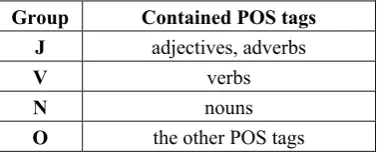
re-searchers (Riloff et al., 2003) pointed out that cer-tain verbs and nouns are also strong indicators of sentiment. According to their significance to sen-timent classification, we categorize the POS tags into four groups, as shown in Table 1.
Group Contained POS tags
J adjectives, adverbs
V verbs
N nouns
O the other POS tags
Table 1. Four groups of POS tags
3.2
Cross-domain K-L Distances
When conducting transfer learning, it is crucial to find that from one domain to another, which part of knowledge changes and which part of knowledge remains similar. Then the “unchanged” part of knowledge should be kept during the learning process, while the “changed” part should be trans-ferred. Our intuition is that from one domain to another, nouns change the most, because domains (or topics) are mostly denoted by nouns; while ad-jectives and adverbs change less, for example, “great” and “love” always express the meaning that something is good, no matter the domain is Book or Movie.
Holding this belief, we observe the cross-domain K-L distance (also called relative entropy) of the class-conditional distribution of each type of POS tags. We use the Multi-Domain Sentiment Dataset1 for statistics. This dataset was introduced
by (Blitzer et al., 2007) and then widely used in the field of cross-domain sentiment classification. It contains product reviews taken from Amazon.com from four product types (domains) – Book (B), DVD (D), Electronics (E) and Kitchen (K). Each of these contains 1000 positive and 1000 negative reviews.
We use the term “X-Y” to denote the task com-puting K-L distance of domain X and Y. For ex-ample, “B-D” denotes the K-L distance between the Book domain and DVD domain. We compute the K-L distance of two domains for each class based on the assumption that the class-conditional
1http://www.cs.jhu.edu/~mdredze/datasets/sentiment/
distribution is the multinomial distribution. The results are presented in Table 2.
We focus on the comparison between different types of POS tags. The K-L distance of N is the largest in all cross-domain tasks, significantly lar-ger than the other POS types and Uni (unigrams). It indicates that from one domain to another, the change of N is the biggest part. On the contrary, the distribution of O changes the least. It is reason-able that the POS tags contained in O, such as prepositions, pronouns, etc., are mostly domain-free. The K-L distance of J is larger than that of O, but significantly smaller than that of N. The value is also smaller compared to that of all unigrams. V gives the comparable K-L distance. We may con-clude that most features in J and V are partially domain-free. It also coincides with our intuition that “great” and “love” always express a positive meaning in whatever domains.
Generally, the cross-domain K-L distances of different types of POS tags can be ranked as: N>>Uni>V>J>O.
Task Class J V N O Uni
Pos 0.1608 0.2022 0.5420 0.0197 0.1968 B-D
Neg 0.1427 0.1632 0.5149 0.0144 0.1779 Pos 0.4353 0.3752 1.2125 0.1329 0.4738 B-E
Neg 0.3585 0.3414 1.1787 0.1221 0.4416 Pos 0.4487 0.4255 1.2059 0.1146 0.4752 B-K
Neg 0.3348 0.3770 1.2620 0.1298 0.4690 Pos 0.3983 0.3614 1.1751 0.1281 0.4579 D-E
Neg 0.3430 0.3429 1.1850 0.0905 0.4279 Pos 0.4028 0.4125 1.2587 0.1168 0.4820 D-K
Neg 0.3372 0.3687 1.3352 0.0921 0.4686 Pos 0.2428 0.1934 0.9310 0.0208 0.3093 E-K
Neg 0.1856 0.1836 0.7791 0.0153 0.2592
Table 2: Cross-domain K-L distance
3.3
Most Significant Cross-domain
Fea-tures
2009a). In table 3, we report the number of differ-ent POS tags from top-50, 100, 200, 500 and 1000 features respectively. “In” denotes the average re-sult of four individual domains. “Share” denotes the number of features shared by all of the four groups of top-N features.
We first observe the average results of four in-dividual top-100 features. The number of J, V, N and O cover the percentage of 42.0, 24.0, 24.0 and 9.0 respectively. Among the four groups of top-100 features, only 11 words appear in all of them. These features are “great”, “love”, “unfortunately”, “money”, “highly”, “bad”, “worst”, “excellent”, “not”, “waste” and “best”, where adjectives, verbs and nouns cover 81.8%, 9.1% and 9.1% respec-tively. In the case of individual top-200 features, the number of shared words by four domains is 19, 63.2% of which are adjectives.
As N increases, the percentage of four groups of POS tags in shared features can be generally ranked as: J>V>N>O. This has confirmed our in-tuition that nouns are the most domain-specific, while adjectives and adverbs are especially good cross-domain features.
Table 3: Top-features by feature selection
4
The Ensemble Model
4.1
A POS-based Weighted Combination
The pursuit of POS-based weighted combination is motivated by the intuition that an appropriate inte-gration of different participants might leverage distinct strengths. For example, the weights as-signed to adjectives and adverbs are supposed to be higher than that of nouns.
We first build a new meta-feature vector , where denotes the predicted score of the base-classifier for the
class, Cis the number of classes and D is the number of base-classifiers (in our approach C
equals 2 and D equals 4). Then, the weighted combination could be represented by
11
the kthbase-classifier.
4.2
Weight Optimization
To learn the weights in Equation (1) , we propose to use stochastic gradient descent (SGD) to opti-mize some criteria. We consider two criteria in our approach, namely the perceptron (Perc) model, and minimal classification error (MCE) criterion.
The cost function of Perc in multi-class case is given by
Note that in implementation, we utilize the average perceptron, a variation of perceptron that averages weights of all iterations, to improve the robustness.
The MCE criterion proposed by (Juang and Katagiri, 1992) is supposed to be more relevant to the classification error. In their approach, a simple version of misclassification measure of the in-stance from the xˆi jth class is defined by
Based on this measure, the cost function of MCE is given by
( 1) ( ) ( ) ,
k k
k J
w t w t t
w
(5)
5.2
Results of Uni-based Ensemble
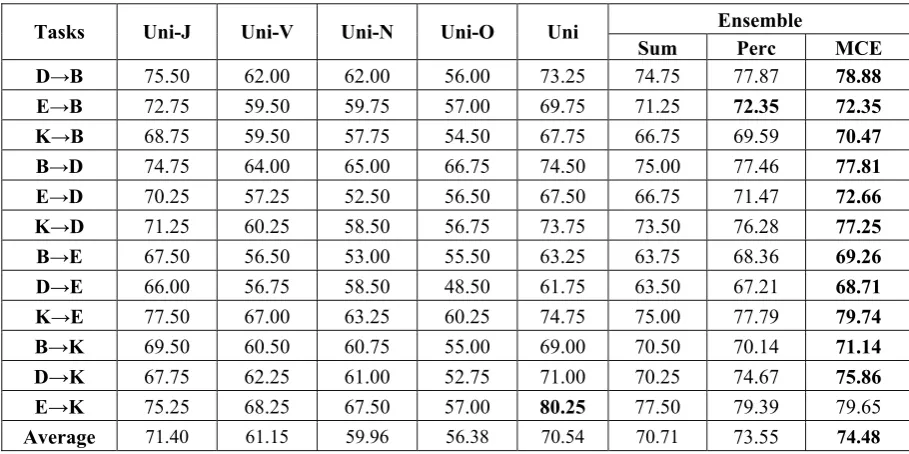
Table 4 reports the performance of Uni-based en-semble. Unigrams are categorized into four groups according to Table 1, denoted by Uni-J, Uni-V, Uni-N and Uni-O respectively. The perforamce of using all unigrams without transfer (denoted by Uni) is taken as the baseline. In ensemble ap-proaches, we report results of three rules, i.e., the Sum rule, Perc and MCE criteria. Perc and MCE are trained by 200 labeled data in the target domain. where denotes the iteration step and t ( )t
de-notes the learning rate. Compared to standard gra-dient descent, SGD is much faster and more efficient, especially for large datasets.
5
Experiments
At first, we focus on the comparison of Uni and Uni-J. Uni-J performs consistently better than Uni in most of the cross-domain tasks (71.40% vs. 70.54%). This is opposite to the conclusion in in-domain tasks that using only adjectives as features results in much worse performance than using the same number of most frequent unigrams (Pang et al., 2002; Benamara et al., 2007). It also confirms our intuition that adjectives and adverbs are more effective feature for cross-domain tasks, and an efficient ensemble of these POS tags may be more effective.
5.1
Experimental Settings
We use the Multi-domain dataset for experiments, which was already introduced in Section 3.2. The term “source→target” is used to denote the cross-domain tasks. For example, “D→B” represents the task that is trained in the DVD domain but the tested in the Book domain.
In our experiments, each dataset is split into a training set of 1600 instances, and a test set of 400 instances. The NLTK toolkit2 is used for word
to-kenization. The MXPOST3 tool is chosen as our
POS tagger. Features with the term frequency no less than four are selected for classification.
Secondly, we observe the performance of Sum rule. We have drawn the conclusion in (Xia et al., 2011) that Sum rule is a low-cost yet effective ap-proach for sentiment classification. However, this conclusion may not hold in the cross-domain tasks. Sum rule performs significantly worse than the best base-classifier (Uni-J). This is quite reason-able that assigning equal weights to unbalanced component base-classifiers will reduce the effect of ensemble.
Since it was reported that Naïve Bayes performs the best among three classifiers (Naïve Bayes, MaxEnt and SVM) on Multi-Domain Sentiment Dataset (Xia et al., 2011), we choose it as the base classification algorithm. We use the tool OpenPR-NB4 in our experiments, with the settings of
multi-nomial event model and Laplace smoothing.
Finally, we observe the results of weighted combination. Their performance is consistently higher than Uni and Uni-J, except for the task E→K (a slight decline). In average of 12 tasks, Perc and MCE outperform the Uni baseline by 3.01% and 3.94% respectively. Comparing Perc and MCE, the performance of MCE is more attrac-tive, 0.93% higher than Perc in average.
After base-classification, the predicted score of the test set is randomly split to a meta-development set and meta-test set. The ensemble systems are trained on the meta-development set to classify the meta-test set to get the final prediction. The learn-ing rate of SGD is set to be one and the maximal iteration number is set to be 100.
The process of meta-learning and test is ran-domly repeated for 100 times. All of the following results are in terms of an average of the 100 re-peats.5
2http://www.nltk.org/
3http://www.inf.ed.ac.uk/resources/nlp/local_doc/MXPOST.html
4http://www.openpr.org.cn/
5 The leave-one-out cross validation procedure was used in
Ensemble
Tasks Uni-J Uni-V Uni-N Uni-O Uni
Sum Perc MCE
D→B 75.50 62.00 62.00 56.00 73.25 74.75 77.87 78.88
E→B 72.75 59.50 59.75 57.00 69.75 71.25 72.35 72.35
K→B 68.75 59.50 57.75 54.50 67.75 66.75 69.59 70.47
B→D 74.75 64.00 65.00 66.75 74.50 75.00 77.46 77.81
E→D 70.25 57.25 52.50 56.50 67.50 66.75 71.47 72.66
K→D 71.25 60.25 58.50 56.75 73.75 73.50 76.28 77.25
B→E 67.50 56.50 53.00 55.50 63.25 63.75 68.36 69.26
D→E 66.00 56.75 58.50 48.50 61.75 63.50 67.21 68.71
K→E 77.50 67.00 63.25 60.25 74.75 75.00 77.79 79.74
B→K 69.50 60.50 60.75 55.00 69.00 70.50 70.14 71.14
D→K 67.75 62.25 61.00 52.75 71.00 70.25 74.67 75.86
E→K 75.25 68.25 67.50 57.00 80.25 77.50 79.39 79.65
Average 71.40 61.15 59.96 56.38 70.54 70.71 73.55 74.48
Table 4. Performance (%) of Uni-based Ensemble
5.3
Results of UB-based Ensemble
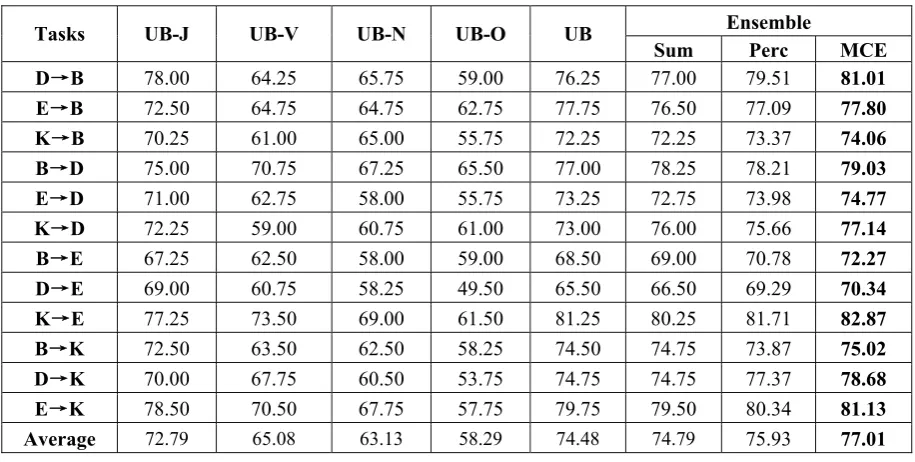
We still consider using unigrams and bigrams to-gether as candidate features for ensemble. Uni-grams and biUni-grams are divided into four subsets (UB-J, UB-V, UB-N and UB-O), according to the POS tags of its headword. The performance of unigrams and bigrams without transfer is used as the baseline (denoted by UB). The reported en-semble results are also with the help of 200 la-beled data from the target domain. Detailed results are presented in Table 5.
We still first compare UB-J and UB. This time, UB-J beats UB in some tasks, but it does not show general superiority. It is probably due to that some adjective information has coupled with other POS tags, such as J-N. Nevertheless, its performance is still comparative higher compared with the other three types of POS tags.
With regard to the ensemble methods, the per-formance of sum rule is not so sound, the same as before. The weighted combination still gains sig-nificant improvements over the UB baseline. In average, Prec and MCE outperform the UB base-line by 3.01% and 3.94% respectively. Overall, the ensemble model is quite effective for cross-domain sentiment classification. Among them, MCE is the most effective.
6
Discussion
6.1
Ensemble Model Revisited
In this section, we try to give some explanations about why the ensemble model is effective for cross-domain sentiment classification.
In traditional linear classifiers, the weights as-signed to each feature are trained on the source-domain labeled data. Each weight thus embodies the significance of its responding feature to the source-domain classification. Transferring from one domain to another, those weights need to be adapted to the target domain.
Based on the observation that some parts of the feature are domain-dependent and some parts are domain-free, an efficient ensemble may be an ef-fective way to adapt those weights to the target-domain. The behind transferring procedure can be interpreted as:
1 2
1 2
3 4
3 4
1 2
3 4
log ( | )
log ( ) log ( | )
log ( ) log ( | ) log ( | )
log ( | ) log ( | ),
j
j i j
i
j i j i j
i J i V
i j i j
i N i O
P c d
P c P t c
P c P t c P t c
P t c P t c
w w
w w
Î Î
Î Î
µ +
= + +
+ +
å
å
å
å
å
Ensemble Tasks UB-J UB-V UB-N UB-O UB
Sum Perc MCE
D→B 78.00 64.25 65.75 59.00 76.25 77.00 79.51 81.01
E→B 72.50 64.75 64.75 62.75 77.75 76.50 77.09 77.80
K→B 70.25 61.00 65.00 55.75 72.25 72.25 73.37 74.06
B→D 75.00 70.75 67.25 65.50 77.00 78.25 78.21 79.03
E→D 71.00 62.75 58.00 55.75 73.25 72.75 73.98 74.77
K→D 72.25 59.00 60.75 61.00 73.00 76.00 75.66 77.14
B→E 67.25 62.50 58.00 59.00 68.50 69.00 70.78 72.27
D→E 69.00 60.75 58.25 49.50 65.50 66.50 69.29 70.34
K→E 77.25 73.50 69.00 61.50 81.25 80.25 81.71 82.87
B→K 72.50 63.50 62.50 58.25 74.50 74.75 73.87 75.02
D→K 70.00 67.75 60.50 53.75 74.75 74.75 77.37 78.68
E→K 78.50 70.50 67.75 57.75 79.75 79.50 80.34 81.13
Average 72.79 65.08 63.13 58.29 74.48 74.79 75.93 77.01
Table 5. Performance (%) of UB-based Ensemble
where the conditional word probability is
trans-ferred from to , which encodes
information of both the sentiment significance and cross-domain ability.
( | )i j
P t c ( | )l
i j P t c w
In table 6, we present the average weights trained by MCE across all tasks. We can see that the weight of J is the largest in four parts, generally a half percentage. Thereby, the conditional prob-ability of features in J will get a comparatively lar-ger value. Such re-assignments of parameters will be good for cross-domain tasks.
Ensemble Tasks J V N O
Uni-based 0.52 0.20 0.16 0.12
UB-based 0.45 0.21 0.16 0.18
Table 6. Average weights trained by MCE
6.2
Sensitivity on Parameter Tuning
In this section, we test the sensitivity on parameter tuning. For simplicity, we fix the weights of V and O to be 0.20 and 0.15 respectively. We use w to denote the weight of J, and the weight of N is thus . We tune the value of w from 0 to 0.65, and observe the average accuracy of ensemble. The curve is displayed in Fig. 1.
(0.65-w)
0 0.1 0.2 0.3 0.4 0.5 0.6 0.65 0.62
0.66 0.7 0.74 0.78
The weight of J
A
ver
age
a
cc
ur
ac
y
Uni-based Ensemble UB-based Ensemble
Fig. 1. Parameter sensitivity test
We can conclude from Fig. 1 that the ensemble performance is quite sensitive to the weights as-signed to base-classifiers. When w is close to 0, the weight of N is comparatively larger, and the ensemble performance drops sharply. The best re-sult was obtained when w locates at the area close to 0.5. The golden weights are quite similar to the results trained by MCE (Table 6). This shows that MCE is effective at parameter tuning.
6.3
Dependency on the Size of Labeled
Data in the Target Domain
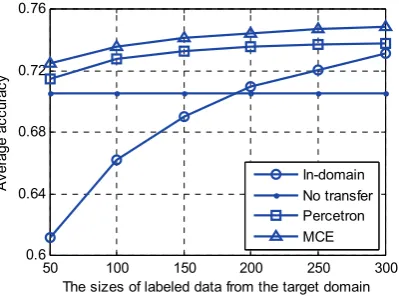
Finally, we discuss the dependency of our ap-proach on the size of labeled data in the target do-main. In Fig. 2, we observe the performance of our ensemble model as the size of labeled data from the target domain increases from 50 to 300. “In-domain” denotes the accuracy trained on those la-beled data for in-domain classification. “No trans-fer” denotes the result trained on 1600 labeled data in the source domain without transfer. Two ensem-ble approaches are also displayed for comparison. The reported accuracy is the average of 12 cross-domain tasks.
50 100 150 200 250 300 0.6
0.64 0.68 0.72 0.76
The sizes of labeled data from the target domain
A
ver
age
a
cc
ur
ac
y
In-domain No transfer Percetron MCE
Fig. 2. Performance as labeled data in target do-main increase
From Fig. 2, we can see that when the size of la-beled data is small, the in-domain performance is fairly poor. At this time, the ensemble model could substantially improve the performance. As the size of labeled data increases, all of the systems yield higher performance. When the size increases to 300, the ensemble model shows limited superiority. It is reasonable that the in-domain learning is al-ways the best if labeled data is enough.
Although the improvements of the ensemble model gained over the in-domain system become less as the size of labeled data increases, we could still conclude that in the case that there is only few labeled data in the target domain, the ensemble model is quite effective, to take the advantage of a large number of labeled data from the source do-mains, to help improving sentiment classification performance in the target domain.
7
Conclusion
In this paper, we propose a POS-based ensemble model for cross-domain sentiment classification. The motivation is based on the observation that some types of POS tags are domain-free, while some others are domain-dependent. Therefore, an efficient ensemble of them would leverage distinct strengths and improve the classification perform-ance. Experimental results show that when the la-beled data in the target is few, the proposed ensemble model is quite effective to make use of the labeled data from the source domain to im-prove the classification performance in the target domain.
We also update our previous conclusion drawn regarding the effectiveness of ensemble for in-domain sentiment classification (Xia and Zong, 2010; Xia et al., 2011). We conclude that the POS-based ensemble model is more effective for cross-domain sentiment classification than in-cross-domain tasks.
In the future, we plan to extend the ensemble model to the tasks of cross-domain sentiment clas-sification with multiple source domains. We also wish to make use of a large amount of unlabeled data in the target domain to help assist the ensem-ble performance for cross-domain sentiment classi-fication in the framework of ensemble learning.
Acknowledgment
The research work has been funded by the Natural Science Foundation of China under Grant No. 60975053 and 61003160, and supported by the External Cooperation Program of the Chinese Academy of Sciences.
References
Anthony Aue and Michael Gamon, 2005. Customizing Sentiment Classifiers to New Domains: A Case Study. In Proceedings of Recent Advances in Natural Language Processing (RANLP).
Farah Benamara, Carmine Cesarano, Antonio Picariello, Diego Reforgiato and V. S. Subrahmanian, 2007. Sentiment Analysis: Adjectives and Adverbs are Bet-ter than Adjectives Alone. In Proceedings of the In-ternational Conference on Weblogs and Social Media (ICWSM).
Domain Adaptation for Sentiment Classification. In Proceedings of the Association for Computational Linguistics (ACL).
Vasileios Hatzivassiloglou and Janyce Wiebe, 2000. Effects of Adjective Orientation and Gradability on Sentence Subjectivity. In Proceedings of the Interna-tional Conference on ComputaInterna-tional Linguistics (COLING), pages 299-305.
BH Juang and S Katagiri, 1992. Discriminative learning for minimum error classification. IEEE Transactions on Signal Processing, 40 (12). pages 3043-3054. Shoushan Li, Rui Xia, Chengqing Zong and Chu-Ren
Huang, 2009a. A framework of feature selection methods for text categorization. In Proceedings of the Annual Meeting of the Association for Computa-tional Linguistics (ACL), pages 692-700.
Shoushan Li, Chengqing Zong and Xia Wang, 2007. Sentiment Classification through Combining Classi-fiers with Multiple Feature Sets. In Proceedings of the IEEE International Conference on Natural Lan-guage Processing and Knowledge Engineering (NLP-KE), pages 135-140.
Tao Li, Yi Zhang and Vikas Sindhwani, 2009b. A non-negative matrix tri-factorization approach to senti-ment classification with lexical prior knowledge. In Proceedings of the Annual Meeting of the Associa-tion for ComputaAssocia-tional Linguistics (ACL), pages 244-252.
Jialin Pan, Xiaochuan Ni, Jiantao Sun, Qiang Yang and Zheng Chen, 2010. Cross-domain sentiment classifi-cation via spectral feature alignment. In Proceedings of the International World Wide Web Conference (WWW), pages 751-760.
Jialin Pan and Qiang Yang, 2009. A survey on transfer learning. IEEE Transactions on Knowledge and Data Engineering, 22 (10). pages 1345-1359.
Bo Pang, Lillian Lee and Shivakumar Vaithyanathan, 2002. Thumbs up? Sentiment Classification using Machine Learning Techniques. In Proceedings of the Conference on Empirical Methods in Natural Lan-guage Processing (EMNLP), pages 79-86.
Ellen Riloff, Janyce Wiebe and Theresa Wilson, 2003. Learning Subjective Nouns using Extraction Pattern Bootstrapping. In Proceedings of the Conference on Natural Language Learning (CoNLL), pages 25-32. Matthew Whitehead and Larry Yaeger, 2008. Sentiment
Mining Using Ensemble Classification Models. In the International Conference on Systems, Computing Sciences and Software Engineering (CISSE).
Rui Xia, Chengqing Zong and Shoushan Li, 2011. En-semble of Feature Sets and Classification Algorithms for Sentiment Classification. Information Sciences, 181 (6). pages 1138-1152.