Joint Segmentation and Tagging
with Coupled Sequences Labeling
Xipeng Qiu
1, F eng Ji
1,2, Jiayi Zhao
1and Xuanjing Huang
1(1) School of Computer Science, Fudan University (2) Suntec Software (Shanghai) Co. Ltd. {xpqiu,fengji,11210240073,xjhuang}@fudan.edu.cn
A
Segmentation and tagging task is the fundamental problem in natural language processing (NLP). Traditional methods solve this problem in either pipeline or joint cross-label ways, which suffer from error propagation and large number of labels respectively. In this paper, we present a novel joint model for segmentation and tagging, which integrates two dependent Markov chains. One chain is used for segmentation, and the other is for tagging. The model parameters can be estimated simultaneously. Besides, we can optimize the whole model by improving the single chain. The experiments show that our model could achieve higher performance over traditional models on both English shallow parsing and Chinese word segmentation and POS tagging tasks.
T
A
C
基于双链序列标注的联合切分和标注模型
在自然语言处理中, 序列标注模型是最常见的模型, 也有着广泛地应用。 针对常见 的可分解为分段和标注两个子任务的复杂序列标注问题,我们提出了双链序列标注模型。 该模型中存在着两条相互联系的马尔科夫链。为此我们提出了一个同时求解这两条链上最 优序列的解码算法。同时利用这两条链,针对不同的实际应用场景可以组合出不同的标注 模型,使用不同的解码算法完成实际的标注任务。为了能够适应不同的解码算法,我们还 提出了一个能够利用异构语料训练模型的参数学习算法。在多个语料上的实验表明,我们 提出的模型性能要优于其他模型,并能在同一个模型内完成多种标注任务。
K
:
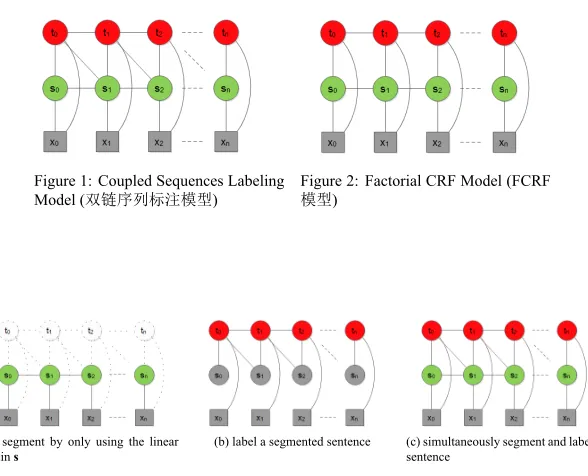
Coupled Sequences Labeling, Segmentation, Tagging.Figure 1: Coupled Sequences Labeling Model (双链序列标注模型)
Figure 2: Factorial CRF Model (FCRF 模型)
(a) segment by only using the linear chains
(b) label a segmented sentence (c) simultaneously segment and label a sentence
Figure 3: Coupled Sequences Labeling Model for Different Tasks (处理不同任务时的双链序列 标注模型变换), where gray nodes are observed nodes.
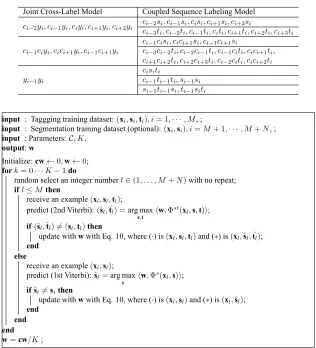
Table 1: Feature templates for shallow parsing (浅层句法分析特征模板)
Joint Cross-Product Model Coupled Sequence Labeling Model
wi−2yi, wi−1yi, wiyi, wi+1yi, wi+2yi wwi−1si, wisi, wi+1si
i−2ti, wi−1ti, witi, wi+1ti, wi+2ti
wi−1wiyi, wiwi+1yi wwi−1wisi, wiwi+1si i−1witi, wiwi+1ti
pi−2yi, pi−1yi, piyi, pi+1yi, pi+2yi pi−1si, pisi, wi+1si
pi−2ti, pi−1ti, piti, pi+1ti, pi+2ti
pi−2pi−1yi, pi−1piyi, pipi+1yi, pi+1pi+2yi
pi−2pi−1si, pi−1pisi, pipi+1si, pi+1pi+2si
pi−3pi−2ti, pi−2pi−1ti, pi−1piti, pipi+1ti,
pi+1pi+2ti, pi+2pi+3ti, pi−1pi+1ti
pi−2pi−1piyi, pi−1pipi+1yi, pipi+1pi+2yi pi−2pi−1pisi, pi−1pipi+1si, pipi+1pi+2si
yi−1yi
wisiti
wisi−1si
wi−1ti−1ti, witi−1ti, pi−1ti−1ti, piti−1ti
Table 2: Feature templates for Chinese S&T (中文分词、词性标注特征模板)
Joint Cross-Label Model Coupled Sequence Labeling Model
ci−2yi, ci−1yi, ciyi, ci+1yi, ci+2yi ci−2si, ci−1si, cisi, ci+1si, ci+2si
ci−3ti, ci−2ti, ci−1ti, citi, ci+1ti, ci+2ti, ci+3ti
ci−1ciyi, cici+1yi, ci−1ci+1yi
ci−1cisi, cici+1si, ci−1ci+1si
ci−3ci−2ti, ci−2ci−1ti, ci−1citi, cici+1ti,
ci+1ci+2ti, ci+2ci+3ti, ci−2citi, cici+2ti
yi−1yi
cisiti
ci−1ti−1ti,si−1si
si−1ti−1si, ti−1siti
input : Taggging training dataset:(xi,si,ti), i= 1,· · ·, M, ;
input : Segmentation training dataset (optional):(xi,si), i=M+ 1,· · ·, M+N, ; input : Parameters:C, K.
output:w
Initialize:cw←0,w←0; fork= 0· · ·K−1do
random select an integer numberl∈(1, . . . , M+N)with no repeat; ifl≤Mthen
receive an example(xl,sl,tl); predict (2nd Viterbi):(ˆsl,tˆl) =arg max
s,t ⟨
w,Φst(x l,s,t)⟩; if(ˆsl,ˆtl)̸= (sl,tl)then
update withwwith Eq. 10, where (·) is(xl,sl,tl)and (∗) is(xl,ˆsl,tˆl); end
else
receive an example(xl,sl); predict (1st Viterbi):ˆsl=arg max
s ⟨
w,Φs(x l,s)⟩; ifˆsl̸=sithen
update withwwith Eq. 10, where (·) is(xl,sl)and (∗) is(xl,ˆsl); end
end end w=cw/K;
Algorithm 1:Online Learning Algorithm for Coupled Sequences Labeling Model. (双链序列标
1
Introduction
In the fields of natural language processing (NLP), joint segmentation and tagging (S&T) task is an important research topic. Many NLP problems can be transformed to joint S&T task, such as shallow parsing(Sha and Pereira, 2003), named entity recognition(Zhou and Su, 2002), Chinese part-of-speech (POS) tagging(Ratnaparkhi, 1996) and so on. For example, there are no explic-itly boundaries between words in Chinese sentence. Therefore, sentence must be segmented into sequence of words, in which each word would be assigned with a POS tag.
Recently many research works focused on joint S&T tasks, which can be categorized into two ways: pipeline and cross-label.
The pipeline approaches are to solve two subtasks in order, segmentation and tagging. However, the obvious disadvantage of these approaches is error propagation, which significantly affects the whole performance.
The cross-label approaches can avoid the problem of error propagation and achieve more higher performance on both subtasks (Ng and Low, 2004). However, due to the large number of labels, two problems arise: (1) The amount of parameters increases rapidly and would be apt to overfit to the training corpus; (2) The decoding efficiency by dynamic programming would decrease.
In addition, joint cross-label approaches cannot segment or tag sentences separately. For example, in Chinese POS tagging task, the joint model cannot segment sentences individually without tag-ging the sentences. Moreover, if the sentences are already segmented, the joint model can not tag individually with the existing segmentation information.
In this paper, we present a novel joint model for S&T task with coupled sequences labeling. The proposed model integrates two linear Markov chains with a two dimensional structure. One chain is used for segmentation, and the other is for tagging. These two chains are labeled simultaneously, so our method does not suffer from error propagation. Unlike cross-label model, the number of labels in our model is much smaller. Experiments on two tasks, shallow parsing and Chinese POS tagging, demonstrate the effectiveness of our model.
The contributions of our methods are as follows:
1. Instead of cross-product labels, two types of nodes in our model make us represent features more flexibly.
2. Exact decoding algorithm can be employed to find the best S&T sequences simultaneously.
3. Our method not only can do joint S&T task, it can also segment or tag sentences separately.
4. Our model can be trained simultaneously with the heterogeneous data sources.
It is very important in practice that to utilize the heterogeneous data sources. For example in Chi-nese POS tagging, we can use two datasets (segmentation dataset and POS tagging dataset) for training parameters. This character is especially useful since the segmentation dataset is more eas-ily annotated than POS tagging dataset.
2
Joint Sequences Labeling Model
In this section, we first introduce and analyze joint S&T task with common sequence labeling model. Then, we present the joint cross-label approach and analyze its complexity.
2.1
Sequence Labeling Model
wherewis the parameter of functionF(·). The feature vectorΦ(x,y)consists of lots of overlapping features, which is the chief benefit of discriminative model.
For example, in first-order Markov sequence labeling model, the feature can be denoted as
ϕk(yi−1, yi,x, i), whereiis the position in the sequence. Then the score function can be rewritten
2.2
Joint S&T with Cross-Label Sequence Labeling Model
In the traditional approach for joint S&T, each labelyiis the cross-product of segmentation label
siand tagging labelti, usually with the form ofsi-ti. Therefore, the state space of cross-labels is |Y|=|S|×|T |, where|S|,|T |is the number of segmentation labels and tagging labels, respectively.
In real applications,|S|is always small, while|T |will be very large. In segmentation task, there are several commonly used label sets such as {B, I}, {B, I, O}, {B, I, E, S}, etc. For example, {B, I, E, S} representBegin,Inside,Endof a multi-node segmentation, andSinglenode segmentation respectively. In tagging task, the label set depends on the detail definition of the task, such as {PER, LOC, ORG, MISC} in classic name entity recognition task, and {NNS, NNPS, NNP, ...} in Part-of-Speech tagging task.
Although joint learning with cross-label can avoid error propagation, which usually occurs in pipeline frameworks, the complexity of decoding algorithm would be increased rapidly due to the increased state space. Suppose we use first order Viterbi algorithm for decoding in linear chain model, the complexity is(|S||T |)2Lin such joint labeling frameworks, while(|S|2+|T |2)Lin pipeline frameworks.
3
Coupled Sequences Labeling Model
3.1
Model Description
Different from the cross-label model, we define two sequencess=s1, . . . , sLandt=t1, . . . , tL for an input sequencex=x1, . . . , xL. sandtrepresent the segmentation and tagging labels re-spectively.
Then we employ a hybrid model by integrating these two linear chains. While keeping relative independence and completeness of these two chains, we also consider the interactions between them in order to cope with error propagation. The graphic structure of our model is shown in Figure 1.
Besides the original undirected edges (hereinafter to be referred as edges) existed in two lin-ear chains, corresponding toe(si−1, si)ande(ti−1, ti), we also append two kinds of edges be-tween different chains. e(si, ti)is equivalent to the representation of “Cross-Label” mentioned in section 2.2. Meanwhile, we also add an edgee(ti−1, si)into the model. This change brings about two new different cliques, respectively associated with variablesC1={si−1, ti−1, si}and
C2={ti−1, si, ti},which essentially gives rise to the increment of the complexity of our model.
The reason for this change is to avoid the “label bias” problem citeLafferty:2001 in factorial CRF (FCRF) (Sutton et al., 2004). FCRF model has a similar graphic structure to our model, shown in Figure 2. As in the case of Chinese POS tagging, if given a contextsi−1= “B”,ti−1= “NN” andsi = “E”,tiwould be assigned to “JJ” instead of “NN” with a higher probability, since the transition from “NN” to “JJ” defeats against the transition to “NN” whilesi= “E” has no effect. However,si = “M” provides a strong clue, which implies that wordwi−1andwiare in the same segmentation and would be assigned to the same label.
3.2
Inference Algorithm
According to the theory of probabilistic graphical models (Koller and Friedman, 2009), we can define a score functionF(·)as the logarithmic potential function:
F(w,Φ(x,s,t)) =
Given an observed sequencex, the aim of inference algorithm is to find two best label sequences simultaneously with the highest score. In order to adapt to our model with two kinds of 3-variable cliques, we make some modifications of a second order Viterbi algorithm (Thede and Harper, 1999). We define two functions for recording the score of the best partial path from the beginning of the sequence to the positioni:
Initially, only features associated with variabless0andt0are hired. Without loss of generality, we sets−1= “BoS”1,t−1= “BoT”2andη−1(s−1, t−1) = 0. Then iteratively calculate these two
score functions for any possible partial path. At last, the final score of two label sequences is
F(w,Φ(x,s,t)) =ηL(sL, tL), (5)
Compared with the complexity of other joint models, the complexity of our model isO((|S|2|T |+ |T |2
|S|)L), which is lower than cross-label model but higher than pipeline model. Although the asymptotic complexity is higher than pipeline model, the advantage is that our model would not suffer from error propagation and could make use of label information more efficiently.
3.3
Discussion of Coupled Sequences Labeling Model
As shown in Figure 1, our model can label two sequences simultaneously. However, we hope our model can be applied to solve the “inconsistent” problem (Section 1). Although two linear chains sandtare modeled in a hybrid framework, they still retain its complete structure. This means that we can independently use the linear chainsto segment a sentence (Figure 3a), while use the linear chaintto label a segmented sentence (Figure 3b) or use the whole structure to label two sequences together (Figure 3c). Therefore, we need two inference algorithms, respectively a first order Viterbi algorithm for segmenting a sentence when only using the linear chains, and a second order Viterbi algorithm (see Section 3.2) for other two applications. The main idea behind this method is the fact that there are many overlapping features used in both segmentation and tagging tasks since most of the features are extracted from a local context.
Another reason to employ different inference algorithms is to maintain the decoding speed for differ-ent applications. If only used in the segmdiffer-entation task, the complexity of our method isO(|S|2L). If applied to tag a segmented sentence, the complexity isO((|T |+|T |2)L) =O(|T |2L). If used in the joint labeling task, its complexity is stillO((|S|2
|T |+|T |2 |S|)L).
However, in the coupled sequences labeling model, two linear chains are highly dependent due to the edgee(ti−1, si). It implies that if we train a model by using the whole structure, we cannot directly use the segmentation features, which are only related to the segmentation chains. Therefore, we need to optimize the whole structure together with the segmentation chain.
Besides training a model with a corpus annotated segmentation and tagging labels, we can also use heterogeneous corpora because two inference algorithms are jointly optimized. It is very meaning-ful in real applications. As we all known, difficulties of annotating corpus for different tasks are different. In our setting, segmentation corpus are easy to annotate while tagging corpus are diffi-culty. As a result, we can easily obtain a large segmentation corpus while a small tagging corpus. Because we aim to optimize two chains simultaneously, it is possible for us to training a unified model with these two different scale corpora. We can learn parameters from a small tagging corpus for two chains, and learn parameters from a large segmentation corpus for the segmentation chain.
3.4
Learning Parameters with Passive-Aggressive Algorithm
In the training stage, we use passive-aggressive algorithm to learn the model parameters. Passive-aggressive (PA) algorithm (Crammer and Singer, 2003; Crammer et al., 2006) was proposed for normal multi-class classification and can be easily extended to structure learning (Crammer et al., 2005). Like perceptron, PA is an online learning algorithm.
with the highest score. In the segmentation task, (·) equals to(x,s)and (∗) is(x,ˆs). In the joint task, (·) denotes(x,s,t)and (∗) is(x,ˆs,ˆt). Hereˆs,ˆtare the incorrect labels with the highest scores. We can define themarginγ(w; (·))as
γ(w; (·)) =F(w,Φ(·))−F(w,Φ(∗)), (6)
Thus, we calculate thehinge lossℓ(w; (·))(abbreviated asℓw) by
ℓw= {
0, γ(w; (·))>1
1−γ(w; (·)), otherwise (7)
In roundk, the new weight vectorwk+1is calculated by
wk+1 = arg min
w
1
2||w−wk|| 2+
C ·ξ, (8)
s.t.ℓ(w; (·))<=ξandξ >= 0 (9)
whereξis a non-negative slack variable, andCis a positive parameter which controls the influence of the slack term on the objective function.
Following the derivation in PA (Crammer et al., 2006), we can get the update rule,
wk+1=wk+τk(Φ(·)−Φ(∗)), (10)
where
τk=min(C, ℓk(w; (·))
∥Φ(·)−Φ(∗)∥2) (11)
Our training algorithm is based on PA algorithm and shown in Algorithm 1. In our algorithm, the input examples are randomly selected in each roundk. According to the source of the selected example, we obtain the best response by using the proper inference algorithm, and finally update the parametersw. Following (Collins, 2002), the average strategy is also adopted to avoid overfitting problem.
4
Experiments
We employ two joint sequence labeling tasks to show the performance of our model. In the follow-ing section, we would report our experiment settfollow-ings and discuss the experiment results.
We compare our method with cross-label model and factorial model with PA algorithm. The fac-torial model is similar with Facfac-torial CRF(Sutton et al., 2007), but its parameters are learning with PA algorithm.
We use the standard evaluation metricsF1score, which is the harmonic mean of precisionP (per-centage of predict phrases that exactly match the reference phrases) and recallR(percentage of reference phrases that returned by system).
4.1
Datasets
In English shallow parsing, the corpus from CoNLL 2000 shared task is commonly used, which contains 8936 sentences for training and 2012 sentences for testing. We employ the commonly used label set{B, M, E, S}in the segmentation task. 12 tagging labels, such as noun phrase (NP), verb phrase (VP),…and others (O), are used in the sequence tagging task.
In Chinese S&T, we employ the Chinese Treebank (CTB) corpus, obtained from the Fourth Inter-national SIGHAN Bakeoff datasets (Jin and Chen, 2008). The label set{B, M, E, S}is also used for segmentation task.
4.2
Performance of Coupled Sequences Labeling Model
In the first experiment, we aim to compare the performances of our coupled sequences labeling model with other traditional joint models. Feature templates used in this experiment are summarized in Table 1 for English shallow parsing and in Table 2 for Chinese word segmenation and POS tagging, in whichwidenotesithword,pidenotesithPOS tag,cidenotesithChinese character. We compare the total performance between traditional joint cross-label model, factorial model and our model. To learn the parameters of these models, we employ PA algorithm with an average parameter strategy to avoid the overfitting problem. The maximum amount of iterations is fixed to be50.
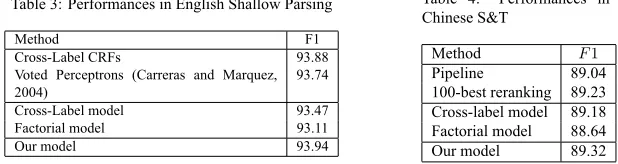
The experiment results are shown in Table 3 for English shallow parsing, and in Table 4 for Chinese S&T. We also provides the performances of other methods reported in papers.
Table 3: Performances in English Shallow Parsing
Method F1
In English shallow parsing, our coupled sequences labeling model achieves the best performance than other two methods. We are surprised to find that the performance of the factorial model is lower than the joint cross-label model because of the “label bias” problem. However, a cross edge
e(ti−1, si)is added into our coupled sequences model and shows its ability to avoid this problem. Experimental results in Chinese S&T show the similar conclusions.
4.3
Performance on Heterogeneous Corpora
The second experiment is to jointly train a unified model with heterogeneous corpora. In this ex-periment, we are expected to find out whether additional resources could increase the performance simultaneously on two different tasks.
We randomly divide the training corpus into two equal parts. One part is used as the joint S&T training corpus while another part is used for just segmentation training corpus.
use the first order Viterbi algorithm to find the most possible segmentation. Only feature templates (listed in Table 1) irrelevant to tagging task are used for the segmentation task. Therefore template such aswi−1tiwould not be used to extract the segmentation features. Moreover this means two different tasks would share many common features in the training stage. The final test performances are shown in Table 5.
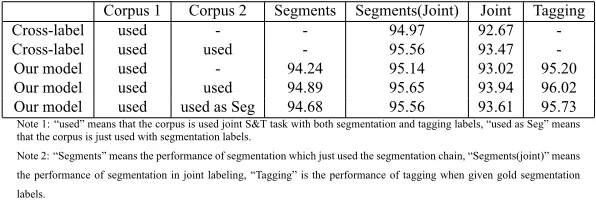
We experiment three real scenarios, respectively only segmenting a sentence, tagging a segmented sentence and jointly labeling a sentence. Notice that these different tasks use the same model in this experiment. Joint cross-label approach is chosen as the baseline, but this method cannot segment a sentence individually or tag a segmented sentence. However, our coupled sequences labeling model can handle these tasks in a unified model.
The experimental results are shown in Table 5 for English shallow parsing, and in Table 6 for Chinese S&T.
Table 5: Performances on English shallow parsing
Corpus 1 Corpus 2 Segments Segments(Joint) Joint Tagging
Cross-label used - - 94.97 92.67
-Cross-label used used - 95.56 93.47
-Our model used - 94.24 95.14 93.02 95.20
Our model used used 94.89 95.65 93.94 96.02
Our model used used as Seg 94.68 95.56 93.61 95.73 Note 1: “used” means that the corpus is used joint S&T task with both segmentation and tagging labels, “used as Seg” means that the corpus is just used with segmentation labels.
Note 2: “Segments” means the performance of segmentation which just used the segmentation chain, “Segments(joint)” means
the performance of segmentation in joint labeling, “Tagging” is the performance of tagging when given gold segmentation
labels.
Table 6: Performances on Chinese S&T
Corpus1 Corpus2 Segments Segments(Joint) Joint Tagging
Cross-label used - - 93.53 87.05
-Cross-label used used - 94.85 89.18
-Our model used - 92.56 93.70 87.39 89.28
Our model used used 94.37 94.71 89.32 91.87
Our model used used as Seg 94.15 95.03 89.21 91.30
In Chinese S&T, we can find that our coupled model on joint labeling task can outperform the cross-label model in both the experiments of using half of the corpus and full corpus. With using the second corpus, all models have better performances. This result demonstrates a common sense in machine learning community “more data, more performance”. However, after adding the second corpus, the performance of the joint task is promoted, but still lower than using the full annotations. It is reasonable because the second corpus is only used as a segmentation corpus. This means we only employ half of the POS annotations to train our model. Experimental results on segmentation task show that after adding the second corpus, our model improves the performance and slightly behind the model trained with the full annotations. With the performance increases on segmentation, the performance of tagging a segmented sentence is increased as well.
Similar conclusions can be found in the experiments of English shallow parsing.
Therefore, we believe that additional resources could be introduced into our model more flexible and be helpful to the final performance.
4.4
Decoding Speed
At last, we also list the decoding speed for different tasks in Table 7.
Table 7: Decoding speed on English Shallow Parsing and Chinese S&T task. (sentences/second)
English Shallow Parsing Chinese S&T
Seg Seg(Joint) Joint Tagging Seg Seg(Joint) Joint Tagging
Cross-label - 1503 1453 - - 117 113
-Our model 22995 1467 1435 1601 17572 130 124 153
Compared to the joint cross-label approach in both corpora, our model has the equivalent decoding speed on the joint task. While on the task of tagging a segmented sentence, our model provides a slight decoding speedup. The reason is that the states of segmentation are much less than tagging. However, on the only segmentation task, our model provides a decoding speedup over 10 times, since we can use the segmentation chain independently in our model.
5
Related Works
Several methods have been proposed to cope with the problems of joint S&T task.
Sutton et al. (2004, 2007) proposed Dynamic Conditional Random Fields (DCRF) to jointly repre-sent the different tasks in a single graphical model. However, the exact training and inference for DCRF are time-consuming.
Duh (2005) proposed a model for jointly labeling multiple sequences. The model is based on the Factorial Hidden Markov Model (FHMM). Since FHMM is directed graphical model, FHMM re-quires considerably less computation than DCRFs and exact inference is easily achievable. How-ever, the FHMM’s generative framework cannot take full advantage of context features, so its performance is lower than DCRF.
Different with our model applied in joint S&T task, both the DCRF and FHMM are used in POS tag-ging and NP Chunking tasks. These two tasks are not strongly dependent on each other. Therefore, their models are relatively simplified for joint S&T task.
6
Conclusion
In this paper, we propose a novel joint S&T model by integrating two linear chains into a coupled sequence labeling model. Our approach does not suffer from the problem of error propagation, which usually occurs in pipeline models. Meanwhile, our proposed model would not result in the rapid increase of states as cross-label models. Our model also takes the advantage of more flexible feature representation, a uniform model with a flexible combination of labeling tasks, etc.
Acknowledgments
References
Carreras, X. and Marquez, L. (2004). Phrase recognition by filtering and ranking with perceptrons. Recent advances in natural language processing III: selected papers from RANLP 2003, 260:205.
Collins, M. (2002). Discriminative training methods for hidden markov models: Theory and experiments with perceptron algorithms. InProceedings of the 2002 Conference on Empirical Methods in Natural Language Processing.
Crammer, K., Dekel, O., Keshet, J., Shalev-Shwartz, S., and Singer, Y. (2006). Online passive-aggressive algorithms.Journal of Machine Learning Research, 7:551–585.
Crammer, K., McDonald, R., and Pereira, F. (2005). Scalable large-margin online learning for structured classification. InNIPS Workshop on Learning With Structured Outputs. Citeseer.
Crammer, K. and Singer, Y. (2003). Ultraconservative online algorithms for multiclass problems. Journal of Machine Learning Research, 3:951–991.
Duh, K. (2005). Jointly labeling multiple sequences: A factorial HMM approach. In Proceed-ings of the ACL Student Research Workshop, pages 19–24, Ann Arbor, Michigan. Association for Computational Linguistics.
Jin, C. and Chen, X. (2008). The fourth international chinese language processing bakeoff: Chi-nese word segmentation, named entity recognition and chiChi-nese pos tagging. InSixth SIGHAN Workshop on Chinese Language Processing, page 69.
Koller, D. and Friedman, N. (2009).Probabilistic Graphical Models: Principles and Techniques. MIT Press.
Ng, H. and Low, J. (2004). Chinese part-of-speech tagging: one-at-a-time or all-at-once? word-based or character-word-based. InProceedings of EMNLP, volume 4.
Ratnaparkhi, A. (1996). A maximum entropy model for part-of-speech tagging. In Brill, E. and Church, K., editors,Proceedings of the Empirical Methods in Natural Language Processing, pages 133–142.
Sha, F. and Pereira, F. (2003). Shallow parsing with conditional random fields. InProceedings of the 2003 Conference of the North American Chapter of the Association for Computational Linguis-tics on Human Language Technology-Volume 1, pages 134–141. Association for Computational Linguistics.
Sutton, C., McCallum, A., and Rohanimanesh, K. (2007). Dynamic conditional random fields: Factorized probabilistic models for labeling and segmenting sequence data.J. Mach. Learn. Res., 8:693–723.
Sutton, C., Rohanimanesh, K., and McCallum, A. (2004). Dynamic conditional random fields: Factorized probabilistic models for labeling and segmenting sequence data. InProceedings of the twenty-first international conference on Machine learning, page 99. ACM.