A Multiple-Domain Ontology Builder
Sara Salem
Samir AbdelRahman
Abstract
The interpretation of a multiple-domain text corpus as a single ontology leads to misconceptions. This is because some concepts may be syntactically equal; though, they are semantically lopsided in different domains. Also, the occurrences of a domain concept in a large multiple-domain corpus may not gauge correctly the concept significance. This paper tackles the mentioned problems and pro-poses a novel ontology builder to extract separate domain specific ontologies from such a corpus. The builder contribution is
to sustain each domain specific concepts and relations to get precise answers for user questions. We extend a single ontol-ogy builder named Text2Onto to apply our thought. We fruitfully enhance it to answer, more precisely, questions on a subset of AQUAINT corpus.
1
Introduction
Domain ontology is a knowledge representation of the domain as a set of concepts and relations. Ontology notion always presents handy semantic solutions for various hot research areas such as Semantic Web, Informational Retrieval, and Question Answering.
Currently, automatic ontology builders pre-sume that the given corpus has a single domain. When used with a multiple-domain corpus, these builders generate 1 large ontology for the whole corpus. Dramatically, this causes 2 domain mis-conception problems. First, the ontology concep-tual model becomes imprecise for the common concepts in various domains having different
semantics. Second, the relevance weights as-signed to the concepts do not measure precisely their significance in specific domains.
This paper presents a promising solution for the mentioned problems. The proposed solution is an integrated 2-layer ontology builder. The ontology layers are: 1) the conceptual layer, which has the key concepts and relations of each separate domain, and 2) the general layer, which maintains the general domain information re-garding related persons, organizations, locations, and dates. Our proposed 2-layer ontology im-proves the extracted answers for single-domain and cross-domain questions. We successfully prove our thought against Text2Onto builder.
Ontology extraction from a domain corpus has been targeted by many researchers. The core ex-traction approaches can be classified into 3 ap-proaches. The first approach is to build the on-tology from scratch (Buitelaar et al., 2004;
Ci-miano and Völker, 2005). The second approach
is to extend a predefined general ontology, such as WordNet, with possible application domain concepts and relations (Navigli and Velardi, 2004). The last approach is to build ontology as a composition of other predefined ontologies (Ci-miano et al., 2006). Moreover, as an ontology building design decision, the resultant ontology is either a single layer ontology or a multi-layered ontology (Benslimane et al., 2000; Du-montier and Villanueva-Rosales, 2007).
The paper is organized as follows: Section 2 introduces some related systems; Section 3 ex-plains the misconceptions due to extracting a single ontology from a multiple-domain corpus; Section 4 describes our proposed builder; Section 5 illustrates our Question Answering system, which is used for the evaluation; Section 6 states our evaluation results; and Section 7 draws our conclusion and directions for the future work.
Computer Science Department
Faculty of Computers and Information - Cairo University
2
Related Work
There are 3 main approaches for ontology build-ing, namely building from scratch, extending a general ontology, or building an ontology as a composition of other predefined ontologies.
Text2Onto (Cimiano and Völker, 2005) ap-plies the first approach. It is a framework for learning ontologies automatically from textual data. It implements diverse linguistic and statis-tical techniques to extract domain concepts and relations. It combines results from different tech-niques, and it represents the extracted ontology elements in a so called Probabilistic Ontology Model (POM), which assigns a confidence value for each learnt element.
OntoLT (Buitelaar et al., 2004) is another ex-ample of building from scratch. It is a Protégé1 plug-in that extracts ontology from text by defin-ing a set of mappdefin-ing rules. The rules map certain linguistic structures in an annotated text into on-tological elements. The extracted elements are validated by the user before being inserted into the ontology.
OntoLearn (Navigli and Velardi, 2004) em-ploys the second approach. It is a framework for trimming and extending general purpose ontolo-gies, like WordNet, with specific domain termi-nologies and taxonomies. It extracts domain ter-minologies, and it uses a relevance measure to keep out non-relevant terms. OntoLearn uses a novel technique, called SSI, to assign a domain specific term to the correct sense in a general ontology.
The third approach is proposed in (Cimiano et al., 2006). It presents a system that integrates several heterogeneous semantic sources into 1 ontology, which is used to extract answers for user queries from various knowledge sources.
As a design decision, the ontology may consist of a single layer or of multiple layers. Bensli-mane et al. (2000) apply the multiple-layer ap-proach for manually generating a set of interre-lated ontology layers; each layer models a spatial domain specific function. Also, Dumontier and Villanueva-Rosales (2007) suggest a 3-layer on-tology design. The first layer (primitive layer) defines the basic domain concepts and relations. The second layer (complex layer) imposes more complex domain restrictions on the primitive
1http://protege.stanford.edu/
layer. The top layer (application layer) maintains application specific restrictions.
Our builder constructs a layered ontology from scratch. Its main distinguished features are: 1) generating separate domain specific ontolo-gies from a multiple-domain corpus, 2) extract-ing general domain information, in addition to core domain conceptual information, and 3) it is an automatic multi-layered ontology builder, un-like other automatic builders, which generate single layer ontologies.
Our system can extend current builders, which extract ontologies from textual data, allowing them to handle a multiple-domain corpus. We selected Text2Onto because it is an automatic ontology builder, and it implements a variety of algorithms to extract many types of ontology elements. We use a news corpus as a multiple-domain corpus since it contains documents from different domains like Politics, Sports, Arts, and Finance.
3
Ontology Misconceptions
Building a single ontology for a given corpus is a familiar method. However, when dealing with a multiple-domain corpus, the builder usually suf-fers from the following 2 problems:
First, the ontology conceptual model becomes
imprecise in the definition of common concepts that are semantically lopsided in different do-mains. For example, the concept "wall street" in the Finance domain is defined as a financial in-stitution, and it is in the Arts domain defined as a movie. It is inaccurate to define the concept with 2 totally different meanings in 1 ontology. It is also incorrect to ignore a definition of them. When using Text2Onto for that example, it gene-rates only 1 definition for "wall street" as a sub-class-of "institution".
Second, when weighing concepts in a
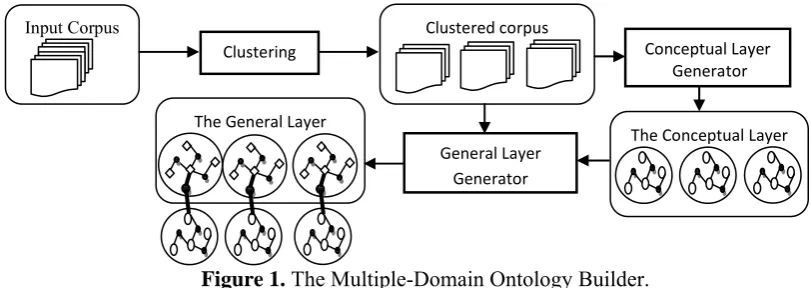
Figure 1. The Multiple-Domain Ontology Builder.
Clustering
Clustered corpus
Input Corpus
Conceptual Layer Generator
General Layer
Generator The General Layer
The Conceptual Layer
4
The Proposed Ontology Builder
Our builder aims to extract precise ontologies, which model possible knowledge in a multiple-domain corpus. A multiple-domain corpus, mostly, not only contains information about the core domain concepts and their relations, but it also contains general domain information such as dates of events and names of persons, locations, or organ-izations participating in the domain. Existing ontology builders either ignore this general in-formation or they provide a limited implementa-tion to extract it.
4.1 System Overview
The input to our builder (Figure 1) is a multiple-domain corpus. The first step is the clustering operation, which divides the given corpus doc-uments into clusters that are different among each other with high internal similarity. The next step is the conceptual layer generation. In this step, we use Text2Onto to extract a separate
on-tology for each domain. Finally, the general
layer generator uses each domain corpus and the conceptual layer ontology to extract relations among the concepts and the Named Entities in that domain.
4.2 The Conceptual Layer
The first step in constructing the conceptual layer is the clustering operation. We separate a mul-tiple-domain corpus into various domain specific corpora such that the domain concepts are weighted based on their significance in that do-main; also, the common concepts in different domains are separated. We favored a hierarchical clustering technique over a flat clustering one. That was because the number of resulting
clus-ters should be known as a parameter in the latter. However, the number of corpus domains might be unknown in our case.
We employ the agglomerative hierarchical clustering technique (Manning et al., 2008). The technique starts with each document as a single-ton cluster, and then it successively merges pairs of similar clusters until all clusters are merged into 1 cluster. We use the vector space model (Manning et al., 2008) to represent each docu-ment as a vector of terms' weights. The weight of a term w in a document d is calculated using the TF-IDF measure (Equation 1).
, , 1
Where N is the corpus size, TF (w,d) is the number of occurrences of the term w in the doc-ument d, and DF (w) is the number of docdoc-uments containing the term w.
The similarity between 2 documents is calcu-lated using the Cosine Similarity measure (Equa-tion 2).
1, 2 1 . 2
|| 1 || || 2 || 2
Where V(d) is the terms' weights vector for the document d, ||V(d)|| is the Euclidean length of the vector V(d), and the numerator is the dot product of the 2 vectors.
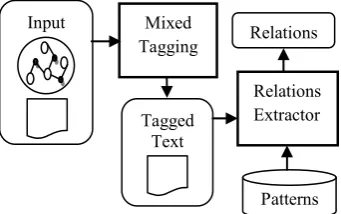
Figure 2. The General Relations Extraction.
We use the UPGMA measure to cluster a
sub-set of DMOZ2 data (1322 documents, in 4
do-mains), and it performs F-Measure of 0.86. Steinbach et al. (2000) describe how to calculate F-Measure for a hierarchy of clusters.
The combination similarity is the similarity of 2 merged clusters. We use this measure to cut the clusters hierarchy into M clusters by grouping ones having a minimum combination similarity of the threshold value €3. After clustering, we use Text2Onto to generate an ontology for each clus-ter (domain).
4.3 The General Layer
Text2Onto performs well in extracting ontology elements such as concepts, sub-class-of relations, instance-of relations, and part-of relations. Un-fortunately, it performs inaccurately in extracting general domain information such as Named Enti-ties and numeric information. There are 3 rea-sons for such misconception. First, proper nouns are not extracted as concepts. Second, numeric data is ignored. Third, restricted patterns are ap-plied for the relations of Named Entities, that include only verb relations like [(NP |PNP) verb (NP|PNP)] and instance-of relations like [NP such as PNP], [such NP as PNP], and [PNP (NP)].
Because of the above reasons, we propose a highly flexible pattern based relation extractor. In our system, a pattern is a sequence of tags in the form of a regular expression. The possible tags are the normal POS tags like NN, VB, JJ, IN besides the following 5 tags CONCEPT, PER-SON, LOCATION, ORGANIZATION, and DATE. This criterion is called Mixed Tagging. Currently, dates are the only data containing numbers extracted by our builder, but we can easily extend it to handle more numeric data.
The Mixed Tagging operation inputs are a document and the related conceptual ontology (Figure 2). The operation output is a mixed tagged document. The tagged text is then pro-vided to the Relations Extractor to take out all
2http://www.dmoz.org/
3 For clustering 600 AQUAINT documents, we use €=0.55 resulting in 7 Clusters (Secion 6.4).
relations matching our current predefined pat-terns. Example patterns are listed in Table 1; the first 2 patterns are verb relations, and the last 2 are noun relations.
The regular expression ([.{1,12}]){0,5} is used to limit the maximum number of tokens between the subject, the object, and the relation to 5 tokens. The expression [NN.?.?] matches any noun tag, and [VB.?] matches any verb tag.
After extracting the relations in all domain documents, the domain general ontology is created. It imports the corresponding conceptual ontology to model the relations among Named Entities and concepts.
([PERSON]) ([.{1,12}]){0,5}([VB.?])+
([.{1,12}]){0,5}([CONCEPT])
Table 1. Sample Relation Patterns.
5
Question Answering System
Based on (Brank et al., 2005), a generated ontol-ogy can be evaluated using 4 different ways: 1) by a human who assesses it based on specific criteria, 2) by a comparison with the source data, 3) by a comparison with a golden standard, or 4) by using the ontology in an application and mea-suring the application performance. We chose the last option because the manual human as-sessment and the comparison with the source data are time consuming. Also, there is no golden standard ontology for a multiple-domain corpus.
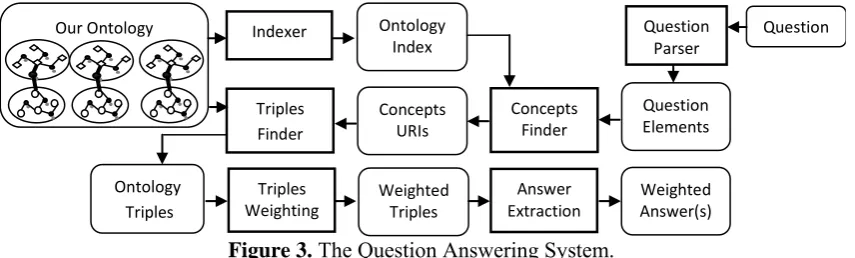
Figure 3. The Question Answering System.
Indexer Ontology
Index
PowerAqua (Lopez et al., 2009) are both ontology based Question Answering systems. PowerAqua extracts answers from various ontologies available on the web, unlike AquaLog, which extracts answers from 1 configurable ontology.
5.1 System Description
We implemented our simple Question Answer-ing system handlAnswer-ing who, when, where, and what questions. In the following, we describe the components of the system (Figure 3).
The Indexer: to make it easier for the system
to locate the question concepts, an index is gen-erated for our layered ontology. All concepts in different ontologies containing a certain stem are grouped in an index entry in the index file. The form of an index entry is as follows:
Stem,(Concept URI)+
The Question Parser: this component parses
the user question, and it extracts 4 elements from it. First, the answer type; it can be PERSON, LOCATION, ORGANIZATION, DATE, or ANY based on the question type such as who, where, when, or what. Second, the answer re-striction; it is used to limit the answers of what questions. For example, the answers for "what sport …?" question are restricted only to the sport types. Third, the question target; it defines the thing in which the question is interested. The fourth element is the relation; it contains the main verb(s) in the question. As an example, the elements of the question "What sport does Jenni-fer Capriati play?" are: the answer type (ANY), the restriction (sport), the question target (Jenni-fer Capriati), and the relation (play).
For a compound (2-clause) question such as "What countries have Rhodes Scholars come
from and has the Hale Bopp comet visible?", each question clause is parsed as a separate ques-tion; finally, the answer extraction step intersects the answers of both clauses.
The Concepts Finder: using the ontology
in-dex, it locates concepts containing the stems of the question target and the restriction (if exists).
The Triples Finder: it extracts the triples
which contain the question target concepts either as subjects or as objects. If the question is a defi-nition question like "What is something?", the triple finder extracts only the sub-class-of triples.
The Triples Weighting: the triples are
weighted based on their similarity to the question using our similarity criterion (Equation 4):
,
∑ ,
4
Where Q and T are sets of the bag-of-words for the question relation and the triple relation respectively, Lin(a,b) is a measure for the seman-tic similarity between a and b based on WordNet (Lin, 1998), and L(x) is the number of elements in the set x.
The Answer Extraction: this component first
∑ ,
5
Where R is the set of extracted triples, S and T are the sets of bag-of-words for the sub concept and the triple relation respectively, sim(S,T) is calculated using Equation 4, and L(R) is the number of elements in R.
For a compound question, the list of resulting answers contains only the common answers ex-tracted for the 2 clauses.
6
Evaluation and Discussion
In our evaluation, we assess: 1) the enhancement of the concepts' weights in a specific domain corpus, 2) the enhancement of modeling com-mon concepts in different domains with different semantics, and 3) the performance of our Ques-tion Answering system. The assessment is done through a comparison between our approach and Text2Onto.
In the development of our builder, we used
Text2Onto4, Stanford Part-Of-Speech Tagger
(POS Tagger)5, Stanford Named Entity
Recog-nizer (NER)6, and Jena7. In the Question Ans-wering system, we also used the Java WordNet Similarity Library (JWSL)8; it implements the Lin measure.
6.1 Data Set
Our evaluation is based on the AQUAINT9
cor-pus (Graff, 2002). It is an English news corcor-pus containing documents from the New York Times News Service, the Xinhua News Service, and the Associated Press Worldstream News Service.
The Question Answering track in TREC10 (The
Text REtrieval Conference) provides a set of questions on AQUAINT corpus along with their answers.
6.2 Concepts Weights Enhancement
For this experiment, we generated a corpus for the 3 domains, namely Finance, Sports, and
4http://code.google.com/p/text2onto/
5http://nlp.stanford.edu/software/tagger.shtml
6http://nlp.stanford.edu/software/CRF-NER.shtml
7http://jena.sourceforge.net/
8http://grid.deis.unical.it/similarity/
9http://www.ldc.upenn.edu/Catalog/CatalogEntry.jsp?catalo
gId=LDC2002T31
10http://trec.nist.gov/data/qa.html
Movies, from AQUAINT documents, such that each domain has equal number of documents. We measured the concepts' significance weights when using Text2Onto to generate a single on-tology for the whole corpus and when using our builder to generate 3 different domains ontolo-gies. We consider 3 measures implemented in Text2Onto, namely the Relative Term Frequency (RTF), the Entropy, and the TF-IDF.
The RTF for a concept w is the probability of the concept occurrence in the corpus (Equation 6).
.
. 6
The entropy and the normalized entropy for a concept w are calculated as follows (Equations 7 and 8 respectively):
log 7
8
In Section 4.2, we mention how to calculate the TF-IDF value for a term w in a document d (Equation 1). The TF-IDF weight and the norma-lized TF-IDF weight for a concept w in the whole corpus are calculated as follows (Equa-tions 9 and 10 respectively):
∑ ,
9
∑ 10
Where D is the set of documents containing w, N is the corpus size, and C is the set of all con-cepts in the corpus.
Domain Concept Entropy TF-IDF RTF Text2
Onto
Our Builder
Text2 Onto
Our Builder
Text2 Onto
Our Builder
Finance Stock 0.181 0.999 0.053 0.103 0.001 0.020
Trading 0.155 0.670 0.044 0.139 0.001 0.010
Shares 0.100 0.670 0.036 0.139 0.000 0.010
Economy 0.100 0.670 0.026 0.051 0.000 0.010
Sports Sport 0.822 0.974 0.344 0.379 0.012 0.019
Baseball 0.321 0.389 0.147 0.190 0.003 0.006
League 0.299 0.363 0.134 0.174 0.003 0.005
Football 0.205 0.251 0.085 0.111 0.002 0.003
Movies Actor 0.525 0.613 0.150 0.194 0.007 0.022
Movie Industry 0.230 0.362 0.098 0.263 0.002 0.011
Music 0.205 0.326 0.085 0.230 0.002 0.009
Home Video 0.038 0.066 0.012 0.032 0.000 0.001
Table 2. Concepts Weights Comparison between Our Builder and Text2Onto.
This fact can be verified easily from Table 2. The 3 measures give higher weights in the do-main specific ontologies than in a single ontolo-gy for the whole corpus.
6.3 Modeling Common Concepts
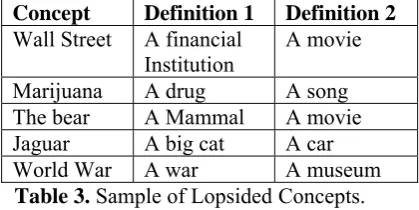
To study the enhancement in modeling common concepts having different meaning in different domains, we chose 5 concepts as samples (Table 3). For each concept, we selected documents from AQUAINT and from the Wikipedia con-cerning the concepts in 2 different domains.
In this experiment, the single ontology gener-ated by Text2Onto contains only 1 definition for each concept namely wall_street is_a institution,
marijuana is_a drug, bear is_a mammal, jaguar
is_a cat, and world_war is_a war. On the other hand, our builder maintains both concept defini-tions in different ontologies.
Concept Definition 1 Definition 2
Wall Street A financial
Institution A movie
Marijuana A drug A song
The bear A Mammal A movie
Jaguar A big cat A car
World War A war A museum
Table 3. Sample of Lopsided Concepts. 6.4 Question Answering Enhancement
The experiment includes common concepts defi-nition questions, single-domain questions, and cross-domain questions.
To illustrate the effect of the common con-cepts misconception problem solved by our builder against Text2Onto, we generated 5 defi-nition questions for the 5 concepts in Table 3, like "what is wall street?", "what is marijua-na?"…etc.
For the single-domain questions, we used a subset of AQUAINT corpus composed of 600 documents clustered into 7 domains using com-bination similarity threshold value of 0.55. We selected 60 factoid questions from TREC 2004 questions having their answers in these docu-ments.Examples of single-domain questions are:
• Who discovered prions? • When was the IFC established?
In addition to factoid questions, TREC 2004 also includes list questions. The answers of each question are aggregated from multiple docu-ments. We used these questions in generating 10 cross-domain questions. Each question combines 2 of TREC list questions such that the 2 list ques-tions are in different domains. Examples of these questions are:
• What cities have an Amtrak terminal and have Crip gangs?
• What countries are Burger King located in and have IFC financed projects?
Evaluation Criteria: the accuracy (A)
.
.
11
The definition and cross-domain questions have multiple correct answers. The average Pre-cision (P), Recall (R), and F-Measure (F) (Equa-tions 12, 13, and 14 respectively) of all ques(Equa-tions are used for our evaluation.
.
Table 4 shows that, in the definition questions, we achieve F-Measure of 1, while Text2Onto achieves 0.5. This is because our builder main-tains the 2 different definitions of each concept, unlike Text2Onto, which contains only one.
Questions
Cross-Domain P=0.49
R=0.59 F=0.44
P=0 R=0 F=0
Table 4. Question Answering Evaluation.
In the single-domain questions, using our on-tology, we could answer 41 questions while us-ing Text2Onto ontology we could answer only 3 questions ("what particle is a quark?", "what are prions made of?", and "What is the treatment of cataract?"). The low coverage of Named Entities in Text2Onto hinders it from answering correctly any question of types Who, When, and Where. This indicates the enhancement introduced by the proposed general layer for modeling accurately more domain information. In the cross-domain questions, we achieve F-Measure of 0.44. None of the cross-domain questions are answered us-ing Text2Onto ontology due to the mentioned Named Entity coverage problem.
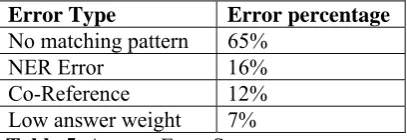
Although our results are better than Text2Onto, there is a room for more improve-ments. There are 4 main sources for retrieving wrong or incomplete answers (Table 5). Some relations are not extracted because their elements (subject, relation, and object) are not near enough from each other in the text, so none of our patterns or Text2Onto patterns could match them. This is the source of 65% of the errors. Missed Named Entities or wrongly tagged ones cause 16% of the errors. Some relations are not extracted because co-reference has not been han-dled yet. That leads to 12% of the total errors. Finally, in the factoid questions, we consider the answer with the highest weight to be the correct answer; 7% of the answers are extracted but with lower weights.
Error Type Error percentage
No matching pattern 65%
NER Error 16%
Co-Reference 12%
Low answer weight 7%
Table 5. Answer Error Sources.
Based on the mentioned experiments, our builder outperforms Text2Onto in Question Answering. In addition, it can be used skillfully to enhance other Natural Language Processing applications such as Information Retrieval from multiple-domain data. Our initial results using 220 queries on 600 AQUAINT documents records 0.35 F-Measure against Lucene11, which achieves 0.18.
7
Conclusion and Future Work
This paper presents the misconception problems when interpreting a multiple-domain corpus in a single ontology. A novel ontology builder is pre-sented handling these problems by generating separate domain ontologies describing core and general domain information.
Currently, we hand on improving our builder relation extractor to answer more TREC ques-tions by automatically learning patterns from text and by handling co-reference. Moreover, we are working to enhance the performance of our In-formation Retrieval system.
References
Benslimane, D., E. Leclercq, M. Savonnet, M.-N. Terrasse, and K. Yétongnon. 2000. On the Defini-tion of Generic Multi-layered Ontologies for Ur-ban Applications. In the International Journal of
Computers, Environment, and Urban Systems, vo-lume 24: 191-214.
Brank, Janez, Marko Grobelnik, and Dunja Mladenić. 2005. A Survey of Ontology Evaluation Tech-niques. In the Proceedings of the 8th International
Multiconference on Information Society: 166-169. Buitelaar, Paul, Daniel Olejnik, and Michael Sintek.
2004. A Protégé Plug-In for Ontology Extraction from Text Based on Linguistic Analysis. In the
Pro-ceedings of the 1st European Semantic Web Sym-posium: 31-44.
Cimiano, Philipp, and Johanna Völker. 2005.
Text2Onto - A Framework for Ontology Learning and Data-driven Change Discovery. In the
Pro-ceedings of the 10th International Conference on Applications of Natural Language to Information Systems: 227-238.
Cimiano, Philipp, Peter Haase, York Sure, Johanna Völker, and Yimin Wang. 2006. Question Answer-ing on Top of the BT Digital Library. In the
Pro-ceedings of the 15th International Conference on World Wide Web: 861-862.
Dumontier, Michel, and Natalia Villanueva-Rosales. 2007. Three-Layer OWL Ontology Design. In the
Proceedings of the 2nd International Workshop on
Modular Ontologies. CEUR Workshop
Proceed-ings, volume 315.
Graff, David. 2002. The AQUAINT Corpus of English News Text. Linguistic Data Consortium,
Philadel-phia.
Lin, Dekang. 1998. An Information-Theoretic Defini-tion of Similarity. In the Proceedings of the 15th
In-ternational Conference on Machine Learning: 296-304.
Lopez, Vanessa, Victoria Uren, Enrico Motta, and Michele Pasin. 2007. AquaLog: An Ontology-driven Question Answering System for Organiza-tional Semantic Intranets. In the Journal of Web
Semantics, volume 5: 72-105.
Lopez, Vanessa, Victoria Uren, Marta Sabou, and Enrico Motta. 2009. Cross Ontology Query Ans-wering on the Semantic Web: An Initial Evalua-tion. In the Proceedings of the 5th International
Conference on Knowledge Capture: 17-24.
Manning, Christopher D., Prabhakar Raghavan, and Hinrich Schütze. 2008. Introduction to Information
Retrieval. Online edition.
http://nlp.stanford.edu/IR-book/information-retrieval-book.html. Cambridge University Press. Navigli, Roberto, and Paola Velardi. 2004. Learning
Domain Ontologies from Document Warehouses and Dedicated Web Sites. In the Journal of
Compu-tational Linguistics, volume 30: 151-179.
Steinbach, Michael, George Karypis, and Vipin Ku-mar. 2000. A Comparison of Document Clustering Techniques. Technical Report #00-034, University