Entity-Focused Sentence Simplification for Relation Extraction
Makoto Miwa1 Rune Sætre1 Yusuke Miyao2 Jun’ichi Tsujii1,3,4 1Department of Computer Science, The University of Tokyo
2National Institute of Informatics
3School of Computer Science, University of Manchester 4National Center for Text Mining
[email protected],[email protected], [email protected],[email protected]
Abstract
Relations between entities in text have been widely researched in the natu-ral language processing and information-extraction communities. The region con-necting a pair of entities (in a parsed sentence) is often used to construct ker-nels or feature vectors that can recognize and extract interesting relations. Such re-gions are useful, but they can also incor-porate unnecessary distracting informa-tion. In this paper, we propose a rule-based method to remove the information that is unnecessary for relation extraction. Protein–protein interaction (PPI) is used as an example relation extraction problem. A dozen simple rules are defined on out-put from a deep parser. Each rule specif-ically examines the entities in one target interaction pair. These simple rules were tested using several PPI corpora. The PPI extraction performance was improved on all the PPI corpora.
1 Introduction
Relation extraction (RE) is the task of finding a relevant semantic relation between two given tar-get entities in a sentence (Sarawagi, 2008). Some example relation types are person–organization relations (Doddington et al., 2004), protein– protein interactions (PPI), and disease–gene as-sociations (DGA) (Chun et al., 2006). Among the possible RE tasks, we chose the PPI extrac-tion problem. PPI extracextrac-tion is a major RE task;
around 10 corpora have been published for train-ing and evaluation of PPI extraction systems.
Recently, machine-learning methods, boosted by NLP techniques, have proved to be effec-tive for RE. These methods are usually intended to highlight or select the relation-related regions in parsed sentences using feature vectors or ker-nels. The shortest paths between a pair of enti-ties (Bunescu and Mooney, 2005) or pair-enclosed trees (Zhang et al., 2006) are widely used as focus regions. These regions are useful, but they can in-clude unnecessary sub-paths such as appositions, which cause noisy features.
2 Related Works
The general paths, such as the shortest path or pair-enclosed trees (Section 1), can only cover a part of the necessary information for relation extraction. Recent machine-learning methods specifically examine how to extract the missing information without adding too much noise. To find more representative regions, some informa-tion from outside the original regions must be included. Several tree kernels have been pro-posed to extract such regions from the parse structure (Zhang et al., 2006). Also the graph kernel method emphasizes internal paths with-out ignoring with-outside information (Airola et al., 2008). Composite kernels have been used to com-bine original information with outside informa-tion (Zhang et al., 2006; Miwa et al., 2009).
The approaches described above are useful, but they can include unnecessary information that distracts learning. Jonnalagadda and Gonzalez (2009) applied bioSimplify to relation extraction. BioSimplify is developed to improve their link grammar parser by simplifying the target sentence in a general manner, so their method might move important information for a given target re-lation. For example, they might accidentally sim-plify a noun phrase that is needed to extract the relation. Still, they improved overall PPI extrac-tion recall using such simplificaextrac-tions.
To remove unnecessary information from a sen-tence, some works have addressed sentence sim-plification by iteratively removing unnecessary phrases. Most of this work is not task-specific; it is intended to compress all information in a tar-get sentence into a few words (Dorr et al., 2003; Vanderwende et al., 2007). Among them, Vickrey and Koller (2008) applied sentence simplification to semantic role labeling. With retaining all argu-ments of a verb, Vickrey simplified the sentence by removing some information outside of the verb and arguments.
3 Entity-Focused Sentence Simplification
We simplify a target sentence using simple rules applicable to the output of a deep parser called Mogura (Matsuzaki et al., 2007), to remove noisy
information for relation extraction. Our method relies on the deep parser; the rules depend on the Head-driven Phrase Structure Grammar (HPSG) used by Mogura, and all the rules are written for the parser Enju XML output format. The deep parser can produce deep syntactic and semantic information, so we can define generally applica-ble comprehensive rules on HPSG with specific examination of the entities.
For sentence simplification in relation extrac-tion, the meaning of the target sentence itself is less important than maintaining the truth-value of the relation (interact or not). For that purpose, we define rules of two groups: clause-selection rules and entity-phrase rules. A clause-selection rule constructs a simpler sentence (still includ-ing both target entities) by removinclud-ing noisy infor-mation before and after the relevant clause. An entity-phrase rule simplifies an entity-containing region without changing the truth-value of the re-lation. By addressing the target entities particu-larly, we can define rules for many applications, and we can simplify target sentences with less danger of losing relation-related mentions. The rules are summarized in Table 1.
Our method is different from the sentence sim-plification in other systems (ref. Section 2). First, our method relies on the parser, while bioSimplify by Jonnalagadda and Gonzalez (2009) is devel-oped for the improvement of their parser. Second, our method tries to keep only the relation-related regions, unlike other general systems including bioSimplify which tried to keep all information in a sentence. Third, our entity-phrase rules modify only the entity-containing phrases, while Vickrey and Koller (2008) tries to remove all information outside of the target verb and arguments.
3.1 Clause-selection Rules
Rule Group Rule Type # Example (original→simplified )
Sentence Clause 1 We show that A interacts with B.→A interacts with B. Clause Selection Relative Clause 2 ... A that interacts with B.→A interacts with B.
Copula 1 A is a protein that interacts with B.→A interacts with B. Apposition 2 a protein, A→A
Entity Phrase Exemplification 4 proteins, such as A→A Parentheses 2 a protein (A)→A Coordination 3 protein and A→A
Table 1: Rules for Sentence Simplification. (# is the rule count. A and B are the target entities.)
(a) S
bbbbbbb\\\\\\\
... VP
bbbbbbb\\\\\\\
N*
ccccc[[cc [[[V
7
7
(copular) ...
bbbbbbb\\\\\\\ ... ENTITY ... N* S-REL
bbbbbbb\\\\\\\
NP-REL
N
N
...
ccccc[[[[[ ... ENTITY ... A is a protein that interacts with B .
(b) S
bbbbbbb\\\\\\\
N*
[image:3.595.111.485.70.152.2]ccccc[[[[[ ccccc...[[[[[ ... ENTITY ... ... ENTITY ... A interacts with B .
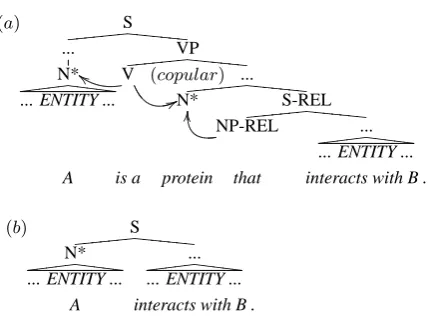
Figure 1: Copula Rule. (a) is simplified to (b). The arrows represent predicate–argument rela-tions.
(a) N*
bbbbbbb\\\\\\\
N* ...
bbbbbbb]]]]]]]]]]]]]
PN
R
R
5
5
(apposition) N*
ccccc[[[[[ ... ENTITY ... protein , A
(b) N*
ccccc[[[[[ ... ENTITY ...
A
Figure 2: Apposition Rule.
clause-selection rules for sentence clauses, rela-tive clauses, and copula. The sentence clause rule finds the (smallest) clause that includes both tar-get entities. It then replaces the original sentence with the clause. The relative clause rules con-struct a simple sentence from a relative clause and the antecedent. If this simple sentence includes the target entities, it is used instead of the orig-inal sentence. We define two rules for the case where the antecedent is the subject of the relative clause. One rule is used when the relative clause includes both the target entities. The other rule is used when the antecedent includes one target en-tity and the relative clause includes the other tar-get entity. The copula rule is for sentences that
include copular verbs (e.g. be, is, become, etc). The rule constructs a simple sentence from a rel-ative clause with the subject of the copular verb as the antecedent subject of the clause. The rule replaces the target sentence with the constructed sentence, if the relative clause includes one target entity and the subject of a copular verb includes the other target entity, as shown in Figure 1.
3.2 Entity-phrase Rules
[image:3.595.74.289.199.358.2]1: S←input sentence 2: repeat
3: reset rules{apply all the rules again} 4: P←parseS
5: repeat
6: r←next rule{null if no more rules} 7: ifris applicable toPthen
8: P ←applyrtoP
9: S←sentence extracted fromP
10: break (Goto 3) 11: end if
[image:4.595.75.244.66.209.2]12: untilris null 13: untilris null 14: return S
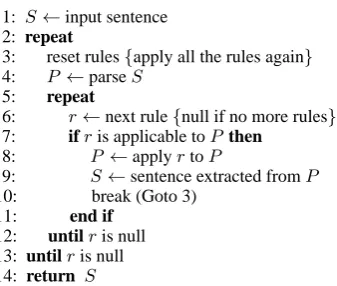
Figure 3: Pseudo-code for sentence simplifica-tion.
former rules). Three coordination rules are de-fined. Removing other phrases from coordinated expressions that include a target entity does not affect the truth-value of the target relation. Two rules are defined for simple coordination between two phrases (e.g. select left or right phrase), and one rule is defined to (recursively) remove one element from lists of more than two coordinated phrases (while maintaining the coordinating con-junction, e.g. “and”).
3.3 Sentence Simplification
To simplify a sentence, we apply rules repeatedly until no more applications are possible as pre-sented in Figure 3. After one application of one rule, the simplified sentence is re-parsed before attempting to apply all the rules again. This is be-cause we require a consistent parse tree as a start-ing point for additional applications of the rules, and because a parser can produce more reliable output for a partly simplified sentence than for the original sentence. Using this method, we can also backtrack and seek out conversion errors by exam-ining the cascade of partly simplified sentences.
4 Evaluation
To elucidate the effect of the sentence simplifi-cation, we applied the rules to five PPI corpora and evaluated the PPI extraction performance. We then analyzed the errors. The evaluation settings will be explained in Section 4.1. The results of the PPI extraction will be explained in Section 4.2. Fi-nally, the deeper analysis results will be presented
in Section 4.3.
4.1 Experimental Settings
The state-of-the-art PPI extraction system AkaneRE by Miwa et al. (2009) was used to evaluate our approach. The system uses a com-bination of three feature vectors: bag-of-words (BOW), shortest path (SP), and graph features. Classification models are trained with a support vector machine (SVM), and AkaneRE (with Mogura) is used with default parameter settings. The following two systems are used for a state-of-the-art comparison: AkaneRE with multiple parsers and corpora (Miwa et al., 2009), and Airola et al. (2008) single-parser, single-corpus system.
The rules were evaluated on the BioIn-fer (Pyysalo et al., 2007), AIMed (Bunescu et al., 2005), IEPA (Ding et al., 2002), HPRD50 (Fun-del et al., 2006), and LLL (N´e(Fun-dellec, 2005) cor-pora1. Table 2 shows the number of positive (in-teracting) vs. all pairs. One duplicated abstract in the AIMed corpus was removed.
These corpora have several differences in their definition of entities and relations (Pyysalo et al., 2008). In fact, BioInfer and AIMed target all oc-curring entities related to the corpora (proteins, genes, etc). On the other hand, IEPA, HPRD50, and LLL only use limited named entities, based either on a list of entity names or on a named en-tity recognizer. Only BioInfer is annotated for other event types in addition to PPI, including static relations such as protein family member-ship. The sentence lengths are also different. The duplicated pair-containing sentences contain the following numbers of words on average: 35.8 in BioInfer, 31.3 in AIMed, 31.8 in IEPA, 26.5 in HPRD50, and 33.4 in LLL.
For BioInfer, AIMed, and IEPA, each corpus is split into training, development, and test datasets2. The training dataset from AIMed was the only training dataset used for validating the rules. The development datasets are used for error analysis. The evaluation was done on the test dataset, with models trained using training and development
1
http://mars.cs.utu.fi/PPICorpora/ GraphKernel.html
BioInfer AIMed IEPA HPRD50 LLL pos all pos all pos all pos all pos all training 1,848 7,108 684 4,072 256 630 - - - -development 256 928 102 608 23 51 - - - -test 425 1,618 194 1,095 56 136 - - - -all 2,534 9,653 980 5,775 335 817 163 433 164 330
Table 2: Number of positive (pos) vs. all possible sentence pairs in used PPI corpora.
BioInfer AIMed IEPA
[image:5.595.326.503.288.417.2]Rule Applied F AUC Applied F AUC Applied F AUC No Application 0 62.5 83.0 0 61.2 87.9 0 73.4 82.5 Clause Selection 4,313 63.5 83.9 2,569 62.5 88.2 307 75.0 83.7 Entity Phrase 22,066 60.5 80.9 7,784 61.2 86.1 1,031 72.7 83.3 ALL 26,281 62.9 82.1 10,783 60.2 85.7 1,343 75.4 85.7
Table 3: Performance of PPI Extraction on test datasets. “Applied” represents the number of times the rules are applied on the corpus. “No Application” means PPI extraction without sentence simplification. ALL is the case all rules are used. The top scores for each corpus are shown in bold.
datasets). Ten-fold cross-validation (CV) was done to facilitate comparison with other existing systems. For HPRD50 and LLL, there are insuf-ficient examples to split the data, so we use these corpora only for comparing the scores and statis-tics. We split the corpora for the CV, and mea-sured theF-score (%) and area under the receiver operating characteristic (ROC) curve (AUC) as recommended in (Airola et al., 2008). We count each occurrence as one example because the cor-rect interactions must be extracted for each occur-rence if the same protein name occurs multiple times in a sentence.
In the experiments, the rules are applied in the following order: sentence–clause, exemplifica-tion, apposiexemplifica-tion, parentheses, coordinaexemplifica-tion, cop-ula, and relative-clause rules. Furthermore, if the same rule is applicable in different parts of the parse tree, then the rule is first applied closest to the leaf-nodes (deepest first). The order of the rules is arbitrary; changing it does not affect the results much. We conducted five experiments us-ing the trainus-ing and development dataset in IEPA, each time with a random shuffling of the order of the rules; the results were 77.8±0.26 inF-score and 85.9±0.55 in AUC.
4.2 Performance of PPI Extraction
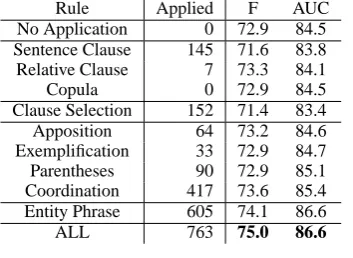
The performance after rule application was bet-ter than the baseline (no application) on all the corpora, and most rules could be frequently ap-plied. We show the PPI extraction performance on
[image:5.595.324.500.450.569.2]Rule Applied F AUC No Application 0 72.9 84.5 Sentence Clause 145 71.6 83.8 Relative Clause 7 73.3 84.1 Copula 0 72.9 84.5 Clause Selection 152 71.4 83.4 Apposition 64 73.2 84.6 Exemplification 33 72.9 84.7 Parentheses 90 72.9 85.1 Coordination 417 73.6 85.4 Entity Phrase 605 74.1 86.6 ALL 763 75.0 86.6
Table 4: Performance of PPI Extraction on HPRD50.
Rule Applied F AUC No Application 0 79.0 84.6 Sentence Clause 135 81.3 85.2 Relative Clause 42 78.8 84.6 Copula 0 79.0 84.6 Clause Selection 178 81.0 85.6 Apposition 197 79.6 83.9 Exemplification 0 79.0 84.6 Parentheses 56 79.5 85.8 Coordination 322 84.2 89.4 Entity Phrase 602 83.8 90.1 ALL 761 82.9 90.5
Table 5: Performance of PPI Extraction on LLL.
Rule B AIMed IEPA H LLL S. Cl. 3,960 2,346 300 150 135 R. Cl. 287 212 17 5 24 Copula 60 57 1 0 0 Cl. Sel. 4,307 2,615 318 155 159 Appos. 3,845 1,100 99 69 198 Exempl. 383 127 11 33 0 Paren. 2,721 2,158 235 91 88 Coord. 15,025 4,783 680 415 316 E. Foc. 21,974 8,168 1,025 608 602 Sum 26,281 10,783 1,343 763 761
Table 6: Distribution of the number of rules ap-plied when all rules are apap-plied. B:BioInfer, and H:HPRD50 corpora.
Rules Miwa et al. Airola et al. F AUC F AUC F AUC B 60.0 79.8 68.3 86.4 61.3 81.9 A 54.9 83.7 65.2 89.3 56.4 84.8 I 77.8 88.7 76.6 87.8 75.1 85.1 H 75.0 86.6 74.9 87.9 63.4 79.7 L 82.9 90.5 86.7 90.8 76.8 83.4
Table 7: Comparison with the results by Miwa et al. (2009) and Airola et al. (2008). The results with all rules are reported.
results. For the clause-selection rules, the per-formance was as good as or better than the base-line for all corpora, except for HPRD50, which indicates that the pair-containing clauses also in-clude most of the important information for PPI extraction. Clause selection rules alone could im-prove the overall performance for the BioInfer and AIMed corpora. Entity-phrase rules greatly im-proved the performance on the IEPA, HPRD50, and LLL corpora, although these rules degraded the performance on the BioInfer and AIMed cor-pora. These phenomena hold even if we use small parts of the two corpora, so this is not because of the size of the corpora.
We compare our results with the results by Miwa et al. (2009) and Airola et al. (2008) in Ta-ble 7. On three of five corpora, our method pro-vides better results than the state-of-the-art system by Airola et al. (2008), and also provides com-parable results to those obtained using multiple parsers and corpora (Miwa et al., 2009) despite the fact that our method uses one parser and one corpus at a time. We cannot directly compare our result with Jonnalagadda and Gonzalez (2009) be-cause the evaluation scheme, the baseline system,
[FP→TN][Sentence, Parenthesis, Coordination] To characterize the AAV functions mediating this effect, cloned AAV type 2 wild-type or mutant genomes were transfected into simian virus 40 (SV40)-transformed hamster cells together with the six HSV replication genes (encoding UL5, UL8, major DNA-binding protein, DNA
polymerase, UL42 , and UL52) which together are
necessary and sufficient for the induction of SV40 DNA amplification (R. Heilbronn and H. zur Hausen, J. Virol. 63:3683-3692, 1989). (BioInfer.d760.s0)
[TP→FN][Coordination] Both the GT155-calnexin and the GT155-CAP-60 interactions were dependent on the presence of a correctly modified oligosaccharide group on GT155, a characteristic of many calnexin interactions. (AIMed.d167.s1408)
[image:6.595.79.279.237.308.2][TN→TN][Coordination, Parenthesis] Leptin may act as a negative feedback signal to the hypothalamic control of appetite through suppression of neuropeptide Y (NPY) secretion and stimulation of cocaine and amphetamine regulated transcript (CART) . (IEPA.d190.s454)
Figure 4: A rule-related error, a critical error, and a parser-related error. Regions removed by the rules are underlined, and target proteins are shown in bold. Predictions, applied rules, and sentence IDs are shown.
[FN→TP][Sentence, Coordination] WASp contains a binding motif for the Rho GTPase CDC42Hs as well as
verprolin / cofilin-like actin-regulatory domains , but no
specific actin structure regulated by CDC42Hs-WASp has been identified. (BioInfer.d795.s0)
[FN→TP][Parenthesis, Apposition] The protein Raf-1 , a key mediator of mitogenesis and differentiation, associates with p21ras (refs 1-3) . (AIMed.d124.s1055)
[FN→TP][Sentence, Parenthesis] On the basis of far-Western blot and plasmon resonance (BIAcore) experiments, we show here that recombinant bovine
prion protein (bPrP) (25-242) strongly interacts with the
catalytic alpha/alpha’ subunits of protein kinase CK2 (also termed ’casein kinase 2’) (IEPA.d197.s479)
Figure 5: Correctly simplified cases. The first sentence is a difficult (not PPI) relation, which is typed as “Similar” in the BioInfer corpus.
and test parts differ.
4.3 Analysis
We trained models using the training datasets and classified the examples in the development datasets. Two types of analysis were performed based on these results: simplification-based and classification-based analysis.
BioInfer AIMed IEPA Before simplification FN FP TP TN FN FP TP TN FN FP TP TN
Not Affected After simplification TP TN FN FP TP TN FN FP TP TN FN FP
No Error 18 2 3 35 14 21 21 8 3 2 0 4 32 No Application 3 2 0 3 0 7 8 0 0 1 0 1 7 Number of Errors 0 2 0 32 4 2 1 4 0 0 0 0 1 Number of Pairs 21 6 3 70 18 30 30 12 3 3 0 5 40 Coordination 0 0 0 20 4 2 1 0 0 0 0 0 1
Sentence 0 2 0 4 0 0 0 4 0 0 0 0 0
Parenthesis 0 0 0 5 0 0 0 0 0 0 0 0 0 Exemplification 0 0 0 2 0 0 0 0 0 0 0 0 0
[image:7.595.78.515.70.193.2]Apposition 0 0 0 1 0 0 0 0 0 0 0 0 0
Table 8: Distribution of sentence simplification errors compared to unsimplified predictions with their types (on the three development datasets). TP, True Positive; TN, True Negative; FN, False Negative; FP, False Positive. “No Error” means that simplification was correct; “No Application” means that no rule could be applied; Other rule names mean that an error resulted from that rule application. “Not Affected” means that the prediction outcome did not change.
simplification in the training dataset. The numbers of such inconsistent sentences are 7 for BioIn-fer, 78 for AIMed, and 1 for IEPA. The few in-consistencies in BioInfer and IEPA are from er-rors by the rules, mainly triggered by parse erer-rors. The frequent inconsistencies in AIMed are mostly from inconsistent annotations. For example, even if all coordinated proteins are either interacting or not, only the first protein mention is annotated as interacting.
For the classification-based analysis, we specifically examine simplified pairs that were predicted differently before and after the simplifi-cation. Pairs predicted differently before and after rule application were selected: 100 random pairs from BioInfer and all 90 pairs from AIMed. For IEPA, all 51 pairs are reported. Simplified results are classified as errors when the rules affect a re-gion unrelated to the entities in the smallest sen-tence clause. The results of analysis are shown in Table 8. There were 34 errors in BioInfer, and 11 errors in AIMed. Among the errors, there were five critical errors (in two sentences, in AIMed). Critical errors mean that the pairs lost relation-related mentions, and the errors are the only er-rors which caused the changes in the truth-value of the relation. There was also a rule-related er-ror (in BioInfer), which means that rules with cor-rect parse results affect a region unrelated to the entities, and parse errors (parser-related errors). Figure 4 shows the rule-related error in BioInfer, one critical error in AIMed, and one parser-related
error in IEPA.
5 Discussion
Our end goal is to provide consistent relation extraction for real tasks. Here we discuss the “safety” of applying our simplification rules, the difficulties in the BioInfer and AIMed corpora, the reduction of errors, and the requirements for such a general (PPI) extraction system.
al., 2009) or coreference resolution, become good enough, they can supplement or even substitute some of the proposed rules.
There are different difficulties in the BioInfer and AIMed corpora. BioInfer includes more com-plicated sentences and problems than the other corpora do, because 1) the apposition, coordi-nation, and exemplification rules are more fre-quently used in the BioInfer corpus than in the other corpora (shown in Table 6), 2) there were more errors in the BioInfer corpus than in other corpora among the simplified sentences (shown in Table 8), and 3) BioInfer has more words per sentence and more relation types than the other corpora. AIMed contains several annotation in-consistencies as explained in Section 4.3. These inconsistencies must be removed to properly eval-uate the effect of our method.
Simplification errors are mostly caused by parse errors. Our rule specifically examines a part of parser output; a probability is attached to the part. The probability is useful for defining the or-der of rule applications, and then-best results by the parser are useful to fix major errors such as co-ordination errors. By using these modifications of rule applications and by continuous improvement in parsing technology for the biomedical domain, the performance on the BioInfer and AIMed cor-pora will be improved also for the all rules case.
The PPI extraction system lost the ability to capture some of the relation-related expressions left by the simplification rules. This indicates that the system used to extract some relations (be-fore simplification) by using back-off features like bag-of-words. The system can reduce bad effects caused by parse errors, but it also captures the an-notation inconsistencies in AIMed. Our simpli-fication (without errors) can capture more general expressions needed for relation extraction. To pro-vide consistent PPI relation extraction in a general setting (e.g. for multiple corpora or for other pub-lic text collections), the parse errors must be dealt with, and a relation extraction system that can cap-ture (only) general relation-related expressions is needed.
6 Conclusion
We proposed a method to simplify sentences, par-ticularly addressing the target entities for relation extraction. Using a few simple rules applicable to the output of a deep parser called Mogura, we showed that sentence simplification is effec-tive for relation extraction. Applying all the rules improved the performance on three of the five corpora, while applying only the clause-selection rules raised the performance for the remaining two corpora as well. We analyzed the simplification results, and showed that the simple rules are ap-plicable with little danger of changing the truth-values of the interactions.
The main contributions of this paper are: 1) ex-planation of general sentence simplification rules using HPSG for relation extraction, 2) presenting evidence that application of the rules improve re-lation extraction performance, and 3) presentation of an error analysis from two viewpoints: simpli-fication and classisimpli-fication results.
As future work, we are planning to refine and complete the current set of rules, and to cover the shortcomings of the deep parser. Using these rules, we can then make better use of the parser’s capabilities. We will also attempt to apply our simplification rules to other relation extraction problems than those of PPI.
Acknowledgments
References
Airola, Antti, Sampo Pyysalo, Jari Bj¨orne, Tapio Pahikkala, Filip Ginter, and Tapio Salakoski. 2008. A graph kernel for protein-protein interaction ex-traction. In Proceedings of the BioNLP 2008
work-shop.
Bunescu, Razvan C. and Raymond J. Mooney. 2005. A shortest path dependency kernel for relation ex-traction. In HLT ’05: Proceedings of the
confer-ence on Human Language Technology and Empiri-cal Methods in Natural Language Processing, pages
724–731.
Bunescu, Razvan C., Ruifang Ge, Rohit J. Kate, Ed-ward M. Marcotte, Raymond J. Mooney, Arun K.
Ramani, and Yuk Wah Wong. 2005.
Compara-tive experiments on learning information extractors for proteins and their interactions. Artificial
Intelli-gence in Medicine, 33(2):139–155.
Chun, Hong-Woo, Yoshimasa Tsuruoka, Jin-Dong Kim, Rie Shiba, Naoki Nagata, Teruyoshi Hishiki,
and Jun’ichi Tsujii. 2006. Extraction of
gene-disease relations from medline using domain dictio-naries and machine learning. In The Pacific
Sympo-sium on Biocomputing (PSB), pages 4–15.
Ding, J., D. Berleant, D. Nettleton, and E. Wurtele.
2002. Mining medline: abstracts, sentences, or
phrases? Pacific Symposium on Biocomputing,
pages 326–337.
Doddington, George, Alexis Mitchell, Mark Przy-bocki, Lance Ramshaw, Stephanie Strassel, and Ralph Weischedel. 2004. The automatic content extraction (ACE) program: Tasks, data, and evalua-tion. In Proceedings of LREC’04, pages 837–840.
Dorr, Bonnie, David Zajic, and Richard Schwartz. 2003. Hedge trimmer: A parse-and-trim approach to headline generation. In in Proceedings of
Work-shop on Automatic Summarization, pages 1–8.
Fundel, Katrin, Robert K¨uffner, and Ralf Zimmer. 2006. Relex—relation extraction using dependency parse trees. Bioinformatics, 23(3):365–371.
Jonnalagadda, Siddhartha and Graciela Gonzalez. 2009. Sentence simplification aids protein-protein
interaction extraction. In Proceedings of the 3rd
International Symposium on Languages in Biology and Medicine, pages 109–114, November.
Matsuzaki, Takuya, Yusuke Miyao, and Jun’ichi Tsu-jii. 2007. Efficient HPSG parsing with supertag-ging and cfg-filtering. In IJCAI’07: Proceedings of
the 20th international joint conference on Artifical intelligence, pages 1671–1676, San Francisco, CA,
USA. Morgan Kaufmann Publishers Inc.
Miwa, Makoto, Rune Sætre, Yusuke Miyao, and
Jun’ichi Tsujii. 2009. Protein-protein
interac-tion extracinterac-tion by leveraging multiple kernels and parsers. International Journal of Medical
Informat-ics, June.
Morante, Roser and Walter Daelemans. 2009. Learn-ing the scope of hedge cues in biomedical texts. In
Proceedings of the BioNLP 2009 Workshop, pages
28–36, Boulder, Colorado, June. Association for Computational Linguistics.
N´edellec, Claire. 2005. Learning language in logic -genic interaction extraction challenge. In
Proceed-ings of the LLL’05 Workshop.
Pyysalo, Sampo, Filip Ginter, Juho Heimonen, Jari Bj¨orne, Jorma Boberg, Jouni J¨arvinen, and Tapio
Salakoski. 2007. BioInfer: A corpus for
infor-mation extraction in the biomedical domain. BMC
Bioinformatics, 8:50.
Pyysalo, Sampo, Antti Airola, Juho Heimonen, Jari Bj¨orne, Filip Ginter, and Tapio Salakoski. 2008. Comparative analysis of five protein-protein
inter-action corpora. In BMC Bioinformatics, volume
9(Suppl 3), page S6.
Pyysalo, Sampo, Tomoko Ohta, Jin-Dong Kim, and
Jun’ichi Tsujii. 2009. Static relations: a piece
in the biomedical information extraction puzzle. In BioNLP ’09: Proceedings of the Workshop on
BioNLP, pages 1–9, Morristown, NJ, USA.
Asso-ciation for Computational Linguistics.
Sarawagi, Sunita. 2008. Information extraction.
Foundations and Trends in Databases, 1(3):261–
377.
Vanderwende, Lucy, Hisami Suzuki, Chris Brockett, and Ani Nenkova. 2007. Beyond sumbasic: Task-focused summarization with sentence simplifica-tion and lexical expansion. Inf. Process. Manage., 43(6):1606–1618.
Vickrey, David and Daphne Koller. 2008. Sentence simplification for semantic role labeling. In
Pro-ceedings of ACL-08: HLT, pages 344–352,
Colum-bus, Ohio, June. Association for Computational Lin-guistics.
Zhang, Min, Jie Zhang, Jian Su, and Guodong Zhou. 2006. A composite kernel to extract relations be-tween entities with both flat and structured features. In ACL-44: Proceedings of the 21st International
Conference on Computational Linguistics and the 44th annual meeting of the Association for Compu-tational Linguistics, pages 825–832. Association for