Verb-Particle Constructions and Lexical Resources
Aline Villavicencio
University of Cambridge Computer Laboratory, William Gates Building, JJ Thomson Avenue,
Cambridge, CB3 0FD, UK
Abstract
In this paper we investigate the phe-nomenon of verb-particle constructions, discussing their characteristics and their availability for use with NLP systems. We concentrate in particular on the coverage provided by some electronic resources. Given the constantly growing number of verb-particle combinations, possible ways of extending the coverage of the available resources are investigated, taking into ac-count regular patterns found in some pro-ductive combinations of verbs and parti-cles. We discuss, in particular, the use of Levin’s (1993) classes of verbs as a means to obtain productive verb-particle constructions, and discuss the issues in-volved in adopting such an approach.
1 Introduction
In this paper we discuss verb-particle constructions (VPCs) in English and analyse some of the avail-able sources of information about them for use in NLP systems. VPCs can range from idiosyncratic or semi-idiosyncratic combinations, such as get on
(in e.g. Bill got on well with his new colleagues), to more regular ones, such astear up(in e.g.In a rage
she tore up the letter Jack gave her). However,
ex-amples of ‘idiomatic’ VPCs likeget on, meaningto
be on friendly terms with someone, where the
mean-ing of the combination cannot be straightforwardly inferred from the meaning of the verb and the par-ticle, fortunately seem to be a small minority (Side,
1990). Most cases seem to be more regular, with the particle compositionally adding a specific meaning to the construction and following a productive pat-tern (e.g. intear up,cut upand split up, where the verbs are semantically related andupadds a sense of completion the action of these verbs).
VPCs have been the subject of a considerable amount of interest, and some investigation has been done on the subject of productive VPCs. For in-stance, even though the particle up occurs with a wide range of verbs, it only combines productively with some classes. Bame (1999) discusses two such cases: the resultative and the aspectual up. For ex-ampleKim carried the television up uses a
resulta-tive up and Kim ate the sandwich up an aspectual
up. With the resultativeup, the argument is affected (i.e., at the end of the action the television isup). In contrast, the aspectual or completiveupsuggests that the action is taken to some conclusion (i.e., the sandwich is totally consumed at the end of the ac-tion).
Fraser (1976) points out that semantic proper-ties of verbs can affect their possibiliproper-ties of com-bining with particles. Thus, semantic properties can influence the patterns of verb-particle combina-tions that verbs follow. For example, in the case
of bolt/cement/clam/glue/paste/nail all are
analogy with existing ones, with often the verb be-ing varied and the particle remainbe-ing (e.g. hang on,
hold onandwait on).
By identifying classes of verbs that follow pat-terns such as these in VPCs, we are able to max-imise the use of the information contained in lexical resources. For instance, we can make use of regular patterns to productively generate VPCs from verbs already listed in a lexical resource, according to their verbal classes (e.g. the resultative combinations
walk up/down/out/in/away/around/... fromwalkand
the directional/locative particles up, down, out, in,
away,around, ...). We consider how we can use
pro-ductive patterns to extend the coverage of current lexical resources, in the next sections. We start by characterising VPCs, and investigating the coverage provided by some available electronic dictionaries, in section 3. We also discuss the use of corpora to extend the coverage provided by these dictionaries. After that we investigate how more productive com-binations can be generated from a semantic classifi-cation of verbs such as Levin’s (1993).
2 Characterizing VPCs
VPCs are combinations of verbs and prepositional or adverbial particles, such as break down in The
old truck broke down. In these constructions
par-ticles are characterised by containing features of motion-through-location and of completion or result in their core meaning (Bolinger, 1971). In syntactic terms in the example above we have an intransitive VPC, where no other verbal complement is required. Other VPCs may have further subcategorisation re-quirements, and in, for example, They came across
an old manuscript we have a transitive VPC which
has a further NP complement.
In this work we are looking exclusively at cases of VPCs, thus excluding prepositional verbs, where a verb subcategorises for a prepositional phrase (PP), such as rely on, inHe relies on his wife for
every-thing. Cases like this and others of adverbial
mod-ification need to be distinguished from VPCs. This difference may be quite subtle and, in order to dis-tinguish VPCs from other constructions we use the following criteria:
The particle may come either before or after the NP in transitive VPCs (e.g. He backed up the
teamvs He backed the team up). Whether a
particle can be separated or not from the verb may depend on the degree of bondage of the particle with the verb, on the size of the NP, and on the kind of NP.
In transitive VPCs unstressed personal pro-nouns must precede the particle (e.g. They ate
it upbut not*They ate up it).
The particle, in transitive VPCs, comes before a simple definite NP without taking it as its ob-ject (e.g. He brought along his girlfriend but
notIt consists of two parts).
In VPCs subcategorising for other verbal com-plements, like PPs and sentential comcom-plements, the particle must come immediately after the verb.
Verbs that subcategorise for an optional goal ar-gument that is fullfilled by a locative or direc-tional particle are considered to be VPCs with the particle further specifying the meaning of the verb (e.g. walk up in Bill walked up the
hill).
As discussed by Bolinger (1971), many of the cri-teria proposed for diagnosing VPCs give different results for the same combination frequently includ-ing unwanted combinations and excludinclud-ing genuine VPCs. Nonetheless, they provide us with at least the basis for this decision.
3 Dictionaries and VPCs
Top Particles
0 100 200 300 400 500 600
ANLT Comlex ERG A+C A+C+E
Dictionaries
VPCs
[image:3.597.88.284.73.172.2]up out off down away
Figure 1: Top Ranked Particles I
[image:3.597.100.269.314.405.2]these dictionaries, including not only VPCs but also other kinds of PV. The third column shows the num-ber of VPC entries (available only for the electronic dictionaries).
Table 1: Phrasal Verb Entries in Dictionaries Dictionary PVs VPCs ANLT 6,439 2,906 CIDE-PV over 4,500 CollinsPV over 3,000 -Comlex 12,564 4,039
ERG 533 337
As we can see from these numbers, each of these dictionaries has a considerable number of PV entries potentially providing us with a good starting point for handling VPCs. Table 2 shows some of the char-acteristics of each dictionary, in more detail, with respect to VPCs, where the seventh column shows the proportion of verbs used in VPCs (sixth column) from all verbs in a dictionary (second column).
Each of these dictionaries uses a different set of verbs and particles in its VPCs. However, with re-spect to the verbs listed in these dictionaries there is a high level of agreement among them with, for example, 93.26% of the verbs in Comlex being also listed in ANLT. In Table 2 we can see the increase in the number of verbs obtained by the union of the dic-tionaries, where A+C represents the union of ANLT and Comlex, A
C their intersection and A+C+E the union of ANLT, Comlex and ERG. Because of the high level of agreement for their verbs, when joined together the contribution made by each dictionary is relatively small, so that the combination of the three (A+C+E) has only 7.3% more verbs than the ANLT
alone, for example.
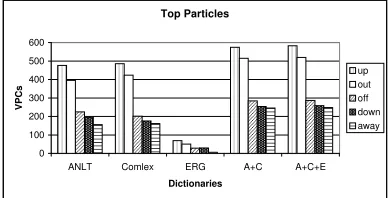
In relation to VPCs, ANLT uses the largest num-ber of particles, and with one exception all the par-ticles contained in the ERG and Comlex are already contained in ANLT. When we rank the particles ac-cording to the frequency with which they occur in the VPCs, we get similar patterns for all of the dic-tionaries, as can be seen in Figure 1. This figure shows the 5 top ranked particles for each of the dic-tionaries, and for all of them up is the particle in-volved in the largest number of combinations. By analysing the VPCs in each of these dictionaries, we can also see that only a small proportion of the total number of verbs in a dictionary is used in its VPCs, Table 2. For example, only 20% of the verbs listed in ANLT form at least one VPC. For the other dic-tionaries this proportion is even lower. These tend to be very widely used and general verbs, such as
come, go, get, put, bringand take. Whether the
re-maining verbs do not form valid VPCs or whether the combinations were simply omitted remains to be investigated.
Even though only a subset of verbs in dictionaries are used in VPCs, this subset generates a large num-ber of combinations, as shown in Table 2. Each of these dictionaries specialises in a subset of VPCs. Because of this difference in coverage, when the dictionaries are combined, as each one is added it helps to significantly extend the coverage of VPCs. Although there is a significant number of entries1
that are common among the different dictionaries, it seems to correspond only to a subset of the to-tal number of entries each dictionary has. For in-stance, from the total number of entries obtained by combining ANLT and Comlex, Table 2, only 34% of the entries are listed in both dictionaries with the remaining 66% of the total number of entries being exclusive to one or the other of these dictionaries. Moreover, even with the large number of entries al-ready obtained by combining these two dictionaries, a considerable proportion (16%) of the entries in the LinGO ERG lexicon are not listed in any of these two dictionaries (this proportion would increase if we took subcategorization etc into account).2 Most
1These figures do not take into account subcategorisation
information, where a given verb-particle construction can occur with more than one subcategorisation frame.
Table 2: VPCs in Dictionaries
Dictionary Verbs VPC Distinct Particles Verbs Proportion of Entries VPCs in VPCs Verbs in VPCs ANLT 5,667 2,906 2,250 44 1,135 20%
Comlex 5,577 4,039 1,909 23 990 17.75%
ERG 1,223 337 270 25 176 14.39%
A+C 6,043 - 3,111 44 1,394 23.07%
A C 5,201 - 1,052 23 731 14.05%
A+C+E 6,113 - 3,156 45 1,400 22.90%
of these are at least semi-compositional, e.g., crisp
up, come together, tie on, and were probably
omit-ted from the dictionaries for that reason,3 though
some others, such as hack up, are probably recent coinages. The coverage of these resources is quite limited and possible ways of extending it are a ne-cessity for successful NLP systems.
4 VPCs in Corpora
The use of corpora to extract verb-particle com-binations can contribute to extending the coverage of dictionaries. An investigation of the automatic extraction of VPCs from corpora is described in Baldwin and Villavicencio (2002). In this section we use VPCs extracted from the British National Corpus (BNC), comparing these VPCs with those contained in the combined A+C+E-VPCs, and dis-cussing how the former can be used to complement the coverage provided by the latter.
The BNC is a 100 million word corpus contain-ing samples of written text from a wide variety of sources, designed to represent as wide a range of modern British English as possible. Using the meth-ods described in Baldwin and Villavicencio (2002), 8,751 VPC entries were extracted from the BNC. These entries are classified into intransitive and/or transitive VPCs, depending on their subcategorisa-tion frame, and they result in 7,078 distinct VPCs. Some of these entries are not VPCs but rather noise, such as**** off, ’s down, etc. After removing the most obvious cases of noise, there were 7,070 VPCs most of the verb-particle entries being empirically motivated by the Verbmobil corpus. It is thus probably reasonably represen-tative of a moderate-size domain-specific lexicon.
3The Cobuild Dictionary explicitly states that literal
mean-ings and combinations are not given for all verbs.
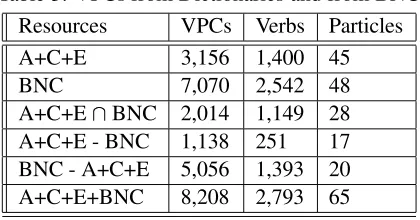
[image:4.597.322.532.294.404.2]left. These are formed by 2,542 verbs and 48 parti-cles, as shown in Table 3.
Table 3: VPCs from Dictionaries and from BNC Resources VPCs Verbs Particles A+C+E 3,156 1,400 45
BNC 7,070 2,542 48
A+C+E BNC 2,014 1,149 28
A+C+E - BNC 1,138 251 17 BNC - A+C+E 5,056 1,393 20 A+C+E+BNC 8,208 2,793 65
When comparing the VPCs in BNC (BNC-VPCs) with those in the combined dictionaries (A+C+E-VPCs) there are 1,149 verbs in common, corre-sponding to 82.1% of the verbs in the combined dic-tionaries. When these resources are joined together, there is a significant increase in the number of verbs and particles, with a total of 2,793 different verbs and 65 particles used in VPCs, Table 3. The verbs that appear in the largest number of VPCs are again general and widely used (e.g. move, come, go, get
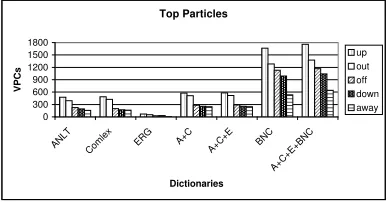
andpull). For these, the five particles that occur in the highest number of VPCs are shown in Figure 2, and they are basically the same as those in the dic-tionaries.
In terms of the VPCs, by joining A+C+E-VPCs with BNC-VPCs there is an increase of 160.30% in the number of VPCs. Among the extracted VPCs many form productive combinations: some contain-ing a more informal or a recent use of verbs (e.g.hop
off, kangaroo down and skateboard away). These
ob-Top Particles
0 300 600 900 1200 1500 1800
ANLT Comlex ERG A+C
A+C+E BNC
A+C+E+BNC Dictionaries
VPCs
[image:5.597.88.283.73.174.2]up out off down away
Figure 2: Top Ranked Particles II
tain only a subset of the existing VPCs, and plau-sible combinations such ashoover upare not found in these combined resources. In the next section we discuss how to extend even further their coverage by making use of productive patterns found in classes of semantically related verbs.
5 VPC Patterns in Levin’s Verb Classes
Fraser (1976) noted how semantic properties of verbs can affect their possibilities of combination with particles (e.g. hunt/track/trail/follow down
andbake/cook/fry/broil up). Semantic properties of
verbs can influence the patterns of combination that they follow (e.g. verbs of hunting and the resulta-tive down and verbs of cooking and the aspectual
up). By having a semantic classification of verbs we can determine how they combine with certain par-ticles, and this can be used to extend the coverage of the available resources by productively generat-ing VPCs from classes of related verbs accordgenerat-ing to the patterns that they follow. One such classification was proposed by Levin (1993). In Levin’s classifica-tion, verbs are grouped into classes in terms of their syntactic and semantic properties. These classes were not developed specifically for VPCs, but it may be the case that some productive patterns of combi-nations correspond to certain classes of verbs. We investigated the possibility of using Levin’s classes of verbs to generate a set of candidate VPCs, and in this section, we briefly discuss Levin’s classes and describe how they can be used to predict productive verb-particle combinations.
There are 190 fine grained subclasses that cap-ture 3,100 different verbs listed, resulting in 4,167 entries, since each verb can belong to more than one class. For example, the verb to run belongs
to classes 26.3 (Verbs of Preparing), 47.5.1 (Swarm Verbs), 47.7 (Meander Verbs) and 51.3.2 (Run Verbs). The number of elements in each class varies considerably, so that 60% of all of these classes have more than 10 elements, accounting for 88% of the verbs, while the other 40% of the classes have 10 or less elements, capturing the remaining 22% of the verbs. The 5 larger classes are shown in Table 4.
Table 4: Verb Entries in Levin’s Classes
Class Name Entries
45.4 Other alternating 257 verbs of change of state
31.1 Amuse 220
51.3.2 Run 124
43.2 Sound emission 119
9.9 Butter 109
It is possible that some productive patterns found in VPCs may be mapped onto the classes defined. In this case, some classes may be good predic-tors of productive VPCs, and to test this possibility we analysed the combinations generated by Levin’s classes and a subset of four particles (down, in,
out, up). To test the validity of a resulting
com-bination, we searched for it first among the VPCs from the combined dictionaries, A+C+E-VPCs, and then among the much more numerous but potentially noisy A+C+E+BNC-VPCs.
All combinations of verbs in Levin’s classes and these four particles were generated and tested for va-lidity. We use the proportion of valid VPCs as a met-ric to determine the degree of productivity of a given class, so that the higher the proportion, the more productive the class, according to the combined re-sources. The classes are then ranked according to their productivity degree.
There are 16,668 possible combinations that can be generated, from the 4,167 entries in Levin’s classes and four particles. However, from the 4,167 only 3,914 entries have verbs that are in A+C+E, so we will consider only 15,656 possible VPCs, when evaluating these results against the combined dictio-naries.
Top 10 Classes
0 0.1 0.2 0.3 0.4 0.5 0.6 0.7 0.8 0.91
11.3 - Bring/take
39.1 - Eat 37.5 - Talk 23.2 - Split15.2 - Keep 54.1 - Register12 - Push/Pull
9.2 - Put in Spatial Config 35.1 - Hunt 11.2 - Slide
Classes
Proportion
[image:6.597.104.266.72.184.2]VPCs
Figure 3: Levin’s VPCs in Dictionaries
(15.69%). In Figure 3, we can see the degree of pro-ductivity of a class, for the 10 highest ranked classes, according to A+C+E-VPCs. From these classes, we can see two basic patterns:
verbs that can form aspectual combinations, with the particle giving a sense of completion and/or increase/improvement to the action de-noted by the verb, e.g. verbs of Eating (39.1) and Splitting (23.2),
verbs that imply some motion or take a loca-tion, e.g. verbs of Bring and Take (11.3), Push and Pull (12) and Putting in spatial configura-tion (9.2), and can form resultative combina-tions.
However, apart from class 11.3, where all verbs form good combinations with all four particles, ac-cording to the dictionaries, the other classes have a lower proportion of valid combinations. As these results may be due to the coverage of the dictionar-ies, we compared these results with those obtained by also using BNC-VPCs to test the validity of a combination. In this case, from the 4,167 entries in Levin’s classification, 3,925 have verbs that are in A+C+E+BNC-VPCs, generating 15,700 candidate VPCs, against which we perform the evaluation. Us-ing this larger set of VPCs, further combinations are considered valid: 4,733 VPCs out of 15,700 candi-dates (30.15%). This time a considerable improve-ment in the results was verified, with a larger num-ber of classes having the majority of its VPCs being considered valid. Figure 4 shows the ten top ranked classes found with A+C+E+BNC-VPCs. Confirm-ing the trends suggested with the dictionaries, most of the top ranked classes have verbs implying some
kind of motion or taking a location (e.g. 11.3 - Bring and Take- and 53.2 - Rushing) forming resultative VPCs, or forming aspectual VPCs (e.g. 23.2 - Split). All of the classes in Figure 4 have 70% or more of their verbs forming valid combinations, according to A+C+E+BNC-VPCs. For these classes a man-ual analysis of the VPCs generated was performed to test the predicted productivity of the class. All those combinations that were not attested were sub-ject to human judgement. Cases of these are:
catapult down/up- e.g.More victories followed
including a hard-fought points win over Lizo Matayi which should have catapulted him up
for a national title challenge,
split/tear in- e.g. The end of the square stick
was then split in for a few inches.
where all examples are from Google. This analy-sis revealed that all of the candidate VPCs in these classes are valid, which comes as a confirmation of the degree of productivity of these high ranked classes.
The classes that have a degree of productivity of 40% or more form 4,344 candidate VPCs, which when joined together with the combined resources obtain a total of 9,919 VPCs. This represents an in-crease of 20.74% in the coverage of A+C+E+BNC-VPCs, by making use of productive patterns found in VPCs.
Top 10 Classes
0 0.1 0.2 0.3 0.4 0.5 0.6 0.7 0.8 0.9 1
11.3 - Bring/take 11.2 - Slide12 - Push/Pull
53.2 - Rushing23.2 - Split 37.2 - Tell 37.5 - Talk 54.2 - Cost17.1 - Throw 19 - Poke
Class
Proportion
[image:7.597.104.266.72.184.2]VPCs
Figure 4: Levin’s VPCs in Dictionaries + BNC
classes, and it is followed closely byout, as shown in Table 6. Thus up is the best predictor of valid verb-particle combinations, for most classes. On the other hand, the weakest predictor of valid combina-tions isin, which occurs in only a few classes, with 40% or more of the verbs. Class 11.3 is the best class predictor, allowing all verbs to combine with all particles.
The classes that have a degree of productivity of 40% or more with a given particle using this more specific measure, generate 4,719 VPCs, and these were used to extend the coverage of these re-sources obtaining a total of 9,896 VPCs. This rep-resents an increase of 20.46% in the coverage of A+C+E+BNC-VPCs, by making use of productive patterns found in VPCs, and a very restricted set of particles.
Table 6: Classes with 40% or more of valid VPCs Particle Classes
up 54.7 % out 53.7 % down 46.7 % in 9.9 %
These results suggest that patterns of productiv-ity of VPCs can be mapped into Levin’s classes. Whether choosing the more productive classes over-all or the more productive class-particle pair the result is a significant increase in coverage of the lexical resources, when VPCs are generated from these classes. More investigation is needed to ver-ify whether the unattested combinations, specially in the lower ranked classes are invalid or simply
did not occur in the dictionaries or in the corpus, because the problem of data sparseness is espe-cially accute for VPCs. Moreover, it is also nec-essary to determine the precise semantics of these VPCs, even though we expect that the more produc-tive classes generate VPCs compositionally, com-bining the semantics of the verb and particle to-gether. Possible alternatives for dealing with this issue are discussed by both Bannard et al. (2003) and McCarthy et al. (2003). Furthermore, although there are some cases where it appears reason-able to treat VPCs as fully productive, there are also cases of semi-productivity (e.g. verbs denot-ing cookdenot-ing processes and aspectual up: boil up
and heat up, but not ?saut´e up), as discussed by
Villavicencio and Copestake (2002), so it is impor-tant to determine which classes are fully productive and which are not.
6 Discussion
We investigated the identification of regular patterns among verb-particle constructions using dictionar-ies, corpora and Levin’s classes. These results sug-gest that Levin’s classes provide us with productive patterns of VPCs. Candidate VPCs generated from these classes can help us improve the coverage of current lexical resources, as shown in this investi-gation. We used the available lexical resources and corpus data to give us an indication of class produc-tivity, and we used this information to rank these classes. We took a sample of those classes that were considered to be good predictors of valid VPCs, and these were further investigated, through human judgements, confirming their correspondence with productive patterns in VPCs. Some of the patterns can also be applied to other related particles (e.g. the resultative pattern and locative/directional particles), but even using a small set of particles it was possi-ble to considerably extended the coverage of these lexical resources.
[image:7.597.136.233.507.585.2]Table 5: Top 5 Classes forup,down,outandin
Class UP Class DOWN Class OUT Class IN 11.2 100% 10.3 100% 10.3 100% 11.3 100% 11.3 100% 11.2 100% 11.2 100% 11.5 54% 12 100% 11.3 100% 11.3 100% 15.2 50% 19 100% 12 100% 10.9 100% 39.1 50% 37.5 100% 18.4 100% 37.2 100% 35.6 50%
drop, float, glide, move, roll, slide, swing) most of
the verb-particles generated were considered accept-able.4 In relation to the A+C+E-VPCs, we found
that 64% of these combinations are not listed. The use of corpora significantly reduces this problem, so that when we also consider the BNC-VPCs, the results are much better, with 80.5% of the combi-nations being listed. But for some classes, such as those involving motion, not even the addition of cor-pus data helps, and a great proportion of the VPCs are not attested, even though most of the combi-nations are considered acceptable by native speak-ers. Thus, a more wide investigation using human judgement and a larger set of VPCs would be nec-essary, also using the World Wide Web as corpus. Nonetheless, these results are encouraging and con-firm that these classes provide us with good predic-tors of VPC acceptability. Thus, the use of these classes to automatically generate verb-particle con-structions, based on groups of verbs and particles presents a reasonable way of improving coverage of existing lexical resources.
Acknowledgments
I’d like to thank Ann Copestake and Francis Bond for their comments and Timothy Baldwin for all his help with this work. This research was supported in part by the NTT/Stanford Research Collaboration, research project on multiword expressions.
References
Timothy Baldwin and Aline Villavicencio. 2002. Ex-tracting the unextractable: A case study on
verb-particles. InProc. of the 6th Conference on Natural
Language Learning (CoNLL-2002), Taipei, Taiwan.
4*drop upis presumably disallowed because of
contradic-tory directional properties.
Ken Bame. 1999. Aspectual and resultative verb-particle constructions with Up. Handout for talk presented at the Ohio State University Linguistics Graduate Stu-dent Colloquium, May.
Colin Bannard, Timothy Baldwin, and Alex Lascarides. 2003. A statistical approach to the semantics of
verb-particles. InProc. of the Workshop on Multiword
Ex-pressions: Analysis, Acquisition and Treatment,
Sap-poro, Japan.
Dwight Bolinger. 1971. The Phrasal Verb in English.
Harvard University Press, Harvard, USA.
John Carroll and Claire Grover. 1989. The derivation of a large computational lexicon of English fromLDOCE.
In B. Boguraev and E. Briscoe, editors,
Computa-tional Lexicography for Natural Language Processing.
Longman.
Ann Copestake and Dan Flickinger. 2000. An open-source grammar development environment and
broad-coverage English grammar using HPSG. InProc. of
the 2nd International Conference on Language
Re-sources and Evaluation (LREC 2000).
Bruce Fraser. 1976. The verb-Particle Combination in
English. Academic Press, New York, USA.
Beth Levin. 1993. English Verb Classes and
Alterna-tions - A Preliminary Investigation. The University of
Chicago Press.
Catherine Macleod and Ralph Grishman. 1998.
Comlex syntax reference manual, Proteus Project.
http://nlp.cs.nyu.edu/comlex.
Diana McCarthy, Bill Keller, and John Carroll. 2003. Detecting a continuum of compositionality in phrasal
verbs. InProc. of the Workshop on Multiword
Expres-sions: Analysis, Acquisition and Treatment, Sapporo,
Japan.
Richard Side. 1990. Phrasal verbs: sorting them out.
ELT Journal, 44(2):144–52.