A Simple Approach to Unknown Word Processing
in Japanese Morphological Analysis
Ryohei Sasano1 Sadao Kurohashi2 Manabu Okumura1
1Precision and Intelligence Laboratory, Tokyo Institute of Technology 2Graduate School of Informatics, Kyoto University
{sasano,oku}@pi.titech.ac.jp, [email protected]
Abstract
This paper presents a simple but effec-tive approach to unknown word processing in Japanese morphological analysis, which handles 1) unknown words that are de-rived from words in a pre-defined lexicon and 2) unknown onomatopoeias. Our ap-proach leverages derivation rules and ono-matopoeia patterns, and correctly recog-nizes certain types of unknown words. Ex-periments revealed that our approach rec-ognized about 4,500 unknown words in 100,000 Web sentences with only 80 harm-ful side effects and a 6% loss in speed.
1 Introduction
Morphological analysis is the first step in many natural language applications. Since words are not segmented by explicit delimiters in Japanese, Japanese morphological analysis consists of two subtasks: word segmentation and part-of-speech
(POS) tagging. Japanese morphological
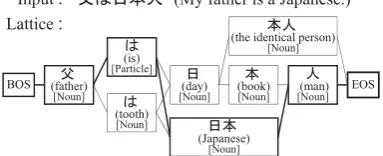
anal-ysis has successfully adopted lexicon-based ap-proaches for newspaper articles (Kurohashi et al., 1994; Asahara and Matsumoto, 2000; Kudo et al., 2004), in which an input sentence is trans-formed into a lattice of candidate words using a pre-defined lexicon, and an optimal path in the lat-tice is then selected. Figure 1 shows an example of a word lattice for morphological analysis and an optimal path. Since the transformation from a sentence into a word lattice basically depends on the pre-defined lexicon, the existence of unknown words, i.e., words that are not included in the pre-defined lexicon, is a major problem in Japanese morphological analysis.
There are two major approaches to this prob-lem: one is to augment the lexicon by acquiring unknown words from a corpus in advance (Mori and Nagao, 1996; Murawaki and Kurohashi, 2008) and the other is to introduce better un-known word processing to the morphological
ana-Input : “ῳ䈲ᣣᧄੱ”(My father is a Japanese.) Lattice:
ῳ
(father) [Noun]
䈲
(is) [Particle]
䈲
(tooth) [Noun]
ᣣ
(day) [Noun]
ᣣᧄ
(Japanese) [Noun]
ᧄ
(book) [Noun]
ੱ
(man) [Noun]
ᧄੱ
(the identical person) [Noun]
EOS BOS
Figure 1: Example of word lattice. The bold lines indicate the optimal path.
lyzer (Nagata, 1999; Uchimoto et al., 2001; Asa-hara and Matsumoto, 2004; Azuma et al., 2006; Nakagawa and Uchimoto, 2007). Although both approaches have their own advantages and should be exploited cooperatively, this paper focuses only on the latter approach.
Most previous work on this approach has aimed at developing a single general-purpose unknown word model. However, there are several types of unknown words, some of which can be easily dealt with by introducing simple derivation rules and unknown word patterns. In addition, as we will discuss in Section 2.3, the importance of un-known word processing varies across unun-known word types. In this paper, we aim to deal with unknown words that are considered important and can be dealt with using simple rules and patterns.
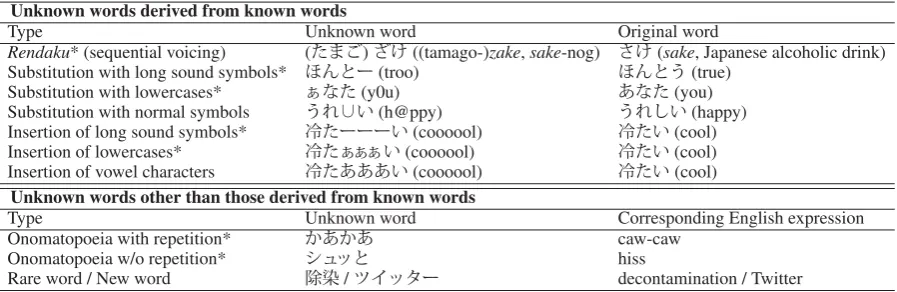
Table 1 lists several types of Japanese unknown words, some of which often appear in Web text. First, we broadly divide the unknown words into two classes: words derived from the words in the lexicon and the others. There are a lot of infor-mal spelling variations in Web text that are derived
from the words in the lexicon, such as “ ”
(y0u) instead of “ ” (you) and “ ”
(coooool) instead of “ ” (cool). The types of
derivation are limited, and thus most of them can be resolved by introducing derivation rules. Un-known words other than those derived from Un-known words are generally difficult to resolve using only simple rules, and the lexicon augmentation ap-proach would be better for them. However, this is not true for onomatopoeias. Although Japanese is rich in onomatopoeias and some of them do not
Unknown words derived from known words
Type Unknown word Original word
Rendaku* (sequential voicing) ( ) ((tamago-)zake,sake-nog) (sake, Japanese alcoholic drink)
Substitution with long sound symbols* (troo) (true)
Substitution with lowercases* (y0u) (you)
Substitution with normal symbols (h@ppy) (happy)
Insertion of long sound symbols* (coooool) (cool)
Insertion of lowercases* (coooool) (cool)
Insertion of vowel characters (coooool) (cool)
Unknown words other than those derived from known words
Type Unknown word Corresponding English expression
Onomatopoeia with repetition* caw-caw
Onomatopoeia w/o repetition* hiss
Rare word / New word / decontamination / Twitter
Table 1: Various types of Japanese unknown words. The ‘*’ denotes that this type is the target of this research. See Section 2.2 for more details.
appear in the lexicon, most of them follow several
patterns such as ‘ABAB,’ ‘A B ,’ and ‘AB ,’1
and they thus can be resolved by considering typi-cal patterns.
Therefore, in this paper, we introduce deriva-tion rules and onomatopoeia patterns to the un-known word processing in Japanese morphologi-cal analysis, and aim to resolve 1) unknown words derived from words in a pre-defined lexicon and 2) unknown onomatopoeias.
2 Background
2.1 Japanese morphological analysis
As mentioned earlier, lexicon-based approaches have been widely adopted for Japanese
morpho-logical analysis. In these approaches, we
as-sume that a lexicon, which lists a pair consisting of a word and its corresponding part-of-speech, is available. The process of traditional Japanese morphological analysis is as follows:
1. Build a lattice of words that represents all the candidate sequences of words from an input sentence.
2. Find an optimal path through the lattice.
Figure 1 in Section 1 shows an example of a
word lattice for the input sentence “ ”
(My father is Japanese), where a total of six can-didate paths are encoded and the optimal path is marked with bold lines. The lattice is mainly built with the words in the lexicon. Some heuristics are also used for dealing with unknown words, but in most cases, only a few simple heuristics are used. In fact, the three major Japanese morpho-logical analyzers, JUMAN (Kurohashi and Kawa-hara, 2005), ChaSen (Matsumoto et al., 2007),
1
‘A’ and ‘B’ denote Japanese characters, respectively.
and MeCab (Kudo, 2006), use only a few sim-ple heuristics based on the character types, such
as hiragana, katakana, and alphabets2, that regard
a character sequence consisting of the same char-acter type as a word candidate.
The optimal path is searched for based on the sum of the costs for the path. There are two types of costs: the cost for a candidate word and the cost for a pair of adjacent parts-of-speech. The cost for a word reflects the probability of the occur-rence of the word, and the connectivity cost of a pair of parts-of-speech reflects the probability of an adjacent occurrence of the pair. A greater cost means less probability. The costs are manually as-signed in JUMAN, and asas-signed by adopting su-pervised machine learning techniques in ChaSen and MeCab, while the algorithm to find the opti-mal path is the same, which is based on the Viterbi algorithm.
2.2 Types of unknown words
In this section, we detail the target unknown word types of this research.
Rendaku(sequential voicing) is a phenomenon
in Japanese morpho-phonology that voices the ini-tial consonant of the non-iniini-tial portion of a com-pound word. In the following example, the initial
consonant of the Japanese noun “ ” (sake,
al-coholic drink) is voiced into “ ” (zake):
(1) (eggnog)
ta ma go - za ke.
Since the expression “ ” (zake) is not
in-cluded in a standard lexicon, it is regarded as an
unknown word even if the original word “ ”
(sake) is included in the lexicon. There are a lot
2
Four different character types are used in Japanese:
of studies on rendaku in the field of phonetics and linguistics, and several conditions that prevent
rendaku are known, such as Lyman’s Law
(Ly-man, 1894), which stated that rendaku does not
occur when the second element of the compound contains a voiced obstruent. However, few
stud-ies dealt withrendakuin morphological analysis.
Since we have to check the adjacent word to
rec-ognizerendaku, it is difficult to deal withrendaku
using only the lexicon augmentation approach. Some characters are substituted by peculiar characters or symbols such as long sound
sym-bols, lowercasekanacharacters3, in informal text.
First, if there is little difference in pronunciation,
Japanese vowel characters ‘ ’(a), ‘ ’(i), ‘ ’(u),
‘ ’(e), and ‘ ’(o) are sometimes substituted by
long sound symbols ‘ ’ or ‘ .’ For example,
a vowel character ‘ ’ in the Japanese adjective
“ ” (hontou, true) is sometimes
substi-tuted by ‘ ’ and this adjective is written as “
” (hontoˆ, troo). We call this phenomenon
substitution with long sound symbols. As well
as long sound symbol substitution, somehiragana
characters such as ‘ ’(a), ‘ ’(i), ‘ ’(u), ‘ ’(e),
‘ ’(o), ‘ ’(wa), and ‘ ’(ka) are substituted by
their lowercases: ‘ ,’ ‘ ,’ ‘ ,’ ‘ ,’ ‘ ,’ ‘ ,’ and
‘ .’ We call this phenomenonsubstitution with
lowercases.
There are also other types of derivation, that is, some characters are inserted into a word that is included in the lexicon. In the following exam-ples, long sound symbols and lowercase are
in-serted into the Japanese adjective “ ” (cool).
(2) (Insertion of
(coooool) long sound symbols)
(3) (Insertion of lowercases)
(coooool)
In addition to the unknown words derived from words in the lexicon, there are several types of un-known words that contain rare words such as “
” (decontamination), new words such as “ ” (Twitter), and onomatopoeias such as “ ” (caw-caw). We can easily generate Japanese onomatopoeias that are not included in the lexi-con. Most of them follow several patterns, such as
‘ABAB,’ ‘A B ,’ and ‘AB ,’ and we classified
them into two types,onomatopoeias with
repeti-tionsuch as ‘ABAB,’ andonomatopoeias without
repetitionsuch as ‘A B .’
3
In this paper, we call the following characters lowercase:
‘ ,’ ‘ ,’ ‘ ,’ ‘ ,’ ‘ ,’ ‘ ,’ and ‘ .’
2.3 Importance of unknown word processing of each type
The importance of unknown word processing varies across unknown word types.
We give three example sentences (4), (5), and (6), which include the unknown words “
” (fluffy), “ ” (decontamination), and “
” (Twitter), respectively. In these examples, (a) denotes the desirable morphological analysis and (b) is the output of our baseline morphologi-cal analyzer, JUMAN version 5.1 (Kurohashi and Kawahara, 2005).
(4) Input:
(A soft and fluffy feeling to the touch.)
(a) / / / /
soft and fluffy of touch
(b) / / / /
soft but straw matting this touch
(5) Input:
(Decontamination is required.)
(a) / /
decontamination is required
(b) / / /
UNKNOWNWORD UNKNOWNWORD is required
(6) Input:
(I started Twitter yesterday.)
(a) / / /
yesterday Twitter ACC started
(b) / / /
yesterday UNKNOWNWORD ACC started
In the case of (4), the unknown word “ ” (fluffy) is divided into three parts by JU-MAN, and influences the analyses of the adjacent
function words, that is, “ ” (and) is changed to
“ ” (but) and “ ” (of) is changed to “ ”
(this), which will strongly affect the other NLP applications. The wide scope of influence is due
to the fact that “ ” consists ofhiragana
characters like most Japanese function words. On the other hand, in the case of (5), although the
unknown word “ ” (decontamination) is
di-vided into two parts by JUMAN, there is no in-fluence on the adjacent analyses. Moreover, in case of (6), although there is no lexical entry of
“ ” (Twitter), the segmentation is
cor-rect thanks to simple character-based heuristics for out-of-vocabulary (OOV) words.
These two unknown words do not contain
hi-raganacharacters, and thus, we think it is
impor-tant to resolve unknown words that contain
hira-gana. Since unknown words derived from words
hi-raganacharacters, we came to the conclusion that it is more important to resolve them than to re-solve rare words and new words that often consist ofkatakanaand Chinese characters.
2.4 Related work
Much work has been done on Japanese unknown word processing. Several approaches aimed to acquire unknown words from a corpus in ad-vance (Mori and Nagao, 1996; Murawaki and Kurohashi, 2008) and others aimed to introduce better unknown word model to morphological an-alyzer (Nagata, 1999; Uchimoto et al., 2001; Asa-hara and Matsumoto, 2004; Nakagawa and Uchi-moto, 2007). However, there are few works that focus on certain types of unknown words.
Kazama et al. (1999)’s work is one of them. Kazama et al. improved the morphological ana-lyzer JUMAN to deal with the informal expres-sions in online chat conversations. They focused on substitution and insertion, which are also the target of this paper. However, while our approach aims to develop heuristics to flexibly search the lexicon, they expanded the lexicon, and thus their approach cannot deal with an infinite number of
derivations, such as “ ,” and “
” for the original word “ .” In addition,
Ikeda et al. (2009) conducted experiments using Kazama et al.’s approach on 2,000,000 blogs, and reported that their approach made 37.2% of the sentences affected by their method worse. There-fore, we conjecture that their approach only bene-fits a text that is very similar to the text in online chat conversations.
Kacmarcik et al. (2000) exploited the normal-ization rules in advance of morphological analysis, and Ikeda et al. (2009) replaced peculiar expres-sions with formal expresexpres-sions after morphological analysis. In this research, we exploit the deriva-tion rules and onomatopoeia patterns in morpho-logical analysis. Owing to such a design, our
sys-tem can successfully deal withrendaku, which has
not been dealt with in the previous works.
UniDic dictionary (Den et al., 2008) handles or-thographic and phonological variations including
rendakuand informal ones. However, the number of possible variations is not restricted to a fixed number because we can insert any number of long sound symbols or lowercases into a word, and thus, all the variations cannot be covered by a dic-tionary. In addition, as mentioned above, since we
䈌
Figure 2: Example of a word lattice with new
nodes “ ,” “ ,” and “ .” The
broken lines indicate the added nodes and paths, and the bold lines indicate the optimal path.
have to take into account the adjacent word to
ac-curately recognizerendaku, the lexical knowledge
alone is not sufficient forrendakurecognition.
For languages other than Japanese, there is much work on text normalization that aims to han-dle informal expressions in social media (Beau-fort et al., 2010; Liu et al., 2012; Han et al., 2012). However, their target languages are seg-mented languages such as English and French, and thus they can focus only on normalization. On the other hand, since Japanese is an unsegmented lan-guage, we have to also consider the word segmen-tation task.
3 Proposed Method
3.1 Overview
We use the rule-based Japanese morphological an-alyzer JUMAN version 5.1 as our baseline system. Basically we only improve the method for build-ing a word lattice and do not change the process for finding an optimal path from the lattice. That is, our proposed system only adds new nodes to the word lattice built by the baseline system by exploiting the derivation rules and onomatopoeia patterns. If the new nodes and their costs are plau-sible, the conventional process for finding the op-timal path will select the path with added nodes.
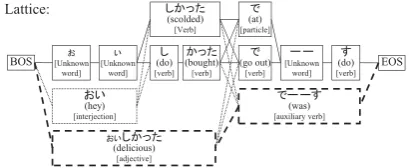
For example, if a sentence “
.” is input into the baseline system, it builds the word lattice that is described with solid lines in Figure 2. However, this lattice does not include
such expressions as “ ” and “ ”
since they are not included in the lexicon. Our proposed system transforms the informal expres-sions into their standard expresexpres-sions such as “
” (delicious) and “ ” (was) by
3.2 Resolution of unknown words derived from words in the lexicon
We deal with five types of unknown words that
are derived from words in the lexicon: rendaku,
substitution with long sound symbols, substitution with lowercases, insertion of long sound symbols, and insertion of lowercases. Here, we describe how to add new nodes into the word lattice.
Rendaku The procedure to add unvoiced nodes
to deal withrendakudiffers from the others. Since
only the initial consonant of a word is voiced by
rendaku, there is at most one possible voiced en-try for each word in the lexicon. Hence, we add the voiced entries into the trie-based lexicon in ad-vance if the original word does not satisfy any
con-ditions that preventrendakusuch as Lyman’s Law.
For example, our system creates the entry “
” (zake) from the original word “ ” (sake),
and adds it into the lexicon. When the system re-trieves words that start from the fourth character in
the example (1) in Section 2.2, “ ,” the
added entry “ ” (zake) is retrieved. Since
ren-dakuoccurs for the initial consonant of the
non-initial portion of a compound word, our system adds the retrieved word only when it is the non-initial portion of a compound word.
Substitution with long sound symbols and low-ercases In order to cope with substitution with long sound symbols and lowercases, our system transforms the input text into normalized strings by using simple rules. These rules substitute a long sound symbol with one of the vowel
char-acters: ‘ ,’ ‘ ,’ ‘ ,’ ‘ ,’ and ‘ ,’ that
mini-mizes the difference in pronunciation. These rules also substitute lowercase characters with the cor-responding uppercase characters. For example, if
the sentence “ .” (It is trooly
DElicious.) is input, the nodes generated from
the normalized string “ .” are
added to the word lattice along with the nodes gen-erated from the original string.
Insertion of long sound symbols and lowercases
In order to cope with the insertion of long sound symbols and lowercases, our system transforms the input text into a normalized string using sim-ple rules. These rules delete long sound symbols and lowercase characters that are considered to be inserted to prolong the original word pronuncia-tion. For example, if the sentence “
.” (It iiisss coooool.) is input, the nodes generated from the normalized string “
Pattern Example Transliteration
ABAB tayu-tayu
ABCABC pokka-pokka
ABCDABCD chorori-chorori
Table 2: Onomatopoeia patterns with repetition
and their examples. ‘A,’ ‘B,’ ‘C,’ and ‘D’ denote
either hiragana or katakana. We consider only
repetitions of two to four characters.
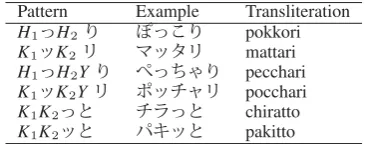
Pattern Example Transliteration
H1 H2 pokkori
K1 K2 mattari
H1 H2Y pecchari
K1 K2Y pocchari
K1K2 chiratto
K1K2 pakitto
Table 3: Onomatopoeia patterns without repetition
and their examples. ‘H,’ denotes thehiragana, ‘K’
denotes thekatakana, and ‘Y’ denotes the
palatal-ized consonants such as ‘ .’
.” are added into the word lattice. We do not consider partly deleted strings such as “
.” and the combination of substi-tution and insertion to avoid combinatorial explo-sion. Therefore, our system cannot deal with un-known words generated by both insertion and sub-stitution, but such words are rare in practice.
Costs for additional nodes Our system imposes small additional costs to the node generated from the normalized string to give priority to the nodes generated from the original string. We set these costs by using a small development data set.
3.3 Resolution of unknown onomatopoeias
There are many onomatopoeias in Japanese. In particular, there are a lot of unfamiliar ono-matopoeias in Web text. Most onoono-matopoeias fol-low limited patterns, and we thus can easily pro-duce new onomatopoeias that follow these pat-terns. Hence, it seems more reasonable to rec-ognize unknown onomatopoeias by exploiting the onomatopoeia patterns than by manually adding lexical entries for them.
com-,QSXW ³䛯䜖䛯䜖䛸ᦂ䜜䜛´6ZD\LQJXQVWHDGLO\
Input : “䈇䈒䉌䈒䉌䈇䋿”(Approximately how much?) Lattice:
Figure 3: Examples of a word lattice with new nodes of onomatopoeia. The broken lines indicate the added nodes and paths, and the bold lines in-dicate the optimal path. While the optimal path includes the added node in the upper example, it does not in the lower example.
pared with trie search. However, the number of potential entries of onomatopoeias without repeti-tion is not so large, and thus our system adds all possible entries of onomatopoeias without repeti-tion into the trie-based lexicon in advance.
4 Experiments
4.1 Setting
We used 100,000 Japanese sentences to evalu-ate our approach. These sentences were obtained from an open search engine infrastructure TSUB-AKI (Shinzato et al., 2008), which included at
least onehiraganacharacter and consisted of more
than twenty characters
We first estimated the recall. Since it is too costly to create a set of data with all unknown words annotated, we made a set of data with only our target unknown words annotated. We could apply a set of regular expressions to reduce the unknown word candidates by limiting the type of unknown words. We manually annotated 100 ex-pressions for each type, and estimated the recall.
A high recall, however, does not always imply that the proposed system performs well. It might be possible that our proposed method gives bad effects on non-target words. Therefore, we also compared the whole analysis with and without the
rules/patterns from the following seven aspects:4
4
There are two major reasons why we did not use the pre-cision, recall and F-measure metrics to evaluate the overall performance. The first reason is that to create a large set of annotated data is too costly. The second reason, which is more essential, is that there is no clear definition of Japanese
1. The number of positive changes for 100
dif-ferent outputs:P100D.
2. The number of negative changes for 100
dif-ferent outputs:N100D.
3. The number of different outputs for 100,000
sentences: D100kS.
4. The estimated number of positive changes for
100,000 sentences: P100∗ kS.
5. The estimated number of negative changes
for 100,000 sentences:N100∗ kS.
6. The relative increase of the nodes:Nodeinc..
7. The relative loss in speed:SPloss.
Different outputs indicate cases in which the systems with and without rules/patterns output a different result. First, for each type of rule/pattern, we extracted 100 different outputs and manually classified them into three categories: the system with the rules/patterns was better (positive), the system without the rules/patterns was better (neg-ative), and both outputs were undesirable (others). When these outputs differed in word segmenta-tion, we only compared the segmentation but did not take into account the POS tags. On the other side, when these outputs did not differ in word seg-mentation, we compared the POS tags. Tables 6-10 list several examples. For example, “
” (can feel amused) in Table 6 should be ana-lyzed as one word, but both systems with and
with-out rules forrendakudivided it into several parts,
and such a case is labeled as others.
We counted the number of different outputs for 100,000 sentences. We then calculated the esti-mated numbers of positive/negative changes for the sentences by using the equations:
X100∗ kS=D100kS×X100D/100.
We also counted the number of created nodes in lattice and calculated the relative increase, which would affect the time for finding the optimal path from the word lattice, and measured the analysis time and calculated the relative loss in speed.
4.2 Results and Discussion
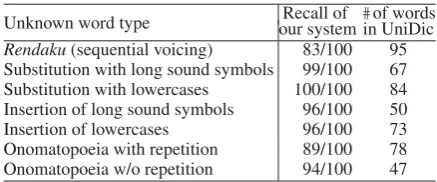
Table 4 lists the recall of our system for each un-known word type with the number of words that are covered by the UniDic dictionary. Note that while our system’s recall denotes the ratio of ac-tually recognized words, the coverage of UniDic
Unknown word type our system in UniDicRecall of #of words
Rendaku(sequential voicing) 83/100 95
Substitution with long sound symbols 99/100 67
Substitution with lowercases 100/100 84
Insertion of long sound symbols 96/100 50
Insertion of lowercases 96/100 73
Onomatopoeia with repetition 89/100 78
Onomatopoeia w/o repetition 94/100 47
Table 4: Recall of our system and the coverage of UniDic.
only denotes the number of words included in the dictionary, which can be interpreted as the up-per bound of the system based on UniDic. We can confirm our system achieved high recall for each type of unknown word. Since UniDic
cov-ered 95% of unknown words ofrendakutype, we
would be able to improve therendakurecognition
by incorporating UniDic and our approach that takes into account the adjacent word. Except for
rendaku, our system’s recall was higher than the coverage of UniDic, which confirms the effective-ness of our method.
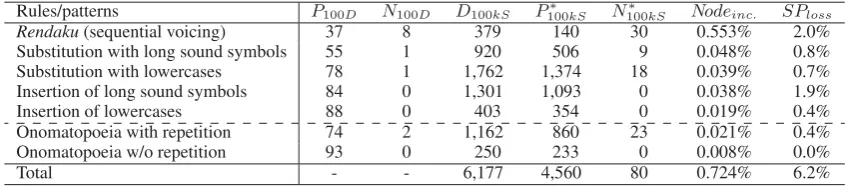
Table 5 summarizes the comparison between the analyses with and without the rules/patterns. In short, our method successfully recognized all types of unknown words with few bad effects. By introducing all the derivation rules and ono-matopoeia patterns, there are 4,560 improvements for 100,000 sentences with only 80 deteriorations and a 6.2% loss in speed. In particular, the deriva-tion rules of inserderiva-tion and substituderiva-tion of long sound symbols and lowercases produced 3,327 improvements for 100,000 sentences at high recall values (see Table 4) with only 27 deteriorations and a 3.8% loss in speed. We confirmed from these results that our approaches are very effec-tive for unknown words in informal text. Since the number of newly added nodes was small, the speed loss is considered to be derived not from the optimal path searching phase but from the lattice building phase.
Table 6 lists some examples of the changed
out-puts by introducing the derivation rules for
ren-daku. As listed in Table 4 and 5, therendaku
pro-cessing produced more negative changes and the lower recall value compared with the other types.
This indicates that rendaku processing is more
difficult than resolving informal expressions with long sound symbols or lowercases. Since long sound symbols and lowercases rarely appear in the lexicon, there are few likely candidates other than the correct analysis. On the other hand, voiced characters often appear in the lexicon and formal
Our system Baseline Gold standard
Positive
Input: (clothespin)
/ / / / /
Negative
Input: (the man without)
/ / / / /
Others
Input: (can feel amused)
/ / / / / /
Table 6: Examples of different outputs by
intro-ducing the derivation rule forrendaku. The ‘/’
de-notes the boundary between words in the corre-sponding analysis, and the bold font indicates the correct output, that is, the output is the same as the gold standard.
Our approach Baseline Gold standard
Positive (insertion)
Input: (a bitter experiment)
/ / / / /
Positive (substitution)
Input: (congratulations)
/ / /
Negative (substitution)
Input: OK (It’s OK)
OK/ / / OK/ / / / OK/ /
Others (insertion)
Input: (very luxury)
/ / / /
Table 7: Examples of different outputs by intro-ducing derivation rules for long sound symbol sub-stitution and insertion.
text, and thus, there are many likely candidates. Table 7 lists some examples of the changed out-put by introducing the derivation rules for informal spelling with long sound symbols. We labeled the
change of the analysis “OK ” (It’s OK)
as negative because the baseline system correctly
tagged the POS of “ ” unlike our proposed
sys-tem, but the baseline system could not also cor-rectly resolve the entire phrase. There was no dif-ferent output that our proposed system could not resolve but the baseline system could fully resolve. Table 8 lists some examples of the changed out-puts by introducing the derivation rules for in-formal spelling with lowercase. We labeled the
change of the analysis “ ” (Yumi’s
bedclothes) as negative because the baseline sys-tem correctly segmented the postpositional
parti-cle “ ” unlike our proposed system. Again for
Rules/patterns P100D N100D D100kS P100∗ kS N100∗ kS Nodeinc. SPloss
Rendaku(sequential voicing) 37 8 379 140 30 0.553% 2.0%
Substitution with long sound symbols 55 1 920 506 9 0.048% 0.8%
Substitution with lowercases 78 1 1,762 1,374 18 0.039% 0.7%
Insertion of long sound symbols 84 0 1,301 1,093 0 0.038% 1.9%
Insertion of lowercases 88 0 403 354 0 0.019% 0.4%
Onomatopoeia with repetition 74 2 1,162 860 23 0.021% 0.4%
Onomatopoeia w/o repetition 93 0 250 233 0 0.008% 0.0%
Total - - 6,177 4,560 80 0.724% 6.2%
Table 5: Comparison between the analyses with and without the rules/patterns.
Our system Baseline Gold standard
Positive (insertion)
Input: (please publish)
/ / / /
Positive (substitution)
Input: (big brother)
/ / / / /
Negative (substitution)
Input: (Yumi’s bedclothes)
/ / / / / / /
Others (insertion)
Input: (lonely)
/ / /
Table 8: Examples of different outputs by intro-ducing derivation rules for lowercase substitution and insertion.
Our system Baseline Gold standard
Positive
Input: (wavy)
/ / / / / /
Negative
Input: (wow wow)
/ /
Table 9: Examples of different outputs by intro-ducing onomatopoeia patterns with repetition.
Our system Baseline Gold standard
Positive
Input: (flat)
/ /
Input: (at a glance)
/
Table 10: Examples of different outputs by intro-ducing onomatopoeia patterns without repetition.
Table 9 lists some examples of the changed out-puts by introducing onomatopoeia patterns with repetition. Our system recognized unknown ono-matopoeias with repetition at a recall of 89%,
which is not very high. However, since there
were several repetition expressions other than
ono-matopoeias, such as “ / ” (wow wow) as
shown in Table 9, we cannot lessen the cost for onomatopoeias with repetition.
Table 10 lists some examples of the changed outputs by introducing onomatopoeia patterns without repetition. Our system recognized the un-known onomatopoeias without repetition at a re-call of 94% and did not output anything worse than
Type # of types # of tokens
Covered by Murawaki’s Lexicon 13 51
Covered by Wikipedia 68 407
Covered by our method 15 105
Others 22 82
Total 118 645
Table 11: Classification results of unknown words that occur more than two times in KNB corpus.
the baseline output with no loss in speed.
In order to approximate the practical coverage of our method, we classified unknown words that occur more than two times in the Kyoto
Univer-sity and NTT Blog (KNB) corpus5into four types:
words that are covered by the lexicon created by Murawaki and Kurohashi (2008) (Murawaki’s Lexicon), words that are not covered by Mu-rawaki’s Lexicon but have entries in Wikipedia, words that are covered only by our method, and the others. Table 11 shows the results. There are total 645 tokens of unknown words that oc-cur more that two times in KNB corpus, 105 of which are newly covered by our method. Since the number of tokens that are covered by neither Murawaki’s Lexicon nor Wikipedia is only 187, we can say that the coverage of our method is not trivial.
5 Conclusion
We presented a simple approach to unknown word processing in Japanese morphological analysis. Our approach introduced derivation rules and ono-matopoeia patterns, and correctly recognized cer-tain types of unknown words. Our experimen-tal results on Web text revealed that our approach could recognize about 4,500 unknown words for 100,000 Web sentences with only 80 harmful side effects and a 6% loss in speed. We plan to ap-ply our approach to machine learning-based mor-phological analyzers, such as MeCab, with Uni-Dic dictionary, which handles orthographic and phonological variations, in future work.
5
References
Masayuki Asahara and Yuji Matsumoto. 2000. Ex-tended models and tools for high-performance part-of-speech tagger. In Proc. of COLING’00, pages 21–27.
Masayuki Asahara and Yuji Matsumoto. 2004. Japanese unknown word identification by character-based chunking. In Proc. of COLING’04, pages 459–465.
Ai Azuma, Masayuki Asahara, and Yuji Matsumoto. 2006. Japanese unknown word processing using conditional random fields (in Japanese). InProc. of IPSJ SIG Notes NL-173-11, pages 67–74.
Richard Beaufort, Sophie Roekhaut, Louise-Am´elie Cougnon, and C´edrick Fairon. 2010. A hybrid rule/model-based finite-state framework for normal-izing sms messages. InProc. of ACL’10, pages 770– 779.
Yasuharu Den, Junpei Nakamura, Toshinobu Ogiso, and Hideki Ogura. 2008. A proper approach to Japanese morphological analysis: Dictionary, model, and evaluation. InProc. of LREC’08, pages 1019–1024.
Bo Han, Paul Cook, and Timothy Baldwin. 2012. Automatically constructing a normalisation dictio-nary for microblogs. InProc.of EMNLP-CoNLL’12, pages 421–432.
Kazushi Ikeda, Tadashi Yanagihara, Kazunori Mat-sumoto, and Yasuhiro Takishima. 2009. Unsuper-vised text normalization approach for morphological analysis of blog documents. InProc. of Australasian Conference on Artificial Intelligence, pages 401– 411.
Gary Kacmarcik, Chris Brockett, and Hisami Suzuki. 2000. Robust segmentation of japanese text into a lattice for parsing. InProc. of COLING’00, pages 390–396.
Jun’ichi Kazama, Yutaka Mitsuishi, Makino Takaki, Kentaro Torisawa, Koich Matsuda, and Jun’ichi Tsujii. 1999. Morphological analysis for japanese web chat (in Japanese). InProc. of 5th Annual Meet-ings of the Japanese Association for Natural Lan-guage Processing, pages 509–512.
Taku Kudo, Kaoru Yamamoto, and Yuji Matsumoto. 2004. Applying conditional random fields to japanese morphological analysis. In Proc. of EMNLP’04, pages 230–237.
Taku Kudo, 2006. MeCab: Yet Another
Part-of-Speech and Morphological Analyzer.
http://mecab.sourceforge.jp/.
Sadao Kurohashi and Daisuke Kawahara. 2005. Japanese morphological analysis system JUMAN version 5.1 manual.
Sadao Kurohashi, Toshihisa Nakamura, Yuji Mat-sumoto, , and Makoto Nagao. 1994. Improvements of Japanese morphological analyzer JUMAN. In Proc. of The International Workshop on Sharable Natural Language Resources, pages 22–38.
Fei Liu, Fuliang Weng, and Xiao Jiang. 2012. A broad-coverage normalization system for social me-dia language. InProc. of ACL’12, pages 1035–1044.
Benjamin Smith Lyman. 1894. The change from surd to sonant in Japanese compounds. Philadelphia : Oriental Club of Philadelphia.
Yuji Matsumoto, Kazuma Takaoka, and Masayuki Asa-hara. 2007. Chasen: Morphological analyzer ver-sion 2.4.0 user’s manual.
Shinsuke Mori and Makoto Nagao. 1996. Word ex-traction from corpora and its part-of-speech estima-tion using distribuestima-tional analysis. InProc. of COL-ING’96, pages 1119–1122.
Yugo Murawaki and Sadao Kurohashi. 2008. Online acquisition of Japanese unknown morphemes using morphological constraints. InProc. of EMNLP’08, pages 429–437.
Masaaki Nagata. 1999. A part of speech estimation method for japanese unknown words using a statis-tical model of morphology and context. InProc. of ACL’99, pages 277–284.
Tetsuji Nakagawa and Kiyotaka Uchimoto. 2007. A hybrid approach to word segmentation and pos tag-ging. InProc. of ACL’07, pages 217–220.
Keiji Shinzato, Tomohide Shibata, Daisuke Kawahara, Chikara Hashimoto, and Sadao Kurohashi. 2008. Tsubaki: An open search engine infrastructure for developing new information access methodology. In Proc. of IJCNLP’08, pages 189–196.