Selective Decoding for Cross-lingual Open Information Extraction
Sheng Zhang Johns Hopkins University
Kevin Duh
Johns Hopkins University [email protected]
Benjamin Van Durme Johns Hopkins University [email protected]
Abstract
Cross-lingual open information extrac-tion is the task of distilling facts from the source language into representations in the target language. We propose a novel encoder-decoder model for this problem. It employs a novel selective de-coding mechanism, which explicitly mod-els the sequence labeling process as well as the sequence generation process on the decoder side. Compared to a stan-dard encoder-decoder model, selective de-coding significantly increases the perfor-mance on a Chinese-English cross-lingual open IE dataset by 3.87-4.49 BLEU and 1.91-5.92 F1. We also extend our
ap-proach to low-resource scenarios, and gain promising improvement.
1 Introduction
Cross-lingual open information extraction is de-fined as the task of extracting facts from the source language (e.g., Chinese text in Fig.1(a)) and rep-resenting them in the target language (e.g. English predicate-argument information in Fig.1(c))1. It is
a challenging task and of great importance to solve the cross-lingual portability issues of various NLP systems which are in the support of open informa-tion extracinforma-tion (Sudo et al., 2004). Additionally, there is often a great demand for rapid access to information across languages, especially when a large-scale incident occurs (Lu et al.,2016).
Conventional solutions decompose the task as a pipeline of machine translation followed by 1The predicate-argument information is normally
repre-sented by relation tuples. Here, we use a richer representation (i.e., a tree structure) adopted by PredPatt (White et al.,2016), a lightweight tool for identifying predicate-argument infor-mation, available at https://github.com/hltcoe/ PredPatt.
P [ Soldiers
A
started P
mortars A
] P P
[Soldiers A
firing P
] P
[(Soldiers:ah) started:ph [(Soldiers:ah) firing:ph(mortars:ah )]]
.
(a)
(d)
(e)
started
firing Soldiers
Soldiers mortars
ARG ARG
ARG ARG
SOMETHING
(c) (b)
Figure 1: Example of cross-lingual open IE: Chinese input text (a), English translation (b), English predicate-argument information (c), lin-earized PredPatt output (d) and output with sep-arated predicate and argument labels (e).
open information extraction (or vice versa), which causes a deviation since machine translation at-taches equal importance to adequacy and fluency of the intermediate translation results (Snover et al.,2009), whereas the final goal focuses more on extracting correct predicates and arguments.
RecentlyZhang et al.(2017a) proposes an end-to-end solution that outperforms the conventional pipeline solutions. They recast cross-lingual open IE as a sequence-to-sequence learning problem by converting the target facts in the tree struc-ture (Fig. 1(c)) into a linear form called lin-earized PredPatt2 (Fig. 1(d)), and employ a
stan-2Linearized PredPatt is converted from the PredPatt tree
structure by taking an in-order traversal of every node in the tree. SeeZhang et al.(2017a) for details.
dard encoder-decoder model to address the prob-lem (from (a) to (d) in Fig.1). In the linearized PredPatt (Fig. 1(d)), special labels are appended to tokens as type indications. Brackets and paren-theses have to be inserted to delimit predicate and argument spans. Such a workaround inevitably ex-pands the vocabulary space and increases the bur-dens on the decoder, which is not ideal for sparse data scenarios and limits the overall performance. In this paper, we reformulate cross-lingual open IE as a sequence generation and labeling problem (from (a) to (e) in Fig.1) by separating the predi-cate and argument labels from the target linearized PredPatt, and removing unnecessary parentheses. We propose a novel encoder-decoder model which employs a selective decoding mechanism to ex-plicitly model the sequence labeling as well as the sequence generation process. The new model sub-stantially reduces the vocabulary space, eases the burden on the decoder, and leads to a significant gain of performance. And the natural of the selec-tive decoding mechanism enables a joint training strategy that optimizes sequence generation and labeling simultaneously. In addition, we introduce an adapted beam search algorithm to further im-prove the prediction quality.
Experimental results demonstrate that our model employing the selective decoding mecha-nism significantly outperforms the previous end-to-end solution not only on a Chinese-English dataset, but also in low-resource cross-lingual open IE scenarios.
2 Problem Formulation
Our goal is to learn a model which directly maps a sentence inputX in the source language into a sentenceY in the target language, and simultane-ously labels each token inY with type information
T. For cross-lingual open IE, the types are pred-icateandargument. It is important to label types because they are used to annotate predicates and arguments in the generated tokens. Formally, we regard the input as a sequenceX =x1,· · · , x|X|, and the output as two sequences (Y, T): (1) the sentence in target languageY =y1,· · ·, y|Y|, and (2) the type informationT = t1,· · · , t|Y|, where
ti ∈ T is the label for the tokenyi, and |X|and
|Y|are the length of the sequence X and Y re-spectively. Our model mapsXinto(Y, T)using a conditional probability which is decomposed as:
Soldiers started
Soldiers firing
mortars <eos>
s0
<bos> Soldiers started Soldiers firing mortars Predicate
Decoder
Argument Decoder
P
A A P A P
[image:2.595.309.528.63.190.2]Selector
Figure 2: Selective decoding process. (Brackets and attention layers are omitted.)
P(Y, T |X) =Y|Y|
i=1P(yi, ti|y<i, t<i, X)
=
|Y| Y
i=1
P(yi |y<i, t≤i, X)P(ti|y<i, t<i, X) (1)
wherey<i =y1· · ·yi−1andt≤i =t1· · ·ti.
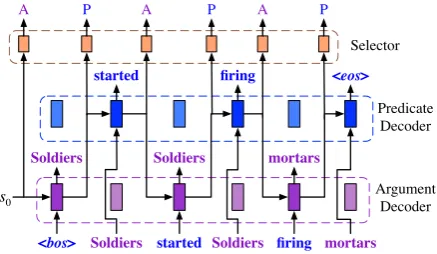
Equation (1) can be interpreted as at each de-coding time step, the model first decides which type (label) of tokens to generate, and then gen-erates a token for that type.
3 Proposed Model
To learn the factored conditional probabilities as shown in Equation (1), we propose a novel encoder-decoder model with the selective decod-ing mechanism: on the encoder side, an input sen-tence X is encoded into vector representations; on the decoder side, the selective decoding mech-anism employs multiple decoders each of which learns the conditional probability of decoding a specific type of token (i.e., P(yi | y<i, t≤i, X)), and a selector learning to decide which type of de-coder to use (i.e.,P(ti |y<i, t<i, X)) at each de-coding time step.
Fig.2illustrates the selective decoding process for the example shown in Fig.1(e). s0 is the
ini-tial decoder hidden state iniini-tialized by the last hid-den state of the encoder. Special tokenshbosiand
heosi are added to the beginning and the end of the sequence to indicate the start and the finish of decoding. The connections at each decoding time step are dynamically changing according to the de-cision of the selector. Specifically, at the decoding time stepi, firstly the selector on the top decides to use which type of decoderDti ∈ {DP, DA}3, and
3D
then the decoder Dti decodes the tokenyi which
is naturally given the labelti.
In addition to distinguish between labels, the multiple decoders used by the selective decoding mechanism has two prominent advantages over the single standard RNN decoder: (1) Multiple de-coders learn different conditional probability dis-tributions for predicate and argument generation respectively. For instance, given the same input to-ken ”wanted”, the predicate decoder would like to next generate tokens such as ”to” and ”by” which starts a prepositional phrase, whereas the argu-ment decoder would be in favor of tokens such as ”a” and ”him” which starts a direct object. (2) Multiple decoders reduce the decoder vocabulary size, which eases the burden of sequence genera-tion. Moreover, we propose an efficient architec-ture that supports batch training of the model. The details of the architecture are described in the De-coder with Selective Decodingsection.
3.1 Encoder
The encoder employs a bi-directional recurrent neural network (Schuster and Paliwal,1997) to en-code the input sequenceX =x1,· · · , x|X|into a sequence of hidden statesh=h1,· · · , h|X|. Each hidden state hi in his a concatenation of a left-to-right hidden state −→hi ∈ Rn and a right-to-left hidden state←h−i ∈Rn,
hi= "←−
hi
− →
hi #
=
"←−
f(xi,←−hi+1) −
→
f(xi,−→hi−1)
#
,
where ←−f and −→f are two L-layer stacked LSTMs units (Hochreiter and Schmidhuber, 1997).
3.2 Decoder with Selective Decoding
Unlike the single standard RNN decoder (Bah-danau et al., 2014), which recurrently uses the same decoder to generate tokens, our model dy-namically selects different decoders at each decod-ing time step to generate tokens (Fig. 2). How-ever, since the decoding path may be different for each input sequenceX, directly running the selec-tive decoding process suffers from a key technical issue: it does not support batched computation, which makes them slow and unwieldy for large-scale NLP tasks (Bowman et al.,2016).
To address this issue, we introduce a general de-coding architecture that is applicable to all selec-tive decoding processes. The detailed connection
si-1 mi
yi-1
yi-1
yi mi[P]
mi[A]
mi[P]
mi[A]
si
Predicate LSTMs
Argument LSTMs Selector Vector Transfer
Copy
Concatenate
[image:3.595.327.508.61.188.2]Pointwise Add Legend
Figure 3: Detailed connection at a decoding step. (Attention layers are ommited.)
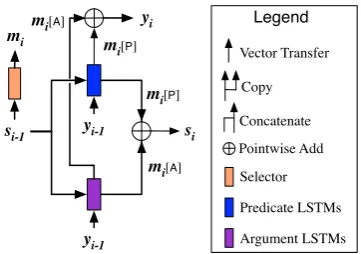
in the architecture is shown in Fig.3. At each de-coding time step, the model feeds the input token and the previous hidden state to all types of de-coders, and use a mask vector created by the selec-tor to select the decoder output to generate tokens and update the hidden state.
Formally, letsi ∈Rndenote the hidden state at decoding time stepi. The last left-to-right hidden state −→h|X| from the encoder is used to initialize the first hidden states0in the decoder.
Selector: At the decoding time stepi, given the sequence of encoder hidden stateshand the pre-vious decoder hidden statesi−1, the selector
com-putes the conditional probability ofti(i.e., the type of decoder to use) as:
P(ti |y<i, t<i, X) =g(ti, si−1,h) =softmax(Uosi−1+Coci−1+bo)[ti], (2)
whereUo ∈ R|T |×n,Co ∈R|T |×nandbo ∈ R|T | are weight matrices and bias.4[t
i]indexes the ele-ment of a vector that corresponds to the typeti.
Attention: The context vector ci−1 captures
the attention to the encoder side (Bahdanau et al., 2014; Luong et al., 2015), computed as a weighted sum of encoder hidden states: ci−1 =
P|X|
j a(i−1)jhj. The weighta(i−1)j is computed by:
a(i−1)j = P|X|exp (score(si−1, hj)) j0=1exp (score(si−1, hj0))
, (3)
where score(si−1, hj) =si−| 1Wahj, andWa∈ Rn×2nis a transform matrix.
Hidden State Update: According to the condi-tional probabilityP(ti |y<i, t<i, X), a mask vec-tor mi is created, which is used to mask out the 4|T |is the number of token types. In the example shown
decoders’ hidden states,
mi[ti] =
1,ifti=argmax t0
i∈T
P(t0i|y<i,t<i,X)
0,otherwise
Then the hidden state si for the decoding time stepiis computed by:
si= X
ti∈T
mi[ti]fti(yi−1, si−1, ci)
whereciis the context vector capturing the atten-tion, computed in the same way as Equation (3).
fti is L-layer stacked LSTMs for the type ti.
In Fig.3, there is anL-layer stacked LSTMs for generating predicate tokens fP, and another L
-layer stacked LSTMs for generating argument to-kensfA. They have untied parameters.
Token Generation: The conditional probability of the tokenyiwith the typetiis defined as:
P(yi |y<i, t≤i, X) =g0(yi−1, si−1,h,mi)
=softmax(Uo0si+Co0ci+b0o)[yi], (4) whereU0
o ∈ R|V|×n,Co0 ∈ R|V|×n andbo ∈ R|V| are weight matrices and bias.5
3.3 Training
In the training procedure, our optimization objec-tive is to minimize the negaobjec-tive log-likelihood of the sequence Y and its type information T given the input sequence X over the training data, de-fined as:
minimize− X (X,Y,T)∈D
logP(Y, T |X)
According to Equation (1), the log-likelihood
logP(Y, T |X)can be decomposed as: |Y|
X
i=1
[logP(yi|y<i,t≤i,X)+logP(ti|y<i,t<i,X)],
whereP(yi|y<i,t≤i,X)models the sequence gen-eration process, andP(ti|y<i,t<i,X)models the sequence labeling process. They are computed by Equations (4) and (2) respectively. The decom-position of the log-likelihood into these two parts enables a joint optimization for the sequence gen-eration and labeling process simultaneously.
We use the Adam optimizer (Kingma and Ba, 2014) and mini-batch gradient to solve this opti-mization problem. To prevent overfitting, we ap-ply dropout operators (Srivastava et al., 2014) to non-recurrent connections between LSTM layers.
5|V|is the vocabulary size of the target language.
3.4 Inference
In the inference procedure, we predict the se-quenceY and its type informationT for an input sequenceXaccording to:
( ˆY ,Tˆ) = argmax
(Y0,T0)∈V|Y0|×T|Y0|P(Y
0, T0 |X)
V|Y0|
× T|Y0|
is the set of all possible (Y0, T0) pairs. And( ˆY ,Tˆ)can be directly converted to the form of linearized PredPatt which is used for eval-uation.
However, it is impractical to iterate over all these (Y0, T0) pairs during inference: here, we use beam search to generate tokens and labels as shown in Algorithm1.
Algorithm 1Beam search for selective decoding
Input: X- sequence in the source language
Output: (Y, T)- sequence in the target language and its type information
1: step←0 2: b←beam size
3: l←max decoder length 4: fw hid←Encoder(X) 5: TERMINATED STATES.init(∅) 6: start state←State(hbosi, fw hid) 7: BEAM.init({start state})
8: whileBEAM6=∅andstep < ldo 9: step←step+ 1
10: ACTIVE STATES.init(∅) 11: forstateinBEAMdo 12: .Select the decoder. 13: t←Selector(state) 14: .Generate the next token.
15: states←Decodert(state)
16: .Update the active states. 17: ACTIVE STATES.update(states)
18: BEAM.clean()
19: .Get the top-kcandidates.
20: forstateintop(b,ACTIVE STATES)do 21: ifstate.decoded token=heosithen
22: b←b−1
23: .Move out the terminated states. 24: TERMINATED STATES.add(state)
25: else
26: .Update the beam.
27: BEAM.add(state)
The beam is used to increase the search space for the sequenceY in the target language. At each decoding time step, we first greedily select the type of decoder, and then generate candidate to-kens from the selected decoder to update the beam. When the special tokenheosiis generated, we re-move the candidate sequence from the beam.
4 Related Work
The model we propose in this paper is adapted from the RNN encoder-decoder architectures which have been successfully applied to a wide range of NLP tasks such as machine trans-lation (Kalchbrenner and Blunsom, 2013; Cho et al., 2014; Bahdanau et al., 2014), image de-scription generation (Karpathy and Fei-Fei,2015; Vinyals et al.,2015b), syntactic parsing (Vinyals et al.,2015a), question answering (Hermann et al., 2015), summarization (Rush et al.,2015), and se-mantic parsing (Dong and Lapata,2016).
As a novel variation of the encoder-decoder ar-chitecture, our model provides a general solution to tasks involving translation and labeling. cross-lingual open IE is an example of this kind of task. The end-to-end solution proposed byZhang et al. (2017a) used a vanilla attention-based encoder-decoder model to achieve results which outper-form the traditional pipeline solutions. Compared to the vanilla encoder-decoder model, our model splits the joint task into two concurrent tasks (i.e., labeling and translating), which are jointly learnt by a selector and multiple decoders. This eases the burden of the decoder by shifting the labeling task to the selector. As a result, our model requires a smaller vocabulary for the target language.
The selective decoding mechanism can be viewed as having different types of decoders stacking together and adding a hard gate to the RNN unit, through which the bit of information will be either totally kept or dropped. It may seem redundant since the RNN gated unit already has the sophisticated gating mechanism such as the GRU unit (Cho et al., 2014) and the LSTM unit (Hochreiter and Schmidhuber, 1997). How-ever, we think that the selective decoding mecha-nism is a complement to the gated unit: rather than having a soft pointwise control, the selective de-coding mechanism adopts a hard vectorwise con-trol to explicitly select a certain type of informa-tion which corresponds to the predicate or the ar-gument by keeping one and dropping the others,
whereas the GRU/LSTM gated unit itself learns to memorize long short-term dependencies. Simi-lar mechanisms have been used in neural machine translating (Tu et al., 2016) and image caption generation (Xu et al., 2015) to explicitly control the influence from source or target contexts. The experiments in § 5 also confirms our point: our model using the selective decoding mechanism significantly improves the performance, compared to the standard encoder-decoder model.
Regarding to open IE systems for generat-ing traingenerat-ing data, PredPatt has shown promis-ing performance on large-scale open IE bench-marks (Zhang et al., 2017c). Compared to other existing open IE systems (Banko et al., 2007; Fader et al., 2011; Angeli et al., 2015), PredPatt uses manual language-agnostic patterns on UD, which makes it a well-founded component across languages. Additionally, the underlying structure constructed by PredPatt has been shown to be a well-formed syntax-semantics interface (Zhang et al.,2017b).
5 Experiments
We describe the hyper-parameters setting for ex-periments, evaluate our approach in two kinds of scenarios, and compare the results of our approach and the other comparing approaches.
5.1 Hyper-parameters
On the encoder side, both the forward RNN and the backward RNN have 2-layer stacked LSTMs with 500 hidden units. On the decoder side, all types of decoders are 2-layer stacked LSTMs with 500 hidden units. All LSTM parameters are sam-pled from U(−0.1,0.1). The dropout rate is set to 0.3. The word embedding size is 300 for input tokens on both the encoder side and the decoder side. We use open-source GloVe vectors (Pen-nington et al., 2014) trained on Common Crawl 840B with 300 dimensions6to initialize the word
embeddings on the decoder side. The mini-batch size is set to 64 and the step size set to 50. Gra-dients are clipped when their norms are greater than 5 (Pascanu et al.,2013). For simplicity, we use vanilla softmax over the decoder vocabulary as opposed to more efficient alternatives such as sampled softmax (Jean et al.,2015). The vocabu-lary size is set to 40,000. The number of epochs
6https://nlp.stanford.edu/projects/
is 20. Early stopping is used to avoid overfitting. The beam size is 5. Before feeding into the en-coder, we reverse the input sentences (Sutskever et al.,2014).
5.2 Chinese-English 5.2.1 Dataset
We first evaluate our approach on the Chinese-English dataset (Zhang et al.,2017a), which con-tains pairs of Chinese sentences and English lin-earized PredPatt. Table 1 shows the number of data for training, validation and test.
#Train #Valid #Test 941,040 10,000 39,626
Table 1: Number of data used for Chinese-English cross-lingual open IE.
5.2.2 Comparisons
Our approach (Selective Decoding) is compared against four other approaches: (1)Joint Seq2Seq, which trains a standard encoder-decoder model on the Chinese-English dataset described in Table1; (2)Joint Moses, which trains a phrase-based ma-chine translation system, Moses (Koehn et al., 2007), directly on the same data; (3)Pipeline-S
which consists of a Moses system that translates Chinese sentence to English sentence, followed by SyntaxNet Parser (Andor et al.,2016) for Uni-versal Dependency parsing on English, and Pred-Patt (White et al., 2016) for predicate-argument identification; and (4) Pipeline-N is the same as Pipeline-S except that the Moses system is re-placed by OpenNMT (Klein et al.,2017), a neural machine translation system.
5.2.3 Evaluation Metrics
For evaluation, we directly convert the output by our approach (e.g. Fig. 1(e)) to the form of lin-earized PredPatt (e.g., Fig. 1(d)), and follow the same manner in Zhang et al. (2017a), using the cased BLEUscore and the token-levelF1 score to evaluate the results, since the generation of lin-earized PredPatt involves translation and informa-tion extracinforma-tion. We also compute the recoverabil-ity: the number of outputs can not be recovered to the tree structure (e.g., Fig.1(c)).
5.2.4 Evaluation using BLEU
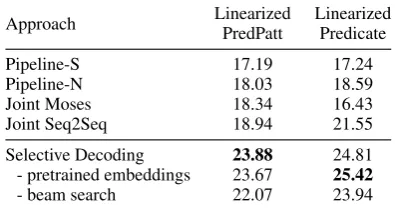
Table2shows the cased BLEUscores of linearized PredPatt and linearized predicates7on the test set.
Selective Decoding significantly improves the per-formance on both of them. Compared to the pre-vious best approach (Joint Seq2Seq), Selective Decoding improves the BLEU score of linearized PredPatt to 23.88, and the score of linearized pred-icates to 25.42.
Approach LinearizedPredPatt LinearizedPredicate
Pipeline-S 17.19 17.24
Pipeline-N 18.03 18.59
Joint Moses 18.34 16.43
Joint Seq2Seq 18.94 21.55
Selective Decoding 23.88 24.81 - pretrained embeddings 23.67 25.42
- beam search 22.07 23.94
Table 2: Evaluation results (BLEU) of linearized PredPatt and linearized predicates on the test set.
We also report two ablation variants of Selective Decoding, i.e., without the pretrained word em-beddings for parameter initialization (-pretrained embeddings), and without beam search, only using greedy search during inference (-beam search). As shown in Table2, while the pretrained word em-beddings moderately improve the BLEU score of linearized PredPatt, they have slightly negative im-pact on linearized predicates. Beam search helps improve the BLEUscore of both.
Selective Decoding explicitly models sequence generation and sequence labeling, which enables a standalone evaluation of the sequence generation process (i.e., the final output without predicate and argument labels). To make a baseline comparison, we train an OpenNMT system (Klein et al.,2017) directly on the same data ignoring the labels.
OpenNMT Selective Decoding
24.92 25.16
Table 3: Evaluation results (BLEU) of sequence generation on the test set.
Table 3 shows the BLEU score of sequence generation on the test set. Selective Decoding achieves higher BLEUthan OpenNMT. It demon-strates that the selective decoding mechanism 7In linearized predicates, arguments are replaced by
placeholders. For example, the linearized PredPatt in Fig.1(d) becomes “[ ?arg started:phSth:= [ ?arg firing:ph
[image:6.595.317.515.197.302.2]learning with extra labels helps improve the qual-ity of sequence generation. We also notice that the BLEUscore (25.16 in Table2) of the final lin-earized PredPatt from Selective Decoding is even higher than OpenNMT (24.92 in Table3). Hence, we can draw a conclusion that simply placing a labeler atop the OpenNMT system to tackle the cross-lingual open IE problem will not narrow the gap in BLEUbetween itself and our Selective De-coding approach.
5.2.5 Evaluation usingF1
Approach Predicate Argument
Pipeline-S 24.24 33.54
Pipeline-N 24.41 33.51
Joint Moses 25.11 38.90
Joint Seq2Seq 25.79 34.44
Selective Decoding 31.71 40.81 - pretrained embeddings 31.56 40.81
[image:7.595.313.522.217.353.2]- beam search 30.06 39.06
Table 4: Evaluation results (F1) of predicates and
arguments on the test set.
We compute the token-levelF1score (Liu et al.,
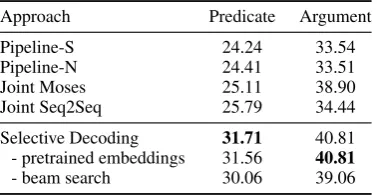
2015) of predicates and arguments. As shown in Table 4, Selective Decoding substantially im-proves theF1 score of both predicates and
argu-ments. In the ablation test, pretrained word em-beddings slightly improve F1 of predicates, but
have no improvement onF1 of arguments. Beam
search helps improve the score of both.
5.2.6 Recoverability
We compute the number of the linearized PredPatt outputs from which the tree structure representa-tion can not be recovered, including the empty out-puts and the outout-puts which have unmatched brack-ets, or have zero or multiple heads for an argument or a predicate. As shown in Table5, compared to the previous best Joint Seq2Seq approach, Selec-tive Decoding further reduces the number of unre-coverable outputs by one order of magnitude.
Pipeline-S Pipeline-N MosesJoint Seq2SeqJoint DecodingSelective
5,965 6,014 33,178 557 53
Table 5: Number of unrecoverable outputs.
5.2.7 Analysis
To analyze the difference between Selective De-coding and the previous best approach Joint
Seq2Seq, we plot the BLEU scores of the lin-earized PredPatt on the test set with respect to the lengths of the reference. As shown in Fig.4, when the reference length is greater than 20, the linearized PredPatt generated by Selective Decod-ing gets notably better BLEUscores, especially for the reference length around 30. However, when the reference length is shorter than 11, the per-formance of Selective Decoding drops below the Joint Seq2Seq approach.
10 15 20 25 30 35 40 45 50
Sequence Length 0
5 10 15 20 25 30
BLEU
[image:7.595.88.277.234.332.2]Selective Decoding Joint Seq2Seq
Figure 4: BLEU scores of the linearized PredPatt on the test set w.r.t. the lengths of the references.
To explain this performance drop, we randomly sample an example from the test set, where the reference length is shorter than 11, and the BLEU score of the linearized PredPatt generated by Joint Seq2Seq is higher than Selective Decoding. The example is shown in Table6.
Input sentence and its English translation:
我哪怕有千分之一的希望呢,我死
活都要给他做最后的
(Even if there was only a one thousandth of a hope , er , live or die I would give him my all.)
Reference8:
(1) (I)wouldgive(him) (myall) Selective Decoding:
(1) Even if(we)have(a UNK per centhope) (2) uh ,(I)wouldhaveSOMETHING9
(3) SOMETHING:= (I)give(him) (the finalthing) Joint Seq2Seq:
(1) (I)wish(everyone) (lasthope)
In this example (Table6), the Chinese input sen-tence has a grammatical error: the object modified by “最后 的” is missing. Additionally, the ref-erence linearized PredPatt output in this example is incomplete: the fact related to the concessive clause is missing. Although here Joint Seq2Seq gets the better BLEUscore against the incomplete reference, Selective Decoding is able to better gen-erlize over the train data: the facts it generates are much closer to the original input sentence, and even better than the reference.
Input sentence and its English translation:
结果,民主党失去了列举布什“罪状”的良
机,
(As a result, the Democratic party lost a good opportunity to list the ‘ charges ’ against Bush. Reference:
(1) As(aresult),(the Democraticparty)lost(a good
opportunity)
(2) (a goodopportunity)list(the ‘charges’ against Bush) Selective Decoding:
(1) As(aresult),(the DemocraticParty)lost(the good
opportunity)
(2) (the goodopportunity)cite(Bush) Joint Seq2Seq:
(1) (Theresult)isSOMETHING
(2) SOMETHING:= (the DemocraticParty)lost(his
opportunity)
(3) (hisopportunity)give(him) (goodopportunity)
Table 7: Example outputs with the reference length longer than 20.
Another example where the reference length is greater than 20 is shown in Table 7. In this example, Selective Decoding generates the same number of facts as the reference, and the mean-ing of the facts is closer to the reference than Joint Seq2Seq: though not perfect, Selective De-coding captures “列举 布什 ‘ 罪状 ’” (“list
the ‘charges’ against Bush”) by generating “cite
(Bush)”, whereas Joint Seq2Seq fails to generate any thing related.
8The predicate tokens are coloredblue, and the argument
tokens are colored purple. Head tokens are underlined in bold. Token labels and brackets are omitted.
9“SOMETHING” is a special argument used to indicate that
the argument is a proposition.
5.3 Low-resource Scenarios
One of the goals of cross-lingual open IE is to extract facts from languages for which few NLP resources and tools are available, and represent the facts in the language for which plenties of re-sources and tools can be used. Therefore, we ex-tend the experiments to cross-lingual open IE from 5 languages to English in a low-resource setting.
5.3.1 Datasets
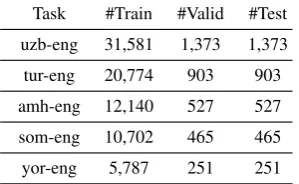
[image:8.595.343.493.210.302.2]Task #Train #Valid #Test uzb-eng 31,581 1,373 1,373 tur-eng 20,774 903 903 amh-eng 12,140 527 527 som-eng 10,702 465 465 yor-eng 5,787 251 251
Table 8: Number of data used for cross-lingual open IE in low-resource scenarios.
To prepare the experiment datasets, we first collect bitexts from DARPA LORELEI language packs (Strassel and Tracey,2016). The source lan-guages of the bitexts are Uzbek, Turkish, Amharic, Somali, and Yoruba.10
We then run a process similar to Zhang et al. (2017a) to generate pairs of source-language sen-tences and English linearized PredPatt: first, we employ SyntaxNet Parser (Andor et al., 2016) to generate Universal Dependency parses for the English sentences, and then run PredPatt (White et al., 2016) to generate English linearized Pred-Patt from the Universal Dependency parses. We remove empty sequences and very long sequences (length>50) in the pairs, and randomly split them into training, validation and test sets in the ratio of 23:1:1. The detailed number of pairs for each experiment is shown in Table8.
5.3.2 Baseline
To compare with Selective Decoding, we imple-ment the Joint Seq2Seq approach which uses a standard encoder-decoder model as the baseline.
5.3.3 Evaluation Results
We train the models of Selective Decoding and Joint Seq2Seq respectively using the same hyper-10These bitexts are from LDC2016E29 (uzb-eng);
parameters setting described in § 5.1, and evalu-ate the results on the test set by computing the cased BLEU score of the linearized PredPatt, and the token-levelF1scores.
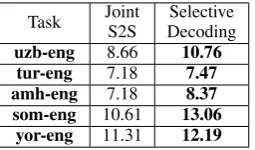
Task JointS2S DecodingSelective uzb-eng 8.66 10.76
[image:9.595.119.247.127.202.2]tur-eng 7.18 7.47 amh-eng 7.18 8.37 som-eng 10.61 13.06 yor-eng 11.31 12.19
Table 9: Evaluation results in low-resource cross-lingual open IE scenarios: BLEU of linearized PredPatt.
Table 9 shows the evaluation results using BBLEU. Selective Decoding outperforms the Joint Seq2Seq approach by 0.29-2.45, which is ex-pected since Selective Decoding employs the de-coder solely for sequence generation and the se-lector solely for sequence labeling.
Task JointPredicate Argument S2S DecodingSelective JointS2S DecodingSelective uzb-eng 12.50 12.46 19.57 24.08
tur-eng 9.89 6.49 17.39 17.76
amh-eng 8.44 8.82 17.31 18.58
som-eng 13.64 13.91 22.81 25.38 yor-eng 11.97 10.74 22.61 25.57 Table 10: Evaluation results in low-resource cross-lingual open IE scenarios: the token-level F1 of
predicates and arguments.
The F1 score measure is shown in Table 10
where both theF1 scores of predicates and
argu-ments are computed seperately. For predicates, Selective Decoding shows no advantage to the Joint Seq2Seq approach. In the tur-eng task, itsF1
score is obviously worse than the baseline. How-ever, Selective Decoding in general shows promis-ing results in the argumentF1scores.
6 Conclusions
In this paper, we recast cross-lingual open IE as a more general problem, which involves sequence generation and sequence labeling. We propose a novel encoder-decoder model which employs the selective decoding mechanism to explicitly model the sequence generation and sequence labeling process. Experimental results show our approach achieves consistent and significant improvements in a variety of cross-lingual open IE scenarios.
Since the selective decoding mechanism is not limited to cross-lingual open IE, we believe that it will also benefit other NLP tasks which can be generalized as jointly doing sequence generation and sequence labeling. In the future, we plan to investigate its effectiveness to tasks such as cross-lingual information retrieval.
Acknowledgments
Thank you to the anonymous reviewers for their feedback. This work was supported in part by the JHU Human Language Technology Center of Excellence (HLTCOE), and DARPA LORELEI. The U.S. Government is authorized to reproduce and distribute reprints for Governmental purposes. The views and conclusions contained in this pub-lication are those of the authors and should not be interpreted as representing official policies or en-dorsements of DARPA or the U.S. Government.
References
Daniel Andor, Chris Alberti, David Weiss, Aliaksei Severyn, Alessandro Presta, Kuzman Ganchev, Slav Petrov, and Michael Collins. 2016. Globally nor-malized transition-based neural networks. In Pro-ceedings of the 54th Annual Meeting of the Associa-tion for ComputaAssocia-tional Linguistics (Volume 1: Long
Papers), pages 2442–2452, Berlin, Germany.
Asso-ciation for Computational Linguistics.
Gabor Angeli, Melvin Jose Johnson Premkumar, and Christopher D. Manning. 2015. Leveraging linguis-tic structure for open domain information extraction.
In Proceedings of the 53rd Annual Meeting of the
Association for Computational Linguistics and the 7th International Joint Conference on Natural
Lan-guage Processing (Volume 1: Long Papers), pages
344–354, Beijing, China. Association for Computa-tional Linguistics.
Dzmitry Bahdanau, Kyunghyun Cho, and Yoshua Ben-gio. 2014. Neural machine translation by jointly learning to align and translate. arXiv preprint arXiv:1409.0473.
Michele Banko, Michael J. Cafarella, Stephen Soder-land, Matt Broadhead, and Oren Etzioni. 2007. Open information extraction from the web. In Pro-ceedings of the 20th International Joint Conference
on Artifical Intelligence, IJCAI’07, pages 2670–
2676, San Francisco, CA, USA. Morgan Kaufmann Publishers Inc.
[image:9.595.73.292.356.443.2]for Computational Linguistics (Volume 1: Long
Pa-pers), pages 1466–1477, Berlin, Germany.
Associa-tion for ComputaAssocia-tional Linguistics.
Kyunghyun Cho, Bart van Merrienboer, Caglar Gul-cehre, Dzmitry Bahdanau, Fethi Bougares, Holger Schwenk, and Yoshua Bengio. 2014. Learning phrase representations using rnn encoder–decoder for statistical machine translation. InProceedings of the 2014 Conference on Empirical Methods in
Nat-ural Language Processing (EMNLP), pages 1724–
1734, Doha, Qatar. Association for Computational Linguistics.
Li Dong and Mirella Lapata. 2016. Language to logi-cal form with neural attention. InProceedings of the 54th Annual Meeting of the Association for Compu-tational Linguistics (Volume 1: Long Papers), pages 33–43, Berlin, Germany. Association for Computa-tional Linguistics.
Anthony Fader, Stephen Soderland, and Oren Etzioni. 2011.Identifying relations for open information ex-traction. InProceedings of the 2011 Conference on Empirical Methods in Natural Language Process-ing, pages 1535–1545, Edinburgh, Scotland, UK. Association for Computational Linguistics.
Karl Moritz Hermann, Tomas Kocisky, Edward Grefenstette, Lasse Espeholt, Will Kay, Mustafa Su-leyman, and Phil Blunsom. 2015. Teaching ma-chines to read and comprehend. In C. Cortes, N. D. Lawrence, D. D. Lee, M. Sugiyama, and R. Garnett, editors,Advances in Neural Information Processing
Systems 28, pages 1693–1701. Curran Associates,
Inc.
Sepp Hochreiter and J¨urgen Schmidhuber. 1997. Long short-term memory. Neural computation, 9(8):1735–1780.
S´ebastien Jean, Kyunghyun Cho, Roland Memisevic, and Yoshua Bengio. 2015. On using very large target vocabulary for neural machine translation.
In Proceedings of the 53rd Annual Meeting of the
Association for Computational Linguistics and the 7th International Joint Conference on Natural
Lan-guage Processing (Volume 1: Long Papers), pages
1–10, Beijing, China. Association for Computa-tional Linguistics.
Nal Kalchbrenner and Phil Blunsom. 2013. Recurrent continuous translation models. In Proceedings of the 2013 Conference on Empirical Methods in Natu-ral Language Processing, pages 1700–1709, Seattle, Washington, USA. Association for Computational Linguistics.
Andrej Karpathy and Li Fei-Fei. 2015. Deep visual-semantic alignments for generating image descrip-tions. In Proceedings of the IEEE Conference on
Computer Vision and Pattern Recognition, pages
3128–3137.
Diederik Kingma and Jimmy Ba. 2014. Adam: A method for stochastic optimization. arXiv preprint arXiv:1412.6980.
G. Klein, Y. Kim, Y. Deng, J. Senellart, and A. M. Rush. 2017. OpenNMT: Open-Source Toolkit for Neural Machine Translation.ArXiv e-prints. Philipp Koehn, Hieu Hoang, Alexandra Birch, Chris
Callison-Burch, Marcello Federico, Nicola Bertoldi, Brooke Cowan, Wade Shen, Christine Moran, Richard Zens, et al. 2007. Moses: Open source toolkit for statistical machine translation. In Pro-ceedings of the 45th annual meeting of the ACL on interactive poster and demonstration sessions, pages 177–180. Association for Computational Linguis-tics.
Zhengzhong Liu, Teruko Mitamura, and Eduard Hovy. 2015. Evaluation algorithms for event nugget detec-tion: A pilot study. InProceedings of the 3rd
Work-shop on EVENTS at the NAACL-HLT, pages 53–57.
Di Lu, Xiaoman Pan, Nima Pourdamghani, Shih-Fu Chang, Heng Ji, and Kevin Knight. 2016. A multi-media approach to cross-lingual entity knowledge transfer. InProceedings of the 54th Annual Meet-ing of the Association for Computational LMeet-inguistics (Volume 1: Long Papers), pages 54–65, Berlin, Ger-many. Association for Computational Linguistics. Minh-Thang Luong, Hieu Pham, and Christopher D.
Manning. 2015. Effective approaches to attention-based neural machine translation. InProceedings of the 2015 Conference on Empirical Methods in
Nat-ural Language Processing, pages 1412–1421,
Lis-bon, Portugal. Association for Computational Lin-guistics.
Razvan Pascanu, Tomas Mikolov, and Yoshua Ben-gio. 2013. On the difficulty of training recurrent neural networks. In Proceedings of The 30th
In-ternational Conference on Machine Learning, pages
1310–1318.
Jeffrey Pennington, Richard Socher, and Christo-pher D. Manning. 2014. Glove: Global vectors for word representation. InEmpirical Methods in
Nat-ural Language Processing (EMNLP), pages 1532–
1543.
Alexander M. Rush, Sumit Chopra, and Jason Weston. 2015. A neural attention model for abstractive sen-tence summarization. In Proceedings of the 2015 Conference on Empirical Methods in Natural Lan-guage Processing, pages 379–389, Lisbon, Portugal. Association for Computational Linguistics.
Mike Schuster and Kuldip K Paliwal. 1997. Bidirec-tional recurrent neural networks. IEEE Transactions
on Signal Processing, 45(11):2673–2681.
Workshop on Statistical Machine Translation, pages 259–268. Association for Computational Linguis-tics.
Nitish Srivastava, Geoffrey E Hinton, Alex Krizhevsky, Ilya Sutskever, and Ruslan Salakhutdinov. 2014. Dropout: a simple way to prevent neural networks from overfitting. Journal of Machine Learning Re-search, 15(1):1929–1958.
Stephanie Strassel and Jennifer Tracey. 2016. Lorelei language packs: Data, tools, and resources for technology development in low resource languages.
In Proceedings of the Tenth International
Confer-ence on Language Resources and Evaluation (LREC
2016), Paris, France. European Language Resources
Association (ELRA).
Kiyoshi Sudo, Satoshi Sekine, and Ralph Grishman. 2004. Cross-lingual information extraction sys-tem evaluation. In Proceedings of the 20th
inter-national Conference on Computational Linguistics,
page 882. Association for Computational Linguis-tics.
Ilya Sutskever, Oriol Vinyals, and Quoc V Le. 2014. Sequence to sequence learning with neural net-works. InAdvances in neural information process-ing systems, pages 3104–3112.
Zhaopeng Tu, Yang Liu, Zhengdong Lu, Xiaohua Liu, and Hang Li. 2016. Context gates for neural ma-chine translation. arXiv preprint arXiv:1608.06043. Oriol Vinyals, Łukasz Kaiser, Terry Koo, Slav Petrov, Ilya Sutskever, and Geoffrey Hinton. 2015a. Gram-mar as a foreign language. InAdvances in Neural
Information Processing Systems, pages 2773–2781.
Oriol Vinyals, Alexander Toshev, Samy Bengio, and Dumitru Erhan. 2015b. Show and tell: A neural im-age caption generator. In Proceedings of the IEEE Conference on Computer Vision and Pattern Recog-nition, pages 3156–3164.
Aaron Steven White, Drew Reisinger, Keisuke Sak-aguchi, Tim Vieira, Sheng Zhang, Rachel Rudinger, Kyle Rawlins, and Benjamin Van Durme. 2016. Universal decompositional semantics on universal dependencies. InProceedings of the 2016 Confer-ence on Empirical Methods in Natural Language
Processing, pages 1713–1723, Austin, Texas.
Asso-ciation for Computational Linguistics.
Kelvin Xu, Jimmy Ba, Ryan Kiros, Kyunghyun Cho, Aaron C Courville, Ruslan Salakhutdinov, Richard S Zemel, and Yoshua Bengio. 2015. Show, attend and tell: Neural image caption generation with visual at-tention. InICML, volume 14, pages 77–81.
Sheng Zhang, Kevin Duh, and Benjamin Van Durme. 2017a. Mt/ie: Cross-lingual open information ex-traction with neural sequence-to-sequence models.
InProceedings of the 15th Conference of the
Euro-pean Chapter of the Association for Computational
Linguistics: Volume 2, Short Papers, pages 64–70,
Valencia, Spain. Association for Computational Lin-guistics.
Sheng Zhang, Rachel Rudinger, Kevin Duh, and Ben Van Durme. 2017b. Ordinal common-sense infer-ence. Transactions of the Association for Computa-tional Linguistics.