Using the Semantic-Syntactic Interface for Reliable Arabic Modality
Annotation
Rania Al-Sabbagh Department of Linguistics University of Illinois at
Urba-na-Champaign
Jana Diesner
School of Library and Infor-mation Science
University of Illinois at Urba-na-Champaign
Roxana Girju Department of Linguistics
University of Illinois at Urbana-Champaign [email protected]
Abstract
We introduce a novel modality scheme where triggers are words and phrases that convey modality meanings and subcategorize for clauses and verbal phrases. This semantic-syntactic working definition of modality ena-bles us to design practical and replicable anno-tation guidelines and procedures that alleviate some shortcomings of current purely semantic modality annotation schemes and yield high inter-annotator agreement rates. We use this scheme to annotate a tweet-based Arabic cor-pus for modality information. This novel lan-guage resource, being the first, initiates NLP research on Arabic modality.
1 Introduction
Modality is the grammaticalized expression of the "speaker's subjective attitudes" (Bybee et al., 1994:176) and "psychological stances" (Mitchell and al-Hassan, 1994:7) towards propositions and events and their factuality status. In NLP applica-tions and domains, modality is considered as one linguistic means to convey and detect attitudes and opinions (Wiebe at al., 2005; Abdul-Mageed and Diab, 2012), commitments and beliefs (Diab et al., 2009), power relations (Prabhakaran et al., 2012), uncertainties and speculations (Szarvas et al., 2008; Matsuyoshi et al., 2010).
We herein present the first work on Arabic modality annotation, which is part of a larger research project to (1) automatically identify modality triggers (i.e. words and phrases convey-ing modality meanconvey-ings), holders (i.e. modality experiencers) and scopes (i.e. the range of lin-guistic constituents modified by the modality triggers), and (2) automatically detect power
re-lations among participants in the social network of Twitter by using this modality information.
Despite solid work on Arabic modality in the-oretical linguistics (Mitchell and al-Hassan, 1994; Brustad, 2000; Moshref, 2012), there are no Arabic corpora annotated for modality, not even the widely used Penn Arabic Treebank. However, there is a plethora of work and anno-tated corpora for modality in other languages, including English (Saurí et al, 2006; Baker et al., 2010; Prabhakaran et al., 2012; Rubinstein et al., 2013), Portuguese (Hendrickx et al., 2010; Avila and Mello, 2013), Japanese (Matsuyoshi et al. 2010) and Chinese (Cui and Chi, 2013).
Arabic modality annotation involves multiple challenges. First, the paradigm of Arabic modali-ty triggers is complex as it includes auxiliaries, lexical verbs, nominals and particles - like many other languages as well. Second, triggers can be lexically and/or semantically ambiguous: a lexi-cally-ambiguous trigger is a word or phrase that may or may not convey a modality meaning based on context. A semantically-ambiguous trigger is a word or phrase that may convey two or more modality meanings. Third, implicit scopes are common in Arabic and annotators have to be made aware of them. Fourth, Arabic word order flexibility allows triggers - especially adverbials - to occur in the scope’sinitial, medial or final positions, which makes it challenging for annotators to identify scope spans. Finally, mo-dality scopes are not necessarily adjacent to their triggers, which furthermore complicates the de-tection of their spans.
The tweets genre on which we work poses an additional challenge due to language variation. We select a random sample of Arabic tweets from the YADAC corpus (Al-Sabbagh and Girju, 2012) posted in Egypt during the first six months
of the 2011 revolution. All selected tweets are about the political situation at that time. Tweets are not only in the Egyptian Arabic (EA) dialect, but also in Modern Standard Arabic (MSA), es-pecially tweets from press agencies and celebri-ties. Therefore, our annotation scheme has to work on both MSA and EA modality.
Arabic and the tweets genre are not the only original aspects of this paper. We present a novel linguistically-motivated annotation scheme with a semantic-syntactic working definition of mo-dality triggers as words and phrases that convey
modality meanings and subcategorize for clauses and verbal phrases. Modality meanings are
based on Palmer's (1989, 2001) cross-lingual typology of modality, which is proven valid for both MSA and EA (Mitchell and al-Hassan, 1994; Brustad, 2000; Moshref, 2012).
The semantic-syntactic interface between mo-dality triggers and their scopes depicted in our definition is well-established in theoretical lin-guistics for Arabic (Moshref, 2012) and for Eng-lish (Jackendoff, 1972; Brennan, 1993; Butler, 2003). Semantics and syntax work simultaneous-ly such that semantics guarantees not to tag all words and phrases that subcategorize for clauses and verbal phrases as modality triggers. Syntax guarantees not to tag words and phrases that share some semantic meanings with modality triggers, but do not subcategorize for clauses and verbal phrases, as modality triggers.
Subcategorization frames of modality triggers are sporadically mentioned in the NLP literature on modality annotation. For English, Saurí et al. (2006) stated in their definition of event modality triggers that "they subcategorize for a that, ge-rundive or infinitival clause, but also an NP headed by event denoting nouns" (p.334). For Portuguese, Hendrickx et al. (2010) stated that "in the majority of the cases, the target [i.e. scope] is a subordinate clause or a verbal phrase ... in some cases, also main clauses can be targets [i.e. scopes]" (p. 1810). However, no prior work integrates the semantic-syntactic interface into a modality annotation scheme.
Our conceptualization and implementation of this semantic-syntactic interface provide annota-tors with practical annotation guidelines that yield highly-reliable results, as shown herein. Furthermore, they define modality in terms of concrete syntactic features which we use in our future work for the automatic identification of triggers and their scopes.
The rest of the paper is structured as follows: section 2 briefly reviews related work. Section 3
gives details about Arabic modality and its com-plexities. Section 4 presents our data, annotation guidelines and procedures. Section 5 reports the annotation results. Finally, we conclude with fu-ture work in Section 6.
2 Related Work
Recent work on modality annotation focuses on English, Portuguese, Japanese and Chinese. Baker et al. (2010) used an idiosyncratic catego-rization of English modality that distinguished 8 semantic meanings: requirement, permissive, success, effort, intension, ability, want and be-lief. They defined each type as a pattern of the form H (modal) P where H is the sentence’s
agent and P is the proposition (e.g. H permits [P to be true/false]). They obtained an average inter-annotator agreement rate of 0.82. The error anal-ysis of their modality tagger showed that errors resulted primarily from the triggers’ lexical am-biguity.
Prabhakaran et al. (2012) focused on 5 seman-tic meanings of English modality, and used the same HP patterns as Baker et al. (2010) for anno-tation guidelines. They reported an inter-annotator agreement rate of 0.95. Their modality tagger yielded a 0.44 F1 score against a gold-standard and 0.79 and 0.91 F1 scores against dif-ferent testing sets from their crowdsourced data.
Rubinstein et al. (2013) used a more standard-ized typology of English modality that entailed (1) priority modality divided into bouletic, teleo-logical and deontic triggers; and (2) non-priority modality divided into epistemic, circumstantial and ability triggers. Their purely semantic anno-tation scheme returned an alpha reliability score of 0.89 only when collapsing the subtypes of pri-ority and non-pripri-ority triggers. The scheme yielded an alpha reliability score of 0.65 for scope span annotation.
Cui and Chi (2013) appliedRubinstein et al.’s
(2013) scheme for modality annotation to the Penn Chinese Treebank. They obtained a reliabil-ity score of 0.94 for triggers' annotation using the collapsed binary typology of modality triggers as priority vs. non-priority. Their error analysis re-ported vagueness in the annotation guidelines as one disagreement factor.
our study, we avoid idiosyncratic typologies of modality that were used in some previous work; and (2) to better guide our annotators, we use practical guidelines that rely on both semantics and syntax rather than semantics only as in pre-vious annotation schemes.
3 Arabic Linguistic Modality
3.1 Background
Among multiple typologies of modality, Palmer's (1989, 2001) was validated for both MSA and EA in theoretical linguistics (Mitchell and al-Hassan, 1994; Brustad, 2000; Moshref, 2012).
Palmer distinguishes two main classes of mo-dality: propositional and event. Propositional
modality is concerned with the speaker’s attitude
to the truth-value of a proposition, and includes: Epistemic modality, which expresses the
speaker's judgment about the factual status of the proposition as well as the speaker's opin-ion and attitude towards that propositopin-ion. Evidential modality, which indicates the
evi-dence the speaker has for his or her judgment or opinion. Evidence can be reported as in hearsay and quotes or sensory.
Event modality refers to events that are not ac-tualized but are merely potential, and includes: Deontic modality, which relates to
obliga-tions and permissions that emanate from an external source, and commissives, which originate from an internal source as speakers lay an obligation on themselves for a poten-tial event.
Dynamic modality, which relates to ability, willingness and wishes.
3.2 Challenges
The challenges of Arabic modality annotation are attributed to (1) the complexity of the Arabic modality paradigm, (2) the lexical and semantic ambiguity of Arabic modality triggers, (3) im-plicit scopes, (4) word order flexibility and (5) potential long dependencies between triggers and their scopes.
The paradigm of Arabic modality triggers in-cludes a large set of auxiliaries, lexical verbs, nominals and particles. Except for auxiliaries, adverbs and some particles, all modality triggers inflect for gender, number, person, tense, aspect and mood. Furthermore, generic modality pat-terns such as نأ *ـﻟا ﻦﻣ mn Al-* >n (it is * that),
where * is typically an adjective (e.g. نأ ﻢﮭﻤﻟا ﻦﻣ
mn Almhm >n (it’s important that)), are com-mon.
Modality triggers can be lexically and/or se-mantically ambiguous. The noun نﺎﻣز zmAn is
one example of a lexically-ambiguous trigger because in 1 it is an epistemic with a clause
lw smEnA klAm AlnAs Ally EndhA xbrp kAn zmAn mbArk lsh byHkmnA
If we'd listened to the elite, Mubarak would have been still ruling us.
zmAn AlHkm Alfrdy AnthY xlAS
The era of individual rulers has come to an end.
The MSA particle ﺪﺑﻻ lAbd is one example of
semantically-ambiguous triggers because in 3 it is an epistemic with a clause scope; whereas in 4 it is an obligative with a verbal-phrase scope.
3
<n mbArk lAbd w>nh tzkr SdAm Hsyn whw ystlqy ElY sryrh AlTby fy qAEp AlmHkmp
It must be that Mubarak remembered Saddam Hussein as he was lying on his medical bed in the court.
4 lAbd An ywDE mbArk fY Alsjn Mubarak must be put in jail.
Implicit modality scopes are common in Ara-bic and come in different realizations. In 5, the scope of the permissive ﺢﻤﺴﻧnsmH (allow) is the
deicticﻚﻟذ*lk (that) which refers to the clause نﺎﮭﯾ
نﻮﯾﺮﺼﻤﻟا ﻦﻟln yhAn AlmSrywn (Egyptians won't
be humiliated). That is, the scope of nsmH is ac-tually a clause. ln yhAn AlmSrywn. ln nsmH b*lk.
Egyptians won't be humiliated. We won't allow it. In 6, the abilitives فﺮﻋا AErf (can) and فرﺎﻋ
EArf (can) share the same verbal-phrase scope of
ا
فﻮﺷ A$wf (see). To avoid redundancy, the
speaker elides the scope of the second abilitive
-ا
فﺮﻋ AErf (can) - and does not replace it with any
deictic expression. Thus AErf modifies an implic-it verbal-phrase scope.
m$ EArf A$wf HAjp lmA AErf Hklmk I can't see anything. When I can, I'll call you.
On the surface level, the obligative مزﻻ lAzm
(must) in 7 is followed by the noun phrase a real
reaction against military trials. Yet, on a deeper
(take) a real reaction against military trials. This
means that lAzm has an implicit verbal-phrase scope.
7 . مزﻻ )
ﺬﺧﺎﻧ
(
ﺪﺿ ﺪﺠﺑ ﻒﻗﻮﻣ تﺎﻤﻛﺎﺤﻤﻟا
ﺔﯾﺮﻜﺴﻌﻟا
lAzm (naxd) mwqf bjd Dd AlmHAkmAt AlEskryp We must (take) a real reaction against military trials
Word order flexibility allows for some mo-dality triggers - especially adverbials - to occur before, after or in the middle of their scope(s).
Long dependencies between modality triggers and their scope(s) are the last challenge with Ara-bic modality annotation. The obligativeﺐﻠطاATlb
(ask; require) in 8 subcategorizes for a comple-ment clause, which starts 9 words later (affixes excluded).
8 . ﺐﻠطا
ﺔﯿﻧﺪﻣ ﺲﺑﻼﻣ ﻲﻓ ﺔﯿﻔﺨﺘﻤﻟا ﺔﯾﺮﺼﻤﻟا ﺔﯿﻨﻣﻷا ةﺰﮭﺟﻻا ﺮﺻﺎﻨﻋ ﻦﻣ ﻮﺟﺮﻔﺘﯾ ﻢﮭﻧا نﺎﻧﻮﻛ ﻲﻠﻋ
يوأ ﺔﺷوﺮﮭﻣ ﻢﮭﺗﺮﻈﻧو ﻢﮭﺴﺒﻟو ﻢﮭﻛﻮﻠﺳ نﺎﺸﻋ
ATlb mn EnASr AlAjhzp Al>mnyp AlmSryp Almtxfyp fy
mlAbs mdnyp Anhm ytfrjw Ely kwnAn E$An slwkhm wlbshm wnZrthm mhrw$p >wy
I ask Egyptian security individuals disguising in civil outfits to watch Conan because their behavior, outfit and looks are ridiculously revealed.
4 Arabic Modality Annotation
4.1 Corpus Encoding and Description
We randomly selected a corpus of 1,704 raw tweets (33,349 tokens and 11,013 unique types) from the YADAC corpus (Al-Sabbagh and Girju, 2012). The considered time span ranges from January 25, 2011 to June 30, 2011. All tweets were posted in Egypt by ordinary individuals, celebrities (e.g. politicians, actors, singers, TV hosts), and the press (e.g. newspapers, TV sta-tions, NGOs, election campaigns).
The corpus includes tweets in both MSA and EA because press users always post in MSA, while celebrities and ordinary individuals fre-quently switch between MSA and EA. Based on our manual annotation of user types, we have 1,318 tweets posted by individuals, 369 tweets by celebrities and 17 tweets by the press.
4.2 Annotators and Annotation Units
Two EA native speakers performed the annota-tion. Being linguistics students, they can be as-sumed to master MSA. They were given a one-hour video tutorial covering the annotation guidelines and procedures in Sections 4.3 and 4.4, respectively, followed by a 30-minute work-shop dedicated to training and discussion.
Each annotator is required to label each (1) modality trigger, (2) its semantic meaning, (3) its scope type(s), and (4) its scope span(s). We keep
holder annotation for future work as it poses ad-ditional challenges.
4.3 Annotation Guidelines
Our core annotation guidelines are summarized in the semantic-syntactic working definition of modality given in Section 1. We define modality triggers as words and phrases that (1) convey a modality meaning from Palmer's (1989, 2001) typology, (2) and subcategorize for clauses and verbal phrases; representing propositions and events, respectively. We also give the annotators a number of supplementary guidelines.
Annotators have to label each trigger and its scope(s). Multiple triggers may have the same scope as in 9 where the two epistemic triggers
فرﺎﻋ EArf (I know) and ﺪﻛﺄﺘﻣ mt>kd (I'm sure)
share the clause scope of that Mubarak won't be
executed.
9 .
ﺎﻧأ
فرﺎﻋ
و
ﺪﻛﺄﺘﻣ
ا ﺶﻣ كرﺎﺒﻣ ن مﺪﻌﺘﯿﺣ
AnA EArf wmt>kd An mbArk m$ HytEdm
I know and I'm sure that Mubarak won't be executed. Annotators have to label all the scopes of the modality trigger for type and then identify their spans. In 10, the obligative مزﻻ lAzm (must)
modifies three verbal-phrase scopes linked by the coordinating conjunctionوw (and).
10 .
ﺎﻨﺣا
مزﻻ
عﻮﺿﻮﻤﻟا ﻊﺑﺎﺘﻧ و
ﮫﯿﻠﻋ ﺶﺘﻜﺴﻧﺎﻣ و
هروﺪﺟ ﻦﻣ ﮫﺒﯿﺠﻧ نﺎﺸﻋ
ﺎﻣ ﻲﻧﺎﺗ ﺶﻠﺼﺤﯾ
AHnA lAzm ntAbE AlmwDwE wmAnskt$ Elyh wnjybh mn jdwrh E$An mA yHSl$ tAny
We must follow up with this, not ignore it and investi-gate it well so it won't happen again.
Finally, annotators have to retrieve implicit scopes whether they are referred to in-text or us-ing their own real-world knowledge.
4.4 Annotation Procedure
Annotation proceeded in four stages. For Stage 0, we used our novel, manually-built, large-scale Arabic Modality Lexicon (AML) to automatically pre-highlight candidate modality triggers. AML was built in three steps:
First, we manually generated the person, gender, number, tense, mood and aspect in-flections as well as the present and past par-ticiple derivations of 276 lemmas compiled from Mitchell and al-Hassan (1994), Brustad (2000) and Moshref (2012).
<entry id="997" token="ﻲﻟﺄﯿﮭﺘﻣ" trans.="mthy>ly" gloss="I think" ambiguity="NA" dialect="EA" semClass="epistemic" features="NA" </entry>
<entry id="2032" token="ﻢﺘﺤﻤﻟا ﻦﻣ" trans="mn AlmHtm" gloss="it's essential that" ambiguity="NA" dialect="MSA" semClass="obligative" features="MWE" </entry>
<entry id="3423" token="ﺰﺠﻋ" trans="Ejz" gloss="failed to" ambiguity="lexical" dialect="MSA/EA" semClass="abilitive" features="inherentlyNeg,Quasi"</entry>
Table 1: An expert from the Arabic Modality Lexicon (AML)
gloss, ambiguities {lexical, semantic, both, NA}, dialects {MSA, EA, both}, modality semantic meaning and special features {quasi; inherently-negative, multi-word expression} as in Table 1.
Currently, AML has 7,584 entries, with the statistical distributions in Table 2. Despite the large size of AML, annotators were instructed to add any words or phrases that match our working semantic-syntactic definition of modality.
Semantic meanings Ambiguity
Epistemic 3,144 Lexical 2,363
Sensory 134 Semantic 155
Reported 427 Lexical/Semantic 116 Obligative 1,091 Unambiguous 4,950 Permissive 815
Commissive 132 Abilitive 957
Volitive 884
Dialects Special Features
MSA 2,268 Quasi 777
EA 3,100 Inherently-Neg. 788
MSA/EA 2,216 MWE 276
Table 2: AML statistics
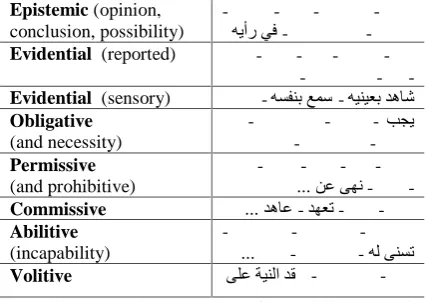
For Stage 1, annotators labeled each pre-highlighted modality trigger for its modality se-mantic meaning. We defined modality sese-mantic annotation as a synonymy judgment task where the annotators, given a number of synsets, had to decide to which synset the pre-highlighted trig-ger belongs. We used 8 synsets; each of which featured one modality semantic meaning from Palmer's (1989; 2001) typology. The average size of the synsets is 15 words/phrases to repre-sent different shades of meaning. Yet, due to space limitations, we only included sample synsets in Table 3. To avoid fatigue, disinterest, and distraction effects, we used counterbalancing and prompted the annotators to provide their own synonym(s) for the pre-highlighted candidate trigger if none of the given synsets seemed syn-onymous.
For Stage 2, annotators labeled the syntactic type of the linguistic constituents modified by the pre-highlighted modality trigger (i.e. scope type) where applicable. Annotators had to choose whether the modified constituent was a clause, a verbal phrase, or another type of constituency (e.g. a noun phrase, an adjectival phrase). Once
the clause or the verbal phrase option was select-ed, annotators were prompted to extract that clause or verbal phrase.
Epistemic (opinion,
Table 3: Sample synsets used for modality semantic annotation
For Stage 3, we automatically extracted the triggers that followed our semantic-syntactic working definition of modality. That is, triggers labeled as synonymous to one of the synsets in Table 3 AND as modifying a clause or a verbal phrase. In this stage, instances such as اوﺮﻜﺘﻓا
AftkrwA in 11 were automatically excluded:
alt-hough it modifies a complement clause, it means
remember which is a non-modality meaning.
11
AftkrwA <n kl mrp bnm$y tHqyq mTAlbnA bybqY <SEb
Remember that every time we leave, it becomes harder to achieve our demands!
Similarly, instances such as اﻮﻨﻠﻋأ >ElnwA
(they announced) in 12 were automatically fil-tered out. It is synonymous with the evidential reported synset, yet it modifies a prepositional phrase.
>ElnwA >xyrA En >smA' AlmEtqlyn fy Alsjn AlHrby They finally announced the names of all prisoners in the military jail.
Instances such asردﺎﻗqAdr (able to) in 13 were
automatically admitted as valid modality trig-gers. It belongs to the dynamic abilitive synset, and modifies the verbal phrase ﻊﻨﺼﯾ نأ >n ySnE
The Egyptian people are able to make their own destiny.
Our annotation procedure pinpoints the effi-ciency and applicability of each dimension of our definition of modality. These guidelines also speed up the annotation process and increase an-notation reliability because they provide annota-tors with practical and concrete prompts, and elicit well-structured answers that can be auto-matically converted into the modality annotation profiles described in Section 4.5.
4.5 Modality Annotation Profiles
Twitter terms of services prohibit redistrib-uting raw tweet texts. Thus at the end of the an-notation process, a profile was built for each tweet with its user name, tweet ID, and modality-related information. Associated software is to be given to help reconstruct tweets using their IDs. Although at the time of writing this paper all tweet IDs are still active, there is a potential of degradation if users delete their tweets or make their accounts private. This does not affect the modality-related profile, however, the complete tweet text will not be available. Modality-related information presents chunks of the tweet texts that represent the trigger word/phrase and the scope clause/verbal phrase. Thus we assume that we are not violating the terms of services.
Triggers are marked with 4-character labels. The first character is T for Trigger. The second two characters indicate the semantic meaning of the trigger {Ep: epistemic, Rp: reported, Sn: sen-sory, Ob: obligative, Pr: permissive, Cm: commissive, Ab: abilitive, Vl: volitive}. The fourth character is an index to indicate whether the trigger is the 1st, 2nd and so on in the tweet and to relate the trigger to its scope(s).
Scopes are marked with 3-character labels. The first is S for Scope. The second represents the syntactic type of the scope - {C: clause, P: verbal phrase}. The last is an index matching that of its trigger. Table 4 shows the modality annota-tion profiles for examples 1 and 9, respectively.
user="alaa"
tweet_id=" 71857458888458240" [[ ("zmAn", "TEP1"),
(("mbArk lsh byHkmnA", "SC1")) ]]
user="eAiNet"
tweet_id="46316910177697792" [[ ("EArf", "TEP1"),
(("An mbArk m$ HytEdm", "SC1"))], [("mt>kd", "TEP2"),
(("An mbArk m$ HytEdm", "SC2")) ]] Table 4: Example modality annotation profiles
5 Annotation Results
5.1 Inter-Annotator Agreement Rates and Disagreement Factors
AML pre-highlighted 2,892 candidate triggers in our 1,704 tweets. We used the kappa κ statistics to measure the Inter-Annotator Agreement (IAA) rates for:
Modality semantic annotation: this labels each candidate trigger as synonymous to one of the synsets in Table 3 featuring Palmer's (1989; 2001) typology.
Modality syntactic annotation: this in-cludes (1) identifying the scope type as to whether it is a clause, a verbal phrase, or none; and (2) identifying the scope span in terms of the beginning and the end of each scope.
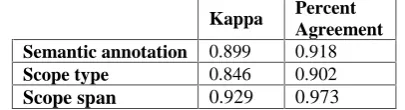
Our macro kappa κIAA rate for modality se-mantic annotation is 0.899 (Table 5). It is hard to measure if this rate is significantly higher than rates reported in the literature of modality seman-tic annotation because direct comparison with prior work is not possible as explained in Section 2. Yet, one point to highlight is that we do not use a collapsed typology of modality semantic meanings as in Rubenstein et al. (2013) and Cui and Chi (2013), who both collapsed modality semantic meanings into two major classes only: priority vs. non-priority.
Kappa Percent Agreement Semantic annotation 0.899 0.918
Scope type 0.846 0.902
Scope span 0.929 0.973
Table 5: Macro kappaκinter-annotator agreement rates for modality semantic and syntactic annotations We attribute our high IAA rate for modality semantic annotation to: (1) the large-scale AML, which provides annotators with an extensive list of candidate triggers; and (2) using synonymy judgments to give annotators practical, self-evident annotation prompts instead of subjective guidelines, defining modality triggers as expres-sions of alternative states in which the world could be.
the annotators, especially when working on a morphologically-rich language such as Arabic, it is better to have the synset members inflected for the same person, gender, number, tense, mood and aspect as the candidate trigger.
It took us three iterations of annotations - each one with two different annotators - to come up with the best final synsets used in this paper. This process is time and labor consuming. Yet, once the synsets have been created, the annota-tion process is fast and replicable with a potential to be crowdsourced. We will examine this option in future work.
Highly-ambiguous lemmas are the first disa-greement factor for modality semantic annota-tion. Epistemic lemmas such as فﺎﺷ $Af (saw),
فﺮﻋ Erf (knew), ﻢﮭﻓ fhm (understood), قﺪﺻSdq
(believed) and لﺎﻗ qAl (said) among others have
multiple meanings of which one or more might be modality-related. This explains why most of the disagreement scores in Table 6 are between modality and non-modality meanings (i.e. NA).
Ep Rp Sn Ob Pr Cm Ab Vl NA
Ep 610 10 3 1 9 0 9 0 33
Rp 7 261 0 13 0 0 0 0 20
Sn 2 0 192 0 0 0 0 0 5
Ob 0 8 0 299 3 0 1 1 0
Pr 0 0 0 1 93 0 6 0 0
Cm 0 0 0 0 0 7 0 0 0
Ab 0 0 0 0 0 0 124 0 0
Vl 0 0 0 0 0 0 0 267 1
NA 98 6 0 0 0 0 0 0 802
Table 6: Confusion matrix for semantic annotation For one annotator ﻢﮭﻔﻧ nfhm in 14 is
synony-mous to حﺮﺸﻧ n$rH (explain) and thus does not
belong to any of the modality synsets in Table 3. For the other annotator, this trigger still means
explain, but not as in explaining factual
infor-mation, but as in making people adopt a specific point of view or a belief. Thus it is synonymous to نأ نﻮﻨﻣﺆﯾ ﻢﮭﻠﻌﺠﻧ njElhm y&mnwn >n (make
them believe that) and is an epistemic trigger. 14 .
ﺪﺑﻻ
ﻢﮭﻔﻧ
سﺎﻨﻟا ﺔﺟﺎﺣ ﺶﯿﺠﻟاو ﺔﺟﺎﺣ يﺮﻜﺴﻌﻟا ﺲﻠﺠﻤﻟا نإ
lAbd nfhm AlnAs <n Almjls AlEskry HAjp wAljy$ Hajp We must explain to people that the Supreme Council of Armed Forces is one thing and the army is another.
The same lemma may also have more than one closely-related modality meaning; (i.e. it is semantically-ambiguous). For one annotator
لﻮﻘﯿﺑbyqwl in 15 is an evidential reported trigger
meaning is saying; whereas it is an epistemic trigger meaning is thinking for the other.
15 .
ﻲﻠﻟا ﺲﺑ نﺎﺸﻋ ناﺪﯿﻤﻟا هﺮﺑ ﻢھﻮﻌﻠطو حﻼﺳ ﻢھﺎﻌﻣ سﺎﻧ اﻮﺸﻔﻗ
لﻮﻘﯿﺑ
ﺔﯿﺠﻄﻠﺑ ﺎﻨﻧإ نﺎﻄﻠﻏ ﮫﻧإ فﺮﻌﯾ
qf$wA nAs mEAhm slAH wTlEwhm brh AlmydAn E$an Ally byqwl <nnA blTjyp yErf <nh glTAn
They arrested some people with guns and kicked them out of the square so that those saying we're thugs realize that they are wrong.
Modality triggers not included in AML are the second disagreement factor for modality se-mantic annotation. A total of 168 triggers were identified as new; 85 of which were agreed upon by both annotators. For future modality annota-tion, agreed-upon new triggers will be added to AML and controversial ones are to be examined by experts prior to inclusion.
The macro kappa κ IAA rate for scope type identification is 0.846 according to Table 5. Main factors of disagreement are:
Clauses vs. verbal phrases: in some con-texts, triggers such as ﻦﻜﻤﻣ mmkn (may, it's
possible that) andيروﺮﺿ Drwry (must; it is
necessary that) can be understood either as auxiliaries subcategorizing for verbal phrases or as adjuncts subcategorizing for clauses. Thusﻷ لﻮﻘﻧ لﺰﻨﻧ يروﺮﺿ Drwry nnzl nqwl l>
can be either we must protest and say no or
it's necessary that we protest and say no.
Implicit scope recovery: implicit scopes with deictic expressions or in-text reference were easy to retrieve unlike implicature-based scopes. For instance, ﮫﺑﺎﻄﺧ ﺎﻨﻗﺪﺻ ﺎﻨﺣا AHnA SdqnA xTAbh (we believed his speech) was
perceived by one annotator as we believed
what he said in his speech was true. Thus the
annotator selected the clause option for the scope type. The other annotator did not see such an implicature and thus selected NA, meaning that the scope is unrecognizable or is neither a clause nor a verbal phrase.
The macro kappa κ IAA rate for scope span recognition in Table 5 is 0.929 which is quite high. We attribute this to the simplicity of the tweet genre, which entails short sentences (140 characters or less) and a writing style that resem-bles short telegraphic notes more than formal and lengthy sentences. Interjections, adjuncts and subordinate conjunctions are the main reasons for disagreement. In 16, one annotator ends the span of the clause-based scope before نﺎﺸﻠﻋ
El$An (so that); while the other includes the
en-tire sentence into the scope span. We will add clearer guidelines for when interjections, ad-juncts and subordinate clauses should be consid-ered into the scope span in future work.
16 . ﻻ مز
لﺰﻨﺗ سﺎﻨﻟا
)
ﻢﮭﺒﻨﺟ ﺪﺣ ﮫﯿﻓ نا اﻮﺴﺤﯾ عرﺎﺸﻟا ﻲﻓ ﻲﻠﻟا نﺎﺸﻠﻋ
(
lAzm AlnAs tnzl (El$An Ally fy Al$ArE yHswA An fyh
People must go to protests (so that those already protest-ing won't feel as if left alone).
As we implemented Stage 3 of our annotation procedure, we sought triggers that adhere to our semantic-syntactic working definition of modali-ty. Triggers labeled as conveying a modality meaning AND subcategorizing for either clauses or verbal phrases were 1,746 and 1,619 triggers by Annotators 1 and 2, respectively. Triggers labeled as not conveying a modality meaning and/or not modifying a clause or a verbal phrase were 1,146 and 1,273 triggers by Annotators 1 and 2, respectively. Exact matches between the two annotators (i.e. triggers labeled similarly for modality meanings, scope type(s) and scope span(s)) amount to 1,343 valid modality triggers according to our definition.
Modal Non-Modal
Annotator 1 1,746 1,146
Annotator 2 1,619 1,273
Agreed-Upon (Exact-Match) 1,343 1,034
Total Exact matches 2,377
Table 7: Exact-match modality annotated corpus
5.2 Annotated Corpus Statistics
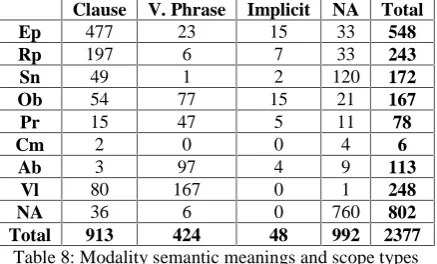
In this section, we give statistics on candidate triggers labeled identically by both annotators: whether triggers eventually considered as valid modality triggers (i.e. 1,343 triggers) or triggers eventually rejected as invalid modality triggers (i.e. 1,034). Table 8 shows the correlation be-tween modality semantic meanings and their scope types. We conclude that:
Except for evidential sensory, modality trig-gers are more likely to modify clauses and verbal phrases than other linguistic constitu-ents such as noun, adjective and adverb phrases. That is, modality triggers subcatego-rize for clauses and verbal phrases.
Propositional modality (i.e. epistemic, evi-dential reported and sensory) subcategorizes more frequently for clauses; whereas event modality (i.e. deontic and dynamic) is more likely to subcategorize for verbal phrases. Triggers that were pre-highlighted as
candi-dates by AML and later rejected for being invalid according to our definition correlate more frequently with linguistic constituents other than clauses and verbal phrases.
Only 2% of scopes are implicit.
Based on AML dialect labels, valid modality triggers are: (1) 77.3% EA-exclusive such as
ﻲﻟﺄﯿﮭﺘﻣ mthy>ly (I think) and ﺰﯾﺎﻋ EAyz (I want),
(2) 15.6% either MSA or EA based on context such as لﺎﻗqAl (he said) andفﺮﻋ Erf (he knew),
and (3) 7% MSA-exclusive such as ﺐﺟﻮﺘﺳا
Astwjb (it necessitated) and تددو wddt (I
want-ed).
Clause V. Phrase Implicit NA Total
Ep 477 23 15 33 548
Rp 197 6 7 33 243
Sn 49 1 2 120 172
Ob 54 77 15 21 167
Pr 15 47 5 11 78
Cm 2 0 0 4 6
Ab 3 97 4 9 113
Vl 80 167 0 1 248
NA 36 6 0 760 802
Total 913 424 48 992 2377
Table 8: Modality semantic meanings and scope types Ambiguity accounts for 37% and 5% of the valid modality lemmas for lexical and semantic ambiguity, respectively. Some of the most fre-quent lemmas from each ambiguity type are il-lustrated in Tables 9 and 10.
Lemma Trans. Modal Freq. Non-Modal Freq.
لﺎﻗ qAl 171 40
ﺲﻔﻧ nfs 56 186
فﺎﺷ $Af 80 129
ﻢﮭﻓ fhm 88 45
Table 9: Top frequent lexically-ambiguous lemmas
Lemma Trans. Modality meanings Freq.
فﺎﺷ $Af epistemic (think) sensory (watch; witness)
47 95
فﺮﻋ Erf epistemic (know) abilitive (can)
41 40
ﻦﻜﻤﻣ mmkn epistemic (possible that) abilitive (can)
28 17 Table 10: Top frequent semantically-ambiguous lemmas
Finally, about 82% of the scope heads are adjacent to their triggers. This is expected given that tweets are typically short.
6 Conclusion and Outlook
We presented a novel modality annotation scheme and applied it to the Arabic language in the tweets genre. This work is part of a larger project to use linguistic modality to detect power relations among participants on Twitter. The presented scheme uses both semantics and syntax to increase annotation reliability. Results show that Arabic modality triggers have regular subcategorization patterns that yield high annota-tion agreement when used as guidelines.
Acknowledgement
This work has been partially supported by a grant on social media and mobile computing from the Beckman Institute for Advanced Science and Technology.
References
Muhammad Abdul-Mageed and Mona Diab. 2012. AWATIF: A Multi-Genre Corpus for Modern Standard Arabic Subjectivity and Sentiment Analy-sis. The 8th International Conference on Language Resources and Evaluation (LREC'12), Istanbul, Turkey, 21-27 May 2012.
Rania Al-Sabbagh and Roxana Girju. 2012. YADAC: Yet another Dialectal Arabic Corpus. The 8th In-ternational Conference on Language Resources and Evaluation (LREC'12), Istanbul, Turkey, 21-27 May 2012.
Kathrin Baker, Michael Bloodgood, Bonnie Dorr, Nathaniel W. Filardo, Lori Levin, and Christine Piatko. 2010. A Modality Lexicon and its Use in Automatic Tagging. The 7th International Confer-ence on Language Resources and Evaluation (LREC'10), Valletta, Malta, 19-21 May 2010.
Virginia Brennan. 1993. Root and Epistemic Modal Auxiliary Verbs, PhD Thesis, University of Massa-chusetts, Amherst.
Kristen E. Brustad. 2000. The Syntax of Spoken Ara-bic: A Comparative Study of Moroccan, Egyptian, Syrian and Kuwaiti Dialects. Georgetown Univer-sity Press, Washington DC, USA.
John Butler. 2003. A Minimalist Treatment of Modal-ity. Lingua, vol. 113 (10): 967-996.
Joan L. Bybee, R. D. Perkins and W. Pagliuca. 1994. The Evolution of Grammar: Tense, Aspect and Modality in the Languages of the World. University of Chicago Press, Chicago, USA.
Mona Diab, Lori Levin, Teruko Mitamura, Owen Rambow, Vinodkumar Prabhakaran and Wei Wei Guo. 2009. Commited Belief Annotation and Tagging. Proceedings of the Third Linguistic Annotation Workshop (ACL-IJCNLP '09), August 2009, Suntec, Singapore.
Iris Hendrickx, Amália Mendes, and Silvia Mencarelli. 2010. Modality in Text: A Proposal for Corpus Annotation. The 7th International Confer-ence on Language Resources and Evaluation (LREC'10), Valletta, Malta, 19-21 May 2010
Ray Jackendoff. 1972. Semantic Interpretation in Generative Grammar. Cambridge, MA: The MIT Press.
Suguru, Matsuyoshi, Megumi Eguchi, Chitose Sao, Koji Murakami, Kentaro Inui, and Yuji
Matsumo-to. 2010. Annotating Event Mentions in Text with Modality, Focus, and Source Information. The 7th International Conference on Language Resources and Evaluation (LREC'10), Valletta, Malta, 19-21 May 2010
T. F. Mitchell and S. A. Al-Hassan. 1994. Modality, Mood and Aspect in Spoken Arabic with Special Reference to Egypt and the Levant. London and NY: Kegan Paul International.
Ola Moshref. 2012. Corpus Study of Tense, Aspect, and Modality in Diaglossic Speech in Cairene Ara-bic. PhD Thesis. University of Illinois at Urbana-Champaign.
Frank R. Palmer. 1989. Mood and Modality. Cam-bridge University Press, CamCam-bridge, UK.
Frank R. Palmer. 2001. Mood and Modality. 2nd Edi-tion. Cambridge University Press, Cambridge, UK.
Vinodkumar Prabhakaran. 2012. Detecting Power Relations from Written Dialog. Proceedings of the 2012 Student Research Workshop, Jeju, Republic of Korea.
Vinodkumar Prabhakaran, Michael Bloodgood, Mona Diab, Bonnie Dorr, Lori Levin, Christine D. Piatko, Owen Rambow and Benjamin Van Durme. 2012. Statistical Modality Tagging from Rule-Based Annotations and Crowdsourcing. Proceedings of the ACL-2012 Workshop on Extra-Propositional Aspects of Meaning in Computational Linguistics (ExProM-2012), Jeju, Republic of Korea.
Roser Saurí, March Verhagen and James Pustejovsky. 2006. Annotating and Recognizing Event Modality in Text. The 19th International FLAIRS Confer-ence, pages: 335-339, Florida, USA, May 2006
György Szarvas, Veronika Vincze, Richárd Farkas, and János Csirik. 2008. The BioScope Corpus: Annotation for Negation, Uncertainty and their Scope in Biomedical Texts. BioNLP 2008: Current Trends in Biomedical Natural Language Pro-cessing, pages: 38-45, Columbus, Ohio, USA, June 2008