Word Ordering as Unsupervised Learning
Towards Syntactically Plausible Word Representations
Noriki Nishida and Hideki Nakayama
Graduate School of Information Science and Technology The University of Tokyo
{nishida,nakayama}@nlab.ci.i.u-tokyo.ac.jp
Abstract
The research question we explore in this study is how to obtain syntacti-cally plausible word representations with-out using human annotations. Our un-derlying hypothesis is that word order-ing tests, or linearizations, is suitable for learning syntactic knowledge about words. To verify this hypothesis, we de-velop a differentiable model called Word Ordering Network (WON) that explic-itly learns to recover correct word order while implicitly acquiring word embed-dings representing syntactic knowledge. We evaluate the word embeddings pro-duced by the proposed method on down-stream syntax-related tasks such as part-of-speech tagging and dependency pars-ing. The experimental results demonstrate that the WON consistently outperforms both order-insensitive and order-sensitive baselines on these tasks.
1 Introduction
Distributed word representations have been suc-cessfully utilized to transfer lexical knowledge to downstream tasks in a semi-supervised man-ner, and well known to benefit various applica-tions (Turian et al., 2010; Collobert et al., 2011; Socher et al.,2011). As different applications gen-erally require different features, it is crucial to choose representations suitable for target down-stream tasks.
The research question we want to explore in this study is how to obtain syntactically plausi-ble word representations without human annota-tions, with a focus on syntax-related tasks (pars-ing, etc.). Whereas a variety of approaches re-lated tosemanticword embeddings have been
pro-Figure 1: Illustration of the word ordering task. The goal of the word ordering task is to recover an original order given a set of shuffled tokens. The figure shows an example where original sentence is“this is a short sentence.” To correctly reorder the tokens, syntactic knowledge about words (e.g. grammatical classes of words and their possible relations) is indispensable. In this study, we ex-plore how well the word ordering task can be an objective to obtain syntactic word representations.
posed (Mikolov et al.,2013a,b;Pennington et al., 2014), it still remains unclear how we should ob-tainsyntacticword embeddings from unannotated corpora.
Word ordering tests, or linearizations, are com-monly used to evaluate students’ language profi-ciency. Suppose that we are given a set of ran-domly shuffled tokens {“a”, “is,” “sentence,” “short,” “this,” “.”}. In this case we can easily recover the original order: “this is a short sen-tence.” We consider this doable thanks to our knowledge about grammatical classes (e.g., part-of-speech (POS) tags) of words and their possible relations. We depict the above explanation in Fig-ure1. Of course, it might not be necessary for ma-chines to mimic exactly the same reasoning
cess in humans. However, syntactic knowledge about words is crucial for both humans and ma-chines to solve the word ordering task.
Inspired by this observation, in this study, we develop an end-to-end model called the Word Or-dering Network (WON) that explicitly learns to recover correct word orders while implicitly ac-quiring word embeddings representing syntactic information. Our underlying hypothesis is that the word ordering task can be an objective for learning syntactic knowledge about words. The WON re-ceives a set of shuffled tokens and first transforms them independently to low-dimensional continu-ous vectors, which are then aggregated to produce a single summarization vector. We formalize the word ordering task as a sequential prediction prob-lem of a permutation matrix. We use a recurrent neural network (RNN) (Elman, 1990) with long short-term memory (LSTM) units (Hochreiter and Schmidhuber, 1997) and a soft attention mecha-nism (Bahdanau et al.,2014;Luong et al.,2015) that constructs rows of permutation matrices se-quentially conditioned on summarization vectors.
We evaluate the proposed word embeddings on downstream syntax-related tasks such as POS tag-ging and dependency parsing. The experimen-tal results demonstrate that the WON outperforms both order-insensitive and order-sensitive base-lines, and successfully yields the highest perfor-mance. In addition, we also evaluate the WON on traditional word-level benchmarks, such as word analogy and word similarity tasks. Combined with semantics-oriented embeddings by a simple fine-tuning technique, the WON gives competitive or better performances than the other baselines. In-terestingly, we find that the WON has a potential to refine and improve semantic features. More-over, we qualitatively analyze the feature space produced by the WON and find that the WON tends to capture not only syntactic but also seman-tic regularities between words. The source code of this work is available online.1
2 The Proposed Method
In this section, we formulate the WON which implicitly acquires syntactic word embeddings through learning to solve word ordering problems.
1https://github.com/norikinishida/won
2.1 Embedding Layer
Given a set of shuffled tokensX ={w1, . . . , wN}, the WON first transforms every single symbolwc into a low-dimensional continuous vector, i.e.,
ec=F(wc)∈RD, (1) whereF is a learnable function. Please note that the number of tokensN in the inputX can vary in the word ordering task.
2.2 Aggregation
To perform reordering on a set of shuffled embed-dings{e1, . . . ,eN}, we aggregate the embeddings and compute a single summarization vector. The aggregation function is a sum of word embeddings followed by a non-linear transformation:
˜ matrix and bias vector, respectively.
2.3 Prediction of a Permutation Matrix We formalize a reordering problem as a prediction task of a permutation matrix.
A permutation matrix is a square binary ma-trix and every row and column contains exactly one entry of 1 and 0s elsewhere. The left-multiplication of a matrixE ∈ RN×D by a per-mutation matrixP ∈ RN×N rearranges the rows of the matrixE, e.g.
Equation 4 gives an example where E = (e3,e1,e4,e2)>, and the original sentence
(cor-rect order) isw1, w2, w3, w4.
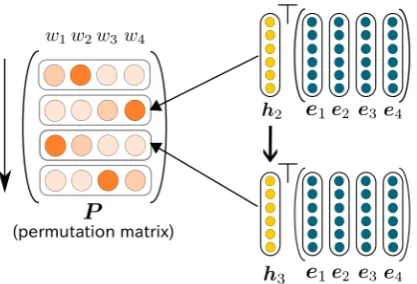
Figure 2: Visualization of our approach to sequen-tially predict a permutation matrix P ∈ RN×N. In this case, we are given N = 4 shuffled to-kens(w1, w2, w3, w4). We first independently
em-beds each symbol to dense vectors(e1,e2,e3,e4).
Then, by using an RNN and a soft attention mech-anism, we sequentially constructs the rows of the permutation matrix P = (p1,p2,p3,p4)> for
N steps through a scoring function. The vector hr ∈ RD denotes the r-th hidden state of the RNN. One can interpretpras a selective probabil-ity distribution over the input tokens. For simplic-ity, in this figure, we ignore the projection matrix in the scoring function (Eq.8).
Recently, Vinyals et al. (2015) proposed the Pointer Networks(PtrNets) that were successfully applied to geometric sorting problems. Inspired by the PtrNet, we develop an LSTM (Hochreiter and Schmidhuber, 1997) with a soft attention mecha-nism (Bahdanau et al.,2014;Luong et al.,2015). The LSTM constructs rows of a permutation ma-trix P = (p1, . . . ,pN)> conditioned on a set of word embeddings{e1, . . . ,em} calculated by Equation1. IfPNc=1pr,c = 1holds, one can in-terpretpr,cas the probability of the tokenwcto be placed at r-th position. In Figure 2, we show a visualization of our approach to predict a permu-tation matrix with the LSTM.
The LSTM’s r-th hidden state hr ∈ RD and memory cellscr∈RDare computed as follows:
hr,cr = (
˜
e, 0 (r = 0)
FLSTM(eir−1,hr−1,cr−1) (1≤r ≤N)
,
(5)
where the functionFLSTMis a state-update
func-tion andir−1 ∈ {1, . . . , N}denotes the index of
the tokenwir−1 that is placed at the previous
posi-tion, i.e.,
ir−1 = argmax
c∈{1,...,N} pr−1,c. (6)
Subsequently, we predict a selective distribution over the input tokens:
pr,c = PNexp(score(hr,ec)) k=1exp(score(hr,ek))
, (7)
where the scoring function score computes the confidence of placing the token wc at r-th posi-tion. We define the scoring function as a bilinear model as follows
score(u,v) =u>Wsv ∈R. (8)
whereWs ∈RD×Ddenotes a learnable matrix. 2.4 Objective Function
As the WON is designed to be fully differentiable, it can be trained with any gradient descent al-gorithms, such as RMSProp (Tieleman and Hin-ton, 2012). Given a set of shuffled tokens X =
{w1, . . . , wN}, we define a loss function as the following negative log likelihood:
L(X) =XN
r=1
−logpr,tr (9)
wheretr ∈ {1, . . . , N} denotes the index of the ground-truth token that appears at r-th position in the original sentence. In other words, an or-dered sequencewt1, wt2, . . . , wtN forms the
orig-inal sentence. 3 Related Work
shown to give improvements in a variety of down-stream tasks, it still remains difficult for these models to learn syntactic word representations ow-ing to their insensitivity to word order. As a con-sequence, word embeddings produced by these order-insensitive models are thus suboptimal for syntax-related tasks such as parsing (Andreas and Klein, 2014). In contrast, our method mainly fo-cuses on word order information and utilize it in the learning process.
Ling et al. (2015b) introduced the structured skip-gram (SSG) model and the continuous win-dow (CWindow) that extend SG and CBOW re-spectively. Let c be the window size. These models learn2ccontext-embedding matrices to be aware of relative positions of context words in a window. The recent work of Trask et al. (2015) is also based on the same idea as SSG and CWin-dow. Ling et al. (2015a) proposed an approach to integrating an order-sensitive attention mech-anism into CBOW, which allows for considera-tion of the contexts of words, and where the con-text words appear in a window. Bengio et al. (2003) presented a neural network language model (NNLM) where word embeddings are simultane-ously learned along with a language model. One of the major shortcomings of these window-based approaches is that it is almost impossible to learn longer dependencies between words than the pre-fixed window sizec. In contrast, the recurrent ar-chitecture allows the WON to take into account dependencies over an entire sentence.
Mikolov et al.(2010) applied an RNN for lan-guage modeling (RNNLM), and demonstrated that the word embeddings learned by the RNNLM cap-ture both syntactic and semantic regularities. The main shortcoming of the RNNLM is that it is very slow to train unfortunately. This is a conse-quence of having to predict the probability distri-bution over an entire vocabularyV, which is gen-erally very large in the real world. In contrast, the WON predicts the probability distribution over entire sentences, whose length N is usually less than 50 |V|. In our preliminary experiments, we found that the computation time for one itera-tion (=forward+ backward+ parameter update) of the WON is about 4 times faster than that of the RNNLM (LSTMLM).
Levy and Goldberg (2014) introduced dependency-based word embeddings. The method applies the skip-gram with negative
sampling (SGNS) model (Mikolov et al., 2013b) to syntactic contexts derived from dependency parse-trees. Their method heavily relies on pre-trained dependency parsers to produce words’ relations for each sentence in training corpora, thus encountering error propagation problems. In contrast, our method only requires raw corpora, and our aim is to produce word embeddings that improve syntax-related tasks, such as parsing, without using any human annotations.
The WON can be interpreted as a simplifica-tion of the recently proposed pointer network (Ptr-Net) (Vinyals et al., 2015). The main difference between the WON and the PtrNet is the encoder part. The PtrNet uses an RNN to encode an un-ordered setX ={w1, . . . , wN}sequentially, i.e.,
ei = RNNenc(wi,ei−1). (10)
In contrast, the WON treats each symbol indepen-dently (Eq.1) and aggregates them with a simpler function (Eq.2). In the word ordering task, the or-der ofX = (w1, . . . , wN)is meaningless because X is an out-of-order set. Nonetheless, according to Equation10, the vectorei depends on the in-put order ofw1, . . . , wi−1. Vinyals et al. (2015)
evaluated the PtrNet on geometric sorting tasks (e.g., Travelling Salesman Problem) where each inputwiforms a continuous vector that represents the cartesian coordinate of the point (e.g., a city). However, in the word ordering task, Equation10 suffers from the data sparseness problem, as each inputwi forms a high-dimensional discrete sym-bol.
4 Experimental Setting
4.1 Dataset and Preprocessing
4.2 Hyper Parameters
We set the dimensionality of word embeddings to
300. The dimensionality of the hidden states of the LSTM was 512. TheL2 regularization term (called weight decay) was set to4×10−6. For the
stochastic gradient descent algorithm, we used the SMORMS3 (Func,2015), and the mini-batch size was set to180.
4.3 Baselines
For a fair comparison, we trained the follow-ing order-insensitive/sensitive baselines on exactly the same pre-processed corpus described in Sec-tion4.1.
• SGNS(Mikolov et al.,2013b): We used the word2vec implementation in Gensim2 to
train the Skip-Gram with Negative Sampling (SGNS). We set the window size to5, and the number of negative samples to5.
• GloVe (Pennington et al., 2014): GloVe’s embeddings are trained by using the origi-nal implementation3provided by the authors.
We set the window size to 15. In our pre-liminary experiments, we found that GloVe with a window size of15 yields higher per-formances than that with a window size of5.
• SSG, CWindow (Ling et al., 2015b): We built word embeddings by using the struc-tured skip-gram (SSG) and the continuous window (CWindow). We used the original implementation4 developed by the authors.
The window size was5, and the number of negative samples was5.
• LSTMLM: We also compared the proposed method with the RNNLM (Mikolov et al., 2010) with LSTM units (LSTMLM). The hyper parameters were the same with that of the WON except for the mini-batch size. We used a mini-batch size of 100 for the LSTMLM.
5 Evaluation on Part-of-Speech Tagging In this experiment, we evaluated the learned word embeddings by using them as pre-trained features in supervised POS tagging.
2https://radimrehurek.com/gensim/ 3http://nlp. stanford.edu/projects/glove/ 4https://github.com/wlin12/wang2vec
Test Acc. (%) SGNS (Mikolov et al.,2013b) 96.76 GloVe (Pennington et al.,2014) 96.31 SSG (Ling et al.,2015b) 96.94 CWindow (Ling et al.,2015b) 96.78
LSTMLM 96.92
WON 97.04
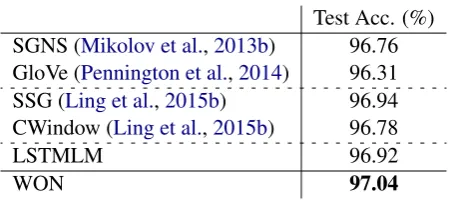
Table 1: Comparison results on part-of-speech tagging with different word embeddings. The dataset is the Wall Street Journal (WSJ) portion of the Penn Treebank (PTB) corpus. The evaluation metric is accuracy (%).
5.1 Supervised POS Tagger
In POS tagging, every token in a sentence is clas-sified into its POS tag (NNfor nouns,VBDfor past tense verbs,JJfor adjectives, etc.). We first used the learned word embeddings to project three suc-cessive tokens (wi−1, wi, wi+1) in an input
sen-tence to feature vectors (ei−1,ei,ei+1) that are
then concatenated and fed to a two-layer percep-tron followed by a softmax function:
P(c|wi−1, wi, wi+1) = MLP([ei−1;ei;ei+1]),
(11)
where[·; ·; ·]denotes vector concatenation. The classifier MLP predicts the probability distribu-tion over POS tags of the center tokenwi. We put special padding symbols at the beginning and end of each sentence. The dimensionality of the hid-den layer of theMLPwas300. The MLP classifier was trained via the SMORMS3 optimizer (Func, 2015) without updating the word embedding layer. We used the Wall Street Journal (WSJ) por-tion of the Penn Treebank (PTB) corpus5 (
Mar-cus et al.,1993). We followed the standard section partition, which is to use sections 0-18 for train-ing, sections 19-21 for validation, and sections 22-24 for testing. The dataset contains 45 tags. The evaluation metric was the word-level accuracy. 5.2 Results & Discussion
Table 1 presents the comparison of the WON to the other baselines on the test split. The re-sults demonstrate that the WON gives the high-est performance, which supports our hypothesis that the word ordering task is effective for acquir-ing syntactic knowledge about words. We also
Dev Test UAS LAS UAS LAS SGNS 91.56 90.09 91.11 89.89 GloVe 88.87 87.09 88.28 86.61 SSG 91.11 89.60 90.93 89.43 CWindow 91.23 89.69 91.16 89.67 LSTMLM 91.83 90.34 91.49 90.08 WON 91.92 90.49 91.82 90.38
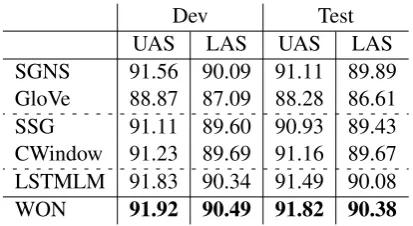
Table 2: Results on dependency parsing with dif-ferent word embeddings. The dataset was the WSJ portion of the PTB corpus. The evaluation metrics were Unlabeled Attachment Score (UAS) and La-beled Attachment Score (LAS).
observe that the order-sensitive methods (WON, LSTMLM, and SSG) tend to outperform the order-insensitive methods (SGNS and GloVe), which in-dicates that, as we expect, word order information is crucial for learning syntactic word embeddings.
6 Evaluation on Dependency Parsing In this experiment, as in Section5, we evaluated the learned word embeddings on supervised de-pendency parsing.
6.1 Supervised Dependency Parser
Dependency parsing aims to identify syntac-tic relations between token pairs in a sentence. We used Stanford’s neural network dependency parser (Chen and Manning, 2014)6, whose word
embeddings were initialized with the learned word embeddings. We followed all the de-fault settings except for the word embedding size (embeddingSize = 300) and the number of training iterations (maxIter=6000).
We used the WSJ portion of the PTB corpus and followed the standard splits of sections 2-21 for training, 22 for validation, and 23 for testing. We converted the treebank corpus to Stanford style dependencies using the Stanford converter. The parsing performances were evaluated in terms of Unlabeled Attachment Score (UAS) and Labeled Attachment Score (LAS).
6.2 Results & Discussion
Table 2 shows the results of the different word embeddings on dependency parsing. First we observe that the WON consistently outperforms
6http://nlp.stanford.edu/software/nndep.shtml
the baselines on both UAS and LAS. Next, by comparing the unlimited-context models (WON and LSTMLM) with the limited-context models (SGNS, GloVe, SSG, CWindow), we can notice that the former give higher parsing scores than the latter. These results are reasonable because the former can learn arbitrary-length syntactic depen-dencies between words without constraints from the fixed-size window size based on which the limited-window models are trained.
7 Fusion with Semantic Features
In various NLP tasks, both syntactic and semantic features can benefit performances. To enrich our syntax-oriented word embeddings with semantic information, in this section, we adopt a simple fine-tuning technique and verify its effectiveness. More precisely, we first initialize the word embed-dingsW with pre-trained parametersWsem
pro-duced by a semantics-oriented model such as the SGNS. Subsequently we add the following penalty term to the loss function in Equation9:
λkW −Wsemk2F, (12)
whereλ ∈ Ris a hyper parameter to control the intensity of the penalty term in the learning pro-cess, andk · k2
F is the Frobenius norm. This term attempts to keep the word embeddings W close to the semantic representationsWsemwhile
min-imizing the syntax-oriented objective on the word ordering task. In our experiments, we used the SGNS’s embeddings asWsemand setλto 1. The
SGNS was trained as explained in Section4.3. In this section, we quantitatively evaluated the WON with the above fine-tuning technique on two major benchmarks: (1) word analogy task, and (2) word similarity task.
7.1 Word Analogy
Question Types SGNS GloVe SSG CWindow LSTMLM WON adjective-to-adverb 24.1 23.3 29.9 12.1 4.3 29.9
opposite 36.2 29.9 37.0 11.7 15.0 37.8
comparative 85.7 79.5 88.5 73.5 55.3 88.7 superlative 59.3 49.1 68.7 43.8 22.4 62.8 present-participle 64.9 61.0 73.6 57.4 27.1 71.8 nationality-adjective 89.4 92.2 89.7 87.3 30.5 90.8 past-tense 58.0 52.2 59.0 54.0 33.1 61.4
plural 75.2 83.0 75.2 70.4 26.4 75.4
plural-verbs 78.9 56.0 84.6 64.6 61.0 82.9 capital-common 94.5 95.3 92.5 93.1 53.8 95.5 captal-world 87.8 94.5 84.0 66.6 22.1 82.6
currency 12.8 8.7 14.0 3.7 1.9 10.7
city 66.0 60.7 56.9 61.9 13.6 67.4
family 84.2 77.9 81.8 59.1 62.9 84.2
Total 69.9 68.3 69.7 58.2 27.0 70.6
Table 3: Results on the word analogy task (Mikolov et al.,2013a) with different word embeddings. The first upper block presents the results on nine syntactic question types. In the lower block we show the results on five semantic question types. The last row presents the total score. The evaluation metric is accuracy (%).
types such as city-in-state and family. Suppose that a vectorew is a representation of a wordw, and is normalized to unit norm. Follow-ing a previous work (Mikolov et al., 2013a), we answer an analogy question “A : B :: C : ?” by finding a wordw∗ that has the closest representa-tion to(eB−eA+eC)in terms of cosine similar-ity, i.e.,
w∗ = argmax w∈V\{A,B,C}
(eB−eA+eC)>ew keB−eA+eCk , (13) whereV denotes the vocabulary. The evaluation was performed using accuracy, which denotes the percentage of words predicted correctly.
In Table3, we report the results of the different word embeddings on this task. As can be seen in the Table3, the WON outperforms the baselines on four out of nine syntactic question types, and tends to yield higher accuracies by a large margin than the baselines except for the SSG. Our method and the SSG totally give the best performances on seven of nine syntactic question types. This ten-dency, as in Section 5.2, indicates that word or-der information is crucial to learn syntactic word embeddings. In regard to semantics, the WON achieves the best scores on three out of five seman-tic question types. Interestingly, on two semanseman-tic question types (capital-common and city), the WON outperforms the SGNS that was used to
WS-353 MC RG SGNS 71.26 81.96 78.86 GloVe 62.54 71.57 75.54 SSG 73.08 81.78 80.37 CWindow 70.31 80.92 77.80 LSTMLM 53.34 66.76 63.23 WON 70.97 82.43 77.64
Table 4: Results on the word similarity task with different word embeddings. Spearman’s rank correlation coefficents (%) are computed on three datasets: WS-353, MC, and RG.
initialize our word embeddings. This result im-plies that the word ordering task has the potential to improve not only syntactic but also semantic features. Our method achieves the highest accu-racy on the overall score.
7.2 Word Similarity
The word similarity benchmark is commonly used to evaluate word embeddings in terms of distri-butional semantic similarity. The word similarity datasets consist of triplets like(w1, w2, s), where s ∈ R is a human-annotated similarity score between two words (w1, w2). In this task, we
Query The 3 most similar words
he she they we
him them us me
his their our your boy kid creature girl boys ladies guys folks dragon werewolf dwarf vamp dragons robots giants spiders city village library palace
cities countries kingdoms neighborhoods drive ride walk hike
drives draws pisses causes drove rode marched strode driving traveling walking riding driven flown propelled shaken happy pleased unhappy thrilled happier crazier prettier tougher happiest hottest toughest coolest good nice bad decent better easier worse safer best worst hardest biggest
in on into under
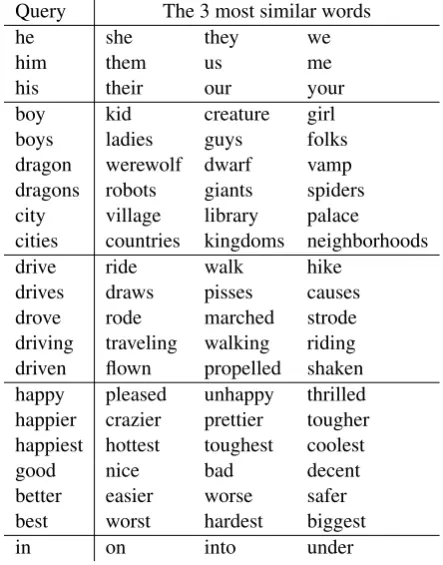
Table 5: Query words and their most similar words. Cosine similarities are computed between their embeddings produced by the WON.
the human-annotated similarities and the com-puted similarities.
Table 4 presents the results on three datasets: WordSim-353 (Finkelstein et al., 2001), MC (Miller and Charles,1991), and RG ( Ruben-stein and Goodenough,1965). we observe that the WON gives a slightly higher performance than the baselines on the MC dataset. On the other datasets, the SSG yields the best performances. These results are interesting because the two models rely on word order information while the word similarity task originally focuses on topical semantic similarities between words.
Further investigation into the interaction be-tween syntactic and semantic representations would be interesting and needs to be explored.
8 Qualitative Analysis
In this section, we inspect the learned vector space by computing the similarities between word em-beddings.
In this experiment we trained the WON on the BookCorpus (Zhu et al.,2015) that is preprocessed in the same way described in Section 4.1. The BookCorpus consists of a large collection of
nov-els, which results in a grammatically sophisticated text corpus that would be suitable for qualitative analysis. Note that to clearly investigate the word embeddings produced by the WON we neither ini-tialize our word embeddings with other models nor use fine-tuning techniques, as in experiments on downstream syntax-related tasks (Section5and Section 6). We choose queries focusing on (1) declension of personal pronouns, (2) singular and plural forms of nouns, (3) verb conjugation, (4) comparative/superlative forms of adjectives, and (5) prepositions.
Table5presents some representative queries for (1)-(5) and their respective most similar words in the learned vector space. First we can observe that our word embeddings produce a continuous vector space that successfully captures syntactic regulari-ties. In addition to the syntactic regularities, inter-estingly, we found that the WON prefers to gather words in terms of those meanings or semantic cat-egories.
9 Conclusion and Future Work
The research question we explored in this study was how to learnsyntactic word embeddings with-out using any human annotations. Our underlying hypothesis is that the word odering task is suitable for obtaining syntactic knowledge about words. To verify this idea, we developed the WON, which implicitly learns syntactic word representations through learning to explicitly solve the word or-dering task. The experimental results demonstrate that the WON gives improvements over baselines particularly on syntax-related tasks, such as part-of-speech tagging and dependency parsing. We can also observe that the WON, by combined with a simple fine-tuning technique, has the potential to refine not only syntactic but also semantic fea-tures.
It remains unclear how well order-sensitive models like the WON can learn syntactic knowl-edge about words in languages other than English. Especially, it is interesting to investigate cases on languages with richer morphology and freer word order. We leave this to future work.
Acknowledgements
discussion. This work was supported by JSPS KAKENHI Grant Number 16H05872 and JST CREST JPMJCR1304.
References
Jacob Andreas and Dan Klein. 2014. How much do word embeddings encode about syntax? In Pro-ceedings of the 52nd Annual Meeting of the Asso-ciation for Computational Linguistics.
Dzmitry Bahdanau, Kyunghyun Cho, and Yoshua Ben-gio. 2014. Neural machine translation by jointly learning to align and translate. arXiv preprint arXiv:1409.0473.
Yoshua Bengio, R´ejean Ducharme, Pascal Vincent, and Christian Jauvin. 2003. A neural probabilistic lan-guage model. Journal of Machine Learning Re-search, 3(Feb):1137–1155.
Danqi Chen and Christopher D. Manning. 2014. A fast and accurate dependency parser using neural net-works. InProceedings of the 2014 Conference on Empirical Methods in Natural Language Process-ing.
Ronan Collobert, Jason Weston, L´eon Bottou, Michael Karlen, Koray Kavukcuoglu, and Pavel Kuksa. 2011. Natural language processing (almost) from scratch. Journal of Machine Learning Research, 12:2493–2537.
Jeffrey L. Elman. 1990. Finding structure in time.
Cognitive Science, 14(2):179–211.
Lev Finkelstein, Evgeniy Gabrilovich, Yossi Matias, Ehud Rivlin, Zach Solan, Gadi Wolfman, and Ey-tan Ruppin. 2001. Placing search in context: The concept revisited. InProceedings of the 10th Inter-national Conference on World Wide Web.
John R. Firth. 1957. A synopsis of linguistic theory, 1930-1955. Blackwell.
Simon Func. 2015. Smorms3 - blog entry: Rm-sprop loses to smorms3 - beware the epsilon!
http://sifter.org/ simon/journal/20150420.html. Zellig S. Harris. 1954. Distributional structure. Word,
10(2-3):146–162.
Sepp Hochreiter and J¨urgen Schmidhuber. 1997. Long short-term memory. Neural Computation, 9(8):1735–1780.
Over Levy and Yoav Goldberg. 2014. Dependency-based word embeddings. InProceedings of the 52nd Annual Meeting of the Association for Computa-tional Linguistics.
Wang Ling, Lin Chu-Cheng, Yulia Tsvetkov, and Sil-vio Amir. 2015a. Not all contexts are created equal: Better word representations with variable attention. InProceedings of the 2015 Conference of Empirical Methods in Natural Language Processing.
Wang Ling, Chris Dyer, Alan Black, and Isabel Trancoso. 2015b. Two/too simple adaptation of word2vec for syntax problems. In Proceedings of the 2015 Conference of the North American Chap-ter of the Association for Computational Linguistics: Human Language Technologies.
Minh-Thang Luong, Hieu Pham, and Christopher D. Manning. 2015. Effective approaches to attention-based neural machine translation. InProceedings of the 2015 Conference on Empirical Methods in Nat-ural Language Processing.
Mitchell P. Marcus, Mary Ann Marcinkiewicz, and Beatrice Santorini. 1993. Building a large annotated corpus of english: The penn treebank. Computa-tional Linguistics, 19(2):313–330.
Tomas Mikolov, Kai Chen, Greg S. Corrado, and Jef-frey Dean. 2013a. Efficient estimation of word representations in vector space. arXiv preprint arXiv:1301.3781.
Tomas Mikolov, Martin Karafi´at, Lukas Burget, Jan Cernock`y, and Sanjeev Khudanpur. 2010. Recurrent neural network based language model. In Proceed-ings of INTERSPEECH.
Tomas Mikolov, Ilya Sutskever, Kai Chen, Greg S. Cor-rado, and Jeff Dean. 2013b. Distributed representa-tions of words and phrases and their compositional-ity. InAdvances in Neural Information Processing Systems.
George A. Miller and Walter G. Charles. 1991. Con-textual correlates of semantic similarity. Language and Cognitive Processes, 6(1):1–28.
Jeffrey Pennington, Richard Socher, and Christo-pher D. Manning. 2014. Glove: Global vectors for word representations. InProceedings of the 2014 Conference on Empirical Methods in Natural Lan-guage Processing.
Herbert Rubenstein and John B. Goodenough. 1965. Contextual correlates of synonymy. Communica-tions of the ACM, 8(10):627–633.
Richard Socher, Jeffrey Pennington, Eric H Huang, Andrew Y Ng, and Christopher D Manning. 2011. Semi-supervised recursive autoencoders for predict-ing sentiment distributions. In Proceedings of the conference on empirical methods in natural lan-guage processing.
Tijmen Tieleman and Geoffrey Hinton. 2012. Lecture 6.5-rmsprop: Divide the gradient by a running av-erage of its recent magnitude. COURSERA: Neural networks for machine learning, 4(2).
Joseph Turian, Lev Ratinov, and Yoshua Bengio. 2010. Word representations: A simple and general method for semi-supervised learning. InProceedings of the 48th Annual Meeting of the Association for Compu-tational Linguistics.
Oriol Vinyals, Meire Fortunato, and Navdeep Jaitly. 2015. Pointer networks. InAdvances in Neural In-formation Processing Systems.