A Common Case of Jekyll and Hyde: The Synergistic Effect of Using
Divided Source Training Data for Feature Augmentation
Yan Song
City University of Hong Kong 83, Tat Chee Ave., Kowloon
Hong Kong, China [email protected]
Fei Xia
University of Washington PO Box 354340 Seattle, WA 98195, USA
Abstract
Feature augmentation is a well-known method for domain adaptation and has been shown to be effective when tested on several NLP tasks (Daume III, 2007). However, a limitation of the method is that it requires labeled data from the target do-main and very often such data is unavail-able. In this paper, we propose to use train-ing data selection to divide the source do-main training data into two parts, pseudo target data (the selected part) and source data (the unselected part), and then ap-ply feature augmentation on the two parts of the training data. This approach has two advantages: first, feature augmenta-tion can be applied even when there is no labeled data from the target domain; sec-ond, the approach can take advantage of all the training data including the part that is not selected by training data selection. We evaluate the approach on Chinese word segmentation and part-of-speech tagging and show that it outperforms the baseline where no feature augmentation is applied.
1 Introduction
The goal of domain adaptation is to alleviate the degradation of NLP systems when training and test data are from different domains. There have been many approaches to domain adaptation, and two of well-known ones are feature augmentation and training data selection. Feature augmentation makes three copies of each feature in the original feature set (one for the source domain, one for the target domain, and one for the general domain) so that features appeared in the source and the tar-get domains can be differentiated in case they be-have differently in the two domains; the method has been shown to be effective for several NLP
tasks (Daume III, 2007). However, a limitation of the method is that it requires labeled data in the tar-get domain, a condition that is hard to meet when creating labeled data in the target domain is expen-sive and time-consuming.
Training data selection addresses the differ-ences between the source and target domains by choosing a subset of the training data in the source domain that is similar to the data in the target do-main. When the amount of source training data is large, this method often provides better perfor-mance than using the entire training data (Moore and Lewis, 2010; Axelrod et al., 2011; Plank and van Noord, 2011; Song et al., 2012). However, when the amount of the training data is small, the selected subset is unlikely to outperform the en-tire training data because the trained model cannot benefit from unselected labeled data.
To address the limitations of both methods, we propose to divide the whole source training data into two subsets via training data selection. We then treat the selected subset as coming from a
pseudo target domain(i.e., a pseuodo domain that is similar to the target domain) and keep the uns-elected data in the source domain. Now we have labeled data from both domains, we can apply fea-ture augmentation in the usual way; that is, we distinguish features from the source domain and the ones from the pseudo target domain. Notice that the ‘unselected subset’ is also used by the trainer, unlike the standard training data selection method where the unselected part is totally dis-carded by the trainer. In addition, we propose a coverage-based measure for training data selec-tion. We evaluate our approach on two NLP tasks, Chinese word segmentation (CWS) and part-of-speech (POS) tagging, and show that it outper-forms the systems which use the entire training data without training data selection or feature aug-mentation.
The reminder of this paper is organized as
lows. Section 2 presents previous work on training data selection and feature augmentation. Section 3 describes our approach in details and introduces a coverage-based measure for training data selec-tion. Section 4 reports experimental results on two NLP tasks with discussion on the results.
2 Related Work
Two main aspects of our work are dividing training data and applying feature augmentation. In this section, we discuss related work in these aspects.
2.1 Training Data Selection
Training data selection is a common approach to domain adaptation. Moore and Lewis (2010) pro-posed to rank training sentences according to the difference of the cross entropy values of a given sentence, and showed that training data selection improved the performance of statistical machine translation systems. Axelrod et al. (2011) used cross entropy in three ways: the first one directly measured cross entropy for the source side of the text; the second one was similar to (Moore and Lewis, 2010) and ranked the data using cross en-tropy difference; the third one took into account the bilingual data on both the source and the tar-get side of translations. Both studies showed that the selected subset of training data worked better than the entire training corpus for machine trans-lation. In addition to these studies, there has been other work (e.g., (Eck et al., 2005; Munteanu and Marcu, 2005; Hildebrand et al., 2005; Lu et al., 2007)) that shows training data selection is an ef-fective way to improve MT.
Plank and van Noord (2011) experimented with several training data selection methods to improve the performance of dependency pars-ing and POS taggpars-ing. These methods fell into two categories: probabilistically-motivated and geometrically-motivated. Their experiments demonstrated that the proposed training data se-lection methods outperformed random sese-lection.
In our previous study (Song et al., 2012), we proposed several entropy-based measures for training data selection, including averaged entropy gain (AEG), cross entropy, difference of entropy, and description length gain (DLG)-based mea-sures. Among them, AEG worked well on CWS and POS tagging and outperformed other mea-sures including difference of cross entropy. In this study, we are using the same data sets as in
that study and we will compare our new coverage-based measure with AEG.
2.2 Feature Augmentation
Feature augmentation (Daume III, 2007) is a well-known domain adaptation method in the super-vised setting, when labeled data exist for both source and target domains. The idea is to dis-tinguish instances from the source and target do-mains by making three copies of each original fea-ture: one copy for the source domain, one copy for the target domain and a third copy for the gen-eral domain that contains both the source and tar-get domains. Daume evaluated the method on several sequence labeling tasks (e.g., named en-tity recognition, POS tagging and shallow parsing) and showed that this method outperformed several baselines and previous approaches. The method is easy to implement and does not require modifica-tions to the trainer.
3 Our Approach
In order to perform feature augmentation on the whole training data, the very first step is to split the training data into two subsets. Training data selec-tion is an effective way to choose a subset from the whole source domain data that is similar to the tar-get domain. The question is what measures should be used for calculating similarity between a source sentence and the target domain. In this section, we discuss some existing entropy-based measures and propose a novel coverage-based measure. Then we explain how we apply feature augmentation to the two subsets.
3.1 Entropy-based Measures
sen-tence given the previous words.
CEL(s, p) =−1
n
n
X
i=1
logp(xi) (1)
The difference of cross entropy (DCE) for a sen-tencesis formulated as
DCE(s, p, q) =|CEL(s, p)−CEL(s, q)| (2)
wherepandqare two language models, built from the source domain and the target domain respec-tively. For training data selection, sentences are sorted by DCE scores and the ones with low scores are considered to be similar to the target domain (Moore and Lewis, 2010; Axelrod et al., 2011).
Another well-performed measure is AEG (Song et al., 2012). LetCbe a corpus andsbe a sentence from the source domain; we define entropy gain (EG) ofsaccording toC as in Eq 3, whereq is a probability distribution estimated from C andq1
is one estimated fromC+s, a new corpus formed by addingstoC. Intuitively, ifsis similar toC, q1will be very similar toq andEG(s, c)will be small.
EG(s, C) =|H(C+s, q1)−H(C, q)| (3)
H(X, p) follows the standard definition of en-tropy in information theory, where X is a dis-crete random variable with mpossible outcomes
{x1, ..., xm}andpis a probability distribution of
X. Given a corpus C, one can collect a set of ngrams (in words or characters) fromC andXis then derived from the set.
H(X, p) =− m
X
i=1
p(xi) logp(xi) (4)
Average entropy gain (AEG) is EG normalized by sentence length, shown in Eq 5.
AEG(s, C) = EG(s, C)
length(s) (5)
3.2 Coverage-based Data Selection
We propose a coverage-based measure, which dif-fers from the entropy-based measures in two as-pects. First, this measure uses ngram coverage, not probability similarity, as the criterion for selecting training data. The rationale is that we would like the selected data to have a good coverage of the test data, because in many NLP tasks, especially in CWS and POS tagging, out-of-vocabulary (OOV)
is a main problem affecting system performance and the problem is more severe when the train-ing and test data come from different domains. Second, existing training data selection methods (such as the ones listed in Section 3.1) select the current sentence without considering the effect of adding that to the previously selected sentences. Our method tackles this problem by considering the overall effect of the selected subset. As check-ing all the subsets is computationally expensive, we use a greedy search to find the best training sentence based on the current selected subset.
The coverage-based data selection is presented in Algorithm 1. Here, L, T, and p refer to the original training data, test data and the proportion (in percentage) of training data to be selected. Ls
andLu are the output, which refer to the selected
and unselected subsets of the training data re-spectively. By conducting such selection method, training data is divided into two parts.
Algorithm 1Coverage-based data selection. Input: L,T,p
Output: Ls,Lu
1: Ls=φ,Lu =L
2: whileSizeof(Ls)< Sizeof(L)∗pdo
3: foreach sentencesiinLudo
4: computecov(Ls∪ {si}, T)
5: end for
6: id=argmaxicov(Ls∪ {si}, T)
7: Ls=Ls∪ {sid},Lu=Lu− {sid}
8: end while 9: return Ls,Lu
In Algorithm 1, coverage function cov(C, T)
represents the coverage of ngrams in a test data T given a corpus C, as shown in Eq. 6. Here, ngis an ngram1 andN gramSet(T)refers to the set of ngram types in T, and the denominator
|N gramSet(T)|is the size of the set.2
cov(C, T) =
P
ng∈N gramSet(T)count(ng, C)
|N gramSet(T)|
(6) To handle the problem of data sparsity, we use the following back-off counting method to find
1Where the units for composing an ngram are different
with respect to different tasks, i.e., they are characters in word segmentation and words in POS tagging.
2We also investigated using ngram tokens for coverage
partial covered low order ngrams inside the high order ngram. The idea of such ngram counting is similar to back-off methods in language modeling. Given an ngramti−n+1...ti−1tiinT, we calculate
thecount( )function as in Eq. 7.αis used to de-termine the value of the “partial credit” given to a substring of the ngram appearing inC. The value ofαis set to 0.5 empirically.3
count(ti−n+1...ti−1ti, C) = (7)
(
1, if ti−n+1...ti−1ti appears in C
α·count(ti−n+2...ti−1ti), otherwise
In Eq. 7,ti is a token in the ngram, i.e., a
char-acter in the CWS task and a word in the POS tag-ging task. If a high order ngram is not found inC, thecount( )function is called recursively until a shorter ngram inside the original ngram is found. The value of thecount( )function is zero only if the tokentiitself is an OOV. For the experiments
in this paper, we use trigram to count the ngram coverage.
3.3 Feature Augmentation
As we mentioned before, a limitation of feature augmentation (Daume III, 2007) is that it requires labeled data from the target domain, and very of-ten such data is not available. To overcome this limitation, we use training data section on the source domain data, treat the selected part of data as from apseudo target domain, and leave the un-selected part in the source domain. Then a feature augmentation is performed on such two “new” do-mains; that is, it makes three copies of each orig-inal feature: fs for the source domain,ft for the
target domain, andfgfor the general domain.
Fol-lowing Daume (Daume III, 2007), the general do-main is simply the union of the source and the tar-get domains. In this case, the tartar-get domain refers to our pseudo target domain; the features associ-ated to the pseudo target domain and the test data are augmented as in Eq. 8, and the features as-sociated to the unselected source domain data are shown in Eq. 9.
f →< fg,0, ft> (8)
3
We tried different value of α in ranging from 0 to 1, whereα= 0means there is no back-off. The results indicate that whenα= 0, selection performance is much worse than the caseα > 0, while whenα >0, selection performance varies so little by using different values ofα.
f →< fg, fs,0> (9)
Another potential issue with feature augmenta-tion is that making several copies of all the features could worsen the problem of data sparsity. It is worth exploring whether duplicating only certain features would produce better performance than duplicating all the features. To test out the idea, we ran another set of experiments where only un-lexicalized features (e.g., word type, POS tags of previous words) are duplicated. The experimen-tal results in Section 4 confirmed our intuition and showed that augmenting only unlexicalized fea-tures works better.
4 Experiments
In this study, we ran several sets of experiments. We compared our training data selection with other methods, and then evaluated our revised fea-ture augmentation method on the CWS and POS tagging tasks.
4.1 Data
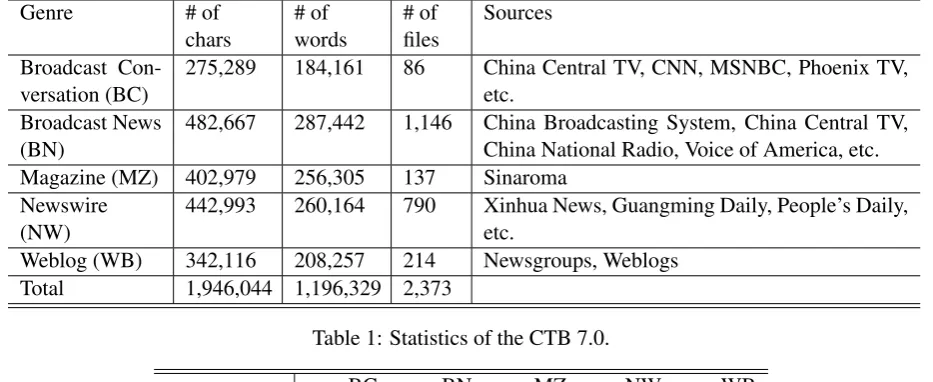
The Chinese Penn Treebank (CTB) version 7.04 (Xia et al., 2000) is used in our experiments. It contains about 1.2 million words from five genres: Broadcast Conversation (BC), Broadcast News (BN), Magazine (MZ), Newswire (NW), and We-blog (WB). The details of the five genres of CTB 7.0 are shown in Table 1.
We divide the data in each genre into ten folds based on character counts, and use the first eight folds for training, the next fold for development, and the last fold for testing. In order to make the size of the training data for each genre to be the same, we set the training size to be the size of the training folds in the BC genre (the smallest genre in the CTB 7.0). We do the same for the develop-ment data. For testing, we use the whole test fold for each genre. The sizes of the data sets used in the experiments are shown in Table 2.5
Without loss of generality, we use BC and NW as the test genres; for each test genre, we use the union of training folds from other four genres as the training data.
4Linguistic Data Consortium No. LDC2010T07 5Although we are not using the development fold for the
Genre # of chars
# of words
# of files
Sources
Broadcast Con-versation (BC)
275,289 184,161 86 China Central TV, CNN, MSNBC, Phoenix TV, etc.
Broadcast News (BN)
482,667 287,442 1,146 China Broadcasting System, China Central TV, China National Radio, Voice of America, etc. Magazine (MZ) 402,979 256,305 137 Sinaroma
Newswire (NW)
442,993 260,164 790 Xinhua News, Guangming Daily, People’s Daily, etc.
Weblog (WB) 342,116 208,257 214 Newsgroups, Weblogs Total 1,946,044 1,196,329 2,373
Table 1: Statistics of the CTB 7.0.
BC BN MZ NW WB
Training 211,795 211,826 211,834 211,853 211,796 Development 30,678 30,760 30,708 30,726 30,746 Test 32,816 48,317 37,531 44,543 33,623
Table 2: Statistics of training, development, and test portions of each genre in CTB 7.0. The numbers are character counts.
4.2 Training Data Selection
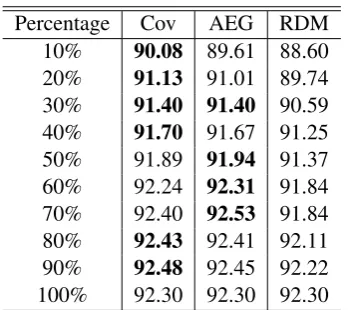
To demonstrate our coverage-based training data selection method, we first compare its perfor-mance on POS tagging with other two methods, AEG (Song et al., 2012) and random selection.6 The selected proportion of training data range from 10% to 90%, based on character counts. Here, we use Stanford POS Tagger (Toutanova et al., 2003). The results on BC and NW are shown in Table 3 and 4, with comparison to random se-lection methods.7
Our coverage-based training data selection method outperforms random selection on both BC and NW. It also outperforms AEG when a low per-centage of data is selected, while its performance is comparable or slightly lower than AEG when a higher percentage of data is selected. To under-stand this behavior, we compare some statistics of the data sets, as in Table 5.
Since OOV rate is important for CWS and POS tagging, we want to compare our coverage-based method and AEG for this factor, and the results are presented in Table 6.
The table shows that when a small percentage
6Song et al. (2012) showed that AEG works better than
cross entropy, as well as difference of cross entropy, on CWS and POS tagging. Therefore we only compare our method with AEG in this paper.
7For each percentage, the result of random selection are
the average of three runs of random selection.
(e.g., 10%, 20%) of source-domain data is se-lected, the OOV rate of the test data is much lower when Cov is used. In contrast, when a large per-centage (e.g., 80% and 90%) of training data is selected, the OOV rates are similar between Cov and AEG. This could be the reason why Cov out-performs AEG when a small percentage of train-ing data is selected, but not so when more traintrain-ing data is selected.
For the rest of the experiments, we will use Cov for training data selection and test whether our revised feature augmentation approach provides some improvement for CWS and POS tagging.
4.3 Chinese Word Segmentation
To evaluate feature augmentation on CWS, we use a conditional random fields (CRF) word segmenter as described in (Song and Xia, 2012). A nice prop-erty of the segmenter is that it incorporates unsu-pervised learning to identify possible new words in the test data in order to enhance the segmenter’s performance on OOVs. To be more specific, the segmenter uses description length gain (DLG) (Kit and Wilks, 1999) for lexical acquisition as that was performed in (Kit, 2000; Kit, 2005). Then the de-cision of the unsupervised word segmentation is represented as featuresTi
charac-Percentage Cov AEG RDM 10% 90.08 89.61 88.60 20% 91.13 91.01 89.74 30% 91.40 91.40 90.59 40% 91.70 91.67 91.25 50% 91.89 91.94 91.37 60% 92.24 92.31 91.84 70% 92.40 92.53 91.84 80% 92.43 92.41 92.11 90% 92.48 92.45 92.22 100% 92.30 92.30 92.30
Table 3: Performance of Stanford POS tagger when tested on BC and trained on the other four genres. The largest number in each row is in bold. Cov, AEG and RDM refer to our coverage-based method, Average entropy gain and random selec-tion.
Percentage Cov AEG RDM 10% 89.97 87.73 87.53 20% 91.15 89.64 89.23 30% 91.73 90.74 90.31 40% 91.91 91.41 91.32 50% 92.21 91.86 91.38 60% 92.18 92.03 91.63 70% 92.32 92.19 91.90 80% 92.41 92.45 92.28 90% 92.51 92.48 92.33 100% 92.56 92.56 92.56
Table 4: Performance of Stanford POS tagger when tested on NW and trained on the other four genres. The largest number in each row is in bold. Cov, AEG and RDM refer to our coverage-based method, Average entropy gain and random selec-tion.
Test genre BC NW Tokens in training 536,356 533,594
Tokens in test 22,088 25,916 OOV tokens 1,034 1,986
OOV rate 4.68% 7.66%
Table 5: Statistics (in words) of the entire training and test data for BC and NW.
BC NW
% Cov AEG Cov AEG
10% 9.04% 11.53% 14.27% 19.61% 20% 5.22% 8.21% 10.19% 14.59% 80% 4.76% 5.19% 7.66% 8.18% 90% 4.68% 4.85% 7.66% 7.94%
Table 6: The OOV rate (in words) when a different percentage (10%, 20%, 80% and 90%) of training data is selected by coverage-based method (Cov) and AEG against test data on BC and NW.
ters. These features are added to the standard fea-ture set for supervised learning. The new feafea-ture set is in Table 7, where the subscript -1, 0, and +1 refer to the previous, current and next character, respectively.
Description Features Char Unigrams C−1,C0,C+1
Char Bigrams C−1C0,C0C+1,C−1C+1 DLG Features T01,T02,T03,T04,T05
Table 7: Feature template of our CRF segmenter.
For feature augmentation, we compare two set-tings: one duplicates all the features and the other duplicates only the unlexicalized features. The re-sults when tested on BC are in Table 8. It shows that augmenting unlexicalized features provides better performance than augmenting all features. For the rest of experiments, feature augmentation will duplicate only the unlexicalized features.
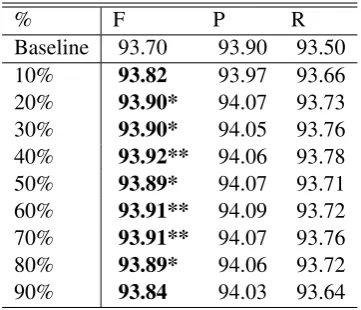
Table 9 shows the performance of using feature augmentation on CWS when tested on NW. Ta-ble 8 and 9 both show that our approach on di-vided training data improves system performance significantly (e.g., over 0.6% when tested on BC) without using any external resources. For Tables 9 and 11, we use a ten-partition two-tailed paired Student t-test for significance test.
4.4 POS Tagging
To evaluate feature augmentation on POS tagging, we used an in-house CRF tagger.8 Table 10 shows the feature set used by the tagger, where subscript -1, 0, and +1 refer to the previous, current and
8The reason that we use our in-house CRF POS tagger,
% of data Unlex. Feat. Aug. All Feat. Aug.
selected F P R F P R
Baseline 94.10 93.87 94.34 94.10 93.87 94.34 10% 94.70 94.30 95.09 93.71 93.43 94.00 20% 94.72 94.35 95.09 94.06 93.98 94.14 30% 94.62 94.23 95.01 94.19 94.07 94.31 40% 94.51 94.07 94.96 94.11 93.96 94.26 50% 94.51 94.08 94.94 93.96 93.80 94.12 60% 94.10 93.77 94.43 93.96 93.86 94.06 70% 94.16 93.86 94.46 94.06 93.99 94.12 80% 94.08 93.80 94.37 93.88 93.81 93.95 90% 94.08 93.84 94.32 93.90 93.60 94.20
Table 8: Performance of feature augmentation on CWS, with unlexicalized and all features augmented. The pseudo target data is selected by coverage-based method. The segmenter is tested onBC, and trained on the other four genres in CTB 7.0. F-score (F), Precision (P) and Recall (R) are presented. F-scores higher than the baseline are in bold.
% F P R
Baseline 93.70 93.90 93.50
10% 93.82 93.97 93.66
20% 93.90* 94.07 93.73
30% 93.90* 94.05 93.76
40% 93.92** 94.06 93.78
50% 93.89* 94.07 93.71
60% 93.91** 94.09 93.72 70% 93.91** 94.07 93.76
80% 93.89* 94.06 93.72
90% 93.84 94.03 93.64
Table 9: Performance of feature augmentation on CWS, with unlexicalized features augmented. The pseudo target data is selected by coverage-based method. The segmenter is tested on NW, and trained on the other four genres in CTB 7.0. F-score (F), Precision (P) and Recall (R) are pre-sented. F-scores higher than the baseline are in bold. Symbols * and ** indicate significance at p=0.05 and p=0.01 against the baseline, respec-tively.
next word, respectively. This feature set is sim-ilar to the one used in the Stanford POS tagger, but our tagger does not include some hard coded treatment and rules (e.g., bidirectional transition rules) used by the Stanford tagger. As a result, the performance of our tagger is slightly lower than the Stanford tagger. For instance, when tested on
BCand trained on the other four genres, the tag-ging accuracy of our tagger is 91.95%, compared to 92.30% by the Stanford tagger (see the last row
Description Features Word Unigrams W−1,W0,W+1
Word Bigrams W−1W0,W0W+1,W−1W+1 Word Prefix P0
Word Suffix S0 Word Prefix Type T P0 Word Suffix Type T S0
Table 10: Feature template of our CRF POS tag-ger.
in Table 11 and Table 3).
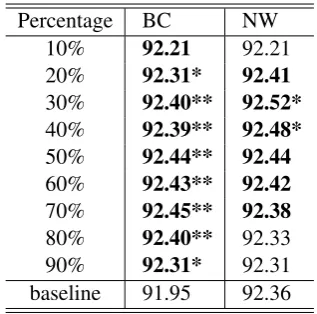
Table 11 shows the results of POS tagging with feature augmentation. The test genre is BC or NW, and the training data come from the other four gen-res. The first row lists the percentage of training data chosen by our coverage-based training data selection. The baseline shows the performance of our CRF tagger when the whole training set is used without training data selection and feature aug-mentation. In the table, the higher-than-baseline tagging accuracy in each test are marked in bold-face. Similar to CWS, training data selection fol-lowed by feature augmentation improves the per-formance of the POS tagger.
4.5 Discussion
fea-Percentage BC NW
10% 92.21 92.21
20% 92.31* 92.41
30% 92.40** 92.52* 40% 92.39** 92.48* 50% 92.44** 92.44 60% 92.43** 92.42 70% 92.45** 92.38 80% 92.40** 92.33
90% 92.31* 92.31
baseline 91.95 92.36
Table 11: Performance of our POS tagger with feature augmentation when tested on BC and NW. Numbers presented in the table are tagging accu-racy, and the ones higher than the baseline are in bold. Symbols * and ** indicate significance at p=0.05 and p=0.01 against the baseline, respec-tively.
ture augmentation (e.g., 91.95% vs. 92.45% on BC in Table 11). Second, duplicating only a sub-set of features outperforms duplicating all the fea-tures, as the large number of features for the lat-ter strategy could aggravate the data sparsity prob-lem. Augmenting some features (e.g., lexicalized) could actually hurt the performance. Third, with regard to the percentage of training data selected for the pseudo target domain, system performance improves when the percentage of selected data in-creases from 10% up to a certain point (70% for testing on BC and 30% for testing on NW on POS tagging), and afterwards it starts to degrade be-cause newly added pseudo target domain data is no longer quite similar to the target domain. The optimal size of the selected subset may depend on how similar the training data is to the test data. Fourth, when comparing CWS and POS tagging, we can find the same trend in feature augmenta-tion across different tasks. That is, when feature augmentation on CWS has higher improvement, usually it also brings higher improvement on POS tagging when comparing across different test data (e.g., the improvement on BC is higher than NW for CWS, and the same is true for POS tagging).
5 Conclusion
This study has made two contributions to domain adaptation. First, we proposed an approach that combines training data selection and feature aug-mentation. It tackles the limitations of both feature
augmentation and training data selection methods as it does not require labeled data from the target domain while it takes advantage of the entire train-ing data. Consequently, it significantly improves system performance over the baseline. We also demonstrate that augmenting some features works better than augmenting all the features because the latter setting triples the number of features which could lead to severe data sparsity problem. Our experimental attempts confirmed the fact that aug-menting less-sparse features (unlexicalized one, e.g., prefix and suffix, character type) led to bet-ter performance than all features. Second, we pro-posed a new measure for training data selection, which selects training sentences to maximize the coverage of ngrams on the test data. It showed a better performance than other measures espe-cially when a small subset of training data is se-lected. The approaches has been evaluated on two NLP tasks, namely, Chinese word segmentation and part-of-speech tagging. Both tasks confirmed the effectiveness of our approaches and yield bet-ter performance than the baseline settings.
For future work, we would like to apply auto-matic feature selection to determine what kind of features should be duplicated to boost the bene-fits of feature augmentation. We would also like to evaluate our approach on other NLP tasks, and test its performance with other machine learning algorithms.
References
Amittai Axelrod, Xiaodong He, and Jianfeng Gao. 2011. Domain adaptation via pseudo in-domain data selection. In Proceedings of EMNLP2011, pages 355–362.
Hal Daume III. 2007. Frustratingly easy domain adap-tation. InProceedings of the 45th Annual Meeting of the Association of Computational Linguistics (ACL), pages 256–263.
Matthias Eck, Stephan Vogel, and Alex Waibel. 2005. Low cost portability for statistical machine transla-tion based on n-gram coverage. In Proceedings of MT Summit X, pages 227–234.
Almut Silja Hildebrand, Matthias Eck, and Stephan Vo-gel. 2005. Adaptation of the translation model for statistical machine translation based on information retrieval. InProceedings of EAMT 2005, pages 133– 142.
Chunyu Kit. 2000. Unsupervised Lexical Learning as Inductive Inference. Ph.D. thesis, University of Sheffield.
Chunyu Kit. 2005. Unsupervised lexical learning as inductive inference via compression. In J. W. Minett and W. S.Y. Wang, editors, Language Acquisition, Change and Emergence, pages 251–296.
Yajuan Lu, Jin Huang, and Qun Liu. 2007. Improv-ing statistical machine translation performance by training data selection and optimization. In Pro-ceedings of EMNLP-CoNLL2007, pages 343–350, Prague, Czech Republic, June. Association for Com-putational Linguistics.
R.C. Moore and W. Lewis. 2010. Intelligent selection of language model training data. InProceedings of ACL2010, Short Papers, pages 220–224.
Dragos Stefan Munteanu and Daniel Marcu. 2005. Im-proving machine translation performance by exploit-ing non-parallel corpora. Computational Linguis-tics, 31(4):477–504.
B. Plank and G. van Noord. 2011. Effective measures of domain similarity for parsing. InProceedings of the 49th Annual Meeting of the Association for Com-putational Linguistics: Human Language Technolo-gies (ACL-HLT), pages 1566–1576.
Yan Song and Fei Xia. 2012. Using a goodness mea-surement for domain adaptation: A case study on chinese word segmentation. InProceedings of the Eighth International Conference on Language Re-sources and Evaluation (LREC-2012), pages 3853– 3860, Istanbul, Turkey, May. European Language Resources Association (ELRA). ACL Anthology Identifier: L12-1580.
Yan Song, Prescott Klassen, Fei Xia, and Chunyu Kit. 2012. Entropy-based training data selection for do-main adaptation. InProceedings of COLING 2012, pages 1191–1200, Mumbai, India, December. The COLING 2012 Organizing Committee.
Kristina Toutanova, Dan Klein, Christopher D. Man-ning, and Yoram Singer. 2003. Feature-rich part-of-speech tagging with a cyclic dependency network. InProceedings of the 2003 Conference of the North American Chapter of the Association for Computa-tional Linguistics on Human Language Technology (NAACL), pages 173–180.