An Unsupervised Approach to Domain-Specific Term Extraction
Su Nam Kim♠, Timothy Baldwin♥♠ ♥CSSE ♥NICTA VRL University of Melbourne
VIC 3010 Australia
[email protected],[email protected]
Min-Yen Kan♣ ♣School of Computing National University of Singapore
Abstract
Domain-specific terms provide vital se-mantic information for many natural lan-guage processing (NLP) tasks and appli-cations, but remain a largely untapped re-source in the field. In this paper, we pro-pose an unsupervised method to extract domain-specific terms from the Reuters document collection using term frequency and inverse document frequency.
1 Introduction
Automatic domain-specific term extraction is a categorization/classification task where terms are categorized into a set of predefined domains. It has been employed in tasks such as keyphrase extraction (Frank et al., 1999; Witten et al., 1999), word sense disambiguation (Magnini et al., 2002), and query expansion and cross-lingual text categorization (Rigutini et al., 2005). Even though the approach shows promise, relatively lit-tle research has been carried out to study its ef-fects in detail (Drouin, 2004; Milne et al., 2006; Rigutini et al., 2006; Kida et al., 2007; Park et al., 2008). Most of the research to date on domain-specific term extraction has employed supervised machine learning, within the fields of term cat-egorization and text mining. However, to date, the only research to approach the task in an un-supervised manner is that of Park et al. (2008). Unsupervised methods have the obvious advan-tage that they circumvent the need for laborious manual classification of training instances, and are thus readily applicable to arbitrary sets of do-mains, tasks and languages.
In this paper, we present a novel unsupervised method for automatically extracting domain-specific terms, targeted domain-specifically at building domain-specific lexicons for natural language
processing (NLP) purposes. One of the main properties utilized in this work isdomain speci-ficity. Our notion of domain specificityis based on statistical analysis of word usage, and adopts the simple notions ofterm frequency(TF) and in-verse document frequency(IDF) over domains to capture their domain specificity.
2 Unsupervised Domain-Specific Term Extraction
In this section, we elaborate on our proposed method, as well as the benchmark method of Park et al. (2008).
2.1 Proposed Method (D1)
Our proposed unsupervised method is based on TF-IDF. The basic underlying idea is that domain-specific terms occur in a particular do-main with markedly higher frequency than they do in other domains, similar to term frequency patterns captured byTF-IDF.
Hence, we compute TF-IDF from TFij, the
term frequency of term ifrom documents in do-mainj, andIDFi, the inverse domain frequency.
The calculation ofTFij is via:
TFij =
nij
∑
knkj
(1)
wherenij is the number of occurrences of termi
in the documents associated with domainj.IDFi
is calculated via:
IDFi =log( |
D|
|{d:ti∈d}|
) (2)
where ti is the term, and D is the set of all
do-mains.
The finalTF-IDFij value of a given term is the
simple product ofTFij andIDFi.
values than a given threshold. We select the threshold heuristically based on the score distri-bution, specifically choosing the point at which there is a significant drop in TF-IDF scores. That is, when the number of domain-specific terms gained at the current similarity is no more than 20% of the previously-accumulated domain-specific terms, we use that similarity as our threshold.
2.2 Benchmark Method (D2)
We compare our proposed method with the only unsupervised domain-specific term extrac-tion method, i.e. the method of Park et al. (2008). Park et al. directly compare term frequencies in documents for a given domain d with term frequencies in the general document collection, based on:
domain specificity(w) =
cd(w)
Nd
cg(w)
Ng
(3)
where cd(w) and cg(w) denote the number of
occurrences of term w in the domain text and general document collection, respectively. Nd
andNg are the numbers of terms in the
domain-specific corpus and in the general corpus, respec-tively. If termwdoes not occur in the general cor-pus, thencg(w)is set to 1; otherwise it is set to the
highest count in the general corpus. In the origi-nal work, a one million term corpus from mostly news articles was used as the general corpus. The final score is computed as:
Final Score = F+M
N ×100 (4) whereN is the number of keywords in the refer-ence data, F is the number of falsely-recognized domain-specific terms (false positives), and M is the number of missed domain-specific terms (false negatives). We avoid computing the final score as shown in (4) since we do not have refer-ence data. Instead, we set a threshold by looking for a significant drop in the score (i.e. the score when the number of newly-extracted terms is less than 20% of the previously-learned terms), as in our approach (D1).
2.3 Collecting Domain-Specific Words
To collect domain-specific words, we used the modified Lewis splitof theReuters document
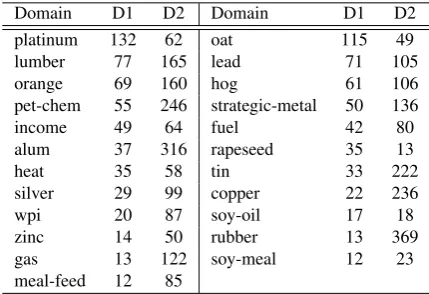
col-Domain D1 D2 Domain D1 D2 platinum 132 62 oat 115 49 lumber 77 165 lead 71 105
orange 69 160 hog 61 106
pet-chem 55 246 strategic-metal 50 136
income 49 64 fuel 42 80
alum 37 316 rapeseed 35 13
heat 35 58 tin 33 222
silver 29 99 copper 22 236
wpi 20 87 soy-oil 17 18
zinc 14 50 rubber 13 369
gas 13 122 soy-meal 12 23 meal-feed 12 85
Table 1: Number of extracted domain-specific terms
lection,1 a dataset which has been extensively used for text categorization, since it contains document-level topics (i.e. domains). In detail,
the modified Lewis split version of the collec-tion is made up of 90 topics and 3,019 and 7,771 test and training documents, respectively. We ex-tract domain-specific terms from the training doc-uments, and use the 3,019 test articles for text cat-egorization and keyphrase extraction evaluation in Section 3.
After collecting words with the proposed (D1) and benchmark (D2) methods, we compared them in the form of the ratio of domain-specific terms to the number of domains. Among all the mains present in the corpus, we selected 23 do-mains which had at least 5 articles in both the test and training data splits, both to manually ver-ify the performance of the two methods, and to utilize the collected domain-specific terms in ap-plications. The total number of terms collected from the 386 selected articles were 1,013 and 2,865, respectively. Table 1 shows the number of domain-specific terms extracted by D1 and the method of D2 over the selected 23 domains. D2 extracts nearly three times more domain-specific terms than D1, but the distribution of terms across domains is relatively well proportioned with D1. This preliminary observation suggests that D1 is more reliable than the benchmark system.
2.4 Human Verification
We manually verified how well our proposed method extracts domain-specific terms. Unlike the method of (Drouin, 2004), where experts
1
scored extracted terms for subtle differences in domain specificity, we opted for a simple annota-tion process involving non-expert annotators. We asked three human annotators to answer “yes” or “no” when given a term and its domain, as pre-dicted by the two methods. Note that before an-notating the actual data set, we trained the hu-man annotators in the context of a pilot annota-tion test. In our human verificaannota-tion process, we at-tained an accuracy of40.59%and36.59%for D1 and D2, respectively, with initial inter-annotator agreement of 69.61% and 73.04%, respectively. Thus, we cautiously conclude that our proposed method performs better than Park et al. (2008). Note that as the work in Park et al. (2008) was originally developed to extract domain-specific terms for use in correcting domain term errors, the authors did not discuss the performance of domain-specific term extraction in isolation.
We made a few observations during the man-ual verification process. Despite the strict anno-tation guidelines (which were further adjusted af-ter the pilot test), the agreement actually dropped between the pilot and the final annotation (espe-cially with one of the annotators, namelyA3). We
asked the individual annotators about the ease of the verification procedure and the notion of do-main specificity, from their individual perspec-tive. It turned out that although the choice of do-main specificity was guided by statistical usage, word senses were involved in the decision pro-cess to some degree. Additionally, the annota-tors commented on the subjectivity of statistical markedness of the terms. The average correla-tions among two annotators are.738and.673for D1 and D2, respectively.
3 Applying Domain-Specific Terms
In this section, we evaluate the utility of the col-lected domain-specific terms via two tasks: text categorization and keyphrase extraction. Our mo-tivation in selecting these tasks is that domain-specific terms should offer a better representation of document topic than general terms.
3.1 Text Categorization
Automatic text categorization is the task of clas-sifying documents into a set of predefined cate-gories.
F1 F3
Type TF TF-IDF TF TF-IDF
Baseline .473 .660 .477 .677
Domain .536 .587 – –
Combined .583 .681 .579 .681
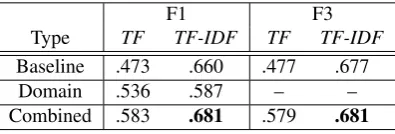
Table 2: Performance of text categorization
To build a text categorization model, we first preprocess the documents, perform part-of-speech (POS) tagging using a probabilistic POS tagger,2 and lemmatization usingmorpha (Min-nen et al., 2001). We then build an SVM-based classifier (Joachims, 1998).3 We useTF-IDFfor feature weighting, and all unigram terms. Note that when domain-specific terms are multiword noun phrases (NP), we break them down into uni-grams based on the findings of Hulth and Megyesi (2006). As baselines, we built systems using un-igram terms which occur above a threshold fre-quency (i.e. frefre-quency ≥ 1, 2 and 3 or F1, F2, F3 in Table 2) after removing stop words. Table 2 shows the micro-averaged F-scores of the text cat-egorization task. Note that since using F2 results in the lowest performance, we report only results over thresholds F1 and F3.
Table 2 shows that domain-specific terms alone do not perform well, since only a relatively small volume of domain-specific indexing terms are extracted, compared to the number of unigram terms. However, when combined with a uni-gram model, they aid uniuni-gram models to improve the overall performance. Despite only showing a small improvement, given the relatively small number of domain-specific terms extracted by our method, we confirm that domain-specific terms are useful for categorizing (monolingual) texts, just as domain specificity has been shown to help in cross-lingual text categorization (Rigutini et al., 2005).
3.2 Automatic Keyphrase Extraction
Keyphrases are simplex nouns or NPs that rep-resent the key ideas of the document. They can serve as a representative summary of the document and also as high-quality index terms. In the past, various attempts have been made
2Lingua::EN::Tagger 3
Type L Boolean TF TF-IDF
KEA NB .200 – –
ME .249 – –
KEA+ NB .204 .200 .197
Domain ME .260 .261 .267
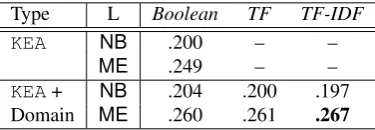
Table 3: Performance of keyphrase extraction
to boost automatic keyphrase extraction perfor-mance, based primarily on statistics (Frank et al., 1999; Witten et al., 1999) and a rich set of heuris-tic features (Nguyen and Kan, 2007).
To collect the gold-standard keyphrases, we hired two human annotators to manually assign keyphrases to 210 test articles in the same 23 selected domains. In summary, we collected a total of 1,339 keyphrases containing 911 sim-plex keyphrases and 428 NPs. We checked the keyphrases found after applying the candidate se-lection method employed from Nguyen and Kan (2007). The final number of keyphrases found in our data was only 750 (56.01% of all the docu-ments), among which 158 (21.07%) were NPs.
To build a keyphrase extractor, we first pre-processed them with a POS tagger and lemma-tizer, and applied the candidate selection method in Nguyen and Kan (2007) to extract candidates. Then, we adopted two features fromKEA(Frank et al., 1999; Witten et al., 1999), as well as the domain-specific terms collected by our method.
KEA uses two commonly used features: TF-IDF
for document cohesion, anddistanceto model the locality of keyphrases. Finally, we used the fea-tures to build a maxent classifier4 and a Na¨ıve Bayes (NB) model. To represent the domain specificity of the keyphrase candidates, we simply presented the 23 domains as three separate sets of features with differing values (Boolean, TF and
TF-IDF), when a given keyphrase candidate is in-deed a domain-specific term. Finally, with KEA
as a baseline, we compared the systems over the top-7 candidates using the current standard eval-uation method (i.e.exact matching scheme). Ta-ble 3 shows the micro-averaged F-scores.
In the results, we first notice that our test sys-tem outperformed KEA with ME, but that our test system using Boolean produced better per-formance thanKEAonly withNB. The maximum
4
http://maxent.sourceforge.net/index. html
improvement in F-score is about 1.8%, in the best configuration whereTF-IDFweighting is used in conjunction with anME learner. This is partic-ularly notable because: (a) the average perfor-mance of current keyphrase extraction systems is a little more than 3 matching keyphrases over the top 15 candidates, but we produce only 7 candi-dates; and (b) the candidate selection method we employed (Nguyen and Kan, 2007) found only 56.01% of keyphrases as candidates. Finally, we note with cautious optimism that domain-specific terms can help in keyphrase extraction, since keyphrases are similar in the same or similar do-mains.
4 Conclusions
In this work, we have presented an unsupervised method which automatically extracts domain-specific terms based on term and document statistics, using a simple adaptation of TF-IDF. We compared our method with the benchmark method of Park et al. (2008) using human judge-ments. Although our method did not extract a large number of domain-specific terms, the qual-ity of terms is high and well distributed over all domains. In addition, we have confirmed the util-ity of domain-specific terms in both text catego-rization and keyphrase extraction tasks. We em-pirically verified that domain-specific terms are indeed useful in keyphrase extraction, and to a lesser degree, text categorization. Although we could not conclusively prove the higher utility of these terms, there is a strong indicator that they are useful and deserve further analysis. Addition-ally, given the small number of domain-specific terms we extracted and used, we conclude that they are useful for text categorization.
Acknowledgements
NICTA is funded by the Australian Government as represented by the Department of Broadband, Communications and the Digital Economy and the Australian Research Council through the ICT Centre of Excellence program.
References
rating: Filtering obscence content on the Web. In Proceedings of ECRATDL. 2000, pp. 403–406. P. Drouin. Detection of Domain Specific
Terminol-ogy Using Corpora Comparison. InProceedings of LREC. 2004, pp. 79–82.
G. Escudero and L. Marquez and G. Rigau. Boosting applied to word sense disambiguation. In Proceed-ings of 11th ECML. 2000, pp. 129–141.
E. Frank and G.W. Paynter and I. Witten and C. Gutwin and C.G. Nevill-Manning. Domain Spe-cific Keyphrase Extraction. InProceedings of 16th IJCAI. 1999, pp. 668–673.
A. Hulth and B. Megayesi. A Study on Automatically Extracted Keywords in Text Categorization. In Pro-ceedings of COLING/ACL. 2006, pp. 537–544. T. Joachims. Text categorization with support vector
machines: Learning with many relevant features. In Proceedings of ECML. 1998, pp. 137–142. M. Kida and M. Tonoike and T. Utsuro and S. Sato.
Domain Classification of Technical Terms Using the Web. Systems and Computers. 2007, 38(14), pp. 2470–2482.
P. Lafon. Sur la variabilite de la frequence des formes dans un corpus. InMOTS. 1980, pp. 128–165.
B. Magnini and C. Strapparava and G. Pezzulo and A. Gliozzo. The role of domain information in word sense disambiguation. NLE. 2002, 8(4), pp. 359– 373.
D. Milne and O. Medelyan and I.H. Witten. Mining Domain-Specific Thesauri from Wikipedia: A case study. InProceedings of the International Confer-ence on Web IntelligConfer-ence. 2006.
G. Minnen and J. Carroll and D. Pearce. Applied morphological processing of English. NLE. 2001, 7(3), pp.207–223.
T.D. Nguyen and M.Y. Kan. Key phrase Extraction in Scientific Publications. In Proceeding of ICADL. 2007, pp. 317-326.
Y. Park and S. Patwardhan and K. Visweswariah and S.C. Gates. An Empirical Analysis of Word Error Rate and Keyword Error Rate. InProceedings of ICSLP. 2008.
L. Rigutini and B. Liu and Marco Magnini. An EM based training algorithm for cross-language text categorization. In Proceedings of WI. 2005, pp. 529-535.
L. Rigutini and E. Di Iorio and M. Ernandes and M. Maggini. Automatic term categorization by extract-ing knowledge from the Web. In Proceedings of 17th ECAI. 2006.
G. Salton and A. Wong and C.S. Yang. A vector space model for automatic indexing. Communications of the ACM. 1975, 18(11), pp. 61–620.