Investigating Features for Classifying Noun Relations
Dominick Ng, David J. Kedziora, Terry T. W. Miu and James R. Curran School of Information Technologies
University of Sydney NSW 2006 Australia
{dong7223,dked9370,tmiu9098,james}@it.usyd.edu.au
Abstract
Automated recognition of the semantic re-lationship between two nouns in a sentence is useful for a wide variety of tasks in NLP. Previous approaches have used ker-nel methods with semantic and lexical evi-dence for classification. We present a sys-tem based on a maximum entropy classifier which also considers both the grammatical dependencies in a sentence and significance information based on the Google Web 1T dataset.
We report results comparable with state of the art performance using limited data based on the SemEval 2007 shared task on nominal classification.
1 Introduction
Analysis of the semantics of natural language is an area of research undergoing renewed interest, driven by the many applications which can di-rectly benefit from such information, including question answering and text summarization. In particular, recognition of the relationship between words in a sentence is useful for clarifying ambi-guities in tools that attempt to interpret and re-spond to natural language. Recent developments in the semantic web – a vision where information is comprehensible to machines as well as people – have also accelerated the need for tools which can automatically analyse nominal relationships.
We approach the task of relation classification using the relation set and training data provided by the SemEval 2007 shared task on nominal clas-sification (Girju et al., 2007). The problem as
defined by the task description is to discover the underlying relationship between the concepts ex-pressed by two nominals, excluding named enti-ties. The relationship is informed by the context of an English sentence, e.g. it is clear that the relationship between door andcar differs in the fragments the car door andthe car scraped the door of the garage. Resolving the relation be-tween nominals in cases where ambiguities exist is useful for generalisation inNLPsystems.
We created a system based upon a maximum entropy (ME) classifier developed by Clark and Curran (2004). A separate binary classifier for each of the relations was trained over the cor-responding training data, and the additional fea-tures used for each relation were selected by performing a seven-fold cross-validation over all combinations of features developed for this task. We report an overall accuracy of 71.9% macro-averaged over the seven relations and an overall F-measure of 70.7%, comparable with state of the art performance.
2 Background
Relation Training Example
Cause-Effect [e1 Famine] following [e2 drought] has hit the West African savannahs,
where there have been other bad droughts. Instrument-Agency The[e1 judge]hesitates,[e2 gavel]poised.
Product-Producer The[e1 artist]made the[e2picture]when he was in fourth grade.
Origin-Entity It’s unfortunate you didn’t try a[e1potato] [e2vodka].
Theme-Tool The[e1 submission] [e2deadline]is February, 2, 2007.
Part-Whole Typically, an unglazed[e1clay] [e2pot]is submerged for 15 to 30 minutes
to absorb water.
Content-Container The[e1 kitchen]holds patient[e2drinks]and snacks.
Table 1: Examples of the SemEval relations.
of these hierarchies to another domain. The or-ganisers of the SemEval task defined the classi-fication problem in terms of seven semantic rela-tions commonly mentioned by researchers, and a list of these along with some training examples is provided in Table 1. An annotated dataset of 140 training examples and at least 70 test sen-tences was created for each relation by searching the web using wild-card search patterns satisfy-ing the constraints of each relation, e.g. * holds * for the Content-Container relation. This method was used in order to provide near miss negative examples (Girju et al., 2007).
Fifteen systems split into four categories were submitted for the SemEval 2007 workshop. Al-most all of the systems utilised extended fea-ture sets that built upon the data provided by the task; most systems also implemented some form of statistical or kernel approach to develop bi-nary classifiers for the relations (see Bedmar et al. (2007), Hendrickx et al. (2007), and Nulty (2007) for some previous approaches to the classification task explored in this paper). The best perform-ing systems achieved F-measures in the range of 71.5% – 72.4% by utilising the provided WordNet sense keys and adding more training examples to those supplied by the task; however, the major-ity of systems did not augment the provided data like this and reported F-measures and accuracies below 67.2% (Girju et al., 2007).
Each training example in the annotated dataset consists of a sentence, two nominals whose re-lationship is to be evaluated, WordNet 3.0 sense keys for each of the nominals, the wild-card query used to obtain the example, and comments on the
choices made during the creation of the example. The evaluation drew distinction between systems that did and did not use the supplied WordNet and wild-card query information.
3 Maximum Entropy Modelling
The entropy of a classifier is a measure of how predictable that classifier’s decisions are. The lower the entropy, the more biased a classifier is, i.e. a relation classifier has zero entropy if it always assigns the same relation to any input. The theory underpinningMEmodelling is that the distribution chosen to fit the specified constraints will eliminate biases by being as uniform as pos-sible. Such models are useful inNLPapplications because they can effectively incorporate diverse and overlapping features whilst also addressing statistical dependencies.
We used the ME implementation described in Clark and Curran (2004). The ME models used have the following form:
p(y|x, λ) = 1
Z(x|λ)exp
n X
k=1
λkfk(x, y) !
whereZ(x|λ)is the normalisation function and the fk are features with associated weights λk.
The system uses Gaussian smoothing on the pa-rameters of the model. The features are binary-valued functions which pair a relationywith vari-ous observationsxfrom the context provided, e.g.
fj(x, y) =
1 ifword(x) =damage&
y=Cause-Effect-True
4 Features and Methodology
We focused our efforts on finding features which aggressively generalise the initial material over as broad a search space as possible. We investigated lexical, semantic, and statistical features sourced from a number of corpora as well as morpho-syntactic features from a grammatical parse of each sentence. Features were evaluated using a seven-fold cross-validation performed over the training data for each relation over every possible combination of features – a process made possible by the small size of the corpora and the relatively small number of features experimented with. The speed of the training process for the ME imple-mentation was also a factor in enabling the ex-haustive search.
The features which resulted in the best perfor-mance for each relation in the cross-validation were then used to train seven binary classifiers for the final run over the supplied test data.
4.1 Preprocessing
Prior to feature generation our system extracted from the supplied data the sentences and marked nominals (termed ase1 ande2). While WordNet
was used internally as features by our system, we did not use the specific sense keys provided by the data to query WordNet – we relied upon a more general word lookup that extracted all of the pos-sible senses for the nominals. We also did not make use of the provided query, based on its inef-fectiveness in previous studies (Girju et al., 2007). Close examination of the training data also re-vealed some negative training examples that were identified in comments as belonging to a differ-ent relation set. These examples were collected and added to the appropriate training file to fur-ther extend the original dataset. However, no new examples were created: only examples which had already been identified as belonging to a particu-lar relation were added in this process.
4.2 Lexical Features
Lexical features are useful for capturing contex-tual information about the training example, and they are the most obvious features to incorporate. However, due to the limited amount of training data available for this task, lexical features en-counter sparseness problems as there are few
rel-evant collisions between words. We utilised the following lexical features:
• sen: The words of the sentence itself. This was used as the baseline for feature testing;
• red: A reduced version of the sentence with all words of length 2 or less removed;
• heads: The head words of the nominals in question, e.g. for [e1 tumor shrinkage] af-ter[e2radiation therapy]the relation actually holds betweenshrinkageandtherapy. This feature is very specific, but allows for nom-inals which are commonly linked to certain relations to be identified;
• dir: The required direction of the relation (i.e. frome1 toe2 or vice versa) that is
en-coded in the data – useful as some relations are more likely to exist in a particular direc-tion, e.g. the Part-Whole relation is most commonly found encoded in the direction
[e1Part]-[e2 Whole](Beamer et al., 2007).
4.3 WordNet Features
WordNet (Fellbaum, 1998) is the most heavily used database of lexical semantics in NLP. Cre-ated at Princeton University, WordNet is based around groups of synonyms (synsets) and encodes a vast array of semantic properties and relation-ships between these synsets. The coverage of WordNet means that it is very useful for gener-alising features over a small corpus of data, and many previous approaches to classification tasks have utilised WordNet in some way – including most of the systems from the SemEval proceed-ings (Girju et al., 2007). However, unlike most of these systems, we did not use the supplied Word-Net sense keys as we believe that it is unrealistic to have such precise data in real-world applica-tions. As a consequence, all of our WordNet fea-tures were extracted using the indicated nominals as query points.
• syn: Synonyms of the nominals. We ex-tracted from WordNet all synonyms in all senses for each of the marked nouns;
broaden the coverage given by the nominals over less specific entities. We exhaustively mined all hypernyms of the marked nouns to a height of two levels, and encoded the two levels as separate features;
• lex: Lexical file numbers, which corre-spond to a number of abstract semantic classes in WordNet, includingnoun.artifact, noun.event, and noun.process. This allows for nominal relations which do not make sense to be identified, e.g. a noun.process should not be able to contain anoun.event, but the process may cause the event (Bedmar et al., 2007);
• cont: Container - a binary feature indicat-ing whether the marked nouns are hyponyms (more specific concepts) of the container synset. This feature was included mainly for the benefit of the Content-Container relation; however, we hypothesised that their inclu-sion may also assist in classifying other rela-tions; e.g. the ‘effect’ in Cause-Effect should not be a physical entity.
4.4 Grammatical Relations Features
Syntactic features representing the pathbetween nominals are a useful complement for semantic and lexical features because they account for the way in which words are commonly used in text. Semantic relationships can often be associated with certain patterns of words, e.g. the patterne1 is inside e2is a strong indicator for the Content-Container relation for many general combinations ofe1 ande2. However, these patterns can be
ex-pressed in many different ways - inside e2 e1 is or inside e2 is e1 are other ways of expressing a Content-Container relationship – and while the words are essentially the same between the ex-amples the changed ordering creates difficulties in designing good features. This problem can be alleviated by considering syntactic dependencies in a sentence rather than a naive concatenation of words (Nicolae et al., 2007).
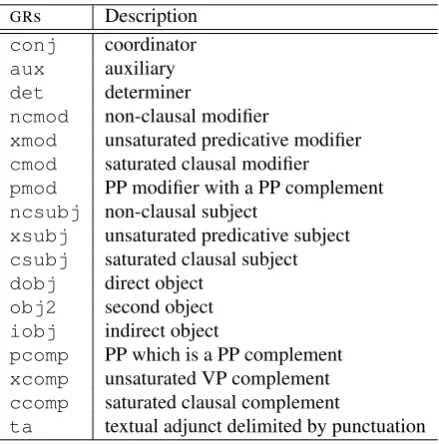
Grammatical relations (GRs) represent the syn-tactic dependencies that hold between a head and a dependent in text. Initially proposed by Carroll et al. (1998) as a framework-independent metric
GRs Description
conj coordinator
aux auxiliary
det determiner
ncmod non-clausal modifier
xmod unsaturated predicative modifier
cmod saturated clausal modifier
pmod PP modifier with a PP complement
ncsubj non-clausal subject
xsubj unsaturated predicative subject
csubj saturated clausal subject
dobj direct object
obj2 second object
iobj indirect object
pcomp PP which is a PP complement
xcomp unsaturated VP complement
ccomp saturated clausal complement
ta textual adjunct delimited by punctuation
Table 2: A list ofGRs
(det man 1 A 0)
(ncmod does 2 not 3) (aux talk 4 does 2) (ncsubj talk 4 man 1 )
(det woman 7 every 6) (ncsubj walks 8 woman 7 ) (conj or 5 walks 8)
(conj or 5 does 2)
Figure 1:GRs output from theC&Cparser
To extract the grammatical relations from the provided data we parsed each training and test ex-ample with the C&C parser developed by Clark and Curran (2007). Figure 1 gives an example of the GRs for the sentence A man does not talk or every woman walks. A dependency graph was generated from this output and the shortest path between the nominals found. In the example in Figure 1, the path between man and woman is talk does or walks.
Features were extracted from this path output in two formats: a generalised version (labelled with a ‘g’ prefix), whereby the two nominals in question were replaced whenever they appeared with the marker tagse1ande2, and the actual
ver-sion, where this extra generalisation step was not applied. We reasoned that the generalised output would be more useful as a classification feature as it removed the stipulation on the start and end of the path; however, we also felt that keeping the identity of the nominals would aid in classifying words often paired with prepositions that suggest some form of spatial or logical relationship, e.g. the fragmentafter hurricanessuggests some form of Cause-Effect relationship from the temporal in-dicator ‘after’. Our path features included:
• path, gpath: The path itself in
a concatenated format, e.g. dam-age comes after hurricanes or
e1 comes after e2. These patterns were postulated to have some correlation with each relation;
• strip, gstrip: The path with a length filter of 2 applied;
• slice, gslice: The nominals with their imme-diate neighbour from the path, e.g. dam-age comes, after hurricanes or e1 comes, aftere2;
• pair, gpair: The bigrams in the path, e.g.
e1 comes, comes after, aftere2;
• ptag, gptag: The underscore-concatenated POStags of the path words.
4.5 Web 1T Significance Features
Web 1T (Brants and Franz, 2006) is a Google-released corpus containing English word ngrams
O11: freq count of word and bound together O12: freq count of bound without word O21: freq count of word without bound O22: freq count of neither bound or word N: total number of tokens
χ2= N(O11O22−O12O21)2
(O11+O12)×(O11+O21)×(O12+O22)×(O21+O22)
Figure 2: The notation and formula used for the sig-nificance testing.
and their observed frequency counts in a body of approximately 1 trillion word tokens of text from publicly accessible web pages. Web 1T counts the occurrences of unigrams, 2-, 3-, 4-, and 5-grams in the 1 trillion word tokens, discarding unigrams appearing less than 200 times in the tokens (1 in 5 billion) and n-grams appearing less than 40 times (1 in 25 billion) in the tokens. This resource cap-tures many lexical patterns used in common En-glish, though there are some inconsistencies due to the permissive nature of the web: some com-monly misspelt words are included and some text in languages other than English are also present.
The idea of searching a large corpus for spe-cific lexical patterns to indicate semantic relations of interest was first described by Hearst (1992). As previously mentioned, we postulated that tain patterns of words would associate with cer-tain relations, but a naive concatenation of words located between the nominals would be unhelpful with such a small data set. This problem can be avoided by examining the frequencies of lexical patterns within a much larger dataset such as Web 1T, where the problem of data sparseness is offset by the size of the corpus. This pattern information would complement the semantic and syntactic in-formation already used by incorporating evidence regarding word use in real-world text.
Baseline F± std
sen 61.3±9.29 Feature Mean Improv± std
red +0.3±1.67 heads +0.7±2.47 dir +0.3±2.10 syn +1.2±3.29 hyp1 +1.3±4.25 hyp2 +5.6±4.39 lex +6.0±6.75 cont +1.5±2.52 path +0.2±1.00 gpath +0.5±3.17 strip +0.2±1.00 gstrip -0.5±3.47 slice +1.5±3.03 gslice +0.5±2.88 pair +0.2±1.93 gpair +1.4±2.82 ptag +0.5±1.54 gptag -0.6±2.79 ngram +1.8±2.94
Table 3: The average improvement in F-measure (us-ing the words of the sentence as a baseline) for each feature macro-averaged over all 7 relations
e2 is a strong indicator for the Content-Container relation for general combinations ofe1ande2.
The significance test was conducted as in Man-ning and Sch¨utze (2000). The Web 1T data was searched for any 3-, 4-, and 5-grams that had the same bounds as the nominals of the sentence in question, i.e. patterns which matche1...e2. Then, for every intermediate word in the pattern, a χ-squared value was calculated to measure the sig-nificance of the word in relation to the bounds. This process was repeated for each training ex-ample, and Figure 2 gives the equations used for this test. We conducted some brief experiments to find the range ofχ-squared values returned by this test; based on these we chose the χ-squared value of 10 to indicate significance to the training example being analysed, and selected all words with aχ-squared value above this level to add as ngram features.
5 Preliminary Feature Testing
As an initial step, we used the sentence words of each example as a baseline to test the individual performance of each feature in a seven-fold
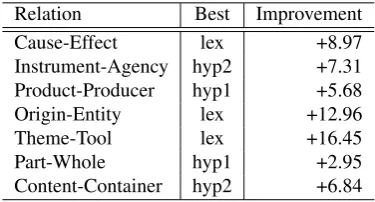
cross-Relation Best Improvement
Cause-Effect lex +8.97 Instrument-Agency hyp2 +7.31 Product-Producer hyp1 +5.68 Origin-Entity lex +12.96 Theme-Tool lex +16.45 Part-Whole hyp1 +2.95 Content-Container hyp2 +6.84
Table 4: The best performing single features (using the words of the sentence as a baseline) and their mean improvement in F-measure for each relation
validation over the training examples for each re-lation. We did this to compare the discrete im-provement over the baseline that each feature of-fered and to allow a comparison as to how com-bining the features improves performance.
Table 3 shows that most features offer small gains on average over the baseline sentence, but also exhibit varying degrees of performance over the relations as seen in the relatively large standard deviations. In particular, lexical file numbers and second-level hypernyms have the largest mean improvement in F-measure, but also the largest standard deviations – indicating a widespread distribution of positive and negative contributions. Table 4 shows that these two fea-tures improve the baseline F-measure of five of the relations, implying from the large standard deviations that they severely worsen the perfor-mance of the remaining two. This behaviour is explained by noting the wide generalisation that these features add, creating the most collisions between training and test data and hence affect-ing the decisions of the classifier the most.
6 Results and Discussion
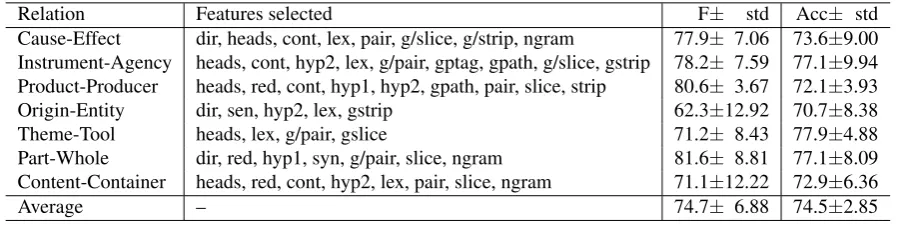
fea-Relation Features selected F± std Acc± std Cause-Effect dir, heads, cont, lex, pair, g/slice, g/strip, ngram 77.9± 7.06 73.6±9.00 Instrument-Agency heads, cont, hyp2, lex, g/pair, gptag, gpath, g/slice, gstrip 78.2± 7.59 77.1±9.94 Product-Producer heads, red, cont, hyp1, hyp2, gpath, pair, slice, strip 80.6± 3.67 72.1±3.93 Origin-Entity dir, sen, hyp2, lex, gstrip 62.3±12.92 70.7±8.38 Theme-Tool heads, lex, g/pair, gslice 71.2± 8.43 77.9±4.88 Part-Whole dir, red, hyp1, syn, g/pair, slice, ngram 81.6± 8.81 77.1±8.09 Content-Container heads, red, cont, hyp2, lex, pair, slice, ngram 71.1±12.22 72.9±6.36
Average – 74.7± 6.88 74.5±2.85
Table 5: The best performing features with F-measure and accuracy percentages from the cross-validation
tures used was 11 – considerably less than the 20 tested during cross-validation – and this sup-ports the general conclusion that using too many features in a maximum entropy approach with a small amount of training data adversely affects classifying performance.
The most commonly selected features were the Grammatical Relations bigram features (pair and g / slice). These features were used in all but one of the classifiers, indicating that bigram in-formation provided very useful evidence for re-lation classification. Given that most path bi-grams involve the nominals with a preposition that indicates a temporal or spatial relationship, we infer that the syntactic dependency between nominals and prepositions is an important fea-ture for semantic relation classification. Other commonly selected features were the head words of the sentence and their lexical file numbers – these were present together in the Cause-Effect, Instrument-Agency, Theme-Tool, and Content-Container classifiers. This correlation is expected given that these relations usually exist between nominals that generally correspond with the se-mantic classes from WordNet.
Table 5 shows that some relations were more challenging to classify than others. Origin-Entity in particular exhibited the worst performance, with a standard deviation of 12.92 around an average F-measure of 62.3% under seven-fold cross-validation. This poor performance was ex-pected given that most attempts from the SemEval proceedings rated Origin-Entity as equal hardest to classify along with Theme-Tool (Girju et al., 2007). On the other hand, our cross-validation yielded good performance for Theme-Tool, with an F-measure of 71.2% – potentially showing that
Relation P R F Acc
Cause-Effect 78.0 69.6 73.6 71.3 Instrument-Agency 84.2 72.7 78.1 76.9 Product-Producer 87.1 70.1 77.7 66.7 Origin-Entity 50.0 75.0 60.0 70.4 Theme-Tool 62.1 72.0 66.7 74.6 Part-Whole 80.8 51.2 62.7 65.3 Content-Container 65.8 89.3 75.8 78.4 Average 72.6 71.4 70.7 71.9
Table 6: Final percentage precision, recall, F-measure, and accuracy results over the test data using the fea-tures listed in Table 5
maximum entropy methods are more effective at handling difficult relations than kernel approaches to the problem. Also notable are the strong perfor-mances of the Part-Whole and Product-Producer classifiers, with F-measures above 80% and ac-curacies above 72%. The other relations also per-formed well, with no other classifier exhibiting an F-measure or accuracy score below 70%.
be noted however that our system performed bet-ter than most others in classifying the difficult re-lations as ranked in the SemEval task (Girju et al., 2007).
We recorded a final F-measure of 70.7% and accuracy of 71.9% macroaveraged over the seven relations, an improvement of 5.9% in both F-measure and accuracy over the best performing system using the same data (no WordNet sense keys or query) from SemEval 2007. Our system performed within an F-measure of 1.7% and ac-curacy of 4.4% of the top system from SemEval 2007, which incorporated a large number of ex-tra ex-training examples and WordNet sense keys (Beamer et al., 2007). Our results are compa-rable with more recent approaches to the same classification task, utilising pattern clusters (F-measure 70.6%, accuracy 70.1%, in Davidov and Rappoport (2008)) and distributional kernels (F-measure 68.8%, accuracy 71.4%, in S´eaghdha and Copestake (2008)).
Overall these results show that a maximum en-tropy approach with a range of informative fea-tures is a feasible and effective method of classi-fying nominal relations when presented with lim-ited data.
7 Conclusion
We have created a system built around a maxi-mum entropy classifier that achieves results com-parable with state-of-the-art with limited training data. We have also demonstrated that syntactic dependencies and frequency-based statistical fea-tures taken from large corpora provide useful ev-idence for classification, especially when com-bined with lexical and semantic information.
We have also shown that a maximum en-tropy approach using informative features per-forms strongly in the task of relation classifica-tion, and that exact WordNet sense keys are not necessary for good performance. This is impor-tant since it is impractical in large scale classify-ing tasks to provide this annotation.
The corpora is extremely small, and it should be noted that the choice to select the dataset using a limited number of queries artificially limits the scope of this task. We feel that an effort to anno-tate a large amount of randomly selected text with several hundred positive examples would greatly
benefit further research into relation classification and validate the results presented in this paper.
Future improvements to the system could in-clude incorporating more external resources (e.g. VerbNet), introducing Word-Sense Disambigua-tion as a replacement for WordNet sense keys, or by incorporating more relation-specific fea-tures, such as meronym (Has-Part) information from WordNet for the Part-Whole and Content-Container relations. More sophisticated analysis of the Web 1T data could also be undertaken, such as a generalised attempt to identify patterns un-derpinning semantic relationships, rather than just those corresponding to the provided sentences.
We achieved a final overall F-measure of 70.7% and accuracy of 71.9%, establishing a new benchmark for performance over the SemEval data without sense keys. Our system is also com-petitive with approaches that use sense keys, and so we expect that it will provide useful semantic information for classification and retrieval prob-lems in the future.
Acknowledgments
The authors would like to thank the three anony-mous reviewers, whose comments greatly im-proved the quality of this paper. Dominick Ng was supported by a University of Sydney Merit Scholarship; Terry Miu was supported by a University of Sydney Outstanding Achievement Scholarship and a University of Sydney Interna-tional Merit Scholarship.
References
Brandon Beamer, Suma Bhat, Brant Chee, Andrew Fister, Alla Rozovskaya, and Roxana Girju. 2007. UIUC: A knowledge-rich approach to identifying semantic relations between nominals. In Proceed-ings of the Fourth International Workshop on Se-mantic Evaluations (SemEval-2007), pages 386– 389, Prague, Czech Republic.
Isabel Segura Bedmar, Doaa Samy, and Jose L. Mar-tinez. 2007. UC3M: Classification of semantic relations between nominals using sequential min-imal optimization. In Proceedings of the Fourth International Workshop on Semantic Evaluations (SemEval-2007), pages 382–385, Prague, Czech Republic.
5-gram version 1. Linguistic Data Consortium, Philadelphia. LDC2006T13.
John Carroll, Ted Briscoe, and Antonio Sanfilippo. 1998. Parser evaluation: a survey and a new pro-posal. InProceedings, First International Confer-ence on Language Resources and Evaluation, pages 447–454, Granada, Spain.
Timothy Chklovski and Patrick Pantel. 2004. Ver-bocean: Mining the web for fine-grained seman-tic verb relations. In Proceedings of the 2004 Conference on Empirical Methods on Natural Lan-guage Processing (EMNLP-2004), pages 33–40, Barcelona, Spain.
Stephen Clark and James R. Curran. 2004. Parsing the WSJ using CCG and log-linear models. In Pro-ceedings of the 42nd Annual Meeting on Associa-tion for ComputaAssocia-tional Linguistics, pages 104–111, Barcelona, Spain.
Stephen Clark and James R. Curran. 2007. Wide-coverage efficient statistical parsing with CCG and log-linear models. Computational Linguistics, 33(4):493–552.
Dmitry Davidov and Ari Rappoport. 2008. Classifica-tion of semantic relaClassifica-tionships between nominals us-ing pattern clusters. InProceedings of the 46th An-nual Meeting of the Association for Computational Linguistics: Human Language Technologies (ACL-08: HLT), pages 227–235, Ohio, USA.
Christiane Fellbaum, editor. 1998. WordNet - An Electronic Lexical Database. MIT Press.
Roxana Girju, Preslav Nakov, Vivi Nastase, Stan Sz-pakowicz, Peter Turney, and Deniz Yuret. 2007. Semeval-2007 task 04: Classification of seman-tic relations between nominals. In Proceedings of the Fourth International Workshop on Semantic Evaluations (SemEval-2007), pages 13–18, Prague, Czech Republic.
Marti Hearst. 1992. Automatic acquisition of hy-ponyms from large text corpora. In Proceedings of the 14th International Conference on Computa-tional Linguistics (COLING-1992), pages 539–545, Nantes, France.
Iris Hendrickx, Roser Morante, Caroline Sporleder, and Antal van den Bosch. 2007. ILK: Machine learning of semantic relations with shallow fea-tures and almost no data. In Proceedings of the Fourth International Workshop on Semantic Eval-uations (SemEval-2007), pages 187–190, Prague, Czech Republic.
Chris Manning and Hinrich Sch¨utze. 2000. Foun-dations of Statistical Natural Language Processing. MIT Press, Massachusetts, United States.
Vivi Nastase and Stan Szpakowicz. 2003. Explor-ing noun-modifier semantic relations. In Proceed-ings of the 5th International Workshop on
Compu-tational Semantics, pages 285–301, Tilburg, The Netherlands.
Cristina Nicolae, Gabriel Nicolae, and Sanda Harabagiu. 2007. UTD-HLT-CG: Semantic archi-tecture for metonymy resolution and classification of nominal relations. InProceedings of the Fourth International Workshop on Semantic Evaluations (SemEval-2007), pages 454–459, Prague, Czech Republic.
Paul Nulty. 2007. UCD-PN: Classification of se-mantic relations between nominals using wordnet and web counts. In Proceedings of the Fourth International Workshop on Semantic Evaluations (SemEval-2007), pages 374–377, Prague, Czech Republic.
Barbara Rosario and Marti Hearst. 2001. Classify-ing the semantic relations in noun compounds via a domain-specific lexical hierarchy. In Proceed-ings of the 2001 Conference on Empirical Methods in Natural Language Processing (EMNLP-2001), pages 82–90, Pennsylvania, United States.
Diarmuid ´O S´eaghdha and Ann Copestake. 2008. Semantic classification with distributional kernels. In Proceedings of the 22nd International Con-ference on Computational Linguistics (COLING-2008), pages 649–655, Manchester, UK.