Relationship between Utterances and “Enthusiasm”
in Non-task-oriented Conversational Dialogue
Ryoko TOKUHISA Toyota Central R&D Labs., INC.
Nagakute Aichi JAPAN
Ryuta TERASHIMA Toyota Central R&D Labs., INC.
Nagakute Aichi JAPAN
Abstract
The goal of this paper is to show how to accomplish a more enjoyable and en-thusiastic dialogue through the analysis of human-to-human conversational dia-logues. We first created a conversational dialogue corpus annotated with two types of tags: one type indicates the particu-lar aspects of the utterance itself, while the other indicates the degree of enthusi-asm. We then investigated the relationship between these tags. Our results indicate that affective and cooperative utterances are significant to enthusiastic dialogue.
1 Introduction
For a non-task-oriented conversational dialogue system (e.g. home robots), we should strive for a dialogue strategy that is both enjoyable and enthusiastic, as well as efficient. Many studies have been conducted on efficient dialogue strate-gies (Walker et al., 1998; Litman et al., 2000; Ko-matani et al., 2002), but it is not clear how to ac-complish a more ”human-like enthusiasm” for a conversational dialogue. The goal of this paper is to show the types of utterances that contribute to enthusiasm in conversational dialogues.
2 Corpus Annotation
We created a conversational corpus annotated with two types of tags: one type indicates particular aspects of the utterance itself, while the other in-dicates the degree of enthusiasm in the dialogue. This section describes our corpus and tagging scheme in detail.
2.1 Corpus Collection
As a result of previous works, several conversa-tional dialogue corpora have been collected with various settings (Graff and Bird, 2000; TSENG, 2001). The largest conversational dialogue cor-pus is the Switchboard Corcor-pus, which consists of about 2400 conversational English dialogues be-tween two unfamiliar speakers over the telephone on one of 70 topics (e.g. pets, family life, educa-tion, gun control, etc.).
Our corpus was collected from face-to-face in-teraction between two unfamiliar speakers. The reasons were 1) face-to-face interaction increases the number of enthusiastic utterances, relative to limited conversational channel interaction such as over the telephone; 2) the interaction between un-familiar speakers reduces the enthusiasm resulting from unobserved reasons during the recording; 3) the exchange in a twoparty dialogue will be sim-pler than that of a multiparty dialogue.
We created a corpus containing ten conversa-tional dialogues that were spoken by an operator (thirties, female) and one of ten subjects (twenties to sixties, equal numbers of males and females). Before beginning the recording session, the sub-ject chose three cards from fifteen cards on the fol-lowing topics:
Food, Travel, Sport, Hobbies, Movies, Prizes,
TV Programs, Family, Books, School, Music,
Pets, Shopping, Recent Purchases, Celebrities
Straying from the selected topic was permitted, because these topic cards were only ever intended as a prompt to start the dialogue. Thus, we col-lected ten dialogues, each about 20 minutes long. For convenience, in this paper, we refer to the op-erator as speaker1, and the subject as speaker2.
2.2 Annotation of DAs and RRs
2.2.1 Definition of tagging scheme
Dialogue Acts (DAs) and Rhetorical Relations (RRs) are well-known tagging schemes for anno-tating an utterance or a sentence. DAs are tags that pertain to the function of an utterance itself, while RRs indicate the relationship between sentences or utterances. We adopted both tags to allow us to an-alyze the aspects of utterances in various ways, but adapted them slightly for our particular needs.
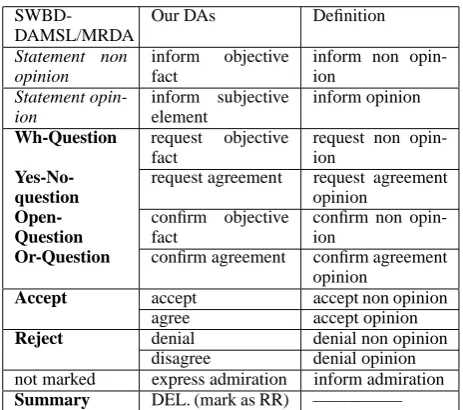
The DA annotations were based on SWBD-DAMSL and MRDA (Jurafsky et al., 1997; Dhillon et al., 2004). The SWBD-DAMSL is the DA tagset for labeling a conversational dia-logue. The Switchboard Corpus mentioned above was annotated with SWBD-DAMSL. On the other hand, MRDA is the DA tagset for labeling the dialogue of a meeting between multiple partici-pants. Table 1 shows the correspondence between SWBD-DAMSL/MRDA and our DAs1. We de-scribe some of the major adaptations below.
The tags pertaining to questions: In
SWBD-DAMSL and MRDA, the tags pertaining to ques-tions were classified by the type of their form (e.g. Wh-question). We re-categorized them into request and confirm in terms of the ”act” for Japanese.
The tags pertaining to responses: We subdivided
Accept and Reject into objective responses (ac-cept,denial) and subjective responses (agree, dis-agree).
The emotional tags: We added tags that indicate
the expression of admiration and interest.
The overlap tags with the RRs definition: We
did not use any tags (e.g. Summary), that over-lapped the RR definition.
Consequently, we defined 47 DAs for analyzing a conversational dialogue.
The RR annotations were based on the rhetor-ical relation defined in Rhetorrhetor-ical Structure The-ory (RST) (Mann and Thompson, 1988; Stent and Allen, 2000). Our RR definition was based only on informational level relation defined in RST be-cause we annotated the intentional level with DAs. Table 2 shows the correspondence between the in-formational relation of RST and our RRs. We de-scribe some of the major adaptations below.
Subdivide evaluation: The evaluation reflects the
degree of enthusiasm in the dialogue, so we
di-1The tags listed in italics are based on SWBD-DAMSL
[image:2.595.306.538.88.293.2]while those in boldface are based on MRDA.
Table 1: Dialogue Act Definition
SWBD-DAMSL/MRDA
Our DAs Definition Statement non
opinion
inform objective fact
inform non opin-ion
Statement opin-ion
inform subjective element
inform opinion
Wh-Question request objective fact
request non opin-ion
Yes-No-question
request agreement request agreement opinion
Open-Question
confirm objective fact
confirm non opin-ion
Or-Question confirm agreement confirm agreement opinion
Accept accept accept non opinion agree accept opinion
Reject denial denial non opinion disagree denial opinion not marked express admiration inform admiration
[image:2.595.306.533.337.462.2]Summary DEL. (mark as RR) —————
Table 2: Rhetorical Relation Definition
Mann’s RST Our RRs definition evaluation
(positive)
U2 is a positive evaluation about U1
Evaluation evaluation (negative)
U2 is a negative evalua-tion about U1
evaluation (neutral)
U2 is neutral evaluation about U1
Volitional cause
volitional cause-effect
U2 is a volitional action, and U1 cause U2 Volitional
re-sult
No Definition addition U2 consists of a part of U1
vided the Evaluation into three types of evaluation (positive/negative/neutral).
Integrate the causal relations: We use a
di-rected graph representation for RR annotations, so that we integrate volitional cause and Non-volitional result into non-Non-volitional cause-effect, and Volitional cause and Volitional result into vo-litional cause-effect.
Add addition relation: The RRs initially
repre-sent the structure of the written text, segmented into clause-like units. Therefore, they do not cover those cases in which one clause is uttered by one speaker, but communicatively completed by an-other. So, we added an addition to our RRs. The following is an example of addition.
speaker A: the lunch in our company cafeteria
speaker B: is good value for money
Context: The father of speaker2 likes watching movies, and so established a home theater system in their living room.
1:speaker2 [addition] that s why my family really loves movies these days <inform objective fact>
you watch them one after another, don t you? <signal understanding> <confirm objective fact> 2:speaker1 [elaboration][apposition]
about 2 or 3 movies per week <accept><inform objective fact>
so many? <signal understanding><exclamation><confirm objective fact> [evaluation
3:speaker2
4:speaker1
we sometimes watch many more <accept><inform objective fact> 5:speaker2 [elaboration]
I suppose you <signal understanding> 6:speaker1
I suppose it s nice to watch them in your home without interruptions, right?
<signal understanding><confirm agreement><confirm objective fact> [volitional
elaboration](neutral)]
[image:3.595.108.500.62.193.2]elaboration] cause-effect]
Figure 1: Example of Dialogue annotated with DAs and RRs (Originally in Japanese)
2.2.2 Annotation of DAs and RRs
DAs and RRs are annotated using the MMAX2 Annotation Tool2(Muller and Strube, 2003). Fig-ure 1 shows an example of our corpus annotated with DAs and RRs. The symbol in Figure 1 indicates a DA, while the [ ] symbol indicates an RR. Below, we describe our annotation process for DAs and RRs.
Step 1. Utterance Segmentation: All the
utter-ances in the dialogue are segmented into DA seg-ments, each of which we define as an utterance. In Figure 1, the utterance is surrounded with a square. In this step, we also eliminated backchan-nels from the exchange.
Step 2. Annotation of DAs: DAs are annotated
to all utterances. In those cases in which one DA alone cannot represent an utterance, two or more DAs are used (see Figure 1 line 2).
Step 3. Annotation of Adjacency Pairs:
Adja-cency pairs (APs) are labeled. An AP consists of two utterances where each part is produced by a different speaker. In Figure 1, the solid and dotted lines correspond to links between the APs.
Step 4. Annotation of RRs: RRs on APs are
la-beled. A solid line indicates an AP that is labeled with RRs, while a dotted line indicates an AP that is not labeled with RRs. If a single RR cannot represent the type of the relationship, two or more RRs are used.
2.3 Annotation of Enthusiasm
2.3.1 Related Work on Annotating the degree of enthusiasm
Wrede et al. annotated Involvement to the ICSI Meeting Recorder Corpus (Wrede and Shriberg,
2This supports multilevel annotation and the creation
of a relationship between utterances. http://www.eml-research.de/english/research/nlp/down-load/mmax.php
utterance ...backchannel ...
Part Of Dialogue ...
POD
Dialogue speaker2
speaker1
Ui-4 Ui-3 Ui-2 Ui-1 Ui Ui+1 Ui+2 Ui+3 Ui+4
PODi-2
PODi-1
PODi
PODi+1
PODi+2
Si-2
Si-1
Si
Si+1
Si+2
Score of enthusiasm ...
S
Figure 2: Rating the score of the enthusiasm
2003b; Wrede and Shriberg, 2003a). In their method, a rater judges involvement (agreement, disagreement, other) or Not especially involved or Don’t Know, by listening to each utterance with-out the context of the dialogue. In the exper-iment, nine raters provided ratings on 45 utter-ances. Inter-rater agreement between Involved and Not especially involved yielded a Kappa ofκ=.59 (p<.01), but 13 of the 45 utterances (28.9%) were rated as Don’t Know by at least one of the raters. For automatic detection, it is certainly effective to rate Involvement without context. However, the re-sults indicate that it is quite difficult to recognize Involvement from a single utterance. Moreover, the fluctuation of Involvement can not be recog-nized by this method because Involvement is cate-gorized into five categories only.
2.3.2 Our Method of Annotating Enthusiasm
In this section, we propose a method for eval-uating the degree of enthusiasm. We describe the process for evaluating the degree of enthusiasm.
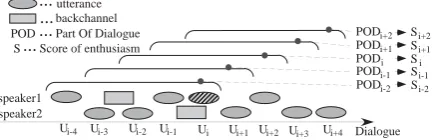
Step 1. Rating the score of enthusiasm for POD
[image:3.595.309.526.249.319.2]the score for the enthusiasm of P ODi. The value of the score can be from 10 to 90.
90 ... Extreme 70 ... Moderate 50 ... Neutral 30 ... Low 10 ... No
When rating the score, a rater must obey the following four rules.
1. Listen to each POD more than three times.
2. Perform estimation based on the entire POD and not just part of the POD. 3. Be sure that own ratings represented a
consistent continuum.
4. Estimate as participants, not as side-participants.
We did not give any definitions or examples to rate the enthusiasm, a rater estimated a score based on their subjective determination.
Step 2. Calculate the score of enthusiasm for an
utterance
The score of enthusiasm for an utteranceUi is given by the average of the scores of the PODs that contain utteranceUi.
V(Ui) = 15
i+2
j=i−2
Sj (1)
Step 3. Calculate the degree of enthusiasm for an
utterance and an adjacency pair
In this paper, we deal with all the degrees of enthusiasm as a normalized score, which we call Enthusiasm, because different raters may have different absolute levels of enthusiasm. Then, Enthusiasm forUi is given as follows:
E(Ui) = V(Ui)−σ V(U) (2)
where
V(U) = n1n
i=1
V(Ui)
σ =
1
n
n
i=1
{V(Ui)−V(U)}2
ndenotes the number of utterances in the di-alogue.
In addition, Enthusiasm forAPi is given by the average of Enthusiasms of the utterances where areAPi.
E(APi) =12{E(Uj) +E(Uk)} (3)
Uj andUkdenote the utterances inAPi.
3 Estimation of Annotated Corpus
3.1 Reliability of DAs and RRs
We examined the inter-annotator reliability for two annotators3for DAs, RRs and APs, using four dialogues mentioned above. Before the start of the investigation, one annotator segmented a dialogue into utterances. The number of segmented utter-ances was 697. The annotaters annotated them as described in steps 2 to 4 of Section 2.2.2.
DAs annotation: We can not apply the Kappa
statistics since it cannot be applied to multiple tag annotations. We then apply formula 4 to examine the reliability.
ag.= (Agreed DAs)×2
T otal of DAs annotated by A1and A2×100 (4)
The result of agreement was 1542 DAs (65.5%) from a total of 2355 DAs. The major reasons for the disagreement were as follows.
• Disagreement of subjective/objective ... 124(15.3%) • Disagreement of request/confirm ... 112(13.8%) • Disagreement of partial/whole ... 72(8.9%)
Building APs: We examined the agreement of
building APs between utterances. The result of agreement was 536 APs (85.2%) from the total of the 629 APs that were built by the annotators. This result shows that the building of APs is reliable.
RRs annotation: We also examined the
agree-ment of RRs annotation. We applied formula 5 to this examination.
ag.= (Agreed RRs)×2
T otal of RRs annotated by A1and A2×100 (5)
As a result, we found agreement for 576 RRs (59.6%) out of a total of 967 RRs.
3We refer to these annotators as A1 and A2. A1 is one of
Table 3: Correlation between random rating and sequential rating
correlation coefficient speaker1 speaker2 twenties,female 0.833 0.881
twenties,male 0.971 0.950 sixties,female 0.972 0.973 sixties,male 0.971 0.958
-3 -2 -1 0 1 2 3
time
Enthusiasm
R3(speaker1) R3(speaker2) R4(speaker1) R4(speaker2)
Figure 3: Enthusiasm of dialogue of speaker1 and speaker2(thirties,female)
3.2 Estimation Context Influence on the rating of Enthusiasm
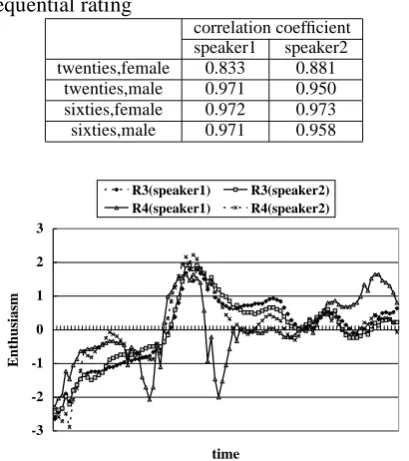
In order to examine the influence of the context on the rating of Enthusiasm, one rater noted Enthusi-asm under two conditions: 1) Listening to PODs randomly, and 2) Listening to PODs sequentially as dialogue. Table 3 shows the correlation be-tween the random rating and the sequential rating. The correlation coefficient was calculated for the Enthusiasm of each of the two participants. The ”speaker1” shows the correlation of the Enthusi-asm rated as speaker1, and ”speaker2” shows the correlation of the Enthusiasm rated as speaker2. This was found to be approximately 0.9 in both cases. These results show that Enthusiasm can be estimated stably and that the context has little in-fluence.
4 Relationship between DAs/RRs and
Enthusiasm
We investigated the relationship between DAs/RRs and Enthusiasm, using four dia-logues. The DAs/RRs corpus annotated by A1 was used in this analysis because A1 is one of the authors of this paper and has a better knowledge of the DAs and RRs tagging scheme than A2. The Enthusiasm corpus annotated by
R3 was used because we found that R4 rated Enthusiasm based on non-subjective reasons: after the examination of the rating, R4 said that speaker1 spoke enthusiastically but that it seemed unnatural because speaker1 had to manage the recording of the dialogue, which appears in the results as speaker1’s Enthusiasm as annotated by R4 as a notable difference (see Figure 3).
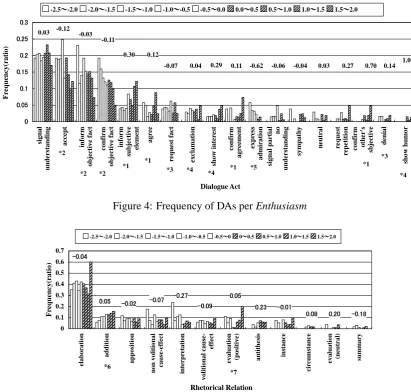
Figure 4 and 5 show the ratio of the frequency of DAs and RRs in each of the levels of Enthu-siasm over a range of 0.5. If DAs and RRs were evenly annotated for any level of Enthusiasm, the graph will be completely even. However, the graph shows the right side as being higher if the DAs and RRs increase as Enthusiasm increases. Conversely, the graph shows the left side as being higher if the DAs and RRs fall as Enthusiasm in-creases. The number in Figure 4 and 5 indicates the average Enthusiasm for each DA and RR. If the average is positive, it means that the frequency of the DAs and RRs is high in that part in which Enthusiasm is positive. In contrast, if the average is negative, it means that the frequency of the DAs and RRs is high in that part in which Enthusiasm is negative.
We determined the following two points about the tendency of the DAs frequency.
Tendency of subjective and objective DAs: The
ratio of the frequency of those DAs related to sub-jective elements tends to increase as Enthusiasm increases (see *1 in Figure 4). In contrast, the ra-tio of the frequency of those DAs pertaining to ob-jective matters tends to decrease (see *2 in Figure 4) or equilibrate as Enthusiasm increases (see *3 in Figure 4) . We can thus conclude that those ex-changes related to subjective elements increases in the enthusiastic dialogue, but those related to ob-jective elements decrease or equilibrate.
Tendency of affective DAs: The ratio of the
fre-quency of those DAs related to the affective con-tents tends to increase as Enthusiasm increases (see *4 in Figure 4). However, express admiration, which is also related to affective contents, tends to decrease (see *5 in Figure 4). We then analyzed several instances of admiration. As a result, we found that the prosodic characteristic of admira-tion utterance will cause this tendency.
Furthermore, we noted the following two points about the tendency of the RRs frequency.
Tendency of additional utterances: The ratio of
signal
understanding
accept inform
objective fact
confirm
objective fact
inform
subjective
element
agr
ee
re
quest fact
exclamation show inter
est
confirm
agr
eement expr
ess
admiration
signal partial
no
understanding
sympathy
neutral req
u
es
t
re
petition confirm other's sbjective denial
show humor
Dialogue Act
Fr
equency(ratio)
-2.5~-2.0 -2.0~-1.5 -1.5~-1.0 -1.0~-0.5 -0.5~0.0 0.0~0.5 0.5~1.0 1.0~1.5 1.5~2.0
0.03 -0.12 -0.03 -0.11
0.30 0.12
-0.07 0.04 0.29 0.11 -0.62 -0.06 -0.04 0.03 0.27 0.70 0.14 1.07
*2 *2
*2
*1 *1 *1
*4 *5 *4
*4 *3
[image:6.595.89.501.60.452.2]*3 *1
Figure 4: Frequency of DAs per Enthusiasm
0 0.1 0.2 0.3 0.4 0.5 0.6 0.7
elaboration
addition
apposition
non volitional cause-effect interpr
etation
volitional
cause-effect
evaluation (positive) antithesis instance
cir
cumstance evaluation (neutral) summary
Rhetorical Relation
Fr
equency(ratio)
-2.5~-2.0 -2.0~-1.5 -1.5~-1.0 -1.0~-0.5 -0.5~0 0~0.5 0.5~1.0 1.0~1.5 1.5~2.0
*6
*7
Figure 5: Frequency of RRs per Enthusiasm
Context:Mother of speaker2 does not cook dinner when the father is out.
1 speaker1: but if he s there then she 2 speaker2: cooks a really delicious dinner 3 speaker1: wow
Figure 6: Example of addition
other participant’s utterance, tends to increase as Enthusiasm increases (see *6 in Figure 5). Figure 6 shows a dialogue example. There are addition relations between lines 1 and 2. This shows that the participant makes an utterance cooperatively by completing the other’s utterances in enthusias-tic dialogues. Such cooperative utterance is a sig-nificant component of enthusiastic dialogues.
Tendency of positive evaluation: The ratio of the
frequency of positive evaluation tends to increase at lower Enthusiasm and higher Enthusiasm (see *7 in Figure 5). We analyzed some instances of
Context:About a hamster and its exercise instrument. 1 speaker2: two hamsters run together in their exercise wheel 2 speaker2: they run up and down and side by side
3 speaker1: but surely they can t they run together if they aren t
4 speaker2: exactly
5 speaker2: one gets carried along if it stops when the other continues to run
6 speaker1: is it? does it lean forward? getting along very well?
7 speaker2: yes
8 speaker2: sometimes it falls out 9 speaker1: that s so cute
Figure 7: Example of positive evaluation
ex-presses positive evaluation on line 9 about the el-ement on line 8. The utterance on line 9 also has the function of expressing an overall positive eval-uation of the previous discourse.
5 Conclusion and Future Research
We analyzed the relationship between utterances and the degree of enthusiasm in human-to-human conversational dialogue. We first created a conver-sational dialogue corpus annotated with two types of tags: DAs/RRs and Enthusiasm. The DA and RR tagging scheme was adapted from the defini-tion given in a previous work, and an Enthusiasm tagging scheme is proposed. Our method of rating Enthusiasm enables the observation of the fluctu-ation of Enthusiasm, which enables the detailed analysis of the relationship between utterances and Enthusiasm. The result of the analysis shows the frequency of objective and subjective utterances related to the level of Enthusiasm. We also found that affective and cooperative utterances are sig-nificant in an enthusiastic dialogue.
In this paper, we only analyzed the relationship between DAs/RRs and Enthusiasm, but we expect the non-linguistic-feature related with Enthusiasm so that we would analyze the relationship in future research. And, we try to achieve more reliable an-notation by reviewing our tagging scheme. Fur-thermore, we would apply the results of the analy-sis to our conversational dialogue system.
References
Rajdip Dhillon, Sonali Bhagat, Hannah Carvey, and Elizabeth Shriberg. 2004. Meeting Recorder Project: Dialog Act Labeling Guide. ICSI
Techni-cal Report, (TR-04-002).
David Graff and Steven Bird. 2000. Many Uses, Many Annotations for Large Speech Corpora: Switch-board and TDT as Case Studies. LREC2000.
Dan Jurafsky, Liz Shriberg, and Debra Biasca.
1997. Switchboard SWBD-DAMSL
Shallow-Discourse-Function Annotation Coders Manual.
www.dcs.shef.ac.uk/nlp/amities/files/bib/ics-tr-97-02.pdf.
Kazunori Komatani, Tatsuya Kawahara, Ryosuke Ito, and Hiroshi Okuno. 2002. Efficient Dialogue Strat-egy to Find Users’ Intended Items from Information Query Results. In Proceedings of the COLING.
Diane Litman, Satinder Singh, Michael Kearns, and Marilyn Walker. 2000. NJFun: A Reinforcement Learning Spoken Dialogue System. In Proceedings
of the ANLP/NAACL.
William C. Mann and Sandra A. Thompson. 1988. Rhetorical Structure Theory: Toward a Functional Theory of Text Organization. Text, 8(3):243–281.
Christoph Muller and Michael Strube. 2003. Multi-Level Annotation in MMAX. In Proceedings of the
4th SIGdial Workshop on Discourse and Dialogue.
Amanda Stent and James Allen. 2000. Annotating Ar-gumentation Acts in Spoken Dialog. Technical
Re-port 740.
Shu-Chuan TSENG. 2001. Toward a Large Sponta-neous Mandarin Dialogue Corpus. In Proceedings
of the 2nd SIGdial Workshop on Discourse and Dia-logue.
Marilyn A. Walker, Jeanne C. Fromer, and Shrikanth Narayanan. 1998. Learning Optimal Dialogue Strategies: A Case Study of a Spoken Dialogue Agent for Email. In Proceedings of COLING/ACL.
Britta Wrede and Elizabeth Shriberg. 2003a. Spotting ”Hot Spots” in Meetings: Human Judgements and Prosodic Cues. Eurospeech-03, pages 2805–2808.