Incremental Parsing with Reference Interaction
Scott C. Stoness, Joel Tetreault, James AllenDepartment of Computer Science University of Rochester
Rochester, NY, USA
[email protected], [email protected]
Abstract
We present a general architecture for incremen-tal interaction between modules in a speech-to-intention continuous understanding dialogue sys-tem. This architecture is then instantiated in the form of an incremental parser which receives suit-ability feedback on NP constituents from a refer-ence resolution module. Oracle results indicate that perfect NP suitability judgments can provide a labelled-bracket error reduction of as much as 42% and an efficiency improvement of 30%. Prelimi-nary experiments in which the parser incorporates feedback judgments based on the set of referents found in the discourse context achieve a maximum error reduction of 9.3% and efficiency gain of 4.6%. The parser is also able to incrementally instantiate the semantics of underspecified pronouns based on matches from the discourse context. These results suggest that the architecture holds promise as a plat-form for incremental parsing supporting continuous understanding.
1 Introduction
Humans process language incrementally, as has been shown by classic psycholinguistic discussions surrounding the garden-path phenomenon and pars-ing preferences (Altmann and Steedman, 1988; Konieczny, 1996; Phillips, 1996). Moreover, a va-riety of eye-tracking experiments (Cooper, 1974; Tanenhaus and Spivey, 1996; Allopenna et al., 1998; Sedivy et al., 1999) suggest that complex se-mantic and referential constraints are incorporated on an incremental basis in human parsing decisions. Computational parsers, however, still tend to op-erate an entire sentence at a time, despite the ad-vent of speech-to-intention dialogue systems such as Verbmobil (Kasper et al., 1996; Noth et al., 2000; Pinkal et al., 2000), Gemini (Dowding et al., 1993; Dowding et al., 1994; Moore et al., 1995) andTRIPS (Allen et al., 1996; Ferguson et al., 1996; Fergu-son and Allen, 1998). Naturalness, robustness, and interactivity are goals of such systems, but control
flow is typically the sequential execution of mod-ules, each operating on the output of its predeces-sor; only after the entire sentence has been parsed do higher-level modules such as intention recogni-tion and reference resolurecogni-tion get involved.
In contrast to this sequential model is the con-tinuous understanding approach, in which all lev-els of language analysis occur simultaneously, from speech recognition to intention recognition. As well as being psycholinguistically motivated, continuous understanding models offer potential computational advantages, including accuracy and efficiency im-provements for real-time spoken language under-standing and better support for the spontaneities of natural human speech. Continuous understanding is necessary if the system is to respond before the entire utterance is analyzed, a prerequisite for in-cremental confirmation and clarification. The major computational advantage of continuous understand-ing models is that high-level expectations and feed-back should be able to influence the search of lower-level processes, thus leading to a focused search through hypotheses that are plausible at all levels of processing.
One of the major current applications of parsers that operate incrementally is for language modelling in speech recognition (Brill et al., 1998; Jelinek and Chelba, 1999). This work is important not only for its ability to improve performance on the speech recognition task; it also models the interactions be-tween speech recognition and parsing in a contin-uous understanding system. Our research attempts to further the quest for continuous understanding by moving one step up the hierarchy, building an incre-mental parser which is the advisee rather than the advisor.
refer-Client (parser)
Mediator
Advisor (reference)
Inform
Inform
Feedback
[image:2.595.107.264.72.186.2]Modify Chart
Figure 1: A General Architecture for Incremental Parsing
ence resolution module and an NP suitability oracle are reported, and the ability of the implementation to incrementally instantiate semantically underspec-ified pronouns is outlined. We believe this research provides an important start towards developing end-to-end continuous understanding models.
2 An Incremental Parsing Architecture Many current parsers fall into the class of history-based grammars (Black et al., 1992). The indepen-dence assumptions of these models make the pars-ing problem both stochastically and computation-ally tractable, but represent a simplification and may therefore be a source of error. In a continuous un-derstanding framework, higher-level modules may have additional information that suggests loci for improvement, recognizing either invalid indepen-dence assumptions or errors in the underlying prob-ability model.
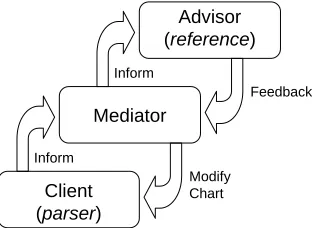
We have designed a general incremental parsing architecture (Figure 1) in which the Client, a dy-namic programming parser, performs its calcula-tions, the results of which are incrementally passed on via a Mediator to an Advisor with access to higher-level information. This higher-level Advi-sor sends feedback to the Mediator which has ac-cess to the Client’s chart, and which then surrepti-tiously changes and/or adds to the chart in order to make the judgments conform more closely to those of the Advisor. The parser, whose chart has (unbe-knownst to it) been changed, then simply calculates chart expansions for the next word, na¨ıvely expand-ing the currently available (and possibly modified) hypotheses.
This architecture is general in that neither the Me-diator nor the Advisor have been specified; either of these modules can be instantiated in any number of ways within the general framework. The typical dynamic programming component will function in very much the same way that it does in the vanilla algorithm, except that the chart in which partial
re-sults are recorded may be modified between time steps. The Client can be any system which uses dy-namic programming to efficiently encode indepen-dence assumptions, so long as it provides the Me-diator with the ability to modify chart probabilities and add chart entries; otherwise the original parser can remain untouched. By having the Mediator per-form these modifications rather than the Advisor, we preserve modularity: in this architecture the Ad-visor need not be aware of the specific implementa-tion of the Client, although depending on the type of advice provided, it may need access to the under-lying grammar. The Mediator isolates the Advisor and Client from each other as well as determining how the feedback will be introduced into into the Client’s chart.
Stoness (2004) identifies two broad categories of subversion - our term for the Mediator’s surrepti-tious modification of the Client’s chart - as outlined below:
• Heuristic Subversion: the Mediator uses the Advisor’s feedback as heuristic information, affecting the search sequence but not the prob-abilities calculated for a given hypothesis; and
• Chart Subversion: the Mediator is free to modify the Client’s chart as necessary, but does not directly affect the search sequence of the Client (except insofar as this is accomplished by the modifications to the chart).
The two types of subversion have very different properties. Heuristic subversion will affect the set of analyses which is output by the parser, but each of those analyses will have exactly the same proba-bility score as under the original parser; the effects of the Advisor are essentially limited to determin-ing which hypotheses remain within the beam, or the order in which hypotheses are expanded, de-pending on whether the underlying parser uses a beam search or an agenda. Chart subversion, on the other hand, will actually change the scores assigned analyses, resulting in a new probability distribution. Heuristic subversion is considerably less powerful, but more stable; the effects of chart subversion can be fairly chaotic, especially if care is not taken to avoid feedback loops. Stoness (2004) outlines con-ditions under which the effects of chart subversion are predictable, becoming broadly equivalent to an incremental version of a post-hoc re-ranking of the Client’s output hypotheses.
incremental parsing and parse re-ranking, the pos-sibilities of multiple Advisors working in combina-tion, and provisions in the model for asynchronous feedback are available in a University of Rochester Technical Report (Stoness, 2004).
3 Instantiating the Architecture
Working in the context of TRIPS, an existing task-oriented dialogue system, we have modified the existing parser and reference resolution modules so that they communicate incrementally with each other. This models the early incorporation of refer-ence resolution information seen in humans (Cham-bers et al., 1999; Allopenna et al., 1998), and al-lows reference resolution information to affect pars-ing decisions.
For example, in “Put the apple in the box in the corner” there is an attachment ambiguity. Reference resolution can determine the number of matches for the noun phrase “the apple” incrementally; if there is a single match, the parser would expect this to be a complete NP, and prefer the reading where the box is in the corner. If reference returns multiple matches for “the apple”, the parser would expect disambiguating information, and prefer a reading where additional information about the apple is pro-vided: in this case, an the NP “the apple in the box”. With solid feedback from reference, it should be possible to remove some of the ambiguity inherent in the search process within the parser. This will simultaneously guide the search to the most likely region of the search space, improving accuracy, and delay the search of unlikely regions, improving effi-ciency. Of course, this comes at the cost of some communication overhead and additional reference resolution. Ideally, the overall improvement in the parser’s search space would be enough to cover the additional incremental operation costs of other modules.
3.1 An Incremental Parser
The pre-existing parser in the dialogue system was a pure bottom-up chart parser with a hand-built gram-mar suited for parsing task-oriented dialogue. The grammar consisted of a context-free backbone with a set of associated features and semantic restric-tions, including agreement, hard subcategorization constraints, and soft selectional restriction prefer-ences. The parser has been modified so that when-ever a constituent is built, it can be sent forward to the Mediator, allowing for the possibility of feed-back. The architecture and experiments described in this paper were performed in a synchronous mode, but the parser can also operate in an incrementally
asynchronous mode, where it continues to build the chart in parallel with other modules’ operations; probability adjustments to the chart then cascade to dependent constituents.
3.2 Interaction with Reference
When the parser builds a potential referring expres-sion (e.g. any NP), it is immediately passed on to the Advisor, the reference resolution module described in Tetreault et. al. (2004) modified for incremental interaction. This module then determines all pos-sible discourse referents, providing the parser with a ranked classification based on the salience of the referents and the (incremental) syntactic environ-ment.
The reference module keeps a dynamically up-dated list of currently salient discourse entities against which incoming incrementally constructed NP constituents are matched. Before any utterances are processed, the module loads a static database of relevant place names in the domain; all other possible referents are discourse entities which have been spoken of during the course of the dialogue. For efficiency, the dynamic portion of the context list is limited to the ten most recent contentful ut-terances; human-annotated antecedent data for this corpus shows that 99% of all pronoun antecendents fall within this threshold. After each sentence is fully parsed the context list is updated with new dis-course entities introduced in the utterance; ideally, these context updates would also be incremental, but this feature was omitted in the current version for simplicity.
The matching process is based on that described by Byron (2000), and differs from that of many other reference modules in that every entity and NP-constituent has a (possibly underspecified) se-mantic feature vector, and it is both the logical and semantic forms which determine successful match-ings. Adding semantic information increases the ac-curacy of the reference resolution from 44% to 58% (Tetreault and Allen, 2004), and consequently im-proves the feedback provided to the parser.
The Mediator receives the set of all possible ref-erents, including the semantic content of the refer-ent and a classification of whether the referrefer-ent is the single salient entity in focus, has previously been mentioned, or is a relevant place name.
3.3 Mediator
and discourse distance, and this set is run through a classifier to reduce it to a single tag. The resulting tag is the reference resolution tag, or R. The NP constituents are also classified by definiteness and number, giving an NP tagN.
For each classifier, we trained a probability model which calculated Pr, the probability that a noun
phrase constituentcwould be in the final parse, con-ditioned onRandN, or
Pr =p(cin final parse|R, N).
This probability was then linearly combined with the parser’s constituent probability,
Pp=p(c→wmn),
according to the equation
P(c) = (1−λ)·Pp+λ·Pr
for various values of λ. Evaluation using held-out data suggested that a value of λ = 0.2 would be optimal. This style of feedback is an example of chart subversion, as it is a direct modification of constituent probabilities by the Mediator, defining a new probability distribution.
4 Experiments
The Monroe domain (Tetreault et al., 2004; Stent, 2001) is a series of task-oriented dialogues between human participants set in a simulated rescue op-eration domain, where participants collaboratively plan responses to emergency calls. Dialogues were recorded, broken up into utterances, and then tran-scribed by hand, removing speech repairs from the parser input. These transcriptions served as input for all experiments reported below.
A probabilistic grammar was trained from su-pervised data, assigning PCFG probabilities for the rule expansions in the CFG backbone of the hand-crafted, semantically constrained grammar. The parser was run using this grammar, but without any incremental interaction whatsoever, in order to es-tablish baseline accuracy and efficiency numbers. The corpus consists of six task-oriented dialogues; four were used for the PCFG training, one was held out to establish appropriate parameter values, and one was selected for testing. The held-out and test dialogues contain hand-checked gold standard parses.
Under normal operation of the sequential dia-logue system, the parser is run in best-first mode, providing only a single analysis to higher-level modules, and has a constituent construction limit in
Base All NPs Def-Sing Precision 94.6 97.2 96.3
Recall 71.1 83.1 78.8
F-statistic 82.9 90.2 87.6
Improvement N/A 7.3 4.7
Error Red. N/A 42.4 27.2
Work Red. N/A 30.3 18.7
Perfect S 224 241 236
[image:4.595.325.531.70.188.2]Parsed S 270 282 279
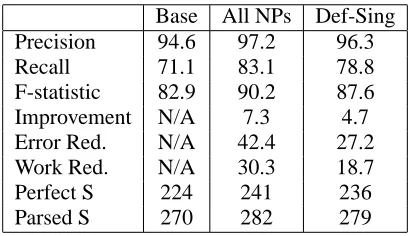
Table 1: Results for (a) The baseline parser without reference feedback, (b) An Oracle Advisor correctly determining status of all NPs, (c) An Oracle Advi-sor correctly determining status of definite singular NPs.
an attempt to simulate the demands of a real-time system. When the parser reaches the constituent limit, appropriate partial analyses are collected and forwarded to higher-level modules. These con-straints were kept in place during our experiments, because they would be necessary under normal op-eration of the system. Thus, the inability to parse a sentence does not necessarily indicate a lack of cov-erage of the grammar, but rather a lack of efficiency in the parsing process.
As can be seen in Table 1, the parser achieves a 94.6% labelled bracket precision, and a 71.1% la-belled bracket recall. Note that only constituents of complete parses were checked against the gold standard, to avoid any bias introduced by the partial parse evaluation metric. Of the 290 gold standard utterances in the test data, 270 could be parsed, and 224 were parsed perfectly.
4.1 Oracle Evaluation
We began with a feasibility study to determine how significant the effects of incremental advice on noun phrases could be in principle. The feedback from the reference module is designed to determine whether particular NPs are good or bad from a refer-ence standpoint. We constructed a simple feedback oracle from supervised data which determined, for each NP, whether or not the final parse of the sen-tence contained an NP constituent which spanned the same input. Those NPs marked “good”, which did appear in the parse, were added to the chart as new constituents. NPs marked “bad” were added to the chart with a probability of zero1. A second
or-1
acle evaluation performed this same task, but only providing feedback on definite singular NPs.
The results of both oracles are shown in Table 1. The first five rows give the precision, recall, statistic, the raw statistic improvement, and the f-statistic error reduction percentage, all determined in terms of labelled bracket accuracy. There is a marked increase in both precision and recall, with an overall error reduction of 42.4% with the full oracle and 27.2% with the definite singular oracle. Thus, in this domain over a quarter of all incorrectly labelled constituents are attributable to syntactically incorrect definite singular NPs. The number of con-stituents built during the parse is used as a measure of efficiency, and the work reduction is reported in the sixth row of the table, showing an efficiency im-provement of 30.3% or 18.7%, depending on the or-acle. The final two lines of the table show that both the number of sentences which can be parsed and the number of sentences which are perfectly parsed increase under both models.
The nature of the oracle experiment ensures some reduction in error and complexity, but the magni-tude of the improvement is surprising, and certainly encouraging for the prospects of incremental refer-ence. Definite singular NPs typically have a unique referent, providing a locus for effective feedback, and we believe that incremental interaction with an accurate reference module might approach the ora-cle performance.
4.2 Dialogue Experiments
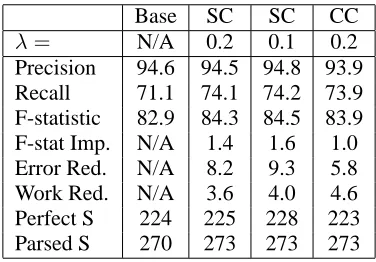
For these experiments the parser interacted with the actual reference module, incorporating feedback ac-cording to the model discussed in Section 3.3. The first data column of Table 2 repeats the baseline re-sults of the parser without reference feedback. The next two columns show statistics for a run of the parser with incremental feedback from reference, using a probability model based on a classification scheme which distinguished only whether or not the set of referent matches was empty. The second data column shows the results for the estimated interpo-lation parameter value of λ = 0.2, while the third data column shows results for the empirically deter-mined optimalλvalue of 0.1.
The results are encouraging, with an error reduc-tion of 8.2% or 9.3% on the test dialogue, although the amount of work the parser performed was re-duced by only 4.0% and 3.6%. A further encour-aging sign is that for every exploratoryλvalue we
whether it is “good” or “bad”. In this degenerate case of all-or-nothing feedback, chart subversion and heuristic subversion are equivalent.
Base SC SC CC
[image:5.595.333.521.70.201.2]λ= N/A 0.2 0.1 0.2 Precision 94.6 94.5 94.8 93.9 Recall 71.1 74.1 74.2 73.9 F-statistic 82.9 84.3 84.5 83.9 F-stat Imp. N/A 1.4 1.6 1.0 Error Red. N/A 8.2 9.3 5.8 Work Red. N/A 3.6 4.0 4.6 Perfect S 224 225 228 223 Parsed S 270 273 273 273
Table 2: Results for Discourse Experiment with Simple (SC) and Complex (CC) Classifiers
tried in either the held-out or the test data, both the accuracy and efficiency improved. Reference infor-mation also helped increase both the number of tences that could be parsed and the number of sen-tences that were parsed perfectly, although the im-provements were small.
The estimated value ofλ= 0.2produced an error reduction that was approximately 20% of the orac-ular, which is a very good start, especially consider-ing that this experiment used only the information of whether there was a referent match or not. The effi-ciency gains were more modest at just above 10% of the oracular results, although one would expect less radical efficiency improvements from this experi-ment, since under the linear interpolation of the ex-periment, even extremely dispreferred analyses may be expanded, whereas the oracle simply drops all dispreferred NPs off the beam immediately.
We performed a second experiment that made more complete use of the reference data, break-ing down referent sets accordbreak-ing to when and how often they were mentioned, whether they matched the focus, and whether they were in the set of relevant place names. We expected that this in-formation would provide considerably better re-sults than the simple match/no-match classification above. For example, consider a definite singular NP: if it matches a single referent, one would expect it to be in the parse with high probability, but multi-ple matches would indicate that the referent was not unique, and that the base noun probably requires ad-ditional discriminating information (e.g. a preposi-tional phrase or restrictive relative clause).
actu-ally decreased by one.
We conjecture that co-reference chains may be a significant source of confusion in the reference data. Ideally, if several entities in the discourse context all refer to the same real-world entity, they should be counted as a single match. The current refer-ence module does construct co-referential chains, but a single error in co-reference identification will cause all future NPs to match both the chain and the misidentified item, instead of producing the single match desired.
The reference module has to rely on the parser to provide the correct context, so there is something of a bootstrapping problem at work, which indicates both a drawback and a potential of this type of in-cremental interaction. The positive feedback loop bodes well for the potential benefits of the incre-mental system, because as the increincre-mental reference information begins to improve the performance of the parser, the context provided to the reference resolution module improves, which provides even more accurate reference information. Of course, in the early stages of such a system, this works against us; many of the reference resolution errors could be a result of the poor quality of the discourse context. Our current efforts aim to identify and correct these and other reference resolution issues. Not only will this improve the performance of the Reference Advisor from an incremental parsing standpoint, but it should also further our understanding of reference resolution itself.
We have shown efficiency improvements in terms of the overall number of constituents constructed by the parser; however, one might ask whether this im-provement in parsing speed comes at a large cost to the overall efficiency of the system. We suggest that this is in some sense the wrong question to ask, be-cause for a real-time interactive system the primary concern is to keep up with the human interlocutor, and the incremental approach offers a far greater op-portunity for parallelism between modules. In terms of time elapsed from speech to analysis, the system as a whole should benefit from the incremental ar-chitecture.
5 Semantic Replacement
When the word “it” is parsed as a referential NP, it is given highly underspecified semantics. We have im-plemented a Mediator which, for each possible ref-erent for “it”, adds a new item to the parser’s chart with the underspecified semantics of “it” instanti-ated to the semantics of the referent.
Consider the sentence sequence “Send the bus to the hospital”, “Send it to the mall”. At the point
that the NP “it” is encountered in the second sen-tence, it has not yet been connected to the verb, so the incremental reference resolution determines that “the bus” and “the hospital” are both possi-ble referents. We add two new constituents to the chart: “it”[the hospital] and “it”[the bus]. They are given probabilities infinitesimally higher than the “it”[underspecified] which already exists on the chart. Thus, if either of the new versions of “it” match the semantic restrictions inherent in the rest of the parse, they will be featured in parses with a higher probability than the underspecified version. “It”[the bus] matches the mobility required of the object of “send”, while “it”[the hospital] does not. This results in a parse where the semantics of “it” are instantiated early and incrementally.
This sort of capability is key for an end-to-end incremental system, because neither the reference module nor the parser is capable, by itself, of deter-mining incrementally that the reference in question must be “the bus”. If we want an end-to-end system which can interact incrementally with the user, this type of decision-making must be made in an incre-mental fashion.
This ability is also key in the presence of soft con-straints or other Advisors which prefer one possi-ble moveapossi-ble referent to another; under incremental parsing, these constraints would have the chance to be applied during the parsing process, whereas a se-quential system has no alternatives to the default, underspecified pronoun, and so cannot apply these restrictions to discriminate between referents.
Our implementation performs the semantic vet-ting discussed above, but we have done no large-scale experiments in this area.
6 Related Work
There are instances in the literature of incremental parsers that pass forward information to higher-level modules, but none, to our knowledge, are designed as continuous understanding systems, where all lev-els of language analysis occur (virtually) simultane-ously.
incremen-tal parser. So, while all of these are in some sense examples of incremental parsing, they are not con-tinuous understanding models.
Schuler (2002) describes a parser which builds both a syntactic tree and a denotation-based seman-tic analysis as it parses. The denotations of con-stituents in the environment are used to inform pars-ing decisions, much as we use the static database of place names. However, the feedback in our system is richer, based on the context provided by the pre-ceding discourse. Furthermore, as an instantiation of the general architecture presented in Section 2, our system is more easily extensible to other forms of feedback.
7 Future Work
There is a catch-22 in that the accurate reference in-formation necessary to improve parsing accuracy is dependent on an accurate discourse context which is reliant on accurate parsing. One way to cut this Gordian Knot is to use supervised data to ensure that the discourse context in the reference module is up-dated with the gold standard parse of the sentence rather than the parse chosen by the parser; a context oracle, if you will.
A major undertaking necessary to advance this work is an error analysis of the reference module and of the parser’s response to feedback; when does feedback lead to additional work or decreased ac-curacy on the part of the incremental parser, and is the feedback that leads to these errors correct from a reference standpoint?
Currently, the accuracy of the parser is couched in syntactic terms. The precision of the baseline PCFG is fairly high at 94.6%, but that could conceal semantic errors, which could be corrected with ref-erence information. Assessing semantic accuracy is one of a number of alternative evaluation metrics that we are exploring.
We intend to gather timing data and investigate other efficiency metrics to determine to what extent the efficiency gains in the parser offset the commu-nication overhead and the extra work performed by the reference module.
We also plan to do experiments with different feedback regimes, experimenting both with the ac-tual reference results and with the oracle data. Fur-ther experiments with this oracle data should enable us to appropriately parameterize the linear interpo-lation, and indeed, to investigate whether linear in-terpolation itself is a productive feedback scheme, or whether an integrated probability distribution over parser and reference judgments is more effec-tive. The latter scheme is not only more elegant, but
can also be shown to produce probabilities equiva-lent to those assigned parses in the parse re-ranking task (Stoness, 2004).
We’ve shown (Stoness, 2004) that feedback which punishes constituents that are not in the fi-nal parse cannot result in reduced accuracy or effi-ciency; under certain restrictions, the same holds of rewarding constituents that will be in the final parse. However, it is not clear how quickly the efficiency and accuracy gains drop off as errors mount. By in-troducing random mistakes into the Oracle Advisor, we can artificially achieve any desired level of accu-racy, which will enable us to explore the character-istics of this curve. The accuracy and efficiency re-sponse under error has drastic consequences on the types of Advisors that will be suitable under this ar-chitecture.
Finally, it is clear that finding only the discourse context referents of a noun phrase is not sufficient; intuitively, and as shown by Schuler (2002), real-world referents can also aid in the parsing task. We intend to enhance the reference resolution compo-nent of the system to identify both discourse and real-world referents.
8 Conclusion
These preliminary experiments, using the coars-est grain of reference information possible, achieve a significant fraction of the oracular accuracy im-provements, highlighting the potential benefits of incremental interaction between the parser and ref-erence in a continuous understanding system.
The Oracle feedback for NPs shows that it is pos-sible to simultaneously improve both the accuracy and efficiency of an incremental parser, providing a proof-in-principle for the general incremental pro-cessing architecture we introduced. This architec-ture holds great promise as a platform for instantiat-ing the wide range of interactions necessary for true continuous understanding.
9 Acknowledgements
Partial support for this project was provided by ONR grant no. N00014-01-1-1015, ”Portable Di-alog Interfaces” and NSF grant 0328810 ”Continu-ous Understanding”.
References
J. Allen, B. Miller, E. Ringger, and T. Sikorski. 1996. Robust understanding in a dialogue sys-tem. In Proc. of ACL-96, pages 62–70.
ev-idence for continuous mapping models. Journal of Memory and Language, 38:419–439.
G. Altmann and M. Steedman. 1988. Interaction with context during human sentence processing. Cognition, 30:191–238.
E. Black, F. Jelinkek, J. Lafferty, D. Magerman, R. Mercer, and S. Roukos. 1992. Towards history-based grammars: using richer models for probabilistic parsing. In Proc. of the Fifth DARPA Speech and Natural Language Workshop. E. Brill, R. Florian, J. C. Henderson, and L. Mangu. 1998. Beyond n-grams: Can linguistic sophisti-cation improve language modeling? In Proc. of COLING-ACL-98, pages 186–190.
D. K. Byron. 2000. Semantically enhanced pro-nouns. In Proc. of DAARC2000: 3rd Interna-tional Conference on Discourse Anaphora and Anaphor Resolution.
C. G. Chambers, M. K. Tanenhaus, and J. S. Magnu-son. 1999. Real world knowledge modulates ref-erential effects on pp-attachment: Evidence from eye movements in spoken language comprehen-sion. Conference Abstract. Architechtures and Mechanisms for Language Processing.
R. M. Cooper. 1974. The control of eye fixation by the meaning of spoken language. Cognitive Psychology, 6:84–107.
J. Dowding, J. M. Gawron, D. Appelt, J. Bear, L. Cherny, R. Moore, and D. Moran. 1993. Gemini: A natural language system for spoken-language understanding. In Proc. of ACL-93, pages 54–61.
J. Dowding, R. Moore, F. Andry, and D. Moran. 1994. Interleaving syntax and semantics in an efficient bottom-up parser. In Proc. of ACL-94, pages 110–116.
G. Ferguson and J. Allen. 1998. Trips: An inte-grated intelligent problem-solving assistant. In Proc. of AAAI-98, pages 567–572.
G. Ferguson, J. Allen, and B. Miller. 1996. Trains-95: Towards a mixed-initiative planning assis-tant. In Proc. of the 3rd International Conference on Artificial Intelligence Planning Systems, pages 70–77.
Frederick Jelinek and Ciprian Chelba. 1999. Putting language into language modeling. In Proc. of Eurospeech-99.
W. Kasper, H.-U. Krieger, J. Spilker, and H. Weber. 1996. From word hypotheses to logical form: An efficient interleaved approach. In Natural Lan-guage Processing and Speech Technology: Re-sults of the 3rd Konvens Conference, pages 77– 88.
Lars Konieczny. 1996. Human Sentence
Process-ing: A Semantics-Oriented Parsing Approach. Ph.D. thesis, Universitat Freiburg.
R. Moore, D. Appelt, J. Dowding, J. M. Gawron, and D. Moran. 1995. Combining linguistic and statistical knowledge sources in natural-language processing for atis. In Proc. ARPA Spoken Lan-guage Systems Technology Workshop.
E. Noth, A. Batliner, A. Kiessling, R. Kompe, and H. Niemann. 2000. Verbmobil: The use of prosody in the linguistic components of a speech understanding system. IEEE Transactions on Speech and Audio Processing, 8(5):519–531. Colin Phillips. 1996. Order and Structure. Ph.D.
thesis, MIT.
M. Pinkal, C.J. Rupp, and K. Worm. 2000. Ro-bust semantic processing of spoken language. In Verbmobil: Foundations of Speech-to-Speech Translation, pages 321–335.
C. P. Rose. 2000. A framework for robust semantic interpretation. In Proc. of the Sixth Conference on Applied Natural Language Processing. W. Schuler. 2002. Interleaved semantic
interpreta-tion in environment-based parsing. In Proc. of COLING-02.
J. C. Sedivy, M. K. Tanenhaus, C. G. Chambers, and G. N. Carlson. 1999. Achieving incremental semantic interpretation through contextual repre-sentation. Cognition, 71:109–147.
A. Stent. 2001. Dialogue Systems as Conver-sational Partners. Ph.D. thesis, University of Rochester.
S. C. Stoness. 2004. A general architecture for incremental parsing. Technical report, TR 838, University of Rochester.
M. K. Tanenhaus and M. Spivey. 1996. Eye-tracking. Language and Cognition Processes, 11(6):583–588.
J. Tetreault and J. Allen. 2004. Semantics, dia-logue, and reference resolution. In Catalog-04: 8th Workshop on the Semantics and Pragmatics of Dialogue.
J. Tetreault, M. Swift, P. Prithviraj, M. Dzikovska, and J. Allen. 2004. Discourse annotation in the monroe corpus. In ACL-04 Discourse Annotation Workshop.
K. Worm. 1998. A model for robust process-ing of spontaneous speech by integratprocess-ing viable fragments. In Proc. of COLING-ACL-98, pages 1403–1407.