International Journal of Research in Advent Technology, Vol.3, No.3, March 2015
Performance Evolution of Proactive and Reactive
Routing Protocols in Mobile Ad Hoc Network
Department of Electrical Engineering Email: gnanamanohar
Abstract-The Mobile Ad hoc Network (MANET) is an autonomous system of mobile nodes connected by wireless links. Each node operates not only as an end system, but also as a router to forward packets. The nodes are free to move about and organize themselves into a networ
main classes of routing protocols are proactive, reactive and hybrid. A reactive (on
a popular routing category for wireless ad hoc routing. It is a relatively new routing philosoph
scalable solution to relatively large network topologies. The design follows the idea that each node tries to reduce routing overhead by sending routing packets whenever a communication is
to evaluate AODV,DSR and DSDV theoretically. We have done on the simulation on AODV,DSR and DSDV and analyze the results through the simulation based on some quantitative performance metrics
throughput, packet delivery ratio, end to end delay and average routing overhead improvements.
Index Terms- - NS2; MANET; AODV
1. INTRODUCTION
A wireless Ad-hoc network consists of wireless nodes communicating without the need for a centralized administration. A collection of autonomous nodes or terminals that communicate with each other by forming a multi hop radio network and maintaining connectivity in a decentralized manner is called an ad hoc network.
wireless data communication devices such as laptops and any personal digital assistants are limited resources and can be deployed in any locations without any fixed infrastructure. Each mobile node is equipped with wireless interface and communicate one another by radio or infrared and
transceiver and intermediate router used to forward the packets for other nodes. From the source node to the destination node, there can be different paths of connection at a given point of time.
mobility is a fundamental characteristics and frequent changes in their physical location causes the topological change in that temporary network able to handle that topological change and
nodes. If any node moved out of the network may cause link broken, affected node can initialize route discovery again.Routing in MANET is a challenging task to choose a really good route to establish the connection between a source and a desti
they can move freely and a comprehensive performance evaluation [1] is of ad hoc routing protocols essential.
International Journal of Research in Advent Technology, Vol.3, No.3, March 2015
E-ISSN: 2321-9637
Performance Evolution of Proactive and Reactive
Routing Protocols in Mobile Ad Hoc Network
E.Gnanamanoharan
1and
R. Bensraj
2Department of Electrical Engineering1, 2 Annamalai University 1, 2 [email protected],[email protected]
Mobile Ad hoc Network (MANET) is an autonomous system of mobile nodes connected by wireless links. Each node operates not only as an end system, but also as a router to forward packets. The nodes are free to move about and organize themselves into a network. These nodes change position frequently. The main classes of routing protocols are proactive, reactive and hybrid. A reactive (on-demand) routing strategy is a popular routing category for wireless ad hoc routing. It is a relatively new routing philosoph
scalable solution to relatively large network topologies. The design follows the idea that each node tries to reduce routing overhead by sending routing packets whenever a communication is requested. We
d DSDV theoretically. We have done on the simulation on AODV,DSR and DSDV and analyze the results through the simulation based on some quantitative performance metrics
throughput, packet delivery ratio, end to end delay and average routing overhead and could be used for further
AODV ; DSR ; DSDV ; Performance comparison
hoc network consists of wireless nodes communicating without the need for a centralized administration. A collection of autonomous nodes or terminals that communicate with each other by forming a multi hop radio network tivity in a decentralized manner is called an ad hoc network. It consist of wireless data communication devices such as laptops and any personal digital assistants are limited can be deployed in any locations Each mobile node is equipped with wireless interface and communicate other by radio or infrared and acts as transceiver and intermediate router used to forward From the source node to ifferent paths of connection at a given point of time. The node mobility is a fundamental characteristics and frequent changes in their physical location causes the topological change in that temporary network and topological change and failure of nodes. If any node moved out of the network may cause link broken, affected node can initialize route Routing in MANET is a challenging task to choose a really good route to establish the connection between a source and a destination so that they can move freely and a comprehensive is of ad hoc routing
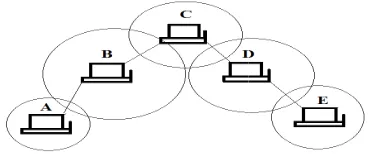
Fig. 1. A simple Ad hoc Network with five nodes.
Fig.1 shows a simple ad hoc network consist of five nodes, the node C act as a intermediate router between set of neighbor nodes AB and DE to forward the incoming packets within the network. There is no direct wireless link between B and D also A and E because they are not within transmission range each other. The user data packets reaches destination via several routers in multi-hop fashion. Need of efficient routing protocol [1] to discover and maintain the routes to deliver the data packets between the appropriate source destination pair. The Link state and distance vector conventional routing protocols are best suited for static topology or network low mobility. The performance of both are entirely dependent on the periodic exchange of control messages and performance degradation is mainly due to increased network size and mobility. Distance vector protocols may form loops and Link state [6] needs high storage and increased communication overhead. An efficient routing protocol should minimize the communication overhead such as periodic update messages. Some of the desirable properties of routing protocol are Alternate routes, less routing overhead, Loop free
International Journal of Research in Advent Technology, Vol.3, No.3, March 2015
Performance Evolution of Proactive and Reactive
Routing Protocols in Mobile Ad Hoc Networks
1, 2
Mobile Ad hoc Network (MANET) is an autonomous system of mobile nodes connected by wireless links. Each node operates not only as an end system, but also as a router to forward packets. The nodes k. These nodes change position frequently. The demand) routing strategy is a popular routing category for wireless ad hoc routing. It is a relatively new routing philosophy that provides a scalable solution to relatively large network topologies. The design follows the idea that each node tries to requested. We have chosen d DSDV theoretically. We have done on the simulation on AODV,DSR and DSDV and analyze the results through the simulation based on some quantitative performance metrics such as could be used for further
A simple Ad hoc Network with five nodes.
consumption secure routing and quality of service. Based on routing information update mechanism, Routing protocol can be classified as either proactive or reactive. Proactive protocols attempt to determine the routes continuously and all the routes are known and made it ready for use. But in reactive protocols starts the discovery of route on demand only
2. MANET ROUTING PROTOCOLS
Several routing protocols have been developed for ad hoc mobile networks [1] [2]. Such protocols must deal with typical limitations of these networks which include high power consumption, low bandwidth and high error rates. Design of the efficient routing protocol in the MANET environment is difficult because of its short live nature and as the network topologies are dynamically changed. Routing protocols for MANETs can be broadly classified as follows.
Fig. 2. MANET routing protocols
2.1. Proactive Routing Protocol
In the table-driven or Proactive protocols, there is minimal delay in determining the route to be
Some Proactive MANET Protocols are GSR, WRP, ZRP and FSR.
2.2. Reactive Routing Protocol
Reactive routing is a popular routing category wireless ad hoc routing. It is a relatively new routing philosophy that provides a scalable solution to relatively large network topologies. The design follows the idea that each node tries to reduce routing overhead by only sending routing packets whe communication is requested. Common for most on demand routing protocols are the route discovery phase where packets are flooded into the network in search of an optimal path to the destination node in the network. Some Reactive MANET Protocols include: DSR, AODV and TORA.
2.3. Hybrid Routing Protocol
consumption secure routing and quality of service. update mechanism, Routing protocol can be classified as either proactive or reactive. Proactive protocols attempt to determine the routes continuously and all the routes are known and made it ready for use. But in reactive protocols
route on demand only[3].
OUTING PROTOCOLS
Several routing protocols have been developed for ]. Such protocols must typical limitations of these networks which include high power consumption, low bandwidth and of the efficient routing protocol in the MANET environment is difficult because of its short live nature and as the network e dynamically changed. Routing protocols for MANETs can be broadly classified as
MANET routing protocols
driven or Proactive protocols, there is minimal delay in determining the route to be selected. are DSDV, DBF,
routing is a popular routing category for wireless ad hoc routing. It is a relatively new routing philosophy that provides a scalable solution to relatively large network topologies. The design follows the idea that each node tries to reduce routing overhead by only sending routing packets when communication is requested. Common for most on-demand routing protocols are the route discovery phase where packets are flooded into the network in search of an optimal path to the destination node in the network. Some Reactive MANET Protocols
Based on combination of both Table driven and On demand routing protocols, some hybrid routing protocols are proposed to combine advantage of both proactive and reactive protocols. The most typical hybrid one is zone routing protocol is presented.
3. AD HOC ON DEMAND DISTANCE VECTOR (AODV)
AODV is based upon distance vector and reactive routing protocol .In AODV, route is requested when needed and does not require nodes to maintain routes to destinations. It supports multicast routing and prevents from Bellman Ford [3] "counting to infinity" problem [2].The freshness of the route is
destination sequence number.
sequence numbers ensures loop freedom and allows to know which of several routes is more fresh. a requesting node always selects the one with the greatest sequence number. AODV
number of control messages in the network due to reactive approach only support one route for each destination. The protocol is composed of the two important phases of "Route Discovery" and "Route Maintenance", which work together to permit to discover and maintain routes for appropriate pair of source and destination and need an
the reliable delivery of data packets.
3.1. Route discovery
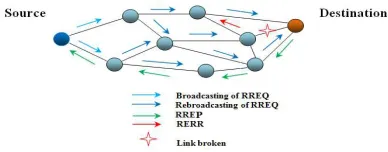
Whenever a node need to communicate and try to get route, source node initialize the route discovery phase and it broadcast the Route Request (RREQ) packet to its one hop neighbors and does not have valid route and they rebroadcast it to other nodes and it propagates through entire network. Source node waits for a RREP and the RREQ number if multiple RREP from various nodes.
Fig. 3. Propagation of RREQ, packets in AODV
3.2. Route maintenance
Based on combination of both Table driven and On demand routing protocols, some hybrid routing protocols are proposed to combine advantage of both proactive and reactive protocols. The most typical
outing protocol is presented.
DEMAND DISTANCE
AODV is based upon distance vector and reactive routing protocol .In AODV, route is requested when needed and does not require nodes to maintain routes t supports multicast routing and "counting to infinity" problem [2].The freshness of the route is realized by Using destination sequence numbers ensures loop freedom and allows several routes is more fresh. a of "Route Discovery" and "Route Maintenance", which work together to permit to for appropriate pair of need an optimum path for
s.
Whenever a node need to communicate and try to source node initialize the route discovery t broadcast the Route Request (RREQ) and does not have valid route and they rebroadcast it to other nodes and it propagates through entire network. Source node and the RREQ [1] reaches a node number if multiple RREP from various nodes.
International Journal of Research in Advent Technology, Vol.3, No.3, March 2015
E-ISSN: 2321-9637
In this route maintenance phase,If Hello messages stop arriving from a neighbor beyond some predefined time, the link is assumed to be broken. When a node detects that a route to a neighbor node is not valid it removes the routing entry and send a RERR message to neighbors and maintain the active neighbor lists. This procedure is repeated at nodes that receive RERR messages. A source that receives an RERR or any link failure notification is shared by all nodes and preventing them to sending data using that failure route or reinitiate the route discovery phase again. When a node observes that a route to a neighbor no longer valid, it remove the entry and send a link failure notification ,a triggered route reply packet [2] to neighbors that are actively using the route ,indicating them the route is no longer valid. The periodic hello packets adds significant overhead to the protocol.
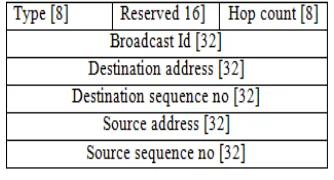
Fig. 4. RREQ format.
In Fig.4 shows the format of RREQ it contains type of message, reserved for further requirement, number of intermediate node from source to destination, broadcast id, destination address and sequence number, source address and sequence number in addition with neighbor list and life time in RREP format.
4.
DYNAMIC SOURCE ROUTING (DSR)DSR [8] is class of reactive protocols permits nodes to dynamically discover a route across the multiple network hops to any destination. It is similar to AODV in that it establishes a route on-demand when a transmitting mobile node requests one. However, it uses source routing instead of relying on the routing table at each intermediate device. In source routing, whereby all the routing information is maintained (continually updated) at mobile nodes and each packet in its header carries complete list of intermediate nodes through which the packet must pass. No need maintain up to date routing information at intermediate nodes and no periodic routing advertisements [9] between them. There is no periodic exchange of control packets so that the overhead is reduced.
4.1. Route discovery
The mechanism by which a sending node obtains a route to destination. The source broadcasts route-request to destination and each node forwards route-request by adding own address and rebroadcasting. Source node detects if the topology has changed or if any node moves out of transmission range, no longer utilize its route to destination because that node listed in a source route [2].
Fig. 5. Routing caches for DSR after route discovery phase.
From the Fig.5 ,the source node C broadcasts the RREQ packet to its neighbor A and G and G rebroadcast the received RREQ to its neighbor H,B and D and node H responds to RREQ and has valid route to destination F. Destination node copies route into a Route-reply packet and sends it back to Source C. All source routes learned by all the intermediate nodes are kept in route Cache [9] and reduces cost of route discovery again. If intermediate node receives RREQ for destination and has entry for destination in route cache, it responds and does not propagate it further.
4.2. Route maintenance
The mechanism by which a sending node detects that the network topology has changed and its route to destination is no longer valid. If any problem with a route in use, a route error is send back to the sender. After receiving this packet, the hop error will be detached from the node's route cache; all routes containing the hop are reduced at that point.DSR [10] does not required the periodic hello packet (beacon) transmissions, which are used by a node to inform its neighbors of its presence.
5. DESTINATION SEQUENCE DISTANCE VECTROR (DSDV)
and less convergence time. It requires each node need to periodically broadcast routing updates and utilize a sequence number to tag every route and largest number is desirable. Each node maintains a routing table which contains list of all known destination nodes within the network along with number of hops required to reach to particular node. Each entry is marked with a sequence number assigned by the destination node. It requires adequate time to converge before the route can be used. In the case of low mobility the required time is less but increases with frequent topology changes and overhead and packet drop also increased.
6. SIMULATION METHODOLOGY
The simulation is carried out with the Network Simulator (NS) 2.34 event driven open source software on a platform with and Ubuntu 9.10. we define the simulation in the 7000 m×500 m region, random waypoint mobile model[14], network setup consists of 50 nodes are CBR data sources placed randomly and transmission range of 250 m moves at constant speeds of 1 m/s. Each simulation run takes 100 simulated seconds.
6.1. Network simulator-2
Ns-2 [11] is a discrete event simulator targeted at networking research. It provides substantial support for simulation of TCP, routing and multicast protocols over wired and wireless networks [12]. A network environment for ad-hoc networks, wireless channel modules (e.g.802.11), Routing along multiple paths, Mobile hosts for wireless cellular networks. Ns-2 is an object-oriented simulator written in C++ and OTcl.
Fig. 6. Basic architecture of NS-2
Fig.6 shows the basic architecture of NS-2. NS2 [12]consists of two key languages: C++ and Object-oriented Tool Command Language (OTcl). While the C++ defines the internal mechanism (i.e., a backend) of the simulation objects, the OTcl sets up simulation by assembling and configuring the objects as well as scheduling discrete events.
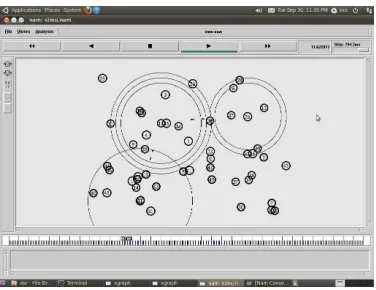
Fig. 7. Simulation Environment consisting 50 nodes
The Network Animator (NAM) is an application that makes it possible to visualize the mobile nodes as they move around and send and receive the packets [11]. Screen shot of simulated NAM window can be seen in Fig.7. Each node is an independent entity node and responsible from finding its own location and velocity as a function of time. Node move around according to a movement pattern specified at the beginning of simulation.Table.1 specifies the parameters are fixed in our TCL script.
Table 1. simulation parameters
Parameter Value
Simulation area X(m) 700m Simulation area Y(m) 500m Transmission range 250 m Mobility speed 10m/s Number of nodes 50 Traffic Type CBR
Mobility model Random way point Packet Rate 8 packets/sec Packet size 512 bytes
Protocols AODV,DSR,DSDV
Simulation Time 50s
6.2. Performance metrics
International Journal of Research in Advent Technology, Vol.3, No.3, March 2015
E-ISSN: 2321-9637
source to the number of data packets received at the destination.
7. RESULTS AND DISCUSSION
The following simulations results have shown that performance of a routing protocol varies widely across different performance differentials
.
Fig. 8. comparison of throughput
Fig. 8 shows the result shows that the throughput for AODV DSR and DSDV. At the stating of simulation time the performance of both AODV and DSR is get closer and at the end AODV is slightly better than DSR. Thus AODV [1] will have a better throughput with increased simulation time. DSDV drops a larger fraction of packets and can be seen in the larger decrease in throughput.
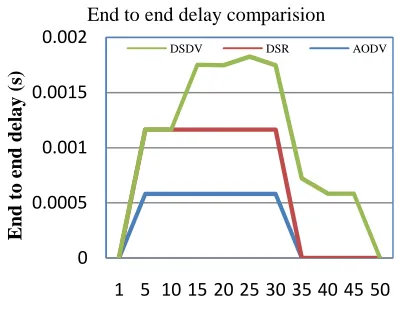
Fig. 9.comparison of delay
DSR has increased spike in delay at regular intervals after 15 s in the simulation time as shown in Fig.9. The difference in delay between these
protocols is very less. However DSR is performs well. There is a constant delay in AODV since it does not require nodes to maintain routes to destinations that are not actively used. The increase in delay for DSDV also comes from the increased time that the packets must stay in buffer.
Fig. 10. comparison of packet lost
Fig.10. illustrates the DSDV is dropping a large fraction of the packets. Both AODV and DSR are rather constant, the fraction of received packet is only decreasing slightly when simulation time increases[9].
Fig. 11. Packet delivery ratio
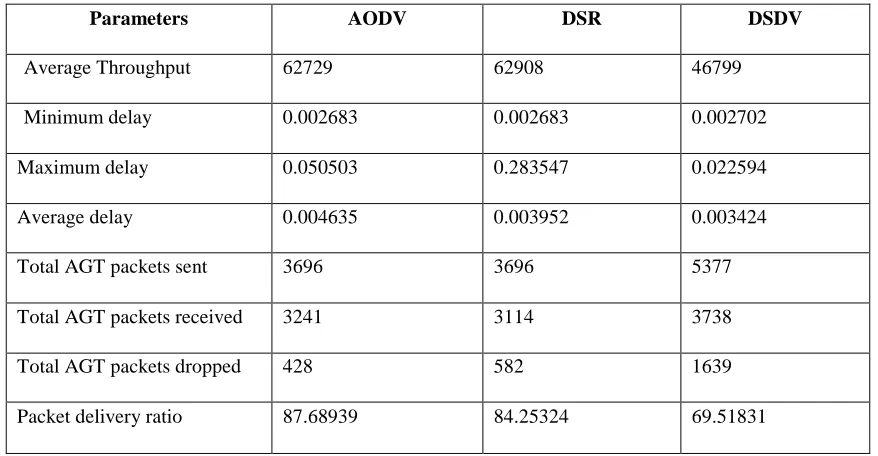
The above chart (Fig.11) represents the variation of packet delivery ratio with increasing simulation time and the delivery ratio for all the protocols is always greater than 60 percent and in Table 2 summaries and compares the PDR for all the three routing protocols. The values given in the table.2 is determined at 25 s. The AODV and DSR are higher packet delivery ratio than DSDV.
Table 2. Parameters obtained during simulation event at 25s.
Parameters AODV DSR DSDV
Average Throughput 62729 62908 46799
Minimum delay 0.002683 0.002683 0.002702
Maximum delay 0.050503 0.283547 0.022594
Average delay 0.004635 0.003952 0.003424
Total AGT packets sent 3696 3696 5377
Total AGT packets received 3241 3114 3738
Total AGT packets dropped 428 582 1639
Packet delivery ratio 87.68939 84.25324 69.51831
8. CONCLUSION
The protocols that we have been analyzed theoretically and experimentally are AODV ,DSR and DSDV. DSDV is the only protocol evaluated from proactive type. This paper provides explanation and simulation analysis also provides a classification of these protocols according to the routing strategy. There is many similarities between reactive AODV and DSR both have a route discovery phase that request messages to find new routes. The difference is that DSR is based on source routing and will learn more routes than AODV and supports unidirectional links. It is observed that the performance of AODV and DSR protocol is better than proactive DSDV routing protocol. So DSR and AODV could be used as a base protocol when we focus to design a new routing protocol for MANET.
REFERENCES
[1] S. R. Das, R. Castaneda , J. Yan, and R. Sengupta, "Comparative performance evaluation of routing protocols for mobile, ad hoc networks," Proceedings of the International Conference on Computer
Communications and Networks, pp. 153-161,Oct. 1998.
[2] C.E. Perkins and E.M. Royer, "Ad-Hoc on Demand Distance Vector Routing, Proc.
Workshop Mobile Computing Systems and Applications" (WMCSA ’99), Feb. 1999 pp.90-100.
[3] C. Cheng, R. Riley, and S. P. R. Kumar, "A loop free extended bellman-ford routing protocol
without bouncing elect," Proceedings of the ACM SIGCOMM, vol. 4, pp. 224- 236, Sep. 1989.
[4]C.E. Perkins and P. Bhagwat, "Highly DynamicDestination Sequence-Vector Routing (DSDV) for Mobile Computers, Computer Communication Review", vol. 24, no.4, 1994, pp. 234- 244.
[5]Martha Steenstrup, "Routing in communication networks". New Jersey, Prentice Hall. ISBN 0- 13-0752-2.
[6]Theodore S.Rappaport, "Wireless Communications: Principle and Prentice". New Jersey, Prentice Hall ISBN 0-13-375536-3. [7]M. Zhang, E.B.Wang, J.J. Xia, and D. K Sung ,“
An Estimated Distance based Routing Protocol for Mobile Ad hoc Networks,” IEEE Transactions on Vehicular Technology, vol.60 no.7, pp.3473-3484 Sept.2011.
[8]David B,Johnson and David A.Maltz, "Dynamic source routing in ad hoc wireless networks", In Mobile Computing , edited by Tomasz Imielinski and Hank Korth,Chapter 5, pages 153-181, Kluwer Academic Publishers.
[9] Johnson, D.B. and D.A. Maltz, "Dynamic source routing in ad hoc wireless networks", Mobile Computing, 1996, pp: 153-181.
[10] J. Broch, D. Johnson, and D. Maltz, "The Dynamic Source Routing Protocol for Mobile AdHoc Networks", IETF Inter
International Journal of Research in Advent Technology, Vol.3, No.3, March 2015
E-ISSN: 2321-9637
1998.(http://www.ietf.org/internet drafts/draft-ietfmanet- dsr-01.txt)
[11]The network simulator - ns-2.http://www.isi.edu/nsnam/ns.
[12]K. Fall and K. Varadhan (Eds.), ns notes and
documentation, 1999.
http://www.mash.cs.berkeley.edu/ns
[13] NS by Example, http://nile.wpi.edu/NS/ [9] Awk - A Tutorial and Introduction - by Bruce Barnett.
[14] T. Camp, J. Boleng, and V. Davies, "A survey of mobility models for Ad hoc network research,"