The ILMT-s2s Corpus — A Multimodal Interlingual Map Task Corpus
Hayakawa Akira
†, Saturnino Luz
‡, Loredana Cerrato
†, Nick Campbell
††ADAPT Centre, School of Computer Science and Statistics, Trinity College Dublin, Ireland
‡Usher Institute of Population Health Sciences & Informatics, University of Edinburgh, UK
†{campbeak, cerratol, nick}@tcd.ie,‡[email protected]
Abstract
This paper presents the multimodal Interlingual Map Task Corpus (ILMT-s2s corpus) collected at Trinity College Dublin, and discuss some of the issues related to the collection and analysis of the data. The corpus design is inspired by the HCRC Map Task Corpus which was initially designed to support the investigation of linguistic phenomena, and has been the focus of a variety of studies of communicative behaviour. The simplicity of the task, and the complexity of phenomena it can elicit, make the map task an ideal object of study. Although there are studies that used replications of the map task to investigate communication in computer mediated tasks, this ILMT-s2s corpus is, to the best of our knowledge, the first investigation of communicative behaviour in the presence of three additional “filters”: Automatic Speech Recognition (ASR), Machine Translation (MT) and Text To Speech (TTS) synthesis, where the instruction giver and the instruction follower speak different languages. This paper details the data collection setup and completed annotation of the ILMT-s2s corpus, and outlines preliminary results obtained from the data.
Keywords:interlingual map task, computer mediated communication, natural task oriented dialogue
1.
Introduction
The aim of this paper is to present the multimodal Inter-lingual Map Task Corpus (ILMT-s2s corpus) (Hayakawa et al., 2015) collected at Trinity College Dublin, and discuss some of the issues related to the collection and analysis of the data.
Fifteen dialogues were collected with the map task elicita-tion technique in a setting where the interacelicita-tion is mediated by a speech-to-speech (S2S) translation system. The sys-tem was implemented using off-the-shelf technology to en-able speakers of different languages to communicate with each other (remotely, over the network) in their native lan-guages. This prototype speech-to-speech translation sys-tem (ILMT-s2s syssys-tem) adds three elements: Automatic Speech Recognition (ASR), Machine Translation (MT) and Text To Speech (TTS) synthesis into the communication — we call these “filters”. Our main interest is to understand how such filters affect the subjects in terms of cognitive load, adaptation of communicative acts to the technology, prosodic alignment and repair strategies, and other factors that might have implications for the design of dialogue sys-tems and, in particular, S2S translation syssys-tems.
To this end we have collected a variety of synchronised and finely time-stamped data streams, including: high quality audio of the subjects’ utterances, video and ASR, MT, TTS events. In addition, heart rate, skin conductance, blood vol-ume pressure and electroencephelography (EEG) signals of one subject in each dialogue has also been recorded during the whole interaction with biosignal monitoring devices. So far the corpus has been used to investigate two speech related interaction phenomena observed in a map naviga-tion setting where the collaborating subjects speak different languages and have their utterances translated by the afore-mentioned S2S translation system. These studies comprise an investigation of how speakers adjust their speaking style in relation to errors from Automatic Speech Recognition (ASR), and an analysis of possible associations between
speech recognition performance and three cognitive states that arise in dialogues.
For the future, besides the traditional analysis of speech, gestures, and facial expression, we plan to investigate pos-sible correlations between the subjects’ brains’ electrical activity (through EEG), their blood volume pulse and their skin conductance with difficult situations during the
inter-actions.1 The collected corpus not only represents a new
source of data for analysis of different repairs strategies and cooperative behaviour but also several aspects of hu-man adaptation to the technology. It also allows to directly compare the dialogues with the original HCRC Edinburgh Map Task (Anderson et al., 1991), as well as its replications (Newlands et al., 2003; Louwerse et al., 2006).
The knowledge acquired by analysing the data can be used to provide baseline material for component development and testing and will also enable testing of methods for “affect sensing” from acoustic, video and biometric data recorded during the interaction.
2.
Data Collection
The data for the ILMT-s2s corpus was collected at Trinity College Dublin between August 2014 and December 2014, using an S2S MT system designed specifically for this pur-pose.
2.1.
ILMT-s2s System
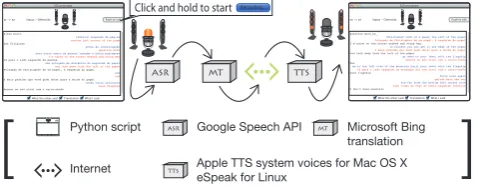
The Interlingual Map Task Speech-to-Speech translation (ILMT-s2s) system is a 700 line Python script that com-bines three off-the-shelf technologies in a clean simple User Interface (UI) (Figure 1). The ILMT-s2s System runs on
both Mac OS X and Linux2 with the three main
compo-nents being;
1
I.e., those in which the communication technology creates problems, communication issues arise, but not obviously due to the intervening technology or the task itself creating difficulty.
2
1. The Google Speech API for ASR.
2. The Microsoft Bing translation system for MT.
3. For TTS:
The Apple TTS system voices provided with Mac OS X computers (English: Kate, Portuguese: Joana). or
The eSpeak speech synthesiser for Linux computers.
ASR MT TTS
S2S prototype
Status - Otherside: en -> pt
question mark_bs_
I'm arrow on the stones washed and stony Bay
one inch away from the left of the paper
Yes
have flagship
I don't have mountain
Christopher inch of a paper the left of the paper
Polegada de Christopher de um papel, à esquerda do papel
is closest you can get to the edge of the paper
é mais próximo que você pode obter para a borda do papel
go down to your level with the flagship
descer ao seu nível com o carro-chefe
go to the left side of the mountain until your level with the flagship
Vá para o lado esquerdo da montanha até seu nível com o carro-chefe
furry once again
peludo mais uma vez
how far from the bottom left corner fire
como longe do fogo do canto esquerdo inferior Push to talk
What I said Translation What the other said S2S prototype
Status - Otherside: pt -> en
Sinto muito
das Filipinas
Vá para o lado esquerdo da página
Polegada de Christopher de um papel, à esquerda do papel
é mais próximo que você pode obter para a borda do papel
descer ao seu nível com o carro-chefe
inferior esquerdo da página
bottom left corner of the page
ponto de interrogação
question mark
seta estou sobre as pedras lavadas e bahia pedregoso
I'm arrow on the stones washed and stony Bay
uma polegada de distância da esquerda do papel
one inch away from the left of the paper
sim What the other said
Recording...
Click and hold to start
ASR MT What the other said
Python script Microsoft Bing
translation Google Speech API
Internet TTS Apple TTS system voices for Mac OS X
eSpeak for Linux
Figure 1: ILMT-s2s System used to collect the data
The ILMT-s2s System takes the speech uttered to the sys-tem, by the subject, and provides a Speech-to-Text (S2T) and Speech-to-Speech (S2S) translation of the subject’s
ut-terance to the interlocutor situated in another room.3
2.1.1. Basic Structure of the System
The ILMT-s2s System is activated by a “Push to talk” but-ton that the subject will click-and-hold for the duration of the utterance, and release once the subject has finished the utterance. For each utterance the ILMT-s2s System ex-ecutes the following processes and logs the five actions Click-and-hold, ASR, MT, TTS send, and TTS received,
in a XML file (refer to§2.2.6. for details):
1. Record and save an audio file sampled at 96 kHz, 24 bit PCM format for the duration of the click-and-hold
action using thesoxcommand.
2. Downsample the audio file recorded in step 1 to 16
kHz, 8 bit FLAC format using thesoxcommand.
3. Send the FLAC format audio file created in step 2 to
the ASR via the internet with thewgetcommand.
4. Send the text result of the ASR to the MT service for
translation via the internet with thewgetcommand.
5. Send the translated MT text result to the interlocutor’s client computer via the internet.
6. The TTS component on the interlocutor’s client puter converts the text to speech with the TTS com-mand and outputs the translated text as synthesised speech in the target language.
2.1.2. User Interface
The principle of the UI design is to be obvious as “
[well]-designed objects are easy to interpret and understand.”
(Norman, 2002), and also to inform the subjeect what the
3For the data collection, S2T translation was not displayed to
the speaker, but only to the interlocutor.
system is doing by providing feedback of the current
sta-tus, “[feedback] and communication encompass far more
than merely displaying alerts when something goes wrong. Instead, it involves keeping subjects informed about what’s happening by providing appropriate feedback and enabling
communication with your app.” (Apple, 2013).
With this in mind, the UI was specifically designed to look minimalistic (Figure 2) so that emphasis could be placed on the displayed text but feedback indicators were also added to provide the subject information of the actions of the sys-tem and their interlocutor.
S2S prototype
Status - Otherside: en -> pt
question mark_bs_
I'm arrow on the stones washed and stony Bay
one inch away from the left of the paper Yes
have flagship
I don't have mountain
Christopher inch of a paper the left of the paper Polegada de Christopher de um papel, à esquerda do papel is closest you can get to the edge of the paper é mais próximo que você pode obter para a borda do papel go down to your level with the flagship descer ao seu nível com o carro-chefe go to the left side of the mountain until your level with the flagship Vá para o lado esquerdo da montanha até seu nível com o carro-chefe furry once again peludo mais uma vez how far from the bottom left corner fire como longe do fogo do canto esquerdo inferior
Push to talk
What I said Translation What the other said
Click and hold “Push to talk” button
Process feedback indicator
Text frame display area
Black text: Interlocutor utterance, output by the system’s TTS Blue text:
User’s utterance ASR result
Red text:
Translation of the ASR result in the target language Interlocutor feedback indicators
System language indicator: Source language -> Target language
Text frame display feature selector
Figure 2: User Interface of the ILMT-s2s System
The design of the textual display is taken from the basic structure of popular texting software. This is based on the assumption that due to the popularity of texting applica-tions on smartphones and computers, the subjects would be familiar with the right-side displaying the subject’s text in colour and the left-side displaying the interlocutor’s text with no colour. The text was timed to be displayed after all the system’s internal processes were completed. For the subject’s display this means that the ASR and MT (the blue and red text of Figure 2) is displayed immediately after the MT translation is sent to the interlocutor’s computer. For the interlocutor, the S2T (the black text of Figure 2) is dis-played on their UI as soon as it is received.
As for the feedback indicators, two systems were included in the UI. One was an indicator of the process being performed by the ILMT-s2s System in the click-and-hold “Push to talk” button (Figure 3), the other was an indicator
that displays thetalkingorlisteningaction of the
interlocu-tor at the top-centre of the UI (Figure 4).
ILMT-s2s process indicator: Text within the click and hold “Push to talk” button was used to display the cur-rent process that was being performed by the ILMT-s2s System (Figure 3). The start time and end time of the five processes, “Recording. . . ” to “Sending text”, where finely time-stamped and saved to the XML
log file (§2.2.6.). Though the terms “Con. to flac”,
ILMT-s2s interlocutor action indicator: The micro-phone and loud-speakers placed at the top-centre of the UI were used to illustrate the action of the interlocutor (Figure 4). While the interlocutor holds the “Push to talk” button, the microphone mesh lights orange to indicate that the interlocutor is speaking to the ILMT-s2s System and then turns back to the original grey colour once the button is released. When the ILMT-s2s System outputs the TTS on the interlocutor’s computer, the loud-speaker cones light orange on the subject’s computer to indicate that the utterance has been sent and output to the interlocutor and turns back to the original grey once the output is finished. This feature could be described in the same line of thought with popular texting applications where a bubble with dots indicate a interlocutor writing text or the description of “Delivered” and “Read” that appears beside messages that are sent.
S2S prototype Status - Otherside: en -> pt
question mark_bs_ I'm arrow on the stones washed and stony Bay one inch away from the left of the paper Yes
have flagship
I don't have mountain
Christopher inch of a paper the left of the paper
Polegada de Christopher de um papel, à esquerda do papel
is closest you can get to the edge of the paper
é mais próximo que você pode obter para a borda do papel
go down to your level with the flagship
descer ao seu nível com o carro-chefe
go to the left side of the mountain until your level with the flagship
Vá para o lado esquerdo da montanha até seu nível com o carro-chefe
furry once again
peludo mais uma vez
how far from the bottom left corner fire
como longe do fogo do canto esquerdo inferior
Push to talk
What I said Translation What the other said
Default display, waiting for user interaction
Displayed during “Click and hold”, indicating that the system is recording the user’s utterance
Displayed while the audio file is being convereted to FLAC format
Displayed while the audio file is being sent for ASR
Displayed while text from ASR is being sent for MT
Displayed while text from MT is being sent to the interlocutor's computer
Default display, waiting for user interaction
Displayed during “Click and hold”, indicating that the system is recording the user’s utterance
Displayed while the audio file is being convereted to FLAC format
Displayed while the audio file is being sent for ASRg S
Displayed while text from ASR is being sent for MT
Displayed while text from MT is being sent to the interlocutor's computer
Figure 3: System action indicator
Microphone lights orange when interlocutor is talking to the system
Loud-speakers lights orange when TTS is output from the interlocutor’s computer
Figure 4: Interlocutor action indicators
2.2.
ILMT-s2s Data Collection
The ILMT-s2s System (§2.1.) was used to collect fifteen
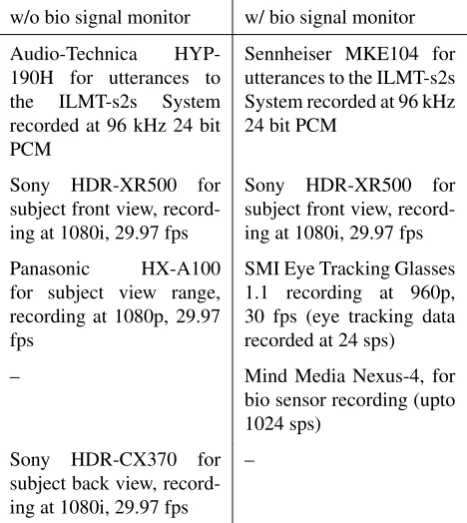
dialogues between native English and Portuguese speakers. Apart from the audio utterance recordings and XML log that the ILMT-s2s System saves, HD video, eye-tracking video and biological signals (heart rate, skin conductance, blood volume pressure and EEG) were recorded using the equipment indicated in Table 1, and worn as displayed in Figure 5 — the eye-tracking video and biological signals were only recorded from one subject per recording.
w/o bio signal monitor w/ bio signal monitor
Audio-Technica
HYP-190H for utterances to
the ILMT-s2s System
recorded at 96 kHz 24 bit PCM
Sennheiser MKE104 for utterances to the ILMT-s2s System recorded at 96 kHz 24 bit PCM
Sony HDR-XR500 for
subject front view, record-ing at 1080i, 29.97 fps
Sony HDR-XR500 for
subject front view, record-ing at 1080i, 29.97 fps
Panasonic HX-A100
for subject view range, recording at 1080p, 29.97 fps
SMI Eye Tracking Glasses 1.1 recording at 960p, 30 fps (eye tracking data recorded at 24 sps)
– Mind Media Nexus-4, for
bio sensor recording (upto 1024 sps)
Sony HDR-CX370 for
subject back view, record-ing at 1080i, 29.97 fps
–
Table 1: Recording devices per subject
w/o bio signal monitor (during recording)
w/ bio signal monitor (during recording)
Detailed
Figure 5: Subjects during recordings
In total, fifteen dialogues totalling approximately 9.5 hours of edited data have been collected and named as the ILMT-s2s Corpus (Table 3 of Appendix 1 for details).
2.2.1. The Map Task
The recorded dialogues do not have a script, so they are elicited according to the map task scheme, in which the two dialogue subjects have a specific role designated before the recording starts: an instruction giver (IG) and an instruc-tion follower (IF). The IG has a map with a route drawn on it and has to guide the IF so they can draw the same route on his/her unmarked copy of the map — the subjects can-not see each other’s map. The subjects were shown a map similar to what was used for the recordings and given an ex-planation of their role as IG and IF only once they arrived for the recording.
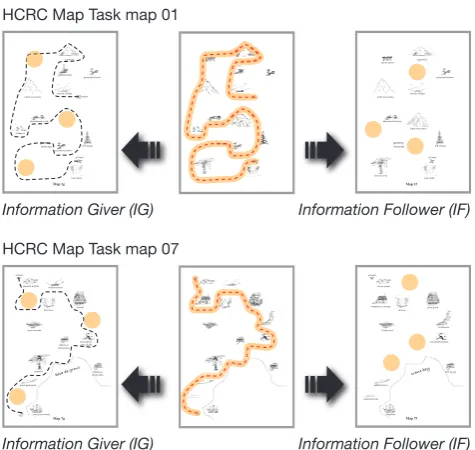
The maps used to elicit the conversation in this ILMT-s2s data collection were taken from the HCRC Map Task cor-pus (Anderson et al., 1991). The postscript files of the
maps were downloaded4 and modified using Adobe
Illus-trator and the original landmark illustrations, placement and names were used but the landmark names where re-written with the “Bradley Hand” font so that all translations
4Link to download HCRC Map Task maps: http://
Map 7g
HCRC Map Task map 07 HCRC Map Task map 01
Information Follower (IF) Information Giver (IG) Information Follower (IF)
Figure 6: Maps used in the ILMT-s2s Data Collection with differences highlighted
could be displayed similarly.
Of the sixteen maps, only two maps, map 01 and map 07,
with different route patterns5 were selected to be used for
the ILMT-s2s data collection (Figure 6).
2.2.2. The Subjects
The subjects of the ILMT-s2s data collection were recruited from the Trinity College Dublin digital noticeboard and also via personal connections. Fifteen recordings of fifteen
native English speakers (♀5, ♂10), and fifteen native
Por-tuguese speakers (♀11,♂4), between the ages of 18 and 45
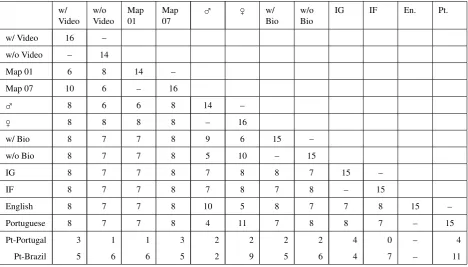
were collected and balanced as illustrated in Figure 7 and indicated in Table 4 of Appendix 2.
Eng.
Port.
w/ Bio w/ Vid. IG 1/7 Map No. B/P Brazilian/Portuguese
1 1 1
Figure 7: Image of subject pairs and recording situation
2.2.3. Recording Environment
The subjects of the ILMT-s2s data collection were informed about the experiment via an information sheet which was sent to them at least 24 hours before the expected time of data collection. At the time of the data collection, the two subjects were together given a short verbal instruction on how to use the ILMT-s2s System and how the ILMT-s2s System is expected to operate and also a simple explanation of their roles as IG and IF. Each recording session lasted
5
There are sixteen HCRC maps which are made of four ba-sic patterns, where the same route is used but the landmarks are changed to make four different maps for each basic pattern.
between 20 and 74 minutes and contains between 33 and 199 utterances to the ILMT-s2s system, and this changes to between 43 and 219 if audible utterances that were not directed to the ILMT-s2s System are included. The record-ing of the data was conducted in a workrecord-ing office of Trinity College Dublin, so environmental noise is included. The two main setup differential of the data collection were “w/o video” – “w/ video” (below) and “Map 01” – “Map 07” (Figure 6).
w/ video: A constant live video stream of the other sub-ject is displayed on the computer screen, but audio is not transmitted with the video stream. TTS output of the interlocutor’s utterance and S2T translation is displayed on the ILMT-s2s System when the system’s processes have been completed. Hence the
interlocu-torscansee each other but can only hear and read the
ILMT-s2s System output.
w/o video: The same setup as “w/ video” but without the
live video stream. Hence the interlocutorscannotsee
each other and can only hear and read the ILMT-s2s System output.
2.2.4. Biosignal Recording
As mentioned in Table 1, to record the biosignals, a Mind Media B.V., NeXus-4 was used to collect Skin Conduc-tance (SC), Heart Rate (HR) using the Blood-Volume Pulse (BVP) readings, and the brains electrical activity through Electroencephelography (EGG). The SC sensor was placed on the middle and ring finger and the BVP sensor was placed on the index finder. EEG sensors were placed in the F4, C4, P4 position with a ground channel placed at A1 of the 10 – 20 location system (Figure 8). The sampling frequency for the SC, HR and EEG were 32 kHz, 32, kHz and 1,024 kHz respectively.
Fp1 EEG Ground channel sensor: A1
Figure 8: 10 – 20 system layout map
2.2.5. ILMT-s2s System User Survey
After each recording the subjects completed a survey to ex-press their disagreement or agreement on fifteen statements designed to gather their perception of the system’s usability
—Ease of use,EffectivenessandSatisfaction. Responses
7 point Likert scale statements
1. Overall, I am satisfied with how easy it was to use
this system.
2. It was simple to use this system.
3. I could effectively complete the tasks using this
sys-tem.
4. I was able to complete the task quickly using this
sys-tem.
5. I was able to efficiently complete the task using this
system.
6. I felt comfortable using this system.
7. It was easy to learn to use this system.
8. I believe I could become productive quickly using this
system.
9. Whenever I made a mistake using the system, I could
recover easily and quickly.
10. The interface of the system was pleasant.
11. I liked using the interface of this system.
12. This system has all the functions and capabilities I expected it to have.
13. I was satisfied with the voice of this system.
14. I was satisfied with the output of this system.
15. Overall, I am satisfied with this system.
Open text field questions
1. Please indicate why you changed the style of
commu-nication.
2. Please indicate what made you give up clarifying the
intention of the other participant.
3. Please indicate all the things that irritated you.
4. Please indicate all the things that pleased you.
5. Please indicate what you felt was most difficult.
Table 2: List of survey statements and questions
2.2.6. ILMT-s2s System XML Log
Each time the subject clicks and holds the “Push to talk” button, the ILMT-s2s System will record a log of the fol-lowing four actions: Recorded utterance, ASR, MT, TTS send. Also when the ILMT-s2s System receives an utter-ance from the interlocutor’s computer, the subject’s ILMT-s2s System will record a log of the received TTS. This means that of the six basic steps of the ILMT-s2s System
explained in§2.1.1., all but the conversion of the .wav
au-dio file to a .flac auau-dio file are recorded in the log.
Apart from this, the system also records the source and tar-get language, date and time of recording, and subject details such as ID, gender, age and origin, that are manually input into the system before the recording starts.
3.
Data to Corpus
3.1.
Synchronisation
Since all the devices used during the dialogue sessions recorded video or audio, Final Cut Pro X of Apple Inc. was used for the synchronisation. The ILMT-s2s System’s au-dio utterance recordings were first synchronised with the video recordings from the SONY HDR-XR500 camcorder. The audio from the camcorder was converted into monaural audio so the resulting video had one channel with the audio from the camcorder and the other channel with the audio from the ILMT-s2s System. This made it possible to com-bine and see the audio that was spoken to the other subject and the audio of the whole session in the same audio file, but still keep them separate. This new video file was then synchronised with the video and audio files from the other devices. Once all files from each subject were synchro-nised, the files from each subject pair were synchronised with each other so that files from both sides of the conver-sation started as they had done in reality (Figure 9).
Figure 9: Representation of synchronised files
The synchronised dialogue is then cut between the points where the subjects start and end the map task to removing unwanted data, as displayed in the lighter grey section of Figure 9.
3.2.
Transcription
3.3.
Annotation
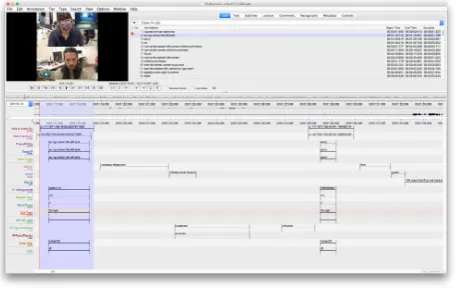
The two students who transcribed the data also annotated the data using the dedicated annotation tool ELAN (Wit-tenburg et al., 2006). Video and audio files were used for the annotation with the following freely definable multi-layered annotation scheme tiers — For the annotation of the cognitive states we calculated the inter-coder agreement on
one of the dialogues and the results are well above 60%6:
• Dialogue acts [25]: Acknowledgement CP/CPU,
Align,Check,Clarify,Explain,Instruct,Interjection,
Query y-n/w,Reply y/n/w, with also aSolovariant.
These labels were based on the Dialogue Structure Coding scheme (Carletta et al., 1997), but with mod-ifications to “Acknowledgement” to differentiate the simple acknowledgement (CP) of the utterance from the acknowledgement with the actual understanding of the utterance (CPU) which is defined under the MU-MIN coding scheme (Allwood et al., 2007). Also, a “Solo” variant of the dialogue acts, and “Interjection” were added due to the “Off-Talk” characteristics (Op-permann et al., 2001) of the collected data.
• Cognitive states [3]:Surprised,Amused,Frustrated.
Understanding that there are numerous cognitive states proposed by various annotation schemes (Mc-Cowan et al., 2005; Popescu-Belis, 2005; Juel Hen-richsen and Allwood, 2013), we chose to initially
an-notate onlySurprised,AmusedandFrustrated.
Since the data collection is task based, we thought the subjects would be focused on providing and
receiv-ing clear instructions. However, due to “the
vocabu-lary problem” (Furnas et al., 1987), clear
communi-cation is difficult even in human-to-human situations.
By adding thefiltersof the ILMT-s2s System, further
complication will arise. We assumed this would bring out the selected cognitive characteristic in the interac-tion with the system.
• Facial expressions [3] and head movements [2]:Smile,
Laughter,Surprise,Feedback-nod,Feedback-shake.
These labels were based upon the “General face” and “Head movement” attributes of the MUMIN
cod-ing scheme (Allwood et al., 2007). Of the
origi-nal “General face” attributes, “Scowl” and “Other” were removed and “Surprised” was added since the ASR and MT results may not provide what the sub-ject was expecting and result in a surprised rather than a scowled expression. The “Head movement” attributes were summarised into “Feedback-nod” for vertical, and “Feedback-shake” for horizontal head movements, following the expected ease of visual communication during the “w/ video” recording setup
mentioned in§2.2.2..
Additionally to the above tiers, the transcription, log data from the ILMT-s2s System XML files and results from fur-ther analysis were also added to the ELAN annotation files
6Calculated using the modified kappa feature of ELAN 4.9.0’s
“Inter-Annotator Reliability. . . ” function.
as tiers. Transcriptions, start and end times of utterances to the system, ASR, MT, TTS delivery and TTS output,
On-Talk7, Off-Talk Self8, Off-Talk Other9, word count etc.
were added for each subject as indicated in Figure 10.
Figure 10: Representation of ELAN data files
4.
Corpus Analyses and Future Work
To date, the data from the ILMT-s2s corpus has been used in four preliminary studies.
User evaluation of the ILMT-s2s system: Results show that in general, the subjects seemed to have
experi-enced the system as easy to learn to useandsimple
to use — mean 4.9. subjects also found the system
pleasant and likeable— mean 5.8, and they liked the
output — TTS obtained the highest grade in the eval-uation with a mean 6.0 (Cerrato et al., 2015).
User adaptation to the ILMT-s2s system: Result shows that speaking rate and clear speech are used as repair strategies when ASR errors occur. This behaviour is not a generalised, stable mode of speaking in the dia-logues we analysed, since it seems to be a targeted and flexible adaptation strategy (Hayakawa et al., 2015a).
Detection of Cognitive states: Results show that a com-bined biosignals yields detection performance well above the baseline (72% accuracy) when the time win-dow is restricted to the perceived duration of the state. Extending the window to the end of the utterance fol-lowing the cognitive state yields poor detection on biosignals alone, but improves considerably when fea-tures of the speech signal are added, thus showing the potential usefulness of speech features as a biosignal (Hayakawa et al., 2015b).
Detection of “Off Talk”: In this study we analysed “Off Talk” (Oppermann et al., 2001). The characteristics
of the three speech types (On-Talk,Off-Talk Self and
Off-Talk Other) show significant differences in terms
of speech rate (F2,2719 = 101.7;p < 2e−16), and
for this reason a detection method was implemented to see if they could also be detected with good accuracy
7
On-Talk: Talking to the ILMT-s2s System. 8
Off-Talk Self: Talking to oneself. 9
based on their acoustic and biological characteristics (Hayakawa et al., 2016).
As already mentioned in§1., we think that the knowledge
acquired by analysing the data can be used to provide base-line material for component development and testing and will also enable testing of methods for “affect sensing” from acoustic, video and biometric data of the interactions.
5.
Acknowledgements
This research is supported by Science Foundation Ireland through the CNGL Programme (Grant 12/CE/I2267) in the ADAPT Centre (www.adaptcentre.ie) at TCD.
6.
Bibliographical References
Allwood, J., Cerrato, L., Jokinen, K., Navarretta, C., and Paggio, P. (2007). The mumin coding scheme for the annotation of feedback, turn management and
sequenc-ing phenomena. Language Resources and Evaluation,
41(3):273–287.
Anderson, A. H., Bader, M., Bard, E. G., Boyle, E., Do-herty, G., Garrod, S., Isard, S., Kowtko, J., McAllister, J., Miller, J., Sotillo, C., Thompson, H. S., and Weinert,
R. (1991). The HCRC Map Task Corpus.Language and
Speech, 34(4):351–366.
Apple. (2013). Mac OS X Human Interface Guidelines.
Apple Inc, Cupertino.
Carletta, J., Isard, S., Doherty-Sneddon, G., Isard, A., Kowtko, J. C., and Anderson, A. H. (1997). The
reli-ability of a dialogue structure coding scheme.
Computa-tional linguistics, 23(1):13–31.
Cerrato, L., Hayakawa, A., Campbell, N., and Luz, S. (2015). A Speech-to-Speech, Machine Translation
Me-diated Map Task: An Exploratory Study. In
Pro-ceedings of the workshop Future and Emerging Trends
in Language Technology (FETLT2015), Seville, Spain.
Springer, LNAI. in press.
Furnas, G. W., Landauer, T. K., Gomez, L. M., and Du-mais, S. T. (1987). The vocabulary problem in
human-system communication. Communications of the ACM,
30(11):964–971.
Hayakawa, A., Cerrato, L., Campbell, N., and Luz, S. (2015a). A Study of Prosodic Alignment in Interlin-gual Map-Task Dialogues. In The Scottish Consortium
for ICPhS, editor,Proceedings of the 18th International
Congress of Phonetic Sciences, Glasgow, UK. The
Uni-versity of Glasgow. Paper number 0760.1-9.
Hayakawa, A., Haider, F., Cerrato, L., Campbell, N., and Luz, S. (2015b). Detection of Cognitive States and Their Correlation to Speech Recognition Performance in
Speech-to-Speech Machine Translation Systems. In
Pro-ceedings of INTERSPEECH’15 Sixteenth Annual Con-ference of the International Speech Communication
As-sociation, pages 2539–2543, Dresden, Germany. ISCA.
Hayakawa, A., Haider, F., Luz, S., Cerrato, L., and Camp-bell, N. (2016). Talking to a system and oneself: A study from a Speech-to-Speech, Machine Translation
medi-ated Map Task. InProceedings of Speech Prosody 2016
(SP8), Boston, Massachusetts, USA. ISCA. In press.
Juel Henrichsen, P. and Allwood, J. (2013). Predict-ing the Attitude Flow in Dialogue Based on Multi-Modal Speech Cues. In Jens Allwood, et al., editors, NEALT2012: Proceedings of the 4th Nordic Symposium
on Multimodal Communication, Link¨oping Electronic
Conference Proceedings, pages 47–53. G¨oteborg Univer-sitet.
Louwerse, M., Jeuniaux, P., Hoque, M., Wu, J., and Lewis, G. (2006). Multimodal communication in
computer-mediated map task scenarios. InProcs. of the Cognitive
Science Society, pages 1717–1722.
McCowan, I., Carletta, J., Kraaij, W., Ashby, S., Bour-ban, S., Flynn, M., Guillemot, M., Hain, T., Kadlec, J., Karaiskos, V., et al. (2005). The AMI meeting corpus.
In Proceedings of the 5th International Conference on
Methods and Techniques in Behavioral Research,
vol-ume 88.
Newlands, A., Anderson, A. H., and Mullin, J.
(2003). Adapting communicative strategies to computer-mediated communication: an analysis of task
perfor-mance and dialogue structure. Applied Cognitive
Psy-chology, 17(3):325–348.
Norman, D. A. (2002). The design of everyday things.
Ba-sic books.
Oppermann, D., Schiel, F., Steininger, S., and Beringer, N. (2001). Off-talk-a problem for
human-machine-interaction? In Proceedings of INTERSPEECH’01:
the 2nd Annual Conference of the International Speech
Communication Association, pages 2197–2200,
Aal-borg, Denmark. ISCA.
Popescu-Belis, A. (2005). Dialogue acts: One or more
di-mensions. ISSCO WorkingPaper 62.
Sj¨olander, K. and Beskow, J. (2000). Wavesurfer - an
open source speech tool. In Proceedings of the 6th
In-ternational Conference on Spoken Language Processing,
pages 464–467, Beijing, China. ISCA.
Wittenburg, P., Brugman, H., Russel, A., Klassmann, A., and Sloetjes, H. (2006). Elan: a professional framework
for multimodality research. InProceedings of the Fifth
International Conference on Language Resources and
Evaluation (LREC’06), pages 1556–1559, Genoa, Italy.
European Language Resources Association (ELRA).
7.
Language Resource References
Hayakawa, Akira and Luz, Saturnino and Cerrato,
Loredana and Campbell, Nick. (2015). The ILMT-s2s
Corpus. CNGL Programme, distributed via ELRA,
Appendix 1: ILMT-s2s Data Summary
Dialogue No— Setting Duration On-Talk
Utt. Count ( IG : IF [% Diff.]) Word Count ( IG : IF [% Diff.])
1 — Map 01, w/ Video 00:23:02 88 ( 55 : 33 [−40%]) 717 ( 450 : 267 [−40%])
2 — Map 01, w/ Video 00:48:57 217 ( 100 : 117 [+17%]) 1,522 ( 593 : 929 [+57%])
3 — Map 01, w/ Video 01:14:20 209 ( 106 : 103 [ −3%]) 818 ( 422 : 396 [ −6%])
4 — Map 01, w/o Video 00:22:31 132 ( 59 : 73 [+24%]) 530 ( 265 : 265 [ ±0%])
5 — Map 01, w/o Video 00:40:20 262 ( 201 : 61 [−70%]) 1,349 ( 915 : 434 [−53%])
6 — Map 01, w/o Video 00:44:07 171 ( 93 : 78 [−16%]) 1,310 ( 744 : 566 [−24%])
7 — Map 01, w/o Video 00:37:55 183 ( 94 : 89 [ −5%]) 1,369 ( 888 : 481 [−46%])
8 — Map 07, w/ Video 00:59:29 174 ( 121 : 53 [−56%]) 1,437 (1,016 : 421 [−59%])
9 — Map 07, w/ Video 00:29:13 202 ( 98 : 104 [ +6%]) 1,011 ( 522 : 489 [ −6%])
10 — Map 07, w/ Video 00:36:07 168 ( 76 : 92 [+21%]) 548 ( 254 : 294 [+16%])
11 — Map 07, w/ Video 00:43:17 157 ( 101 : 56 [−45%]) 942 ( 481 : 461 [ −4%])
12 — Map 07, w/ Video 00:48:19 176 ( 100 : 76 [−24%]) 1,283 ( 551 : 732 [+33%])
13 — Map 07, w/o Video 00:26:13 98 ( 49 : 49 [ ±0%]) 652 ( 345 : 307 [−11%])
14 — Map 07, w/o Video 00:25:59 126 ( 69 : 57 [−17%]) 473 ( 294 : 179 [−39%])
15 — Map 07, w/o Video 00:19:38 76 ( 34 : 42 [+24%]) 416 ( 235 : 181 [−23%])
Total 09:39:27 2,439 (1,356 : 1,083 [−20%]) 14,377 (7,975 : 6,402 [−20%])
Table 3: ILMT-s2s Corpus Data Summary
Appendix 2: ILMT-s2s Data Balance
w/ Video
w/o Video
Map 01
Map 07
♂ ♀ w/
Bio
w/o Bio
IG IF En. Pt.
w/ Video 16 –
w/o Video – 14
Map 01 6 8 14 –
Map 07 10 6 – 16
♂ 8 6 6 8 14 –
♀ 8 8 8 8 – 16
w/ Bio 8 7 7 8 9 6 15 –
w/o Bio 8 7 7 8 5 10 – 15
IG 8 7 7 8 7 8 8 7 15 –
IF 8 7 7 8 7 8 7 8 – 15
English 8 7 7 8 10 5 8 7 7 8 15 –
Portuguese 8 7 7 8 4 11 7 8 8 7 – 15
Pt-Portugal 3 1 1 3 2 2 2 2 4 0 – 4
Pt-Brazil 5 6 6 5 2 9 5 6 4 7 – 11