Human Motion Tracking with Multiple Pose using
Skeleton Model
Praveen.N
1, Christhuraj.M.R
2 PG Student of CSE1, Assistant Professor of CSE2Adithya Institute of Technology, Coimbatore [email protected], [email protected]
Abstract- This paper presents a new technique for deriving information on human skeleton models with
experimental motion tracking data. Human body tracking has received increasing attention in recent many years due to be used many broad applicability. These tracking of algorithms, pose estimation filter is consists an effective approach for human motion models. There motion tracking conveys a wealth of socially meaningful information. From even a brief exposure,biometrics,biological and medical terms motion enable the recognition of familiar with human, and inference of data attributes such as age, gender, normal actions day to day and many applications. Then a video based 3D human tracking algorithm we can infer physical attributes day to day actions of aspects of physical and mental state. The task is useful for man and communication with machine system and it provides the performance of 3D pose tracking methods. The results on a large corpus of human motion capture data and the output of a simple 3D pose tracker applied to videos of human.
Index Terms- Human pose tracking, Multiple actions, Action transition, Transition paths, Skeleton models,
Gait analysis, Transfer learning, Human attributes.
1. INTRODUCTION
The challenging issues in machine vision and computer graphic applications is the modelling and animation of human characters. Especially human body motions modelling using video sequences is a difficult task that has been investigated a lot in the last decade. Now the 2D and 3D human models are employed in various applications like Biometrics, Biological, medical terms, Sports, Games, Movies, Video Games, and virtual Environments. 3D scanners and video cameras are two sample tools that have been presented for 3D human model reconstruction. 3D scanners have limited flexibility and freedom constraints. In addition, Video cameras are nonintrusive and flexible devices for extraction of human motion. The high number of degrees of freedom for the human body, human motion tracking is a difficult task. In addition, self-occlusion of human segments and their unknown kinematics make the human tracking algorithm more challenging. The vision based approaches for human motion analysis may be divided into groups, including model based and model free methods in model based methods a known human model is employed to represent human joints and segments as well as their kinematics. Model free approaches do not employ a predefined human model for motion analysis instead, the motion information is derived directly from video sequences. Model free approaches mostly use a database applications or a learning machine for motion reconstruction. Some approaches are based on monocular cameras, to employ Multi-camera video streams. The approaches views or cameras, while others utilize uncalibrated images.
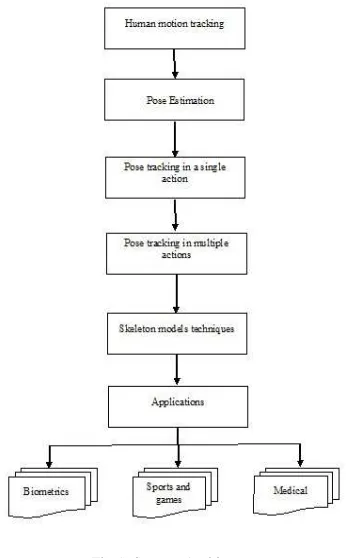
Fig 1. System Architecture
robustness to instantaneous observation. The above mentioned method employs multiple action models. The researchers have surveyed various approaches for human body motion and skeleton tracking for various applications. The human body motion and skeleton tracking techniques using an ordinary camera are not easy and require extensive time in human motion pose from uncalibrated monocular video sequences based on the morphing appearance model matching. The human pose estimation is made by integrated human joint tracking with pose reconstruction method. The Euler angles of joint are estimated by inverse kinematics based on human skeleton constrain. Then, the coordinates of pixels in the body segments in the scene are determined by forward kinematics, by projecting these pixels in the scene onto the image plane under the assumption of perspective projection to obtain the region of morphing appearance model in the image. The experimental this method can obtain favourable reconstruction a number of complex human motion sequences. A key feature of our approach is the proposed method to reconstruct 3D human pose from the corresponding 2D joints on the image plane. The human 3D pose reconstruction is accomplished automatically or manually.
Ignasi Riusa, Jordi Gonzàleza, Javier Varonab, F.Xavier Rocaa[2] To reconstruct the 3D motion parameters of a human body model from the known 2D positions of a reduced set of joints in the image plane. Towards this end, an action-specific motion model is trained from a database of real motion captured performances, and used within a particle filtering framework as a priori knowledge on human motion. Then, the state space is constrained so only integration of the estimated 3D body postures by our tracker within the HSE scheme for scene methods. Samarjit Das and Namrata Vaswani[3] The shape change of a configuration of landmark points key points of interest Over time and to use these models for filtering and tracking to automatically extract landmarks, synthesis, and change detection. The term shape activity” a particular stochastic model for the dynamics of landmark shapes Dynamics after global translation, scale, and rotation effects are normalized for). The key contribution of this work is a novel
approach to define a generative model for both 2D and 3D Nonstationary landmark shape sequences. Greatly improved performance using the proposed models is demonstrated for sequentially filtering noise-corrupted landmark configurations to compute Minimum Mean Procrustes Square Error (MMPSE) estimates of the true shape and for tracking human activity videos, for using the filtering to predict the locations of the landmarks (body parts) and using this prediction for faster and more accurate landmarks.
Zheng Zhang, Hock Soon Seah, Chee Kwang Quah, Jixiang Sun [4] to monocular pose tracking, 3D articulated body pose tracking from multiple cameras can better deal with self-occlusions and meet less ambiguities. Though considerable advances have been made, pose tracking from multiple images has not been extensively studied very seldom generative sampling algorithm with a refinement step of local optimization. This multi-layer search method does not rely on strong motion priors and generalizes well to general human motions. Physical constraints are incorporated in a novel way and 3D distance transform is employed for speedup. A voxel subject-specific 3D body model is created automatically at the initial frame to fit the subject to be tracked. The design and develop the optimized parallel implementations of time-consuming algorithms on GPU (Graphics Processing Unit) using CUDA [Compute Unified Device Architecture], which significantly accelerates the pose tracking process.
I Cheng Chang and Shih YaoLin [5] Human body tracking has received increasing attention in recent years due to its broad applicability.3D model based body tracking has received increasing attention in recent years due to its applicability to many areas, including surveillance, virtual reality, and medical analysis,biostatistics,and computer game design. To detect human motion, some researchers placed motion sensors on the human body and obtained 3D motion parameters according to sensor. This device is extremely expensive most applications involving human computer interface. The approach is markerless human body tracking. It sufficient information from video sequences to recover the parameters of body motion correctly is a difficult task for two reasons. The large number of degrees of freedom in human body configurations, the high computational loading, the limbs and the torso, which makes posture estimation difficult.3D human motion tracking by applying the three principal processes of hierarchical searching, multiple predictions and iterative mode searching.
3. RELATED WORK
Human motion analysis is an active and growing research area. Here model-based tracking methods and review work on human body models, motion models and search strategies in order to put our work in context. Model based tracking approaches very popular in human motion analysis recently. In such an approach, a geometric human body model is represented by a number of joints and sticks that connect each other according to the human body structure.
Human Body Structure Model
The human body models as consisting of six articulated chains, namely the trunk lower trunk, upper trunk, head and neck, two arms upper arm, fore arm, palm and two legs thigh, knee joints and foot. In this model is based on the skeleton structure and flexibility of the human body. The model consists of the joint locations and parameters of the tapered super quadrics describing each rigid segment. The model can be simplified to a skeleton model using just the axis of the super quadric. The recovery of the human body model.
Body Model Kinematics
The kinematic pose BMI employ a relatively generic of male and female likelihood model from that tries to maximize the similarity between the projection of the model and the observed silhouette extracted from their image. The voxel body model consists of a kinematical skeleton and a surface shape model. 3D pose of the articulated chain as well as indices and are chosen so as to minimize the sum of the elements in the vector which is given.
BMI=[hcm-100]=wt-kg (1)
BMI=[Fhcm-105]= ]=wt-kg (2)
Metric Space Information Gain
The natural objective function used to evaluate whether a split s reduces uncertainty in this space is the information gain,
I
(3)
where H (U) is the differential entropy of the random variable U with distribution PU this is defined as
method.In practice the information gain can be approximated using an empirical distribution Q = {ui} drawn from pU as
Z
H(U) = EpU(u)[−log pU(u)] = − pU(u)log pU(u)du. (4)
U
3D Articulated Human Body Model
Articulated human body models are consistent with the natural mechanism of human motion.
Therefore, able to directly apply our knowledge about human motion to it. The model usually has a hierarchical structure, so the motion of a parent node will constrain that of its child or grandchild nodes. This relationship is reflected by the rigid geometric transformations between the local coordinate systems of the body parts:
P’ = RP + T (5)
Pose Estimation
The pose estimation is the problem of determining the transformation of an object in a 2D image which gives the 3D object. The need for 3D pose estimation arises from the limitations of feature based pose estimation. There exist environments where it is difficult to extract corners or edges from an image.
E(θ,C)=λ visEvis(θ,C)+λ prior Eprior(θ)+λintEint(θ) (6)
4. PROPOSED WORK
Human skeleton model
The human body models as tree like structure, which is inspired by the human body model employed at the Human Modelling and Simulation. The human skeleton model consists of rigid parts connected by joints, in which, J1 is the root joint correspond to pelvis. Information about other joints is provided in the tree structure of human skeleton model. There native lengths of human body segments in the model are ratios of lengths which can obtained from anthropomorphic measurement. A local coordinate system is attached to each body part. The orientation of local coordinate system and the origin of coordinates is located at the position of each method.
Perception of biological motion
The simple display with a small number of dots, moving as if attached to major joints of the human body, elicits a compelling percept of a human body models figure in motion. The can be detect people quickly and reliably from such displays, we can also retrieve details about their specific nature. Biological motion cues enable the recognition of Familiar with human, animals, plants, leaves and other thing in skeleton models. The inference of human body attributes such as gender, age, mental stage, normal actions, physical moves and intentions, even for unfamiliar with human. The Principal Component Analysis (PCA) and linear discriminants modelled such aspects of human perception.
Biometrics
also used to identify individuals in groups that are under surveillance.Biometric identifiers are the distinctive,measurable characteristics used to label and describe individuals.It with include,not be limited to fingerprint, face-recognition, DNA, Palmprint, handgeometry, irisrecognition, retina and skeleton models. Behavioural characteristics are related to the pattern of behaviour of a person, including but not limited to typing rhythm, gait, and pose model. Human motion complements these sources of information.Gait analysis is closely related to our task here.There is a growing literature on gait recognition,and on gender discrimination from gait and substantial benchmark data sets exist for gait recognition.such data sets are not well suited for 3D model-based pose tracking as they lack camera calibration and resolution is often poor.Indeed, most approaches to gait recognition rely mainly on background subtraction and properties of 2D silhouettes.
The gait recognition, gender classification from gait is usually formulated in terms of 2D silhouettes, often from sagittal views where the shape of the upper body, rather than motion, is the primary cue.When multiple views are available some form of voting is often used to merge 2D cues. The use of articulated models for gender discrimination has been limited to 2D partial body models. It including 2D joint angles, dynamics of hip angles, the correlation between left and right leg angles, and the centre coordinates of the hip knee cyclogram, with linear,and 3 layer Feed forward neural net for gender classification. However, they assume 2D sagittal views and a green screen to simplify the extraction of silhouette-based gait analysis. With the use of 3D articulated tracking we avoid the need for view-based models, known camera viewpoints, and constrained domains. The video sequences we use were collected in an indoor environment with different calibrated camera locations.
Action recognition
The biometrics, most work on action recognition has focused on space and time features, local interest points, space complicity and time complicity shape in the image domain rather than with 3D pose in a body centric or world frame of reference. Holistic approaches focused on global space and time representations, with early methods relying on template based encoding obtained by aggregating contour images, or derived from person-cantered optical flow and matching. It is widely believed that 3D pose estimation is sufficiently noisy that estimator bias and variance will outweigh the benefits of such compelling representations for action recognition and the analysis of activities. In these 3D pose estimation methods is introduced as an intermediate latent representation used for action recognition. While these focused on classifying grossly different motion patterns, in this tackle the
more suitable problem of inferring meaningful attributes from human body motion.
5. EXPERIMENTAL RESULT
Hardware and Software
The project involved in hardware and software parts.it have implemented this algorithm with java on a platform with a processor Intel core i3-330m, it speed 2.13 GHZ and cache capacity is 3m, video camera. The project involved Mat lab is a scientific computational package that provides an expandable environment for Mathematical computing and visualization for data analysis. It provides an intuitive Language for development of algorithms and applications. The image processing and video processing are used Mathematical, statistical, and engineering functions.
Input and output
The given input and output is video based pose estimates of walking, running and jogging people. The basic coordinate system are of head, hands, and feet. It including with joint angles, dynamics of hip angles, the correlation between left and right leg angles, and the canter coordinates of the hip knee cyclogram. Model fitting is achieved by adjusting a pose of a skeletal model with a set of joint angles and positions method.
Image features: The image features were used for
empirical evaluation in a studio. One of them was extracted only from a single view, and the other was from multiple views.
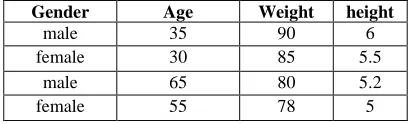
Gender Age Weight height
male 35 90 6
female 30 85 5.5
male 65 80 5.2
female 55 78 5
Table 1. Human Physical attributes like age, Weight, Height
Motion models and particles
(mm) M1 M2 M3 M4 M5
Set1,t1 20 24 20 20 20
Set1,t2 25 25 25 25 25
Set2, t1 30 34 30 30 30
Set2, t2 35 39 35 35 35
Set3, t1 40 40 40 40 40
Set3, t2 45 34 37 31 23
Table 2. Pose Estimated Joints using volume descriptors..
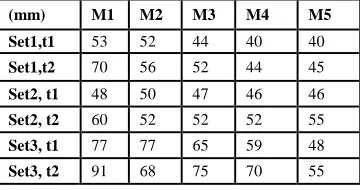
(mm) M1 M2 M3 M4 M5
Set1,t1 53 52 44 40 40
Set1,t2 70 56 52 44 45
Set2, t1 48 50 47 46 46
Set2, t2 60 52 52 52 55
Set3, t1 77 77 65 59 48
Set3, t2 91 68 75 70 55
Table 3. Pose Estimated Joints using Shape Contexts.
6. PERFORMANCE ANALYSIS
Pose tracking with volume descriptors
The physical attributes like age, gender height and weight of the output of a video based techniques of 3D human pose tracking using skeleton models. The models are used to infer binary attributes and real valued attributes. A correct action at each moment, was given manually.
0 20 40 60 80 100
male female male female
Fig 2. Human Data Attributes like Age, Weight, and Height.
Pose tracking with shape contexts
Pose tracking with shape contexts, which is more challenging than that with volume descriptors, was evaluated. The tracking results of different subjects with set1, set2, set3 respectively. The all joint positions through all frames are of temporal pose estimation accuracy .the obtained from T2 set3 of one subject. Roughly speaking, inequality relations among the results obtained by shape contexts were almost similar to those obtained by volume descriptors. Then video datasets and pose
datasets of multiple actions were used for learning and evaluation.
Fig.3. Comparison of pose tracking accuracy of the
different models. The graphs show the all joint positions estimated by using shape contexts.
Multitier videos were captured by eight cameras at 30 fps.Variables were set as follows throughout all experiments: wv=0.5, wo=0.5, the dimension of a
space models. The samples, four subjects were captured for testing data. The four subjects were captured for testing data. With each subject, three kinds of action sets below were captured Set1 (normal actions):Waving the arms by different ways like 1) Right-Upper & Left-Upper, 2) Right-Upper & Left-Lower, 3) Lower & Left-Upper, 4) Right-Lower & Left-Right-Lower. All the motion when the arms were waved in front of the body. Set2 (two gait actions): Sports, games, biomedical actions. Set3 (six gait actions): 1)Walking, 2) walking slowly, 3) walking fast, 4) action movement 5) jogging, 6) stopping from walking and start walking.
0 20 40 60 80
Set1,t1 Set1,t2 Set2, t1 Set2, t2 Set3, t1 Set3, t2
Fig. 3. Comparison of pose tracking accuracy of the different models. The graphs show the all joint positions estimated by using
7. CONCLUSION
This paper proposed the motion models of multiple actions for human pose tracking. The models are acquired from independently captured action sequences so that potential transition paths. Increasing accuracy of path synthesis might improve pose tracking and regression during action transitions. The human motion tracker uses the 2D positions of a variable set of body joints on the image plane to infer the state of a human body model. The pose estimation issues related nature of likelihood functions for 3D human body motion tracking applications method.Furthermore, in experiments, it was validated that similar actions can be modelled even in a single model. The fewer the number of the models, the greater the number of particles in each model. This results in improving tracking stability. This fact human attributes the similar actions should be grouped and modelled together for combining the advantages of separate and unified modelling.
REFERENCES
[1]. Aravind Sundaresan and Rama Chellappa “Multicamera Tracking of Articulated Human Motion Using Shape and Motion Cues” IEEE Transactions on image processing, vol.18, no.9, September 2013.
[2]. Balan. A, Sigal.L, Black.M.J, Davis.J, and Haussecker.H, “Detailed Human Shape and Pose from Images,” Proc. IEEE Conf.Computer Vision and Pattern Recognition, 2007.
[3]. Beiji Zou, ShuChen, Umugwaneza Marie “Automatic reconstruction of 3D human motion pose from uncalibrated monocular video sequences based on markerless human motion tracking”Pattern Recognition 42(2009) 1559– 1571.
[4]. C. Thurau and V. Hlavac, “Pose Primitive Based Human Action Recognition in Videos or Still Images,” Proc. IEEE Conf. Computer Vision and Pattern Recognition, pp. 1-8, 2008. [5]. Cuong Tran and Mohan Manubhai Trivedi,”
3-D Posture and Gesture Recognition for Interactivity in Smart Spaces” IEEE Transactions on Industrial Informatics, vol. 8, no.1, february 2012.
[6]. Ignasi Riusa, JordiGonzàleza, JavierVaronab, F.XavierRocaa ,“Action-specific motion prior for efficient Bayesian 3D human body tracking” Pattern Recognition 42 (2009) 2907 – 2921.
[7]. J.M. del Rincon, D.Makris,C. Orrite-Urunuela, J.-C.Nebel,“Tracking human position and lower body parts using Kalman and particle filters constrained by human biomechanics”,IEEE Trans. Syst. Man Cybern. B Cybern. 41(1) (2011)26–37.
[8]. Jinshi Cui,Ye Liu, Yuandong Xu, Huijing Zhao, and Hongbin Zha,” Tracking Generic Human Motion via Fusion of Lowand High-Dimensional Approaches” IEEE transactions on systems, man, and cybernetics: systems, vol. 43, no. 4, july 2013.
[9]. Ming Du, Xiaoming Nan, and Ling Guan,” Monocular Human Motion Tracking by Using DE-MC Particle Filter” IEEE Transactions on Image Processing, vol. 22, no. 10, October 2013.
[10].N.Howe, M.Leventon, B.Freeman, “Bayesian reconstruction of 3d human motion from single-camera video”,in: Proceedings of the Neural Information Processing Systems,1999,pp.820–826.
[11].R. Rosales, M. Siddiqui, J. Alon, S. Sclaroff, Estimating “3D body pose using uncalibrated cameras”, in: Proceedings” of the IEEE Conference on Computer Vision and Pattern Recognition, 2001, pp. 821–827.
[12].S. Ali and M. Shah, “Human Action Recognition in Videos Using Kinematic Features and Multiple Instance Learning,” IEEE Trans. Pattern Analysis and Machine Intelligence,vol. 32,no.2,pp. 288-303,Feb. 2010.
[13].Samarjit Das and Namrata Vaswani, “Nonstationary Shape Activities: Dynamic Models for Landmark Shape Change and Applications” IEEE Transactions on Pattern Analysis and Machine Intelligence, vol. 32, no. 4, April 2010.
[14].Tanaya Guha, and Rabab Kreidieh Ward, “Learning Sparse Representations for Human Action Recognition”IEEE Transactions on Pattern Analysis and Machine Intelligence 34(8), 1576-1588, (2012).