Authorship Attribution and Verification with Many Authors and Limited
Data
Kim Luyckx and Walter Daelemans
CNTS Language Technology Group University of Antwerp
Prinsstraat 13, 2000 Antwerp, Belgium
{kim.luyckx,walter.daelemans}@ua.ac.be
Abstract
Most studies in statistical or machine learning based authorship attribution focus on two or a few authors. This leads to an overestimation of the importance of the features extracted from the training data and found to be discriminating for these small sets of authors. Most studies also use sizes of training data that are unreal-istic for situations in which stylometry is applied (e.g., forensics), and thereby over-estimate the accuracy of their approach in these situations. A more realistic interpre-tation of the task is as anauthorship ver-ificationproblem that we approximate by pooling data from many different authors as negative examples. In this paper, we show, on the basis of a new corpus with 145 authors, what the effect is of many authors on feature selection and learning, and show robustness of a memory-based learning approach in doing authorship at-tribution and verification with many au-thors and limited training data when com-pared to eager learning methods such as SVMs and maximum entropy learning.
1 Introduction
In traditional studies on authorship attribution, the focus is on small sets of authors. Trying to classify an unseen text as being written by one of two or of a few authors is a relatively simple task, which
c
Kim Luyckx & Walter Daelemans, 2008. Li-censed under the Creative Commons Attribution-Noncommercial-Share Alike 3.0 Unported license (http://creativecommons.org/licenses/by-nc-sa/3.0/). Some rights reserved.
in most cases can be solved with high reliabil-ity and accuracies over 95%. An early statistical study by Mosteller and Wallace (1964) adopted distributions of function words as a discriminat-ing feature to settle the disputed authorship of the Federalist Papers between three candidate authors (Alexander Hamilton, James Madison, and John Jay). The advantage of distributions of function words and syntactic features is that they are not under the author’s conscious control, and there-fore provide good clues for authorship (Holmes, 1994). Frequencies of rewrite rules (Baayen et al., 1996), n-grams of syntactic labels from par-tial parsing (Hirst and Feiguina, 2007),n-grams of parts-of-speech (Diederich et al., 2000), function words (Miranda Garc´ıa and Calle Mart´ın, 2007), and functional lexical features (Argamon et al., 2007) have all been claimed to be reliable markers of style. There is of course a difference between claims about types of features and claims about in-dividual features of that type. E.g., it may be cor-rect to claim that distributions of function words are important markers of author identity, but the distribution of a particular function word, while useful to distinguish between one particular pair of authors, may be irrelevant when comparing an-other pair of authors.
The field of authorship attribution is however dominated by studies potentially overestimating the importance of these specific predictive features in experiments discriminating between only two or a few authors. Taking into account a larger set of authors allows the computation of the degree of variability encountered in text on a single topic of different (types of) features. Recently, research has started to focus on authorship attribution on larger sets of authors: 8 (Van Halteren, 2005), 20 (Arga-mon et al., 2003), 114 (Madigan et al., 2005), or up
to thousands of authors (Koppel et al., 2006) (see Section 5).
A second problem in traditional studies are the unrealistic sizes of training data, which also makes the task considerably easier. Researchers tend to use over 10,000 words per author (Argamon et al., 2007; Burrows, 2007; Gamon, 2004; Hirst and Feiguina, 2007; Madigan et al., 2005; Stamatatos, 2007), which is regarded to be ’a reliable mini-mum for an authorial set’ (Burrows, 2007). When no long texts are available, for example in po-ems (Coyotl-Morales et al., 2006) or student es-says (Van Halteren, 2005), a large number of short texts is selected for training for each author. One of the few studies focusing on small texts is Feiguina and Hirst (2007), but they select hundreds of these short texts (here 100, 200 or 500 words). The ac-curacy of any of these studies with unrealistic sizes of training data is overestimated when compared to realistic situations. When only limited data is available for a specific author, the author attribu-tion task becomes much more difficult. In foren-sics, where often only one small text per candidate author is available, traditional approaches are less reliable than expected from reported results.
In this paper, we present a more realistic inter-pretation of the authorship attribution task, viz. as a problem of authorship verification. This is a much more natural task, since the group of poten-tial authors for a document is essenpoten-tiallyunknown. Forensic experts not only want to identify the au-thor given a small set of suspects, they also want to make sure the author is not someone else not under investigation. They often deal with short e-mails or letters and have only limited data avail-able. The central question in authorship verifica-tion isDid candidate author x write the document? Of the three basic approaches to authorship veri-fication - also including a one-class learning ap-proach (Koppel et al., 2007) - we selected aone vs. all approach. This approach is similar to the one investigated by Argamon et al. (2003), which al-lows for a better comparison of results. With only few positive instances and a large number of neg-ative instances to learn from, we are dealing with highly skewed class distributions.
We show, on the basis of a new corpus with 145 authors, what the effect is of many authors on fea-ture selection and learning, and show robustness of a memory-based learning approach in doing thorship attribution and verification with many
au-thors and limited training data when compared to eager learning methods such as SVMs and max-imum entropy learning. As far as feature selec-tion is concerned, we find that similartypesof fea-tures tend to work well for small and large sets of authors, but that no generalisations can be made aboutindividual features. Classification accuracy is clearly overestimated in authorship attribution with few authors. Experiments in authorship veri-fication with aone vs. allapproach reveal that ma-chine learning methods are able to correctly clas-sify up to 56% of the positive instances in test data. For our experiments, we use the Personae cor-pus, a collection of student essays by 145 authors (see Section 2). Most studies in stylometry focus on English, whereas our focus is on Dutch written language. Nevertheless, the techniques used are transferable to other languages.
2 Corpus
The 200,000-word Personae corpus1 used in this
study consists of 145 student (BA level) essays of about 1400 words about a documentary on Artifi-cial Life, thereby keeping markers of genre, regis-ter, topic, age, and education level relatively con-stant. These essays contain a factual description of the documentary and the students’ opinion about it. The task was voluntary and students produc-ing an essay were rewarded with two cinema tick-ets. The students also took an online Myers-Briggs Type Indicator (MBTI) (Briggs Myers and Myers, 1980) test and submitted their profile, the text and some user information via a website. All students released the copyright of their text and explicitly allowed the use of their text and associated per-sonality profile for research, which makes it pos-sible to distribute the corpus. The corpus cannot only be used for authorship attribution and verifi-cation experiments, but also for personality predic-tion. More information about the motivation be-hind the corpus and results from exploratory ex-periments in personality prediction can be found in Luyckx & Daelemans (2008).
3 Methodology
We approach authorship attribution and verifica-tion as automatic text categorizaverifica-tion tasks that la-bel documents according to a set of predefined egories (Sebastiani, 2002, 3). Like in most text
cat-1The Personae corpus can be downloaded from
egorization systems, we take a two-step approach in which our system (i) achieves automatic selec-tion of features that have high predictive value for the categories to be learned (see Section 3.1), and (ii) uses machine learning algorithms to learn to categorize new documents by using the features se-lected in the first step (see Section 3.2).
3.1 Feature Extraction
Syntactic features have been proposed as more re-liable style markers than for example token-level features since they are not under the conscious control of the author (Baayen et al., 1996; Arga-mon et al., 2007). To allow the selection of lin-guistic features rather than (n-grams of) terms, ro-bust and accurate text analysis tools such as lem-matizers, part of speech taggers, chunkers etc., are needed. We use the Memory-Based Shallow Parser (MBSP) (Daelemans and van den Bosch, 2005), which gives an incomplete parse of the input text, to extract reliable syntactic features. MBSP tokenizes the input, performs a part-of-speech analysis, looks for noun phrase, verb phrase and other phrase chunks and detects subject and object of the sentence and a number of other gram-matical relations.
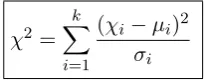
Word or part-of-speech (n-grams) occurring more often than expected with either of the cate-gories are extracted automatically for every docu-ment. We use theχ2metric (see Figure 1), which calculates the expected and observed frequency for every item in every category, to identify features that are able to discriminate between the categories under investigation.
χ2=Xk
i=1
(χi−µi)2
σi
Figure 1: Chi-square formula
Distributions ofn-grams of lexical features (lex) are represented numerically in the feature vectors, as well as of n-grams of both fine-grained (pos) and coarse-grained parts-of-speech (cgp). The most predictive function words are present in the fwd feature set. For all of these features, theχ2 value is calculated.
An implementation of the Flesch-Kincaid met-ric indicating the readability of a text, along with its components (viz., mean word and sentence length) and the type-token ratio (which indicates
vocabulary richness) are also represented (tok).
3.2 Experimental Set-Up
This paper focuses on three topics, each with their own experimental set-up:
(a) the effect of many authors on feature selection and learning;
(b) the effect of limited data in authorship attri-bution;
(c) the results of authorship verification using many authors and limited data on learning. For (a), we perform experiments in authorship attribution while gradually increasing the number of authors. First, we select a hundred random sam-ples of 2, 5 and 10 authors in order to minimize the effect of chance, then select one random sample of 20, 50, 100 authors and finally experiment with all 145 authors (Section 5.1).
We investigate (b) by performing authorship at-tribution on 2 and 145 authors while gradually in-creasing the amount of training data, keeping test set size constant at 20% of the entire corpus. The resulting learning curve will be used to compare performance of eager and lazy learners (see Sec-tion 5.1).
The authorship verification task (c) - which is closer to a realistic situation in e.g. forensics -using limited data and many authors is approxi-mated as a skewed binary classification task (one vs. all). For each of the 145 authors, we have 80% of the text in training and 20% in test. The neg-ative class contains 80% of each of the other 144 author’s training data in training and 20% in test (see Section 5.2).
All experiments for (a), (b) and (c) are per-formed using 5-fold cross-validation. This allows us to get a reliable indication of how well the learner will do when it is asked to make new pre-dictions on the held-out test set. The data set is di-vided into five subsets containing two fragments of equal size per author. Five times one of the subsets is used as test set and the other subsets as training set.
For classification, we experimented with both lazy and eager supervised learning methods. As an implementation of the lazy learning ap-proach we used TiMBL (Tilburg Memory-Based Learner) (Daelemans et al., 2007), a supervised in-ductive algorithm for learning classification tasks based on the k-nn algorithm with various exten-sions for dealing with nominal features and fea-ture relevance weighting. Memory-based learning stores feature representations of training instances in memory without abstraction and classifies new instances by matching their feature representation to all instances in memory. From these ’nearest neighbors’, the class of the test item is extrapo-lated.
As eager learners, we selected SMO, an im-plementation of Support-Vector Machines (SVM) using Sequential Minimal Optimization (Platt, 1998), and Maxent, an implementation of Maxi-mum Entropy learning (Le, 2006). SMO is em-bedded in the WEKA (Waikato Environment for Knowledge Analysis) software package (Witten and Frank, 1999).
Our expectation is that eager learners will tend to overgeneralize for this task when dealing with limited training data, while lazy learners, by de-laying generalization over training data until the test phase, will be at an advantage when dealing with limited data. Unlike eager learners, they will not ignore - i.e. not abstract away from - the fre-quently occurring infrequent or untypical patterns in the training data, that will nevertheless be useful in generalization.
4 Results and Discussion
In this section, we present results of experiments concerning the three main issues of this paper (see Section 3.2 for the experimental set-up):
(a) the effect of many authors on feature selection and learning;
(b) the effect of limited data in authorship attri-bution;
(c) the results of authorship verification using many authors and limited data on learning.
4.1 Authorship Attribution
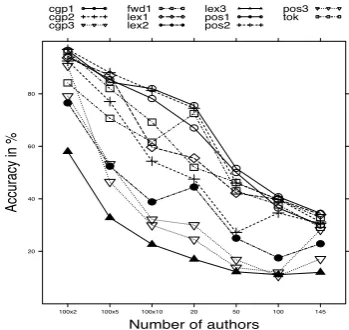
(a) Figure 2 shows the effect of many authors in authorship attribution experiments using memory-based learning (TiMBL) (k=1) and separate fea-ture sets. Most authorship attribution studies
fo-Number of authors
Accuracy in %
20 40 60 80
100x2 100x5 100x10 20 50 100 145 cgp1
cgp2 cgp3
fwd1 lex1 lex2
lex3 pos1 pos2
pos3 tok
Figure 2: The effect of many authors using single feature sets
cus on a small set of authors and report good re-sults, but systematically increasing the amount of authors under investigation leads to a significant decrease in performance. In the 2-author task (100 experiments with random samples of 2 authors), we achieve an average accuracy of 96.90%, which is in line with results reported in other studies on small sets of authors. The 5-, 10- (both in 100 experiments with random samples) and 20-author tasks show a gradual decrease in performance with results up to 88%, 82% and 76% accuracy, respec-tively. A significant fall in accuracy comes with the 50- and 100-author attribution task, where accu-racy drops below 52% for the best performing fea-ture sets. Experiments with all 145 authors from the corpus (as a multiclass problem) show an ac-curacy up to 34%. Studies reporting on accuracies over 95% are clearly overestimating their perfor-mance on a small set of authors.
Incremental combinations of feature sets per-forming well in authorship attribution lead to an accuracy of almost 50% in the 145-author case, as is shown in Figure 3. This indicates that provid-ing a more heterogeneous set of features improves the system significantly. Memory-based learning shows robustness for a large set of authors in au-thorship attribution.
Number of authors
Accuracy in %
20 40 60 80
100x2 100x5 100x10 20 50 100 145
lex1+pos1 lex1+pos1+tok lex1+pos1+tok+fwd lex1+pos2
lex1+pos2+tok lex1+pos2+tok+fwd lex1+tok
Figure 3: The effect of many authors using combi-nations of feature sets
Number of authors
Evolution of chi
!
square value
0 10 20 30 40
100x2 100x5 100x10 20 50 100 145 !
conclusie erg
ik langs man
mier mijn strengen
was
Figure 4: The effect of many authors onχ2value for 2-author discriminating features
Figure 4 shows the top-ten features with highest
χ2 value in one of the randomly selected 2-author samples. In 5-author cases, we see that some of these features have some discriminating power, but with the increase of the number of authors comes a decrease in importance.
(b) The effect of limited data is demonstrated by means of a learning curve. The performance of lazy learner TiMBL is compared to that of ea-ger learners Maxent (Maximum Entropy Learning) and SMO (Support-Vector Machines) when com-paring different training set sizes. Figure 5 shows the evolution of learning in authorship attribution using thelex1feature set. Although memory-based learning does show robustness when dealing with limited data, we cannot show a clear superiority on this aspect to the eager learning methods in this experiment. However, results are good enough to
Percentage of training data
Accuracy in %
20 40 60 80
20 40 60 80
TiMBL 2 authors Maxent SMO
TiMBL 145 authors Maxent SMO
Figure 5: The effect of limited data in authorship attribution onlex1
warrant continuing the experiments on authorship verification with this method.
4.2 Authorship Verification
(c) We now focus on a more realistic interpreta-tion of the authorship attribuinterpreta-tion task, viz. as a authorshipverificationproblem. Forensic experts want to answer both questions of authorship attri-bution (Which of the n candidate authors wrote the document?) and verification (Did candidate author x write the document?). They often deal with limited data like short e-mails or letters, and the amount of candidate authors is essentially un-known. With only few positive instances (of 1 au-thor) and a large amount of negative instances (of 144 authors in our corpus), we are dealing with highly skewed class distributions.
We approximate the author verification problem by defining a binary classification task with the au-thor fragments as positive training data, and the fragments of all the other authors as negative train-ing data. A more elegant formulation would be as a one-class problem (providing only positive train-ing data), but in exploratory experiments, these one-class learning approaches did not yield useful results.
Feature set Precision Recall F-score
tok 20.66% 15.93% 17.99%
fwd 37.89% 8.41% 13.76%
lex1 56.04% 7.03% 12.49%
lex2 47.95% 5.66% 10.12%
lex3 34.05% 8.73% 13.90%
cgp1 25.70% 24.55% 25.11% cgp2 36.35% 18.28% 24.33%
cgp3 33.13% 3.79% 6.80%
pos1 42.42% 0.97% 1.90%
pos2 42.66% 4.21% 7.66%
pos3 38.75% 2.14% 4.06%
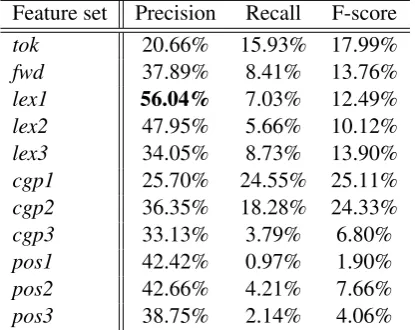
Table 1: Results of one vs. allAuthorship Verifi-cation experiments using MBL
Table 1 shows the results for the positive class of one vs. allauthorship verification using memory-based learning. We see that memory-memory-based learn-ing on the authorship verification task is able to correctly classify up to 56% of the positive class which is highly underrepresented in both training and test data. Despite the very skewed class distri-butions, memory-based learning scores reasonably well on this approximation of authorship verifica-tion with limited data. The most important lesson is that in a realistic set-up of the task of authorship verification, the accuracy to be expected is much lower than what in general can be found in the pub-lished literature.
5 Related Research
As mentioned earlier, most research in author-ship attribution starts from unrealistic assumptions about numbers of authors and amount of training data available. We list here the exceptions to this general rule. These studies partially agree with our own results. Argamon et al. (2003) report on re-sults in authorship attribution on twenty authors in a corpus of Usenet newsgroups on a variety of top-ics. Depending on the topic, results vary from 25% (books, computer theory) to 45% accuracy (com-puter language) for the 20-author task. Linguis-tic profiling, a technique presented by Van Hal-teren (2005), takes large numbers of linguistic fea-tures to compare separate authors to average files. In a set of eight authors, a linguistic pro-filing system correctly classifies 97% of the test documents. Madigan et al. (2005) use a collec-tion of data released by Reuters consisting of 114 authors, each represented by a minimum of 200
texts. Results of Bayesian multinomial logistic re-gression on this corpus show error rates between 97% and 20%, depending on the type of features applied. This is only partially comparable to the authorship attribution results on 145 authors pre-sented in this paper because of the large amount of data in the Madigan et al. (2005) study, while our system works on limited data. In a study of weblog corpora, Koppel et al. (2006) show that authorship attribution with thousands of candidate authors is reasonably reliable, since the system gave an an-swer in 31.3% of the cases, while the anan-swer is correct in almost 90% of the cases. Whereas these cases show similar results as ours, we believe this study is the first to study the effect of training set size and number of authors involved system-atically.
When applied to author verification on eight authors, the linguistic profiling system (Van Hal-teren, 2005) has a False Reject Rate (FRR) of 0% and a False Accept Rate (FAR) of 8.1%. Argamon et al. (2003) also report onone vs. alllearning in a set of twenty authors. Results vary from 19% (books, computer theory) to 43% (computer lan-guage) accuracy, depending on the topics. Madi-gan et al. (2005) also did authorship verification experiments on their corpus of 114 authors we de-scribed above. They vary the number of target, decoy, and test authors to find that the ideal split is 10-50-54, which produces an error rate of 24%. Koppel et al. (2007) also report on results in one vs. all experiments. Using a corpus of 21 books by 10 authors in different genres (including essays, plays, and novels), their system scores a precision of 22.30% and recall of 95%. Our system performs better in precision and worse in recall. Their cor-pus nevertheless consists of 21 books (each rep-resented by more than forty 500-word chunks) by 10 authors, which makes the task considerably less difficult.
and verification. When systematically increasing the number of authors in authorship attribution, we see that performance drops significantly. Similar types of features work well for different amounts of authors in our corpus, but generalizations about individual features are not useful.
Memory-based learning shows robustness when dealing with limited data, which is essential in e.g. forensics. Results from experiments in authorship attribution on 145 authors indicate that in almost 50% of the cases, a text from one of the 145 au-thors is classified correctly. Using combinations of good working lexical and syntactic features leads to significant improvements. The authorship veri-fication task is a much more difficult task, which, in our approximation of it, leads to a correct clas-sification in 56% of the test cases. It is clear that studies reporting over 95% accuracy on a 2-author study are overestimating their performance and the importance of the features selected.
Further research with the 145-author corpus will involve a study of handling with imbalanced data and experimenting with other machine learning al-gorithms for authorship attribution and verifica-tion and a more systematic study of the behavior of different types of learning methods (including feature selection and other optimization issues) on this problem.
Acknowledgements
This study has been carried out in the framework of the ’Computational Techniques for Stylometry for Dutch’ project, funded by the National Fund for Scientific Research (FWO) in Belgium. We would like to thank the reviewers for their com-ments which helped improve this paper.
References
Argamon, Shlomo, Marin Saric, and Sterling S. Stein. 2003. Style mining of electronic messages for mul-tiple authorship discrimination: First results. In Pro-ceedings of the 2003 Association for Computing Ma-chinery Conference on Knowledge Discovery and Data Mining (ACM SIGKDD), pages 475–480. Argamon, Shlomo, Casey Whitelaw, Paul Chase,
Sushant Dawhle, Sobhan R. Hota, Navendu Carg, and Shlomo Levitan. 2007. Stylistic text classifica-tion using funcclassifica-tional lexical features. Journal of the American Society of Information Science and Tech-nology, 58(6):802–822.
Baayen, Harald R., Hans Van Halteren, and Fiona Tweedie. 1996. Outside the cave of shadows: Using
syntactic annotation to enhance authorship attribu-tion. Literary and Linguistic Computing, 11(3):121– 131.
Briggs Myers, Isabel and Peter B. Myers. 1980. Gifts differing: Understanding personality type. Moun-tain View, CA: Davies-Black Publishing.
Burrows, John. 2007. All the way through: Testing for authorship in different frequency data. Literary and Linguistic Computing, 22(1):27–47.
Coyotl-Morales, Rosa M., Luis Villase˜nor Pineda, Manuel Montes-y G´omez, and Paolo Rosso. 2006. Authorship attribution using word sequences. In Proceedings of the Iberoamerican Congress on Pat-tern Recognition (CIARP), pages 844–853.
Daelemans, Walter and Antal van den Bosch. 2005. Memory-Based Language Processing. Studies in Natural Language Processing. Cambridge, UK: Cambridge University Press.
Daelemans, Walter, Jakub Zavrel, Ko van der Sloot, and Antal van den Bosch. 2007. TiMBL: Tilburg Mem-ory Based Learner, version 6.1, Reference Guide. Technical Report ILK Research Group Technical Re-port Series no. 07-07, ILK Research Group, Univer-sity of Tilburg.
Diederich, Joachim, J¨org. Kindermann, Edda Leopold, and Gerhard Paass. 2000. Authorship attribution with Support Vector Machines. Applied Intelligence, 19(1-2):109–123.
Feiguina, Ol’ga and Graeme Hirst. 2007. Authorship attribution for small texts: literary and forensic ex-periments. InProceedings of the 30th International Conference of the Special Interest Group on Infor-mation Retrieval: Workshop on Plagiarism Analysis, Authorship Identification, and Near-Duplicate De-tection (SIGIR).
Gamon, Michael. 2004. Linguistic correlates of style: Authorship classification with deep linguistic anal-ysis features. In Proceedings of the 2004 Inter-national Conference on Computational Linguistics (COLING), pages 611–617.
Hirst, Graeme and Ol’ga Feiguina. 2007. Bigrams of syntactic labels for authorship discrimination of short texts. Literary and Linguistic Computing, 22(4):405–417.
Holmes, D. 1994. Authorship Attribution. Computers and the Humanities, 28(2):87–106.
Koppel, Moshe, Jonathan Schler, and Elisheva Bonchek-Dokow. 2007. Measuring differentiabil-ity: Unmasking pseudonymous authors. Journal of Machine Learning Research, 8:1261–1276.
Le, Zhang. 2006. Maximum Entropy Modeling Toolkit for Python and C++. Version 20061005.
Luyckx, Kim and Walter Daelemans. 2008. Per-sonae: a corpus for author and personality prediction from text. In Proceedings of the 6th International Conference on Language Resources and Evaluation (LREC).
Madigan, David, Alexander Genkin, David D. Lewis, Shlomo Argamon, Dmitriy Fradkin, and Li Ye. 2005. Author identification on the large scale. In Proceedings of the 2005 Meeting of the Classifica-tion Society of North America (CSNA).
Miranda Garc´ıa, Antonio and Javier Calle Mart´ın. 2007. Function words in authorship attribution stud-ies. Literary and Linguistic Computing, 22(1):49– 66.
Mosteller, F. and D. Wallace. 1964. Inference and dis-puted authorship: the Federalist. Series in Behav-ioral Science: Quantitative Methods Edition. Platt, John, 1998. Advances in Kernel Methods -
Sup-port Vector Learning, chapter Fast training of Sup-port Vector Machines using Sequential Minimal Op-timization, pages 185–208.
Sebastiani, Fabrizio. 2002. Machine learning in auto-mated text categorization. Association for Comput-ing Machinery (ACM) ComputComput-ing Surveys, 34(1):1– 47.
Stamatatos, Efstathios. 2007. Author identification us-ing imbalanced and limited trainus-ing texts. In Pro-ceedings of the 18th International Conference on Database and Expert Systems Applications (DEXA), pages 237–241.
Van Halteren, Hans. 2005. Linguistic profiling for au-thor recognition and verification. InProceedings of the 2005 Meeting of the Association for Computa-tional Linguistics (ACL).