Proceedings of the 22nd International Conference on Computational Linguistics (Coling 2008),pages 1113–1120
A Hybrid Generative/Discriminative Framework to Train a Semantic
Parser from an Un-annotated Corpus
Deyu Zhou and Yulan He Information Research Centre
The University of Reading Reading, RG6 6BX, UK
[email protected], [email protected]
Abstract
We propose a hybrid
genera-tive/discriminative framework for se-mantic parsing which combines the hidden vector state (HVS) model and the hidden Markov support vector machines (HM-SVMs). The HVS model is an extension of the basic discrete Markov model in which context is encoded as a stack-oriented state vector. The HM-SVMs combine the advantages of the hidden Markov models
and the support vector machines. By
employing a modified K-means clustering method, a small set of most representative sentences can be automatically selected
from an un-annotated corpus. These
sentences together with their abstract an-notations are used to train an HVS model which could be subsequently applied on the whole corpus to generate semantic
parsing results. The most confident
semantic parsing results are selected to generate a fully-annotated corpus which is used to train the HM-SVMs. The proposed framework has been tested on the DARPA Communicator Data. Experimental results show that an improvement over the base-line HVS parser has been observed using the hybrid framework. When compared with the HM-SVMs trained from the fully-annotated corpus, the hybrid framework gave a comparable performance with only a small set of lightly annotated sentences.
c
°2008. Licensed under the Creative Commons Attribution-Noncommercial-Share Alike 3.0 Unported li-cense (http://creativecommons.org/licenses/by-nc-sa/3.0/). Some rights reserved.
1 Introduction
Semantic parsing maps the natural language sen-tences to complete formal meaning representa-tions. Traditionally, research in the field of se-mantic parsing can be divided into two categories: rule-based approaches and statistical approaches. Based on hand-crafted semantic grammar rules, rule-based approaches fill slots in semantic frames using word pattern and semantic tokens (Dowding et al., 1994; Ward and Issar, 1994). Such rule-based approaches are typically domain-specific and often fragile. Statistical approaches are gen-erally based on stochastic models. They can be further categorized into three types: generative approaches, discriminative approaches and a hy-brid of the two. Generative approaches learn the joint probability model, P(W, C), of input sen-tenceW and its semantic tag sequence C, com-puteP(C|W)using the Bayes rule, and then take the most probable tag sequence C. The hidden Morkov model (HMM), being a generative model, has been predominantly used in statistical seman-tic parsing. It models sequential dependencies by treating a semantic parse sequence as a Markov chain, which leads to an efficient dynamic pro-gramming formulation for inference and learning. The hidden vector state (HVS) model (He and Young, 2005) is a discrete HMM model in which each HMM state represents the state of a push-down automaton with a finite stack size. State transitions are factored into separate stack pop and push operations constrained to give a tractable search space. The result is a model which is complex enough to capture hierarchical structure but which can be trained automatically from only lightly annotated data. Discriminative approaches directly model posterior probabilityP(C|W) and
learn mappings from W to C. One representa-tive example is support vector machines (SVMs) (Vapnik, 1995). More recently, the hidden Markov support vector machines (HM-SVMs) (Altun et al., 2003) have been proposed which combine the flex-ibility of kernel methods with the idea of HMMs to predict a label sequence given an input sequence. However, HM-SVMs require full annotated cor-pora for training which are difficult to obtain in practical applications. On the other hand, the HVS model can be easily trained from only lightly an-notated corpora. It is thus interesting to explore the feasibility to combine the advantages of the HVS model and the HM-SVMs.
We propose a hybrid generative/discriminative framework here where a modified K-means clus-tering method is first applied to select a small set of the most representative sentences automat-ically from an un-annotated corpus. These sen-tences together with their abstract annotations are used to train an HVS model which could be sub-sequently applied on the whole corpus to generate semantic parsing results. The most confident se-mantic parsing results are selected to generate a fully-annotated corpus which is used to train the HM-SVMs. Experimental results show that an im-provement over the baseline HVS parser has been achieved using the hybrid framework. When com-pared with the HM-SVMs trained from the fully-annotated corpus, the hybrid framework gave a comparable performance with only a small set of lighted annotated sentences.
The rest of this paper is organized as follows. Section 2 reviews other proposed hybrid gener-ative/discriminative frameworks in recent years. Section 3 briefly describes the HVS model and the HM-SVMs followed by the presentation of the proposed hybrid framework. In Section 4, exper-imental setup and results are discussed. Finally, Section 5 concludes the paper.
2 Related Work
Combination of generative and discriminative models for data classification has recently attracted much interests in the machine learning community. It has been shown theoretically and experimentally in (Jaakkola and Haussler, 1998; Ng and Jordan, 2002; Bouchard and Triggs, 2004) that the hy-brid model combines the complementary powers of the both models. The first extensive study on hy-brid models were discussed in (Jaakkola and
Haus-sler, 1998) where discriminative features were ex-tracted using generative models and were later used in discriminative models. More recently, the HM-SVMs (Altun et al., 2003) have been proposed which incorporate kernel methods into HMMs to predict a label sequence given an input sequence.
There have also been several studies on explor-ing the hybrid generative/discriminative frame-works which combine the generative and discrim-inative models in a pipelined way. One exam-ple is the hybrid framework proposed in (Abou-Moustafa et al., 2004) for sequential data classi-fication. The framework employs HMMs to map the variable length sequential data into a fixed size
P-dimensional vector that can be classified us-ing any discriminative model. Experiments were conducted on the NIST database for handwritten digits and results showed a better recognition rate than that of standard HMMs. Another example is the hybrid generative/discriminative approach pro-posed in (Holub et al., 2008) for detecting and classifying object categories in the machine ver-sion domain. In this approach, “Fisher Kernels” were used to retain most of the desirable prop-erties of generative methods and a discriminative setting was used to increase the classification per-formance. Experimental results showed signifi-cant performance improvement over the generative counterpart.
3 Methodologies
This section first introduces the hidden vector state (HVS) model and the hidden Markov sup-port vector machines (HM-SVMs) followed by the presentation of the proposed hybrid genera-tive/discriminative framework.
3.1 Hidden Vector State Model
Given a model and an observed word sequence
W = (w1· · ·wT), semantic parsing can be
viewed as a pattern recognition problem and the most likely semantic representation can be found through statistical decoding. If assuming that the hidden data take the form of a semantic parse tree
Cthen the model should be a push-down automata which can generate the pairhW, Cithrough some canonical sequence of moves D = (d1· · ·dT).
That is,
P(W, C) =YT
t=1
For the general case of an unconstrained hierarchi-cal model,Dwill consist of three types of proba-bilistic move:
1. popping semantic category labels off the stack;
2. pushing one or more non-terminal semantic category label onto the stack;
3. generating the next word.
When considering a constrained form of au-tomata where the stack is finite depth andhW, Ci
is built by repeatedly popping 0 to n labels off the stack, pushing exactly one new label onto the stack and then generating the next word, it defines the Hidden Vector State (HVS) model in which conventional grammar rules are replaced by three probability tables.
Given a word sequence W, concept vector se-quenceC and a sequence of stack pop operations
N, the joint probability ofP(W, C, N)can be de-composed as
P(W, C, N) =
T
Y
t=1
P(nt|ct−1)P(ct[1]|ct[2· · ·Dt])
P(wt|ct) (2)
wherect, the vector state at word positiont, is a
vector of Dt semantic concept labels (tags), i.e. ct= [ct[1], ct[2], ..ct[Dt]]wherect[1]is the
preter-minal concept label andct[Dt]is the root concept
label,ntis the vector stack shift operation at word
positiontand take values in the range0, . . . , Dt−1 andct[1] = cwt is the new preterminal semantic
tag assigned to wordwtat word positiont.
3.2 Hidden Markov Support Vector Machines
To learn a function that assigns to a sequence of wordsW = (w1· · ·wT), wi ∈ W, i = 1, . . . T a
sequence of semantic tagsC = c1c2. . .cT,ci ∈ C, i = 1, . . . T, a common approach is to deter-mine a discriminant functionF :W × C →Rthat assigns a score to every inputW ∈ W :=W∗and
every semantic tag sequenceC∈ C :=C∗, where
W∗denotes the Kleene closure ofW. In order to
obtain a predictionf(W)∈ C, the function is max-imized with respect tof(W) =argmax
C∈C F(W, C).
In particular, the functionF(W, C)is assumed to be linear in some combined feature represen-tation of W and C in HM-SVMs (Altun et al.,
2003), F(W, C) := hw,Φ(W, C)i. Given a set of training data(Wi, Ci), i= 1, . . . N, the
param-etersw are adjusted so that the true semantic tag sequence Ci scores higher than all other tag
se-quencesC ∈ Ci := C\Ci with a large margin. To
achieve the goal, the following optimization prob-lem is solved instead.
min
ξi∈R,w∈F Cons
X
i
ξi+12kwk2 (3)
s.t. hw,Φ(W, Ci)i − hw,Φ(W, C)i ≥1−ξi, ∀i= 1, . . . N andC ∈ C\Ci
whereξi is non-negative slack variables allowing
one to increase the global margin by paying a lo-cal penalty on some outlying examples, andCons
dictates the desired trade off between margin size and outliers. To solve the equation 3, the dual of the equation is solved instead. The solutionw∗can
be written as
w∗ =
N
X
i=1 X
C∈C
αi(C)Φ(Wi, C), (4)
whereαi(C)is the Lagrange multiplier of the
con-straint associated with exampleiandCi.
3.3 A Hybrid Generative/Discriminative Framework for Semantic Parsing
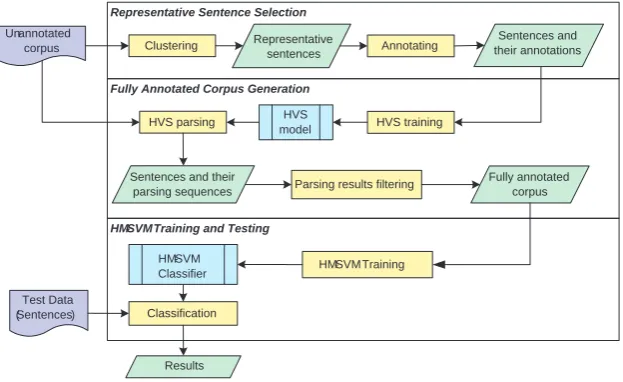
The framework of combining the HVS model and the HM-SVMs is illustrated in Figure 1. It consists of three main stages,Representative Sentences Se-lection, Fully Annotated Corpus Generation, and
HM-SVM Training and Testing. Each of them is discussed in details below.
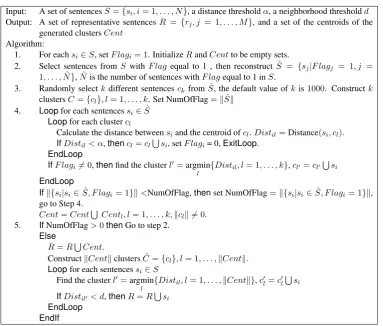
• Representative Sentences Selection. Given an un-annotated corpus, the modified K-means clustering algorithm is first employed to se-lect the most representative sentences for an-notation. This is to avoid annotating the whole corpus and hopefully the model trained from the subset of the original corpus would still give a similar performance when com-pared with the model trained from the full corpus. The modified K-means clustering al-gorithm is described in Figure 3.3.
Initially, k different sentences are randomly selected as the initial centroids. Then, each sentencesi in the training data is assigned to
HM-SVM Training and Testing Fully Annotated Corpus Generation Representative Sentence Selection
Un-annotated corpus
Test Data (Sentences)
HVS model
Parsing results filtering HVS training HVS parsing
Clustering Annotating
HM-SVM Training
Classification
Results
Sentences and their annotations
Fully annotated corpus Sentences and their
parsing sequences
Representative sentences
[image:4.595.144.456.75.266.2]HM-SVM Classifier
Figure 1: The hybrid generative/discriminative framework for semantic parsing.
After that, the centroids of thekclusters are recalculated. The above process repeats until there are no further changes in the centroids. The similarity between two sentences is cal-culated based on sequence alignment. Sup-posea=a1a2· · ·anandb=b1b2· · ·bmare
the two word sequences of length ofnandm,
Sim(i, j) is defined as the score of the op-timal alignment between the initial segment froma1toaiofaand the initial segment from b1 tobj ofb, whereSim(i, j)is recursively
calculated as follows:
Sim(i,0) = 0, i= 1,2, ...n Sim(0, j) = 0, j = 1,2, ...m
Sim(i, j) = max
0,
Sim(i−1, j−1) +s(ai, bj), Sim(i−1, j) +s(ai,0−0), Sim(i, j−1) +s(0−0, bj)
Heres(ai, bj)is the score of aligningaiwith bjand is defined as:
s(ai, bj) = log
h p(a
i, bj) p(ai)×p(bj)
i (5)
where,p(ai)denotes the occurrence
probabil-ity of the word ai and p(ai, bj) denotes the
probability thatai andbj appear at the same
position in two aligned sequences.
To ensure that content words containing key information are weighted more heavily than the less relevant words such as function
words, a score matrix can then be built and dynamic programming is used to find the largest score between two sequences. The distance between the two sentences is de-fined as the negation of the similarity between them.
After generating k clusters, the centroid in each of the clusters is selected as the represen-tative sentence for annotation. This results in an exactlyksentences being selected. There are however two ways to construct the anno-tated corpus depending on the neighborhood threshold value d. When d = 1, the anno-tated corpus only containsksentences. When
d <1, both the centroid and some of its near-est neighboring sentences in each cluster will receive the same abstract annotation. Thus, the annotated corpus will contain more than
k sentences. It has to be noted that in both cases, onlyksentences (centroids) need to be annotated.
probabil-Input: A set of sentencesS={si, i= 1, . . . , N}, a distance thresholdα, a neighborhood thresholdd Output: A set of representative sentencesR = {rj, j = 1, . . . , M}, and a set of the centroids of the
generated clustersCent Algorithm:
1. For eachsi∈S, setF lagi= 1. InitializeRandCentto be empty sets.
2. Select sentences from Swith F lagequal to 1 , then reconstruct Sˆ = {sj|F lagj = 1, j = 1, . . . ,Nˆ},Nˆis the number of sentences withF lagequal to 1 inS.
3. Randomly selectkdifferent sentencesckfromSˆ, the default value ofkis1000. Constructk clustersC={cl}, l= 1, . . . , k. Set NumOfFlag=kSˆk
4. Loopfor each sentencessi∈Sˆ Loopfor each clustercl
Calculate the distance betweensiand the centroid ofcl.Distil=Distance(si, cl). IfDistil< α,thencl=clSsi, setF lagi= 0,ExitLoop.
EndLoop
IfF lagi6= 0,thenfind the clusterl0=argmin
l {Distil, l= 1, . . . , k},cl
0=cl0Ssi EndLoop
Ifk{si|si∈S, F lagˆ i= 1}k<NumOfFlag,thenset NumOfFlag=k{si|si∈S, F lagˆ i= 1}k, go to Step 4.
Cent=CentSCentl, l= 1, . . . , k,kclk 6= 0. 5. IfNumOfFlag>0thenGo to step 2.
Else
R=RSCent.
ConstructkCentkclustersCˆ={cl}, l= 1, . . . ,kCentk. Loopfor each sentencessi∈S
Find the clusterl0=argmin
l {Distil, l= 1, . . . ,kCentk},c
0
l=c0lSsi IfDistil0< d,thenR=RSsi
[image:5.595.109.493.66.392.2]EndLoop EndIf
Figure 2: A modified K-means clustering method.
ity threshold, the most confident parse results are selected for the construction of the fully annotated corpus.
• HM-SVMs Training and Testing. Given the fully annotated corpus generated in the previ-ous stage, the HM-SVMs can then be trained which could later be used to derive the seman-tic tag sequences for the test data.
4 Experiment
Experiments have been conducted on the DARPA Communicator data (CUData, 2004) which are available to the public as open source download. The data contain utterance transcriptions and the semantic parse results from the rule-based Phoenix parser1. The DARPA Communicator data were
collected in 461 days. From these, 46 days were randomly selected for use as test set data and the remainder were used for training. After cleaning up the data, the training set consist of 12702 utter-ances while the test set contains 1178 utterutter-ances.
1http://communicator.colorado.edu/phoenix
The abstract annotation used for training and the reference annotation needed for testing were de-rived by hand correcting the Phoenix parse results. For example, for the sentence “Show me flights from Boston to New York”, the abstract annota-tion would be
FLIGHT(FROMLOC(CITY) TOLOC(CITY)). Such an annotation need only list a set of valid se-mantic concepts and the dominance relationships between them without considering the actual real-ized concept sequence or attempting to identify ex-plicit word/concept pairs. Thus, it avoids the need for expensive tree-bank style annotations.
To evaluate the performance of the model, a ref-erence frame structure was derived for every test set sentence consisting of slot/value pairs. An ex-ample of a reference frame is:
Show me flights from Boston to New York. Frame: FLIGHT
Slots: FROMLOC.CITY = Boston
TOLOC.CITY = New York
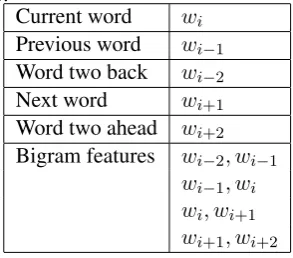
Table 1: Feature templates used in HM-SVMs. wi
is the current word, and w1, . . . , wn is the entire
sentence.
Current word wi
Previous word wi−1 Word two back wi−2
Next word wi+1
Word two ahead wi+2 Bigram features wi−2, wi−1
wi−1, wi wi, wi+1
[image:6.595.326.493.78.224.2]wi+1, wi+2
Table 2: The number of representative sentences vs the different settings ofαandd.
HH
HHHH
d α 0.5 0.6 0.7 0.8 0.9
1 350 663 1068 1743 2763
0.6 6878 7596 9810 9640 11872
the precision (P) and recall (R) values with equal weight and is defined asF = (P +R)/2P R.
In all the subsequent experiments, the open source SV Mhmm(Tsochantaridis et al., 2005) 2
has been used to train and test the HM-SVMs. The features used in the HM-SVMs are listed in Ta-ble 1.
4.1 Comparison between HVS and HM-SVMs
In the modified K-means clustering algorithm de-scribed in Figure 3.3, the number of representative sentences depends on both the distance thresholdα
and the neighborhood thresholdd. Table 2 shows the number of representative sentences obtained by varyingαandd.
First, a set of experiments were conducted to compare the performance of the HVS model with the HM-SVMs only without incorporating the hy-brid framework. Based on the different values of
dandα, we constructed different sets of the anno-tated corpus. For example, whenα = 0.5, there are 350 clusters generated from a total of 12702 sentences in the un-annotated corpus. The centroid from each of the cluster is then selected for annota-tion. These 350 sentences were annotated with ab-stract annotation for the HVS model training. And they were also fully annotated by providing word-level annotations for HM-SVMs training.
2http://www.cs.cornell.edu/People/tj/svm light/svm hmm.html
0.5 0.6 0.7 0.8 0.9
0.5 0.55 0.6 0.65 0.7 0.75 0.8 0.85 0.9 0.95 1
α
F−measure HM−SVM
HVS (d = 1) HVS (d = 0.6)
Figure 3: Comparisons of the performance of HVS and HM-SVMs on differentα.
Since only abstract annotations need to be pro-vided for the HVS model training, it is possible to automatically enlarge the annotated corpus by in-cluding some of the neighboring sentences if the same annotation of the centroid can be assigned to them. This is controlled by varying the neighbor-hood threshold d. Ifd = 1, then the annotated corpus only contains 350 sentences with their ab-stract annotations. If varyingdto 0.6, then for each cluster, some of the neighboring sentences also re-ceive the same abstract annotation as that of the centroid, thus the annotated corpus is enlarged to contain 6878 sentences.
The performance comparison of the HVS and the HM-SVMs is shown in Figure 3. It can be observed that in general, HM-SVMs outperforms HVS. This is not surprising as HM-SVMs was trained from the fully annotated corpus. The HVS model based on d = 0.6 achieved better perfor-mance over the one based ond = 1since the en-larged annotated corpus was used for training. The best performance given by HM-SVMs is 92.5% of F-measure whenα = 0.9and 2793 annotated sentences were used for training, while the HVS model gave an F-measure of 86.9%.
Though HM-SVMs outperforms HVS by 5.5%, it should be noted that the time consumed for preparing the fully annotated corpus for HM-SVMs is far more than the time spent for abstract annotation for HVS as shown in Figure 4. When
[image:6.595.108.255.116.245.2]0 20 40 60 80 100 120 140
1 2 3 4 5
alpha
hours
Abstract Annotation Word level Annotation
Figure 4: Comparison of time Consuming in preparing training data for the HVS model and the HM-SVMs.
4.2 Comparison between HVS and the Hybrid Framework with Clustering
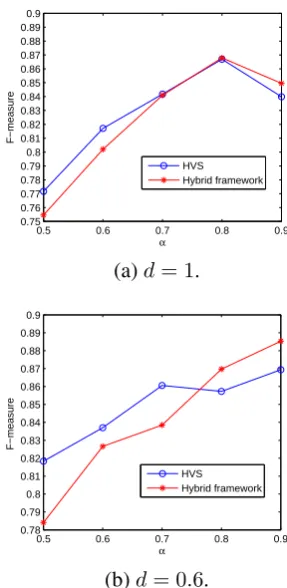
Figure 5 shows the performance comparison be-tween the HVS model and the hybrid framework by varyingα. It can be observed that when the size of the annotated corpus is small, the HVS model outperforms the hybrid framework. However, with increased number of annotated sentences, the hy-brid framework achieves the better performance. For both the HVS model and the hybrid frame-work, improved performance is observed by train-ing the model/framework from the augmented an-notated corpus with the neighboring sentences au-tomatically added in (cf. Figure 5(a) and (b)). We notice from Figure 5(a) that when the num-ber of annotated sentences increases from 1743 to 2763, the performances of both the HVS model and the hybrid framework decrease. By analyz-ing the clusteranalyz-ing results generated from the mod-ified K-means algorithm, we found that some of the clusters formed actually contain those rare sen-tences and they represent the outliers of the orig-inal training set. This therefore leads to the de-creased performance of the HVS model and the hybrid framework.
With only 2763 annotated sentences, the hybrid framework trained underd = 0.6achieves 88.5% in F-measure which results in a relative error re-duction of 12% when compared with the HVS model where the F-measure value of 87.0% was obtained.
4.3 Comparison between HVS and the Hybrid Framework without Clustering
Experiments have also been conducted to compare the performance of the HVS model and the
hy-0.5 0.6 0.7 0.8 0.9
0.75 0.76 0.77 0.78 0.79 0.8 0.81 0.82 0.83 0.84 0.85 0.86 0.87 0.88 0.89 0.9
α
F−measure
HVS Hybrid framework
(a)d= 1.
0.5 0.6 0.7 0.8 0.9
0.78 0.79 0.8 0.81 0.82 0.83 0.84 0.85 0.86 0.87 0.88 0.89 0.9
α
F−measure
HVS Hybrid framework
[image:7.595.94.271.74.200.2](b)d= 0.6.
Figure 5: Comparison of the performance of the HVS model and the hybrid framework
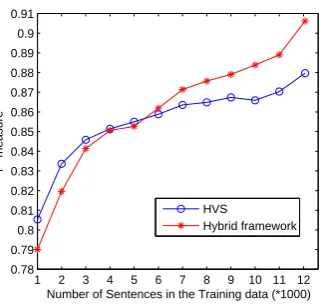
brid framework without employing the modified K-means clustering algorithm to automatically se-lect the most representative sentences for annota-tion. That is, the whole corpus of 12702 sentences were provided with abstract annotations. Both the HVS model and the hybrid framework were trained from the training set which was formed by randomly selecting the annotated sentences from the original corpus. Figure 6 illustrates the perfor-mance of the HVS model and the hybrid frame-work versus the varying sizes of the training data. Here 10-fold cross validation was performed and the F-measure value at each point of the curve in Figure 6 was calculated by averaging the perfor-mance of the 10 experiments each time with dif-ferent training set of the same size.
It can be observed that the performance of both the HVS model and the proposed hybrid frame-work increases with the increased size of the train-ing data. The hybrid framework outperforms the HVS model when the size of the training data is beyond 6000. The improvement is more substan-tial by incorporating more training data.
[image:7.595.337.481.75.370.2]1 2 3 4 5 6 7 8 9 10 11 12 0.78
0.79 0.8 0.81 0.82 0.83 0.84 0.85 0.86 0.87 0.88 0.89 0.9 0.91
Number of Sentences in the Training data (*1000)
F−measure
HVS
[image:8.595.96.258.77.229.2]Hybrid framework
Figure 6: Performance of the HVS model and the hybrid framework vs the size of the training data.
in Table 3. It can be observed that the hybrid framework gives the relative error reduction of 22% when compared with the performance of the HVS model where only 87.97% was achieved.
Table 3: Performance comparison between HVS and the hybrid framework.
Measurement HVS Hybrid Framework
Recall 87.81% 90.99 %
Precision 88.13% 90.25%
F-measure 87.97% 90.62%
It should also be noted that the best performance of 87.97% in F-measure was obtained when the HVS model was trained on the whole annotated corpus of 12702 sentences. By employing the clus-tering method to select the most representative sen-tences, the hybrid framework trained with less than one fourth of the original training data (2763 an-notated sentences) achieves 88.53% in F-measure, which is better than that of the HVS model.
5 Conclusions
This paper presented a hybrid framework by com-bining the HVS model and the HM-SVMs for se-mantic parsing. Experimental results show that 22% relative error reduction in F-measure was ob-tained using the hybrid framework on the DARPA Communicator Data when compared with the per-formance of the HVS model. Furthermore, em-ploying the modified K-means clustering algo-rithm to automatically select the most representa-tive sentences for annotation greatly reduces the human effort for annotation. With only 2763 annotated sentences, the hybrid framework gives
the better performance compared with the HVS model trained on the full 12702 annotated sen-tences. Also, the hybrid framework gives the com-parable performance with that of the HM-SVMs but without the use of the expensive word-level an-notations.
References
Abou-Moustafa, K.T., C.Y. Suen, and M. Cheriet. 2004. A generative-discriminative hybrid for se-quential data classification. In Acoustics, Speech, and Signal Processing, 2004 (ICASSP ’04), vol-ume 5, pages 805–808.
Altun, Y., I. Tsochantaridis, and T. Hofmann. 2003. Hidden markov support vector machines. In Inter-national Conference in Machine Learning, pages 3– 10.
Bouchard, Guillaume and Bill Triggs. 2004. The trade-off between generative and discriminative classifiers. InProc. of COMPSTAT 2004, pages 721–728. CUData. 2004. Darpa communicator travel data.
university of colorado at boulder. Avaiable from http://communicator.colorado.edu/phoenix.
Dowding, J., R. Moore, F. Andry, and D. Moran. 1994. Interleaving syntax and semantics in an efficient bottom-up parser. InProc. of the 32th Annual Meet-ing of the Association for Computational LMeet-inguistics, pages 110–116, Las Cruces, New Mexico, USA. He, Yulan and Steve Young. 2005. Semantic
process-ing usprocess-ing the hidden vector state model. Computer Speech and Language, 19(1):85–106.
Holub, Alex D., Max Welling, and Pietro Perona1. 2008. Hybrid generative-discriminative visual cat-egorization. International Journal of Computer Vi-sion, 77:239–258.
Jaakkola, T. and D. Haussler. 1998. Exploiting genera-tive models in discriminagenera-tive classifiers. InProc. of Advances in Neural Information Processing 11. Ng, A. and M. Jordan. 2002. On generative vs.
dis-criminative classifiers: A comparison of logistic re-gression and naive bayes. In Proc. of Advances in Neural Information Processing 15, pages 841–848. Tsochantaridis, Ioannis, Thorsten Joachims, Thomas
Hofmann, and Yasemin Altun. 2005. Large mar-gin methods for structured and interdependent output variables. J. Mach. Learn. Res., 6:1453–1484. Vapnik, Vladimir N. 1995. The nature of statistical
learning theory. Springer-Verlag New York, Inc., New York, NY, USA.
Ward, W. and S. Issar. 1994. Recent improvements in the cmu spoken language understanding system. In
[image:8.595.75.288.389.445.2]