R. Dale et al. (Eds.): IJCNLP 2005, LNAI 3651, pp. 792–803, 2005. © Springer-Verlag Berlin Heidelberg 2005
Applied to Verb Semantics
Timothy Chklovski and Patrick Pantel
Information Sciences Institute,University of Southern California, 4676 Admiralty Way,Marina del Rey, CA 90292
{timc, pantel}@isi.edu
Abstract. Recently, researchers have applied text- and web-mining algorithms to mine semantic resources. The result is often a noisy graph of relations be-tween words. We propose a mathematically rigorous refinement framework, which uses path-based analysis, updating the likelihood of a relation between a pair of nodes using evidence provided by multiple indirect paths between the nodes. Evaluation on refining temporal verb relations in a semantic resource called VERBOCEAN showed a 16.1% error reduction after refinement.
1 Introduction
Increasingly, researchers are creating broad-coverage semantic resources by mining text corpora [1][5] and the Web [2][6]. These resources typically consist of a noisy collection of relations between words. The data is typically extracted on a per link basis (i.e., the relation between two nodes is determined without regard to other nodes). Yet, little work has taken a global view of the graph of relations, which may provide additional information to refine local decisions by identifying inconsistencies, updating confidences in specific edges (relations), and suggesting relations between additional pairs of nodes.
For example, observing the temporal verb relations “discover happens-before re-fine” and “refine happens-before exploit” provides evidence for the relation “discover
happens-before exploit,” because the happens-before relation is transitive.
We conceptualize a semantic resource encoding relations between words as a graph where words are nodes and binary relations between words are edges. In this paper, we investigate the refinement of such graphs by updating the confidence in edges using a global analysis relying on link semantics. Our approach is based on the observation that some paths (chains of relations) between a pair of nodes xi and xj imply the presence or absence of a particular direct relation between xi and xj. Despite each individual path being noisy, multiple indirect paths can provide sufficient evidence for adding, remov-ing, or altering a relation between two nodes. As illustrated by the earlier example, inferring a relation based on the presence of an indirect path relies on the semantics of the links that make up the path, like transitivity or equivalence classes.
framework include: “ascertain happens-before evaluate”, “approve happens-before back”, “coat happens-before bake”, “plan happens-before complete”, and “interrogate
happens-before extradite”.
Examples of edges that are removed by applying our framework include: “induce
happens-before treat”, “warm happens-before heat”, “halve happens-before slice”,
and “fly happens-before operate”.
Experiments show that our framework is particularly good at filtering out the in-correct temporal relations in VERBOCEAN. Removing incorrect relations is particu-larly important for inference systems.
2 VerbOcean
We apply our path-based refinement framework to VERBOCEAN [2], a web-extracted lexical semantics resource with potential applications to a variety of natural language tasks such as question answering, information retrieval, document summarization, and machine translation. VERBOCEAN is a graph of semantic relations between verbs, with 3,477 verbs (nodes) and 22,306 relations (edges). Although the framework applies whenever some paths through the graph imply presence or absence of a relation, for the evaluation we focus on the temporal precedence relation in VERBOCEAN,and, in an ancillary role, on the similarity relation. Senses are not discriminated and an edge indicates that the relation is believed to hold between some senses of the verbs in this relation.
The five semantic relations present in VERBOCEAN are presented in Table 1.
Tem-poral precedence (happens-before) is a transitive asymmetric temporal relation
be-tween verbs. Similarity is a relation that suggests two nodes are likely to be in the same equivalence class, although polysemy makes it only weakly transitive.
Table 1. Types, examples and frequencies of 22,306 semantic relations in VERBOCEAN
Semantic Relation Example Transitive Symmetric # in VERBOCEAN
temporal precedence marry :: divorce Y N 4,205
similarity produce :: create Y Y 11,515
strength wound :: kill Y N 4,220
antonymy open :: close N Y 1,973
enablement fight :: win Y N 393
In VERBOCEAN, asymmetric relations between two nodes are enforced to be unidi-rectional (i.e., presence of an edge xi happens-before xj guarantees absence of an edge
xj happens-before xi). Larger, inconsistent loops are possible, however, as extraction
3 Global Refinement
Our approach relies on a global view of the graph to refine a relation between a given pair of nodes xi and xj, based on multiple indirect paths between the two nodes. The analysis processes triples <xi, r, xj> for the relation r to output r, its opposite (which we will denote q), or neither. The opposite of happens-before is the same relation in the reverse direction (happens-after). The refinement is based on evidence provided by indirect paths, over a probabilistic representation of the graph.
Section 3.1 introduces the steps of the refinement, Section 3.2 details which paths are used as evidence, and Section 3.3 derives the statistical model used for combining evidence from multiple unreliable paths.
3.1 Overview of the Refinement Algorithm
We first introduce some notation. Let Ri,jdenote the event that the relation r is present between nodes xi and xj in the original graph – i.e., the graph indicates (perhaps spuri-ously) the presence of the relation r between xi and xj. Let ri,j denote the relation r actually holding between xi and xj. Let ψi,j denote an acyclic path from xi to xj of (pos-sibly distinct) relations {Ri,i+1 .. Rj-1,j}. For example, the path “x1similar x2
happens-before x3” can be denoted ψ1,3. If the edges of ψi,j indicate the relation r between the
nodes xi and xj, we say that ψi,jindicatesri,j.
Given a triple <xi, r, xj>, we identify the set Ψr full of all paths ψi,j such that ψi,j indi-cates ri,j and ψi,j’s sequence of relations {Ri,i+1 .. Rj-1,j} matches one of the allowed sequences. That is, we only consider certain path types. The restriction on types of paths considered is introduced because identifying and processing all possible paths indicating ri,j is too demanding computationally in a large non-sparse graph. The path types considered are detailed in Section 3.2. Note that the intermediate nodes of paths can range over the entire graph.
For each ψi,j in the above set Ψr full, we compute the estimated probability that ri,j holds given the observation of (relations that make up) ψi,j. Each edge in the input graph is treated as a probabilistic one, with probabilities P(ri,j) and P(ri,j|Ri,j) estimated
from human judgments on a representative sample. Generally, longer paths and paths made up of less reliable edges will have lower probabilities. Section 3.3 presents the full model for estimating these probabilities.
Next, we form the set Ψr by selecting from Ψr full only the paths which have no
common intermediate nodes. This is done greedily, processing all paths in Ψr full
in order of decreasing score, placing each in Ψr iff it does not share any intermediate
nodes with any path already in Ψr. This is done to avoid double-counting the available
evidence in our framework, which operates assuming conditional independence of paths.
Next, we compute P(ri,j | Ψr), the probability of ri,j given the evidence provided by the paths in Ψr. The model for computing this is described in Section 3.3. Similarly,
Ψq and P(qi,j | Ψq) are computed for qi,j, the opposite of ri,j. Next, the evidence for r and q are reconciled by computing P(ri,j | Ψr, Ψq) and, similarly, P(qi,j | Ψr, Ψq).
Finally, the more probable of the two relations ri,j and qi,j is output if its probability exceeds a threshold value Pmin (i.e., ri,jis output if P(ri,j | Ψr, Ψq) > P(qi,j | Ψr, Ψq) and
3.2 Paths Considered
The enabling observation behind our approach is that in a graph in which edges have certain properties such as transitivity, some paths Ψi,j indicate the presence of a rela-tion between the first node xi and the last node xj. In the paths we consider, we rely on two kinds of inferences: transitivity and equivalence. Also, we do not consider very long paths, as they tend to become unreliable due to accumulation of chance of false detection of each edge and sense drift in each intermediate node. The set of paths to consider was not rigorously motivated. Rather, we aimed to cover some common cases. Refining the sets of paths is a possible fruitful direction for future work.
For the presence of happens-before, a transitive asymmetric relation, we consid-ered all 11 path types of length 3 or less which imply happens-before between the end nodes based on transitivity and equivalence:
“happens-before” “similar, similar, happens-before” “happens-before, similar” “happens-before, happens-before, similar” “similar, happens-before” “similar, happens-before, happens-before” “happens-before, happens-before” “happens-before, similar, happens-before” “happens-before, similar, similar” “happens-before, happens-before, happens-before” “similar, happens-before, similar”
3.3 Statistical Model for Combining Evidence
This section presents a rigorous derivation of the probabilistic model for computing and combining probabilities with which indirect paths indicate a given edge.
3.3.1 Estimating from a Single Path
We first derive probability of r1,n given single path ψ 1,n:
(
rn n)
P 1, |ψ1,
If n is 2, i.e. ψ1,n has only one edge R1,2, we have simply the probability that the
edge actually holds given its presence in the graph:
(
r1,2| 1,2) (
Pr1,2|R1,2)
P ψ = (1)
Otherwise, ψ1,n has intermediate nodes, in which case P(r1,n | ψ1,n) can be estimated as follows:
(
) (
)
(
)
Let Pmatch denote the probability that there is no significant shift in meaning at a given intermediate node. Then, assume that path r1,2,…, rn-1,n indicates r1,n iff the meanings at n – 2 intermediate nodes match:
(
)
2Also, when one or more of the relations ri,i+1 do not hold, nothing is generally
im-plied1 about r1,n, thus
(
)
(
rn r rn n) ( )
Prn P 1, |¬ 1,2,..., −1, = 1,Plugging these in, we have:
(
)
= −∏
= −(
+ +) ( )
+(
− −∏
=1..−1(
,+1 ,+1)
)
which can be rewritten as:
(
) ( )
= +(
−( )
)
−∏
=1..−1(
,+1 ,+1)
probability that an edge will be labeled with relation r by a human judge, and P(ri,i+1 | Ri,i+1) is the precision with which the system could identify R. While Pmatch can be estimated empirically we have not done so. We experimentally set Pmatch = 0.9.3.3.2 Combining Estimates from Multiple Paths
In this subsection we derive an estimate of the validity of inferring r1,n given the set
Ψr of m paths ψ1,n1, ψ1,n2, …, ψ1,nm: between a pair of nodes from a sample set with no additional evidence. The case of one path has been treated in the previous section. In the case of multiple paths, we derive the expression as follows (omitting for convenience subscripts on paths, and distinguishing them by their superscripts). We assume conditional independence of any two paths ψk and ψl given r or ¬r. Using Bayes’ rule yields2:
This is not the case for paths in which the value of one edge, given the other edges, is corre-lated with the value of the end-to-end relation. The exception does not apply for happens-before edges if there are other happens-happens-before edges in the path, nor does it ever apply for any similar edges.
2
The above denominator can be rewritten as:
Using Bayes’ rule again, the expressions in the above products can be rewritten as follows:
Substituting into Eq. 5 the Eqs. 6 and 7 yields:
(
)
( )∏
( )
( )∏
(
)
( )∏
( ) ( )
( ) ( ( ))∏
(
( )
( )) ( )
Using the above for the denominator of Eq. 4, using Eq. 6 in the numerator of Eq. 4, and simplifying, we have:
(
)
( )
(
(
)
)
which can be rewritten as
(
)
(
)
3.3.3 Estimating from Supporting and Opposing Paths
(
q r) (
Pq r)
P |¬,Ψr = |¬ and P
(
q|¬r,Ψr,Ψq) (
=Pq|¬r,Ψq)
, and similarly(
r q)
P(
r q)
P |¬ ,Ψq = |¬ and P
(
r|¬q,Ψr,Ψq)
=P(
r|¬q,Ψr)
We proceed by deriving the following, each consequent relying on the previous re-sult:
Substituting the result of Lemma 1 (Eq. 10) into the above yields:
(
) (
( )
) ( )
Substituting the result of Lemma 2 (Eq. 12) into the above yields:
THEOREM 3 we can simplify:
(
r r q) (
P q r q)
P(
r q r)
(
P(
q r q)
)
P(
r q r)
P |Ψ ,Ψ = ¬ |Ψ ,Ψ |¬ ,Ψ =1− |Ψ ,Ψ |¬ ,Ψ (15)Similarly,
(
q r q) (
P r r q) (
Pq r q)
(
P(
r r q)
) (
Pq r q)
P |Ψ ,Ψ = ¬ |Ψ ,Ψ |¬ ,Ψ =1− |Ψ ,Ψ |¬ ,Ψ (16)
Substituting, Eq. 16 into Eq. 15 yields:
(
)
(
(
(
)
) (
)
)
(
)
Expanding and simplifying, we establish our Theorem 1:
(
)
(
( )
)
(
( )
( ) (
)
(
(
)
) ( )
(
)
(
)
(
)
( )
)
4 Experimental Results
In this section, we evaluate our refinement framework on the temporal precedence relations discovered by VERBOCEAN, and present some observations on applying the refinement to other VERBOCEAN relations.
4.1 Experimental Setup
Following Chklovski and Pantel [2], we studied 29,165 pairs of verbs obtained from a paraphrasing algorithm called DIRT [4]. We applied VERBOCEAN to the 29,165 verb pairs, which tagged each pair with the semantic tag happens-before, happens-after
and no temporal precedence3.
3
VERBOCEAN actually produces additional relations such as similarity, antonymy, strength and
For our experiments, we randomly sampled 1000 of these verb pairs, and presented them to two human judges (without revealing the VERBOCEAN tag). The judges were asked to classify each pair among the following tags:
Happens-before with entailment Happens-before without entailment Happens-after with entailment Happens-after without entailment Another semantic relation No semantic relation
For the purposes of our evaluation, tags a and b align with VERBOCEAN’s
happens-before tag, tags c and d align with the happens-after tag, and tags e and f align with
the no temporal relation tag4. The Kappa statistic [7] for the task was κ = 0.78.
4.2 Refinement Results
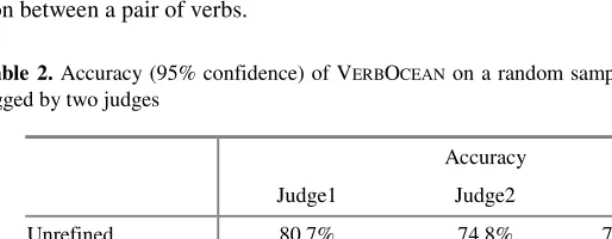
Table 2 shows the overall accuracy of VERBOCEAN tags on the 1000 verb pairs ran-domly sampled from DIRT. Each row represents a different refinement. The number in parentheses is Pmin, the threshold value for the strength of the relation from Section 3.1. As the threshold is increased, the refinement algorithm requires greater evidence (more supporting paths and absence of opposing evidence) to trigger a temporal rela-tion between a pair of verbs.
Table 2. Accuracy (95% confidence) of VERBOCEAN on a random sample of 1000 verb pairs tagged by two judges
Accuracy
Judge1 Judge2 Total
Unrefined 80.7% 74.8% 77.7% ± 2.0%
Refined (0.5) 66.0% 63.7% 64.8% ± 2.6%
Refined (0.66) 75.4% 71.7% 73.5% ± 2.4%
Refined (0.9) 83.1% 77.2% 80.2% ± 2.1%
Refined (0.95) 84.5% 78.0% 81.3% ± 1.9%
Refined (Combo)* 86.8% 81.3% 84.0% ± 2.4%
* Combo combines the no temporal relation from the 0.5 and the happens-before and
happens-after from the and 0.95 refinements, where the reported accuracy is
com-puted on the subset of 716 verb pairs for which the algorithm is most confident.
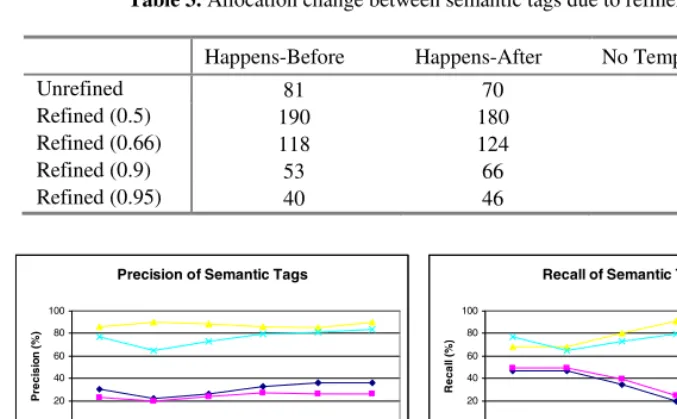
Table 3 shows the reassignments due to refinement. At the 0.5 level, the refinement left 76 of 81 relations unchanged, revising 3 to happens-after and 2 to no temporal
relation. Similarly, only two of the original happens-after relations were changed
with refinement. However, of the 849 originally tagged no temporal relation, the
4
Fig. 3. Refinement precision on all 1000 verb pairs vs. on the 819 verb pairs on which the annotators agree on tag
Overall Precision vs. Precision on Agreed Pairs
60 65 70 75 80 85 90 95 100
Unrefined R 0.5 R 0.66 R 0.9 R 0.95 R Combo
Refinement Algorithm
P
re
c
is
io
n
(
%
)
Overall Agreed Pairs Table 3. Allocation change between semantic tags due to refinement
Happens-Before Happens-After No Temporal Relation
Unrefined 81 70 849
Refined (0.5) 190 180 630
Refined (0.66) 118 124 758
Refined (0.9) 53 66 881
Refined (0.95) 40 46 914
refinement moved 113 to happens-before and 109 to happens-after. The precision of the 0.5 refinement on the no temporal
relation tag increased by 4%; however,
the precision on the temporal relations decreased by 5.7%. At the 0.95 refine-ment level, 54 of the 81 relations origi-nally tagged happens-before and 45 of the 70 relations originally tagged
hap-pens-after were changed to no temporal
relation. Only 34 of the 849 no temporal
relations were changed. At this level, the
precision of no temporal relation tag decreased by 0.8% and the temporal relations’ precision increased by 4%.
Hence, at the 0.5 level, pairs classified as no temporal relation were improved while at the 0.95 level, pairs classified as a temporal relation were improved. To lev-erage benefits of the two, we applied both the 0.5 and 0.95 level refinements and kept
happens-before and happens-after classifications from the 0.95 level, and kept the no
temporal relation classification from the 0.5 level.5 284 verb pairs were left
unclassi-fied. On the 716 classified verb pairs, refinement improved accuracy by 6.3%.
5 This combination is guaranteed to be free of conflicts in classification because it is
impossi-ble for a relation to be classified as temporal at the 0.95 threshold level while being classified as non-temporal at the 0.5 level.
Fig. 1. Refinement precision on each semantic tag
Precision of Semantic Tags
0 20 40 60 80 100
Unrefined R 0.5 R 0.66 R 0.9 R 0.95 R Combo
Refinement Algorithm
P
re
c
is
io
n (
%
)
Happens-Before Happens-After No Temporal Relation Overall
Fig. 2. Refinement recall on each semantic tag
Recall of Semantic Tags
0 20 40 60 80 100
Unrefined R 0.5 R 0.66 R 0.9 R 0.95 R Combo
Refinement Algorithm
Re
c
a
ll
(
%
)
Figures 1 and 2 illustrate the refinement precision and recall for each semantic tag. Both annotators have agreed on 819 verb pairs, and we examined performance on these. Figure 3 shows a higher precision on these pairs as compared to the overall set, illustrating that what is easier for the annotators is easier for the system.
4.3 Observations on Refining Other Relations
We have briefly investigated refining other semantic relations in VERBOCEAN. The extent of the evaluation was limited by availability of human judgments. We ran-domly sampled 100 pairs from DIRT and presented the classifications to three human judges for evaluation [2].
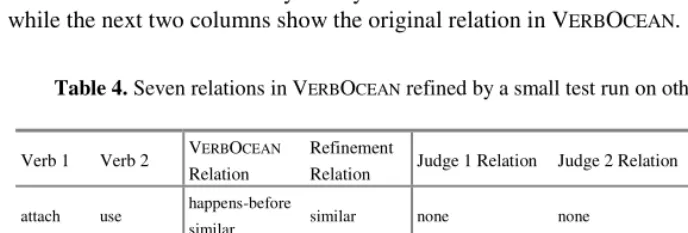
Of the 100 pairs, 66 were identified to have a relation. We applied our refinement algorithm to VERBOCEAN and inspected the output. On the 37 relations that VERBOCEAN got wrong, our system identified six of them. On the remaining 29 that VERBOCEAN got correct, only one was identified as incorrect (false positive). Hence, on the task of identifying incorrect relations in VERBOCEAN, our system has a preci-sion of 85.7%, where precipreci-sion is defined as the percentage of correctly identified erroneous relations. However, it only achieved a recall of 16.2%, where recall is the percentage of erroneous relations that our system identified. Table 4 presents the relations that were refined by our system. The first two columns show the verb pair while the next two columns show the original relation in VERBOCEAN.
Table 4. Seven relations in VERBOCEAN refined by a small test run on other relations
Verb 1 Verb 2 VERBOCEAN Relation
Refinement
Relation Judge 1 Relation Judge 2 Relation Judge 3 Relation
attach use happens-before
similar similar none none none
bounce get weaker than stronger than none none none
dispatch defeat opposite none none none happens-before
doom complicate opposite similar* none stronger-than stronger-than
flatten level stronger than no relation* similar similar similar
outlaw codify similar opposite none none opposition
privatize improve happens-before none happens-before happens-before happens-before
* only revision of relation to its opposite or “none” was attempted here
4.4 Discussion
Our evaluation focused on the presence or absence of relations after refinement, with-out exploiting the fact that our framework also updates confidences in a given rela-tion. The additional information about confidence can benefit probabilistic inference approaches (e.g., [3]).
A similar A' happens-before B
suggests the absence of A happens-before B.
Other important avenues of future work include applying our framework to other relations (e.g., strength in VERBOCEAN) and to better characterize the refinement thresholds.
5 Conclusions
We presented a method for refining edges in graphs by leveraging the semantics of multiple noisy paths. We re-estimated the presence of an edge between a pair of nodes from the evidence provided by multiple indirect paths between the nodes. Our ap-proach applies to a variety of relation types: transitive symmetric, transitive asymmet-ric, and relations inducing equivalence classes. We applied our model to refining temporal verb relations in a semantic resource called VERBOCEAN. Experiments showed a 16.1% error reduction after refinement. On the 72% refinement decisions that it was most confident, the error reduction was 28.3%.
The usefulness of a semantic resource is highly dependent on its quality, which is often poor in automatically mined resources. With graph refinement frameworks such as the one presented here, many of these resources may be improved automatically.
References
1. Berland, M. and E. Charniak, 1999. Finding parts in very large corpora. In ACL-1999. pp. 57-64. College Park, MD.
2. Chklovski, T., and Pantel, P. 2004. VERBOCEAN: Mining the Web for Fine-Grained Semantic Verb Relations. In Proceedings of 2004 Conference on Empirical Methods in
Natural Language Processing (EMNLP 2004), Barcelona, Spain, July 25-26.
3. Domingos, P. and Richardson, M. 2004. Markov Logic: A unifying framework for statistical relational learning. In Proceedings of ICML Workshop on Statistical Relational
Learning and its Connections to Other Fields. Banff, Canada.
4. Lin, D. and Pantel, P. 2001. Discovery of inference rules for question answering. Natural Language Engineering, 7(4):343-360.
5. Pantel, P. and Ravichandran, D. 2004. Automatically labeling semantic classes. In
Proceedings HLT/NAACL-04. pp. 321-328. Boston, MA.
6. Shinzato, K. and Torisawa, K. 2004. Acquiring hyponymy relations from web documents.
In Proceedings of HLT-NAACL-2004. pp. 73-80. Boston, MA.