Parsing 2-Dimensional Language
Masaru Tomita
Computer Science Department and
Center for Machine Translation Carnegie-Mellon University
Pittsburgh, PA 152131
Abstract
2-Dimensional Context-Free Grammar (2D-CFG) for 2-dimensional input text is introduced and efficient parsing algorithms for 2D-CFG are presented. In 2D-CFG, a grammar rule's right hand side symbols can be placed not only horizontally but also vertically. Terminal symbols in a 2-dimensional input text are combined to form a rectangular
region,
and regions are combined to form a larger region using a 2 -dimensional phrase structure rule. The parsing algorithms presented in this paper are the 2D-Ear1ey algorithm and 2D-LR algorithm, which are 2-dimensionally extended versions of Earley’s algorithm and the LR(O) algorithm, respectively.1. In tro d u c tio n
Existing grammar formalisms and formal language theories, as well as parsing algorithms, deal only with one-dimensional strings. However, 2-dimensional layout information plays an important role In understanding a text. It is especially crucial for such texts as title pages of artldes, business cards, announcements and formal letters to be read by an optical character reader (OCR). A number of projects [ 1 1 ,6 ,7 ,2 ], most notably by Fujisawa
et al.
[4], try to analyze and utilize the 2-dimensional layout information. Fujisawaet al.,
unlike others, uses a procedural language called Form Definition Language (FDL) [5, 12] to specify layout rules. On the other hand, in the area of image understanding, several attempts have been also made to define a language to describe 2-dimensional images [3, 10].This paper presents a formalism called 2-Dimensional Context-Free Grammar (2D-CFG ), and two parsing algorithms to parse 2-dimensional language with 2D-CFG . Unlike all the previous attempts mentioned above, our approach is to extend existing well-studied (one dimensional) grammar formalisms and parsing techniques to handle 2-dimensional language. In the rest of this section, we informally describe the 2-dimensional context-free grammar (2D-CFG) in comparison with the 1-dimensional traditional context-free grammar.
Input to the traditional context-free grammar is a string, or
sentence
; namely a one-dimensional array of terminal symbols. Input to the 2-dimensional context-free grammar, on the other hand, is a rectangular block of symbols, ortext,
namely, a 2-dimensional array of terminal symbols.In the traditional context-free grammar, a non-terminal symbol represents a
phrase
, which is a substring of the original input string. A grammar rule is applied to combine adjoining phrases to form a larger phrase. In the 2-dimensional context-free grammar, on the other hand, a non-terminal represents aregion,
which is a rectangular sub-block of the input text. A grammar rule is applied to combine two adjoining regions to form a larger region. Rules like1T h » research was supported by the National Science Foundation under contract IRI-8858085.
A — > B C (1)
are used to combine horizontally adjacent regions. In addition, rules like
B
A --> (2)
C
can be used in the 2-dimensional context-free grammar to combine vertically adjacent regions.
A region can be represented with a non-terminal symbol and 4 positional parameters: x, y, X and Y, which determine the upper-left position and the lower-right position of the rectangle (assuming that the coordinate origin is the upper-left corner of the input text).
Horizontally adjacent regions, (B, x8, yB, x B, Y s) and (C, x,., yc , Xc , Y c ), can be combined only if
• yB - yc.
• Y B = Yc , and
• X B = Xq.
The first two conditions say that B and C must have the same vertical position and the same height, and the last condition says that B and C are horizontally adjoining.
Similarly, vertically adjacent regions, B and C, can be combined only if • x0 = xc ,
• Xg 3 Xq, and
•
y b=
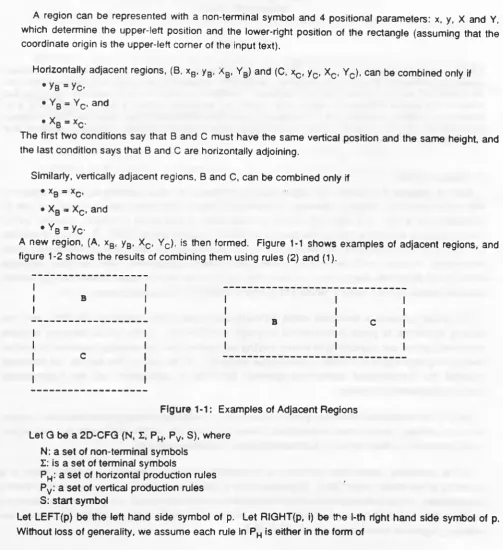
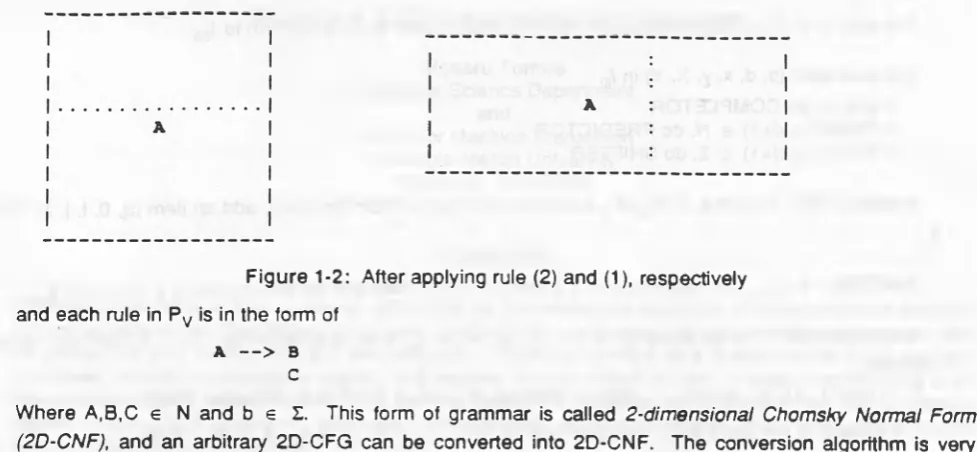
[image:2.563.25.529.147.698.2]/c-A new region, (/c-A, xB, yB, Xc , Yc ), is then formed. Figure 1-1 shows examples of adjacent regions, and figure 1-2 shows the results of combining them using rules (2) and (1).
B
C
Figure 1-1: Examples of Adjacent Regions
Let Q be a 2D -C FG (N, I , P H> Pv, S), where N: a set of non-terminal symbols
I : is a set of terminal symbols
PH: a set of horizontal production rules Pv : a set of vertical production rules
S:
start symbolLet LEFT(p) be the left hand side symbol of p. Let RIGHT(p, i) be the i-th right hand side symbol of p. Without loss of generality, we assume each rule in PH is either in the form of
A — > B C or A — > b
Figure 1-2: After applying rule (2) and (1), respectively and each rule in Pv is in the form of
a — > B
c
Where A,B,C € N and b € I . This form of grammar is called 2-dim ensional Chom sky N orm al Form (2D-CNF), and an arbitrary 2D-CFG can be converted into 2D-CNF. The conversion algorithm is very similar to the standard CNF conversion algorithm, and we do not describe the algorithm in this paper.
The subsequent two sections present two efficient 2D parsing algorithms: 2D-Ear1ey and 2D-LR.
2. T h e 2 D -E a rle y P a rs in g A lg o rith m
In p u t:
2D -C FQ G = (N, I , PH, Pv , S) and an input text
a n * 21 ... * n l
*12 *22 ... *n2
* l m * 2 » * n m
where a^ e I .
O u tp u t:
A parse table
^oo ^io ... ^nO
/,j is a set of item s and each item is (p, d, x, y, X, Y), where p is a rule in PH or Pv, d is an integer to represent its dot position (0 < d < |p|, where |p| represents the length of p’s left hand side). The integers x and y represent the item’s origin (x,y) or the upper-left comer of the region being constructed by the item. The integers X and Y represent its perspective lower-right comer, and the parser’s horizontal (vertical) position should never exceed X (Y) until the item is completed.
[image:3.563.39.528.61.287.2]Method:
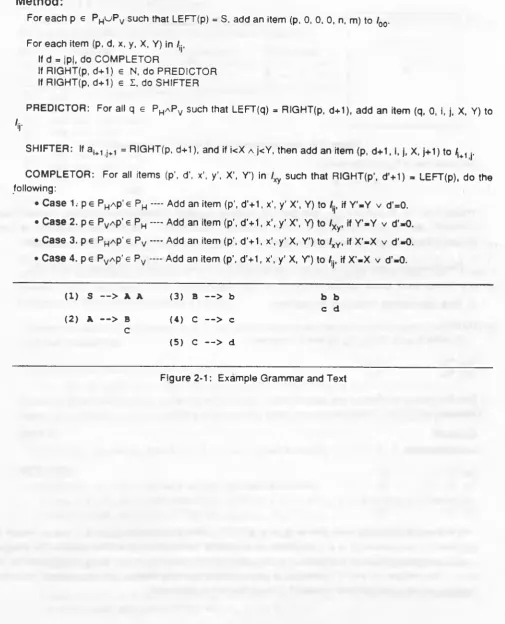
For each p € PHu P v such that LEFT(p) = S, add an item (p, 0, 0, 0, n, m) to /00.
[image:4.563.31.537.58.683.2]For each item (p, d, x, y, X, Y) in
lY],
If d = |p|, do COM PLETORIf RIGHT(p, d+1) e N, do PREDICTOR If RIGHT(p, d+1) e I , do SHIFTER
PREDICTO R: For all q € Ph aPv such that LEFT(q) = RIGHT(p, d+1), add an item (q, 0, i, j, X, Y) to
V
SHIFTER: If aj+1j+1 = RIGHT(p, d+1), and if i<X a j<Y, then add an item (p, d+1, i, j, X, j+1) to /|+1
y
C O M PLETO R : For all items (p\ d \ x’, y', X ’, Y’) in such that RIG HT(p’, d’+1) = LEFT(p), do the following:
• Case 1.- p e PHAp’ e PH — Add an item (p\ d’+1, x’, y’ X’, Y) to /jjt if Y ’- Y v d’=0.
• Case 2. p e Pv a p’ g Ph — - Add an item (p\ d’+ 1, x’, y’ X’, Y) to /Xy, if Y’- Y v d'-O.
• Case 3. p e PHAp’ e Pv — - Add an item (p\ d’+1, x’, y’ X, Y ’) to /xY, if X ’- X v d’-O. • Case 4. p € PVAp’ e Pv Add an item (p\ d’+ 1, x \ y’ X,
Y)
to /ij( H X ’- X v d’-O.(1 ) S — > A A (3) B — > b b b c d (2 ) A — > B (4) C - - > c
C
(5) C - - > d
Figure 2-1: Example Grammar and Text
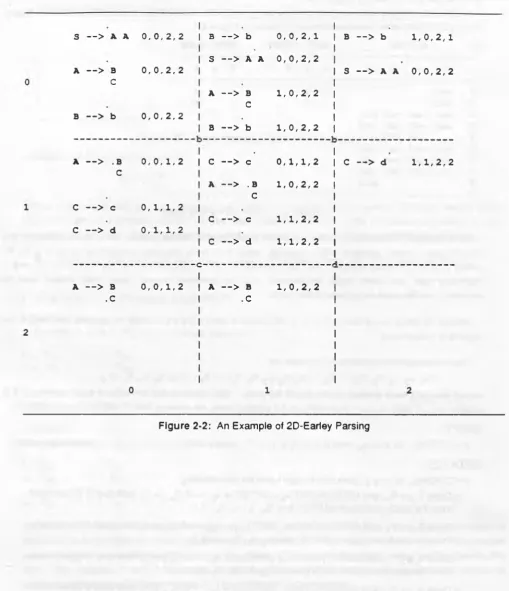
3 - - > A A 0, 0, 2, 2 |
A — > B 0, 0, 2, 2 C
B — > b 0, 0, 2, 2
B — > b 0, 0, 2, 1
S - - > A A 0 , 0 , 2, 2
A - - > B 1 , 0 , 2 , 2 C
B — > b 1 , 0 , 2 , 2
B - - > b 1 , 0 , 2 , 1
S — > A A 0 , 0 , 2 , 2
A —
C
C
> . B C
0, 0, 1, 2 I C — > c
■> c 0 , 1 , 1 , 2 |
I
•> d 0, 1 , 1, 2 |■> . B C
■> c
■> d
0
,
1
,
1,2
1 , 0 , 2 , 2
1
,
1
,
2,2
1 , 1 ,
2
,
2
C — > d 1 , 1 , 2 , 2
- c
---I
0, 0, 1, 2 | A — > B
I . c
A — > B . C
1 , 0 , 2 , 2
F ig u re 2-2: An Exam ple of 2D-Ear1ey Parsing
[image:5.563.27.537.61.653.2]3. The 2D-LR Parsing Algorithm
A 2 D -L R (0) parsing table consists of three parts: A C TIO N , G O T O -R IG H T and G O T O -D O W N . Figure
3-1 is a 2 D -L R (0) table obtained from the gram m ar in Figure 2-1.
ST A C T I O N GOTO-RIGHT GOTO-DOWN
b c d $ s A B C S A B C
0 sh3 8 1 4
1 sh3 2 4
2 rel rel rel rel
3 r«3 re3 re3 re3
4 sh6 sh7 5
5 re2 re2 re2 re2
6 re4 re4 re4 re4
7 ro5 re5 ro5 re5
8 acc
F ig u re 3-1: A 2D -L R Parsing Table
As in Standard LR parsing, the runtime parser performs shift-reduce parsing with a stack guided by this
2 D -L R table. Unlike standard LR(0), however, each item in the stack is represented as (s, x, y, X, Y),
w here s is an LR state number, and (x,y) represents the current position in the input text. X and Y
represent right and lower limits, respectively, and no positions beyond these limits should ever be
explored until this state is popped off the stack.
Initially the stack has an item (0, 0, 0, n, m), where n and m are the number of columns and rows in the
input text, respectively.
Now let the current elem ents in the stack be
... (S31 Ygi Xg, Y^) B2 (^2» *2’ y2' ^2’ ^2) (®1» *1» y v ^1'
w here the right most elem ent is the top of the stack. Also assum e that the current input symbol aij is b,
w here i » x ^ 1 and j = y ,+ 1 . According to the parsing table, we perform S H IF T , R E D U C E or A C C E P T .
SHIFT:
If A C T IO N (s 1, b) = sh s0, then if x1 < X1 a y1 < Y v push b and (s0, x ^ l , y 1t X v y ^ l ) onto the stack.
REDUCE:
If A C T IO N (s 1, b) * re p, then let k be |p|+1 and do the following:
•
Case
1. p e P H and G O T O - R IG H T ^ , LEFT(p)) = s0 — If Y M * Y1 then pop 2 #|p| elem ents from the stack, and push LEFT(p) and (s0, xv y v X ^ Y t ).•
Case
2. p e P H and G O T O -D O W N (s k, L E F T(p)) = s0] — If Y M * Y1 then pop 2*|p| elem ents from the stack, and push LEFT(p) and (s0, x^, Y 1f x v Y k).•
Case
3. p e P v and G O T O -R IG H T (s k, LEFT(p)) = s0 — It Xk_t * X1 then pop 2 #|p| elem ents from the stack, and push LEFT(p) and (s0, X v yk, X ^ y ^ .•
Case 4.
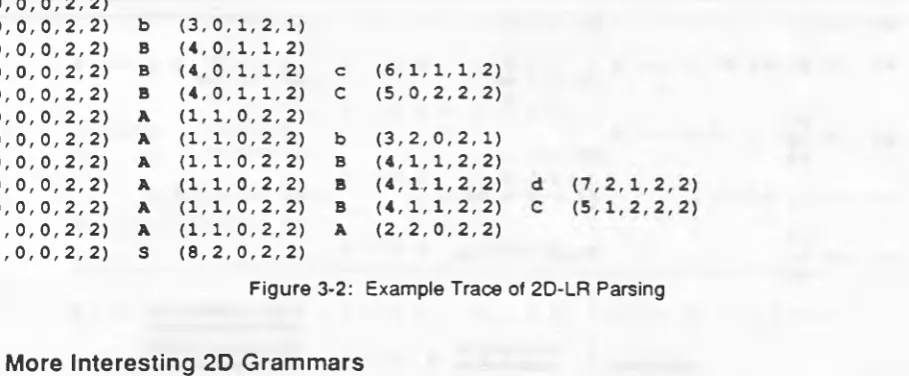
p e Pv and G O T O -D O W N (s k, L E F T(p)) - s0 — If Xk.1 - X1 then pop 2*|p| elem ents from the stack, and push L EFT(p) and (s0, xv y v X v Y k).Figure 3 -2 shows an exam ple trace of 2D -L R parsing with the gram m ar in Figure 2-1.
[image:6.563.47.526.68.294.2](0,0,0,2,2)
(0,0,0,2,2) b (3,0,1,2,1)
(0,0,0,2,2) B (4,0,1,1,2)
(0,0,0,2,2) B (4,0,1,1,2) c (6, 1, 1, 1, 2)
(0,0,0,2,2) B (4,0,1,1,2) C (5, 0, 2, 2, 2)
(0,0,0,2,2) A (1,1,0,2,2)
(0,0,0,2,2) A (1, 1,0,2,2) b (3,2,0,2, 1)
(0, 0, 0, 2, 2) A (1, 1, 0, 2, 2) B (4,1,1,2, 2)
(0,0,0,2,2) A (1,1,0,2,2) B (4,1.,1,2, 2)
(0,0,0,2,2) A (1,1,0,2,2) B (4,1,1,2, 2)
(0,0,0,2,2) A (1,1,0,2,2) A (2,2,0,2,2)
(0,0,0,2,2) S (8,2,0,2,2)
F ig u re 3-2: Exam ple Trace of 2D -L R Parsing
4. More Interesting 2D Grammars
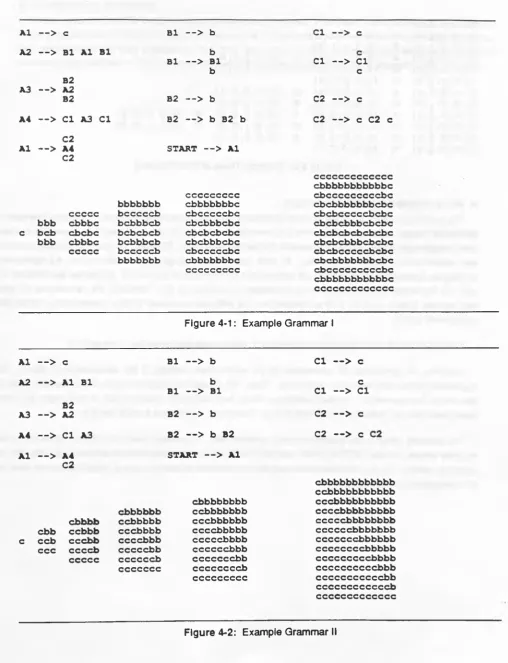
This section presents a couple of more interesting exam ple grammars and texts. Exam ple G ram m ar I
generates nested rectangles of b’s and c’s, one after the other. In the gram m ar, B1 represents vertical
bars (sequences) of b’s, and B2 represents horizontal bars of b’s. Similarly, C1 and C2 represent vertical
and horizontal bars of c’s, respectively. A1 then represents rectangles surrounded by c’s. A2 represents
rectangles surrounded by c’s which are sandwiched by two vertical bars of b’s. A3 further sandwiches A2
with two horizontal b bars, representing rectangles surrounded by b’s. Similarly, A4 sandwiches A3 with
two vertical c bars, and A1 further sandwiches A4 with two horizontal c bars, representing rectangles
surrounded by c’s.
A similar analysis can be m ade for G ram m ar II, which generates triangles of b’s and c’s.
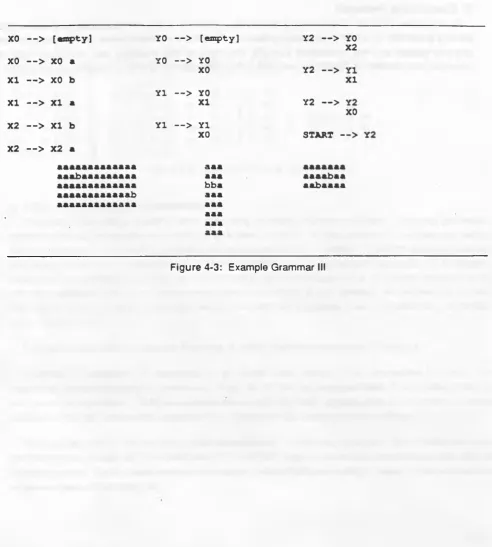
G ram m ar III generates all rectangles of a's which have exactly 2 b’s som ew here in them. Xn
represents horizontal lines of a s with n b’s. Thus, XO, X1 and X2 represent lines of a ’s, keeping track of
how many b’s are inside. Yn then combines those lines vertically, keeping track of how m any a ’s have
been seen thus far (n being the num ber of b ’s). Therefore, Y 2 contains exactly two b’s.
T h e exam ple given in this section is totally deterministic. In general, however, a 2 D -L R table m ay have
multiple entries, or both G O T O -D O W N and G O T O -R IG H T m ay be defined from an identical state with an
identical symbol. Such nondeterminism can also be handled efficiently using a graph-structured stack as
in G eneralized LR Parsing [8, 9].
[image:7.563.61.516.67.255.2]A 1 --> c
A 2 — > BI A1 BI
A3 -B2 -> A2 B2
A4 — > Cl A3 Cl
A1 -C2 -> A4 C2
ccccc
b bb cbbbc
c b cb cbcbc
bbb cbbbc
ccccc bbbbbbb bcccccb bcbbbcb bcbcbcb bcbbbcb bcccccb bbbbbbb
BI — > b
Bl — > BI b
B2 — > b
B2 — > b B2 b
START — > A1
ccccccccc cbbbbbbbc cbcccccbc cbcbbbcbc cbcbcbcbc cbcbbbcbc cbcccccbc cbbbbbbbc ccccccccc
C l - - > C l
cC2 --> c
C2 — > c C2 c
ccccccccccccc c bbbbbbbbbbbc cbcccccccccbc cbcbbbbbbbcbc cbcbcccccbcbc cbcbcbbbcbcbc cbcbcbcbcbcbc cbcbcbbbcbcbc cbcbcccccbcbc cbcbbbbbbbcbc c b cccccccccbc c b bbbbbbbbbbc c c ccccccccccc
F ig u re 4 -1 : Exam ple G ram m ar I
>
M 1 1 V c Bl — > b Cl — > cA2 — > Al Bl b
Bl — > Bl Cl -->
c Cl
A3 — > B2
A2 B2 — > b C2 — > c
A4 — > Cl A3 B2 — > b B2 C2 — > c
Al — > A4 START — > Al
C2
cbbbb
ebb ccbbb
c ccb cccbb
ccc ccccb
ccccc c bbbbbb ccbbbbb cccbbbb ccccbbb cccccbb ccccccb ccccccc cbbbbbbbb ccbbbbbbb cccbbbbbb ccccbbbbb cccccbbbb ccccccbbb cccccccbb ccccccccb ccccccccc
cbbbb b b b b b b b b ccbbb b b b b b b b b cccbbb b b b b b b b ccccbb b b b b b b b ccccc b b b b b b b b ccccc c b b b b b b b cc c c c c c b b b b b b cc c c c c c c b b b b b cc c c c c c c c b b b b c c c c c c c c c c b b b c c c c c c c c c c c b b c c c c c c c c c c c c b c c c c c c c c c c c c c
F ig u re 4 -2 : Exam ple G ram m ar II
[image:8.563.25.534.48.712.2]XO — > [ampty] Y O — > [e mp t y ] Y2 — > YO X2
xo — > XO a YO — > YO
xo Y2 — >
XI — > xo b
YI — > YO
XI --> XI a XI Y2 — >
X2 — > XI b YI --> YI
XO START
-X2 — > -X2 a
a aa aaaaaaaa aaa aaaaaaa
a ab aaaaaaaa aaa aaaabaa
a aa a aaaaaaa bba aabaaaa
a aa a aaaaaab aaa
aaa aia aaa
XI
XO
F ig u re 4-3: Exam ple G ram m ar III
[image:9.563.40.533.45.593.2]5. Concluding Remarks
In this paper, 2 D -C F G , 2-dimensional context-free grammar, has been introduced, and two efficient
parsing algorithms for 2 D -C F G have been presented. Traditional one-dim ensional context-free grammars
are well studied and well understood (e.g. [1]), and many of their theorem s and techniques might be
extended and adopted for 2 D -C F G , as we have done in this paper for Earley’s algorithm and LR parsing.
References
[1] Aho, A. V. and Ullman, J. D.
The Theory o f Parsing, Translation and Compiling. Prentice-Hall, Englewood Cliffs, N. J., 1972.
[2] Akiyam a, T. and M asuda, I.
A Method of D ocum ent-Im age Segm entation Based on Projection Profiles, Stroke Density and Circumscribed Rectangles.
Trans. IECEJ 6 9 -D (8 ):1 187-1196, 1986.
[3] K. S. Fu.
Syntactic Pattern Recognition. Springer-Verlag, 1977.
[4] Fujisawa, H. et al.
Docum ent Analysis and Decomposition Method for Multimedia Contents Retrieval.
.
Proc. 2 nd International Sym posium on Interoperable Inform ation System s:231, 1988.[5] Hlgashino, J., Fujisawa, H., Nakano, Y. and Ejiri, M. A K now ledge-Based Segm entation Method for Docum ent Understanding. Proc. 8th Int. Conf. Pattern R ecognition :745-748, Oct., 1986.
[6] Inagaki, K., Kato, T., Hiroshima, T. and Sakai, T.
M A C S Y M : A Hierarchical Im age Processing System for Event-Driven Pattern Understanding of Documents.
Pattern R ecognition 17(1):8 5 -1 08 , 1984.
[7] Kubota, K. et al.
Docum ent Understanding System.
In Proc. 7th Int. Conf. Pattern Recognition, pages 6 1 2 -6 1 4 . , 1984.
[8] Tom ita, M.
E fficient Parsing for N atural Language.
Kluwer Academ ic Publishers, Boston, MA, 1985.
[91 Tom ita, M.
An Efficient A ugm ented-C ontext-Free Parsing Algorithm. C om putational Linguistics 13(1 -2):31 -46, January-June, 1987.
[10] W atan abe, S. (ed.).
Frontiers o f Pattern Recognition. A cadem ic Press, 1972.
[11] W ong, K., C asey, R. and W ahl, F. Docum ent Analysis System .
IBM J. R esearch a n d D evelopm ent2 6 (6 ):6 4 7 -6 5 6 , 1982.
[12] Yashiro, H. et.al.
A N ew M ethod of Docum ent Structure Extraction.
In International W orkshop on Industrial A pplications o f M achine Intelligence and Vision (MIV-89), pages 282. , April, 1989.