C u s t o m i z i n g a L e x i c o n t o B e t t e r S u i t a
C o m p u t a t i o n a l T a s k
Marti A. Hearst Hinrich Schfitze Computer Science Division
571 Evans Hall, UC Berkeley Berkeley, CA 94720 USA
ma rti@cs, be rkele y. edu
CSLI
Ventura Hall, Stanford University Stanford, CA 94305 USA schuetze @csli. stanford, edu
A b s t r a c t
We discuss a method for augmenting and rearranging a structured lexicon in order to make it more suitable for a topic labefing task, by making use of lexical association information from a large text corpus. We first describe an algorithm for converting the hierarchical structure of WordNet [13] into a set of flat categories. We then use lexical cooccurrence statistics in combination with these categories to classify proper names, assign more specific senses to broadly defined terms, and classify new words into existing categories. We also describe how to use these statistics to assign schema-like information to the categories and show how the new categories improve a text-labeling algorithm. In effect, we provide a mechanism for successfully combining a hand-built lexicon with knowledge-free, statistically-derived information.
1
I n t r o d u c t i o n
Much effort is being a p p l i e d to the creation of lexicons and the acquisition of s e m a n t i c and s y n t a c t i c a t t r i b u t e s o f the lexical i t e m s t h a t comprise t h e m , e.g, [1], [4],[7],[8], [11], [16], [18], [20]. However, a lexicon as given m a y not suit the r e q u i r e m e n t s of a p a r t i c u l a r c o m p u t a t i o n a l task. Because lexicons are expensive to build, r a t h e r t h a n create new ones from scratch, it is preferable to a d j u s t existing ones to m e e t an a p p l i c a t i o n ' s needs. In this p a p e r we describe such an effort: we a d d a s s o c i a t i o n a l i n f o r m a t i o n to a hierarchically s t r u c t u r e d lexicon in order to b e t t e r serve a t e x t labeling task.
A n a l g o r i t h m for p a r t i t i o n i n g a full-length e x p o s i t o r y t e x t into a sequence of s u b t o p i e a l discussions is described in [9]. Once the p a r t i t i o n i n g is done, we need to assign labels 1 i n d i c a t i n g w h a t t h e s u b t o p i c a l discussions are a b o u t , for the p u r p o s e s of i n f o r m a t i o n retrieval and h y p e r t e x t n a v i g a t i o n . One way to label texts, when working within a l i m i t e d d o m a i n of discourse, is to s t a r t w i t h a pre-defined set of topics a n d specify the word contexts t h a t i n d i c a t e the topics of interest (e.g., [10]). A n o t h e r way, a s s u m i n g t h a t a large collection of p r e - l a b e l e d t e x t s exists, is to use s t a t i s t i c s to a u t o m a t i c a l l y infer which lexical i t e m s i n d i c a t e which labels (e.g., [12]). In contrast, we are interested in assigning labels to general, d o m a i n - i n d e p e n d e n t text, w i t h o u t benefit o f pre-classified texts. In all three cases, a lexicon t h a t specifies which lexical i t e m s correspond to which topics is required. T h e topic labeling m e t h o d we use is s t a t i s t i c a l and thus requires a large n u m b e r of r e p r e s e n t a t i v e lexical i t e m s for each category.
T h e s t a r t i n g p o i n t for our lexicon is W o r d N e t [13], which is r e a d i l y available online and provides a large r e p o s i t o r y of English lexical items. W o r d N e t 2 is c o m p o s e d of s y n s e t s ,
structures containing sets of terms with synonymous meanings, thus allowing a distinction to be made between different senses of homographs. Associated with each synset is a list of relations that the synset participates in. One of these, in the noun dataset, is the hyponymy relation (and its inverse, hypernymy), roughly glossed as the "ISA" relation. This relation imposes a hierarchical structure on the synsets, indicating how to generalize from a subordinate term to a superordinate one, and vice versa. 3 This is a very useful kind of information for m a n y tasks, such as reasoning with generalizations and assigning probabilities to grammatical relations [17].
We would like to adjust this lexicon in two ways in order to facilitate the label as- signment task. The first is to collapse the fine-grained hierarchical structure into a set of coarse but semantically-related categories. These categories will provide the lexical evidence for the topic labels. (After the label is assigned, the hierarchical structure can be reintroduced.) Once the hierarchy has been converted into categories, we can augment the categories with new lexical items culled from free :text corpora, in order to further improve the labeling task.
The second way we would like to adjust the lexicon is to combine categories from distant parts of the hierarchy. In particular, we are interested in finding groupings of terms that contribute to a frame or schema-like representation [14]; this can be achieved by finding associational lexical relations among the existing taxonymic relations. For example, WordNet has the following synsets: "athletic game" (hyponyms: baseball, ten- nis), "sports implement" (hyponyms: bat, racquet), and "tract, piece of land" (hyponyms: baseball_diamond, court), none of which are closely related in the hierarchy. We would like to automatically find relations among categories headed by synsets like these. (In Version 1.3, the WordNet encoders have placed some associational links among these categories, but still only some of the desired connections appear.)
In other words, we would like to derive links among schematically related parts of the hierarchy, where these links reflect the text genre on which text processing is to be done. [19] describes a method called WordSpace that represents lexical items according to how semantically close they are to one another, based on evidence from a large text corpus. We propose combining this term-similarity information with the hierarchical information already available in WordNet to create structured associational information.
In the next section we describe the algorithm for compressing the WordNet hierarchy into a set of categories. This is followed by a discussion of how these categories are to be used and why they need to be improved. Section 4 describes the first improvement technique: including new, related terms from a corpus, and Section 5 describes the sec- ond improvement technique: bringing disparate categories together to form schematic groupings while retaining the given hierarchical structure. Section 6 concludes the paper.
2
Creating Categories from W o r d N e t
We would like to decompose the WordNet noun hierarchy into a set of disjoint categories, each consisting of a relatively large number of synsets. (This is necessary for the text- labeling task, because each topic must be represented by m a n y different terms.) The goal of creating categories of a particular average size with as small a variance as possible. There is some limit as to how small this variance can be because there are several synsets
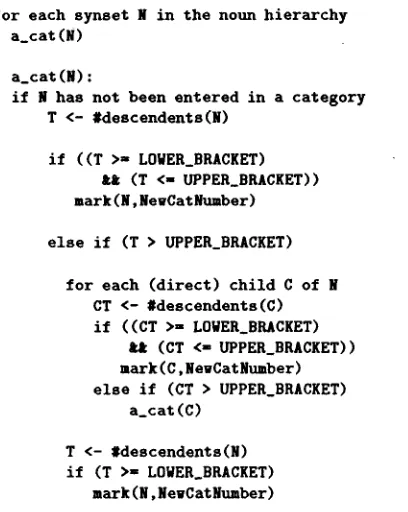
f o r e a c h s y n s e t N i n t h e n o u n h i e r a r c h y a _ c a t ( N )
a _ c a t ( N ) :
i f N h a s n o t b e e n e n t e r e d i n a c a t e g o r y
T < - # d e s c e n d e n t s ( N )
i f ( ( T >= LOWER_BRACKET) • ~ (T < - UPPER_BRACKET)) m a r k ( N , N e e C a t N u m b e r )
e l s e i f (T > UPPER_BRACKET)
for each (direct) child C of N CT <- #descendents(C) i f ((CT >- LOWER_BRACKET)
(CT <-UPPER_BRACKET)) mark(C,NewCatNumber)
else if (CT > UPPER_BRACKET) a_cat(C)
T <- #descendents(N) if (T >- LOWER_BRACKET)
lark(N,NewCatNumber)
Figure 1: Algorithm for creating categories from WordNet's noun hierarchy.
that have a very large number of children (there are sixteen nodes with a branching factor greater than 100). This primarily occurs with synsets of a taxonymic flavor, i.e., mushroom species and languages of the world. There are two other reasons why it is not straightforward to find uniformly sized, meaningful categories:
(i) There is no explicit measure of semantic distance among the children of a synset.
(ii) The hierarchy is not balanced, i.e., the depth from root to leaf varies dramatically throughout the hierarchy, as does the branching factor. (The hierarchy has ten root nodes; on average their m a x i m u m depth is 10.5 and their minimum depth is 2.)
Reason (ii) rules out a strategy of traveling down a uniform depth from the root or up a uniform height from the leaves in order to achieve uniform category sizes.
[image:3.612.105.309.99.355.2]is derived from the synset at N. If N has too many descendants, that is, the count of its unmarked descendants exceeds the upper bound, then each of its immediate children is checked in turn: if the child's descendant count falls between the boundaries, then the child and its descendants are bundled into a category. If the child and its unmarked de- scendants exceed the upper bound, then the procedure is called recursively on the child. Otherwise, the child is too small and is left alone. After all of N's children have been processed, the category that N will participate in has been made as small as the algo- rithm will allow. There is a chance that N and its unmarked descendants will now make a category that is too small, and if this is the case, N is left alone, and a higher-up node will eventually subsume it (unless N has no parents remaining). Otherwise, N and its remaining unmarked descendants are bundled into a category.
If N has more than one parent, N can end up assigned to the category of any of its parents (or none), depending on which parent was accessed first and how many unmarked children it had at any time, but each synset is assigned to only one category.
The function "mark" places the synset and all its descendents that have not yet been entered into a category into a new category. Note that #descendents is recalculated in the third-to-last line in case any of the children of N have been entered into categories.
In the end there may be isolated small pieces of hierarchy that aren't stored in any category, but this can be fixed by a cleanup pass, if desired.
3
A T o p i c L a b e l e r
We are using a version of the disambiguation algorithm described in [21] to assign topic labels to coherent passages of text. Yarowsky defines word senses as the categories listed for a word in Roger's Thesaurus (Fourth Edition), where a category is something like TOOLS/MACHINERY. For each category, the algorithm
• Collects contexts that are representative of the category.
• Identifies salient words in the collective contexts and determines the weight for each word.
• Uses the resulting weights to predict the appropriate category for a word occurring in a novel context.
The proper use of this algorithm is to choose among the categories to which a particular ambiguous word can belong, based on the lexical context that surrounds a particular instance of the word.
In our implementation of the algorithm, the 726 categories derived from WordNet, as described in the previous section, are used instead of Rogel's categories, because these are not available publically online. Training is performed on Grolier's American Academic Encyclopedia (~ 8.7M words).
comparison purposes, and the third column shows the words in the synset at the top- most node of the category (these are not always entirely descriptive, so some glosses are provided in parentheses).
United States Constitution
0 16300 assembly (court, legislature)
Genesis
29424 deity divinity god
1 14286 due_process_of.law 28949 relative relation (mother, aunt) 2 13313 legal_document legal_instrument 28934 worship
3 11764 administrative_unit 28603 man adult_male 4 11566 body (legislative) 28321 professional
5 11481 charge (taxes) 28263 happiness gladness felicity 6 11468 administrator decision_maker 28005 woman adult_female 7 10442 document written_document 27643 evildoing transgression 8 10250 approval (sanction, pass) 27514 literary_composition 9 9428 power powerfulness 27203 religionist religious_person
Note that although most of the categories are appropriate (with the glaring exception of "professional" in Genesis), there is some redundancy among them, and in some cases they are too fine-level to indicate main topic information.
In an earlier implementation of this algorithm, the categories were in general larger but less coherent than in the current set. The larger categories resulted in better-trained classifications, but the classes often conflated quite disparate terms. The current imple- mentation produces smaller, more coherent categories. The advantage is that a more distinct meaning can be associated with a particular label, but the disadvantage is that in many cases so few of the words in the category appear in the training data that a weak model is formed. Then the categories with little distinguishing training data dominate the labeling scores inappropriately.
In the category-derivation algorithm described above, in order to increase the size of a given category, terms must be taken from nodes adjacent in the hierarchy (either descendants or siblings). However, adjacent terms are not necessarily closely related semantically, and so after a point, expanding the category via adjacent terms introduces noise. To remedy this problem, we have experimented with increasing the size of the categories in two different ways:
(1) The first approach is to retain the categories in their current form and add semanti- cally similar terms, extracted from corpora independent of WordNet, thus improving the training of the labeling algorithm.
(2) The second approach is to determine which categories are semantically related to one another, despite the fact that they come from quite different parts of the hierarchy, and combine them so that they form schema-like associations.
These are described in the next two sections, respectively.
4
A u g m e n t i n g Categories w i t h Relevant Terms
WordSpace algorithm, and the subsequent subsections show how it can be used to aug- ment the derived categories.
4.1
Creating WordSpace from Free Text
WordSpace [19] is a corpus-based method for inducing semantic representations for a large number of words (50,000) from lexical cooccurrence statistics. The representations are derived from free text, and therefore are highly specific to the text type in question. The medium of representation is a multi-dimensional, real-valued vector space. The cosine of the angle between two vectors in the space is a continuous measure of their semantic relatedness.
Lexical coocurrence, which is the basis for creating the word space vectors, can be easily measured. However, for a vocabulary of 50,000 words, there are 2,500,000,000 possible coocurrence counts, a number too high to be computationally tractable. Therefore, letter fourgrams are used here to bootstrap the representations. Cooccurrence statistics are collected for 5,000 selected fourgrams. The 5000-by-5000 matrix used for this purpose is manageable. A vector for a lexical item is then computed as the sum of fourgram vectors that occur close to it in the text.
The first step of the creation of WordSpace consists of deriving fourgram vectors that reflect semantic similarity in the sense of being used to describe the same contexts. Consequently, one needs to be able to pairwise compare fourgrams' contexts. For this purpose, a collocation matrix for fourgrams was collected such that the entry a i j counts the number of times that fourgram i occurs at most 200 fourgrams to the left of fourgram j. Two columns in this matrix are similar if the contexts the corresponding fourgrams are used in are similar. The counts were determined using five months of the New York Times (June - October 1990). The resulting collocation matrix is dense: only 2% of entries are zeros, because almost any two fourgrams cooccur. Only 10% of entries are smaller than 10, so that culling small counts would not increase the sparseness of the matrix. Consequently, any computation that employs the fourgram vectors directly would be inefficient. For this reason, a singular value decomposition was performed and 97 singular values extracted (cf. [5]) using an algorithm from SVDPACK [3]. Each fourgram can then be represented by a vector of 97 real values. Since the singular value decomposition finds the best least- square approximation of the original space in 97 dimensions, two fourgram vectors will be similar if their original vectors in the collocation matrix are similar. The reduced fourgram vectors can be efficiently used in the following computations.
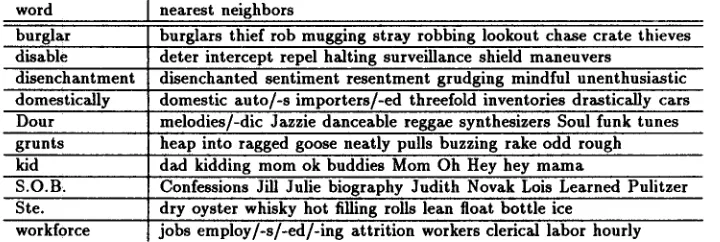
word burglar disable disenchantment domestically Dour grunts kid S.O.B:. Ste. workforce
nearest neighbors
burglars thief rob mugging stray robbing lookout chase crate thieves deter intercept repel halting surveillance shield maneuvers
domestic auto/-s importers/-ed threefold inventories drastically cars
heap into ragged goose neatly pulls buzzing rake odd rough
Confessions Jill Julie biography Judith Novak Lois Learned Pulitzer dry oyster whisky hot filling rolls lean float bottle ice
jobs employ/-s/-ed/-ing attrition workers clerical labor hourly
Table 1: Ten r a n d o m words and their nearest neighbors.
#
Z ( Z
ice(w) ! close to i
Table 1 shows a r a n d o m sample of 10 words and their nearest neighbors in Word Space. As can be seen from the table, proximity in the space corresponds closely to semantic similarity in the corpus. (N'Dour is a Senegalese jazz musician. In the 1989/90 New York Times, S.O.B. mainly occurs in the book title "Confessions of an S.O.B.", and Ste. in the n a m e "Ste.-Marguerite" a Quebec river t h a t is popular for salmon fishing.)
4 . 2
Augmenting WordNet Categories using WordSpace
We chose the following simple m a p p i n g from the derived WordNet categories to WordSpace:
• for each category i from Section 2:
• collect the vectors of all the words in i t h a t are covered by WordSpace
• c o m p u t e the centroid of these vectors
"rhis centroid defines an area in WordSpace thai, corresponds 1,o tile WordNet category. Ilsing these eentroids we can now assign a word ill WordSl)ace to a derived category I)y examining the nearest neighbors of the word. T h e assignment algorithm we use is:
• for each word w in WordSpace
• collect the 20 nearest neighbors of w in the space
• c o m p u t e the score si of category i for w as the n u m b e r of nearest neighbors t h a t are in i
• assign w to the highest scoring category or categories
In order to test this algorithm, we selected 1000 words from the m e d i u m frequency words in WordSpace. 4 These turned out to be the medium-frequency words from defor- estation to downed. T h e following subsections describe the application of the assignment
[image:7.612.112.472.96.217.2]algorithm to classifying proper names, reassigning words in the categories, and assigning words that are not covered by the categories.
4.2.1 S e m a n t i c c l a s s i f i c a t i o n o f p r o p e r n a m e s
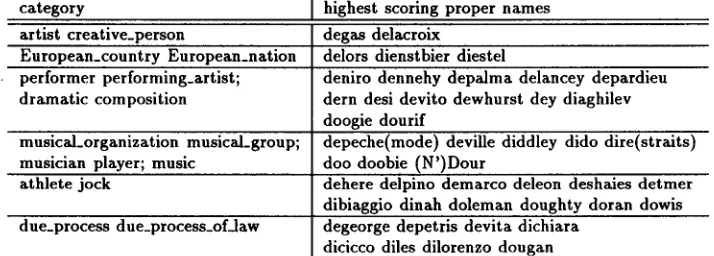
A deficiency of WordNet for our text labeling task and for m a n y other applications is that it omits m a n y proper names (and since the set of important proper names changes over time, it cannot be expected to contain an exhaustive list). We tested the performance of our assignment algorithm by searching for proper names that had high scores for the categories in Table 2. For each category on the left-hand side we show all of the proper names that assigned high scores those categories. The proper names assigned to "artist" are painters, the proper names assigned to "European country" are European politicians, "performer" contains actors, dancers and roles, writers and titles of movies, "music" has musicians and titles of musical performances (the Pasadena Doo Dah Parade, Purcell's "Dido and Aeneas"), "athlete jock" players of various sports, and "process of law" lawyers, judges and defendants. We checked the referents of all proper names in Table 2 in the New York Times and found only one possible error (although a few names like "DePalma" and "Delancey" had several referents only one of whom pertained to the assigned category): The President of Michigan State University, John DiBiaggio, was assigned to the "athlete" category because his name is mainly mentioned in articles dealing with a conflict he had with his athletic department.
category highest scoring proper names
artist creative_person degas delacroix European_country European_nation delors dienstbier diestel
performer performing_artist; deniro dennehy depalma delancey depardieu dramatic composition dern desi devito dewhurst dey diaghilev
doogie dourif
musical_organization musical_group; depeche(mode) deville diddley dido dire(straits) musician player; music doo doobie (N')Dour
athlete jock dehere delpino demarco deleon deshaies detmer dibiaggio dinah doleman doughty doran dowis due_process due_process_of.law degeorge depetris devita dichiara
dicicco diles dilorenzo dougan
Table 2: Assigning proper names to WordNet categories.
4.2.2 F i n e - t u n i n g W o r d N e t t e r m s
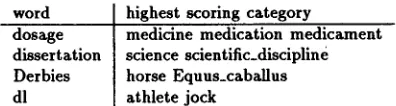
[image:8.612.114.471.346.474.2]word dosage dissertation Derbies dl
highest scoring category
medidne medication medicament science scientific_discipline horse Equus_caballus athlete jock
T a b l e 3: D e t e c t i n g m i s a s s i g n m e n t s in W o r d N e t .
word WordNet definition
dosage dose, dosage - (the quantity of an active agent (substance or radiation) taken in or absorbed at any one time)
dissertation dissertation, thesis = > treatise - (a formal exposition)
derby bowler hat, bowler, derby, plug hat - (round and black and hard with a narror brim; worn by some British businessmen)
dl deciliter, decilitre, dl
T a b l e 4: S y n o n y m sets in W o r d N e t for the words in T a b l e 3.
word degradable demagoguery deprenyl desktop deuterium (pas de) deux dideoxyinosine (per) diem dieters dinnerware dioxins dispersants disservice dissidence disunity diuretic diuretics doctrinal dogfight doggie doggone Domaine domesticity dopamine dossier doubleheaders downbeat eva]. + 0 + + + + + + + + + 0 + + + + + + + 0 0 0
highest scoring categories compound chemical_compound feeling emotion
infectious_disease; disease memory_device storage_device
chemical_element element; substance matter dancing dance terpsichore
medicine medication medicament; infectious_disease commercial_document/instrument; occupation business line foodstuff
tableware
chemical_element element change alteration modification cognitive_state state_oLmind leader; social_group
speech_act symptom
disease; liquid_body_substance body_fluid religion faith church
happening occurrence; conflict struggle unpleasant_person persona_non_grata
unit_oLmeasurement unit; integer whole_number wine vino
person individual man mortal human soul; feeling emotion medicine medication medicament; room
statement; message content subject_matter substance
time_period period period_oLtime amount_oLtime; athlete jock message content subject_matter substance; feeling emotion
[image:9.612.106.490.77.672.2] [image:9.612.190.388.100.153.2]dosage and dissertation are defined in a very general way in Wordnet (see Table 4). While they can be used with the general sense given in WordNet, almost all uses of dissertation in the New York Times are for doctoral dissertations that report on scientific work. Similarly, non-medical contexts are conceivable for dosage, but the dosages that the New York Times mentions are exclusively dosages of radiation or medicine in a medical context. The automatically found labelings in Table 3 indicate the need for specialization and can be used as the basis for reassignment.
In some cases, the WordNet hierarchy is also incomplete. The two senses "horse race" and "Disabled List" for derby and dl are missing from WordNet, although they are the dominant uses in the New York Times. Again the classification algorithm finds the right topic area for the two words which can be used as the basis for reassignment.
Unfortunately, the algorithm also labels some correctly assigned words with incorrect categories. We are working on an improved version that will not give "false positives" in the detection of misassignments.
4 . 2 . 3 A s s i g n i n g u n k n o w n w o r d s
We would like to be able to handle unknown words since they are often highly specific and excellent indicators for the topical structure of a document. Table 5 shows the automatic assignments for all words in the 1000 word test set that were not found in WordNet.
The results are mixed. 63% (17/27) of the words are assigned to a correct topic (+), an additional 19% (5/27) are assigned to topics they are related to (0), 19% are misassigned (- ). We are considering several ways of improving the assignment algorithm. For instance, there are "diluted" categories such as "speech_act" and "trait character feature" whose members are mostly words that are poorly characterized collocationally. If we ignore them in assigning categories (hoping that most unknown words will be topic-specific special terms) we can correct some of the errors, e.g. disunity would be assigned to "group_action interaction social_activity" which seems correct. We expect that we can improve the results in Table 5 as we gain more experience in combining WordSpace and WordNet.
These results are encouraging; we have not yet tested to see if they improve the particular task of interest.
5
Combining Distant Categories
5 . 1 T h e A l g o r i t h m
To find which categories should be considered closest to one another, we first determined how close they are in WordSpace and then group categories together that mutually ranked one another highly.
To compute the first-degree closeness of two categories cl and cj we used the formula:
1 1
- 2
ledlcjl
The primary rank of category i for category j indicates how closely related i is to j. For instance rank 1 means that i is the closest category to j, and rank 3 means there are only two closer categories to j than i.
The second-degree closeness is computed from the rank of the primary ranks. To determine that close association is mutual between two categories, we check for mutual high ranking. Thus category i and j are grouped together if and only if i ranks j highly and j ranks i highly (where "highly" was determined by a cutoff value - i and j had to be ranked k or above with respect to each other, for a threshold k). Secondary ranking is needed because some categories are especially "popular," attracting m a n y other categories to them; the secondary rank enables the popular categories to retain only those categories that they mutually rank highly.
The results of this algorithm were difficult to interpret until we displayed them graph- ically. The graph layout problem is notoriously difficult, but [2] describes a presentation tool based on theoretical work by [6] which uses a force-directed placement model to layout complex networks (edges are modeled as springs; nodes linked by edges are attracted to each other, but all other pairs of nodes are repelled from one another). Figure 2 shows a piece of the network. In these networks only connectivity has meaning; distance between nodes does not connote semantic distance.
Looking at Figure 2 in more detail, we see that categories associated with the notion "sports", such as "athletic_game", "race", "sports_equipment', and "sports_implement", have been grouped together. The network also shows that categories that are specified to be near one another in WordNet, such as the categories related to "bread", are found to be closely interrelated. This is useful in case we would like to begin with smaller categories, in order to eliminate some of the large, broad categories that we are currently working with.
The connectivity of the network is interesting also because it indicates the intercon- nectivity between categories. Athletics is linked to vehicle and competition categories; these in turn link to military vehicles and weaponry categories, which then lead in to legal categories.
Most of the connectivity information suggested by the network was used to create the new categories. However, m a n y of the desireable relationships do not appear in the network, perhaps because of the requirement for highly mutual co-ranking. If we were to relax this assumption we may find better coverage, but perhaps at the cost of more misleading links. The remaining associations where determined by hand, so that the original 726 categories were combined into 106 new super-categories.
5 . 2 I m p r o v i n g t h e T o p i c L a b e l e r
The super-categories are intended to group together related categories in order to eliminate topical redundancy in the labeler and to help eliminate inappropriate labels (since the categories are larger and so have more lexical items serving as evidence). Thus the top four or five super-categories should suffice to indicate the main topics of documents. We have not yet rigorously analyzed the performance of the labeler with the original categories or with the super-categories. In future we plan to obtain reader judgements about which categories are the best labels for various texts. Here we show some example output and discuss its characteristics.
the algorithm; the scores in both cases are roughly similar. It is important to realize that only the top four or five labels are to be used from the super-categories; since each super- category subsumes many categories, only a few super-categories should be expected to contain the most relevant information. The first article is a 31-sentence magazine article, published in 1987, taken from [15]. It describes how Soviet women have little political power, discusses their role as working women, and describes the benefits of college life. The second article is a 77-sentence popular science magazine article about the Magellan space probe exploring Venus. When using the super-categories, the labeler avoids grossly inappropriate labels such as "mollusk.genus" and "goddess" in the Magellan article, and combines categories such as "layer", "natural_depression", and "rock stone" into the one super-category "land terra_firma".
Raisa Gorbachev article
Original C a t e g o r i e s Super-Categories
0 696 woman adult_female 637 social_standing 1 676 status social.state 592 education 2 666 m a n adult_male 577 politics 3 654 political_orientation ideology 567 legal_system
4 628 force personnel 561 people
5 626 charge 547 psychological_state
6 621 relationship 531 socializing
7 608 fear 521 social_group
8 603 attitude 512 personal_relationship
9 600 educator pedagogue 506 government
Magellan space probe article
Original Categories Super-Categories
0 2770 celestial_body heavenly_body 2480 outer_space
1 2760 mollusk_genus 2246 light_and_energy
2 2588 electromagnetic.radiation 2056 atmosphere 3 2349 layer (surface) 1908 land terra_firma 4 2266 atmospheric_phenomenon 1778 physics
5 2139 physical_phenomenon 1484 arrangement
6 2122 goddess 1448 shapes
7 2095 natural_depression depression 1413 water_and_liquids
8 2032 rock stone 1406 properties
9 1961 space (hole) 1388 amounts
United States Constitution Genesis
0 12200 legal_system 26459 religion 1 11782 government 25062 breads
2 7859 politics 24356 mythology
3 7565 conflict 23377 people
4 7354 crime 21810 social_outcasts
5 6814 finance 21790 social.group
6 6566 social_standing 21600 psychological_state
7 6458 honesty 73 20614 personality
8 6349 communication 20514 literature
6
C o n c l u s i o n s
We have discussed t w o approaches to augmenting and rearranging the components of a lexicon, in effect adding new features to its members, by making use of lexical association information from a large corpus. We've used lexical cooecurrence statistics in combination with a modified lexicon to classify proper names, associate more specific senses to broadly defined terms, and classify new words into existing categories with some degree of success. We've also used these statistics to suggest how to rearrange a lexicon with a taxonymic structure into more frame-like categories, and assigned more general main-topic labels to texts based on these categories.
One conclusion that m a y be drawn from this work, especially the results in Section 4, is that we have provided a mechanism for successfully combining hand-built lexicon infor- mation with knowledge-free, statistically-derived information. The combined information from the categories derived from WordNet provided the clusters from which WordSpace centroids could be created, and these centroids in turn provided candidate words to im- prove the categories.
In future, in addition to expanding the evaluation of the results described here, we would like to try reversing the experiment; that is, starting with WordSpace vectors, see which parts of WordNet should be interlinked into schematic categories.
A c k n o w l e d g m e n t s The authors would like to thank Jan Pedersen for his help and en- couragement. We are also indebted to Mike Berry for SVDPACK. The first author's research was sponsored in part by the Advanced Research Projects Agency under Grant No. MDA972-92- J-1029 with the Corporation for National Research Initiatives (CNRI), in part by an internship at Xerox Palo Alto Research Center; and this material is based in part upon work supported by the National Science Foundation under Infrastructure Grant No. CDA-8722788. The second author was supported in part by the National Center for Supercomputing Applications under grant BNS930000N.
R e f e r e n c e s
[1] Hiyan Alshawi. Processing dictionary definitions with phrasal pattern hierarchies. American Journal o] Computational Linguistics, 13(3):195-202, 1987.
[2] Elan Amir. Carta: A network topology presentation tool. Project Report, UC Berkeley, 1993.
[4] Nicoletta Calzolari and Remo Bindi. Acquisition of lexical information from a large textual italian corpus. In Proceedings o/the Thirteenth International Conference on Computational Linguistics, Helsinki, 1990.
[5] Scott Deerwester, Susan T. Dumais, George W. Furnas, Thomas K. Landauer, and Richard Harshman. Indexing by latent semantic analysis. Journal o] the American Society/or Information Science, 41(6):391-407, 1990.
[6] T. Fruchtermann and E. Rheingold. Graph drawing by force-directed placement. Techni- cal Report UIUCDCS-R-90-1609, Department of Computer Science, University of Illinois, Urbana-Champagne, Ill, June 1990.
[7] G. Grefenstette. A new knowledge-poor technique for knowledge extraction from large corpora. In Proceedings of SIGIR'92, Copenhagen, Denmark, June 21-24 1992. ACM. [8] Marti A. Hearst. Automatic acquisition of hyponyms from large text corpora. In Proceedings
ol the Fourteenth International Conference on Computational Linguistics, pages 539-545, Nantes, France, July 1992.
[9] Marti A. Hearst. TextTiling: A quantitative approach to discourse segmentation. Technical Report 93/24, Sequoia 2000, University o f California, Berkeley, 1993.
[10] Paul Jacobs and Lisa Rau. SCISOR: Extracting information from On-Line News. Commu- nications of the ACM, 33(11):88-97, 1990.
[11] Judith Markowitz, Thomas Ahlswede, and Martha Evens. Semantically significant patterns in dictionary definitions. Proceedings of the 24th Annual Meeting of the Association for Computational Linguistics, pages 112-119, 1986.
[12] Brij Masand, Gordon Linoff, and David Waltz. Classifying news stories using memory based reasoning. In Proceedings of SIGIR 92, pages 59-65, 1992.
[13] George A. Miller, Richard Beckwith, Christiane Fellbaum, Derek Gross, and Katherine J. Miller. Introduction to WordNet: An on-line lexical database. Journal off Lexicography,
3(4):235-244, 1990.
[14] Marvin Minsky. A framework for representing knowledge. In Patrick Winston, editor, The psychology o] computer vision. McGraw-Hill, 1975.
[15] Jane Morris. Lexical cohesion, the thesaurus, and the structure of text. Technical Report CSRI-219, Computer Systems Research Institute, University of Toronto, 1988.
[16] James Pustejovsky. On the acquisition of lexical entries: The perceptual origin of thematic relations. Proceedings o] the 25th Annual Meeting o] the Association ]or Computational Linguistics, 1987.
[17] Philip Resnik. WordNet and Distributional Analysis: A Class-based Approach to Lexical Discovery. In Carl Weir, editor, Statistically-Based Natural Language Programming Tech- niques: Papers from the 1992 Workshop. AAAI Press,Technical Report W-92-01, Menlo Park, CA, 1992.
[18] Hinrich Sch~tze. Part-of-speech induction from scratch. In Proceedings of ACL 31, Ohio State University, 1993.
[19] Hinrich Sch~tze. Word space. In Stephen J. Hanson, Jack D. Cowan, and C. Lee Giles, editors, Advances in Neural ln]ormation Processing Systems 5. Morgan Kaufmann, San Mateo CA, 1993.
[20] Yorick A. Wilks, Dan C. Fass, Cheng ming Guo, James E. McDonald, Tony Plate, and Brian M. Slator. Providing machine tractable dictionary tools. Journal o/Computers and Translation, 2, 1990.
aliment s e a f o
g:alllfl aceolls_l
blv
Ig
admlnlstr co u I11
peratlo~aln
•
.=."~'~ d u e_ p r o c e s s7I
o'
,
:)~Ig D ap~alsal
Isehood
ternal body_part
eat [ ~ t l m e _ p e r i o d j ~ ] rate
time E],,~mon key Ascom~
real
ol/lilhicle
attack
skilledworker
sports_imrl
stroke
bridge
•
] travel rqa~lcev/bll
[image:15.612.123.476.98.561.2]