A Web-based System for Crowd-in-the-Loop Dependency Treebanking
Stephen Tratz
∗, Nhien Phan
†∗U.S. Army Research Laboratory, Adelphi, Maryland, USA †University of Maryland, College Park, Maryland, USA
[email protected], [email protected]
Abstract
Treebanks exist for many different languages, but they are often quite limited in terms of size, genre, and topic coverage. It is difficult to expand these treebanks or to develop new ones in part because manual annotation is time-consuming and expensive. Human-in-the-loop methods that leverage machine learning algorithms during the annotation process are one set of techniques that could be employed to accelerate annotation of large numbers of sentences. Additionally, crowdsourcing could be used to hire a large number of annotators at relatively low cost. Currently, there are few treebanking tools available that support either human-in-the-loop methods or crowdsourcing. To address this, we introduce CROWDTREE, a web-based interactive tool for editing dependency trees. In addition to the visual frontend, the system has a Java servlet that can train a parsing model during the annotation process. This parsing model can then be applied to sentences as they are requested by annotators so that, instead of annotating sentences from scratch, annotators need only to edit the model’s predictions, potentially resulting in significant time savings. Multiple annotators can work simultaneously, and the system is even designed to be compatible with Mechanical Turk. Thus, CROWDTREEsupports not simply human-in-the-loop treebanking, but crowd-in-the-loop treebanking.
Keywords:annotation, dependency trees, visualization, GUI, crowdsourcing, treebanking
1.
Introduction
Although treebanks exist for a number of languages, they are often quite small in size. Even some of the largest and most useful treebanks are restricted to only a hand-ful of sources, genres, and/or topic areas—the venerable Penn Treebank (Marcus et al., 1993) being a prime ex-ample of this. Unfortunately, manual annotation is expen-sive and slow, which impedes both the expansion of exist-ing treebanks and the creation of new ones. For example, The Prague Dependency Treebank, which contains over 1 million syntactically connected words, cost approximately $600,000 to create (B¨ohmov´a et al., 2003). One method for accelerating the treebanking process is to utilize human-in-the-loop1methods that leverage machine learning
algo-rithms during annotation. Such algoalgo-rithms could pre-parse the data, highlight attachment decisions of greater impor-tance, and/or suggest sentences for annotation that are most likely to prove useful as training examples. Another useful method is crowdsourcing, which taps into a large (and typ-ically inexpensive) worker pool. Together, these comple-mentary techniques hold tremendous promise for reducing the time and cost of creating large datasets for natural lan-guage processing, including treebanks. In order to facilitate faster and less expensive dependency tree annotation, this paper presents CROWDTREE, which is, to the best of our knowledge, the first web-based treebanking tool designed specifically for human-in-the-loop, and even crowd-in-the-loop, tree annotation.
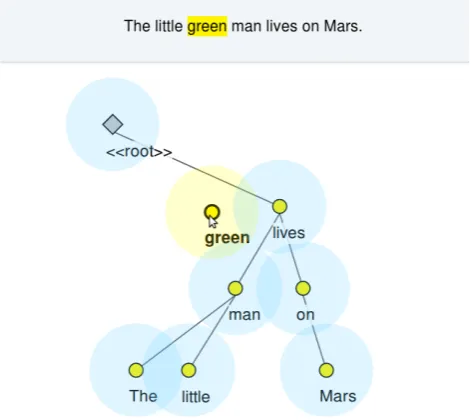
The system consists of two primary components, an inter-active graphical frontend, shown in Figure 1, and a Java servlet. The frontend, which enables users to visually con-struct/edit dependency trees using drag-and-drop, is based on the EASYTREEdependency tree editor (Little and Tratz, 2016) but has a variety of improvements, including an
im-1By ‘human-the-loop’, we mean ‘involving both human
in-teraction and machine learning’.
proved layout and various bug fixes. It is written entirely in HTML, CSS, and JavaScript, and, thus, works with modern browsers without the need for special plugins. The fron-tend communicates with the second component, the Java servlet, which, in addition to recording the annotated data, has the option to constantly train a transition-style parsing model (McDonald and Nivre, 2007) throughout the annota-tion process from the work that is submitted to the server. This model can parse a sentence as it is provided to an an-notator, which promises to reduce the number of edits re-quired to construct correct dependency trees. CROWDTREE
has a Mechanical Turk-compatible mode, which opens new possibilities for large scale treebanking as well as new op-portunities for research into the use of large numbers of non-expert treebankers.
The remainder of this paper provides a more detailed de-scription of the nature and capabilities of our tree annota-tion system (Secannota-tion 2), describes related tools and research efforts (Section 3), summarizes our contributions (Section 4), and details some of our planned experimental work and feature additions (Section 5). We are planning to release our system open source in the near future via the U.S. Army Research Laboratory’s GitHub site or similar repository.
2.
System Description
CROWDTREE has a client-server architecture with two components: a graphical web-based interface that annota-tors use to create dependency trees and a Java servlet for storing user annotations and running machine learning pro-cesses.
2.1.
User Interface
The user interface, shown in Figure 1, is written using standard web technologies—HTML, CSS, and JavaScript. The interactive Support Vector Graphics-based dependency tree widget is implemented using the popular D3.JS2 data
2
visualization and manipulation JavaScript library.
Anno-Figure 1: In CROWDTREE, blue “drop zones” highlight possible attachment sites when dragging word nodes.
tators alter the dependency tree structure by clicking on word nodes and dragging them to their appropriate attach-ment sites. When the dragging process begins, circular “drop zones” appear around the potential attachment sites, as shown in Figure 1. When the dragged node is dropped, the layout of the tree adjusts in a smooth, animated fash-ion. The code is derived from the EASYTREEdependency tree editor (Little and Tratz, 2016) but the visual layout is modeled after the layout used in the tree editor TRED (Pa-jas and ˇStˇep´anek, 2008), with the words maintaining their original left-to-right order on the horizontal axis. One of the challenges with the EASYTREElayout is that the horizontal ordering of word nodes is not maintained across the entire sentence, and, hence, a noun phrase like the little brown flower potwould have the last two wordsbrownandflower
appear to the right of the wordpotinstead of to its left. Both labeled and unlabeled dependency annotation are sup-ported by the system, which can be configured to either hide or show the dependency labels and part-of-speech tags of the word nodes. Plugging in one’s own dependency labels and part-of-speech tags can be accomplished easily with just a text editor.
CROWDTREEincludes pan and zoom capabilities to enable users to easily work with very large trees. Zooming in and out is accomplished using the mouse scrollwheel, and the user can reposition the entire tree by clicking on the back-ground and dragging the mouse in the desired direction.
2.2.
Java Servlet
The Java servlet, in addition to handling some important input and output functions, is in charge of running ma-chine learning processes. It currently has the option of training either a SWAPparser (Nivre, 2009) or an EASY -FIRSTstyle parsing model (Goldberg and Elhadad, 2010) with support for non-projectivity via swapping (Tratz and Hovy, 2011). The servlet runs a model training thread that
continuously iterates over the annotations that have been received; thus, the model tends to improve as annotation proceeds. Whenever an annotator requests a sentence from the servlet, the parser processes the sentence using its cur-rent model weights and sends the resulting parse to the an-notator for correction. The same parsing model is shared across all annotators, which enables them to benefit from each other’s work. This promises to accelerate the entire annotation process by minimizing the number of edits an-notators need to make in order to construct correct parse structures.3
2.3.
Input and Output
One of the significant limitations of the EASYTREE depen-dency tree editor, which our system is derived from, is that the default method for getting data into and out of the ed-itor is to copy and paste an individual sentence, make any needed changes, and then save out a file containing the an-notation. This process is, of course, rather tedious, not to mention disruptive to the annotator’s concentration. With our tree editor, the locations of the input and output files are specified in a system configuration file. The sentences contained in the input file are loaded by the Java servlet and are sent, as requested, to the web client via HTTP/HTTPS in JavaScript Object Notation (JSON). The annotations pro-duced by the annotator(s) are then returned to the servlet in a similar fashion. When the servlet receives annotated trees, it writes them out to the file specified in the configu-ration and adds them to the pool of training instances that the server-side parser learns from.
CROWDTREEincludes Java classes for reading files in dif-ferent input formats, including plain text, CoNLL-U, and our own format. To support as many formats as possible, it is also possible to implement a custom reader Java class and plug it in. The frontend is capable of displaying both left-to-right and right-to-left scripts, and UTF-8 encoding is used throughout the system, so it can support a wide variety of different languages.
2.4.
Mechanical Turk Mode
One of the most notable features of CROWDTREEis that it
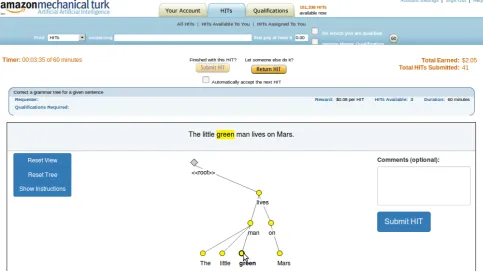
was designed from the beginning to be able to run in con-nection with the Amazon Mechanical Turk crowdsourcing platform. This is accomplished via Mechanical Turk’s Ex-ternalQuestionHuman Intelligence Tasks (HITs). HITs are the basic unit of work on Mechanical Turk; essentially, they are questions to be answered, with a monetary award at-tached. In the case ofExternalQuestionHITs, the requester provides Amazon with the URL of a web site located ex-ternally to the main Mechanical Turk website. As shown in Figure 2, when the workers on Mechanical Turk view and work on the HITs, they see a web page hosted on the main Mechanical Turk website with an internal frame (an HTML iframe) that points to the external website hosting the CROWDTREEsystem. When the worker submits his/her work, it is sent both to the external server, where it can be
3
Figure 2: Screenshot of CROWDTREEworking in the Mechanical Turk sandbox.
accessed by the parsing model training thread (or any ma-chine learning processes implemented in the future), and to the Mechanical Turk website so that the worker can proceed to the next HIT, have his/her work approved, and receive payment.
2.5.
Standalone Mode
As mentioned above, CROWDTREEwas designed with Me-chanical Turk in mind. It is possible, however, for annota-tors to connect directly to the server hosting the Java servlet instead. In this use case, annotators work on each sentence in the order that they appear in the input file. In the future, we would like to add more sophisticated methods for as-signing particular sentences to specific annotators as well as tools that would help supervisors review annotators’ work.
3.
Related Work
3.1.
Treebanking Tools
Perhaps the best known tool for treebanking is the tree ed-itor TRED (Pajas and ˇStˇep´anek, 2008). TRED is a pro-grammable graphical user interface for editing and view-ing parse trees, includview-ing both constituent and dependency trees, and has been used for several treebanking projects, including the Prague Arabic Dependency Treebank (Hajiˇc et al., 2004). It has a wide array of functionality—more than our system—but can be difficult to set up and learn. One of TRED’s greatest limitations is that it is a standalone application written in Perl. In contrast, CROWDTREE is designed to run in modern web browsers, making it com-paratively simple to deploy, especially for geographically distributed annotators. Some aspects of the visual layout and styling of CROWDTREEwere inspired by TRED.
Another web-based tool that can be used for treebanking is WEBANNO (Yimam et al., 2013; Yimam et al., 2014; de Castilho et al., 2016). It builds upon the BRAT inter-face (Stenetorp et al., 2012) and supports multiple layers of annotation across a variety of linguistic annotation tasks. Additionally, WEBANNOis designed to support annotation
across geographically distributed sites and has an integrated machine learning model for suggesting span annotations. It may, however, be more appropriate for semantic labeling tasks, such as word sense disambiguation (WSD) and se-mantic role labeling (SRL), than for syntactic annotation; although compact, we hypothesize that its horizontal word layout, an example of which is depicted in Figure 3, is slower for treebanking and more exhausting to annotators because they have to follow curved arcs with their eyes and pay attention to the arrowheads at the ends in order to un-derstand the directionality of the dependencies.
Three other dependency tree editors with horizontal layouts similar to WEBANNO but designed with a more focused range of functionality are ARBORATOR (Gerdes, 2013), UD ANNOTATRIX(Tyers et al., 2018), and DGANNOTA
-TOR4.
Figure 3: Screenshot showing the type of horizontal lay-out used inBRAT, WEBANNO, and most other dependency annotation tools.
4
3.2.
Crowdsourcing Parsing
To date, there have been very few efforts to crowdsource parsing and no efforts, to the best of our knowledge, to do so directly with a full parse tree editor like CROWDTREE
outside small classroom studies like that of Gerdes (2013). In one notable ongoing effort, researchers have built and de-ployed a Game With a Purpose (GWAP) (Von Ahn, 2006) called ZOMBILINGOin order to crowdsource a French tree-bank (Fort et al., 2014; Guillaume et al., 2016; Fort et al., 2017). ZOMBILINGOparticipants work on one attachment decision at a time, using the metaphor that the governing word is devouring the child just as zombies seek out brains. Participants must complete a training phase for each depen-dency relation they work on and can not work on the rela-tions deemed more difficult until they have demonstrated some skill on less challenging dependency relations. ZOM
-BILINGOrelies entirely on volunteers and is a standalone website5not designed for integration with Mechanical Turk
or similar crowdsourcing platforms.
Another notable effort is that of He et al. (2016), who, in a first step toward human-in-the-loop parsing, crowd-source individual attachment annotations by asking annota-tors multiple choice questions automatically generated us-ing parse trees produced by an existus-ing parser. For exam-ple, to resolve the attachment of a relative clause with a root verb ofsells, the question posed to the annotators would be something like, “Whatsellssomething?”, and the available answers would be the list of noun phrases that appear prior to the relative clause. He et al. are able to achieve some modest gains, improving by 0.2 F1 on their in-domain cor-pus and 0.6 F1 on their out-of-domain corcor-pus.
3.3.
Crowdsourcing combined with Machine
Learning
Even though using crowdsourcing to collect data for processing with machine learning algorithms has been widespread for a number of years, it is still relatively rare to run machine learning algorithms at the same time that the crowd is actively annotating. This is especially true in the field of natural language processing (NLP). One notable exception to this rule is the work of Laws et al. (2011), who ran active learning processes while crowdsourcing Named Entity Recognition (NER) and sentiment detection tasks on Mechanical Turk. To the best of our knowledge, no one has utilized machine learning in any similar fashion while crowdsourcing parse trees.
4.
Conclusion
In this paper, we introduce CROWDTREE, an interactive graphical editor for dependency tree annotation. Based upon standard web technologies, the system is compatible with modern browsers and, thus, easy to deploy to geo-graphically distributed annotators. Our system’s integrated back end parsing model makes it suitable for human-in-the-loop or even crowd-in-human-in-the-loop annotation, where the integrated parsing model learns as the annotation proceeds so that, ideally, the amount of effort required per sentence
5
https://zombilingo.org/
decreases as time goes on. CROWDTREE supports left-to-right and right-to-left scripts, labeled and unlabeled de-pendency annotation, and can run in conjunction with Me-chanical Turk (viaExternalQuestionHITs) or in standalone mode. To the best of our knowledge, it is the first de-pendency tree editor designed for use with a large online crowdsourcing platform; thus, we expect it to prove useful to the wider computational linguistics research community and intend to release the code open source in the near fu-ture, likely as a repository on the U.S. Army Research Lab-oratory’s GitHub site6.
5.
Future Work
We built CROWDTREEto explore the feasibility of crowd-sourcing dependency parse annotation and to demonstrate the value of utilizing human-in-the-loop machine learning during the parse annotation process. Accordingly, we will be posting HITs on Mechanical Turk with a variety of pa-rameterizations and publishing our findings. We hope to show that annotators without extensive linguistic training (e.g., Turkers) can quickly, cheaply, and accurately con-struct dependency trees and that integrated machine learn-ing greatly benefits the overall process.
Furthermore, we intend to expand the system’s machine learning capabilities by adding support for one or more ac-tive learning schemes. One obvious option would be to host multiple parsing models on the server and to select sen-tences for annotation based upon the level of disagreement between the parsers. We are considering the possibility of training one (or perhaps more) models per annotator dur-ing the annotation process, although implementdur-ing this in such a way as to avoid overtaxing available memory and computational resources may be a challenge.
A number of other extensions could be made to improve the tool’s versatility in order to support a greater range of tree-banking projects. We envision supporting empty nodes in order to handle traces and other phenomena, and we would like to support multiple syntactic word nodes for a given surface token, which would be valuable functionality for languages that make frequent use of clitics, such as Ara-bic. Finally, we hope to eventually expand the capabilities of CROWDTREEto support use cases beyond dependency parsing, such as part-of-speech tagging, semantic role la-beling, or even language learning.
Acknowledgements
We wish to thank the anonymous reviewers for their comments and the Army Educational Outreach Program (AEOP) for the College Qualified Leaders (CQL) under-graduate internship program.
References
B¨ohmov´a, A., Hajiˇc, J., Hajiˇcov´a, E., and Hladk´a, B. (2003). The Prague Dependency Treebank. In Anne Abeill´e, editor, Treebanks: Building and Using Parsed Corpora, pages 103–127. Springer Netherlands. de Castilho, R. E., Mujdricza-Maydt, E., Yimam, S. M.,
Hartmann, S., Gurevych, I., Frank, A., and Biemann, C.
6
(2016). A Web-Based Tool for the Integrated Annotation of Semantic and Syntactic Structures. InProceedings of the Workshop on Language Technology Resources and Tools for Digital Humanities (LT4DH), pages 76–84. Fort, K., Guillaume, B., and Chastant, H. (2014).
Cre-ating Zombilingo, a Game With A Purpose for depen-dency syntax annotation. InProceedings of the First In-ternational Workshop on Gamification for Information Retrieval, pages 2–6.
Fort, K., Guillaume, B., and Lefebvre, N. (2017). Who wants to play Zombie? A survey of the players on ZOMBILINGO. InProceedings of Games4NLP: Using Games and Gamification for Natural Language Process-ing.
Gerdes, K. (2013). Collaborative dependency annotation. In Proceedings of the Second International Conference on Dependency Linguistics (DepLing 2013), pages 88– 97.
Goldberg, Y. and Elhadad, M. (2010). An Efficient Algo-rithm for Easy-First Non-Directional Dependency Pars-ing. In Human Language Technologies: The 11th An-nual Conference of the North American Chapter of the Association for Computational Linguistics (HLT-NAACL 2010).
Guillaume, B., Fort, K., and Lefebvre, N. (2016). Crowd-sourcing Complex Language Resources: Playing to An-notate Dependency Syntax. InProceedings of the 26th International Conference on Computational Linguistics (COLING), pages 3041–3052.
Hajiˇc, J., Smrz, O., Zem´anek, P., ˇSnaidauf, J., and Beˇska, E. (2004). Prague Arabic Dependency Treebank: Develop-ment in Data and Tools. InProceedings of the NEMLAR International Conference on Arabic Language Resources and Tools, pages 110–117.
He, L., Michael, J., Lewis, M., and Zettlemoyer, L. (2016). Human-in-the-Loop Parsing. InProceedings of the 2016 Conference on Empirical Methods in Natural Language Processing (EMNLP 2016), pages 2337–2342.
Laws, F., Scheible, C., and Sch¨utze, H. (2011). Active Learning with Amazon Mechanical Turk. In Proceed-ings of the 2011 Conference on Empirical Methods in Natural Language Processing (EMNLP 2011), pages 1546–1556.
Little, A. and Tratz, S. (2016). EasyTree: A Graphical Tool for Dependency Tree Annotation. InProceedings of the Tenth International Conference on Language Resources and Evaluation (LREC 2016).
Marcus, M. P., Marcinkiewicz, M. A., and Santorini, B. (1993). Building a Large Annotated Corpus of En-glish: The Penn Treebank. Computational Linguistics, 19(2):330.
McDonald, R. and Nivre, J. (2007). Characterizing the Errors of Data-Driven Dependency Parsing Models. In
Proceedings of the 2007 Joint Conference on Empiri-cal Methods in Natural Language Processing and Com-putational Natural Language Learning (EMNLP-CoNLL 2007), pages 122–131.
Nivre, J. (2009). Non-projective dependency parsing in expected linear time. InProceedings of the Joint
Con-ference of the 47th Annual Meeting of the ACL and the 4th International Joint Conference on Natural Language Processing of the AFNLP (ACL-IJCNLP 2009), pages 351–359.
Pajas, P. and ˇStˇep´anek, J. (2008). Recent Advances in a Feature-Rich Framework for Treebank Annotation. In
Proceedings of the 22nd International Conference on Computational Linguistics (COLING 2008), pages 673– 680.
Stenetorp, P., Pyysalo, S., Topi´c, G., Ohta, T., Ananiadou, S., and Tsujii, J. (2012). brat: a Web-based Tool for NLP-Assisted Text Annotation. In Proceedings of the Demonstrations at the 13th Conference of the European Chapter of the Association for Computational Linguis-tics (EACL 2012).
Tratz, S. and Hovy, E. (2011). A Fast, Accurate, Non-Projective, Semantically-Enriched Parser. In Proceed-ings of the 2011 Conference on Empirical Methods in Natural Language Processing (EMNLP), pages 1257– 1268.
Tyers, F. M., Sheyanova, M., and Washington, J. (2018). UD Annotatrix: An Annotation Tool for Universal Dependencies. In Proceedings of the 16th Interna-tional Workshop on Treebanks and Linguistic Theories (TLT16), pages 10–17.
Von Ahn, L. (2006). Games with a Purpose. Computer, 39(6):92–94.
Yimam, S. M., Gurevych, I., Eckart de Castilho, R., and Biemann, C. (2013). WebAnno: A Flexible, Web-based and Visually Supported System for Distributed Annota-tions. InProceedings of the 51st Annual Meeting of the Association for Computational Linguistics (ACL 2013): System Demonstrations, pages 1–6.