Dataset for the First Evaluation on Chinese Machine Reading Comprehension
Yiming Cui
†, Ting Liu
‡, Zhipeng Chen
†, Wentao Ma
†, Shijin Wang
†and Guoping Hu
† †Joint Laboratory of HIT and iFLYTEK, iFLYTEK Research, Beijing, China‡Research Center for Social Computing and Information Retrieval,
Harbin Institute of Technology, Harbin, China
†{ymcui,zpchen,wtma,sjwang3,gphu}@iflytek.com ‡[email protected]
Abstract
Machine Reading Comprehension (MRC) has become enormously popular recently and has attracted a lot of attention. However, existing reading comprehension datasets are mostly in English. To add diversity in reading comprehension datasets, in this paper we propose a new Chinese reading comprehension dataset for accelerating related research in the community. The proposed dataset contains two different types: cloze-style reading comprehension and user query reading comprehension, associated with large-scale training data as well as human-annotated validation and hidden test set. Along with this dataset, we also hosted the first Evaluation on Chinese Machine Reading Comprehension (CMRC-2017) and successfully attracted tens of participants, which suggest the potential impact of this dataset.
Keywords:Chinese Reading Comprehension, Question Answering, Evaluation
1.
Introduction
Machine Reading Comprehension (MRC) has become enormously popular in recent research, which aims to teach the machine to comprehend human languages and answer the questions based on the reading materials. Among var-ious reading comprehension tasks, the cloze-style reaing comprehension is relatively easy to follow due to its sim-plicity in definition, which requires the model to fill an exact word into the query to form a coherent sentence ac-cording to the document material. Several cloze-style read-ing comprehension datasets are publicly available, such as CNN/Daily Mail (Hermann et al., 2015), Children’s Book Test (Hill et al., 2015), People Daily and Children’s Fairy Tale (Cui et al., 2016).
In this paper, we provide a new Chinese reading compre-hension dataset1, which has the following features
• We provide a large-scale automatically generated Chinese cloze-style reading comprehension dataset, which is gathered from children’s reading material.
• Despite the automatic generation of training data, our evaluation datasets (validation and test) are annotated manually, which is different from previous works.
• To add more diversity and for further investigation on transfer learning, we also provide another evaluation datasets which is also annotated by human, but the query is more natural than the cloze type.
We also host the 1st Evaluation on Chinese Machine Read-ing Comprehension (CMRC2017), which has attracted over 30 participants and finally there were 17 participants sub-mitted their evaluation systems for testing their reading comprehension models on our newly developed dataset, suggesting its potential impact. We hope the release of the
1CMRC 2017 Public Datasets: https://github.com/
ymcui/cmrc2017.
dataset to the public will accelerate the progress of Chi-nese research community on machine reading comprehen-sion field.
We also provide four official baselines for the evaluations, including two traditional baselines and two neural base-lines. In this paper, we adopt two widely used neural read-ing comprehension model: AS Reader (Kadlec et al., 2016) and AoA Reader (Cui et al., 2017).
The rest of the paper will be organized as follows. In Sec-tion 2, we will introduce the related works on the reading comprehension dataset, and then the proposed dataset as well as our competitions will be illustrated in Section 3. The baseline and participant system results will be given in Section 4 and we will made a brief conclusion at the end of this paper.
2.
Related Works
In this section, we will introduce several public cloze-style reading comprehension dataset.
2.1.
CNN/Daily Mail
Some news articles often come along with a short sum-mary or brief introduction. Inspired by this, Hermann et al. (2015) release the first cloze-style reading comprehension dataset, called CNN/Daily Mail2. Firstly, they obtained
large-scale CNN and Daily Mail news data from online websites, including main body and its summary. Then they regard the main body of the news as theDocument. The
Queryis generated by replacing a name entity word from the summary by a placeholder, and the replaced named en-tity word becomes theAnswer. Along with the techniques illustrated above, after the initial data generation, they also propose to anonymize all named entity tokens in the data to avoid the model exploit world knowledge of specific en-tities, increasing the difficulties in this dataset. However,
2The pre-processed CNN and Daily Mail datasets are available
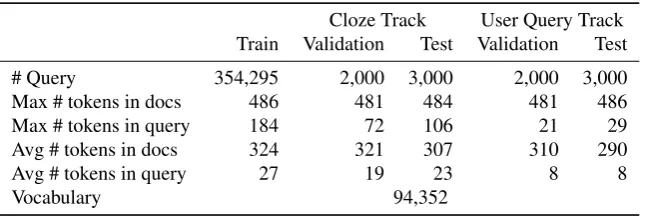
Cloze Track User Query Track Train Validation Test Validation Test
# Query 354,295 2,000 3,000 2,000 3,000
Max # tokens in docs 486 481 484 481 486
Max # tokens in query 184 72 106 21 29
Avg # tokens in docs 324 321 307 310 290
Avg # tokens in query 27 19 23 8 8
Vocabulary 94,352
Table 1: Statistics of the dataset for the 1st Evaluation on Chinese Machine Reading Comprehension (CMRC-2017).
as we have known that world knowledge is very impor-tant when we do reading comprehension in reality, which makes this dataset much artificial than real situation. Chen et al. (2016) also showed that the proposed anonymization in CNN/Daily Mail dataset is less useful, and the current models (Kadlec et al., 2016; Chen et al., 2016) are nearly reaching ceiling performance with the automatically gener-ated dataset which contains much errors, such as corefer-ence errors, ambiguous questions etc.
2.2.
Children’s Book Test
Another popular cloze-style reading comprehension dataset is the Children’s Book Test (CBT)3proposed by Hill et al.
(2015) which was built from the children’s book stories. Though the CBT dataset also use an automatic way for data generation, there are several differences to the CNN/Daily Mail dataset. They regard the first 20 consecutive sentences in a story as theDocumentand the following 21st sentence as theQuerywhere one token is replaced by a placeholder to indicate the blank to fill in. Unlike the CNN/Daily Mail dataset, in CBT, the replaced word are chosen from various types: Name Entity (NE), Common Nouns (CN), Verbs (V) and Prepositions (P). The experimental results showed that, the verb and preposition answers are not sensitive to the changes of document, so the following works are mainly focusing on solving the NE and CN genres.
2.3.
People Daily & Children’s Fairy Tale
The previously mentioned datasets are all in English. To add diversities to the reading comprehension datasets, Cui et al. (2016) proposed the first Chinese cloze-style reading comprehension dataset: People Daily & Children’s Fairy Tale, including People Daily news datasets and Children’s Fairy Tale datasets. They also generate the data in an au-tomatic manner, which is similar to the previous datasets. They choose short articles (several hundreds of words) as
Documentand remove a word from it, whose type is mostly named entities and common nouns. Then the sentence that contains the removed word will be regarded asQuery. To add difficulties to the dataset, along with the automatically generated evaluation sets (validation/test), they also release a human-annotated evaluation set. The experimental results show that the human-annotated evaluation set is signifi-cantly harder than the automatically generated questions. The reason would be that the automatically generated data
3Available at http://www.thespermwhale.com/
jaseweston/babi/CBTest.tgz
is accordance with the training data which is also automati-cally generated and they share many similar characteristics, which is not the case when it comes to human-annotated data.
3.
The Proposed Dataset
In this section, we will briefly introduce the evaluation tracks and then the generation method of our dataset will be illustrated in detail.
3.1.
The 1st Evaluation on Chinese Machine
Reading Comprehension (CMRC-2017)
The proposed dataset is typically used for the 1st Evaluation on Chinese Machine Reading Comprehension (CMRC-2017)4, which aims to provide a communication platform to the Chinese communities in the related fields. In this evaluation, we provide two tracks. We provide a shared training data for both tracks and separated evaluation data.• Cloze Track: In this track, the participants are required to use the large-scale training data to train their cloze system and evaluate on the cloze evaluation track, where training and test set are exactly the same type.
• User Query Track: This track is designed for using transfer learning or domain adaptation to minimize the gap between cloze training data and user query evalu-ation data, i.e. training and testing is fairly different.
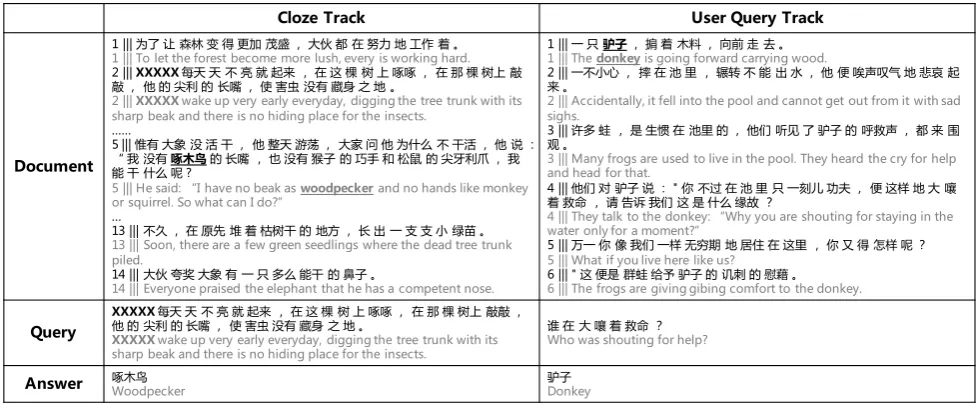
Following Rajpurkar et al. (2016), we preserve the test set only visible to ourselves and require the participants submit their system in order to provide a fair comparison among participants and avoid tuning performance on the test set. The examples of Cloze and User Query Track are given in Figure 1.
3.2.
Definition of Cloze Task
The cloze-style reading comprehension can be described as a triplehD,Q,Ai, whereDrepresentsDocument, Q rep-resentsQuery and theArepresentsAnswer. There is a re-striction that the answer should be a single word and should appear in the document, which was also adopted in (Hill et al., 2015; Cui et al., 2016). In our dataset, we mainly fo-cus on answering common nouns and named entities which require further comprehension of the document.
4CMRC 2017 Official Website: http://www.hfl-tek.
Cloze Track User Query Track
Document
1 ||| 为了 让 森林 变 得 更加 茂盛 , 大伙 都 在 努力 地 工作 着 。
1 ||| To let the forest become more lush, every is working hard.
2 ||| XXXXX每天 天 不 亮 就 起来 , 在 这 棵 树 上 啄啄 , 在 那 棵 树上 敲 敲 , 他 的 尖利 的 长嘴 , 使 害虫 没有 藏身 之 地 。
2 |||XXXXXwake up very early everyday, digging the tree trunk with its sharp beak and there is no hiding place for the insects.
...
5 ||| 惟有 大象 没 活 干 , 他 整天 游荡 , 大家 问 他 为什么 不 干活 , 他 说 : “ 我 没有啄木鸟的 长嘴 , 也 没有 猴子 的 巧手 和 松鼠 的 尖牙利爪 , 我 能 干 什么 呢 ?
5 ||| He said: “I have no beak aswoodpeckerand no hands like monkey or squirrel. So what can I do?”
...
13 ||| 不久 , 在 原先 堆 着 枯树干 的 地方 , 长 出 一 支 支 小 绿苗 。
13 ||| Soon, there are a few green seedlings where the dead tree trunk piled.
14 ||| 大伙 夸奖 大象 有 一 只 多么 能干 的 鼻子 。
14 ||| Everyone praised the elephant that he has a competent nose.
1 ||| 一 只驴子, 掮 着 木料 , 向前 走 去 。
1 ||| Thedonkeyis going forward carrying wood.
2 ||| 一不小心 , 摔 在 池 里 , 辗转 不 能 出 水 , 他 便 唉声叹气 地 悲哀 起 来 。
2 ||| Accidentally, it fell into the pool and cannot get out from it with sad sighs.
3 ||| 许多 蛙 , 是 生惯 在 池里 的 , 他们 听见 了 驴子 的 呼救声 , 都 来 围 观 。
3 ||| Many frogs are used to live in the pool. They heard the cry for help and head for that.
4 ||| 他们 对 驴子 说 : " 你 不过 在 池 里 只 一刻儿 功夫 , 便 这样 地 大 嚷 着 救命 , 请 告诉 我们 这 是 什么 缘故 ?
4 ||| They talk to the donkey: “Why you are shouting for staying in the water only for a moment?”
5 ||| 万一 你 像 我们 一样 无穷期 地 居住 在 这里 , 你 又 得 怎样 呢 ?
5 ||| What if you live here like us?
6 ||| " 这 便是 群蛙 给予 驴子 的 讥刺 的 慰藉 。
6 ||| The frogs are giving gibing comfort to the donkey.
Query
XXXXX每天 天 不 亮 就 起来 , 在 这 棵 树 上 啄啄 , 在 那 棵 树上 敲敲 , 他 的 尖利 的 长嘴 , 使 害虫 没有 藏身 之 地 。
XXXXXwake up very early everyday, digging the tree trunk with its sharp beak and there is no hiding place for the insects.
谁 在 大 嚷 着 救命 ?
Who was shouting for help?
Answer 啄木鸟Woodpecker 驴子Donkey
Figure 1: Examples of the proposed datasets (the English translation is in grey). The sentence ID is depicted at the beginning of each row. In the Cloze Track, “XXXXX” represents the missing word.
3.3.
Automatic Generation
Following Cui et al. (Cui et al., 2016), we also use simi-lar way to generate our training data automatically. Firstly we roughly collected 20,000 passages from children’s read-ing materials which were crawled in-house. Briefly, we choose an answer word in the document and treat the sen-tence containing answer word as the query, where the an-swer is replaced by a placeholder “XXXXX”. The detailed procedures can be illustrated as follows.
• Pre-processing: For each sentence in the document, we do word segmentation, POS tagging and depen-dency parsing using LTP toolkit (Che et al., 2010).
• Dependency Extraction: Extract following depen-dencies: COO, SBV, VOB, HED, FOB, IOB, POB5, and only preserve the parts that have dependencies.
• Further Filtering: Only preserve SBV, VOB and re-strict the related words not to be pronouns and verbs.
• Frequency Restriction: After calculating word fre-quencies, only word frequency that greater than 2 is valid for generating question.
• Question Restriction: Only five questions can be ex-tracted within one passage.
3.4.
Human Annotation
Apart from the automatically generated large-scale training data, we also provide human-annotated validation and test data to improve the estimation quality. The annotation pro-cedure costs one month with 5 annotators and each question is cross-validated by another annotator. The detailed proce-dure for each type of dataset can be illustrated as follows.
5Full descriptions of abbreviations can be found athttp://
www.ltp-cloud.com/intro/en/#dp_how.
3.4.1. Cloze-style Reading Comprehension
For the validation and test set in cloze data, we first ran-domly choose 5,000 paragraphs each for automatically gen-erating questions using the techniques mentioned above. Then we invite our resource team to manually select 2,000 questions based on the following rules.
• Whether the question is appropriate and correct
• Whether the question is hard for LMs to answer
• Only select one question for each paragraph
3.4.2. User Query Reading Comprehension
Unlike the cloze dataset, we have no automatic question generation procedure in this type. In the user query dataset, we asked our annotator to directly raise questions according to the passage, which is much difficult and time-consuming than just selecting automatically generated questions. We also assign 5,000 paragraphs for question annotations in both validation and test data. Following rules are applied in asking questions.
• The paragraph should be read carefully and judged whether appropriate for asking questions
• No more than 5 questions for each passage
• The answer should be better in the type of nouns, named entities to be fully evaluated
• Too long or too short paragraphs should be skipped
4.
Experiments
Single Model Ensemble
Rank System Validation Test Validation Test
- Baseline - Random Guess 1.65 1.67 -
-- Baseline - Top Frequency 14.85 14.07 -
-- Baseline - AS Reader (default settings) 76.05 77.67 -
-- Baseline - AoA Reader (default settings) 77.20 78.63 -
-1 6ESTATES 75.85 74.73 81.85 81.90
2 Shanghai Jiao Tong Univeristy BCMI-NLP 76.15 77.73 78.35 80.67
3 XinkTech 77.15 77.53 79.20 80.27
4 East China Normal University (ECNU) 77.95 77.40 79.45 79.70
5 Ludong University 74.75 75.07 77.05 77.07
6 Wuhan University (WHU) 78.20 76.53 -
-7 Harbin Institute of Technology at Shenzhen (HITSZ) 76.05 75.93 -
-8 HuoYan Technology 73.55 75.77 -
-9 Wuhan University of Science and Technology (WUST) 73.80 74.53 -
-10 Beijing Information Science and Technology University 70.05 70.20 -
-11 Shanxi Univerisity (SXU-2) 62.60 64.70 66.65 68.47
12 Shenyang Aerospace University (SAU) 63.15 65.80 -
-13 Shanxi University (SXU-1) 64.85 64.67 -
-14 Zhengzhou Univerisity (ZZU) 52.80 54.53 -
-Table 2: Results on Cloze Track. The best baseline and participant systems are depicted in bold face.
4.1.
Baseline Systems
We set several baseline systems for testing basic perfor-mance of our datasets and provide meaningful comparisons to the participant systems. In this paper, we provide four baseline systems, including two simple ones and two neu-ral network models. The details of the baseline systems are illustrated as follows.
• Random Guess: In this baseline, we randomly choose one word in the document as the answer.
• Top Frequency: We choose the most frequent word in the document as the answer.
• AS Reader: We implemented Attention Sum Reader (AS Reader) (Kadlec et al., 2016) for modeling doc-ument and query and predicting the answer with the Pointer Network (Vinyals et al., 2015), which is a popular framework for cloze-style reading compre-hension. Apart from setting embedding and hidden layer size as 256, we did not change other hyper-parameters and experimental setups as used in Kadlec et al. (2016), nor we tuned the system for further im-provements.
• AoA Reader: We also implemented Attention-over-Attention Reader (AoA Reader) (Cui et al., 2017) which is the state-of-the-art model for cloze-style reading comprehension. We follow hyper-parameter settings in AS Reader baseline without further tuning.
In the User Query Track, as there is a gap between training and validation, we follow (Liu et al., 2017) and regard this task as domain adaptation or transfer learning problem. The neural baselines are built by the following steps.
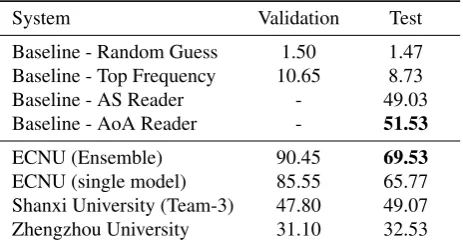
System Validation Test
Baseline - Random Guess 1.50 1.47
Baseline - Top Frequency 10.65 8.73
Baseline - AS Reader - 49.03
Baseline - AoA Reader - 51.53
ECNU (Ensemble) 90.45 69.53
ECNU (single model) 85.55 65.77
Shanxi University (Team-3) 47.80 49.07
Zhengzhou University 31.10 32.53
Table 3: Results on User Query Track. Due to the using of validation data, we did not report its performance.
• We first use the shared training data to build a gen-eral systems, and choose the best performing model (in terms of cloze validation set) as baseline.
• Use User Query validation data for further tuning the systems with 10-fold cross-validations.
• Increase dropout rate (Srivastava et al., 2014) to 0.5 for preventing over-fitting issue.
All baseline systems are chosen according to the perfor-mance of the validation set.
4.2.
Participant Systems
The participant system results6are given in Table 2 and 3.
4.2.1. Cloze Track
As we can see that two neural baselines are competitive among participant systems and AoA Reader successfully
6Full CMRC 2017 Leaderboard:http://www.hfl-tek.
outperform AS Reader and all participant systems in single model condition, which proves that it is a strong baseline system even without further fine-tuning procedure. Also, the best performing single model among participant sys-tems failed to win in the ensemble condition, which suggest that choosing right ensemble method is essential in most of the competitions and should be carefully studied for further performance improvements.
4.2.2. User Query Track
Not surprisingly, we only received three participant sys-tems in User Query Track, as it is much difficult than Cloze Track. As shown in Table 3, the test set performance is significantly lower than that of Cloze Track, due to the mismatch between training and test data. The baseline results give competitive performance among three partic-ipants, while failed to outperform the best single model by ECNU, which suggest that there is much room for tuning and using more complex methods for domain adaptation.
5.
Conclusion
In this paper, we propose a new Chinese reading com-prehension dataset for the 1st Evaluation on Chinese Ma-chine Reading Comprehension (CMRC-2017), consisting large-scale automatically generated training set and human-annotated validation and test set. Many participants have verified their algorithms on this dataset and tested on the hidden test set for final evaluation. The experimental results show that the neural baselines are tough to beat and there is still much room for using complicated transfer learning method to better solve the User Query Task. We hope the release of the full dataset (including hidden test set) could help the participants have a better knowledge of their sys-tems and encourage more researchers to do experiments on.
6.
Acknowledgements
We would like to thank the anonymous reviewers for their thorough reviewing and providing thoughtful comments to improve our paper. We thank the Sixteenth China National Conference on Computational Linguistics (CCL 2017) and Nanjing Normal University for providing space for evalua-tion workshop. Also we want to thank our resource team for annotating and verifying evaluation data. This work was supported by the National 863 Leading Technology Research Project via grant 2015AA015409.
7.
Bibliographical References
Che, W., Li, Z., and Liu, T. (2010). Ltp: A chinese lan-guage technology platform. InProceedings of the 23rd International Conference on Computational Linguistics: Demonstrations, pages 13–16. Association for Compu-tational Linguistics.
Chen, D., Bolton, J., and Manning, D. C. (2016). A thor-ough examination of the cnn/daily mail reading compre-hension task. InProceedings of the 54th Annual Meeting of the Association for Computational Linguistics (Vol-ume 1: Long Papers), pages 2358–2367. Association for Computational Linguistics.
Cui, Y., Liu, T., Chen, Z., Wang, S., and Hu, G. (2016). Consensus attention-based neural networks for chinese reading comprehension. In Proceedings of COLING 2016, the 26th International Conference on Computa-tional Linguistics: Technical Papers, pages 1777–1786. The COLING 2016 Organizing Committee.
Cui, Y., Chen, Z., Wei, S., Wang, S., Liu, T., and Hu, G. (2017). Attention-over-attention neural networks for reading comprehension. InProceedings of the 55th An-nual Meeting of the Association for Computational Lin-guistics (Volume 1: Long Papers), pages 593–602. Asso-ciation for Computational Linguistics.
Hermann, K. M., Kocisky, T., Grefenstette, E., Espeholt, L., Kay, W., Suleyman, M., and Blunsom, P. (2015). Teach-ing machines to read and comprehend. In Advances in Neural Information Processing Systems, pages 1684– 1692.
Hill, F., Bordes, A., Chopra, S., and Weston, J. (2015). The goldilocks principle: Reading children’s books with explicit memory representations. arXiv preprint arXiv:1511.02301.
Kadlec, R., Schmid, M., Bajgar, O., and Kleindienst, J. (2016). Text understanding with the attention sum reader network. InProceedings of the 54th Annual Meeting of the Association for Computational Linguistics (Volume 1: Long Papers), pages 908–918. Association for Com-putational Linguistics.
Liu, T., Cui, Y., Yin, Q., Zhang, W.-N., Wang, S., and Hu, G. (2017). Generating and exploiting large-scale pseudo training data for zero pronoun resolution. InProceedings of the 55th Annual Meeting of the Association for Com-putational Linguistics (Volume 1: Long Papers), pages 102–111. Association for Computational Linguistics. Rajpurkar, P., Zhang, J., Lopyrev, K., and Liang, P. (2016).
Squad: 100,000+ questions for machine comprehension of text. InProceedings of the 2016 Conference on Em-pirical Methods in Natural Language Processing, pages 2383–2392. Association for Computational Linguistics. Srivastava, N., Hinton, G. E., Krizhevsky, A., Sutskever, I.,
and Salakhutdinov, R. (2014). Dropout: a simple way to prevent neural networks from overfitting. Journal of Machine Learning Research, 15(1):1929–1958.