TF-LM: TensorFlow-based Language Modeling Toolkit
Lyan Verwimp, Hugo Van hamme, Patrick Wambacq
ESAT – PSI, KU LeuvenKasteelpark Arenberg 10, 3001 Heverlee, Belgium
{lyan.verwimp, hugo.vanhamme, patrick.wambacq}@esat.kuleuven.be
Abstract
Recently, an abundance of deep learning toolkits has been made freely available. These toolkits typically offer the building blocks and sometimes simple example scripts, but designing and training a model still takes a considerable amount of time and knowledge. We present language modeling scripts based on TensorFlow that allow one to train and test competitive models directly, by using a pre-defined configuration or changing it to their needs. There are several options for input features (words, characters, words combined with characters, character n-grams) and for batching (sentence- or discourse-level). The models can be used to test the perplexity, predict the next word(s), re-score hypotheses or generate debugging files for interpolation with n-gram models. Addi-tionally, we make available LSTM language models trained on a variety of Dutch texts and English benchmarks, that can be used immediately, thereby avoiding the time and computationally expensive training process. The toolkit is open source and can be found at https://github.com/lverwimp/tf-lm.
Keywords:language modeling, LSTM, deep learning, toolkit
1.
Introduction
Language models (LMs) play a crucial role in many speech and language processing tasks, among others speech recog-nition, machine translation and optical character recogni-tion. The current state of the art are recurrent neural net-work (RNN) based LMs (Mikolov et al., 2010), and more specifically long short-term memory (LSTM) (Hochreiter and Schmidhuber, 1997) LMs (Sundermeyer et al., 2012). Building, training, optimizing and testing these networks from scratch would require a huge amount of expertise and time. There exist many deep learning frameworks that offer the building blocks: TensorFlow (Abadi et al., 2015), Keras (Chollet, 2015), Torch (Collobert et al., 2011), Theano (Theano Development Team, 2016), Caffe (Jia et al., 2014) and others. Researchers proposing a new type of model also frequently publish their code, but typically do not offer a more general framework.
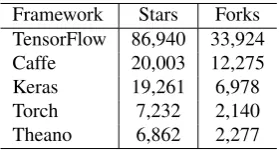
Among the deep learning frameworks, TensorFlow is ar-guably the most widely used, as the Github statistics in ta-ble 1. demonstrate. However, as far as we know (see sec-tion 2. for a more detailed descripsec-tion of the existing tools), there does not exist a toolkit that allows one to quickly de-sign, train and test their own ‘baseline’ LMs with Tensor-Flow. We release a toolkit that contains modular code that should be easy to adapt, standard recipes to train compet-itive baseline models that can be adapted in a simple con-figuration file and LMs that are pre-trained on a variety of English benchmarks and corpora of spoken Dutch.
Framework Stars Forks TensorFlow 86,940 33,924
Caffe 20,003 12,275
Keras 19,261 6,978
Torch 7,232 2,140
Theano 6,862 2,277
Table 1: Github statistics for several deep learning frame-works, recorded on Sept 6, 2017.
In the remainder of this paper, we discuss other toolkits that provide language modeling scripts in section 2., de-scribe the documentation and functionality that our toolkit provides (sections 3. and 4.) and the pre-trained LMs (sec-tion 5.). We end with experimental results (sec(sec-tion 6.) and a conclusion (section 7.).
2.
Related work
Although there already exist open-source neural lan-guage modeling toolkits, they only offer feedforward NNs (Schwenk, 2013), vanilla RNNs (Mikolov et al., 2014) or are not easy to adapt and hence not very attractive to re-searchers (Sundermeyer et al., 2014). TheanoLM (Enarvi and Kurimo, 2016) should be more flexible and offers many state-of-the-art models such as LSTMs and GRUs, but is built on Theano. TensorFlow has a larger community than Theano and is updated frequently, also including state-of-the-art models. Moreover, it has been announced that the development of Theano will not be continued.
The TensorFlow documentation offers a tutorial on re-current neural network language modeling (TensorFlow, 2017), with code to train a word-level LM. It trains on batches that go across sentence boundaries, while not re-setting the state of the LSTM for every new sentence. This implies that the model in theory can remember words from the previous sentence(s). However, for some architectures (e.g. bidirectional models) or applications, working on the sentence level is a more natural choice. As explained in sec-tion 4., we offer many more opsec-tions in our toolkit, among others the choice between training on sentence-level or ‘discourse’-level batches.
To the best of our knowledge, we are not aware of a similar TensorFlow-based language modeling toolkit that offers the same variety of options as ours.
3.
Documentation
Documentation about the toolkit can be found in the Github repository: we provide a high-level overview of the options the toolkit offers, an overview of what every script does, a list of possible combinations of options together with ex-amples of commands and a link to the pre-trained models. We also give a detailed description of what the configura-tion should look like: mandatory versus opconfigura-tional parame-ters, expected type for every parameter and a description of what they do. The web page containing the pre-trained LSTM LMs also gives some information about the data and models.
4.
Functionality
TF-LMoffers different options with respect to device place-ment, data reading, unit of input/output, batching, training schemes and testing.
Firstly, the code will automatically run on GPU if one is available, but if one does not want to use the available GPU, it is possible to run on CPU by simply using the command line option--device cpu.
Secondly, with respect to data handling, all data is read at once and kept in memory, but this is not possible when deal-ing with large datasets. For those datasets one can choose to read the data sentence per sentence. This option can so far only be combined with sentence-level batches (see sec-tion 4.2. for more informasec-tion about batching).
Thirdly, the main script will automatically train, validate and test the model specified in the configuration file, un-less certain options are switched off (with command line options--train False,--valid Falseor--test False). Thus, if one for example only wants to check the perplexity of a cer-tain data set for an already trained model, this can be done by using these switches.
All other options that the toolkit offers are specified in a configuration file (command line option --config), which contains a list of parameters and values. Certain param-eters should always be specified, such as the path where the model should be saved and the path where the data can be found, others are optional. More detailed information about every option, and about the possible combinations of options can be found in the Github READMEs.
We tried to design the toolkit in such a manner that imple-menting new models or new manners of feeding data, train-ing or testtrain-ing the models should be easy. One can typically start from a base class and adapt only the parts that are nec-essary: e.g. the LM that takes as input character n-grams rather than words inherits from the baseline LM class, and only adapts the initialization of variables and the manner in which the input embeddings are generated.
4.1.
Words, characters or both?
As regards unit of input/output, there are four options: word, character, word and characters and character n -grams. The word-level LM is the default option, and trains a model that predicts the next word given the previous
words. The input embeddingetfor the word-level model is calculated as follows:
et=Ww×wt (1)
withWw the word embedding matrix andwt the one-hot vector of the word at time stept. The character-level LM does exactly the same but for characters: ctis the one-hot vector of the current character.
et=Wc×ct (2)
In the output layer, this model predicts the next character. The combination of word and characters feeds the current word to the input along with a predetermined number of characters occurring in the word, as in (Verwimp et al., 2017b). The word and character embeddings are concate-nated and the result of this operation is fed to the LSTM:
e>t = [(Ww×wt)>(W1c×c1t)>
(W2c×c2t)> . . . (Wnc ×cnt)>] (3)
wherec1
t is the one-hot encoding of the first character,W 1 c its embedding matrix andnthe total number of characters added to the model. This option can be specified with the parameterword_char_concat(set toTrue), the number of characters to be added withnum_char, the size of the char-acter embeddings withchar_sizeand the order in which the characters should be added withorder: begin_firstimplies that we start at the beginning of the word (e.g. 5 characters from ‘pineapple’:p, i, n, e, a),end_firstthat we start at the ending of the word (e.g. 5 characters from ‘pineapple’:e, l, p, p, a), andboththat we add both the firstnum_char char-acters starting from the beginning and from the ending (e.g. 3 characters from ‘pineapple’:p, i, n; e, l, p). In the output layer the model predicts the next word.
The option of charactern-grams (parameterchar_ngram) feeds a vector containing the counts of all character n -grams that occur in the current word to the network:
et=Wg×gt (4)
wheregtisnota one-hot vector but a vector of the length of the character n-gram vocabulary, containing for every character n-gram its frequency in the current word. For example, for the word ‘home’, the character 2-grams are: <bow>h, ho, om, me and e<eow>(we append a beginning-and end-of-word token<bow>, <eow>). It is also possible to use skipgrams (parameterskipgramwith an integer value specifying the number of skips), for example with skips of 1 character, ‘home’ has the following skipgrams:<bow>o, hm, oe, m<eow>.
and add a special symbol<cap>to the vector and assign it the number of capitals in the word (parametercapital). Finally, it is also possible to reserve a part of the total in-put embedding for a standard word embedding, in a similar manner as for character-word LMs (Verwimp et al., 2017b):
e>t = [(Ww×wt)>(Wg×gt)>] (5)
In this case, the input embedding consists of a concatena-tion of the word embedding and the charactern-gram input. In the output layer, the charactern-gram model always pre-dicts a distribution over words.
4.2.
Going beyond sentence boundaries?
By default, the models are trained on batches that optimally make use of the available space. For example (extract taken from Penn TreeBank):
“owned by <unk> & <unk> co. was under contract with <unk> to make the cigarette filters <eos> the find-ing probably"
The batches may contain (multiple) (parts of a) sentence, separated from each other with the end-of-sentence token <eos>. Since the hidden state of the LSTM is transferred across the batches, it is not a problem that sentences are spread over several batches and the LSTM can in theory remember information from previous sentences. If the pa-rameterper_sentenceis present in the configuration file, the model will train on batches that contain only one sentence, padded until they all have the same length:
“<bos> the plant which is owned by <unk> & <unk> co. was under contract with <unk> to make the cigarette filters <eos> @ @ @. . ."
“<bos> the finding probably will support those who ar-gue that the u.s. should regulate the class of asbestos including <unk> more <unk> than the common kind of asbestos <unk> found in most schools and other build-ings dr. <unk> said <eos> @ @ @. . ."
In the above examples, ‘@’ is the padding symbol and the number of padding symbols that has to be added to obtain the length of the longest sentence in the whole dataset is of-ten large. We also introduce a beginning-of-senof-tence sym-bol<bos> to be able to predict the first word in the sen-tence. In this model, a lot of memory is wasted on padding, although in principle no extra computation is done using TensorFlow’s dynamic RNN. To reduce the memory usage, it is possible to stream the data sentence per sentence. The state of the LSTM is always reset after each sentence, such that it does not remember the previous sentence(s). The per-plexity calculation is adapted to exclude the padding. We will refer to this condition as ‘sentence LSTM’, whereas the one that should remember previous sentences is referred to as ‘discourse LSTM’.
It is important to note that most research papers on language modeling do not explicitly mention whether their models go beyond sentence boundaries or not. Some exceptions are (Pelemans et al., 2016) and (Chelba et al., 2017), who re-port worse perplexity results for models trained on sentence level than on discourse level, supporting the intuition that knowledge of the previous sentence(s) can have a positive
influence on the language modeling capacity. However, for certain architectures or applications, such as bidirectional models, sentence-level models are required.
4.3.
Training
Certain parameters for training always have to be speci-fied in the configuration file. Firstly, the vocabulary size should be specified (vocab_size) and if it is smaller than the full vocabulary of the data, words that do not appear in the vocabulary should be mapped to an unknown to-ken (we also make available a script to do this mapping). All models are trained with an open vocabulary: the un-knowntoken is part of the input and output vocabulary and hence an ‘unknown’ word can be predicted. If one does not want to use a vocabulary based on the frequency of the words, one can load their own vocabulary with the option read_vocab_from_file.
Secondly, the size of the TensorFlow graph can be spec-ified in number of layers, number of neurons per layer, batch size and number of steps to unroll the network for backpropagation through time. The models are randomly initialized with a uniform distribution between -init_scale and +init_scale. Several optimizers are included (stochas-tic gradient descent, adam and adagrad) but a new optimizer can be easily added. With respect to regularization, by de-fault dropout is used on the input embeddings and on the outputs of the LSTM cell, and the norm of the gradients is clipped to avoid exploding gradients.
If the configuration parameter bidirectionalis added, the LM is trained as a bidirectional LSTM, whereby the for-ward state of the current time step and the backfor-ward state of next time step + 2 are combined:
yt+1=f(Wofh
f
t +Wobhbt+2+b) (6) In the equation above, f is the softmax function, yt+1 is the probability distribution predicted for the word at time stept+ 1,Wf
o andWob the output weight matrices of re-spectively the forward and backward LSTM,hft the hidden state of the forward LSTM for the current time step,hb
t+2 the hidden state of the backward LSTM for the next time step + 2 andbthe output bias vector. We usehb
t+2because for the task of language modeling, the input from the next time step is equal to the target from the current time step. There are two training schemes available: training a fixed number of epochs or training with early stopping. For early stopping, the validation perplexity of the current epoch is compared with those of the x(specified with early_stop) previous epochs, and training is stopped when it has been higherxtimes. If this is not the case, training is continued until the maximum number of epochs (max_max_epoch), similar to the other training scheme. Both schemes can be combined with an exponentially decaying learning rate: during the first epochs (specified with max_epoch), the same initial learning rate is used. Then an exponential de-cay is applied:
ηi=α ηi−1 (7)
4.4.
Testing
TF-LM offers several options to test the performance of a trained LM. Firstly, the test or validation perplexity of the standard data sets can be calculated by running the same configuration with the --train and respectively --valid or --testarguments switched off. Other test sets can be speci-fied with theother_testparameter.
Secondly, a trained model can be used for re-scoring sen-tences: given a list of sentences/hypotheses, the model will assign log probabilities to every sentence, that can be used for re-ranking hypotheses.
A third option is generating the most likely (sequence of) word(s) given a certain history according to a trained model. This option can be specified withpredict_nextand takes as input a file containing word sequences that serve as the ‘history’. It then iteratively samples the most likely word given the history, then given the history including the previously sampled word, and so on. It is possible to spec-ify the maximum number of words that should be generated withmax_num_predictions(the default is 100). The gener-ation will stop if the<eos>-symbol is predicted or else if the maximum number of predictions has been generated. Optionally, one can choose to not generate the most likely word at every step, but to sample from a multinomial dis-tribution as specified by the softmax probabilities.
The final option for testing can be used to easily cal-culate interpolation weights for LSTM LMs and n-gram LMs. SRILM (Stolcke, 2002) offers a script to calculate the optimal interpolation weights between several models (compute-best-mix) based on the outputs of running differ-ent LMs on the same test set (with the -debug 2 option, which prints the probabilities per word). The debug file generated by our code has a similar structure as SRILM’s debug file, containing (log) probabilities per word. Re-scoring, generating the next word(s) and generating a debug file are all implemented on sentence-level batches, even if the LM was trained on discourse-level batches.
5.
Pre-trained LSTM Language Models
We make available LSTM LMs trained on several English and Dutch datasets, that can be found athttp://homes. esat.kuleuven.be/~lverwimp/lstm_lm/. The English datasets are two publicly available bench-marks: Penn TreeBank (PTB) (Marcus et al., 1993) and WikiText (Wiki) (Merity et al., 2016). PTB contains 900k word tokens for training, 70k word tokens as validation set and 80k words as test set and has a vocabulary of 10k words. For WikiText we used the small dataset for training, WikiText-2, which contains 2M words for training, 210k words for validation and 240k words for testing. We used the same 33k vocabulary as Merity et al. (2016).The Dutch datasets are two corpora of spoken Dutch, the Corpus of Spoken Dutch (CGN) (Oostdijk, 2000) and a dataset of subtitles (Sub). The CGN dataset contains nor-malized versions of all components, both Flemish and Dutch. The dataset is split in a training set of 8M words, a validation set of 200k words and a test set of 240k words. The Sub dataset contains 45M words for training, 100k words for validation and 120k words for testing. It con-tains subtitles for a variety of TV shows from the Flemish
national broadcaster, including fiction, documentaries, talk shows, quizzes, lifestyle programs and news. For more in-formation about this dataset, including a reference to pre-trainedn-gram LMs, see (Verwimp et al., 2017a); for more details about the normalization, we refer the reader to (Ver-wimp et al., 2016). The vocabulary for both Dutch datasets is limited to the 100k most frequent words (the full vo-cabulary size is 145k for CGN and 330k for the subtitles dataset).
6.
Experimental results
6.1.
Perplexity
In table 2, we report perplexity results for the pre-trained models.
Data 5-gram sentence LSTM discourse LSTM
PTB 147.9 102.4 84.1
Wiki 231.0 150.6 98.2
CGN 395.2 257.6 192.6
Sub 114.5 74.4 65.1
Table 2: Test perplexities for the pre-trained sentence and discourse LSTM LMs compared to 5-gram LMs.
We compare a 5-gram model with interpolated modified Kneser-Ney smoothing (Chen and Goodman, 1999) trained with SRILM (Stolcke, 2002), with two baseline LSTM models, one trained on sentence-level batches and one trained on discourse-level batches. More details about the complexity of the models can be found on the Github repository and the download page. The perplexities for the English benchmark datasets are comparable to results for baseline word-level models reported in the literature: e.g. Jozefowicz et al. (2015) report a perplexity of 81.4 for a standard LSTM model on PTB and Grave et al. (2017) report a baseline perplexity of 99.3 for WikiText. As expected, discourse-level batching performs better than sentence-level batching: the improvement is largest for WikiText that has many long-term dependencies.
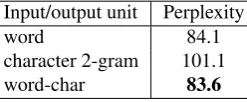
Input/output unit Perplexity
word 84.1
character 2-gram 101.1
word-char 83.6
Table 3: Test perplexities for models trained with differ-ent input/output units on Penn TreeBank. The ‘word-char’ model is one to which 9 characters starting from the end of the word have been added.
same hidden size, which has characters as input and output (and hence a different output vocabulary than the models in table 3), has a perplexity of 2.8.
6.2.
Interpolation weights
The toolkit can also be used to calculate interpolation weights between different neural LMs and/or n-gram LMs. As an example, we generate a debugging file for the val-idation set of PTB with our pre-trained LSTM LM. If we generate a debugging file for a 5-gram LM with inter-polated modified Kneser-Ney smoothing with the SRILM toolkit, we can automatically define the optimal interpola-tion weights on the validainterpola-tion set, which are 0.24 for the n-gram model and 0.76 for the LSTM model. These weights can subsequently be used in applications such as N-best rescoring. The perplexity of the interpolated model (see table 4) has improved 8% with respect to the LSTM LM alone.
Model Valid Perplexity Test Perplexity
5-gram 155.1 147.9
LSTM 107.5 102.4
interpolation 98.6 94.7
Table 4: Validation and test perplexities for a 5-gram LM, an LSTM LM and their interpolation on PTB.
6.3.
Predicting next word(s)
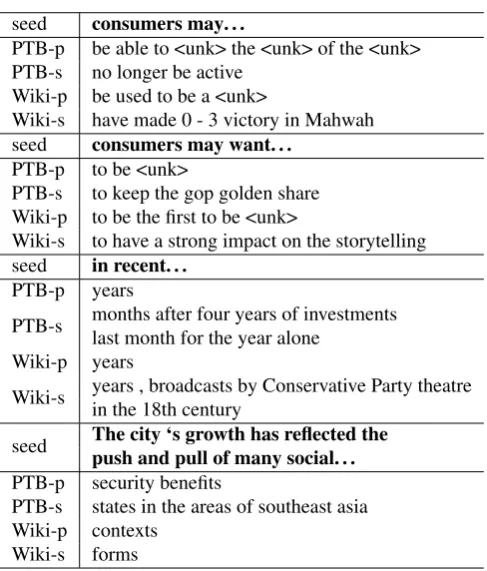
In table 5, we show some examples of generating text with trained LMs. We show the difference between gen-erating text with a model trained on PTB or on WikiText, and between generating the most likely word at every time step (‘-p’) or sampling based on a multinomial distribution (‘-s’). Since the class of unknown words is treated as a word itself, unknown words can in principle be predicted too, but in the case of sampling from the multinomial dis-tribution, we sample another word is the unknown word has been chosen. We observe that sampling from the multino-mial distribution, hence not always choosing the most prob-able word, results in sequences that are more ‘free’ in the sense that they are often longer and contain less frequent words.
6.4.
Rescoring
The rescoring option can be used to assign log probabilities to a list of sentences with a trained LM. For example, in ta-ble 6 we show some results after rescoring the 100-best lists from the DARPA WSJ’92 and WSJ’93 data sets, used by among others (Xu et al., 2009) and (Filimonov and Harper, 2009). The LM used for rescoring is the pre-trained PTB LM. Note that these log probabilities should be scaled by the number of words in the sentence (with aword insertion penalty) to properly compare them, since hypotheses with more words get a lower probability as more log probabili-ties are added. Compare for example the log probability for he made a sales goal he says(-31.997), and for the exact same sentence but with an extra word at the end,he made a sales goal he says it(-35.9978).
seed consumers may. . .
PTB-p be able to <unk> the <unk> of the <unk> PTB-s no longer be active
Wiki-p be used to be a <unk>
Wiki-s have made 0 - 3 victory in Mahwah seed consumers may want. . .
PTB-p to be <unk>
PTB-s to keep the gop golden share Wiki-p to be the first to be <unk>
Wiki-s to have a strong impact on the storytelling seed in recent. . .
PTB-p years
PTB-s months after four years of investments last month for the year alone
Wiki-p years
Wiki-s years , broadcasts by Conservative Party theatre in the 18th century
seed The city ‘s growth has reflected the push and pull of many social. . . PTB-p security benefits
PTB-s states in the areas of southeast asia Wiki-p contexts
Wiki-s forms
Table 5: Results of predicting the most probable sequence (‘-p’) or sampling based on a multinomial distribution (‘-s’) with the pre-trained PTB and Wiki models given several seeds extracted from the validation data from PTB and Wiki.
Hypothesis Log prob
he made a sales goal he says -31.9997 he made a sales coal he says -32.0020 he made a sales goal he sets -32.0021 he made a sales call he says -32.0053 he made its sales goal he says -32.0184 he made its sales coal he says -32.0221 he made its sales call he says 32.0255 he made as sales goal he says -32.0304 he made as sales coal he says -32.0331 he made as sales call he says -32.0360 he made it sails call he says -32.0619 he may to a sales goal he says -35.9857 he made a sales goal he says it -35.9978 he made a sale of coal he says -35.9994 he made a sales to call he says -36.0034 he made a sales call he says it -36.0043 he made a sale to call he says -36.0083
Table 6: Sorted log probabilities for part of the WSJ N-best list development set, assigned by a model trained on PTB.
7.
Conclusion
8.
Acknowledgements
This research is funded by the Flemish government agency IWT project 130041, SCATE.
9.
Bibliographical References
Abadi, M., Agarwal, A., Barham, P., Brevdo, E., Chen, Z., Citro, C., Corrado, G. S., Davis, A., Dean, J., Devin, M., Ghemawat, S., Goodfellow, I., Andrew Harp, G. I., Isard, M., Jozefowicz, R., Jia, Y., Kaiser, L., Kudlur, M., Levenberg, J., Mané, D., Schuster, M., Monga, R., Moore, S., Murray, D., Olah, C., Shlens, J., Steiner, B., Sutskever, I., Talwar, K., Tucker, P., Vanhoucke, V., Va-sudevan, V., Viégas, F., Vinyals, O., Warden, P., Wat-tenberg, M., Wicke, M., Yu, Y., and Zheng., X. (2015). Tensorflow: Large-scale machine learning on heteroge-neous systems.Software available from tensorflow.org. Chelba, C., Norouzi, M., and Bengio, S. (2017). N-gram
language modeling using recurrent neural network esti-mation. Technical report, Google.
Chen, S. F. and Goodman, J. (1999). An empirical study of smoothing techniques for language modeling. Computer Speech and Language, 17:359–394.
Chollet, F. (2015). Keras. https://github.com/ fchollet/keras.
Collobert, R., Kavukcuoglu, K., and Farabet, C. (2011). Torch7: A matlab-like environment for machine learn-ing. InBigLearn, NIPS Workshop.
Enarvi, S. and Kurimo, M. (2016). TheanoLM – An Exten-sible Toolkit for Neural Network Language Modeling. In Proceedings Interspeech, pages 3052–3056.
Filimonov, D. and Harper, M. (2009). A joint language model with fine-grain syntactic tags. In Proceedings Conference on Empirical Methods in Natural Language Processing (EMNLP).
Grave, E., Joulin, A., and Usunier, N. (2017). Improving neural language models with a continuous cache. In Pro-ceedings International Conference on Learning Repre-sentations (ICLR).
Hochreiter, S. and Schmidhuber, J. (1997). Long short-term memory.Neural Computation, 9(8):1735–1780. Jia, Y., Shelhamer, E., Donahue, J., Karayev, S., Long, J.,
Girshick, R., Guadarrama, S., and Darrell, T. (2014). Caffe: Convolutional architecture for fast feature embed-ding. arXiv preprint arXiv:1408.5093.
Jozefowicz, R., Zaremba, W., and Sutskever, I. (2015). An Empirical Exploration of Recurrent Network Architec-tures. InProceedings of the 32nd International Confer-ence on Machine Learning (ICML), pages 2342–2350. Kim, S. (2017). word-rnn-tensorflow. https://
github.com/hunkim/word-rnn-tensorflow. Marcus, M. P., Marcinkiewicz, M. A., and Santorini, B. (1993). Building a Large Annotated Corpus of English: the Penn Treebank. Computational Linguistics, 19:313– 330.
Merity, S., Xiong, C., Bradbury, J., and Socher, R. (2016). Pointer sentinel mixture models. arXiv preprint arXiv:1609.07843.
Mikolov, T., Karafiát, M., Burget, L., ˘Cernocký, J., and Khudanpur, S. (2010). Recurrent neural network based
language model. In Proceedings Interspeech, pages 1045–1048.
Mikolov, T., Kombrink, S., Deoras, A., Burget, L., and ˇ Cer-nocký, J. (2014). RNNLM - recurrent neural network language modeling toolkit. InProceedings Interspeech, pages 2093–2097.
Oostdijk, N. (2000). The Spoken Dutch Corpus. Overview and first Evaluation. In Proceedings Language Re-sources and Evaluation Conference (LREC), pages 887– 894.
Ozair, S. (2017). char-rnn-tensorflow.
https://github.com/sherjilozair/ char-rnn-tensorflow.
Pelemans, J., Shazeer, N., and Chelba, C. (2016). Sparse non-negative matrix language modeling. Transactions of the Association for Computational Linguistics, 4:329– 342.
Schwenk, H. (2013). CSLM – a modular open-source con-tinuous space language modeling toolkit. InProceedings Interspeech, pages 1198–1202.
Stolcke, A. (2002). SRILM an extensible language mod-eling toolkit. In Proceedings International Conference Spoken Language Processing, pages 901–904.
Sundermeyer, M., Schlüter, R., and Ney, H. (2012). LSTM Neural Networks for Language Modeling. In Proceed-ings Interspeech, pages 1724–1734.
Sundermeyer, M., Schlüter, R., and Ney, H. (2014). rwthlm – The RWTH Aachen University Neural Net-work Language Modeling Toolkit. InProceedings Inter-speech, pages 2093–2097.
TensorFlow. (2017). Recurrent neural networks. https://www.tensorflow.org/tutorials/ recurrent.
Theano Development Team. (2016). Theano: A Python framework for fast computation of mathematical expres-sions. arXiv preprint arXiv:1605.02688.
Verwimp, L., Desplanques, B., Demuynck, K., Pelemans, J., Lycke, M., and Wambacq, P. (2016). STON: Effi-cient subtitling in Dutch using state-of-the-art tools. In Proceedings Interspeech, pages 780–781.
Verwimp, L., Pelemans, J., Lycke, M., Van hamme, H., and Wambacq, P. (2017a). Language Models of Spoken Dutch. arXiv preprint arXiv:1709.03759.
Verwimp, L., Pelemans, J., Van hamme, H., and Wambacq, P. (2017b). Character-Word LSTM Language Models. InProceedings of the European Chapter of the Associa-tion for ComputaAssocia-tional Linguistics (EACL), pages 417– 427.