Available online at www.ijrat.org
21
Usage of BlockChain-based Provenance Enabled
Technology to Process and Track Land Transactions
C.Sravani
1, G Murali
2 1M.Tech Student, 2Assistant Professor 1, 2 Dept Of Computer Science And Engineering,
1,2Jntua College Of Engineering, Pulivendula-516390, Andhra Pradesh, India)
[email protected],Mobile:7382311481
Abstract: Blockchain is the technology that has attracted enormous interest recently as it provides security and privacy through immutable distributed ledger. It is the backbone of the most popular cryptocurrency, bitcoin. Due to its robust consensus mechanism and tamper proof data storage, it is getting widely adopted in the applications where trust is given utmost importance.Data provenance, the ability to trace back the origin history by maintaining a chronological sequence of events, helps in auditing the records. With the current paper-based land registration process, it is very difficult to detect fraud and it is time consuming too as collaboration of multiple parties is required. It is very easy to tamper the documents and change the ownership of the properties. In this paper we propose how this blockchain technology can be used to build Reliable, tamper-proof and efficient land registration system and having provenance as a key differentiator which will improve the trust of land owners on the governance system. Permissioned blockchain can be used to have restricted access to the pariticipants and only specific nodes in the blockchain network can be allowed to participate in the consensus mechanism. This will also improve performance of the network and helps in faster addition of blocks the chain.
Keywords- Security, Blockchain, Privacy, Provenance, Permissioned Blockchain, Data integrity, Immutability.
1. INTRODUCTION
As per the World Bank Group’s 2016 statistics, 70% of the world’s population do not have proper digital access to the land records. Majority of registration records maintained by Government systems are not digitized and are still using hard copies of the documents. This can lead to forgery of documents and ownership of land can be changed without the consent of the actual owner. This can become a huge problem if the officials who handles the records are corrupt. Even if the records are digitized and stored in a centralized database, there is a possibility of database getting hacked and data may get compromised. With Blockchain's high security features and data immutability, land records can be secured and property rights cannot be easily tampered. With digitization of land records, Governments can also reduce the expenditure on human resources and improve efficiency.
Many Government departments are involved in land transactions and proper communication and coordination channels should be established
between them. Otherwise it may lead to delayed information, data tampering, data loss etc. Since blockchain is a distributed ledger and each department has its own copy of the ledger, collaboration is made easy and they can function efficiently. Provenance of land transactions can also be easily achieved with data stored in an immutabledistributedledger. . Usage of blockchain technology in land registration has many advantages. Security and immutability which are the main features of blockchain will help in creating a registration system that is tamper-proof and immutable which will reduce the scope for forgery and manipulation tremendously. Also as land registration involves multiple stakeholders, having a unified platform for all the operations and transactions will improve efficiency of the system and reduce inaccuracies that are common in a typical land registration process. Furthermore blockchain could help automate the process of registration through the use of smart contracts disintermediating human beings that are vulnerable to falling prey to corrupt practices.
In the proposed solution, we are using a provenance enabled permissioned blockchain based architecture that provides the security and privacy of the records.A blockchain-based provenance enabled land registry solution has the following benefits: It secures the entire registry system, since the records once registered cannot be modified.It improves the validation and verification of recordsby giving real time access to the data.By
acting as an instantaneous notary service, it reduces the costs of property rights registration.
2. BACKGROUND WORK
Available online at www.ijrat.org
22
block in the blockchain is called genesis block. When an user submits a transaction to the network, a one-way hash is generated using SHA(Secure Hashing Algorithm) for the transaction and it is stored inside the transaction. This hashing of transaction data is the key to keeping the transactions secure and immutable. A merkle tree is created with these hashes which maintains the order of the transactions that are added to the block. when certain number of transactions are added to the block, a consensus mechanism will be initiated. After validating the block, it will be added to the chain and previous block’s hash is also added to the current block. Since the current block also contains the previous block’s hash, if some intruder or hacker tries to change the data inside the transactions, he should also change the hash of the transaction and the merkel root of the block. Doing this for all the blocks is very difficult and time consuming process. So once the data is stored in the blockchain, it is immutable and cannot be modified.This data immutability simplifies the
determination of data provenance as the
participants are sure that the data has not been tampered with.
Consensus is a mechanism by which the blockchain network verifies and validates the transactions before adding them to the chain. Based on the type of consensus mechanism used, the blockchain can be categorised into Public blockchain and Private Blockchain. In Public blockchain, any participant node can validate and add transactions. Popular example for this is Bitcoin. In Private blockchain, only certain nodes are given permission to validate the transactions. These nodes have to be authenticated and authorized before performing the validation. This is mostly used in enterprise applications which are not open for public. The private blockchain is also called permissioned blockchain as the nodes should have required permissions to participate in the consensus
mechanism. Both public and permissioned
blockchains are distributed, peer-to-peer,
decentralized, and have immutable ledgers. However in public blockchains every node
participates in the consensus mechanism and as a result of this more computation power is required when compared to the private blockchain. There are four consensus algorithms that are commonly used in the blockchain. They are 1.Practical
Byzantine Fault Tolerant(PBFT) Algorithm,
2.Proof of work(POW), 3.Proof of stake(POS), 4.delegated proof of stake(DOPS). Apart from this well known consensus protocols, some blockchain implementations can have there own custom consensus mechanisms.
Blockchain has many business benefits.
Transaction costs can be lowered by using blockchain as it acts as a trusted intermediary in managing transactions involving assets. As the data is immutable and cannot be modified once it is added to the chain, it can be used to track the history of assets such as tracking the shipments, finding the origin of valued artifacts, maintaining the records for auditing.
Smart contracts that can be built into blockchain
technology are self-enforcing rules that
automatically execute on predefined events or conditions, saving users the hassle of resorting to legal measures.They are also called digital contracts, self-executing contracts or blockchain contracts. The reason for calling them smart contracts is thatthe executable code snippets can also be stored apart from storing the blocks of data within blockchain transactions. For example, let’s say a smart contract is written as executable code in the blockchain. the participants involved cannot be known by others, but the contract is stored in the public ledger. This smart contract can be written in such a way that it has to be executed when certain criteria such as time/date has occurred. The contract will be automatically executed when a triggering event is occurred.
Bitcoin is one of the applications that uses Blockchain as its underlying technology. They are many open source frameworks that implement and deploy blockchain solutions. Of them most popular
are Hyperledger fabric, Ethereum, QTUM,
MultiChain, Cardono and NEO.
3. RELATED WORK
In the proposed solution, since the Land transaction happens between two identified individuals and it has to be monitored by a Government agency, permissioned blockchain has to be used. Only Participants with appropriate permissions can perform specific transactions and can be allowed to participate in consensus mechanism. A land transaction involves transfer of ownership of the land from one individual to another. Many parties are involved in this process such as seller, buyer,
registrar, Banks, revenue department etc. And each of these parties may have their own set of smart contracts that needs to be executed when certain criteria is met.
Current Land Registration Process:
Available online at www.ijrat.org
23
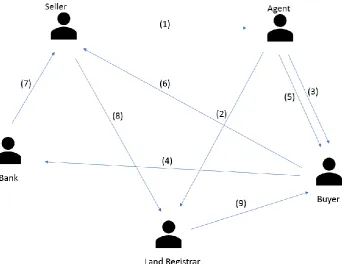
3. The land is kept for sale by providing advertises and providing best offers on price of land
4. The buyer can check the land and has a property evaluation by a bank on buyer and issue loan from a bank.
5. The agent also verifies the buyer details before signing a final contract.
6. The buyer must pay a down payment to the seller.The seller must pay some amount to the agent for selling the property.
7. Loan approved from bank the amount directly transferred to the sellers account.
8. Buyers settlement agent submits the loan documents to the government authority for issuing Certificate of Ownership.
9. Registrar will check all the documents and issue the Ownership Certificate.
[image:3.595.124.469.223.487.2]Fig 1 below illustrates the above land registration process.
Fig 1 : Current land registration process
Challenges in present Land Registration: 1. Ownership Verification is the main challenge faced in registration process. Authorities has to verify many documents and owner has to provide many identify proofs to prove his ownership. 2. Transaction history is not stored properly and so Ownership History does not exists on many properties.If history exists on properties then trust will increase for buyers to purchase a property. 3. As ownership verification is a difficult process, unauthorized selling of properties can take place
causing loss and mental agony to actual owners of the property..
4.Transfer of ownership is a time consuming process as the records are paper-based and finding the records can take lot of time.
5.Detecting scams and fraud is very difficult in the current paper based registry. Even if the records are digitalized and stored in a central repository, it is a single point of failure and possibility of records getting modified is more.
Blockchain registration Process:
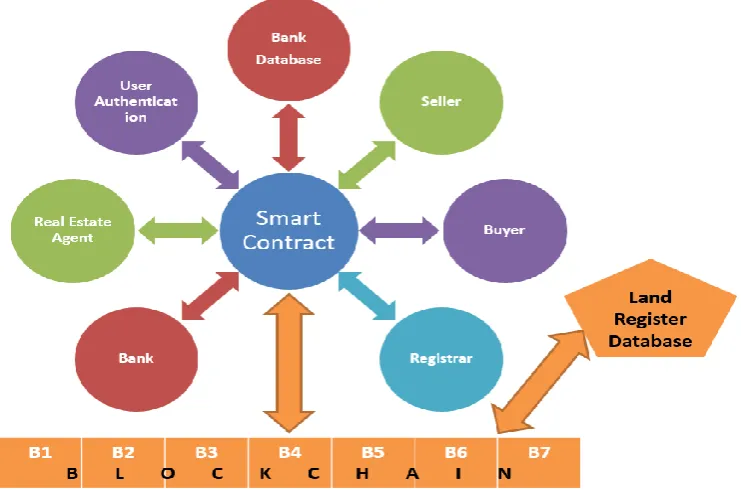
1.Seller login to the blockchain web application to verify the identity details and land details.
2.Seller contacts real estate agent through web application for selling the land and signed the contract between the seller and agent.
3.Agent checks the land documents and ownership verification through web application.
4.Registered seller add property cost to the blockchain for the bank to approve and check saving time.
5.The bank and agent can correctly fetch the information from the blockchain.Land inspection reports attached to the web application.
Available online at www.ijrat.org
24
information in the blockchain.Authorized users can access the contract.
7.The loan agreement is uploaded by bank on the web application and digitally signs it and only buyer can access it.
8.The buyer signs the digital document and bank process the down payment to the agent via the web application.
9.Buyer after inspecting the details updates and approves the contract. Agent after deducting the fees pays the deposit to the seller.
10.Sale contract is digitally executed using smart contract. The Blockchain is updated with the bank transactions. The executed contract is available in the web application for all the authorized parties to see.
11.The Certificate of Ownership request along with the required documents are available in the
web/app. The government authority can verify the status and issue the Certificate of Ownership. 12.Stamp duty and other charges/taxes are calculated automatically in the web/app. Settlement agent makes the payment online. The Certificate of Ownership is created and registered on the blockchain.
Fig 2 illustrates the blockchain enabled land registration process.
Eliminates delays with Blockchain:
1. Processing time is reduced. 2. Paperwork is eliminated.
3. Reduce corruption through blockchain.
4. Fraud can be prevented from unauthorized sale of property .
[image:4.595.124.495.292.537.2]5. Secured tranfer of ownership of the properties.
Fig 2: Blockchain enabled Land registration process
Provenance
As all the transactions and land records are stored in the blockchain, one can revisit the chain and see what happened when and can easily track the history of the land registrations. For example if the buyer wants to find the history of the transactions that are done with a piece of land that he is willing to purchase, he can query the blockchain, verify the land title and check from whom the land ownership
has been transferred from the beginning.
Additionally as the data is stored in a distributed ledger, the transaction and land record details are available to all the parties involved in the process and thereby reducing the errors in communication and increasing the efficiency of the overall process. It also improves the trust of the seller and buyer, as
the data that is stored in blockchain is tamper-proof.
Hyperledger
Hyperledger is an open source implementation of blockchain technology. It is supported by The Linux Foundation. It has many sub projects such as Hyperledger Fabric and Hyperledger composer.
Unlike Bitcoin and other Blockchain
implementations, there is no crypto-currency involved it hyperledger. It is mostly used for
permissioned blockchain and consensus
Available online at www.ijrat.org
25
Hyperledger composer to build the provenance enabled Land registration system.
4. CONCLUSION AND FUTURE WORK
In this paper,we are presenting a reliable and secure land registration web application with blockchain, data provenance and deployed on the Hyperledger Fabric using the Hyperledger Composer.Using
blockchain the records are secure and
unaltered.Provenance can provide history of the property and it is powerful in preventing fraud transactions.For future work , InterPlanetary file sharing can be implemented to store and retrieve the documents to reduce the size of database and computational time.
REFERENCES
[1]Tosh, D. K., Shetty, S., Liang, X., Kamhoua, C., & Njilla, L. (2017). Consensus protocols for blockchain-based data provenance: Challenges and opportunities. 2017 IEEE 8th Annual Ubiquitous
Computing, Electronics and Mobile
Communication Conference (UEMCON). [2]http://www.indiaenvironmentportal.org.in/files/f ile/Blockchain_Applications_and_SDGs_IGES_20 18.pdf
[3]https://dzone.com/articles/a-blockchain-solution-for-data-provenance-using-hy
[4]http://ficci.in/spdocument/22934/Blockchain.pdf [5]https://www2.deloitte.com/content/dam/Deloitte /us/Documents/financial-services/us-fsi-rec-blockchain-in-commercial-real-estate.pdf
[6]http://drops.dagstuhl.de/opus/volltexte/2018/934 6/pdf/LIPIcs-GISCIENCE-2018-18.pdf
[7]http://ica-it.org/pdf/Blockchain_Landregistry_Report.pdf
[8]https://www.elra.eu/wp- content/uploads/2017/02/10.-Jacques-Vos-Blockchain-based-Land-Registry.pdf
[9]https://committee.iso.org/files/live/users/fh/aj/aj/ tc211contributor%40iso.org/files/ISO%20TC%202 11%2044th%20meeting_Wednesday%20seminar% 20presentations/Blockchain%20for%20real%20est ate%20and%20other%20use%20cases_Magnus%2 0Kempe.pdf