A Constraint-Based Approach for
Cooperative Information-Seeking Dialogue
Yan Qu
Clairvoyance Corporation
5001 Baum Boulevard, Suite 700
Pittsburgh, PA 15213
[email protected]
Nancy Green
Department of Mathematical Sciences
University of North Carolina at Greensboro
Greensboro, NC 27402
[email protected]
Abstract
We present a dialogue generation model, implemented in the COMIX prototype in-formation system, which uses a Con-straint-Based Problem-Solver (CBPS) to support cooperative mixed-initiative in-formation-seeking dialogue. Use of the CBPS enables a dialogue system to 1) in-crementally interleave query construction with solution construction 2) immediately detect under-constrained and over-constrained information requests, and 3) provide cooperative responses when these types of problems are detected. We also present a system evaluation investigating how well COMIX handles dialogues with over-constrained requests.
1 Introduction
Many existing dialogue systems adopt a two-phase approach to satisfying a user's request for informa-tion: query construction followed by solution con-struction and presentation, with the former concerned with the acquisition of the preferences and restrictions in a user's information needs, and the latter concerned with presenting solutions that satisfy those needs (e.g., Abella, et al., 1996; Lit-man, et al., 1998; Chu-Carroll, 2000). When we look at human-human information-seeking dia-logues, however, we observe that a two-phase ap-proach can lead to problems such as delayed identification of over-constrained problems (see example below).
A1: ok what flights do you want to have him on?
C2: ok he would like to be on United flight one one one seven
A3: first of all he's going all the way through to Copenhagen?
C4: oh, that's right
A5: and this is a connection in what city? C6: ah Los Angeles
A7: and what time does that United flight leave? C8: it's ah going out at uh two o'clock today, SFO to Los Angeles
A9: and then connecting to SAS flight nine thirty two?
C10: nine thirty two that's right
A11: actually the eleven seventeen I'm showing sold out
In this dialogue between a travel agent (A) and a customer (C) (SRI transcripts, 1992), the over-constraining attribute-value pair – flight United 1117 – occurred in turn C2, but was not detected until turn A11. Instead, the travel agent continues to collect more constraints to complete the infor-mation need specification only to find during the solution phase that the problem is over-constrained. Worse yet, if the human agent or in-formation system cannot offer the user informed assistance, such as suggesting which constraint(s) to relax when an over-constrained situation is fi-nally detected, the user is forced to adopt an ineffi-cient trial-and-error strategy of selecting constraints to relax.
construction 2) immediately detect under-constrained and over-under-constrained information re-quests, and 3) provide cooperative responses when these types of problems are detected. The model has been implemented in COMIX, a prototype sys-tem for providing airline flight information. In ad-dition, we present a system evaluation designed to evaluate COMIX's performance when users make over-constrained requests.
2 Related
Work
Cooperative and efficient dialogue between a user and information system has been an important goal in dialogue systems research for many years. Early work on cooperative response generation ad-dressed how to generate responses explaining the reason for natural language query failures (Kaplan, 1979; Di Eugenio, 1987). However, those systems processed and responded to each query in isolation. Subsequent work addressed understanding the user's query in the context of the preceding dis-course (Carbonell, 1983) and inferred plans (e.g., Allen and Perrault, 1980; Carberry, 1990). Raskutti and Zukerman (1997) describe a plan-based ap-proach that integrates understanding the user's in-tentions with generating queries for clarification and generating responses to under-constrained and over-constrained requests. Their system does not use a constraint-based problem solver and does not provide access to data in a standard commercial database system.
Research on mixed-initiative dialogue has in-vestigated techniques for deciding when a dialogue system should take initiative and techniques for content planning (e.g., see papers in Haller, Kobsa, and McRoy, 1999). Following Chu-Carroll and Brown (1999), we distinguish dialogue initiative from task initiative (i.e., taking the lead in prob-lem-solving). In this view, a dialogue participant may take both types of initiative, dialogue initia-tive only, or neither. Preliminary studies suggest that human-computer dialogue is more efficient when a system dynamically allocates control of task initiative (Smith and Gordon, 1997). In COMIX, task initiative is exercised in asking for additional constraints when the user’s request is under-constrained, or in suggesting constraints to relax when the request is over-constrained.
However, none of the above research has made use of a CBPS as a knowledge source for
generat-ing the system's contributions. Previous dialogue systems research involving constraint satisfaction models includes Jordan and Di Eugenio's (1997) analysis of cooperative problem-solving dialogue as a constraint satisfaction problem. However, they did not use the model to generate system re-sponses. Donaldson and Cohen (1997) propose a constraint-based model to manage a system's turn taking goals, but not as a knowledge source for helping to meet a user's information needs.
3 Dialogue Generation Model of COMIX
In this section, we present our dialogue generation model as implemented in COMIX. First, we briefly describe the application domain and provide an example of user interaction with a version of COMIX (COMIX-MI) implemented for the system evaluation to be described in section 4. Then we present the COMIX system architecture and briefly describe the CBPS. Finally, we describe how the dialogue manager uses information provided by the CBPS to take initiative and to select dialogue ac-tions.
3.1
COMIX application domain and COMIX-MIinforma-tion provided by the CBPS, COMIX-MI takes the task initiative and suggests constraints to relax.
For example, the user interface of COMIX-MI is shown in Figure 1. The user has supplied values for attributes departure city, arrival city and depar-ture time with preference strengths. Because the user's specification is over-constrained, COMIX-MI takes the task initiative to suggest which con-straint to relax, as shown in Figure 2. It should be noted that the form-based user interface does not demonstrate all of the capabilities of COMIX de-scribed in this paper (such as providing sugges-tions for restricting under-constrained requests). Extensive simulation experiments to evaluate many of the capabilities of COMIX's dialogue generation model are described in (Qu, 2001).
3.2
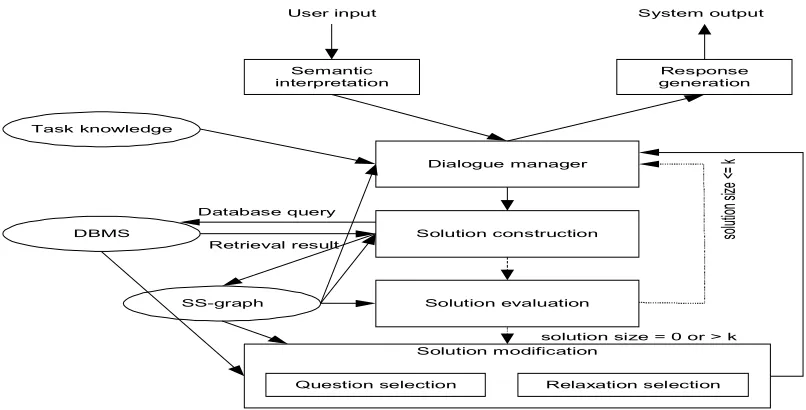
COMIX architectureFigure 3 shows the COMIX information system architecture. A user's input is first translated, e.g., from spoken or form-based input, into a semantic representation. The dialogue manager translates the semantic representation into constraints that are sent to the CBPS. (A constraint consists of an at-tribute-value pair and its preference strength rang-ing on a five-unit scale from Required to Weak). Also, the dialogue manager determines when it is licensed to take dialogue and task initiative and what dialogue action to perform. After a dialogue action has been selected, it is realized by the sur-face response generator; e.g., in COMIX-MI, the action to inform the user of the results of a success-ful query is realized as a results form.
Constraint-based problem solver
As shown in Figure 3, the CBPS has three sub-components, labeled Solution Construction, Solu-tion EvaluaSolu-tion, and Solution Modification, and maintains a solution synthesis graph (SS-graph). Nodes of the SS-graph represent subsets of user constraints and database tuples satisfying them. The Solution Construction module of the CBPS incrementally constructs and updates the SS-graph as user constraints are passed to it from the dia-logue manager. Solution Construction queries the database (labeled DBMS in Figure 3) to obtain tu-ples satisfying the user's constraints. Solution Evaluation uses the current number of tuples satis-fying the constraints in the SS-graph to determine if (1) a satisfactory solution has been found or (2)
the problem is currently over-constrained or under-constrained. In case (2), Solution Modification uses the SS-graph and database domain constraints to identify relaxation or restriction candidates for over-constrained or under-constrained queries, re-spectively. Various solution modification heuris-tics have been evaluated through simulation experiments (Qu, 2001). For example, for over-constrained queries, Qu found that one effective heuristic is to identify constraints with weaker preference strengths that result in an empty solu-tion set. COMIX has adopted this heuristic; thus, the system is able to suggest relaxation of the con-straints that resulted in an over-constrained request but are less important to the user.
The solution set from the SS-graph and the re-laxation or restriction candidates from Solution Modification are passed to the Dialogue Manager. The Dialogue Manager uses this information to select cooperative dialogue actions for resolving under-constrained or over-constrained situations as soon as they are detected. The cycle of interacting with the user to add or modify constraints can be repeated until a satisfactory solution is found. De-tails about the CBPS are presented in (Qu and Beale, 1999) and details about interaction with the database management system are given in (Qu, 2001).
Dialogue generation
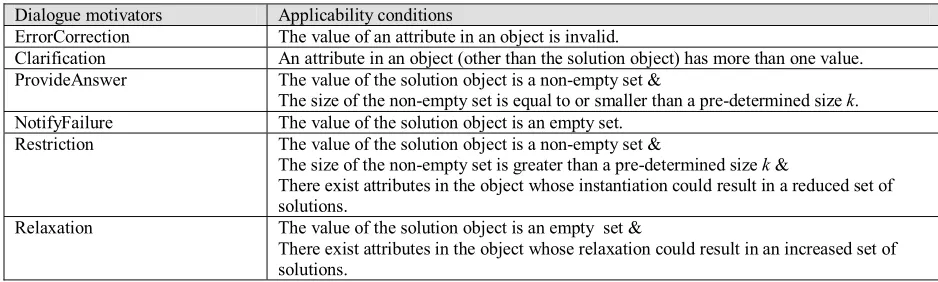
COMIX extends the approach described in (Abella and Gorin, 1999) where a collection of dialogue motivators is iteratively tested and, whenever the test for a motivator succeeds, the motivator's asso-ciated dialogue action is performed. In COMIX, a dialogue motivator's test, or applicability condi-tions, may refer to information from the CBPS. Whereas in Abella and Gorin's approach, a motiva-tor is associated with one action, in COMIX a mo-tivator can be realized through one of several alternative dialogue actions; selection of the action depends upon information from the CBPS. When-ever at least one motivator applies, COMIX takes dialogue initiative.
the current specification of the user's information need is over-constrained (i.e., the solution set is empty) and relaxation of certain attributes could result in a non-empty solution set, while Restric-tion applies when the specificaRestric-tion is under-constrained. In the form-based interfaces to COMIX used in the system evaluation, all motiva-tors are tested in the order shown in Table 1 imme-diately after the user fills in a field in the query form. This order insures, e.g., that ambiguity (Clarification) is addressed before the system computes the results of the query (ProvideAn-swer).
Table 2 presents the dialogue actions available to the dialogue manager for each motivator. Note that the dialogue actions associated with the Re-striction and Relaxation motivators are performed only when the system is allowed to take task initia-tive in addition to dialogue initiainitia-tive. In COMIX-MI, the system is allowed to take task initiative whenever one of these two motivators applies. For the Restriction and Relaxation motivators, a sys-tem allowed to take both task and dialogue initia-tive must decide among several actions. The choice is based upon information from the CBPS. For ex-ample, when Relaxation has been invoked and COMIX-MI must choose between ProposeNew-Val (i.e., suggesting a relaxation candidate) and ProposeNewVal&Answer (i.e., providing a pro-posed relaxation candidate along with the resulting solution set of adopting the proposal), the latter action is preferred to the former when the resulting solution set would be small enough. Once a dia-logue action has been selected, it is realized by the response generator, e.g., as form-based output in COMIX-MI.
4 System
Evaluation
The purpose of the system evaluation is to evaluate whether the task initiative-taking actions enabled by the CBPS improve usability for over-constrained requests. We compare dialogues col-lected for two different task initiative settings through two versions of COMIX: COMIX-MI vs. COMIX-UI. COMIX-UI ("User Initiative"), is a version of COMIX with a form-based interface similar to the interface of COMIX-MI. The crucial difference between these two versions of COMIX is that COMIX-UI is never allowed to take task initiative while, as described in the preceding
sec-tion, COMIX-MI is whenever certain motivators apply.
Initially, eight users were given flight reserva-tion tasks that required them to access the airline schedule database described earlier. (The informa-tion needed to complete a task is referred to below as the user's original information need.) Each user participated in three sessions: a training session and two evaluation sessions, one with COMIX-MI and another with COMIX-UI. The order of work-ing with COMIX-MI and COMIX-UI was varied to neutralize sequencing/learning effects. These eight users were each asked to solve four one-way trip tasks (two under-constrained and two over-constrained) and four round-trip tasks (again two under-constrained and two over-constrained). The users performed four tasks at each of the two evaluation sessions, i.e., the tasks were evenly dis-tributed between the sessions with COMIX-UI and COMIX-MI. Due to the observed differences in the results for one-way and round-trip tasks, we re-cruited an additional eight users and repeated the above experiment for the four round-trip tasks only.
Data were collected in two ways: dialogue logs and user survey data. The system logged the total completion time of a dialogue (Total Completion Time), the user actions, the system actions, and the effect of these actions. From these logs, we com-pute the number of dialogue turns that the user takes (User Turns) and the number of dialogue turns the system takes (System Turns). Based on the user's recorded solution for each task, we calculate Kappa scores (Carletta, 1996) to measure the degree of task success (Task Success) with respect to the user’s original information need. The user surveys, which measure subjective evaluation of the system by the user, were collected through a post-task questionnaire. The post-task question-naire asks the user’s judgment of task success (User Task Success) and user satisfaction. User satisfaction was calculated for each task from the user’s response to a survey adapted from the ques-tionnaire used by Walker et al. (1997).
4.1
Task complexityFor the one-way trip tasks, sixteen dialogues were recorded for each setting. We observed no statisti-cally significant1 differences between the two
sys-tem settings for any of the performance measures. For the round-trip tasks, thirty-two dialogues were recorded for each setting. Table 3 summarizes the performance measures collected from the two sys-tem settings. COMIX-MI improves the dialogue efficiency measures by reducing the average total completion time by about 14%, the number of sys-tem turns by 35.2%, and the number of user turns by 49.6%. The improvements with these efficiency measures are statistically significant (p=0.032 for System Turns, p=0.020 for User Turns, and p=0.015 for Total Completion Time). Task Suc-cess scores increase from 0.843 by the COMIX-UI setting to 0.889 by the COMIX-MI setting (p=0.042). The differences between the scores for User Task Success and User Satisfaction, how-ever, are not significant.
To sum up, our experiments show that the sys-tem’s task initiative-taking actions result in better performance in terms of dialogue efficiency and the Task Success scores for the harder round-trip tasks. For the easier one-way trip tasks, no signifi-cant differences are observed across the perform-ance measures. User’s perception of task success (i.e., User Task Success) and usability (i.e., User Satisfaction) is comparable for both system set-tings regardless of the system’s task initiative-taking capability.
4.2
Over-constrained tasksWe further examined the effect of system initiative on the over-constrained tasks of the round-trip tasks. Sixteen dialogues were recorded for each setting.
Table 4 summarizes the performance measures collected from the two system settings. We ob-served that the COMIX-MI setting improves the dialogue efficiency measures by reducing the aver-age total completion time by 18.6%, the number of system turns by 48.5%, and the number of user turns by 63.6%. The improvements with these effi-ciency measures are statistically significant (p=0.031 for System Turns, p=0.016 for User
1 Statistical significance in this work is measured with the
paired sample t test, with the significance level at α<0.05.
Turns, and p=0.017 for Total Completion Time). A detailed analysis of the distributions of the num-bers of system turns and users turns for the over-constrained round-trip tasks shows that the distri-butions of system turns and user turns are less spread out for COMIX-MI, and that the distribu-tions of system turns and user turns are more spread out for COMIX-UI (Qu, 2001), which sug-gests that COMIX-UI is influenced to a greater degree by the variability in user’s ability to find relaxation solutions, while COMIX-MI evens out the variability of user’s problem-solving expertise by offering suggestions.
User satisfaction and the subjective task success scores (i.e., User Task Success) are very similar between COMIX-MI and COMIX-UI, as only one user gave up on one task. Task success as meas-ured by Kappa, however, increased significantly by 13.5% from 0.693 by the COMIX-UI setting to 0.787 by the COMIX-MI setting (p=0.035). As there is not much difference in the subjective User Task Success scores, it suggests that user’s per-ception of task completion/success is not always reliable, and does not correlate well with the objec-tive Task Success scores.
In summary, our experiments show that the bet-ter performance we have observed with COMIX-MI in terms of dialogue efficiency and the Kappa scores for the round-trip tasks are associated pri-marily with the over-constrained round-trip tasks, for which COMIX-MI had the opportunities to of-fer cooperative relaxation suggestions. COMIX-MI also helps to even out the variability in user’s abil-ity to find relaxation candidates. User’s perception of task success (i.e., User Task Success) and us-ability (i.e., User Satisfaction) is comparable for both system settings, but we have observed that user’s perception of task success is not always reli-able, and does not correlate well with the objective Task Success scores.
5 Conclusions and Future Work
select cooperative dialogue actions. Results from the system evaluation have demonstrated that gen-eration of cooperative dialogue action in over-constrained dialogue situations significantly im-proves dialogue efficiency and task success for more complex information seeking tasks such as round-trip flight reservation tasks. Possible future work includes performing a similar usability study for under-constrained requests, extending the ap-proach to other domains (e.g., finding a hotel, buy-ing a house or computer), and evaluatbuy-ing COMIX in spoken dialogue systems where noise from other system components such as the speech recognizer and parser may mitigate the effectiveness of COMIX.
References
Alicia Abella, Michael K. Brown, and Bruce Bunt-schuh. 1996. Development principles for dialogue-based interfaces. In Proceedings of ECAI’96 Work-shop on Dialogue Processing in Spoken Language Systems, pages 1-7.
Alicia Abella and Allen L. Gorin. 1999. Construct alge-bra: analytical dialog management. In Proceedings of the ACL’99, pages 191-199.
James F. Allen and C. Raymond Perrault, 1980. Analyz-ing intention in utterances. Artificial Intelligence, 15:143-178.
Jaime J. Carbonell. 1983. Discourse pragmatics and ellipsis resolution in task-oriented natural language interfaces. In Proceedings of the ACL’83, pages 164-168.
Sandra Carberry. 1990. Plan Recognition in Natural
Language Dialogue. ACL-MIT Press Series on
Natu-ral Language Processing. MIT Press, Cambridge, MA.
Jean C. Carletta. 1996. Accessing agreement on classifi-cation tasks: the kappa statistic. Computational Lin-guistics, 22(2):249-254.
Jennifer Chu-Carroll. 2000. MIMIC: An adaptive mixed initiative spoken dialogue system for information queries. In Proceedings of the 6th Conference on
Ap-plied Natural Language Processing, pages 97-104.
Jennifer Chu-Carroll and Michael K. Brown. 1999. An Evidential Model for Tracking Initiative in Collabo-rative Dialogue Interactions. In Susan Haller, Alfred Kobsa and Susan McRoy (eds).
Barbara Di Eugenio. 1987. Cooperative behavior in the FIDO system. Information Systems, 12(3):295-316.
Toby Donaldson and Robin Cohen. 1997. A constraint satisfaction framework for managing mixed-initiative discourse. In Technical Reports of AAAI-97 Spring Symposium on Computational Models for Mixed-Initiative Interaction.
Susan Haller, Alfred Kobsa and Susan McRoy (eds). 1999. Computational Models of Mixed-Initiative In-teraction. Kluwer Academic Press, Dordrecht. Pamela W. Jordan and Barbara Di Eugenio. 1997.
Con-trol and initiative in collaborative problem solving dialogues. In Technical Reports of AAAI-97 Spring Symposium on Computational Models for Mixed-Initiative Interaction.
Samuel Jerrold Kaplan. 1979. Cooperative Responses from a Portable Natural Language Data Query Sys-tem. Ph.D. thesis, School of Computer and Informa-tion Science, University of Pennsylvania.
Diane J. Litman, Shimei Pan, and Marilyn A. Walker. 1998. Evaluating response strategies in a web-based spoken dialogue agent. In Proceedings of
ACL/COLING’98: 36th Annual Meeting of the
Asso-ciation of Computational Linguistics, pages 780-786. Bhavani Raskutti and Ingrid Zukerman. 1997. Generat-ing Queries and Replies durGenerat-ing Information-seekGenerat-ing Interactions. International Journal of Human Com-puter Studies, 47(6): 689-734.
Ronnie Smith and Steven Gordon. Effects of Variable Initiative on Linguistic Behavior in Human-Computer Spoken Natural Language Dialogue. Com-putational Linguistics, 23(1): 141-168.
Yan Qu. 2001. A Constraint-Based Model of Mixed-Initiative Dialogue in Information-Seeking
Interac-tions. Ph.D. thesis, School of Computer Science,
Carnegie Mellon University.
Yan Qu and Steve Beale. 1999. A constraint-based model for cooperative response generation in infor-mation dialogues. In Proceedings of AAAI-99, pages 148-155.
SRI Transcripts. 1992. Transcripts derived from audio-tape conversations made at SRI International, Menlo Park, CA. Prepared by Jacqueline Kowtko under the direction of Patti Price.
Marilyn A. Walker, Diane Litman, Candace Kamn, and Alicia Abella. 1997. PARADISE: A general frame-work for evaluating spoken dialogue agents. In
Pro-ceedings of the 35th Annual Meeting of the
Figure 1: Flight query form in COMIX-MI.
Figure 2: System response form for over-constrained queries in COMIX-MI.
Dialogue manager
Solution evaluation Semantic
interpretation generationResponse
Solution modification
Question selection Relaxation selection
User input System output
Task knowledge
DBMS
SS-graph
Solution construction Database query
Retrieval result
solution size = 0 or > k
so
lut
ion
size
<=
k
Dialogue motivators Applicability conditions
ErrorCorrection The value of an attribute in an object is invalid.
Clarification An attribute in an object (other than the solution object) has more than one value.
ProvideAnswer The value of the solution object is a non-empty set &
The size of the non-empty set is equal to or smaller than a pre-determined size k.
NotifyFailure The value of the solution object is an empty set.
Restriction The value of the solution object is a non-empty set &
The size of the non-empty set is greater than a pre-determined size k &
There exist attributes in the object whose instantiation could result in a reduced set of solutions.
Relaxation The value of the solution object is an empty set&
[image:8.612.70.539.83.224.2]There exist attributes in the object whose relaxation could result in an increased set of solutions.
Table 1: Summary of the applicability conditions for the dialogue motivators.
Dialogue Motivator Task & Dialogue Initiative
(COMIX-MI)
Dialogue Initiative only (COMIX-UI)
Restriction RequestVal ProposeVal
ProposeVal&Answer
No action
Relaxation ProposeNewVal
ProposeNewVal&Answer No action
Clarification Clarify Clarify
ErrorCorrection InformError InformError
ProvideAnswer Answer Answer
NotifyFailure InformFailure InformFailure
Table 2: Selection of dialogue actions based on dialogue motivator and whether the system is allowed to take both dialogue and task initiative (column 2) or dialogue initiative only (column 3).
Performance measures COMIX-UI COMIX-MI %change p
System Turns 11.375 7.375 -35.2 0.032
User Turns 17.375 8.75 -49.6 0.020
Total Completion Time 381.313 328.094 -14.0 0.015
Task Success 0.843 0.889 +5.5 0.042
User Task Success 0.969 1 +3.2 0.163
User Satisfaction 33.469 33.719 +0.8 0.351
Table 3: Summary of round-trip results, with significant p values in italics.
Performance measures COMIX-UI COMIX-MI %change p
System Turns 16.5 8.5 -48.5 0.031
User Turns 27.625 10.063 -63.6 0.016
Total Completion Time 445.688 362.875 -18.6 0.017
Task Success 0.693 0.787 +13.5 0.035
User Task Success 0.938 1 +6.7 0.167
User Satisfaction 32.813 33.188 +1.2 0.382