4
𝐷
Einstein-Lovelock black holes: Hierarchy of orders in curvature
R. A. Konoplya1, 2,* and A. Zhidenko1, 3,†1Institute of Physics and Research Centre of Theoretical Physics and Astrophysics,
Faculty of Philosophy and Science, Silesian University in Opava, Bezručovo nám. 13, CZ-746 01 Opava, Czech Republic
2Peoples Friendship University of Russia (RUDN University),
6 Miklukho-Maklaya Street, Moscow 117198, Russian Federation
3Centro de Matemática, Computação e Cognição (CMCC), Universidade Federal do ABC (UFABC),
Rua Abolição, CEP: 09210-180, Santo André, SP, Brazil
The Einstein-Lovelock theory contains an infinite series of corrections to the Einstein term with an increasing power of the curvature. It is well-known that for large black holes the lowest (Gauss-Bonnet) term is the dominant one, while for smaller black holes higher curvature corrections become important. We will show that if one is limited by positive values of the coupling constants, then the dynamical instability of black holes serves as an effective cut-off of influence of higher curvature corrections in the 4D Einstein-Lovelock approach: the higher is the order of the Lovelock term, the smaller is the maximal value of the coupling constant allowing for stability, so that effectively only a first few orders can deform the observable values seemingly. For negative values of coupling constants this is not so, and, despite some suppression of higher order terms also occurs due to the decreasing threshold values of the coupling constant, this does not lead to an noticeable opportunity to neglect higher order corrections. In the case a lot of orders of Lovelock theory are taken into account, so that the black-hole solution depends on a great number of coupling constants, we propose a compact description of it in terms of only two or three parameters encoding all the observable values.
PACS numbers: 04.50.Kd,04.70.Bw,04.30.-w,04.80.Cc
I. INTRODUCTION
According to the Lovelock theorem only metric and Einstein tensors are divergence free, symmetric, and con-comitant of the metric tensor and its derivatives in four dimensions [1, 2]. Therefore, it was concluded that the appropriate vacuum equations in𝐷= 4are the Einstein equations. In𝐷 >4 the theory of gravity is generalized by adding higher curvature corrections [1] to the Ein-stein term. Motivated by the low-energy limit of string theory and higher dimensional gravity, black hole in the 𝐷 > 4 Einstein-Gauss-Bonnet and Einstein-Lovelock gravity were extensively studied and a number of inter-esting features were observed. The life-time of even a softly Gauss-Bonnet corrected black hole proved out to be much longer due to a strong suppression of Hawking radiation [3]. The eikonal quasinormal modes for grav-itational perturbations break down the correspondence between the eikonal quasinormal modes and characteris-tics of null geodesics [4, 5]. When the coupling constants responsible for higher curvature corrections are not small enough, the black holes are known to be unstable and the instability develops at high multipoles numbers [6 14] and is called the eikonal instability [8, 9].
Recently, there has been suggested the way to bypass the Lovelock's theorem [15] by performing a kind of di-mensional regularization of the Gauss-Bonnet equations and obtain an eectively four-dimensional metric
the-*[email protected] †[email protected]
ory of gravity with dieomorphism invariance and sec-ond order equations of motion. The theory is formulated in 𝐷 > 4 dimensions and then, the four-dimensional eective theory is dened as the limit 𝐷 → 4 of the higher-dimensional theory after the re-scaling of the cou-pling constant𝛼→𝛼/(𝐷−4). It is interesting to note that, prior to [15], the dimensional regularization of the Einstein-Gauss-Bonnet theory was suggested in [16].
This approach was generalized to the 4𝐷 Einstein-Lovelock gravity in [17, 18]. Various properties of black holes in this context, such as (in)stability, quasinormal modes and shadows, were considered for the rst time in [19], while the innermost circular orbits were analyzed in [20]. The generalization to the charged black holes and an asymptotically anti-de Sitter and de Sitter cases in the4𝐷 Einstein-Gauss-Bonnet theory was considered in [21]. Some further properties of black holes for this novel theory, such as axial symmetry, Hawking radiation and thermodynamics, linear perturbations, stability, collapse, vacuum solutions and others were considered in [2258]. Let us emphasise that the approach suggested in [15] is essentially a regularization scheme. It is formulated in 𝐷 >4 dimensional spacetime and the𝐷→4 limit gives nothing, but the second order dierential equations for the metric tensor which does not guarantee that the var-ious tensor identities which we used to see in4𝐷General Relativity, for example, the Bianchi identity, will have the same form. Therefore, when one considers the mat-ter which is propagating in the background of the 4𝐷 metric, the obtained 4𝐷 limit for the metric is valid, while when the matter is non-minimally coupled to grav-ity, like it happens, for example, for gravitational
turbations and analysis of stability, then 𝐷-dimensional perturbation equations must be the starting point, as it was done, for example, in [19, 29]. This, in our opinion rather evident fact, was emphasised in [59]. Another evi-dent observation is that not every higher-dimensional so-lution allow for the four-dimensional regularization, sim-ply because there may be no four dimensional analogue of the corresponding higher dimensional system. For ex-ample, in order to obtain the rotating black hole solution in 4𝐷, one cannot consider a higher-dimensional black hole with multiple momenta in dierent directions, but rather the higher dimensional black hole with a single momentum on the brane. A qualitatively similar illus-tration was suggested in [60]. None of the above ob-servations disproves the dimensional regularization sug-gested in [15]. Recently in [61] it was claimed that non-linear perturbations cannot be regularized in the same way, although the linear perturbations do not have this problem [19, 29]. Apparently non-linear perturbations and the initial value problem must be further studied within the above approach. The facts that the four-dimensional black hole metric obtained when searching for quantum corrections to the entropy [62, 63] was re-produced via dimensional regularization scheme in [15] and the BTZ-like black brane found in [27] was recently reproduced via adding extra degrees of freedom (a scalar eld) in the well-dened four dimensional scalar-tensor theory [64] with the Gauss-Bonnet term apparently sig-nify that the above regularization can be an eective tool at least in some cases and further study of the limits of its applicability is appealing. It has been recently shown within the Bondi-Sachs framework that the correspond-ing scalar-tensor Hordenski gravity has no scalar propa-gator in low-dimensional theories [65], indicating thereby that the stability analysis performed in [29, 47] is also valid for such theories.
An essential question arises when dealing with the Einstein-Gauss-Bonnet theory as the low-energy limit of string theory: How good approximation the Gauss-Bonnet correction is, that is, can we ignore the innite series by neglecting all the higher orders of the Lovelock expansion except the lowest Gauss-Bonnet one? As the coupling constant of𝑚-th order comes with the denom-inator 𝑟𝐻−2𝑚+2, where𝑚 = 2 corresponds to the Gauss-Bonnet term, then for suciently small black holes the immediate answer is no! At the same time, for suciently large black holes even the Gauss-Bonnet term must be a good approximation. Apparently, between these two extreme regimes a number of Lovelock terms must be important and our aim here is to understand further fea-tures of black holes when a number of higher curvature corrections with various coupling constants are added. Using the previously announced by us general analysis of the region of eikonal (in)stability [29] we rst show that if one is limited by positive values of coupling constants in front of Lovelock terms, then the eikonal instability works as an eective cut-o for higher order terms, be-cause the larger is the order of the Lovelock correction,
the smaller is the critical value of the coupling constant for the onset of instability. We show that basic observ-able quantities such as quasinormal modes, radius of the black-hole shadow, frequencies at the innermost stable circular orbit etc. change almost indistinguishably when the Lovelock corrections of higher than the fourth order in curvature are included.
This eective cut-o due to the instability does not take place for negative coupling constants, for which case, however, the inuence of higher orders in curvature are also suppressed, though at a much smaller rate, so that corrections of even the 10th and higher orders in cur-vature can still be distinguished from the Schwarzschild limit. At this point we come to another problem: How to study properties of a black hole metric in the Einstein-Lovelock theory with a lot of Einstein-Lovelock terms, that is, containing many coupling constants as parameters of the metric? The eective way to solve this problem has been recently suggested in [66], where, using the generic parametrization [67, 68] it was shown that astrophysi-cally relevant black holes whose observable quantities in the radiation zone can be distinguished from those in the Einstein theory can usually be very well approximated by only a few parameters. Here we apply this approach for analysis of 4𝐷 Einstein-Lovelock black holes with a lot of Lovelock terms.
The paper is organized as follows. Sec. II gives brief information on4𝐷 Einstein-Lovelock regularization and the black-hole metric under consideration. Sec. III dis-cusses the eective cut-o of higher curvature terms owing to the eikonal instability and inuence of Love-lock terms at higher orders upon observable quantities. Sec. IV suggests a compact description of the black hole metric which depends upon a lot of coupling constants in terms of only a few parameters. Finally, in the Con-clusions we summarize the obtained results and mention some open questions.
II. STATIC BLACK HOLES IN THE FOUR-DIMENSIONAL LOVELOCK THEORY
The Lagrangian density of the Einstein-Lovelock the-ory has the form [1]:
ℒ=−2Λ +
𝑚 ∑︁
𝑚=1
1 2𝑚
𝛼𝑚
𝑚 𝛿
𝜇1𝜈1𝜇2𝜈2...𝜇𝑚𝜈𝑚
𝜆1𝜎1𝜆2𝜎2...𝜆𝑚𝜎𝑚 (1)
×𝑅 𝜆1𝜎1
𝜇1𝜈1 𝑅
𝜆2𝜎2
𝜇2𝜈2 . . . 𝑅
𝜆𝑚𝜎𝑚
𝜇𝑚𝜈𝑚 ,
where 𝛿𝜇1𝜇2...𝜇𝑝
𝜈1𝜈2...𝜈𝑝 is the generalized totally
antisymmet-ric Kronecker delta,𝑅 𝜆𝜎
𝜇𝜈 is the Riemann tensor, 𝛼1 =
1/8𝜋𝐺= 1and 𝛼2, 𝛼3, 𝛼4, . . . are arbitrary constants of
the theory.
Lagrangian density (1) read [69]:
Λ𝛿𝜇𝜈 =𝑅𝜇𝜈−𝑅 2𝛿
𝜇 𝜈 +
𝑚 ∑︁
𝑚=2
1 2𝑚+1
𝛼𝑚
𝑚 𝛿
𝜇𝜇1𝜈1𝜇2𝜈2...𝜇𝑚𝜈𝑚
𝜈𝜆1𝜎1𝜆2𝜎2...𝜆𝑚𝜎𝑚
×𝑅 𝜆1𝜎1
𝜇1𝜈1 𝑅
𝜆2𝜎2
𝜇2𝜈2 . . . 𝑅
𝜆𝑚𝜎𝑚
𝜇𝑚𝜈𝑚 . (2)
The antisymmetric tensor is nonzero only when the indices 𝜇, 𝜇1, 𝜈1, 𝜇2, 𝜈2, . . . 𝜇𝑚, 𝜈𝑚 are all distinct. Thus,
the general Lovelock theory is such that 2𝑚 < 𝐷. In particular, for 𝐷 = 4, we have 𝑚= 1 corresponding to the Einstein theory [2]. When𝐷= 5or6,𝑚= 2and one has the (quadratic in curvature) Einstein-Gauss-Bonnet theory with the coupling constant𝛼2.
Following [8], we introduce
̃︀
𝛼𝑚=
𝛼𝑚
𝑚
(𝐷−3)! (𝐷−2𝑚−1)! =
𝛼𝑚
𝑚
2𝑚−2 ∏︁
𝑝=1
(𝐷−2−𝑝) (3)
and consider the limit 𝐷 → 4 while 𝛼̃︀𝑚 remain
con-stant. In this way, we obtain the regularized4𝐷 Einstein-Lovelock theory formulated in [18], which generalizes the approach of [15] used for the Einstein-Gauss-Bonnet the-ory.
The four-dimensional static and spherically symmetric black hole in the Einstein-Lovelock theory (Λ = 0) is given by the following line element [18]:
𝑑𝑠2=−𝑓(𝑟)𝑑𝑡2+ 1 𝑓(𝑟)𝑑𝑟
2+𝑟2(𝑑𝜃2+𝑑sin2𝜃𝑑𝜑2). (4)
The metric function𝑓(𝑟)is dened through a new vari-able𝜓(𝑟),
𝑓(𝑟) = 1−𝑟2𝜓(𝑟), (5)
which satises the algebraic equation [70]
𝑊[𝜓(𝑟)]≡𝜓(𝑟) +
𝑚 ∑︁
𝑚=2 ̃︀
𝛼𝑚𝜓(𝑟)𝑚=
2𝑀
𝑟3 , (6)
where𝑀 is the asymptotic mass [71],𝑚 is the power of curvature of the corresponding Lovelock term. The Love-lock corrections result in more than one branch, only one of which is perturbative in𝛼̃︀𝑚for the Einstein-Lovelock
theory of any order.
For example, the (quadratic in curvature, so 𝑚 = 2) Gauss-Bonnet theory leads to the two branches [21]:
𝑓(𝑟) = 1− 𝑟
2
2𝛼̃︀2 (︃
−1±
√︂
1 +8𝛼̃︀2𝑀
𝑟3 )︃
, (7)
one of which, corresponding to the + sign, is perturba-tive in𝛼̃︀2, while for the - the metric function𝑓(𝑟)goes
to innity when𝛼̃︀2→0.
It is convenient to measure all dimensional quantities in units of the horizon radius 𝑟0. For the asymptotic
mass we obtain
2𝑀 =𝑟0 (︃
1 +
𝑚 ∑︁
𝑚=2 ̃︀
𝛼𝑚
𝑟20𝑚−2
)︃
. (8)
The metric function𝑓(𝑟)for the perturbative branch of the general Einstein-Lovelock black hole can be obtained numerically [18].1
III. CUT-OFF DUE TO THE EIKONAL INSTABILITY
In order to understand how important the Lovelock correction at𝑖-th order in curvature is, let us rst make here one observation about black-hole stability at dier-ent orders of Lovelock theory. Let us suppose that the coupling constants𝛼̃︀𝑚are either a) all positive or null or
b) all negative or null, that is, the coupling constants at dierent orders cannot be of opposite signs. In the most general framework this is certainly not a strict suppo-sition, unless one associates the coupling constant with the fundamental string scale. Therefore, later we will also discuss the case in which 𝛼̃︀𝑚 can be both positive
and negative at dierent orders.
Let us consider the Einstein-Lovelock theory with the only one non-zero Lovelock term, that is, all𝛼̃︀𝑚̸=𝑖 = 0,
except one𝛼̃︀𝑖 >0, and designate the threshold value of
this coupling constant𝛼̃︀𝑖=𝛼̃︀ 𝑐𝑟𝑖𝑡
𝑖 at which the eikonal
in-stability [29] occurs. Then, if one or more other Lovelock terms are added to this system, that is, more coupling constants are turned on𝛼̃︀𝑚>0, then the critical value of
the𝛼̃︀𝑖will always decrease. This is an important
observa-tion, because it means that in order to estimate the max-imal deformation of the black-hole geometry caused by the𝑖−𝑡ℎorder Lovelock term, it is sucient to consider all other Lovelock corrections as vanishing 𝛼̃︀𝑚̸=𝑖 = 0.
Whenever more Lovelock terms are added, the relative deformation of the geometry caused by a given term will only decrease. Here the measure of deformation or de-viation of the geometry from its Schwarzschild limit is understood as a deviation of some gauge invariant ob-servable quantity, such as radius of the shadow or fre-quency at the innermost stable circular orbit (ISCO).
Now, we are in position to discuss observable quan-tities, which we use for measuring deviation of the 4𝐷 Einstein-Lovelock black holes from the Schwarzschild ge-ometry: quasinormal modes, radius of the shadow, Lya-punov exponent, and the frequency at the innermost sta-ble orbit.
A. Quasinormal modes
For the purpose of illustration here we will mainly study a test electromagnetic eld, although the analysis can be easily extended to the gravitational perturbations, the eective potentials for which were obtained in [29].
The general covariant equations for an electromagnetic eld has the form
1 √
−𝑔𝜕𝜇
(︀
𝐹𝜌𝜎𝑔𝜌𝜈𝑔𝜎𝜇
√ −𝑔)︀
= 0, (9)
where 𝐹𝜌𝜎 = 𝜕𝜌𝐴𝜎 −𝜕𝜎𝐴𝜌 and 𝐴𝜇 is a vector
poten-tial. After separation of the variables the perturbation equation (9) takes the following general wave-like form
(︂
𝑑2 𝑑𝑟2
*
+𝜔2−𝑓(𝑟)ℓ(ℓ+ 1) 𝑟2
)︂
Ψ = 0, (10)
whereℓis the multipole number, and𝑟* is the tortoise coordinate, dened as
𝑑𝑟*= 𝑑𝑟 𝑓(𝑟).
Quasinormal modes 𝜔𝑛 correspond to solutions of the
master wave equation (10) with the requirement of the purely outgoing waves at innity and purely incoming waves at the event horizon:
Ψ∝𝑒±𝑖𝜔𝑟*, 𝑟*→ ±∞. (11)
In order to nd quasinormal modes here we will use the sixth order WKB formula developed in [7274] (see also [75, 76] for reviews) and time-domain integration, pro-posed in [77].
From Table I for the positive values of coupling con-stants we can see that the quasinormal modes for the third order Einstein-Lovelock (with the vanishing Gauss-Bonnet term) black hole diers from that for the purely Einstein theory by about four percents, while already at the fth order the dierence is only slightly exceeds one percent.
From here we conclude that only rst few Lovelock correction may change the quasinormal modes seemingly, while higher than the 5th order can be safely ignored. This is not so for the case of negative𝛼̃︀𝑚for which, as can
be seen in Table II, even the 8th Lovelock order change the quasinormal frequency by more than ten percents. Nevertheless, the convergence in Lovelock orders takes place even in this case and each higher orders contributes less owing to the constrain upon the values of the negative coupling constants. Notice that WKB method does not provide reliable results for large negative values of the Lovelock coupling. That is why we have calculated the dominant QNMs by tting time-domain proles.
As can be seen from the comparison of the rst-order WKB formula, which depends on the rst two derivatives of the metric function, and a more accurate sixth-order WKB formula, which depends on higher (up to 12th) derivatives, in order to estimate the order of deviation from the Schwarzschild geometry it sucient to consider only quantities, which depend on the lowest derivatives. Since the rst-order WKB formula represent the eikonal regime, in the next subsection we shall see that the order of eect due to the Lovelock terms on the fundamental quasinormal modes can be estimated by considering the shadow radius and the Lyapunov exponent.
B. Shadow radius and the Lyapunov exponent
First we need to nd the radius of the photon sphere 𝑟𝑝ℎ, which for a spherically symmetric solution is
deter-mined by means of the following function: (see, for ex-ample, [78])
ℎ2(𝑟)≡ 𝑟
2
𝑓(𝑟). (12)
The photon sphere corresponds to the minimum ofℎ(𝑟), so that in order to calculate𝑟𝑝ℎ we nd the solution to
the equation
ℎ′(𝑟) = 0. (13)
Then, the radius of the black-hole shadow 𝑅𝑠ℎ, as seen
by a distant static observer located at𝑟𝑂, obeys
𝑅𝑠ℎ=
ℎ(𝑟𝑝ℎ)𝑟𝑂
ℎ(𝑟𝑂)
=𝑟𝑝ℎ
√︀
𝑓(𝑟𝑂) √︀
𝑓(𝑟𝑝ℎ)
≈ √︀𝑟𝑝ℎ 𝑓(𝑟𝑝ℎ)
, (14)
where we assumed that the observer is located suciently far away from the black hole so that𝑓(𝑟𝑂)≈1.
The Lyapunov exponent𝜆characterizes the mean life-time of particles at the photon sphere, and depends on the second derivative of the metric function at𝑟=𝑟𝑝ℎ,
𝜆=𝑟2𝑝ℎ
√︃
ℎ′′(𝑟
𝑝ℎ)
ℎ5(𝑟 𝑝ℎ)
= 𝑓(𝑟𝑝ℎ) 𝑟𝑝ℎ
√︃
1−𝑟
2
𝑝ℎ𝑓′′(𝑟𝑝ℎ)
2𝑓(𝑟𝑝ℎ)
. (15)
In the eikonal limit ℓ → ∞ the quasinormal modes of test elds are connected with the parameters of null geodesics, namely, the damping rate is related with the Lyapunov exponent𝜆and the real oscillation frequency is related with the orbital frequency [4],
𝜔= 1
𝑅𝑠ℎ (︂
ℓ+1 2
)︂
−𝑖𝜆
(︂
𝑛+1 2
)︂
+𝒪
(︂1
ℓ
)︂
. (16)
This correspondence, however not guaranteed for gravi-tational eld, is always valid for minimally coupled test elds [5].
From Table I we can see that for positive coupling con-stants the radius of the shadow and the Lyapunov expo-nent already at the fourth Lovelock order diers from the Schwarzschild case by less than one percent. Therefore, for this case, we can safely ignore the fth and higher Lovelock orders as it is unlikely that the deviation from the Einstein theory for the geodesics' parameters could be observed with accuracy of∼0.2%in the near future. On the contrary, for negative coupling constants (see Ta-ble II) even at the 8th Lovelock order the shadow radius and the Lyapunov exponent dier from the Schwarzschild values by tens of percents.
C. Frequencies at the innermost stable circular orbit
The condition of the circular orbit is
order 𝛼𝑖𝑛𝑠𝑡 𝑅𝑠ℎ 𝜆 Ω𝐼𝑆𝐶𝑂 𝜔(QNM) (1st order)𝜔(QNM) (6th order)
2 0.0890 2.76248 0.335675 0.130467 0.536410−0.160180𝑖 0.471821−0.163727𝑖 3 0.0145 2.63255 0.375673 0.134254 0.566013−0.178276𝑖 0.494739−0.176565𝑖 4 0.0050 2.61074 0.382160 0.135409 0.571197−0.181209𝑖 0.496803−0.178715𝑖 5 0.0023 2.60401 0.383823 0.135771 0.572766−0.181969𝑖 0.492613−0.183712𝑖 6 0.001281 2.60140 0.384359 0.135909 0.573361−0.182216𝑖 0.490779−0.187169𝑖 7 0.000776 2.60009 0.384589 0.135977 0.573654−0.182324𝑖 0.492773−0.187527𝑖 8 0.000500 2.59937 0.384705 0.136015 0.573814−0.182378𝑖 0.495693−0.186350𝑖 9 0.000348 2.59898 0.384765 0.136035 0.573901−0.182407𝑖 0.497424−0.185287𝑖 10 0.000250 2.59873 0.384804 0.136049 0.573957−0.182425𝑖 0.497769−0.184813𝑖 11 0.000185 2.59856 0.384829 0.136058 0.573995−0.182437𝑖 0.497362−0.184795𝑖 12 0.000141 2.59844 0.384846 0.136064 0.574020−0.182445𝑖 0.496825−0.184954𝑖 13 0.000110 2.59836 0.384858 0.136068 0.574038−0.182451𝑖 0.496442−0.185116𝑖 14 0.000087 2.59830 0.384867 0.136071 0.574051−0.182455𝑖 0.496256−0.185221𝑖 15 0.000070 2.59826 0.384873 0.136073 0.574061−0.182458𝑖 0.496207−0.185272𝑖 16 0.000058 2.59823 0.384878 0.136075 0.574068−0.182460𝑖 0.496223−0.185288𝑖 17 0.000048 2.59820 0.384882 0.136076 0.574073−0.182462𝑖 0.496262−0.185288𝑖 18 0.000040 2.59818 0.384885 0.136077 0.574078−0.182463𝑖 0.496300−0.185284𝑖 19 0.000034 2.59816 0.384887 0.136078 0.574081−0.182464𝑖 0.496328−0.185279𝑖 1 (Schwarzschild) 2.59808 0.384900 0.136083 0.574101−0.182471𝑖 0.496383−0.185274𝑖
TABLE I. The threshold value of (in)stability𝛼𝑖𝑛𝑠𝑡, radius of the shadow𝑅𝑠ℎ, Lyapunov exponent𝜆, frequency at ISCOΩ𝐼𝑆𝐶𝑂
and the fundamental quasinormal mode𝜔for electromagnetic perturbations (ℓ= 1,𝑛= 0) calculated by the 6th order WKB formula. All quantities are measured in units of the event horizon radius (𝑟0= 1); the last line corresponds to the Schwarzschild
black hole.
order 𝑅𝑠ℎ 𝜆 Ω𝐼𝑆𝐶𝑂 fundamental QNM
2 1.70722 1.054030 0.166374 0.537−0.388𝑖 3 1.87218 0.819374 0.188296 0.539−0.347𝑖 4 1.99829 0.667574 0.180030 0.541−0.321𝑖 5 2.09629 0.564746 0.169830 0.541−0.302𝑖 6 2.17223 0.500088 0.163101 0.541−0.287𝑖 7 2.23081 0.463993 0.158578 0.541−0.275𝑖 8 2.27627 0.445002 0.155346 0.540−0.265𝑖 1 2.59808 0.384900 0.136083 0.496−0.185𝑖
TABLE II. Radius of the shadow𝑅𝑠ℎ, Lyapunov exponent𝜆,
frequency at ISCOΩ𝐼𝑆𝐶𝑂and the fundamental quasinormal
mode or electromagnetic perturbations (ℓ = 1, 𝑛 = 0) cal-culated by the time-domain integration; for each order𝑖the only nonzero coupling constant has the near-extreme negative value,𝛼̃︀𝑚=𝑖=−𝑚
−1+ 10−3. All quantities are measured in
units of the event horizon radius (𝑟0= 1); the last line
corre-sponds to the Schwarzschild black hole.
where𝑉𝑒𝑓 𝑓 is the eective potential for a particle of unit
mass with energy𝐸 and angular momentum𝐿,
𝑉𝑒𝑓 𝑓(𝑟) =
𝐸2
𝑓(𝑟)− 𝐿2
𝑟2 −1. (18)
The innermost stable circular orbit corresponds to van-ishing of the second derivative of the eective potential:
𝑉𝑒𝑓 𝑓′′ (𝑟𝐼𝑆𝐶𝑂) = 0. (19)
The frequency at ISCO is
Ω𝐼𝑆𝐶𝑂 =
𝑑𝜑 𝑑𝑡
⃒ ⃒ ⃒ ⃒
𝑟=𝑟𝐼𝑆𝐶𝑂
=
√︂
𝑓′(𝑟) 2𝑟
⃒ ⃒ ⃒ ⃒
𝑟=𝑟𝐼𝑆𝐶𝑂
. (20)
In the case of positive coupling constant the correc-tion due to the fourth order Lovelock term is less than one percent, so that the fth and higher orders could practically ignored. The negative couplings, again, are characterized by very slow convergence of Lovelock or-ders with the eect of tens of percent even at the 8th order (see Table II).
If take a completely agnostic position and suppose that coupling constants can change the sign from one Lovelock order to another, then the negative couplings have oppo-site eect to the positive ones: they enlarge the region os stability and make slower the convergence of Lovelock terms. Anyway, there are constrains on these coupling constants and convergence takes place even for mixed (positive and negative)𝛼̃︀𝑚.
IV. PARAMETERIZED DESCRIPTION OF4𝐷 EINSTEIN-LOVELOCK BLACK HOLES
In [66] it was shown that the so called moderate metrics can be approximated by the following parametrization:
𝑓(𝑟) = 1−𝑟0(𝜖+ 1)
𝑟 +
𝑟03(𝜖+𝑎1)
𝑟3 −
𝑟40𝑎1
Here 𝑟0 is the radius of the event horizon, so that
𝑁(𝑟0) = 0; 𝜖, 𝑎1 are some parameters, such that when
they all are equal to zero, the Schwarzschild limit is re-produced. Moderate metrics are those which can be ap-proximated by the above parametrization with sucient accuracy. Normally they include a class of metrics, for which the metric functions change relatively slowly from the event horizon up to the end of the eective zone of radiation, which is about the innermost stable circular orbit. This allows one to describe, in a unied way, black-hole metrics whose observable values are distinguishable from those of the Schwarzschild solution [66].
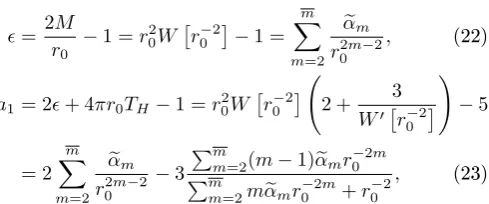
For the Einstein-Lovelock theory we have
𝜖= 2𝑀 𝑟0
−1 =𝑟20𝑊[︀
𝑟0−2]︀
−1 =
𝑚 ∑︁
𝑚=2 ̃︀
𝛼𝑚
𝑟20𝑚−2, (22)
𝑎1= 2𝜖+ 4𝜋𝑟0𝑇𝐻−1 =𝑟02𝑊 [︀
𝑟−02]︀ (︃
2 + 3
𝑊′[︀
𝑟0−2]︀
)︃
−5
= 2
𝑚 ∑︁
𝑚=2 ̃︀
𝛼𝑚
𝑟20𝑚−2 −3
∑︀𝑚
𝑚=2(𝑚−1)𝛼̃︀𝑚𝑟
−2𝑚 0 ∑︀𝑚
𝑚=2𝑚𝛼̃︀𝑚𝑟
−2𝑚 0 +𝑟
−2 0
, (23)
where𝑀 is the asymptotic mass and𝑇𝐻 is the Hawking
temperature.
When this parametrization via only the two param-eters𝜖 and 𝑎1 is not a suciently good approximation,
we can use the general parametrization developed in [67]. Namely, we approximate the metric function by a ratio-nal function of 𝑟, which is introduced through the con-tinued fraction as
𝑓(𝑟) =𝑟−𝑟0 𝑟
⎛
⎜ ⎜ ⎜ ⎜ ⎝
1−𝜖𝑟0
𝑟 −
𝜖𝑟2 0
𝑟2 +
𝑎1𝑟30
𝑟3
1 + 𝑎2
𝑟−𝑟0
𝑟 1 +. . .
⎞
⎟ ⎟ ⎟ ⎟ ⎠
, (24)
where dimensionless constants 𝑎1, 𝑎2, . . . are xed by
matching the series expansion for𝑓(𝑟)at the event hori-zon. In particular, one can nd that
𝑎2=−3
𝑟2 0(3𝑊
[︀
𝑟0−2]︀2
𝑊′′[︀
𝑟−02]︀
+ 2𝑊[︀
𝑟−02]︀
𝑊′[︀
𝑟−02]︀3
+ 8𝑊[︀
𝑟0−2]︀
𝑊′[︀
𝑟0−2]︀2
)−10𝑊′[︀
𝑟−02]︀3
2𝑟2 0𝑊
[︀
𝑟−02]︀
𝑊′[︀
𝑟−02]︀2
(2𝑊′[︀
𝑟−02]︀
+ 3)−10𝑊′[︀
𝑟0−2]︀3 . (25)
quantity value effect 1st order error 2d order error 𝑅𝑠ℎ 2.380080 8.39 % 0.429 % 0.198 %
𝜆 0.470996 22.37 % 1.956 % 1.153 %
Ω𝐼𝑆𝐶𝑂 0.143640 5.55 % 0.906 % 0.542 %
TABLE III. The shadow radius𝑅𝑠ℎ, Lyapunov exponent 𝜆,
and frequency at ISCOΩ𝐼𝑆𝐶𝑂 for𝑟0 = 1,𝛼̃︀2 =−0.12,𝛼̃︀3 =
−0.011,𝛼̃︀4= 0.009,𝛼̃︀5= 0.002,𝛼̃︀6 =−0.001.
The Mathematica○R code which constructs the ap-proximation of any given order for the metric function for arbitrary values of the Lovelock coupling constants
̃︀
𝛼2,𝛼̃︀3, . . . is attached to the arXiv preprint as a
supple-mentary material.
In Table III we give an example of description of the six parameter black hole, depending upon the ve Love-lock coupling constants and mass, in terms of only two (𝜖and𝑎1) or three (when𝑎2is added) parameters of the
parametrization (21). From Table III we can see not only the values of observable quantities, but also the
corre-sponding deviations from their Schwarzschild limit when calculated for the parametrized black hole at the rst (𝜖 and𝑎1 are non-zero) and second (𝑎2 is not zero as well)
order of the parametrization. It is natural to assume that if the eect is at least one order larger than the er-ror, the approximation is suciently accurate. From the above example for the particular values of the coupling constants we see that while the shadow radius and the Lyapunov exponent can be calculated with the relative error which is one order smaller than the eect already at the rst order of the parametrization, this is not so for the frequency at the innermost stable orbit, for which the eect is only 5 times larger than the error. The second order remedy this situation.
In general, we observe that a) the three parameter (𝜖, 𝑎1 and 𝑎2) approximation (21) is sucient to represent
4𝐷Einstein-Lovelock black hole with many coupling con-stants for the most part of the range of values of the cou-pling constants 𝛼̃︀𝑚, if the black hole is suciently far
absolute value when going over to higher orders of the Lovelock series, the description via the two parameters only (𝜖and𝑎1) gives the relative error at least one order
smaller than the eect. Therefore the parametrization converges very fast, when we are limited by strictly posi-tive coupling constants because of the natural cut-o on the values the higher order couplings.
V. CONCLUSIONS
Here we have studied properties of the 4𝐷 Einstein-Lovelock black holes obtained as a result of the dimen-sional regularization suggested in [17, 18] in a similar fashion with the recent approach for the 4𝐷 Einstein-Gauss-Bonnet black hole [15]. In particularly, we have learned what is the role of higher curvature corrections given by the Lovelock terms and how to describe the multi-parameter black holes when a lot of Lovelock terms are taken into consideration, so that analysis of various eects on every parameter would be very cumbersome problem. When we are limited by positive values of the coupling constants, the eikonal instability of the black hole gives the answer to the rst question: higher or-der Lovelock terms have swiftly decreasing upper bound on the absolute value of the corresponding coupling con-stant, so that its inuence decreases quickly and only a few rst Lovelock terms can lead to noticeable eect on the geometry, while higher order can be safely ignored. When negative couplings are allowed, this is not so,
de-spite inuence of higher orders are smaller as well. If implying the low-energy limit description of small black holes with positive coupling constants, when decreas-ing the black-hole size, higher order Lovelock corrections should play more important role, as the corresponding coupling constant is divided by the radius of the black hole at some power. At the same the instability will cut o the values of the coupling constant, so that a few rst order of the Lovelock series will be always enough for an adequate description of even small black holes. This remarkable results does not take place in the𝐷 >4 Einstein-Lovelock theory for which the instability does not cut-o higher orders of the Lovelock series [8].
We also nd an elegant answer to the question how to treat the black hole geometry when many coupling constants due to Lovelock terms come into play. Using the general parametrization for the arbitrary spherically symmetric black holes we nd that approximate descrip-tion of the black hole geometry is possible with only two or three parameters when the black hole is suciently far from the instability threshold.
ACKNOWLEDGMENTS
The authors acknowledge the support of the grant 19-03950S of Czech Science Foundation (GAR). This pub-lication has been prepared with partial support of the RUDN University Program 5-100 (R. K.).
[1] D. Lovelock, J. Math. Phys. 12, 498 (1971) doi:10.1063/1.1665613;
[2] D. Lovelock, J. Math. Phys. 13, 874 (1972) doi:10.1063/1.1666069.
[3] R. A. Konoplya and A. Zhidenko, Phys. Rev. D 82, 084003 (2010) doi:10.1103/PhysRevD.82.084003 [arXiv:1004.3772 [hep-th]].
[4] V. Cardoso, A. S. Miranda, E. Berti, H. Witek and V. T. Zanchin, Phys. Rev. D 79, 064016 (2009) doi:10.1103/PhysRevD.79.064016 [arXiv:0812.1806 [hep-th]].
[5] R. A. Konoplya and Z. Stuchlík, Phys. Lett. B 771, 597 (2017) doi:10.1016/j.physletb.2017.06.015 [arXiv:1705.05928 [gr-qc]].
[6] G. Dotti and R. J. Gleiser, Phys. Rev. D 72, 044018 (2005) doi:10.1103/PhysRevD.72.044018 [gr-qc/0503117].
[7] R. J. Gleiser and G. Dotti, Phys. Rev. D 72, 124002 (2005) doi:10.1103/PhysRevD.72.124002 [gr-qc/0510069].
[8] R. A. Konoplya and A. Zhidenko, JCAP 1705, 050 (2017) doi:10.1088/1475-7516/2017/05/050 [arXiv:1705.01656 [hep-th]].
[9] R. A. Konoplya and A. Zhidenko, JHEP 1709, 139 (2017) doi:10.1007/JHEP09(2017)139 [arXiv:1705.07732 [hep-th]].
[10] D. Yoshida and J. Soda, Phys. Rev. D 93, no.
4, 044024 (2016) doi:10.1103/PhysRevD.93.044024 [arXiv:1512.05865 [gr-qc]].
[11] Prog. Theor. Phys. 125, 1289 (2011) doi:10.1143/PTP.125.1289 [arXiv:1102.1785 [gr-qc]]. [12] R. A. Konoplya and A. Zhidenko, Phys. Rev. D
77, 104004 (2008) doi:10.1103/PhysRevD.77.104004 [arXiv:0802.0267 [hep-th]].
[13] M. A. Cuyubamba, R. A. Konoplya and A. Zhi-denko, Phys. Rev. D 93, no. 10, 104053 (2016) doi:10.1103/PhysRevD.93.104053 [arXiv:1604.03604 [gr-qc]].
[14] T. Takahashi, PTEP 2013, 013E02 (2013) doi:10.1093/ptep/pts049 [arXiv:1209.2867 [gr-qc]]. [15] D. Glavan and C. Lin, Phys. Rev. Lett. 124, no.
8, 081301 (2020) doi:10.1103/PhysRevLett.124.081301 [arXiv:1905.03601 [gr-qc]].
[16] Y. Tomozawa, arXiv:1107.1424 [gr-qc].
[17] A. Casalino, A. Colleaux, M. Rinaldi and S. Vicentini, arXiv:2003.07068 [gr-qc].
[18] R. Konoplya and A. Zhidenko, Phys. Rev. D 101, no.8, 084038 (2020) doi:10.1103/PhysRevD.101.084038 [arXiv:2003.07788 [gr-qc]].
[19] R. A. Konoplya and A. F. Zinhailo, arXiv:2003.01188 [gr-qc].
[23] R. Kumar, S. G. Ghosh, arXiv:2003.0892 [cond-mat.soft]. [24] K. Hegde, A. N. Kumara, C. L. A. Rizwan, A. K. M. and
M. S. Ali, arXiv:2003.08778 [gr-qc].
[25] Y. P. Zhang, S. W. Wei and Y. X. Liu, arXiv:2003.10960 [gr-qc].
[26] H. Lu and Y. Pang, arXiv:2003.11552 [gr-qc].
[27] R. A. Konoplya and A. Zhidenko, arXiv:2003.12171 [gr-qc].
[28] S. G. Ghosh and R. Kumar, arXiv:2003.12291 [gr-qc]. [29] R. A. Konoplya and A. Zhidenko, arXiv:2003.12492
[gr-qc].
[30] T. Kobayashi, arXiv:2003.12771 [gr-qc].
[31] C. Y. Zhang, P. C. Li and M. Guo, arXiv:2003.13068 [hep-th].
[32] A. Kumar and R. Kumar, arXiv:2003.13104 [gr-qc]. [33] S. A. Hosseini Mansoori, arXiv:2003.13382 [gr-qc]. [34] S. W. Wei and Y. X. Liu, arXiv:2003.14275 [gr-qc]. [35] D. V. Singh, S. G. Ghosh and S. D. Maharaj,
arXiv:2003.14136 [gr-qc].
[36] M. S. Churilova, arXiv:2004.00513 [gr-qc]. [37] A. K. Mishra, arXiv:2004.01243 [gr-qc].
[38] M. Heydari-Fard, M. Heydari-Fard and H. R. Sepangi, arXiv:2004.02140 [gr-qc].
[39] R. A. Konoplya and A. F. Zinhailo, arXiv:2004.02248 [gr-qc].
[40] X. H. Jin, Y. X. Gao and D. J. Liu, arXiv:2004.02261 [gr-qc].
[41] C. Y. Zhang, S. J. Zhang, P. C. Li and M. Guo, arXiv:2004.03141 [gr-qc].
[42] A. Naveena Kumara, C. L. A. Rizwan, K. Hegde, M. S. Ali and A. K. M, arXiv:2004.04521 [gr-qc]. [43] A. Aragón, R. Bécar, P. A. González and Y. Vásquez,
arXiv:2004.05632 [gr-qc].
[44] D. Malafarina, B. Toshmatov and N. Dadhich, arXiv:2004.07089 [gr-qc].
[45] S. J. Yang, J. J. Wan, J. Chen, J. Yang and Y. Q. Wang, arXiv:2004.07934 [gr-qc].
[46] P. G. S. Fernandes, P. Carrilho, T. Clifton and D. J. Mul-ryne, arXiv:2004.08362 [gr-qc].
[47] M. A. Cuyubamba, arXiv:2004.09025 [gr-qc]. [48] S. Mahapatra, arXiv:2004.09214 [gr-qc]. [49] F. W. Shu, arXiv:2004.09339 [gr-qc].
[50] A. Casalino and L. Sebastiani, arXiv:2004.10229 [gr-qc]. [51] P. Liu, C. Niu and C. Y. Zhang, arXiv:2004.10620 [gr-qc]. [52] S. Devi, R. Roy and S. Chakrabarti, arXiv:2004.14935
[gr-qc].
[53] L. Ma and H. Lu, arXiv:2004.14738 [gr-qc].
[54] P. Liu, C. Niu, X. Wang and C. Y. Zhang, arXiv:2004.14267 [gr-qc].
[55] R. Kumar, S. U. Islam and S. G. Ghosh, arXiv:2004.12970 [gr-qc].
[56] M. S. Churilova, arXiv:2004.14172 [gr-qc].
[57] X. H. Ge and S. J. Sin, arXiv:2004.12191 [hep-th].
[58] X. X. Zeng, H. Q. Zhang and H. Zhang, arXiv:2004.12074 [gr-qc].
[59] M. Gurses, T. C. Sisman and B. Tekin, arXiv:2004.03390 [gr-qc].
[60] S. X. Tian and Z. H. Zhu, arXiv:2004.09954 [gr-qc]. [61] J. Arrechea, A. Delhom and A. Jiménez-Cano,
arXiv:2004.12998 [gr-qc].
[62] G. Cognola, R. Myrzakulov, L. Sebastiani and S. Zerbini, Phys. Rev. D 88, no. 2, 024006 (2013) doi:10.1103/PhysRevD.88.024006 [arXiv:1304.1878 [gr-qc]].
[63] R. G. Cai, L. M. Cao and N. Ohta, JHEP 1004, 082 (2010) doi:10.1007/JHEP04(2010)082 [arXiv:0911.4379 [hep-th]].
[64] R. A. Hennigar, D. Kubiznak, R. B. Mann and C. Pol-lack, [arXiv:2004.09472 [gr-qc]]; arXiv:2004.12995 [gr-qc]. [65] H. Lu and P. Mao, [arXiv:2004.14400 [hep-th]].
[66] R. A. Konoplya and A. Zhidenko, arXiv:2001.06100 [gr-qc].
[67] L. Rezzolla and A. Zhidenko, Phys. Rev. D 90, no. 8, 084009 (2014) doi:10.1103/PhysRevD.90.084009 arXiv:1407.3086 [gr-qc].
[68] R. Konoplya, L. Rezzolla and A. Zhidenko, Phys. Rev. D 93, no. 6, 064015 (2016) doi:10.1103/PhysRevD.93.064015 [arXiv:1602.02378 [gr-qc]].
[69] G. Kofinas and R. Olea, JHEP 0711, 069 (2007) doi:10.1088/1126-6708/2007/11/069 [arXiv:0708.0782 [hep-th]].
[70] T. Takahashi and J. Soda, Prog. Theor. Phys. 124, 711 (2010) doi:10.1143/PTP.124.711 [arXiv:1008.1618 [gr-qc]]; Prog. Theor. Phys. 124, 911 (2010) doi:10.1143/PTP.124.911 [arXiv:1008.1385 [gr-qc]]. [71] R. C. Myers and J. Z. Simon, Phys. Rev. D 38, 2434
(1988) doi:10.1103/PhysRevD.38.2434.
[72] B. F. Schutz and C. M. Will, Astrophys. J. 291, L33-L36 (1985) doi:10.1086/184453.
[73] S. Iyer and C. M. Will, Phys. Rev. D 35, 3621 (1987) doi:10.1103/PhysRevD.35.3621.
[74] R. Konoplya, Phys. Rev. D 68, 024018 (2003) doi:10.1103/PhysRevD.68.024018 [arXiv:gr-qc/0303052 [gr-qc]].
[75] R. Konoplya, A. Zhidenko and A. Zinhailo, Class. Quant. Grav. 36, 155002 (2019) doi:10.1088/1361-6382/ab2e25 [arXiv:1904.10333 [gr-qc]].
[76] R. Konoplya and A. Zhidenko, Rev. Mod. Phys. 83, 793-836 (2011) doi:10.1103/RevModPhys.83.793 [arXiv:1102.4014 [gr-qc]].
[77] C. Gundlach, R. H. Price and J. Pullin, Phys. Rev. D 49, 883-889 (1994) doi:10.1103/PhysRevD.49.883 [arXiv:gr-qc/9307009 [gr-qc]].