1
International Research Journal of Commerce and Lawhttp://ijmr.net.in, Email: [email protected]
STUDY OF VARIOUS STRATEGIES FOR IMPROVING THE
PERFORMANCE OF ORGANIZATION
Sharath Kumar P
1, Dr. Hari Om
2Department of Management
1,2
OPJS University, Churu (Rajasthan) – India
Abstract
Organizational Development professionals are the CEOs partners in making a top performance culture for the organization. Organizational Development professionals are pros in Change Management and Culture Development. Anyway, many winds up in positions that make it hard to get a straight line of communication to the CEO. Mostly due to the Organizational structure and the fact that OD-Organization Development is situated under HR. Anyway, the truth is that most OD professionals still work under the more customary structure. Perceiving this perspective, numerous organizations are assigning free structures for the OD work. Organization Development is about change. Early OD exertion fundamentally addressed first-arrange change making moderate adjustments to the organization, to people and its processes. Today the organization's demand is great to the point that second-arrange change is required in numerous occurrences. The organization is being rethought, work undertakings are being reengineered, the rules of the market place are being modified, and the essential idea of organizations is evolving. Without a doubt, the new condition of things will be immeasurably not quite the same as the old condition of things.
1. INTRODUCTION
Give your staff the right tools they must do the job. This sound like common sense yet most companies unwittingly do as much as they can to diminish the ability of their employees. Management layers inside organizations don't simply cut out authority for a chosen few, they additionally cut out ability, constraining staff below them to their job spec as it were. At the point when Toyota concluded that they needed to build up the best auto manufacturing process on the planet they gave their production line staff the capabilities to do it. Doing so conveyed everything to an end, and no more autos would be delivered that day until the point when the problem was documented and expelled from the
manufacturing process. This is the reason today Toyota can assemble the absolute highest quality autos on the market starting with no outside help in only 17 hours. They gave their employees the capabilities to do so.
2
International Research Journal of Commerce and Lawhttp://ijmr.net.in, Email: [email protected] Ordinarily, they're not, and organizations can
without much of a stretch end up loaded up with people doing 'occupied work,' assignments that stay with the ticking over as opposed to advancing it. To improve an organization's productivity, you should decrease this, with the goal that employees invest their time and vitality on the things that issue. The ideal approach to begin is to write a 'Stop Doing' list, errands that you consistently do that don't have an impact on the strategic goals of the company. Once you've kept in touch with them for yourself next, write them for your team. From your team at that point write them for your company.
2. STRATEGIES FOR IMPROVING ORGANIZATIONAL PERFORMANCE BY LEARNING ORGANIZATION & TRANSFER OF TRAINING
This research expects to investigate a relationship between the learning organization and transfer of training as methodologies for learning and overseeing knowledge to make a performance improvements gain or keep up a competitive advantage. Various similarities are recognized in the literature that is demonstrative of the relationship between the learning organization and transfer of training, for example, accentuation on both as procedures for a competitive advantage; focus on learning and knowledge, accentuation on making a move to improve performance and link between individual learning and organizational learning.
This research proposes a positive relationship recommending that learning organization will probably practice the transfer of training. The significance placed on the learning organization and transfer of training as basic factors for improving performance and picking up a competitive advantage requires that the two
regions be additionally explored. Any relationship between the learning organization and transfer of training could prompt performance improvements and augment the benefits picked up and enable organizations to stay competitive notwithstanding global competition, a continually evolving environment, and unstable monetary conditions. The elements of global competition, technological progressions, corporate rebuilding, and unstable financial conditions are combining on business and making it more important than any time in recent memory those organizations learn and adjust to make improvements in performance.
Learning Organization
Learning Organizations have been characterized in literature from a few viewpoints. A few creators characterize it from the perspective of a living organism, or, in other words, and changing itself, not simply by the learning of members inside the organization yet also by members outside the have characterized it from the perspective of building a culture and climate that supports learning and transformation. The learning viewpoint incorporates picking up of new knowledge, nonstop learning, learning from errors and learning by all members of the organization. The changing perspective incorporates the change in behaviour and change in the processes utilized based on the knowledge picked up.
Knowledge Creation And Conversation
3
International Research Journal of Commerce and Lawhttp://ijmr.net.in, Email: [email protected] organizational learning and leaders can improve
the process and aftereffect of organizational learning activities. Leaders can enhance the capacity of organizational learning by making a dream and giving learning opportunities to the subordinates. The roles of leaders of learning organization distinguished by various creators
are suitable to a transformational leader. In this time of rapid change and global disturbance, leaders must have the capacity to react to consistent change and lead their organizations in not just surviving but rather changing their structure, functions, subsidizing and methods of delivery to viably propel the mission.
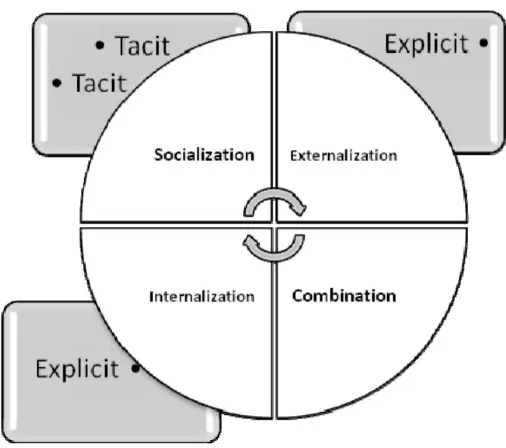
Figure 1: Knowledge Creation Spiral
The interactions between tacit and explicit knowledge are called knowledge conversion. Through the conversion process, tacit and explicit knowledge expands in both quality and quantity. There are four odes of knowledge conversion - socialization, externalization, internalization, and combination. The knowledge creation and conversion processes are modelled below in the figure 1.
3. IMPROVING ORGANIZATIONAL PERFORMANCE THROUGH REWARD SYSTEMS
In order to improve the results of projects, senior management of software development companies define programs to measure and
improve productivity. This interest is related to the need to monitor whether the results of teams are aligned with organizational strategic goals and whether they are achieving the levels of productivity expected, such as, for example, the levels set for finance, customer satisfaction, product quality levels, and so forth. There are several strategies for improving productivity that are researched in the area of software development. The large majority are related to some previously studied factors that affect the productivity of teams. For example:
4
International Research Journal of Commerce and Lawhttp://ijmr.net.in, Email: [email protected]
Size of teams: small teams tend to be more productive
Length and size of the project: increasing the length of the project or its size tend to decrease productivity
Use of tools: the impacts of the increase or decrease in productivity related to introducing and using tools in the software development process
Reuse of software artifacts.
Instability of the requirements and of the software architecture
However, other than the zones related to tools, methodologies, work environment, management and reuse, the territory of personal incentives, brought up in a study by Boehm, ought to be considered as one of the activities to be coordinated into a program for improving productivity. Adjusted to Boehm's mind-set, in
his research studies on the productivity of teams, detailed that the primary problems of our work are not just of a technological sort. Many are sociological in nature. The theories of motivation contend that the people who contribute more to a company ought to get more to do. This desire affects the design of incentive systems, and instalment by legitimacy programs mirrors this impact. However, they do not generally accomplish their destinations.
There are a few zones that can increase productivity in programming development: programming development processes, testing tools, characterizing the design and reward systems. Based on the above musings, the significance of this issue is related to the fact that the suggestions proposed might be valuable for taking care of everyday problems and need to think about the idea of remuneration systems in order to get a gain in productivity.
Figure 2: Time-Line Related To Some Strategies for Improving Productivity
In addition, this research will continue the discussion of a topic that is less emphasized in
5
International Research Journal of Commerce and Lawhttp://ijmr.net.in, Email: [email protected] more related to technological aspects. At the
same time, this theme is widely discussed and implemented in the disciplines of Economics and Social Sciences, where various aspects related to incentives have been applied and can be considered as lessons learned for software organizations software.
4.TRAINING, ORGANIZATIONAL STRATEGY, AND FIRM PERFORMANCE
The link between firm-provided training and organizational performance is presently recognized as fundamental by generally organizations. The knowledge and aptitudes of employees through training activities have turned out to be important to firm performance. Success in today's competitive markets is determined principally by human capital, not physical capital and strongly upheld more noteworthy firm interests in training with the end goal to provide better knowledge, abilities, and capabilities for employees as opposed to their competitors. Accordingly, firms spending on training activities are expecting that it is instrumental for organizations to remain and enhance their employee's aptitudes and knowledge with the end goal to make sustainable competitive advantage and improve firm performance. In spite of the fact that training activities are strongly acknowledged to identify with firm performance, guided by possibility hypothesis, we trust that training might be more helpful for organizations if training is consistent with different characteristics of the organizations. For instance, strategic human resource management researchers propose that the impact of training on firm performance may increase better results if training activities are consistent with an organizational strategy.
Like this, on the one hand, firms that highly institutionalize processes or decrease mistakes are viewed as a cost strategy. Then again, companies that focus on aptitude procurement and development are consistent with a quality strategy, while firms that are nimble, adaptable and responsive are viewed as an adaptability strategy. There are various hypothetical models that have been utilized to portray the link between training, organizational strategy, and firm performance in the strategic human resource management literature. Behavioural perspective (infers that successful execution of organizational strategy depends vigorously on employee behaviour since employee behaviour is a primary mediator between strategy and firm performance.
Therefore, the organization should execute human resource practices to inspire, control, and strengthen those behaviours. For instance, an organization can set up and utilize human resource practices that guarantee that employees with the required abilities are procured and be propelled to carry on in courses consistent with the organizational strategy. Since behaviour is an element of capacity and motivation, when applied to train, the behavioural perspective proposes that training is a major means used to empower and strengthen the employee's motivation and behaviour.The second theoretical model is control theory in strategic human resource management which focuses on three types of control systems:
1. Behaviour control, 2. Output control, and
3. Input control used simultaneously in the strategic context of firms.
6
International Research Journal of Commerce and Lawhttp://ijmr.net.in, Email: [email protected] aptitudes, abilities, values, and intentions of
employees; behaviour control changes the transformation process; and yield control manages results. Thus, powerful performance relies upon coordinating human resource practices with the organizational setting set up by strategy. Applying the hypothetical control to training recommends that training can be viewed as an instrument that controls and changes contribution from firms, for example, knowledge, aptitudes, and abilities of employees. For instance, when cause-impact knowledge is deficient, and standards of desirable performance are ambiguous, neither behaviour control nor yield control is probably going to be a viable choice for managers.
5. ROLE OF TRAINING &
DEVELOPMENT IN AN
ORGANIZATIONAL DEVELOPMENT
Training and development is the field which is worried about organizational activity went for bettering the performance of Individuals and groups in an organizational setting. It is a consolidated role regularly called human resources development (HRD) which means the development of "Human" resources to stay competitive in the marketplace. Training focuses on doing activities today to create employees for their current jobs and development is preparing employees for future roles and responsibilities. It completes an analysis that the target of training and development is to innovative learning organizations which guarantee that employees through value expansion can viably perform their jobs, increases competitive advantage and looks for self-growth: this measurable performance coming about because of good training and development, will enhance organization development.
It is a process transferring data and knowledge to bosses. It is preparing businesses to decipher that data and knowledge into practice to enhancing organization adequacy and productivity, and the quality of management of people. It ought to be considered alongside instruction policies and systems which are vital to the development of human resources. Ordinary 'training' is required to cover basic work-related skills, techniques and knowledge, and quite a bit of this adopting a positive progressive strategy to this kind of traditional training. Training and development direct are oriented predominantly around what's good for people, as opposed to mainly what's profitable for organizations.
6. CONCLUSION
The primary motivation behind my paper
was to depict and examine the role of
performance management and employee
relationship. Successful communication and
culture of trust are crucial. The system not
directly affecting the achievement of results,
it has greatly affected staff, and has
absolutely highlighted regions that require
attention and further improvement. It is
without a doubt conceivable to inspire
employees
to
perform
well
for
an
7
International Research Journal of Commerce and Lawhttp://ijmr.net.in, Email: [email protected]
REFERENCES
[1]. Goetsch DL, Davis SB (2014) Quality management for organizational excellence. Upper Saddle River, NJ: pearson.
[2]. Marta JKM, Singhapakdi A, Lee DJ, Sirgy MJ, Koonmee K, et al. (2013) Perceptions about ethics institutionalization and quality of work life: Thai versus American marketing managers. Journal of Business Research 66: 381-389.
[3]. Banks S (2014) Reclaiming social work ethics: Challenging the new public management. Ethics, critical and radical debates in social work 1: 1-24.
[4]. Carter MZ, Armenakis AA, Feild HS, Mossholder KW (2013) Transformational leadership, relationship quality, and employee performance during continuous incremental organizational change. Journal of Organizational Behaviour 34: 942-958.
[5]. Ayanian, J. Z., &Weissman, J. S. (2002). Teaching Hospitals and quality of care: A review of the literature. Milbank Quarterly, 80(3), 569– 593.10.1111/milq.2002.80.issue-3 [6]. Campbell, S. M., Roland, M. O.,
&Buetow, S. A. (2000). Defining quality of care. Social Science and Medicine, 51, 1611–1625
[7]. Greener, I. (2009). Public management: A critical text. Basingstoke: Palgrave Macmillan.