WORKSHOP PAPER
Intraneuronal information processing, directional
selectivity and memory for spatio-temporal sequences
∗
Horace Barlow
Physiological Laboratory, University of Cambridge, Cambridge CB2 3EG, UK
Received 31 January 1996
Abstract. Interacting intracellular signalling pathways can perform computations on a scale that is slower, but more fine-grained, than the interactions between neurons upon which we normally build our computational models of the brain (Bray D 1995 Nature 376 307–12). What computations might these potentially powerful intraneuronal mechanisms be performing? The answer suggested here is: storage of spatio-temporal sequences of synaptic excitation so that each individual neuron can recognize recurrent patterns that have excited it in the past. The experimental facts about directionally selective neurons in the visual system show that neurons do not integrate separately in space and time, but along straight spatio-temporal trajectories; thus, neurons have some of the capacities required to perform such a task. In the retina, it is suggested that calcium-induced calcium release (CICR) may provide the basis for directional selectivity. In the cortex, if activation mechanisms with different delays could be separately reinforced at individual synapses, then each such Hebbian super-synapse would store a memory trace of the delay between pre- and post-synaptic activity, forming an ideal basis for the memory and response to phase sequences.
1. A new level of computation in the brain
Dennis Bray has recently argued that the intracellular biochemical signalling pathways of
E. coli that control its behaviour interact with each other in a manner analogous to the
interactions of the (supposedly) neuron-like elements of artificial neural networks (Bray 1995). This has revolutionary implications for neuroscience: it implies that we should think of neurons not only as units that compute and make decisions by interacting with each other, but also as units that each contain decision networks within themselves. The brain is not just a very complicated hierarchy of relatively simple neural elements, but each of these elements is itself a very complicated decision network of a type that we are only beginning to understand in biophysical terms.
As an example of an intracellular computational process consider briefly how E. coli controls its flagellar motor. Just as direction of motion is important in vision, so the directions of changes in the concentrations of nutrients and toxins are important to E. coli. If a nutrient is increasing in concentration as the bacterium moves through its environment, it is moving correctly and should go on doing the same, but if the concentration is decreasing, it should stop and do something different. The appropriate actions are the reverse for increases and decreases in the concentrations of toxins. Substances in the surrounding medium bind to receptors in the bacterial membrane and these release messenger molecules ∗ This paper was presented at the Workshop on Information Theory and the Brain, held at the University of Stirling, UK, on 4–5 September 1995.
into the cytoplasm. In order to detect whether a substance is increasing or decreasing, the bacterium has two messengers, one of which responds rapidly, the other more slowly, thus integrating the estimate of the substance concentration over a few seconds in the past. The control of the flagellar motor depends upon comparing the immediate and the time-averaged estimates, thereby making the response depend upon rate of change of concentration, not its absolute value.
Bray gives examples of proteins in E. coli that can act as switches and other computational elements. A pyramidal cell from the cerebral cortex receives about 104 synapses on spines, and each spine is about the size of E. coli; thus there cannot
be any doubt that a single pyramidal cell might perform enormously more complicated computations than those contemplated by McCulloch and Pitts (1943) and Donald Hebb (1949) five decades ago.
It is difficult to estimate how much additional computing power these intracellular mechanisms might bring, especially in view of the reconsideration of dendritic action that is in progress (see Segev 1992, Mel 1994, Segev et al 1995 for reviews), but three points seem clear. First, intracellular mechanisms are in general slower than the conventional ones involving the membrane potential. Second, it is possible for there to be a very large number of different states of the variables involved in intracellular computations in each cell, and the finer spatial grain of these mechanisms increases the total computational power by a much larger factor than their slowness decreases it; the result is an overall increase by a large factor, perhaps by as much as 100 times. Third, this additional level is not a substitute for computation using membrane potentials, but an addition to it, for the results of intraneuronal computations operate through the membrane potential.
What these computations achieve will only be found out by experiments on real neurons, but theoreticians should feel challenged by the question: what might intraneuronal computations accomplish? In the following section of this paper I have taken up this challenge and propose one particular answer. But this is obviously not the only possible answer; the complexity of intracellular mechanisms in E. coli should inspire many other speculations.
2. The need for memory of spatio-temporal patterns
In taking up the challenge I have been guided partly by a theoretical concern: how does the brain store and access past information? Initially one tends to accept the hint from technology that memory requires some specialized external medium such as a magnetic tape or silicon chip. E. coli certainly does not have that but uses the form of intracellular short-term memory outlined above and, if E. coli can use the temporal pattern of its own past inputs as a basis for its decisions, it seems likely that a pyramidal cell can do so too. Hence arises the idea that each cell might beneficially store a record of the temporal patterning of its own past experience.
of sequence and timing in every cell and this memory would be compared constantly and automatically with the current spatio-temporal pattern of synaptic activation reaching each cell. I do not know whether such a mechanism should be called short- or long-term memory, for although the synaptic weights could persist for a long time, the maximum duration for the sequences stored would correspond to the longest synaptic delay, which could be no more than a few seconds.
3. Facts about directional selectivity
The ability to detect and respond selectively to spatio-temporal patterns is proved most directly by the existence of neurons selectively sensitive to the direction of motion of objects in the visual field. Directional selectivity in visual cortical neurons will be the main focus of this article; however, the mechanism is perhaps more open to analysis in simpler preparations such as rabbit retinal ganglion cells, and I shall also speculate about these.
First consider a psychophysical fact. It is well known that vernier misalignments can be detected down to about 6 seconds of arc, or roughly one fifth of the separation of a pair of foveal cones. Twenty years ago Westheimer and McKee (1975) made the striking discovery that this performance was maintained when the target was swept through the visual field at rates up to 2.5 deg/s, which corresponds to 300 cones/s. They used an exposure duration of 200 ms to preclude tracking eye movements, during which time the image would have been moved across about 50 cones; hence, the spatial or temporal displacement corresponding to the vernier offset could be detected when the image fell on sequences of 50 different cones just as well as when it was held stable in one position.
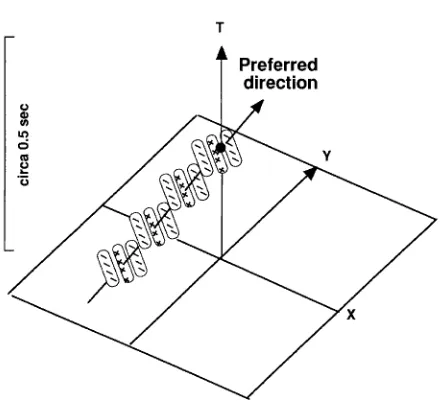
The system certainly integrates in time because performance improves with increased stimulus duration, but if it could only integrate in time, the image would be hopelessly blurred. I think the result strongly suggests that the receptive fields of cortical neurons integrate along straight trajectories in space–time (Barlow 1979) and are not fixed in retinal coordinates in the way we normally suppose. Such receptive fields cannot be represented by separate spatial and temporal weighting functions but require a combined spatio-temporal weighting function for their adequate description, as suggested in figure 1. This neuron would integrate along the trajectory in spacetime shown by the arrow, but it would preserve its very fine sensitivity to displacements with a component orthogonal to this axis, either vertically in time, or in space, or in a combination as required for moving verniers.
There are further experiments showing the same thing. Burr (1981) measured the threshold for moving spots and for lines of the same spatial and temporal extent that his spots traced out: temporal summation for the moving dots extended to much longer times than for the lines.
Burr et al (1986) performed ingenious masking experiments, from which they could predict receptive field shape, and came up with receptive fields similar to the well known Hubel and Wiesel type, but changing with time as in figure 1. Furthermore, the flanking regions they found show that the units not only integrate along straight spatio-temporal trajectories, but also differentiate in an orthogonal direction, explaining how positional precision can be maintained.
The first direct confirmation of such receptive fields was obtained by Emerson et al (1987) from a spatio-temporal analysis of the receptive fields of complex cells in cat visual cortex. Similar results have been obtained by Freeman and his colleagues on simple cells (DeAngelis et al 1995); as these authors put it, cortical neurons have moving receptive fields.
Figure 1. Three-dimensional representation of a receptive field that could resolve moving verniers in the experiments of Westheimer and McKee (1975). The spatio-temporal weighting function is not separable in space and time, but allows integration along a linear spatio-temporal trajectory.
been widely accepted that directionally selective neurons have receptive fields in which spatial and temporal integration are not separable; we now see that this inseparability takes the specific form of integration along straight spatio-temporal trajectories. But how is this achieved physiologically? It could be achieved by having delayed inputs to each cell, rather as suggested by Mitchison (1989), and the lagged inputs from the LGN (Saul and Humphrey 1990) might serve such a role. But, in accordance with my goal in this article, I want to explore new possibilities.
4. Possible delay mechanisms
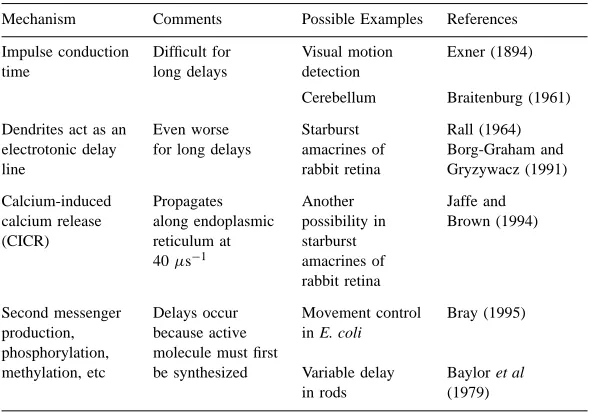
What is needed is a mechanism for collecting together information with different delays for different inputs. Table 1 shows some possible mechanisms for delaying the effect of an input to a neuron. The first mechanism was suggested 100 years ago by Sigmund Exner when he proposed a very modern-looking explanation for motion after-effects; conduction times are also the main component of the delay in the reverberating circuits proposed by Lorent´e de Nˆo (1938) and taken up by Hebb (1949) to account for persistent activity in his cell assemblies. The electrotonic properties of dendrites have been extensively discussed recently (see for instance the thorough review by Mel (1994)); thus, to pursue my goal I shall again ignore these two possibilities and discuss the last two.
Table 1. Possible delay mechanisms.
Mechanism Comments Possible Examples References Impulse conduction Difficult for Visual motion Exner (1894)
time long delays detection
Cerebellum Braitenburg (1961) Dendrites act as an Even worse Starburst Rall (1964) electrotonic delay for long delays amacrines of Borg-Graham and
line rabbit retina Gryzywacz (1991)
Calcium-induced Propagates Another Jaffe and calcium release along endoplasmic possibility in Brown (1994) (CICR) reticulum at starburst
40µs−1 amacrines of
rabbit retina
Second messenger Delays occur Movement control Bray (1995) production, because active in E. coli
phosphorylation, molecule must first
methylation, etc be synthesized Variable delay Baylor et al
in rods (1979)
slowly inside the cell, along the surface of the endoplasmic reticulum, without influencing the cell membrane directly. The results on the membrane potential are indirect and are the consequence of flooding the cytoplasm with Ca++ ions. This can have many effects, but these are likely to include the opening of K+channels with consequent stabilization of the membrane potential near its resting value, i.e. inhibition. Since directional selectivity in the rabbit retina seems to depend upon a spreading inhibitory effect, CICR is a likely candidate. Figure 2 shows a modification of a scheme originally proposed (Barlow and Levick 1965) for the ON–OFF type directional selectivity in the rabbit retina. Since then the morphology of these ganglion cell dendritic trees has been described by Oyster et al (1993), the cholinergic ‘starburst’ amacrine cells involved in directional selectivity have been found by Masland and Mills (1979), further described by Famiglietti (1983) and Masland and Tauchi (1986) and incorporated in a mechanism fitting many of the facts by Vaney (1991). But there are discordant features and none of the proposals fits all the elegant experimental results of Yang and Masland (1992, 1994).
Figure 2. Calcium-induced calcium release (CICR) may provide the veto mechanism for ON–
OFF directional selectivity in ganglion cells of the rabbit retina. The top version is the scheme originally proposed by Barlow and Levick (1965): delayed (or more persistent) inhibition is conducted in the null direction, so if C is excited first it vetoes responses that would have been elicited by B, and likewise for B and A. In the CICR scheme it is proposed that the bipolar B normally excites the underlying dendrites of the ganglion cell through the tips of the dendrites of the starburst amacrine cell, but this is vetoed if a wave of CICR has been initiated more centrally along a starburst amacrine’s dendrite by excitation at C. Similarly oriented dendrites of another amacrine conduct CICR initiated by B and veto transmission from A to the ganglion cell. The other dendrites of each amacrine veto motions in other directions.
5. Temporally sensitive Hebbian super-synapses
Turning to cortical neurons, figure 3 shows an idea that would make these into enormously powerful elements for storing and responding to spatio-temporal patterns or ‘phase sequences’.
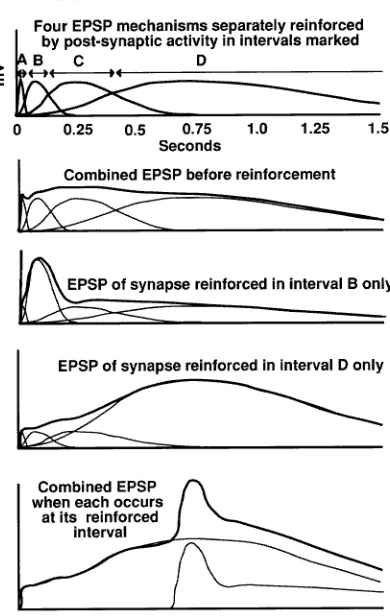
Figure 3. Hebbian super-synapse capable of storing the delay between pre-synaptic activity
and reinforcement by post-synaptic activation. The top panel shows four postulated synaptic mechanisms with different time courses for their EPSPs. These are separately reinforced if post-synaptic activity occurs in the time intervals marked and increase in amplitude when this happens; otherwise they decrease. The second, third and fourth panels show the combined EPSP before reinforcement, after reinforcement in interval B and after reinforcement in interval D. The last panel shows the EPSP from two synapses, one reinforced in B and one reinforced in D, when the D-reinforced synapse is activated first followed by the B-reinforced one at the appropriate interval. A large combined EPSP results, whereas for other sequences and timings the EPSP is smaller and often little larger than for each alone. A neuron provided with such synapses would become selectively sensitive to spatio-temporal input patterns that succeed in causing post-synaptic activity and would thus be an ideal mechanism for storing and detecting phase sequences.
panel is produced. But this is a Hebbian synapse, so if a post-synaptic action potential occurs it will increase the potency of one or more of the mechanisms; it is assumed that each mechanism is reinforced in this way when the post-synaptic action potential occurs near its peak. Any mechanism not so reinforced becomes weaker.
The third and fourth panels show what happens to the combined EPSPs at a synapse or group of synapses if there is reinforcement in the second or fourth interval only. The EPSP is changed in shape and peaks at the interval of the reinforcement.
their peaks will coincide, producing the combined EPSP of the bottom line. With any other sequence or interval a smaller EPSP will be produced, often little bigger than each could produce by itself. Figure 3 shows only four excitatory mechanisms peaking at 25, 75, 250 and 750 ms, but it is possible that there might be more of them covering a larger range; inhibitory mechanisms are also possible and would improve the resolution of the system.
A network of such units would form a sparse representation based on commonly occurring spatio-temporal patterns of input. As with the network proposed by F¨oldi´ak (1990) it would require anti-Hebbian inhibitory interconnections to decorrelate units that shared a large proportion of their inputs. Changing the units to make them capable of handling spatio-temporal as well as purely spatial patterns would create a network well suited to the task of sorting out the commonly occurring patterns in, for example, auditory speech inputs, or visual images of motion through an environment.
In his book, Hebb (1949) attached great importance to the brain’s ability to respond to spatio-temporal patterns, which he called ‘phase sequences’, and invoked reverberating cell assemblies as a mechanism of short-term memory that would make this possible. The intracellular mechanism proposed here meets both the spatial and temporal requirements for selective response to phase sequences and thereby provides an ideal mechanism for them.
6. Conclusions
From this discussion the general conclusion is that important computational mechanisms exist at the intraneuronal level and that cellular physiology provides the key to understanding these. Specifically, it seems possible that a single synapse could store the time delay between arrival of transmitter from pre-synaptic terminals and post-synaptic activity. The fact that temporally sensitive Hebbian super-synapses have not already been described is not good evidence against them, for you do not find such mechanisms without looking specifically for them. But I must admit that when you do look for such things, you very often find something a little different; thus, we must be prepared for disappointments and surprises. Nevertheless, I am convinced that computation in the sub-synaptic cytoplasm is a rich field to explore.
Acknowledgment
As usual, ideas such as those proposed here owe a lot to discussions with many other people, but Michael Berridge, Dennis Bray and Graeme Mitchison have helped particularly by drawing my attention to work I would otherwise have missed.
References
Adelsen E A and Bergen J R 1985 Spatio-temporal energy models for the perception of motion J. Opt. Soc. Am. A 2 284–99
Barlow H B 1979 Reconstructing the visual image in space and time Nature 279 189–90
Barlow H B and Levick W R 1965 The mechanism of directionally selective units in the rabbit’s retina J. Physiol.
178 477–504
Baylor D A, Lamb T D and Yau K-W 1979 Responses of retinal rods to single photons J. Physiol. 288 613–34 Borg-Graham L and Gryzywacz N M 1991 Single Neuron Computation ed T McKenna et al (New York: Academic) Braitenburg V 1961 Functional interpretation of cerebellar histology Nature 190 539
Bray D 1995 Protein molecules as computational elements in living cells Nature 376 307–12
DeAngelis G C, Ohzawa I and Freeman R D 1995 Receptive field dynamics in the central visual pathways Trends
Neurosci. 18 451–8
Emerson R C, Citron M C, Vaughn W J and Klein S A 1987 Non-linear directionally selective sub-units in complex cells of cat striate cortex J. Neurophysiol. 58 33–65
Exner S 1894 Entwurf zu einer physiologischen Erklarung der psychischen Erscheinungen (Leipzig, Vienna: Franz Deuticke)
Famiglietti E V 1983 Starburst amacrine cells and cholinergic neurons: mirror-symmetric ON and OFF amacrine cells in the rabbit retina Brain Res. 261 138–44
F¨oldi´ak P 1990 Forming sparse representations by local anti-Hebbian learning Biol. Cybern. 64 165–70 Hebb D O 1949 The Organisation of Behaviour (New York: Wiley)
Jaffe D B and Brown T H 1994 Metabotropic glutamate receptor activation induces calcium waves within hippocampal dendrites J. Neurophysiol. 72 471–4
Lorent´e de Nˆo 1938 Analysis of the activity of chains of internuncial neurons J. Neurophysiol. 1 207–44 Masland R H and Mills J W 1979 Autoradiographic identification of acetylcholine in the rabbit retina J. Cell Biol.
83 159–78
Masland R H and Tauchi M 1986 The cholinergic amacrine cell Trends Neurosci. 9 218–23
McCulloch W S and Pitts W H 1943 A logical calculus of the ideas immanent in nervous activity Bull. Math.
Biophys. 5 115–33
Mel B W 1994 Information processing in dendritic trees Neural Comput. 6 1031–85
Mitchison G 1989 Learning algorithms and networks of neurons The Computing Neuron ed R Durbin et al (Wokingham: Addison-Wesley) pp 35–53
Oyster C W, Amthor F R and Takahashi E S 1993 Dendritic architecture of ON–OFF directionally-selective ganglion cells in the rabbit retina Vision Res. 33 579–608
Rall W 1964 Neural Theory and Modeling ed R Reiss (Palo Alto, CA: Stanford University Press)
Saul A B and Humphrey A L 1990 Spatial and temporal properties of lagged and unlagged cells in cat Lateral Geniculate Nucleus J. Neurophysiol. 64 206–24
Segev I 1992 Single neuron models: oversimple, complex and reduced Trends Neurosci. 15 414–21
Segev I, Rinzel J and Shepherd G M (ed) 1995 The Theoretical Foundation of Dendritic Function (Cambridge, MA: MIT Press)
Vaney D I 1991 The mosaic of amacrine cells in the mammalian retina Prog. Retinal Res. 9 50–100
Westheimer G and McKee S P 1975 Visual acuity in the presence of retinal-image motion J. Opt. Soc. Am. 65 847–50
Yang G and Masland R H 1992 Direct visualisation of the dendritic and receptive fields of directionally selective retinal ganglion cells Science 253 1949–52