in deaf children
Mairéad Finola MacSweeney
Department of Psychology,
University College London
All rights reserved
INFORMATION TO ALL USERS
The quality of this reproduction is dependent upon the quality of the copy submitted. In the unlikely event that the author did not send a complete manuscript and there are missing pages, these will be noted. Also, if material had to be removed,
a note will indicate the deletion.
uest.
ProQuest U642960
Published by ProQuest LLC(2016). Copyright of the Dissertation is held by the Author. All rights reserved.
This work is protected against unauthorized copying under Title 17, United States Code. Microform Edition © ProQuest LLC.
ProQuest LLC
789 East Eisenhower Parkway P.O. Box 1346
in deaf children
Mairéad MacSweeney, Department of Psychology, University College London Submitted for the degree of Doctor o f Philosophy, October 1998.
Abstract
Deaf people do not have full access to the auditory component of spoken language. This thesis tackled the question ‘what impact does this have on their STM representations and overall STM performance?’ Also, how does impoverished
exposure to auditory spoken language affect the development of STM coding and
STM ability? To answer these questions deaf subjects of different ages were tested on immediate recall of pictures in a variety of paradigms.
Recall by deaf teenagers, but not deaf adults, was impaired by non- articulatory concurrent tasks. It is argued that this indicates a delay in the development of central executive processes in deaf people. There was evidence for the use o f multiple STM codes. Young deaf children (eight-year-olds), like their hearing RA controls, used a visual STM code. This code was also used by deaf teenagers but was supplemented by the use of a speech-based code, which was also used by deaf adults. However, there was no evidence for the widespread use of sign- based coding in these studies. The use of a speech-based STM code and overall STM ability were closely related to reading age, both at the individual level (correlational analyses) and at the group level (in comparison to RA controls). Speech rate and sign rate were also related to these skills. Deaf people did not use this code as efficiently as hearing people. Nevertheless, speech-based coding was widely used by deaf readers, even when the task demands did not necessitate its use.
I would like to thank my supervisors Ruth Campbell and Chris Donlan for their support and encouragement in completing this thesis, especially at the final stages. Thanks go to Ruth in particular for her patience in updating me on aspects of English grammar that I didn’t learn in my ‘70’s education (or is ‘never learnt’ better?). Abe Sterne has also been a great support to me both as a good friend and colleague, prepared to give up much of his time to discuss ideas and calm me in times of panic.
Many close friends have helped me through the emotional ups and downs of
Abstract 2
Acknowledgements 3
Table of Contents 4
List of Tables 11
List of Figures 13
Extended Abstract 15
Chapter 1
1.1 Introduction 19
1.2 Audiological and aetiological factors 20
1.2.1 Type of deafness 20
1.2.11 Aetiology of sensorl-neural deafness 21
1.2.111 Age at onset of deafness 22
1.2.1v Quality and degree of deafness 23
1.3 Early language experience at home and at school 24
1.3.1 Age at diagnosis of deafness 25
1.3.11 Parents’ hearing status and choice of
communication method 26
1.3.111 Language modality used at school 30
1.4 Chapter 1 : Implications 33
Chapter 2: Short-term memory in hearing adults and children
2.1 Introduction 34
2.2 Models of memory 35
2.3 The working memory model (Baddeley & Hitch, 1974;
Baddeley, 1986) 38
2.3.1 The Central Executive 38
2.3.11 Vlsuo-Spatlal Sketchpad 39
2.3.111 The Phonological Loop 41
2.4.11 Irrelevant speech effect 47
2 4.iii Word length effect 48
2.4.iv Speech similarity effect 50
2.4.V Concurrent speech effect 50
2.5 Developmental changes in phonological STM 52
2.5.1 Word length effect 53
2.5.Ü Speech similarity effect 54
2.5. iii Concurrent speech effect 5 5
2.5.iv Use of STM codes by hearing children 56
2.5.V Development of subvocal cumulative rehearsal 58
2.5.vi Insights from development: conclusions 59
2.6 Further consideration of concurrent speech 60
2.6.1 Non-artlculatory control tasks In tests of
Immediate recall by adults 61
2.6.11 Non-artlculatory concurrent activity In tasks other
than Immediate recall 63
2.6.111 Use of non-artlculatory control tasks with children 67
2.6.1v Summary of studies using concurrent speech 69
2.7 Chapter 2: Conclusion 70
Chapter 3: Short-term memory coding by deaf people
3.1 Introduction 71
3.2 STM coding options available to deaf people 72
3.2.1 Visual coding 73
3.2.11 Speech-based coding 73
3.2.111 Sign-based coding 74
3.3 Similarity of stimuli 77
3.3.111 Speech similarity effects on recall by
deaf teenagers (Conrad, 1979) 80
3.4 Irrelevant Stimuli 83
3.4.1 Visual and manual irrelevant tasks
(Siple & Brewer, 1985) 84
Irrelevant pseudo-signs
(Wilson & Emmorey, in preparation) 84
3.5 Length of stimuli 86
3.5.1 Word length effects and response modality
(Campbell & Wright, 1990) 86
3.5.Ü Sign length effects (Wilson & Emmorey, 1998) 87
3.6 Concurrent tasks 88
3.6.1 The effect of concurrent speech and finger tapping
(Chincotta & Chincotta, 1996) 88
3.6.Ü The effects of concurrent sign and speech (Kyle, 1986) 90
3.6.111 Concurrent hand movement during free recall
(Siedlecki, Votaw, Bonvillian & Jordan, 1990) 92
3.6.iv Interactions between concurrent signing, sign-similarity &
sign-length effects (Wilson & Emmorey, 1997a; 1998) 94
3.6.V Summary of studies involving concurrent tasks with
deaf people 97
3.7 Is there a sign-based working memory system? 98
3.8 What subject characteristics relate to the use
of a speech-based code? 100
3.9 The relationship between the use of a speech-based
STM code and higher level cognitive skills in deaf children 102
3.10 What is the nature of a speech-based code used by deaf people? 104
3.10.1 A speech code based on lip-read information 104
3.12 Chapter 3 : Conclusions 113
3.13 Summary o f Chapters 1 -3 and questions addressed in this thesis 114
Chapter 4: The effect of recall type on immediate recall by deaf teenagers
Introduction 118
Experiment 1 - A comparison o f free and serial order recall by deaf teenagers
Introduction 118
Method 120
Results 125
Discussion 128
Chapter 5: The use of concurrent tasks to investigate STM coding by deaf people
Introduction 130
Pilot Study 1: Recall by hearing teenagers during concurrent tasks involving the hands and the feet
Introduction 131
Method 134
Results 136
Discussion 137
Pilot Study 2: Recall by deaf teenagers during concurrent hand & foot movement and an investigation of use of a spatial array in ordered recall
Introduction 138
Method 139
Introduction 142
Method 143
Results and Discussion 144
Summary of Pilot Studies 1, 2 and 3 147
Experiment 2a: Ordered recall by deaf teenagers during simplified concurrent tasks
Introduction 149
Method 151
Results 156
Discussion 163
Experiment 2b: Correlational analyses: The relationship between STM ability, individual differences and language measures.
Introduction 166
Method 169
Results 171
Discussion 175
Experiment 3: Ordered recall by deaf adult signers during concurrent tasks
Introduction 179
Method 180
Results 181
Discussion 184
Introduction 191
Experiment 4 - The effect of visual, speech and sign similarity on picture recall
Introduction 192
Method 195
Results 205
Discussion 218
Experiment 5 - The role of dynamic semantic information in LTM representation o f deaf children
Introduction 224
Method 227
Results 232
Discussion 235
Chapter 7: General Discussion
7.1 Introduction 237
7.2 Do deaf people have a general deficit in the immediate
recall of linguistic stimuli or do they have a specific
deficit in serial order recall? 237
7.3 To what extent do deaf people of different ages use
speech- and sign-based STM codes in the immediate
recall of pictures? 239
7.3.i Sign-based STM coding 240
7.3.ii Speech-based STM coding 242
7.4 What is the developmental progression in the use of
STM coding and strategies by deaf children? 244
different STM codes and overall STM ability? 246
7.6.i Language modality at school 247
7.6.Ü Reading ability 247
7.6.iii Speech Intelligibility 248
7.6.iv Speech rate and sign rate 249
7.7 Can the working memory model account for the use of
multiple STM codes and the impact of semantic features on
STM performance demonstrated in this thesis? 250
7.8 Can the working memory model account for the relationships
between reading ability, speech and sign rates and STM
demonstrated in this thesis? 251
7.9 Further work 254
References 259
1.1 Classification of the aetiology of permanent hearing impairment (>40dB) in children bom in the Trent Region from 1985-1993 (Davis et al., 1997) 21
1.2 Classification labels of levels of deafness (RNID, 1997) 24
4.1 Subject characteristics of participants in Experiment 1 122
4.2 Labels of pictorial stimuli used in Experiment 1 124
4.3 Mean (s.d.) percentage correctly recalled as a function o f recall type 126
4.4 ANOVA table for Group by Recall Type 127
5.1 Concurrent tasks included in the experiments reported in Chapter 5 and
their relationship to the articulatory and linguistic skills of deaf signers 133
5.2 Mean (s.d.) percentage correctly recalled during concurrent tasks by
hearing 16-year-olds (N=15) tested on free recall 137
5.3 Subject characteristics of deaf subjects (n=3) tested in Pilot Study 2 140
5.4 Mean percentage correctly recalled during concurrent tasks by deaf
14-year-olds (n=3) tested on ordered recall 141
5.5 Mean (s.d.) percentage correctly recalled by hearing adults (n=7) as a function
of concurrent task 145
5.6 Scores received for ‘perfect’ serial recall (position 1 to 6) on all 4 trials 146
5.7 Subject characteristics of participants in Experiment 2 153
5.8 Mean (s.d.) percentage correctly recalled as a function of concurrent task 157
5.9 ANOVA table for Group by Concurrent Task 158
5.10 Mean words/ signs per second by deaf 14-year-olds in the present study
and from comparison studies 172
5.11 Deaf 14-year-olds - Correlation matrix controlled for chronological age 174
5.12 Mean (s.d.) percentage correctly recalled by deaf adults (n=9) as a
school by deaf adults 183
5.14 Mean percentage correctly recalled by two Deaf adults of Deaf
parents during concurrent tasks 184
6.1 Subject characteristics of participants in Experiment 4 198
6.2 Labels of pictorial stimuli used in Experiment 4 203
6.3 Mean (s.d.) percentage correctly recalled as a function of stimulus type 206
6.4 ANOVA table o f Group by Stimulus Type analyses for deaf
8-year-olds and hearing 5-year-olds 207
6.5 Mean (s.d.) percentage correctly recalled as a function of stimulus type 208
6.6 ANOVA table of Group X Stimulus Type analyses for older
subject groups 209
6.7 Deaf 8-year-olds correlation matrix (n=l 1) 216
6.8 Deaf 14-year-olds correlation matrix (n=23) 218
6.9 Characteristics of participants in Experiment 5 228
6.10 List o f pictorial stimuli used in Experiment 5 {semantically grouped) 230
6.11 Mean (s.d.) percentage of each stimulus type correctly recalled 232
Pg-1.1 Audiogram example 23
2.1 The Phonological Loop, derived from Baddeley (1986) 42
3.1a & b Handshape minimal pair: same location, orientation and movement 75
3.2a & b Location minimal pair: same handshape, orientation and movement 75
3.3a & b Movement minimal pair: same handshape, orientation and location 75
3.4a & b Orientation minimal pair: same handshape, movement and location 76
4.1 Mean % correctly recalled by each group as a function of recall type 126
5.1 First movement in the production of the BSL sign BECAUSE 133
5.2 Second movement in the production of the BSL sign BECAUSE 133
5.3 Diagram of star shape subjects were required to trace 135
5.4 Array of stimuli following individual presentation 140
5.5 Serial position curves for each condition weighted for order of report 146
5.6 Mean % correctly recalled by each group as a function of concurrent task 158
5.7 Serial position curves for each subject groups across all conditions 161
5.8 Mean % correctly recalled during concurrent tasks by deaf adult
subgroups 183
6.1 Relationships between subject groups tested in Experiment 4 195
6.2 Examples of stimuli used in Experiment 4 201
6.3 BSL handshape ‘A ’ 202
6.4 BSL handshape ‘A^’ 202
6.5 Mean % recalled by deaf 8-year-olds & hearing 5-year-olds
as a function of stimulus type 207
6.8 Visual and speech difference scores of hearing 8-year-olds 213
6.9 Visual and speech difference scores of deaf 14-year-olds 214
6.10 Mean % o f ‘dynamic’ and ‘static’ stimuli recalled by deaf
The dominant form of representation used in short-term memory (STM) by hearing people is a code based on the phonological and/ or phonetic aspects of speech. Deaf people do not have full access to the auditory component of spoken language. This thesis tackled the question - what impact does this have on their STM representations and overall STM performance? Also, how does impoverished
exposure to auditory spoken language affect the development of STM coding and
STM ability?
Chapter 1 describes some factors that affect the early life experiences of deaf children. These include audiological and aetiological factors and language experience at home and at school. Exposure to the auditory component of spoken language can vary greatly between deaf children depending on the aetiology, type, age at onset, degree and quality of the deafness. These factors were controlled as far as possible in this thesis by only selecting subjects with congenital or prelingual sensori-neural deafness and who were severely or profoundly deaf. The language experience of deaf children can also vary greatly depending on age at diagnosis, parental hearing status and the language approach used in the home and at school. A consideration of these factors indicates that the majority of deaf children do not experience adequate language exposure to sign or speech in the early years critical to language development. This is likely to have a substantial impact on subsequent development
of linguistic cognitive skills, including linguistic STM. ^
Chapter 3 reviews studies that have explored the use of STM codes by deaf people. In particular the use of visual, speech and sign-based STM codes are considered. In summary, there appears to be evidence for the use of all these types of STM codes. Which type o f code is used can depend on subject characteristics and task demands. For example, a speech-based code is more likely to be used to recall printed English stimuli than a sign-based code. Similarly, the only evidence for the use of a sign-based STM code has come from studies that have used sign stimuli. A number of questions are raised by this consideration of the literature, which are addressed in this thesis.
Whether deaf children have a general deficit in the immediate recall of linguistic stimuli or a specific deficit in serial ordered recall is unclear. Experiment 1 in Chapter 4 addresses this question. Here deaf teenagers and hearing RA and CA controls are tested on serial ordered recall and free recall of pictures. The results suggest that deaf people do have a specific deficit in recall of ordered linguistic stimuli. When recall of order was not required performance by deaf teenagers fell between that of hearing RA and CA controls, but did not differ significantly from either group.
In Experiment 5 (Chapter 6) the use of speech and sign based codes was explored using a different methodology. Subjects were required to recall pictorial stimuli, which could vary in visual, sign name or spoken name similarity. The main aim of this experiment was to establish the nature of the developmental progression in the type o f codes used in STM by deaf children. Therefore different age groups of deaf children (eight- and fourteen-year-olds) and appropriate hearing control groups were tested. Again performance by deaf groups was similar to that of their hearing RA controls. The data suggested that deaf eight-year-olds used a visual code alone whereas deaf teenagers used both visual and speech-based codes. Again there was no evidence for the use of a sign-based code by these subjects.
Despite similarities between deaf subjects and their RA controls in
Experiments 1, 2 and 4, Experiment 5 (Chapter 6) tested one aspect of STM
performance in which differences were predicted. Given differences in the early environments of deaf children it was predicted that the special semantic salience of
perceived object movement in a deaf child’s world would lead to richer LTM
representations for items that had dynamic properties. Young deaf children and hearing CA and RA controls were tested on recall of pictures of objects that were rated as having high or low dynamic potential. Recall of ‘dynamic’ stimuli by deaf children was better than their recall of ‘static’ stimuli. In contrast, hearing controls showed no difference between their recall as a function of this variable. This finding underlines the importance of considering the impact of long-term semantic knowledge on immediate recall and that subtle differences in semantic organisation between deaf and hearing children may be reflected in their STM performance.
become more fully realised in research with hearing children. The important consideration therefore is how deaf and hearing children may differ in their long-term semantic and phonological representations.
Chapter 1
1.1 Introduction
Over the last ten years our understanding of the development of short-term memory
(STM) processes in hearing children has increased substantially (see Gathercole, 1998). It is now realised that there is a strong relationship between STM skills and
aspects of language processing such as learning to read (Gathercole & Baddeley, 1993). This relationship has also been identified in deaf children (Conrad, 1979). However, deaf children’s proficiency in language processing domains is typically poor. Compared with hearing peers deaf children have poor memory spans for linguistic stimuli (e.g., Blair, 1957; Campbell & Wright, 1990; Hanson, 1982; Krakow & Hanson, 1985; Pintner & Paterson, 1917; Waters & Doehring, 1990). They are also delayed in vocabulary development (e.g., Griswold & Commings, 1974) and reading development (e.g., Harris & Beech, 1995; Harris & Beech, 1998), demonstrated by the finding that the majority of deaf children leave school with a reading age of around nine-years-old (e.g., Conrad, 1979). The link between STM and
fundamental language processing skills makes the study of STM processing by deaf children an important area of research. The aim of this thesis is to develop a richer
understanding of STM processing by deaf children. A particular area of focus is how deaf children represent information within STM.
This chapter outlines the factors that affect the early life experiences of deaf children.
A consideration of these factors allows some insight into the world of a deaf child and
the immense impact that deafness can have on all aspects o f life, including parent- child interaction, family dynamics, early socialisation and cognitive, social and emotional development. In particular, factors likely to affect their preferred way of
• audiological and aetiological factors
• early language experience at home and at school
1.2 Audiological and aetiological factors
It is estimated that 6.6 percent of the UK population under 60-years-old have some degree of hearing loss (RNID, 1997). This thesis is concerned only with a small sub
sample of this group. All deaf participants had a congenital/ prelingual, severe/ profound, sensorineural hearing loss. In addition, no deaf participant had any additional disability and all had hearing parents. Each of the following audiological
and aetiological factors will now be discussed in detail:
• type of deafness
• aetiology of sensori-neural deafness
• age of onset of deafness • quality and degree of deafness
1.2.1 Type of deafness
Deafness can result from damage to different parts of the auditory apparatus and its
consequences are different depending on the site of impairment. Conductive deafness
refers to any condition in which the transfer of sound from the outer and middle ear to
the inner ear is impaired. This can be caused by structural damage to the outer or middle ear and also by middle ear disease or otitis media. Otitis media prevents the
eardrum and ossicles in the middle ear from vibrating freely and therefore impairs the
transfer of sound. Conductive losses are usually ameliorated either by amplification or surgery. In contrast, sensori-neural deafness is due to damage of the inner ear, specifically the nerves of the cochlea or the auditory nerve. This form of deafness has
does not provide a clear signal and the sound is often distorted.
Conductive deafness is often transient, particularly if caused by middle ear disease
(otitis media). Therefore, the amount of auditory speech experienced by children with conductive hearing losses can vary over time. For this reason, only children with sensori-neural, permanent, hearing impairment participated in the experiments
in this thesis.
1.2.Ü Aetiology of sensori-neural deafness
Sensori-neural deafness can occur before, during or after birth. Table 1.1 shows the aetiological classification o f children with permanent hearing impairment (> 40dB)
bom in the Trent region from 1985-1993 (Davis, Bamford, Wilson, Ramkalawan, Forshaw & Wright, 1997). This table also gives examples of the main causes of deafness within each classification.
Table 1.1: Classification o f the aetiology of permanent hearing impairment (>40dB) in children bom in the Trent Region from 1985-1993 (Davis et al., 1997).
Aetiology %
Genetic 39.7
Prenatal (e.g., mbella - accounting for 1/3 of cases) 3.7
Perinatal (e.g., prematurity, lack of oxygen at birth) 6.7
Postnatal (e.g., meningitis, measles) 6.1
Cranio-Facial Abnormalities 1.2
Other (e.g., chemotherapy) 1.7
Unknown 40.9
In the Davis et al. study around 40% of cases of permanent hearing impairment were
impairment (20% of total). This is defined as permanent hearing impairment in at
least one of the following family members: parent, sibling, grandparent, great-
grandparent, aunt, uncle, nephew, niece or cousin (Davis et al., 1997). Davis et al. do not report what proportion of these deaf children were bom to one or two deaf parents, though a common estimate is that approximately 10% of deaf children fall
into this category (e.g., Marschark, 1993a). Since deaf children of deaf parents have been shown to differ in linguistic, cognitive, social and emotional development from
deaf children of hearing parents (e.g., Padden & Humphries, 1988; see section 1.3.Ü),
only deaf children of hearing parents participated in experiments reported here
According to the Davis et al. study the aetiology of deafness is unknown for a
considerable proportion of deaf children. This makes experimental control of this variable difficult. It is known that children who are deaf through non-genetic
influences often have additional disabilities or sensory problems. In an attempt to control for the influence of aetiology of deafness, deaf children were only selected to participate in the experiments reported here if there were no additional
disabilities identified in their school records or by their class teacher.
1.2.iii Age at onset of deafness
The age at which a child becomes deaf affects early auditory speech experience.
Although the age of mastering a language varies from child to child, the age of three years is generally accepted as the cut-off for distinguishing those who become deaf
prelingually (before learning a spoken language) and postlingually (after learning a
spoken language) (e.g., Conrad, 1979). Only children whose deafness was reliably
diagnosed as occurring before the age of three years participated in the
l,2.iv Quality and degree of deafness
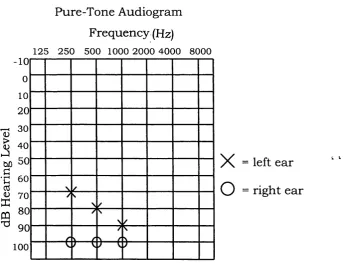
Quality of deafness is measured by testing the child’s responses to tones at different
frequencies (125 - 8,000 Hz). These tones are played through headphones to each ear separately. Each tone is first played at a high decibel (dB) level and gradually
decreased until the child fails to respond. The final dB level at which the child
responds to each frequency is then plotted on an audiogram (see Figure 1.1).
Information on such pure-tone sensitivity is essential to ensure that the child is provided with the hearing aid that enhances sounds at appropriate frequencies. Since
every child’s audiogram is different, it is difficult to control for hearing loss at specific frequencies in group studies therefore degree of deafness across frequencies is used as one of the selection criteria in this thesis.
Figure 1.1: Audiogram example
Pure-Tone Audiogram
Frequency (Hz)
125 250 500 1000 200 0 4000 8000
!
CiO ■ g D X9
-10 0 10 20 30 40 50 60 70 100 / V /r\ (\ //■\
vj) K) Ir
X
O
left ear
right ear
hearing loss of lOOdB in the right ear and 80dB in the left ear. A person’s overall degree of hearing loss is then usually described as the level o f hearing loss in the
better ear. In Figure 1.1 the child has a hearing loss of 80dB in the better ear. This degree of hearing loss is then used to categorise a person’s deafness according to a classification system that ranges from normal hearing to profound deafness.
Boundaries of this classification system can vary. The system used by the RNID (1997) is adopted in this thesis. This is shown in Table 1.2.
Table 1.2: Classification labels o f levels of deafness (RNID, 1997)
Range of hearing loss Label
up to 25 dB normal
26-40 dB mild
41-70 dB moderate
71-95 dB severe
95 dB + profound
Speech requires mean intensities of around 45-55 dBs to be heard clearly over the tested frequency range, although sensitivity to different speech sound contrasts differs
over this range. Since this thesis is concerned with those deaf children who are least likely to have useful auditory speech experience, only severely or profoundly deaf
children were tested.
1.3 Early language experience at home and at school
From an audiological perspective, deaf children are not a homogeneous group. The
amount and quality of speech input differs greatly between deaf children due to the
type of deafness (sensori-neural or conductive), the age at onset and the degree of deafness at specific frequencies. Another factor to affect heterogeneity of the deaf
deaf people as a homogeneous experimental group who were ‘without language’ (e.g., Furth, 1966). However, consideration of the factors that affect the early language experience of deaf children demonstrates that they are not ‘without language’. Rather
the early language experience of a deaf child, in the home and at school, is
dramatically different to that of a hearing child.
Most deaf children are not brought up in a fluent sign language environment.
Therefore they miss out on incidental language that a hearing child can overhear or a
deaf child in a fluent sign language environment can oversee. The importance of such
incidental language exposure in the first three years of life, regardless of modality, cannot be overestimated. This is precisely the crucial window of opportunity for learning language (Newport, 1990). A child exposed to language after this sensitive period may not achieve fully proficient language skills. Such poor language development in early childhood will affect social, emotional and cognitive development and will also have knock on effects for subsequent language
development when the child reaches school age. Since the first systematic language exposure many deaf children encounter is when they enter school, at around four- years-old, the language approach used at school is also likely to influence their cognitive development.
The factors important to a deaf child’s early linguistic experience considered here are:
• age at diagnosis of deafness ,
• parent’s hearing status and choice of communication method • language modality used at school
1.3.Î Age at diagnosis of deafness
Recent technological advances mean that universal neo-natal screening for hearing
situation is that most infants are first tested for hearing at eight months. This test is administered by a health visitor and determines whether the child turns to locate low-
level sounds made out of the child’s field of vision. Davis et al. (1997) found that around fifty percent of children with a hearing loss greater than 40dB would not be
diagnosed by eighteen months using this method of screening. Furthermore, half of
these children would not be diagnosed by the age of three and a half. Therefore, at school entry age, around twenty-five percent of children with a permanent hearing
loss have not been diagnosed.
Failure to diagnose deafness until a child is two- or three-years-old means that:
• The child will not have had the benefit of wearing hearing aids and therefore will
have missed out on important early auditory experience.
• Parents will not have adapted their communication behaviour accordingly to accommodate their child’s deafness.
• Parental and family adjustment is more likely to be problematic (Bamford & McSporran, 1993).
Late diagnosis of deafness can thus lead to impoverished early language experience. This can impair subsequent language development, placing major obstacles in the way of the child’s development of cognitive, social and emotional skills.
1.3.11 Parents’ hearing status and choice of communication method
D eaf children o f hearing parents
Ninety percent of deaf children are bom to hearing parents who are unlikely to have
previous experience of deaf people. Their knowledge of the audiological condition of deafness is likely to be limited, as will be their knowledge of the community in which
many deaf people participate. This is usually termed ‘D eaf culture. As a result of this
arrival of a deaf child (see Gregory, 1976; Gregory, Bishop & Sheldon, 1995).
Adjustment to having a deaf child in the family will depend on a range of factors such as marital stability, social support, socio-economic status and mother’s educational
level (see Musselman & Kircaali-Iftar, 1996; Calderon, 1988 - cited in Calderon & Greenberg, 1993).
One of the most difficult decisions faced by parents is choosing the language approach to use with their deaf child. The main options available are spoken language
and sign language. Although these are not necessarily used independently of each other, they can be defined as follows:
• Spoken language: There are a number of approaches with the shared goal of
achieving good spoken language skills by deaf children. All these approaches involve maximising the child’s use of their residual hearing by paying particular
attention to the appropriate use of hearing aids. The natural aural approach
assumes that natural speech reading with aided hearing will suffice to develop
spoken language ‘normally’. A more traditional oral approach would also include
some specific speech-training techniques, both visual and aural. Finally, cued
speech (Cornett, 1967) incorporates taught cues to aid lip-reading. Handshapes, positioned around the mouth, are used to disambiguate patterns that are difficult to lip-read. However, cued speech is not used in formal education in the UK and therefore is not widely accessible.
• Sign Language (in the UK, British Sign Language - BSL): Sign languages are
natural languages used by Deaf communities around the world. Sign languages are now recognised as full languages in the same sense as spoken languages (see Sutton-Spence & Woll, in press). The grammatical structure of BSL is very
different to that of the spoken language that surrounds it, English. BSL is
conveyed in space using movement of the hands, face and body. In addition to
uses 26 different handshapes to represent the letters of the alphabet. Therefore,
any English word can be spelt on the hands. In BSL fingerspelling is mainly
restricted to representing proper names.
One of main factors influencing whether a deaf child will develop good language skills, regardless of the approach chosen, is the degree of parental commitment and
motivation to the language development of their child (see Musselman & Kircaali-
Iftar, 1996). In particular this may be the case for hearing parents who choose sign language as their mode of communication with their child, since they are unlikely to
have previous useful experience of sign language.
Only a small proportion of hearing parents of deaf children uses sign language. Of those that do, few achieve proficiency in its use (Young, 1997) as they are late
learners of a second language. Hearing parents learning sign language are likely to face a number of additional difficulties. Young (1997) suggests they must try to balance the “ ..quest for Sign Language proficiency, ....acknowledging the overriding
importance of communication and confirming the visual quality and child
appropriateness of the signing” (1997, pg. 264). Therefore, in practice, hearing parents often use single signs to support spoken English. This is termed Sign Supported English (SSE) as English word order is retained and single signs are used
to represent the main terms. SSE can be considered to be an inter-language: - a form combining elements both of English and BSL, although relative dominance of each
language will vary between individuals (see Woll, 1998). This means that deaf children are often exposed to language models that are ill-formed in terms of BSL.
Also, spoken language may be slowed and more disjointed when used in conjunction
with signs. Therefore, although sign language is conveyed wholly in the visual
medium and is fully accessible to a deaf child on a sensory basis, good models from
D eaf children o f deafparents
So far, only deaf children of hearing parents have been considered. Deaf children of
deaf parents (10% of total) are likely to have very different language exposure for a
number o f reasons.
• Deaf children of deaf parents (DoD) are likely to be diagnosed earlier than deaf
children of hearing parents (DoH) as they are considered to be at risk.
• The first language in most deaf households is BSL, therefore DoDs are able to
oversee signed conversations in the same way a hearing child can overhear spoken conversations at a very early age.
• Regardless of whether the first language in the home is sign or speech, DoDs are
likely to experience a more effective language environment than DoHs as deaf parents are usually more aware of their deaf child’s needs and adapt their behaviour accordingly. For example, a hearing child can look at an object while
simultaneously attending to an auditory label given by the caregiver. In contrast, a deaf child must switch attention from the object to the caregiver to see the label, whether it is spoken or signed. Deaf mothers often make this learning process easier for their deaf child by performing the sign next to the corresponding object, rather than in normal signing space, so that visual input is maximised (Harris, Clibbens, Chasin & Tibbetts, 1989; Harris & Mohay, 1997).
The finding that DoDs often outperform DoHs on different aspects o f cognitive
ability such as IQ (Braden, 1994) and reading (Kusche, Greenberg & Garfield, 1983) has often been attributed to their rich early language exposure, usually presumed to be sign language. However, isolating one factor as the cause of the enhanced cognitive
development of DoDs may be too simple. DoDs are also likely to have experienced
better family dynamics, parental support and general early socialisation than DoHs.
Although these could be considered secondary factors of language experience, they
Language modality used at school
Language experience at school may influence cognitive processing of deaf children
tested in this thesis to an even greater extent than language experience at home for
two reasons:
• Approximately twenty-five percent of deaf children are not diagnosed until the age of three and a half (Davis et al., 1997). For these children, the language environment they encounter at school is likely to be their first systematic exposure to language and is critical to their subsequent language development.
• The majority of deaf children who participated in this thesis attended residential schools for the deaf where the communication policy employed in the classroom is extended to out of school hours. Thus, the effect of language modality used at school may be extensive.
The issue o f which language approach should be used to educate deaf children has
been debated since the beginning of modem deaf education. This is a politically sensitive issue as it can be argued that the choices made on behalf o f the child ultimately determine how the child will later fit into society as a deaf adult. That is, whether they will integrate into the hearing world, the Deaf world or feel comfortable in both. Any researcher working in the field of deafness needs to be aware of these
issues, which are difficult to avoid. Therefore the educational placements available to
deaf children, in terms of language approach, will be reviewed briefly. ^
Oral approach
The oral approach uses only spoken language and particular attention is paid to
maximising residual hearing using hearing aids. The main premise of this approach is
that spoken language is dominant in mainstream society and a child should not be
same levels of academic achievement as their hearing peers. For example, Conrad (1979) showed that the average reading age of the deaf school leaver was nine-years-
old. He concluded that “ Oral education leaves too many deaf children close to
illiterate” (1979, pg. 175). This led many education authorities in the UK to
incorporate sign language into the education of deaf children.
Total Communication
Schools that adopt a sign language approach do not use pure BSL. This is due to a lack of deaf teachers and a lack o f hearing teachers of the deaf with appropriate levels
of sign proficiency. The most widely used ‘manual’ approach is Total Communication (TC) which involves a combination of BSL signs and spoken English. As spoken English and BSL have different grammatical structures it is not possible to use both languages simultaneously. Instead, English word order is usually retained and either Signed English (SE) or Sign Supported English (SSE) is used. In SE signs are used to represent all terms in the spoken sentence including morphological aspects of spoken language for example, plurals and tenses. This makes communication very slow and therefore SE is restricted to use in educational situations. SSE is a more widely used system. Here, the English word order is retained and only the key parts o f the sentence, such as nouns and verbs, are signed.
Recently, proponents of oralism have argued that the educational achievements of
deaf children under a TC approach have not increased substantially since the timq of
Conrad’s study and that this approach has failed deaf children (Lewis, 1996; Lynas, 1994a; 1994b). They claim that more efficient hearing aids and earlier diagnosis of deafness mean that oral education can now provide deaf children with greater access
to spoken language leading to higher academic achievement. They argue it is time for
a return to the oral education of deaf children (Lewis, 1996).
The response to this challenge from proponents of sign language is that a sign
succeed (Kyle, 1994). They argue that since the majority of teachers of the deaf are
hearing, with variable levels of sign skill, deaf children are often not exposed to ‘true’ sign language. In school they are usually exposed to an artificial use of sign language
in the form of SSE, whose syntax and morphology come from spoken English.
Bilingualism
A new approach to the education of deaf children is that of ‘Bilingualism’. Some
regard this as a resolution of the conflict between the inadequacies of oral and TC approaches. Ideally bilingualism involves using BSL to establish good language skills and a good knowledge base, while English is taught as a second language to facilitate
access to literacy.
However, this approach does not satisfy all parties and many argue that Bilingualism has been embraced too readily in the absence of empirical support, as perhaps TC was twenty years ago. Lynas (1994a) goes further in her condemnation and argues that the enthusiasm for bilingualism;
“ ...has been given momentum by the weight of an ‘evangelical’ movement of, doubtlessly well intentioned but politicised, militant deaf activists claiming rights to cultural hegemony of deaf individuals” (Lynas, 1994a, pg. 150).
This statement captures something of the heat of the debate within deaf education
today. Although deaf children attending schools employing different language
approaches are compared in this thesis, the aim is not to present evidence for or against different types of language approach. Rather the goal is to explore the effect
1.4 Chapter 1: Implications
This chapter has outlined some of the factors that affect the early life experiences of deaf children. A consideration of these factors allows some insight into the world of a
deaf child and the immense impact that deafness can have on all aspects of early socialisation and cognitive, social and emotional development. Perhaps surprisingly,
the atypical language experience of so many deaf children does not appear to result in a general cognitive deficit. Deaf children have been shown to perform as well as their hearing peers on tests of non-verbal IQ (Braden, 1994). However, the combined influence of the factors discussed in this chapter can have a devastating effect on some aspects of a deaf child’s cognition, in particular those tapping linguistic ability. Deaf children usually perform below their hearing peers in tests of reading ability
(e.g., Conrad, 1979), verbal IQ (Braden, 1994) and vocabulary development (e.g., Griswold & Commings, 1974). Since language-based STM skills are related to important cognitive skills such as learning to read, the focus of this thesis is STM for
linguistic stimuli.
The subject characteristics discussed in this chapter are likely to influence the
Chapter 2 - Short-term memory in hearing adults and children
2.1. Introduction
Short-term memory (STM), as measured by immediate recall or recognition of
previously presented items, is related to a range of cognitive tasks such as learning to read, reading complex text and arithmetic skills (see Gathercole & Baddeley, 1993). One of the sources of evidence for this relationship comes from research with special populations. For example, numerous studies have shown that developmental dyslexies
have poor memory spans (e.g., Jorm, 1983; Snowling, 1991). However, the direction of causality between STM skill and performance on cognitive tasks is not yet clear. Memory span may have a direct effect on reading skill, alternatively reading may affect memory span. It is also possible that there is a reciprocal relationship between the two skills or that this relationship is mediated by a third independent factor, such
as phonological awareness (see Goswami & Bryant, 1990). Moreover, the inter relationships may differ at different ages and different levels of skill. Despite the
debate in this area, the fact that a relationship does exist between STM and a range of
cognitive skills makes the study of STM an important area of research. By establishing the nature o f STM functioning in children, the possibility of specifying
the precise relationship between STM and other cognitive skills is enhanced.
The purpose of this chapter is to review the literature regarding STM processing and
coding by hearing people. In particular, the development of these processes in hearing children will be discussed. This chapter is divided into four main sections:
• First, models of STM will be discussed. The working memory model (Baddeley
• The second part of the chapter explores characteristic effects of verbal STM
which have informed the development of models of STM over the past thirty years. The use of a speech-based code in STM will be discussed, along with the effect of irrelevant speech, word length, speech similarity and concurrent speech on immediate serial ordered recall (SOR). Some of these effects, and their
possible sign language analogues, are explored with the deaf participants in this
thesis.
• The third part of the chapter reviews the emergence of these characteristic aspects of verbal STM in hearing children. How this informs our understanding of the
development of STM coding and processes in hearing children will be discussed. • Finally, the use o f concurrent tasks to investigate STM processes will be
considered in more detail. Concurrent tasks are used in two experiments reported in this thesis. Therefore, it is necessary to explore the principles and assumptions that underlie the use of this approach with hearing people.
2.2. Models of memory
There has been much debate regarding the structure of memory. Some argue that memory is a unitary system made up of one store (Melton, 1963). Others argue that memory comprises functionally separable systems: one termed short-term memory
(STM), which is resource-limited and required for temporary storage and processing
of information, and another, termed long-term memory (LTM), which is potentially
unlimited in size and required for permanent storage and knowledge (e.g., Waugh & Norman, 1965). The debate regarding the structure of memory continues today.
Evidence supporting a dissociation between STM and LTM led to the proposal of a number of information processing models of memory. Atkinson and Shiffrin (1968)
proposed the modal model, which was a development of Broadbent’s (1958) model of
selective attention. According to the modal model, information enters the processing system via modality dependent sensory stores. This information is then passed into a
short-term store and finally into a long-term store. The short-term store was assumed to be an active part of the system involved in processing information en route to the
long-term store and incorporating a number of control processes, such as rehearsal, coding and retrieval. Atkinson and Shiffrin also proposed that the short-term store was involved in many aspects of human cognition and should therefore be regarded as a ‘working memory’.
However, Atkinson and Shiffrin’s model could not readily account for some aspects of the neuropsychological data. Shallice and Warrington (1970) identified a patient K.F. whose STM skills were impaired, yet his long-term learning was normal. Furthermore, K.F.’s STM impairment did not affect his performance of everyday activities. Until this time it had been assumed that any STM system was a unitary storage system of limited capacity. It was also assumed that STM played a fundamental role in a number of cognitive processes such as reasoning and comprehension. That is, all sensory information must be processed via STM.
However, KF had impaired digit span yet his general cognitive processing was intact. Baddeley and Hitch (1974) explored this discrepancy by attempting to create, an
analogue of KF’s performance in normal subjects by ‘filling STM’ with a demanding task (dual task paradigm).
The digit span task had traditionally been regarded as an index of STM ability. This
task requires immediate recall of digits in the order presented. If performance on a cognitive task, such as reasoning, relies entirely on STM processes, then requiring
subjects to retain digits and perform a reasoning task simultaneously should impair
digits) there was little or no effect on reasoning. When the load was increased to six
digits performance on the reasoning task, although impaired, was still functional. This
suggested that there was a “ ..considerable component of working memory which is not taken up by the digit span task” (Baddeley & Hitch, 1974, pg. 75). That is, STM
may comprise of multiple systems, each related to a specific domain. Support for this interpretation came from STM patients such as PV whose memory impairment differed across different aspects of STM. PV’s recall o f auditory stimuli was
substantially poorer than her recall of visually presented stimuli (Basso, Spinnler, Vallar & Zanobio, 1982).
To account for these data Baddeley and Hitch (1974) proposed the ‘Working Memory’ model. In this model STM was fractionated into a number of subsystems: a control system, termed the central executive, and a number of modality-specific slave
systems (verbal and spatial). According to this model, patients such as PV and KF were able to perform everyday activities because they had only suffered damage to the part of the STM system that dealt with verbal material, yet the rest of their STM system was intact. The working memory model was also able to account for the differential effects of memory loads of three and six digits on reasoning ability. When verbal memory load exceeds the capacity of the verbal slave system, central executive
processes are recruited to help retain the sequence. These processes were thought to be employed in cognitive tasks such as reasoning. Therefore when a large memory
load was imposed performance on the cognitive task was impaired. ,
In the UK, the term ‘working memory’ has become synonymous with the model of
STM proposed by Baddeley and Hitch (1974), later revised to account for new
findings (Baddeley, 1986). However, the term is used elsewhere to refer to rather different concepts (for a review of the use of the term see Richardson, 1996). In North
America ‘working memory’ is often used to refer to a general processing resource that co-ordinates the functions of STM and LTM in relation to a specific task such as text
term working memory, in this thesis the term working memory is only used to refer to the model proposed by Baddeley and Hitch (1974; Baddeley, 1986).
The working memory model has remained particularly influential, especially in the UK. It has generated much research, which has led to refinements in the model itself (Baddeley, 1986). It has also inspired the development of new models, particularly of
phonological STM (see Gathercole, 1996; 1997; Chapter 7 in this thesis), which have
their roots in the working memory model (e.g., Burgess & Hitch, 1992).
2.3. The working memory model (Baddeley & Hitch, 1974; Baddeley,
1986)
The original working memory model, proposed by Baddeley and Hitch (1974), consisted o f a control system, termed the central executive and two slave systems: the visual spatial-sketch pad, specialised for visuo-spatial material and the articulatory loop for speech material. The basic structure of the model has not changed materially, although the slave systems have become more fully specified over this time. Each of the components of the working memory model will now be discussed in turn.
2.3.i. The Central Executive
The central executive is thought of as a limited capacity processor involved in the
planning and control of actions. It is also thought to play a role in visual imagery (Logie, 1995) and the combination of information from the visuo-spatial sketchpad,
the phonological loop and other cognitive systems, including LTM (Baddeley, 1996).
Although many high level cognitive processes have been attributed to the central executive it remains “ ...the most complex and least understood component of the
supervisory attentional system (SAS) proposed by Norman and Shallice (1980). This model accounts for a subject’s strategic control of action when necessary. For
example, allowing a subject to cope when an automated task, such as driving, is
interrupted.
A task used to explore the function of the central executive, which demonstrates the
possible role of the SAS, is the random generation of numbers, letters or spatial sequences. Numbers and letters are often cited in a well-known order, for example ‘1, 2, 3’ or ‘A, B, C’. The requirement to produce these stimuli in random order places
demands on the central executive to override the automated route of ordered
production (Baddeley, 1966a). Increasing task demands further, by requiring a fast generation rate, leads to greater impairment of performance and responses become less random (Baddeley, 1966a; Towse, 1998). This suggests that the random
generation task taps central executive resources and can, in turn, be used in a dual task paradigm to determine which cognitive processes are dependent upon the central executive (see Baddeley, 1986).
Further use of random number generation and other tasks may further illuminate the structure of this part of the working memory model. At present it is unclear whether the central executive is a unitary system or made up of a separate subsystems (e.g.,
Barnard, 1985) that form an “ executive committee” (Baddeley, 1996, pg. 26).
2.3.Ü. Visuo-Spatial Sketchpad
The visuo-spatial sketchpad is thought to be responsible for the processing and
storage o f visual and spatial information within STM. Until recently the visuo-spatial
sketchpad has been a poorly developed part of the working memory model. In a review o f this area, Logie (1995) proposed that the visuo-spatial sketchpad might
information. Second, an inner scribe that is thought to rehearse information in the visual store and be involved in planning movement.
Temporary storage of information in the visual cache in the form o f a visual
representation has been inferred from a number of sources. First, irrelevant visual material appears to interfere specifically with retention of visual stimuli (Quinn &
McConnell, 1996). Second, confusions for items that are visually (pictorially) similar can be made in STM. However, this only occurs under some conditions:
• In young children who do not yet use a speech-based STM code for visual stimuli (e.g., Hayes & Schulze, 1977).
• In children in late childhood when concurrent speech precludes verbal recoding of the item (Hitch, Woodin & Baker, 1989).
• In adults, in conditions of concurrent speech when stimuli are presented simultaneously rather than sequentially (Frick, 1985).
• When stimuli are presented at a fast rate so that verbal labelling of items is not
possible (Wolford & Hollingsworth, 1974).
• When stimuli are unnamable, such as unfamiliar Chinese characters (Hue & Ericsson, 1988).
Evidence supporting the existence of an inner scribe has come mainly from studies involving performance of irrelevant tasks. A series of studies by Smyth and colleagues have shown that memory for movement sequences can be disrupted,by
irrelevant movement in the retention interval (e.g., Smyth & Pelky, 1992; Smyth &
2.3.iii. The Phonological Loop
The phonological loop is the most thoroughly explored part of the working memory model. It is thought to be responsible for processing and maintaining phonological
information. Originally this component was termed the ‘articulatory loop’. This was
thought to be linked to underlying speech mechanisms and have the primary function
of refreshing articulatory programs stored in the loop (Baddeley & Hitch, 1974). It was also thought to be a time-based system, with a linear relationship between the number of words recalled in serial order and the time taken to articulate the words (Baddeley, Thomson & Buchanan, 1975; Hulme, Thomson, Muir & Lawrence, 1984).
This simple model of phonological STM was later revised to account for new experimental data. It was renamed the ‘phonological loop’ to account for the fact that the loop was not purely articulatorily based (Baddeley, 1990). One of the main lines of evidence for this came from teenagers unable to speak since birth, anarthrics. These subjects showed similar characteristics of phonological STM as normally articulating people (Bishop & Robson, 1989). The major revision to the structure of the model was to divide the loop into two components that dealt with phonologically structured material: a phonological store and a control process involving subvocal rehearsal under strategic control of the individual (Baddeley, 1986; Salamé & Baddeley, 1982) (see Figure 2.1). Support for the functional and possible structural dissociation
between a phonological store and a subvocal control process comes from recent
imaging studies which suggest the phonological store to be localised in the left
Figure 2.1: The Phonological Loop, derived from Baddeley (1986)
■A subvocal rehearsal
process
phonological store non-speech
input
speech input
The phonological store temporarily holds information in the form of a phonological
memory trace. The memory trace of the stimuli to be recalled is thought to decay after approximately one and a half to two seconds unless it is refreshed via the subvocal rehearsal process (Hulme, Thomson, Muir & Lawrence, 1984). This rehearsal is thought to be cumulative. That is, after the presentation of each new stimulus the whole set is rehearsed from the beginning.
The phonological loop is thought to deal with stimuli in different ways according to modality. Spoken stimuli have direct access to the phonological store, whether they are auditory or simply lip-read (Campbell & Dodd, 1980). In contrast, since the store only processes phonologically structured material visual stimuli, such as pictures or
text, must first be recoded into a phonological code to gain entry to the store. The subvocal control process is responsible for this recoding. Thus, the subvocal control
process is thought to be responsible for recoding visual stimuli into a speech-based code to gain access to the phonological store and subvocal rehearsal of these speech-
2.3.iv. Summary of Section 2.3
Over the last twenty-four years the working memory model has proved to be an influential model of STM, particularly in the UK. By making only few assumptions about its structure, the model can account for a wide range of experimental data. It has
also generated a wealth o f new research and raised new empirical questions. An
indication o f the fruitful nature of the working memory model is its continued development over time rather than simply being replaced by an alternative model.
Very recent developments in the proposed structure of the working memory model have attempted to account for the data indicating the strong influence of long-term knowledge on STM processes which the earlier model did not address (see Baddeley, Gathercole & Papagno, 1998; Gathercole, 1997; Logie, 1995; 1996). These
developments and alternative models of STM will be considered further in the Discussion chapter of this thesis and in Experiment 5 (Chapter 6) which explores the influence of long-term semantic knowledge on immediate recall by deaf children.
At this point it is worth considering how coding systems used by deaf people may be accommodated in the working memory model. One possibility may be that deaf
signers use a code based on the phonological parameters of sign language within the
visuo-spatial sketchpad. However, the visuo-spatial sketchpad is specifically
non-linguistic (see Logie, 1995) and BSL is, above all, a structured language (Sutton- Spence & Woll, in press). So the phonological loop may be a more appropriate
framework in which to consider STM for linguistic stimuli by deaf people.
2.4. Characteristic effects of phonological STM in hearing people
The task most widely used to investigate the nature of the phonological loop is the
either be recalled in the order in which they were presented (serial order recall -
SOR), or in any order regardless of serial position (free recall - FR). Rehearsal in the
loop is cumulative and is therefore based on temporal order. SOR is therefore a sensitive measure of phonological loop function. The two most commonly used ways
of testing SOR are:
• Memory span - The number of items presented for recall is increased until the subject fails to reach a certain criterion, such as accurate recall of two out of three lists at a particular list length. Memory span is then the largest number of items recalled before errors occur.
• Recall of stimuli of fixed list lengths - In this procedure all subjects are presented with a fixed number o f stimuli. To avoid ceiling effects the number of stimuli presented is usually set at above the average memory span for the subject group tested. Since memory span increases with age, in developmental research different age groups are usually presented with different list lengths of stimuli. The dependent variable (memory accuracy) is then the mean number of items correctly recalled across trials.
Manipulations of these SOR tasks have led to the identification of characteristic effects of phonological STM. The following effects will be discussed in detail:
• speech-based coding
• irrelevant speech effect
• word length effect
• speech similarity effect