1
The Shape of Cities: Geometry,
Morphology, Complexity and
Form
Why have cities not, long since, been identified, understood and treated as problems of organized complexity?Ifthe people concerned with the life sciences were able to identify their difficult problems as problems of organized complexity, why have people professionally concerned with cities not identified thekind of problems they had? Oacobs, 1961, p. 434.)
1.1
Understanding Cities
When Jane Jacobs posed her prescient question over 30 years ago, our understanding of cities was still dominated by the search for a visual order. As our immediate knowledge of the city is visual, it is perhaps explicable that urban problems which manifest themselves in cities are first associated with the destruction of visual order and harmony. The clear consequence of this has been the quest to solve, or at least alleviate, these problems by reimposing this order or developing it anew through city planning and design. Indeed, modern city planning still takes its inspiration from works such as Camillo Sitte's (1889, 1965)City Planning, According to Artistic
Prin-ciples,which was published a little over 100 years ago. As long as man has
sought to interpret the city, this has been mainly though the visual arts and architecture, culminating in the present century in the ideologies of the Garden City, the City Beautiful, and the Modern Movement. This deeply ingrained view of the city has had a profound influence on less artistic, more humanistic and somewhat more explicitly scientific approaches which in turn have sought to see the city through the need to assert statistical order in terms of homogeneity of its structure and the suppression of 'unde-sirable' diversity. Indeed, since Jane Jacobs elaborated her thesis, our under-standing now augmented by the realization that the city presents a kaleido-scope of complexity, has hardly changed; planning and design still seek to impose a simplistic order on situations which defy our proper understanding and which we can only perceive as disordered.
distinction between these types is manyfold and often blurred, and of course there exists a continuum from organic to planned growth, many if not most towns being formed from elements of both. One of the key distinc-tions involves the speed at which cities change, while another relates to the scale of their development. Organically growing cities develop much more slowly than those which are planned. Cities which grow naturally are for-med from a myriad of individual decisions at a much smaller scale than those which lead to planned growth which invariably embody the actions of somewhat larger agencies. Planned cities or their parts are usually more monumental, more focussed and more regular, reflecting the will of one upon the many or, at best, reflecting the will of the majority through their elected representatives. Finally, organic change involves both growth and decline, while planned change is more asymmetric, frequently embodying growth but rarely dealing with decline. Thus in this sense, a more complete picture of urban development is based on a backcloth of natural or organic growth interwoven both in space and time by planned development.
These distinctions articulate themselves in clear visual ways. Organically growing towns seem to fit their natural landscape more comfortably in that if decisions are smaller in scale, they reflect the properties of nature more closely as well as reflecting more intense concerns at the local level. The degree of overall control and coordination between such individual decisions is usually less explicit while the overall resources which govern such development are mobilized separately in their parts without regard to any economies of scale which might be generated centrally. The develop-ment which occurs is much less systematic and often irregular in form, and such irregularity of form conflicts with our intuition and predisposition to thinking in terms of the simplistic geometrical order based on the geometry of Euclid and the Greeks. Moreover, it is naturally growing cities which have led to the various biological analogies so popular in describing city growth since the work of Geddes (1915, 1949). Planned growth appears more man-made in that the patterns produced are more regular, reflecting more control over the natural landscape, and the mobilization and coordi-nation of much larger quantities of resources devoted to the development in question.Inhistory, such plarui.ed developments are invariably centered upon the areas of towns associated with political or religious power - pal-ace and temple complexes, or with rapidly developing colonial towns, while in the modem age, retail and industrial developments in contrast to residential display some of the same regularity. However, it is impossible to identify solely organic or planned towns, for these two classes of devel-opment merge into one another in many different parts of the city and at many different scales.
In terms of the doctrine of visual and statistical order, organic towns when viewed in plan form resemble cell growth, weaving in and out of the landscape, closely follOWing the terrain and other natural features, embodying the technology of movement through main transport routes, like spider webs or tree-like forms focussed on centers which usually con-tain the origin of growth. Their geometry seems irregular, although as we will be at pains to emphasize throughout this book, this should not imply
Idisorder'. In contrast, planned towns display a geometry of straight lines
The Shape of Cities: Geometry, Morphology, Complexity and Form 9
imposed from above, embodying some sense of man's direct control over nature through technology. Until this century, such planned developments were either parts of larger towns or very small complete towns, more at the scale of the village; although with the institutionalization of large scale urban planning in the last 80 years, much more grandiose plans for entire cities such as the British New Towns or capital cities such as Chandigargh and Brasilia have been attempted which embody a more perfect geometry. Nevertheless, most towns and cities provide a blend of both, usually con-taining elements of the planned within a backcloth of organic growth. One of the clearest and perhaps surprising examples is the Athens of the fifth century BC where the acropolis, the agora and straight streets such as the
Panathenaic way were but isolated elements in a city whose
"... corresponding architectural growth was ... slow and unsystematic and irregular" (Wycherley, 1962).
. These differences between organic and planned growth strike at the very core of the way cities are developed and manifest themselves in every way we might conceive their study. Inthis context, we will concentrate on the geometry of cities, on their spatial properties as displayed mainly in two dimensions through their plans, and in this sense, we will emphasize their shape. Nevertheless, we are confident that our approach does not stand aside from the mainstream, but maps closely onto other ways of under-standing cities through diverse disciplines within the arts, humanities, the social and the engineering sciences. Our starting point in this chapter will be the ways in which traditional and popular geometry has been fashioned to extend our understanding of cities. Wherever planned development has taken place, man has invoked the doctrine of visual order and imposed simple, regular geometrical forms or shapes on cities using the geometry of Euclid and drawing inspiration from such city building as far back as the Greeks. Yet during this century, and particularly since scholars, such as Jane Jacobs amongst others, have drawn our attention to the poverty of city planning in this ancient tradition, the paradigm of the visual order has come under intense scrutiny.
We will begin by tracing the various changing conceptions of how space and time have been abstracted across the broad sweep of human history. Our tendency to continually abstract through simplification manifests itself in the way we use mathematics to portray order and regularity, the way we conceive time as a continuous flow, and the way we perceive space as composed of simple geometries. But this is rapidly changing and we are entering a time when many of these traditional notions are being intensely scrutinized. In our quest to refocus the study of cities using these new ideas, we will first trace the juxtaposition of planned and organic urban forms and the ways these conceptions have dominated the study of urban form throughout history. From this review will emerge a deeper sense of how the morphology of cities should be understood in terms of their form and process, scale and shape, their statics and dYnamics; and this will enable us to map out our approach which builds our understanding of urban form about the new geometry of the irregular - fractal geometry.
In essence the shift engendered by this approach is fundamental in that a theory of the fractal city breaks directly with the tradition that sees cities as simple, ordered structures, expressible by smooth lines and shapes which describe their overall morphology and the disposition of their elements. The change we seek to impress moves us closer to the view that cities are complex organisms, evolving and changing according to local rules and conditions which manifest more global order across many scales and times. In this, our view of cities is closer to modern biology than it is to either the visual arts or classical economics which have both influenced the study of cities and their planning so profoundly over the last century (Steadman, 1979). Nevertheless, our emphasis will still, in the first instance, be upon approaching the study of cities through their geometry and form, but always with this broader and deeper context in mind.
1.2 Ancient and Traditional Conceptions of Space
From the earliest examples of the written record, there is evidence that man has always made sense of the world through powerful simplifying abstractions which seek out the underlying principles and order in our experiences and perceptions. The power to abstract is one which probably sets man aside from the rest of the animal kingdom and it is clear that the ability to impress order and structure on diverse phenomena though cast-ing aside detail irrelevant to the quest in hand, is strongly correlated with our conventional view of human progress. In short, abstraction leads to theory and theory enables the kernel of any phenomena to be isolated, defined and thence explained. From prehistory, such abstraction has been associated with the power to simplify the world visually and from the earl-iest cave p~intings,man has sought to impose smooth geometry on art so that its meaning can be communicated in the simplest and most effective way.
The Shape of Cities: Geometry, Morphology, Complexity and Form 11
agriculture. This was what Toffler (1981) has called 'the first wave', begin-ning in the 'fertile crescent' centered upon the Rivers Euphrates and Tigris, in ancient Babylon. The evidence of man's attempts at visual abstraction and geometrical simplification of both natural and artificial phenomena come fast and furious from these times. Although this revolution was marked more by the natural or 'organic' growth of towns, there are many examples of 'planned' developments where man imposed his simple geometry on the land and upon the processes through which cities were sustained. The first cities show evidence of straight streets, of ordered land uses separated from one another, of vistas and monuments associated with the visual display of political and economic power in temple and palace complexes, of routes radiating from central places and of well-developed hierarchies of city systems consistent with elaborate agricultural and market economies. The earliest excavations have revealed urban agglomerations existing around 2500 BC; the Babylonian city of Ur, Harrapan cities along the Indus such as Mohenjo-daro and ancient Egyptian palaces as at Tel-el-Amarna all attest to the imposition of geometrically ordered streets and buildings following gridiron plans and focussed upon central points such as markets and temples (Morris, 1979).
In fact, there is no sense in the written record of any time when man's spatial sense of order was any less developed than in modern times, although the association of geometrical order with science and with the means to impose that order through technology has changed substantially since the first urban civilizations emerged. The Egyptians considered the world to be a flat plane yet the notion that the world might be round in some sense has been imbedded deep in our psyche since prehistory. The first known map of the world inscribed on a Sumerian clay tablet around 1500 BC, shows the familiar concentric and perhaps egocentric view of society, in that case centered in a circle about Babylon. This convention of centering or focussing social and economic activity in space around some powerful focus such as a city repeats itself throughout history when maps are made and plans proposed, and it has only been in the present century that there has been any sustained effort at thinking ourselves out of this traditional perspective.
It was the Greeks who first developed our visual senses to the point
combinations of the regular, in contrast to the irregular which remained beyond understanding (Berthon and Robinson, 1991).
During Greek and Roman times, the distinction between 'regular plan-ned' and 'irregular organic' forms of urban settlement first appeared. In fact as we noted earlier, most towns grew organically as the product of many individual decisions made according to local rules and circumstances. But the Greeks and Romans left a legacy of planned towns, largely through their efforts at colonizing the known world, and it is there that the first examples of regular town plans based on the gridiron form make their appearance as at Miletus and Priene in present-day Asia Minor. The Roman military camp which could be assembled in a matter of hours also imposed geometrical order on places where none had been hitherto, and as tech-nology developed to a larger scale, this geometry became imposed upon the wider landscape though long straight roads, walls and other man-made barriers as well as through large-scale agricultural cultivation. When the Roman world collapsed and Europe descended into her dark ages, what was left in terms of our knowledge and understanding of space was exten-sive and widely recorded in many treatises: Ptolemy's Geography, Vitru-vius's De Architectura,and of course Euclid's magnificent exposition in his
Elements of Geometrywritten some 300 BC, all of which rang down the ages
to be rediscovered during Europe's Renaissance, precursor to the modern age.
For almost a thousand years from the division of the Roman Empire until the Crusades, the formal knowledge of geometry and science bequeathed upon us by the Greeks lay dormant in the monasteries or in the east in Constantinople where the crossroads with Islam gave it another twist through the development of algebra. In fact, the geometry was so deep-seated that it remained central to mainstream religious thought. There is a beautiful example of man's sense of the world and its geometry in the map produced by Isidore, the seventh century archbishop of Seville, which shows the world as round but formed as three continents, Asia, Europe and Africa, divided by the Mediterranean Sea, and the Rivers Nile and Don
which we show in Figure 1.1. Isidore's map is more abstract than many
before such as Ptolemy's, but it does reveal the extreme abstraction which has persisted until this present century in much map making, especially at the local scale. In the 13th and 14th centuries, Europe began to wake from its long sleep, trade revived, and the world view of society dominated for so long by religion came under increasing scrutiny. With this, the geometry and the science of the Greeks was rediscovered, literally reborn and almost immediately new advances were made in the development of geometry though the discovery of perspective. But it was in science that the real revol-ution in our perceptions of space came from, this time around.
The Shape of Cities: Geometry, Morphology, Complexity and Form 13
Figure 1. 1. A seventh century world geometry (from Berthon and Robinson, 1991).
the laws of gravitation which held for the observable solar system, but also the physical principles for diverse physical phenomena at many scales. Much of Newton's science and that of his contemporaries was deeply rooted in the notion of a perfect geometry. However, it was not the mech-anics established by his insights, but the mathematics which he fashioned to present his science, which reinforced Euclid's view, still our conventional
world view of geometry.In essence, Newton's mechanics depended upon
the principle of continuity. Both space and time had to be continuous in the simplest possible sense for his theories to triumph. In short, the scale of physical systems and the forces which might change their scale could not admit any discontinuity which might change their form. Mass, for example,
should be capable of being accelerated continuously, and if the force
responsible were to cease, so would the acceleration and movement, but at a continually decreasing rate. This was the kind of science that embodied the principle of continuity, enshrined in the mathematics of the calculus which Newton and his contemporary Leibnitz invented to make all this possible. Such systems were said to change in a linear, continuous fashion both in terms of the space and scale they occupied and by which they were defined, and within the time frame of their existence.
During the 19th century, this type of physics based on the mechanics of Newton and the geometry of Euclid became the cornerstone of modern science. In other areas such as in biology, Darwin's theories of continuous evolution through survival of the fittest were also fashioned into the New-tonian mould, while the emergent social sciences began their quest to develop a science akin to physics based on reducing every phenomenon to
continuously varying structures based on simple causal relations,
Bronowski (1973) amongst others has referred to it. The world, however, was about to change, casting a doubt upon our age-old and perhaps super-ficial abilities to simplify through immediate and intuitive abstraction.
1.3 The New Science of Space and Time
At this point, it is worth posing a series of dichotomies which are not only useful in summarizing the changes to various world views which are rel-evant to our quest for a better understanding of space and time but are central to the changes in viewpoint which we will imply in the theory of fractal cities to be developed in this book. First we must contrast the notions
ofsimplicityand complexity.Science stands at an edge between reality and
mind, in perpetual tension between the need to simplify in order to under-stand and the need to provide a requisite variety in our theory to meet the perceived complexity. In one sense, however, the emphasis is more on simplicity, for great science, it is argued, seeks to provide the most parsi-monious,. hence the simplest and most elegant explanation, and success is thus judged through Occam's razor. In fact, we will argue that the science which is emerging everywhere in the late 20th century has found that pre-vious standards of parsimony no longer admit the requisite explanation and thus we are now being forced to move to a higher threshold. In this sense then, our theories are becoming more complicated as well as dealing with new orders of complexity.
A second distinction is between reductionism and holism. Reductionist thinking has dominated physics and economics until quite recently, as indeed it has done biology, but there is a general and growing consensus that more holistic theory is needed which seeks to synthesize, not simply by aggregating the fine detail but by enabling the emergence of higher level form and function associated with new causes and forces. That 'the whole is more than the sum of the parts' may be a long-worn cliche of general systems theory,. but ultimate explanations are no longer likely to be found in the quest for knowing more and more about less and less. To some extent, these issues smack of vitalism,. and one small comer of our quest to counter this depends upon the logic of the ideas developed here. We have already mentioned our third distinction - the emphasis in Newtonian science upon the idea of continuity and the polarization of thecontinuous
The Shape of Cities: Geometry, Morphology, Complexity and Form 15
A fourth distinction involves the degree of homogeneity or heterogeneity which systems display, in essence the degree to which systems manifest
uniformity ordiversity. Systems which are intrinsically diverse and
hetero-geneous have for long been treated as being beyond science in some sense, while those systems for which the most pleasing explanations have been found are those which are well-behaved, controllable, homogeneous and ordered - that is, uniform in some sense. However, increasingly even the simplest systems betray a degree of complexity which departs from our traditional perceptions of uniformity and new theories are beginning to directly address the issue of explaining rather than suppressing diversity. A fifth dichotomy relates certainty to uncertainty. As we have begun to explain more and more, it seems that we are certain about less and less, that is, that our knowledge seems increasingly contingent upon time and space, upon the unique and the ephemeral. How is it, we ask, that the bounds of what we know seem to retreat a little faster than the rate at which we generate new ideas and insights? Is this progress? As we will argue throughout this book, this insight in itself is probably progress of a kind in a world of infinite variety and complexity, one whose nature we have only just begun to recognize.
Lastly, let us dwell briefly on the contrast between the regular and the
irregular. In this book, we will be using this distinction in a very specific
sense to draw out the differences between urban form conceived and per-ceived using the geometry of Euclid with that using the geometry of Mand-elbrot (1983), the founder of fractal geometry, the geometry of the irregular. But the distinction is deeper and more far-reaching than this in that our penchant to abstract is strongly rooted in searching out the regular and dismissing the irregular. In short, we are predisposed to filter out that which we cannot cast into the geometry and the science of the regular although in doing so, we are indanger of casting out the very essence of what we need to explain. Science is only just beginning to grasp the notion that it is the irregular, the complex, the diverse, the uncertain, the whole system which is the proper domain of inquiry and to which we must reorient our quest.
In fact, at the end of the 19th century, classical physics was challenged, not by any of these opposites that are implied in the distinctions we have just sketched, but by the need to address basic forces inrelative rather than
absolute terms. Two different sources of anomaly emerged. First physical
observations of phenomena involving the speed of light such as planetary orbits no longer seemed to fit Newtonian theory, while the conceptual prob-lem of reconciling the space-time frameworks of observers light years apart loomed large. It was Einstein's intuition to visualize such problems and reconcile them by showing that the space-time continuum could no longer be treated as the absolute mould within which the universe existed if observers were to see the same thing at different positions in time and space. This represented the first loosening of a framework which had domi-nated scientific assumption since prehistory and as such represented the biggest challenge to man's intuitive grasp of the universe so far.
constituent parts became an intense focus of concern. As more and more particles came to be discovered - first the electron, then the proton, neutron and so on, a new framework for explaining the position of each was required, and with this came the startling conclusion that the actual position of such subatomic particles was uncertain. Because physical observations of position in time and space could only be made with physical forces, their actual position was fundamentally influenced by the parameters of the measuring device, and so was born the principle of uncertainty attributed to Heisenberg, a central postulate of the quantum theory. In fact, this notion of uncertainty was probably easier to accept in the social world where experience suggested that direct observation of phenomena often had an influence on the nature of that phenomena, and thus physicists were simply learning that the more remote the phenomena from direct observation, the more uncertain the outcome of that observation, a simple enough concept but one that again rocked long-held assumptions of the scientific world.
Reaction against reductionism too has been forced onto the agenda in many fields during the present century. In physics, there has been little success to date with the development of unified theory linking the very small to the very large, although there are intense efforts at the present time and there are signs of breakthrough. However, in less dramatic domains, particularly in the social and biological sciences, the idea that the whole system need be understood has become paramount. Aggregating micro to macro theory has proved to be virtually impossible in economics for exam-ple. Systems which contain many elements have required frameworks for their reconciliation which construct the whole from the parts and from the mid-century, the development of general systems theory has become sig-nificant. At first such theory was static in focus, intent upon explaining the form and function of systems at an instant of time, although in the last two decades such systems theory has been deeply enriched with new ideas concerning system dynamics and behavior. Moreover, the notion that sys-tems might operate almost entirely using local forces which ultimately add up or aggregate to global order has also gained ground as it has become clearer that the very small and the very large can be different aspects of the same underlying system phenomena.
The Shape of Cities: Geometry, Morphology, Complexity and Form 17
economic events which thrive upon such imperfections and although such theory is under intense scrutiny at present, it will take at least a generation for economics to reestablish its theoretical sights.
The same has been true for other social sciences, sociology and psy-chology for example where the space-time matrix has been simply assumed to be a given, neutral with respect to its effects upon the phenomena under study. This lack of a geometrical perspective in the social domain has been both liberating and constraining.Ithas meant in fact that social science has long avoided the trap of physical determinism but at the same time it has meant that the physical constraints of space and time have had little influ-ence in social explanation where often such influinflu-ence is important. In the study of cities for example, it has kept the social and artistic approaches separate except through the pragmatism of geography, and it has inhibited the development of a theory of city systems which is a relevant synthesis of social process and spatial form. In practice, this dichotomy can be seen at its most extreme when commentators and researchers dealing with the same subject using the same jargon present their ideas in diametric oppo-sition through entirely visual or entirely verbal media. Urban theorists from the social domain have found the visual paradigm to be empty for their study of social process while those from the visual arts have found social processes to be impossible to relate to the manipulation of physical space which represents the long-standing medium for city planning and design. Yet changes in our conceptions of space and time which see irregularity and discontinuity as reflecting a new underlying order and system do per-haps provide a fresh perspective as to the impact of physical determinants on social and economic processes. The emergence during the last 20 years of a mathematics and a geometry in which discontinuous change can be ordered in terms of catastrophes and bifurcations and where sudden change can be easily accounted fOf, has helped show the importance of formal dynamics to many fields. More recently, the development of theories of chaos in which deterministic systems generate behavior paths which are unique and never repeat themselves are finding enormous applicability in qualitative studies of system behavior and structure in the social and bio-logical sciences. In fact, there are many physical systems such as the weather which are subject to the same underlying complexity and the notion of an intrinsic order based on strange attractors which can only be envisaged in the higher geometry of their mathematical space has become central to the study of many real systems. In biology too, the notion of smooth change or evolution has also been informed by these theories which explain the importance of punctuated equilibrium, sudden species develop-ment and ecological catastrophe. And in all of this, the smooth geometry associated with Euclid which has dominated our thinking for so long is giving way to a geometry of the irregular which is still ordered but where the order repeats itself across many scales and through many times and where such irregularity is clearly consistent with observations and measure-ments of our most interesting systems.
complexity, she was invoking ideas from general systems theory, of a more speculative kind and associated with tlle writings of Warren Weaver (1967). Weaver argued, as we have done here, that science developed from the 17th to the 19th centuries dealing with problems of simplicity, two-body problems amenable to linear mathematics and strict determinism. The emergence of quantum theory shifted this balance to problems of disor-ganized complexity where the predominant characteristic method of expla-nation was statistical. But between, there lay many problems amenable to neither approach,f l • • •problems which involve dealing simultaneously with
a sizable number of factors which are interrelated into an organic whole" (Weaver, 1967). In short, such systems are those in which the emergence of organization is reflected in their form or morphology. We are now in a position to begin to develop some of these ideas in our study of cities, but before we do so, it is worth reviewing examples and principles of the geometry describing a range of city shapes beginning with the planned city, the city of the ideal, the city of pure geometry.
1.4 The City of Pure Geometry
If there has been any significant change in our visual sense of the city through history, this has been in the nature of the way it has been abstracted and represented. From a contemporary perspective, there appears to have been increasingly abstract representation of urban phenom-ena in visual terms as we delve further into the past which manifests itself in less realism and greater simplicity· than is now acceptable. Currently, with more media to record than at any time in history through photo-graphs, digital imagery and the like, city plans and maps from the past seem to abstract away too much while portraying some detail in almost surrealistic ways. Mapping, now perhaps, is also considerably more single-minded in purpose, and the sort of detail contained in historical maps relat-ing to people and events as well as places suggest that the visual records of the past were for somewhat different and more comprehensive purposes than those we employ today.
The Shape of Cities: Geometry, Morphology, Complexity and Form 19
Figure 1.2. The earliest depiction of the city of pure geometry (from Kostof, 1991).
interstices within the grid, the clear segregation of uses which is often imposed within such planned forms, and the fortified outer wall which was a feature of many cities until the present century when the technology of war went beyond this need.
The first evidence we have of highly ordered geometric forms is associ-ated with either very rapid physical development, such as in military camps, or with more monumental, larger scale building related to the dem-onstration of political-religious-economic power within the city, such as in palace and temple complexes. For example, the camps used by workers to construct the pyramids and other monuments in ancient Egypt were laid out according to the strict principles of the grid, while colonial cities from the earliest Greek civilizations represented a more permanent but neverthe-less rapid application of the same principles. Miletus and Priene are the archetypes, but there are many other examples which have been docu-mented (Morris, 1979; Wycherley, 1962). The grid is also repeated in the development of larger complexes associated with the display of wealth and power throughout the ancient civilizations. All the important cities of the ancient world, Babylon, Knossos, Mycenae, Athens and of course, Rome, provide much evidence of a well-ordered geometry largely built around the gridiron as a basis for the construction of temples, market places, civic buildings and organized leisure in terms of sport and drama.
into a star shape, about some central point, usually the origin of growth. In fact, it is hard to find many examples where such circularity has been invoked as the basis of a geometrical order in towns before the medieval era. The Greeks did introduce radiality into their grids occasionally and there was some preoccupation with the use of the circle in theater com-plexes and stadia. The Romans did the same with their circuses and also in more detailed building through their invention and widespread use of the semi-circular arch. But it was not until the late middle ages and the Renaissance that cities really began to exploit the geometry of the pure circle. This perhaps was due to the lesser control over the geometry through the then available building technology althoughit is more likely that this may have been a purely aesthetic difference between ancient and modern, a difference in taste.
The best examples, of course, of the use of the grid come from the Roman military camp or castra, which is still the basis of many towns plans in contemporary Europe as evidenced best in England in towns ending with 'the word - chester.The main axes - the decumanus and the cardo - of such grids marked out the center of the camp where dwelt the legate, the legion-ary commander, and as the ASSYrian map suggests arrayed around this were more specialized uses serving the legion, with the barracks banished to the edge of the camp often with recreation (the circus, amphitheater, etc.) beyond the wall. The Roman camp also marks the typical scale at which town plans were visualized and depicted up to these times. Although towns could be depicted in terms of their growth at a scale which abstracted away from the actual building and streets, this was very rare. The norm was to represent the town in terms of buildings and streets, and often to impose the geometry of the straight line on forms that clearly did not meet such geometrical purity in reality. However, the size of typical towns up until the modern age was so small and their form so compact that the sort of exploding metropolis reminiscent of the growth of London or the eastern seaboard of the United States which will be examples of our concern here, simply did not exist. This too goes some way in explaining their typical depiction.
The descent of Europe into its dark and middle ages led to the disappear-ance of the city of pure geometry. Towns looked inward; their form was compact although irregular and idiosyncratic, buildings huddled around the center which by now was church and market square. In fact, the notion of the circular city was much in evidence during these times to be fashioned a little later during Europe's Renaissance in more geometric form. In some instances, in the case of planned towns, for military purposes of control at borders, for example, the grid was still being used as it was wherever speed of development dictated its use, a fine example being the crusader port of Aigues-Mortes in the Rhone delta (Kostof, 1991). But what did develop quite distinctly during this period was a concern and fascination for elabor-ate fortifications based on regular but discontinuous geometries which max-imized the amount of space available for the defense of a town.
The Shape of Cities: Geometry, Morphology, Complexity and Form 21
e1100
el700
original castra while by 1100, although this has collapsed into the huddle of medieval buildings, the effect of the original grid is still apparent. The fortifications which encircled the town by 1700 represented a tight bound on growth, although the focus of the town is clearer in its approximately circular expansion from the original center of settlement. The fortifications based on regularly spaced triangular displacements from the straight wall represent the classic style of fortifying towns to increase the wall space available for their defense and as such represent a kind of space-filling phenomenon which as we shall see in the next chapter, is reminiscent of the regular fractal called the Koch or snowflake curve.
The Renaissance, however, was the time of high theory for the city of pure geometry. The rediscovery of the architecture of Greece and Rome through the written works of scholars such as Vitruvius (Bacon, 1967) led to massive experimentation and speculation on ideal town forms. Com-bined with developments in the architecture of fortification, the discovery of perspective which generated the need for a radial focus in the plan as well as within the three-dimensional massing of the city, and the need for regularly laid out city blocks, ideal town plans were much more ambitious than anything previously and such was the strength of commitment and belief in the new order, that the ideal became real in many instances. Figure 1.4 shows two such ideals; the first in 1.4(a) is based on Vitruvius's (republished 1521) first book which is somewhat perplexing in that it estab-lished an ideal in the circular plan, something as we have remarked, that did not exist in Greek or Roman city building. The second plan in Figure
1A(b) is that which was actually built for the city of Palma Nuova outside Venice usually accredited to the Italian architect Scamozzi (Morris, 1979).
Many similar ideal town geometries were suggested as we will note in the next chapter although perhaps the finest which was built is Naarden in Holland whose plan is as close to the original as any. In fact, many such ideas were incorporated into existing cities such as we see at Regensburg in Figure 1.3 as well as in much larger cities such as Paris, Rome and Vienna
where idealized fortifications were continually under construction.
Examples of more regular circular geometries also date from this time, one of the best examples being Karlsruhe which we picture in Figure 1.5 (Morris, 1979; Kostof, 1991). Nevertheless the circular town form was embodied much more thoroughly within existing towns in the form of foci for radial streets and the strategic disposition of circles and squares. Excel-lent examples date from the replanning of Rome under Pope Sixtus V in the late 16th century, Hausmann's Paris in the mid-19th century, Nash's Regent's Park in London, and l'Enfant's plan for Washington DC which was modified by Ellicott, the last two both being implemented during the early 19th century.
The Shape of Cities: Geometry, Morphology, Complexity and Form 23
(a)
i t ,
_...
-...,
.....,..._
...---
-...,.-.,~Figure 1.5. Circular towns: Karlsruhe (from Morris, 1979).
America conformed to the grid as Reps' (1965)The Making of Urban America
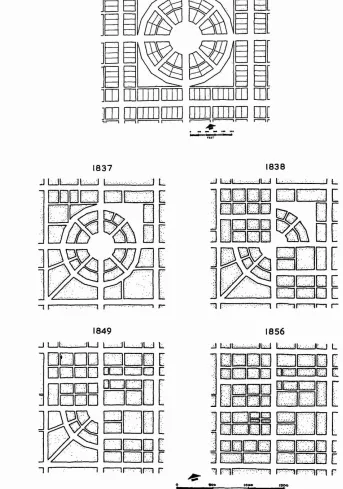
so clearly demonstrates. Yet during these years too, there are few docu-mented examples of how geometrically ordered plan forms actually developed; that is, concerning the extent to which such plans were modi-fied. As we have reiterated throughout this chapter, such plans usually only exist for a snapshot in time and as such, once implemented do in fact begin to adapt to the physical and other constraints of settlement as well as to the actions of individuals working with a different purpose to that of larger agencies. Two examples of the extent to which pure geometry guided devel-opment, however, are worth illustrating. First, the town of Savannah, Geor-gia, was laid out in gridiron fashion in the 1730s by colonists from England and with surprising commitment given the rapid development during these years, the residents of Savannah grew their town according to the grid for the next 100 years. The evolution of the town is shown in Figure 1.6 and is one of the very few examples of urban growth clearly built on purely geometric principles.
The Shape of Cities: Geometry, Morphology, Complexity and Form 25
1733
1801
1735
1815
~
~~
~~~~~~5i3~til~~~ 888BSE38S8888 S1~~~~~~~~~f;l~
B88B§l8sE3B888
t?~~~~~~r;l
8888§g3gLJ
1790
1841
1799
1856
Figure 1.6. Regular cellular growth: Savannah 1733-1856 (from Reps, 1965).
grid as illustrated in Figure 1.7. Aside from the somewhat idiosyncratic example this poses, it does show the power of pure geometry in city build-ing as well as reinforcbuild-ing our popular and deeply-build-ingrained perception of what constitutes 'good design'.
During the present century, there has been a distinct shift to geometries which combine perfect circles and squares and the like with more sinuous although still smooth curves. There has also, in the last 50 years, been a major shift towards conceiving cities in terms of ideal network geometries based on communications routes, largely road systems. Architects and urban designers have exuded more confidence too in their quest to build the city of pure geometry, suggesting larger and larger idealizations of the old ideas. In the late 19th century, more abstract conceptions of the ideal city system based on social and economic ideas of utopia became important in movements such as the Garden Cities (Howard, 1898). These are so sig-nificant that we will deal with them in a later section for what they imply concerning urban form is pitched at a different spatial scale from the ideas of this and the next section. But we must point to the most significant of the 20th century physical utopias and we will begin with Le Corbusier.
The Ville Radieuse is perhaps the most important of Corbusier's
1837
j UL..J~ t.·.,.:... ·...·.:1 L
J
ODD.
D.::.·....O.;.:~~
[.::.::.··.:::·.:.·.1 E.:.:J~~B~8t
J
nQn
FJr7Flr
;: kd
~~ ~~(;_LJ
L
l~··~~nr
J··~(jUL
"'1,. · · · · t f · .... "'I~
1856
.JW~LJL....JLdLJ L
]
: nFJDrJ
~D::"":~r
•..
~~~=~~
JLJDDD
DDtJ
L
1
[]D~D
E:Jf71fl [
JOrnDrtiJWU·.
J
~f7;lnP.71 ~P0P1
[:.j LJW~~ ~LdU .'
~r=9r"":"""""~~n[·
.dLd~ Ld~W ;'
.., I ' j r-:-:l~nr ~." F1r··::·.··:·,·:·, ~P9n
r
....
eGO 10" ,~ ,.~~T
(a)
The Shape of Cities: Geometry, Morphology, Complexity and Form 27
Cen:ral area
•
Housing 0Industry ;0
Secondary schools Gil
Primary schools 51
Open space 0
======1Miles
1 100000
4 kill 3miles tirst phase ot urbanization _ final green areas
(c)
its conception is much greater than anything we have illustrated so far in this chapter but its form is still rooted very firmly within conventional Euclidean geometry. However, the plan like so many in the 20th century is more comprehensive, emphasizing strict segregation of uses, as well as a separate landscape - a green grid - which is the complement of the urban transportation and neighborhood grid. Similar types of grid can be seen in some of the British New Towns which we also illustrate in Figures 1.8(b) and (c).
In contrast, Frank Lloyd Wright's Broadacre City is a city of low density which sacrifices the rigor of communal tower block living to a more indi-vidualist, American style, although he too casts his ideas into a rigid grid. Many other geometric schemes have been suggested since the beginning of the industrial era based on exploiting single principles of urban develop-ment: transport around which the linear city such as Sonia y Mata's Cuidad
Lineal was fashioned in a proposal in 1882 and its application to existing
city forms as in the MARS plan for London in the early 1940s, integrated service provision as in Frank Lloyd Wright's later and somewhat extreme reaction to his ownBroadacre City through the idea of mile high residential superblocks, and in Dantzig and Saaty's (1973) Compact City in which all services are concentrated in a city of five or so levels, but built entirely in purely geometric and organized fashion as a machine for living. We illus-trate these conceptions in Figure 1.9 where it is now clear that the emphasis has changed a little. The geometry of the ideal town has been relaxed slightly during the 20th century; it is more curvilinear, but still linear none-theless.Itis more organized around new transportation technologies and it is more concerned with land uses and activities than with specific build-ing shapes. However, these ideals are still largely visual in organization and intent, and rarely portray any sense of urban evolution which is so important to the development of cities. We will, however, shift our focus, still concentrating on the visual form of cities in two not three dimensions, but now examining cities which are not dominated by pure geometry, those for which their development is often assumed to be more 'natural'.
1.5 The Organic City
Organic cities do not display obvious signs that their geometry has been planned in the large, although they may well be a product of many detailed and individual decisions which have been coordinated in the small. There-fore it is probably more a hindrance than a help to think of organic cities as being 'unplanned' in contrast to those that have been 'planned', as this represents only the most superficial of reactions to urban form. Thus we will avoid any association between'organic' cities and the notions of unco-ordinated or uncontrolled growth, although we will follow at least the spirit if not the word of Kostof (1991) who characterizes the organic city as:
The Shape of Cities: Geometry, Morphology, Complexity and Form 29
(a)
(b)
K Perl
C Sport,
L Motor Inn Tempre~,,(j':eme·
0 Professionel Offices tery
t.4 Industry U Research Stedium
N Merchand;sing V Zoo
F Hotel
Reilroed W Schools
S Sdnit4rium
(c)
Area of Plan is Two Square Miles
(d)
Aerial
view
I I
Vertical view,\ A
:.*.
~========·.i::+=======~>.1 240feet
IE---8840feet ~):"'f
I
Vertical sectionofterrace atA
(p~a/tf~:~Ss) 1~~~~~~~~i"""~"""'~>.~l~"""'~~~~~
...
:>.I
240feet"Land" for building..;lf -'"~_ homes and
facilities
The Shape of Cities: Geometry, Morphology, Complexity and Form 31
of the land, and the daily life of the citizens. The resultant form is irregular, non-geometric, 'organic', with an incidence of crooked and curved streets. and randomly defined open spaces. To stress process over time in the making of such city-forms, one speaks of 'unplanned evolution' or 'instinctive growth'. (Kostof, 1991.)
The biological metaphor in city planning has been used since the 16th century, from a time when man first began to move beyond myth to a scientific study of the body and when analogy became one of the dominant ways of making progress in the sciences (Steadman, 1979). In one sense, the idea of the organic city follows this metaphor, especially reinforced in the notion that the organic cities adapt to individual social and economic preferences, to the constraints of the natural landscape, and to the dominant technology of the city. The metaphor has been exploited as cities have grown exponentially in population especially over the last 300 years, and as activities have begun to restructure themselves more quickly through decentralization of functions and increasing locational specialization. The idea of the city as being composed of a 'heart' - the central business district (CBD), of 'arteries' and 'veins' in terms of the hierarchy of transport and communications routes, of 'lungs' in terms of green space and so on, has been writ large across the face of urban analysis and city planning over the last 100 years.
Yet there has been a subtle and growing contradiction between this meta-phor and the dominant practice of city planning: although the metameta-phor has been widely embraced, it has been used both to argue that cities are sometimes poorly-adapted, sometimes well-adapted - that cities should be planned according to the metaphor or against it - that the evolution of cities shows good fit with their requirements or not, and that cities show stability or are pathological in their evolution, exhibiting more cancerous than balanced growth. There is little consistency between these points of view and the preoccupation with the design of cities in visual terms. In fact, in this book, although we will not exploit the terminology of the biological metaphor, much of what we will argue is entirely consistent with it in seek-ing an understandseek-ing of the city which is deeper and less superficially vis-ual than that associated with the traditional geometric model. Itis in this sense too, that our interpretation of the city is tilted more towards the organic than the city of pure geometry.
higher scales where the focus is upon the growth of entire towns and cities in their urban region.
As we have implied, there is a major problem of representation when we come to examine the visual history of town form. Not only has the type of artistic representation changed as we can clearly see when we examine the forms shown in the figures in this chapter, but the scale at which towns are depicted has altered as they have grown through time, with many more scales of possible representation now than at earlier periods of history. Moreover, the focus of representation has changed. Town plans and maps now are clearly geared to more functional purposes than they were cen-turies ago and there are a greater variety of possible types of urban map. There are also differences between plans which are designed to show geo-metric form which often embody yet-to-be-realized ideas in contrast to existing plans which are part of the historical record and rarely designed to show such ideal conceptions.
The biggest differences, however, between urban forms through history are due to size and scale. Before the modern age, most cities were small and compact, with higher densities, much smaller space standards than now, often by orders of magnitude (witness the barracks space in a typical Roman fort), and transport technologies which were much more limited in terms of their ability to move people and goods as well as in their access by ordinary citizens. By far the biggest city before the 17th century was the Rome of the later Empire which at its peak had over one million inhabi-tants. But Rome was an anachronism. The size of the city was a symptom of the malaise of the Empire for the technology of the civilization was sim-ply unable to sustain such a system. By contrast, the Greek city states rarely grew to larger than 20,000 with only Athens and Syracuse growing to 50,000. Thus before the modern age, urban form was dramatically con-strained in contrast to the physical urbanization of the last 200 years. In this view then, the conception of what we might call organic is not independent of either history or culture.
The Shape of Cities: Geometry, Morphology, Complexity and Form 33
organization, although such elements rarely exist now in isolation from more modern forms of town. Inshort, what this implies is that the theories and models which we advocate here are restricted very much to western cultures whose cities are still largely industrial in structure, although rap-idly changing to the post-industrial. We do, however, consider that the principles of fractal geometry which we will be developing here are rel-evant to cities of any time and any culture, but the examples which we have chosen and the scales at which these are depicted are very much rooted in contemporary patterns of urban growth in the west at the city and regional level.
Another important issue relates to the way the organic and geometric principles of urban form vary with respect to scale. At one scale, the city might appear to be ordered in terms of pure geometry while at another it may appear to have no such planned order and be the product of a multi-tude of local decisions. The example par excellenceonce again is New York. Manhattan developed organically until the early 19th century when the commissioners of the city laid out the island on a regular grid about which all development then took place. But in the wider urban region, develop-ment east through Long Island, on the Jersey shore, into Westchester and Connecticut to the north east was not planned on any form of grid, and at this scale of the city region, the growth looks 'unplanned' and explosive. Zooming out even further to megalopolis - the eastern seaboard (Gottman, 1961) - the organic analogy holds although the region contains much pure geometric planning at the local scale in cities such as Washington, Philadel-phia and Baltimore. At this wider scale, there has been less contention about the merits of geometric planning although the 20th century has witnessed many attempts at such large scale urban planning as we demonstrated in the last section and illustrated in Figures 1.8 and 1.9. However, notwith-standing our focus on irregularity and organic growth at the urban scale and above in this book, fractal geometry is still applicable at lower scales, and in Chapters 2, 7 and 10 we will indicate how such geometry might be used at these finer scales.
dynamic growth
along new line"s of favourable conditions (phase C 1 )
dynamic growth towards an irregular form (phase C 2 ) static city
dynamic growth in a uniform surrounding
(phase A )
dynamic growth: along lines of favourable condition
(phase B)
dynamic growth towards equ~lisatjon of conditions
I
grid 5 x5 km
Figure 1.10. The shape of the organically growing city (from Doxiadis, 1968).
The Shape of Cities: Geometry, Morphology, Complexity and Form 35
still characteristic of those today in the Middle East and parts of Africa; they were inward looking, based almost entirely on pedestrian traffic, with some sense of regularity in terms of the use of straight lines to demarcate property, but closely hugging the landscape and with no sense of overall visual unity in plan form. In so far as the visual quality of such organic development can be applauded, it is in terms of its informality, its idiosyncracies and its picturesque properties and occasionally in its exploi-tation of dramatic natural features, but never in terms of the power of its geometry. As we have implied, from these times there are hardly any examples of organic growth which are faster than the century by century adaptation characteristic of these types of town. Where organic growth was faster and larger in scale as in the Athens of Pericles or in second century Rome, the emphasis was not upon transport and decentralization and dis-persion of functions, but on adapting the site to the most cultured art and architecture in an effort to mesh the pure geometry of building with the natural geometry of the landscape.
By the middle ages, the slow accretion and adaptation of development to its site so characteristic of the medieval town was well established and there are several illustrative examples. We have already seen the evolution of Regensburg in Figure 1.3 from its Roman grid in the fourth century to its replacement by a huddled mass of different sized and shaped buildings by the year 1100. The development is characteristic of the high feudalism which made its mark on the medieval market town too. A more picturesque example taken from southern Bohemia around 1300 is the town of Cesky Krumlov (Morris, 1979) which shows how the meander of the river, the topography of the river valley in which it sits and the circuitous nature of the transport routes have molded its urban form. There is no sense of the grid or the circle in this type of town, although had this been the New World of the 19th century, a grid would certainly have been imposed with interesting consequences. The town and its medieval development are shown in Figure 1.11. Finally, the medieval town also represents the last example of very slow organic growth where towns were compact and constrained behind their walls in a period of comparative stability when population and economic growth was modest but slow.
Figure 1.11. Medieval organic growth in Cesky Krumlov (from Morris, 1979).
Although we are unable to present a clear map of the development of Rome in the late Empire, an excellent illustration of urban development in the early 19th century is Clarke's 1832 map which is given in Figure 1.13. Many of the features of organic and geometric form which we have noted in these last two sections are illustrated here; amongst these, are the clear radial structure of the city in its straight roads focussing upon the Palatine Hill, the slow cell-like growth of Rome itself and its medieval development, the distinct Roman monumental architecture of the Coliseum, forum,
stad-ium and so on, and the geometric planning of Pope Sixtus Vin the late
The Shape of Cities: Geometry, Morphology, Complexity and Form 37
(b) ,~,
Figure 1.13. The organic growth of Rome by the early 19th century (from Morris, 1979).
the power of individual decisions concerning development in contrast to earlier and grander geometric plans for coordination.
Only at this point are we in a position to examine the kinds of urban form which will determine the essence of our explanations in this book. As we have indicated, we do not have a clear and unambiguous time series of urban development in terms of visual (or for that matter any other) form except from old maps, and these are never consistent from time period to time period. However, to give some sense of evolution of urban form over the last 200 years, we show in Figure 1.14 a series of maps for the town of Cardiff from the mid-18th century to the modern day, all reproduced at different scales, showing the way urban development has been depicted differently over this period and also the type of irregularity of form which is the norm rather than the exception in terms of the modern city. We have not abstracted from these maps because we do so in later chapters where we use Cardiff extensively as one of our examples. In fact, in Plate 5.1 (see color section), we show the growth of the city from the late 1880s to 1949 in four stages taken from the relevant maps within the series given in Figure 1.14.
The Shape of Cities: Geometry, Morphology, Complexity and Form 39
(a)
CARDIFF IN tSll
(b)
i£~:t:
~~~
"..."..
(,
(d)
scale, that of the city and its region, had been well established. In Figure 1.15, we show a diagram from the first edition (1950) of Gallion and Eisner's (1975) bookThe Urban Pattern which is entitled 'The Exploding Metropolis', where the caption implying that such growth is disordered, hence undesir-able, both illustrates the predominant concerns of the urban analyst and the ideologies of the city planner. These are the kinds of patterns which we will begin to measure and explain from the next chapter on in our quest to convince that this type of form reveals a degree of order which is considerably deeper than the superficial order associated with the city of pure geometry. Moreover, although we will not dwell very much in this book upon the way in which cities grow and merge forming larger metro-politan areas and urban regions, conurbations in Geddes' (1915, 1949) terms, our analysis and ideas will be entirely consistent with these examples.
The reader is encouraged to skim the figures in later chapters to get some idea of the kinds of forms we will be investigating here, although we will conclude this section with what we consider to be an example of the arch-etypical urban form for which a theory of the fractal city is most appropri-ate. Figure 1.16 shows five urban clusters without any scale. There are sev-eral points to make here. This pattern of urban development shows no evidence of planned growth, it is radially concentric in structure, it shows
Before 1850 1875 1900 M,d·17th Century Mld·18th Century
CHICAGO
NEW YORK CITY
18th Century
ZURICH
1633
t . ~
'I'\;":"!
..•
~.
lilt.,..
..
..
-~.
oil..
Today70'
-1800 Today
~
f
19th Century 20th Century
l
•
I t~\
1833 1933
The Shape of Cities: GeometryI MorphologyI Complexity and Form 41
Figure 1.16. Contemporary urban growth patterns (from Chapin and Weiss, 1962).
about the fractal city are appropriate now, and although the principles are likely to be enduring, the examples will change as the approach develops.
1.6 Morphology: Growth and Form, Form and
Function
We have made use of the word 'form' extensively already without attempting any definition, for in one sense, the term is self-evident: as 0'Arcy Thompson (1917, 1961) implies, form means shape, and in this con-text, shape pertains to the way cities can be observed and understood in terms of their spatial pattern. In fact, we will need to reflect a little more deeply on the word because our usage here implies a certain approach to geometry and space as well as process and function. Whyte (1968) sums this up when he says: "The word 'form' has many meanings, such as shape, configuration, structure, pattern, organization, and system of relations. We are here interested in these properties only in so far as they are clearly set in space", and this is the usage we will follow here. Form is broader than shape per se,although our immediate and first attack on its measurement and understanding is through the notion of shape, in "the outward appear-ance of things" (Arnheim, 1968). In terms of the study of cities, form will represent the spatial pattern of elements composing the city in terms of its networks, buildings, spaces, defined through its geometry mainly, but not exclusively, in two rather than three dimensions. Yet form can never merely be conceived in terms of these local properties but has a wider significance or gestalt, a more global significance in the way cities grow and change.
The analytic study of form of which this book is a part is always more than it seems at first sight. Form is the resultant of many forces or determi-nants interacting in a diverse manner through space and time, thus causing the system to evolve in novel and often surprising ways. 0'Arcy Thompson (1917, 1961) best sums it up when he says: "In short, the form of an object is a 'diagram of forces"', and in this sense, the study of form without~he
processes which give rise to it is meaningless. The association of process with form has two clear dimensions. The first is 'growth' which is loosely used in biology and even in city planning to embrace all types of change, and involves the notion that forms evolve through growth, that objects are transformed through the diverse interaction of their forces. This has led to the term'organic form'. The second dimension relates to function. The vari-ous processes which contain the forces which determine form have specific functions and a study of form from the static viewpoint, form at one snap-shot in time for example, is often rooted in the quest to understand function. This approach has been widely exploited throughout the arts and sciences, especially in the first half of the 20th century. 'Form Follows Function' has been the battle cry of the Modern Movement in Architecture, although it is somewhat ironic that in its application to city planning by designers such as Corbusier and Wright, the plans produced have rarely followed the
The Shape of Cities: Geometry, Morphology, Complexity and Form 43
minimalist, hence the most restrictive of functions. Indeed, it is the task of this chapter and of this book to demonstrate the poverty of urban analysis and city planning which seeks such a rigid interpretation of form.
The term morphology was first coined by Goethe in 1827 as 'the study of unity of type of organic form' (noted in March and Steadman, 1971). Morphology is thus the study of form and process, growth and form, form and function and as Goethe stated: "The formative process is the supreme process, indeed the only one, alike in nature and art" (quoted in Whyte, 1968). Form too is always more than shape, and we will follow Whyte (1968) who speaks ofspatial form which he defines as comprising external form or visible shape, and internal form which is structure. This brings us back full circle to the idea of form being some manifestation of system with structure being the underlying or invisible form which explains the external urban form, the form which is the subject of our immediate and casual observation. Systems are often studied in terms of their statics or their dynamics, the first implying structure, the second behavior usually in the context of changing structures. Our first grasp of systems, at least those that in some sense are external to us, is in terms of their structure from which we proceed to infer their behavior in the quest to understand their dynamics. In fact, it is system structure of which form is the most superficial characteristic which often provides the basis for classification, the begin-nings of scientific study through appropriate description and measurement. System structures are defined as being composed of elements and relations, the elements being the basic components of the system, the relations defining the way the elements interact and function. Various decompositions of the system into sets of elements define subsystems which it may be possible to associate with, and arrange into, a distinct hierarchy. The various elements, and aggregations thereof into subsystems, may reflect the same form but at different system levels of the hierarchy, and if this conception of organizing the system this way is spatial in any sense, these subassemblies may be replications of the same form at different scales.
This is an important point for it reflects one of the principles which we will use in the sequel to develop our idea that cities are fractal in form.
remorseless. The basic component or building block of cities is a unit of development, often housing, sometimes called a 'block', smaller than the neighborhood, and these can be usually assembled into a hierarchy of both distinct and overlapping spatial areas. Together with the various communi-cations networks which link these components and all the related functions such as employment, commerce, education, recreation which have their own hierarchies and networks, these compose a complex but rich spatial ordering which manifests itself in a geometry which cannot be captured in the traditions of Euclid. However, from this brief description, it is important to draw out the idea that system structure can be described by relations organized as networks and/ or hierarchies, and this will be the path we follow in the rest of this book.
There are many more problems in finding as convenient a representation for the dynamic processes which evolve the city through its functions. Pro-cesses are never immediately obvious, or directly observable, and our measurement of them is subject to an uncertainty principle. We do not have time here to speculate on the wide array of theories and methods used to study urban processes which are the subject of inquiry throughout the social sciences. All we can say is that many of the current approaches which at some point enable an understanding and prediction of urban spatial form can be seen as consistent with the ideas we pursue here. For example, the idea of a hierarchy of urban space which results from growth of cities and the development of systems of cities is a basic ordering principle of general systems enabling stable growth and change. Systems, when changed, are changed at the level of their cells rather than more globally, and in this sense, contain a degree of spatial resilience which is manifested in the per-sistence of their form (Simon, 1969). Moreover, such cellular or local growth by the successive addition or deletion of basic elements also leads to a fitness of the resultant form to its context or environment which can be destroyed through too rapid growth or intervention at an inappropriate level. This is Alexander's (1964) thesis in which he argues that good design or good decision-making in a broader sense must be based on an under-standing of the ways the system evolves through the elements within its hierarchy.
The Shape of Cities: Geometry, Morphology, Complexity and Form 45
a) b) c)
Disaggregation Hierarchy Network
o
~
H
~
o
0 0 0 0 0 0 0 0 0 0 0 0 0 0 0 0
D
~
OJ
~
[±]
[±]
~
ITEB
~
H
ITEEJ
A'AAA
~ ~~
Figure 1.17. Spatial disaggregation: strict subdivision, hierarchy and network structure.
the actual shape of the space to which we apply it: that is, it serves to define either the organic city or the city of pure geometry although as we shall see, it does cast a different light upon the idea of organis: form.
EB
EEEEEBEB
EEEEEBEB
EBEEEBEE
EE
Figure 1.18. Spatial aggregation: overlapping subdivision and lattice structure.
of a semi-lattice; but that when we organize a city artificially, we organize itas a tree".
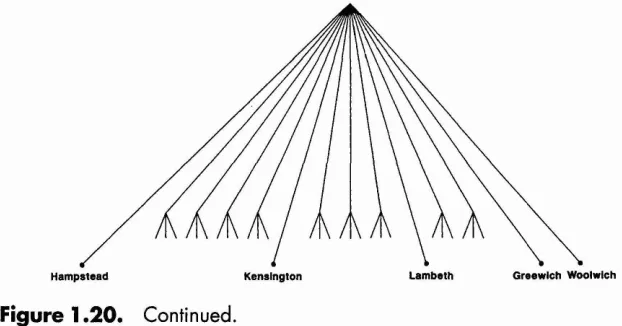
It is but a short step from Alexander's ideas to the notion that organic cities are not only cities which display an 'irregular' geometry but also cities where that underlying structure of the geometry of its relationships is also 'irregular', or at least asymmetricinthe sense of the difference between a lattice and tree. In fact, Alexander (1965) goes on to say that:f l • • •whenever