R E S E A R C H A R T I C L E
Open Access
Construction and pilot test of a set of
indicators to assess the implementation
and effectiveness of the who safe
childbirth checklist
Pedro J. Saturno-Hernández, María Fernández-Elorriaga
*, Ismael Martínez-Nicolás and Ofelia Poblano-Verástegui
Abstract
Background:The World Health Organization (WHO) launched the“Safe Childbirth Checklist (SCC) Collaboration”in 2012. The SCC is designed to contribute to quality care by providing reminders of evidence-based practices for the prevention and management of the leading causes of maternal and neonatal morbidity and mortality. However, indicators to monitor the implementation and effectiveness of the SCC have not been defined. This study aimed to produce and pilot test a set of valid, reliable and feasible indicators to assess the implementation and effectiveness of the SCC, with an emphasis on best practices.
Methods:As part of the WHO Collaboration, the SCC was adapted to the Mexican context, and a set of indicators
was developed to assess the SCC use and adherence to SCC-related best practices. The indicators were pilot tested in three hospitals for feasibility and reliability using the prevalence- and bias-adjusted kappa index (PABAK) for multiple independent evaluators (initial sample,n= 47; second sample,n= 30 to re-test reliability). The data sources were clinical records and cognitive tests drawn from questionnaires to mothers and health professionals.
Results:We generated 53 indicators, and 38 of the indicators (those related to best practices and outcomes) were pilot tested. Of these, 26 relate to care for the mother (20 were measured based on clinical records and 6 via questionnaire), and 12 relate to newborn care (9 were medical record-based and 3 were from questionnaires). Feasible indicators were generally also reliable (PABAK≥0.6). Routine feasibility is affected by the frequency of assessed events.
Conclusions:The generated indicators allow an assessment of the implementation and effectiveness of the SCC
and the monitoring of quality of care during childbirth and the immediate postpartum period.
Keywords:Safe Childbirth Checklist, Indicators, Quality improvement, Implementation
Background
Maternal and infant health is a matter of international relevance. There is a broad consensus on the importance of acting around the time of delivery to reduce compli-cations in mothers and newborn babies. It is at this time when there is a higher risk and when the burden of maternal and perinatal death accumulates; most of these deaths occur during the first 24 h after birth [1–3].
Access to professional care at the time of birth, as an isolated strategy without assuring the quality of the care provided, is increasingly considered insufficient to re-duce injury to the maternal and child population. Low quality contributes to poor performance [4]. For years, Mexico has promoted institutional childbirth as a strat-egy to reduce the number and negative impact of com-plications in mothers and newborns. As a result, by 2012, qualified health professionals attended an average of 99.6% of births [5]. However, there is no correlation between attention to birth in healthcare institutions and the maternal mortality ratio (MMR) [6]. The reported * Correspondence:[email protected]
Research Center for Evaluations and Surveys (CIEE), National Institute of Public Health of Mexico (INSP), Avenida Universidad No. 655, Colonia Santa María Ahuacatitlán, C.P. 62100 Cuernavaca, Mor, Mexico
2015 MMR in Mexico was 38 women per 100,000 live births [7], a figure that did not reach the target MMR of 22 women per 100,000 live births established in the Millennium Development Goals. This number is also far from the MMR of 21 and the infant mortality ratio of 6.5 per 1000 live births in countries of the Organization for Cooperation and Economic Development [8,9].
With a high rate of access to care at the time of delivery, improving the quality of care that the mother and new-born receive becomes a key strategy for the improvement of health outcomes [10]. To confront this problem, a“Safe Childbirth Checklist” (SCC) with reminders of essential best practices has been generated, and the utilization of the SCC has been tested in a before-after study, in which some essential components included a purposive selection of centers without input problems and the presence of coaches who supervised and observed the SCC use [11].
Based on this promising but difficult to generalize experi-ence, the World Health Organization (WHO) launched the “Safe Childbirth Checklist Collaboration” initiative [12] to obtain evidence regarding the effectiveness and factors as-sociated with the implementation of the SCC. In parallel, in Uttar Pradesh, India, the design and implementation of a cluster-randomized controlled trial to test the impact of the coaching-based use of the SCC on reducing severe mater-nal, fetal, and newborn harm [13, 14] was also planned. Several countries, including Mexico, are participating in this WHO Collaboration, which will potentially address im-plementation and effectiveness issues in different contexts using different strategies [15]. Within this international ini-tiative, some studies have recently been published to evalu-ate the impact of coaching on completing the SCC [16], the level of the SCC use and completion in one tertiary hospital [17], and the improvement in the SCC completion when the SCC is utilized, using Plan-Do-Study-Act (PDSA) cycles in some outcomes [18]. However, a specific comprehensive set of valid and reliable indicators to comparatively evaluate the SCC implementation and the specific good practices promoted by the SCC is still lacking. These indicators are fundamental to understanding the factors associated with SCC implementation and monitoring quality of care [19], the improvements associated with the use of the SCC [20], and eventually the effective implementation of the SCC strategy, thus preventing this strategy from becoming a mere list of intentions [21]. The objective of the present study was to generate a set of indicators, and assess their feasibility and reliability, for routine use to assess the imple-mentation and effectiveness of the SCC, which will primar-ily be used in the Mexican context but could also be adapted to other countries and contexts.
Methods
A multi-stage study comprising the following phases was conducted: (i) the adaptation of the SCC to the Mexican
context; (ii) the adaptation and development of indica-tors to evaluate the adherence to best practices related to safe childbirth and the use of the SCC; and (iii) a pilot study to assess the feasibility and inter-rater reliability of the proposed indicator set.
Adaptation of the SCC to the Mexican context
A working group was established with the participation of the obstetrical, perinatology and quality management staff from four hospitals in the state of Hidalgo, the state of Mexico and Mexico City, supported by a research team from the National Institute of Public Health. The working group adhered to the WHO call for Collabor-ation on the implementCollabor-ation of the SCC [12]. Following the WHO SCC Collaboration recommendations, the ori-ginal SCC [22] was refined and adapted to the Mexican context after several iterative discussion sessions. Adap-tation was carried out for both content and format. For instance, in relation to format the original WHO SCC is a single document including childbirth and newborn, while our group decided to have separated checklists (one for mother and another for the newborn) to better accommodate the SCC to the structure of hospital child-birth care responsibilities (see online Additional file1 in Spanish and Additional file 2 in English). In relation to contents, whereas the original SCC asks for simple checks, we added additional information to complete in-formation and reinforce their use as reminder for best practice. For instance, the original SCC ask to check if there was a cesarean section, but in Mexico we added to check on the reason or justification for the cesarean section, according to a list proposed by the working group based on accepted Practice Guidelines.
Development of indicators
(Additional file3) and English (Additional file4). For the indicators regarding the SCC utilization and the factors associated with the SCC, we adapted previous research on the implementation of the Safe Surgery Checklist [26] to the SCC.
Pilot study for feasibility and reliability
Different strategies were used to measure the indicators depending on the expected data source (clinical records or surveys):
We performed a cross-sectional retrospective study of the indicators that were estimated from clinical records. In two hospitals, systematic random samples were ob-tained from cases with corresponding ICD-10 codes identified in the computerized system of hospital dis-charges (SAEH, acronym in Spanish). First, two samples (n = 15 each) were obtained from hospital A and were independently assessed by two pairs of evaluators; then, a second sample (n = 17) was obtained at hospital B, which was assessed by three evaluators. The seven evalu-ators did not participate in the construction of the indi-cators but were trained (10 h) in the use of the indicators and the electronic data capture. An inter-observer reliability analysis was performed by calculating the prevalence-adjusted, bias-adjusted kappa (PABAK) [27] for the pooled sample of 47 cases. An indicator was considered reliable if the PABAK value was≥0.6, particu-larly when the observed prevalence was extreme (com-pliance or non-com(com-pliance ≥85%) [28, 29]. The results of this assessment were used to refine the tools and the unreliable indicators. The refined indicators were pilot tested again by four evaluators in a sample of 30 cases (15 cases per couple) in a third hospital. The pilot data were also used to assess the feasibility of measurement. All data were analyzed with the statistical packages Epidat 4.1 [30] and Stata 14.1 [31].
For the indicators obtained from questionnaires, we organized four sessions in two of the participating hospi-tals following the pre-test cognitive methodology [32], which includes concurrent observation of the behavior of the interviewee and reading/responding aloud. Cog-nitive methodology was used to ensure respondents understanding of the questionnaire. Reactions and re-sponses were used to change the wording of the ques-tions, when necessary, in order obtain a final version of the questionnaire. The group utilized to test the health personnel questionnaire included 12 professionals. The group for testing the questionnaire for mothers included 15 mothers. Finally, the surveys were fully pilot tested with individual interviews with 5 health professionals and 6 mothers. Two researchers, with previous experi-ence in interviews and surveys, conducted the cognitive sessions and pilot interviews and analyzed the data.
Results
Development of indicators
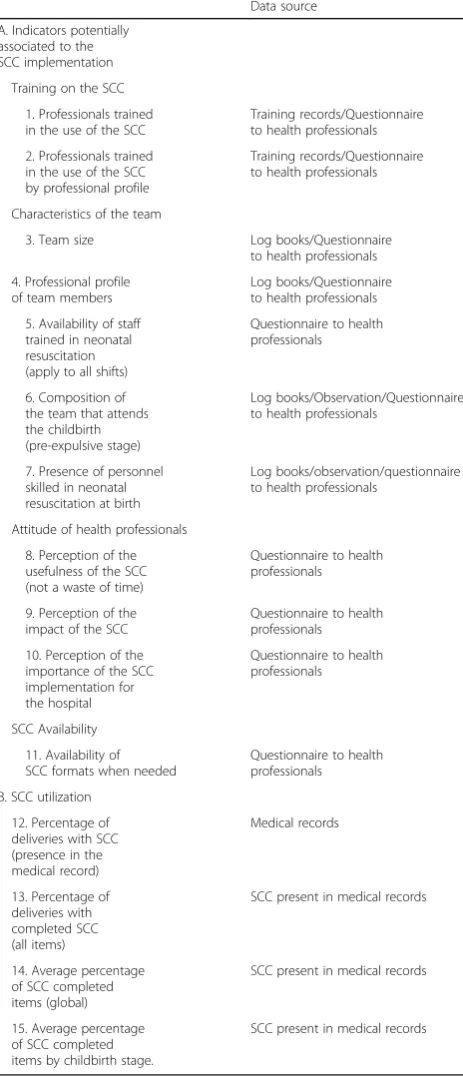
We constructed 53 indicators (Table 1), 15 of which were used to assess the factors associated with utilizing the SCC and the SCC utilization itself (Table 2). The remaining indicators (38), which are described in Tables3 and4, were constructed to monitor the impact of the SCC, mainly on good practices but also on out-comes related to complications and adverse events (Table 3). Among these indicators, 25 relate to health-care for the mother, 11 relate to the newborn and 1 indi-cator relates to both. Mortality indiindi-cators (maternal and neonatal) were excluded from the present pilot study since these indicators are already well established and may be measured from existing databases rather than in-ternally at the institutions using the SCC. The good practice (structure and process) indicators were further classified according to the phases of the SCC: admission and labor, immediately post-partum, and prior to dis-charge. Indicators that may apply to various stages were grouped in a“general”category.
Pilot test of the indicators
Reliability of the feasible indicators obtained from clinical records
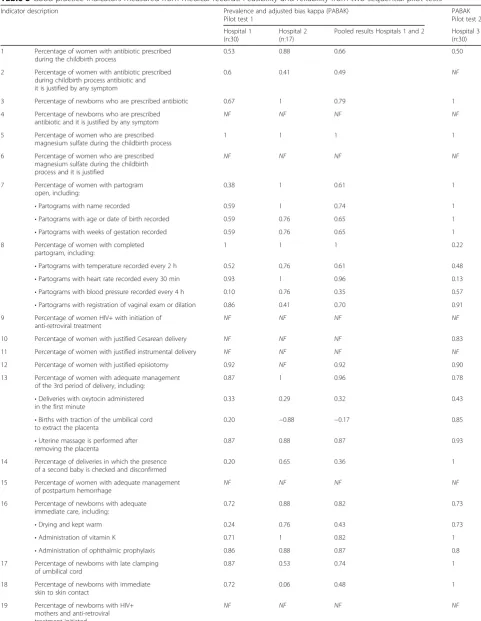
Table 3 describes the feasibility and reliability results of the indicators measured using data registered in clinical records in phases 1 and 2 of the pilot test. To better re-produce an actual situation that may be encountered in most facilities willing to implement the SCC and moni-tor its impact on good practices, all deliveries were sam-pled; no samples were obtained according to particular pathologies or specific events, which in most cases may not be coded in the discharge database. For this reason, 6 of the 29 indicators could not be assessed for reliability due to the low number of cases with the required condi-tion in the general samples. Purposive (usually not rou-tinely feasible) or much larger samples may be required to monitor these indicators. Reliability could not be assessed for this reason in cases of newborns with condi-tions justifying the prescription of antibiotics or the ad-equate prescription of magnesium sulfate to mothers or for HIV+ women for whom anti-retroviral treatment was prescribed for both the mother and the newborn. The lack of routine feasibility also affected two other in-dicators (the justification for prescribing antibiotics to mothers and the justification of a cesarean section) in some of the three hospitals. In these cases, incomplete or confusing medical records made the assessment of the reliability and the actual measurement of the indica-tors unfeasible.
of the first pilot test. Only one indicator (deliveries with oxytocin administered during the first minute) was not adequately improved, and another indicator (the com-posite indicator reflecting the completeness of the parto-gram) had a worse PABAK value in the third hospital, related to difficulties in accurately assessing the time in-tervals of recording temperature (in the mother) and heart rate (in the fetus). All outcome indicators, mostly related to adverse events or complications in either the mother or the newborn, were feasible and reliable.
Indicators obtained from questionnaires
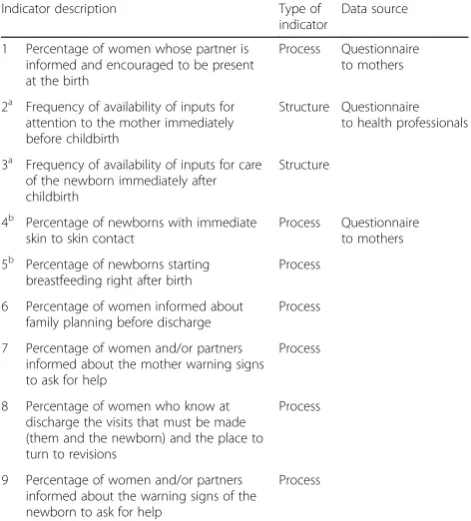
Short questionnaires for mothers and health profes-sionals were proposed as data sources for nine relevant indicators (Table 4). Three of these indicators (the per-centage of newborns with skin-to-skin contact immedi-ately after birth, breastfeeding right after birth, and the percentage of mothers with information on family plan-ning prior to discharge) may theoretically be obtained from either the clinical record or questionnaires to mothers. However, we found the questionnaire more re-liable. As an example, “skin-to-skin contact” was not registered in any of the reviewed clinical records, while mothers understood the question perfectly well in the cognitive test of the questionnaire, thereby providing this relevant information. Furthermore, as an alternative to the periodic inspection of the facilities or the observa-tion of a sample of childbirths, we found that health pro-fessionals may be a good data source for a quick assessment of the indicators related to the availability of inputs regarding the attention to the mother during labor and regarding the newborn immediately after childbirth. The other four indicators in this group reflect aspects of the experience of the mother that could be measured only by asking these women.
Discussion
The “Safe Childbirth Checklist Collaboration” intiative [12] was organized by the WHO with the objectives of identifying the factors that may influence the SCC im-plementation, better defining a strategy for the effective
utilization of the SCC, and gathering data regarding the impact on the quality of care provided to mothers and newborns, with the ultimate goal of improving health outcomes for both. As part of this collaboration, we adapted the SCC to a Mexican context and defined and pilot tested a set of indicators to assess both the SCC
Table 1Indicators developed to assess the SCC
implementation, use and association to good practice and outcomes
Monitoring Objective Type of indicator Total
Structure Process Outcome
Factors associated to the SCC implementation
11 – – 11
Utilization of the SCC – 4 – 4
Good practices 2 26 – 28
Health outcomes – – 10 10
Total 13 30 10 53
Table 2Indicators developed to assess the SCC utilization and factors potentially associated to SCC implementation
Data source
A. Indicators potentially associated to the SCC implementation
Training on the SCC
1. Professionals trained
Characteristics of the team
3. Team size Log books/Questionnaire to health professionals
4. Professional profile of team members
Log books/Questionnaire to health professionals
5. Availability of staff trained in neonatal resuscitation (apply to all shifts)
Questionnaire to health professionals
6. Composition of the team that attends the childbirth (pre-expulsive stage)
Log books/Observation/Questionnaire to health professionals
7. Presence of personnel skilled in neonatal resuscitation at birth
Log books/observation/questionnaire to health professionals
Attitude of health professionals
8. Perception of the usefulness of the SCC (not a waste of time)
Questionnaire to health professionals
9. Perception of the impact of the SCC
Questionnaire to health professionals
10. Perception of the importance of the SCC implementation for SCC formats when needed
Questionnaire to health
SCC present in medical records
14. Average percentage of SCC completed items (global)
SCC present in medical records
15. Average percentage of SCC completed items by childbirth stage.
Table 3Good practice indicators measured from medical records. Feasibility and reliability from two sequential pilot tests Indicator description Prevalence and adjusted bias kappa (PABAK)
Pilot test 1
PABAK Pilot test 2
Hospital 1 (n:30)
Hospital 2 (n:17)
Pooled results Hospitals 1 and 2 Hospital 3 (n:30)
1 Percentage of women with antibiotic prescribed during the childbirth process
0.53 0.88 0.66 0.50
2 Percentage of women with antibiotic prescribed during childbirth process antibiotic and it is justified by any symptom
0.6 0.41 0.49 NF
3 Percentage of newborns who are prescribed antibiotic 0.67 1 0.79 1
4 Percentage of newborns who are prescribed antibiotic and it is justified by any symptom
NF NF NF NF
5 Percentage of women who are prescribed magnesium sulfate during the childbirth process
1 1 1 1
6 Percentage of women who are prescribed magnesium sulfate during the childbirth process and it is justified
NF NF NF NF
7 Percentage of women with partogram open, including:
0.38 1 0.61 1
•Partograms with name recorded 0.59 1 0.74 1
•Partograms with age or date of birth recorded 0.59 0.76 0.65 1
•Partograms with weeks of gestation recorded 0.59 0.76 0.65 1
8 Percentage of women with completed partogram, including:
1 1 1 0.22
•Partograms with temperature recorded every 2 h 0.52 0.76 0.61 0.48 •Partograms with heart rate recorded every 30 min 0.93 1 0.96 0.13 •Partograms with blood pressure recorded every 4 h 0.10 0.76 0.35 0.57 •Partograms with registration of vaginal exam or dilation 0.86 0.41 0.70 0.91 9 Percentage of women HIV+ with initiation of
anti-retroviral treatment
NF NF NF NF
10 Percentage of women with justified Cesarean delivery NF NF NF 0.83
11 Percentage of women with justified instrumental delivery NF NF NF NF
12 Percentage of women with justified episiotomy 0.92 NF 0.92 0.90
13 Percentage of women with adequate management of the 3rd period of delivery, including:
0.87 1 0.96 0.78
•Deliveries with oxytocin administered in the first minute
0.33 0.29 0.32 0.43
•Births with traction of the umbilical cord to extract the placenta
0.20 −0.88 −0.17 0.85
•Uterine massage is performed after removing the placenta
0.87 0.88 0.87 0.93
14 Percentage of deliveries in which the presence of a second baby is checked and disconfirmed
0.20 0.65 0.36 1
15 Percentage of women with adequate management of postpartum hemorrhage
NF NF NF NF
16 Percentage of newborns with adequate immediate care, including:
0.72 0.88 0.82 0.73
•Drying and kept warm 0.24 0.76 0.43 0.73
•Administration of vitamin K 0.71 1 0.82 1
•Administration of ophthalmic prophylaxis 0.86 0.88 0.87 0.8
17 Percentage of newborns with late clamping of umbilical cord
0.87 0.53 0.74 1
18 Percentage of newborns with immediate skin to skin contact
0.72 0.06 0.48 1
19 Percentage of newborns with HIV+ mothers and anti-retroviral treatment initiated
implementation process and the impact on best practices and outcomes. The indicators were based on previous research on the implementation of the Safe Surgery Checklist [26] and the evidence-based good practices included in the SCC [1,11]. The constructed set consists of 53 indicators: 15 indicators related to the imple-mentation of the SCC and 38 indicators involving SCC-related good practices and outcomes. After two sequential pilot tests in three hospitals, we found feasi-bility problems in six of these indicators and insuffi-cient reliability for two indicators. The considerations described below reflect the knowledge gained from our study and emphasize the importance of systematic measurement of SCC implementation to compare results both within and between healthcare units and to gather evidence on the effectiveness of the SCC and its associated implementation factors.
The need for valid and reliable indicators linked to the SCC
The SCC includes reminders for interventions with proven positive impacts on quality childbirth and the management of complications and mortality in both the mother and the newborn, but the SCC was launched without identifying indicators that may be used to moni-tor the utilization and impact of the SCC. However, valid measures allow the monitoring of processes and results of strategies, thereby evaluating the strategies and facili-tating decision making [33]; monitoring is necessary for Table 3Good practice indicators measured from medical records. Feasibility and reliability from two sequential pilot tests
(Continued)
Indicator description Prevalence and adjusted bias kappa (PABAK) Pilot test 1
Pooled results Hospitals 1 and 2 Hospital 3 (n:30)
20 Percentage of women with hemorrhage 0.87 0.88 0.87 0.93
21 Percentage of women with blood pressure disorders
0.93 0.88 0.91 0.93
22 Percentage of women with post-partum or perinatal infection
0.87 1 0.91 0.71
23 Percentage of infants with neonatal infection
0.8 1 0.87 1
24 Percentage of infants with neonatal asphyxia
0.93 1 0.96 0.87
25 Percentage of women with Cesarean delivery
1 1 1 1
26 Percentage of women with instrumental delivery
1 1 1 1
27 Percentage of women with episiotomy at childbirth
1 1 1 0.88
28 Percentage of deliveries with adverse events in women
0.8 0.88 0.83 1
29 Percentage of deliveries with adverse events in newborns
1 1 1 0.60
NFNot feasible due to few or lack of cases in the general sample: it may need specific sample for routine use
General indicators: #1 to 6 (applicable at any time during childbirth); Admission and labor: # 7 to 15; Newborns (immediate post-partum): #16 to 19; Complications and adverse events: #20 to 29
Table 4Good practice indicators measured with surveys to mothers or health professionals
Indicator description Type of indicator
Data source
1 Percentage of women whose partner is informed and encouraged to be present at the birth
Process Questionnaire to mothers
2a
Frequency of availability of inputs for attention to the mother immediately before childbirth
Structure Questionnaire to health professionals
3a Frequency of availability of inputs for care of the newborn immediately after childbirth
Structure
4b
Percentage of newborns with immediate skin to skin contact
Process Questionnaire to mothers
5b Percentage of newborns starting breastfeeding right after birth
Process
6 Percentage of women informed about family planning before discharge
Process
7 Percentage of women and/or partners informed about the mother warning signs to ask for help
Process
8 Percentage of women who know at discharge the visits that must be made (them and the newborn) and the place to turn to revisions
Process
9 Percentage of women and/or partners informed about the warning signs of the newborn to ask for help
Process
a
the effective implementation of a strategy and contrib-utes to preventing the strategy from becoming a mere list of intentions [21]. Measuring and reporting results is also important for accountability and transparency [33]. In recent years, particularly after the completion of the Millennium Development Goals, there has been an em-phasis on the design of valid strategies and measuring instruments to monitor interventions and enable com-parisons at the national and international levels [20, 23, 33]. To better analyze the attributed impact and eventual implementation strategies, we believed that a set of spe-cific indicators closely related to the SCC content was required to evaluate the SCC impact, along with mea-sures of SCC utilization. To date, the largest study on the implementation of the SCC, the Better Birth Trial, assessed the SCC use in 18 of the 39 best practices for which the SCC provided reminders and was based on the comparative observation of coaches and independent observers when coaches were not present [16]. The main objective was to assess the impact of coaching on SCC use, and the analyzed practices were therefore those that could be observed by either coaches or independent ob-servers when the coaches were not present. No attempt was made to provide indicators that could be used to assess the SCC strategy as such, including factors other than coaching that may influence the SCC use. Other studies [17, 18] primarily focused on the completion of the SCC when used, excluding from the analysis all cases in which the SCC was not utilized.
Pilot test reveals reliability and context-related difficulties
Our proposed indicators are intended for use in moni-toring the implementation and effectiveness of the SCC, allowing for comparisons among cases and also institu-tions where the SCC has not been used. Therefore, the target population was total deliveries, and the data sources were not only those cases in which the SCC was utilized. The numerator and denominator, the terms used and proposed data sources may thus be carefully defined. However, regardless of how well-defined the terms and data sources of an indicator are, pilot testing in actual environments is necessary to guarantee the feasibility of a measurement, an unambiguous interpret-ation and an eventual technical refinement to increase reliability. A pilot test may reveal that the specifications must be more detailed or that the data may not be avail-able [34–36]. Skipping this step may result in proposing unfeasible or unreliable, and therefore not valid, indica-tors [36]. We observed all of these types of problems. In some cases, we discussed and refined the specifications or the seemingly unreliable indicators based on the PABAK value obtained in the first pilot test, and in other cases, we highlighted problems with the data source that may affect the generalization of the proposed measures.
It was most difficult to find correctly recorded time specifications, and in some cases, we changed specifica-tions to include different ways in which such recorded data could actually be compliant but disparate. For ex-ample, “oxytocin administered during the first minute” was sometimes recorded as“oxytocin given after the lib-eration of shoulders”or“was given oxytocin immediately after the release of the product”; for this reason, we in-cluded these response options as valid compliance in the indicator description. However, the majority of feasibility problems related to deficiencies in the data sources, including the identification of cases for assessment and the quality of the recorded information in clinical re-cords and other existing documents, such as partograms, which underscores the importance of context-specific obstacles to monitoring otherwise potentially valid indi-cators. In relation to the identification of cases (i.e., de-liveries) in the routine hospital discharge system, we observed that in many cases, deliveries were not coded as such; the existence of any previous condition or com-plication as the cause of hospitalization was preferred in many cases. We also identified (and propose to identify) childbirths by searching individual records for other variables that are related to childbirths, such as the gestational age, in combination with the recording of a birth product. There were women with“gestational age” and“birth products”not coded as deliveries.
After selecting cases, extracting the necessary informa-tion may also be complex. The lack of uniformity in the formats of medical records is a major contributor to the confusion. Many times, the required information could be recorded in different places or formats, and it is ne-cessary to clarify what format should be revised for each variable. For instance, gestational age may not be in the medical record but may instead be in the partogram. In some cases, when the same information was recorded in different formats, it was possible to detect inconsisten-cies (even in relation to simple variables, such as the sex of the newborn or the type or birth, vaginal or cesarean) that contributed to context-specific causes of the lack of data reliability.
performed with small sample sizes [36], but for national or regional projects, a period of monitoring data quality and availability as well as designing strategies to generate timely and reliable data have been suggested [37,38] .
The need for questionnaires and purposive sampling for comprehensive SCC monitoring
Some of the SCC items, although relevant, apply to sub-populations of mothers and newborns defined by a given condition. Routine monitoring of these indicators would not be possible unless the information system allows for the easy identification of cases with that particular condi-tion, given the relatively low frequency in which these cases may occur. We classified these indicators, a total of six indicators, as routinely non-feasible. The timely initi-ation of antiretroviral treatment for HIV+ women and their newborns is a clear example of this type of indicator, which applies only to the subpopulation of known HIV+ women. The same situation occurs with other cases that cannot be readily identified in the discharge information system, such as the justification of antibiotic treatment, the justified administration of magnesium sulfate, and even the adequate management of postpartum hemorrhage. Larger or specific purposive samples, in cases in which these situations could be identified in routine da-tabases, may be required to measure these indicators. In other SCC studies, based only on those cases in which the SCC was utilized and using the SCC checked items as the data source [17,18], these indicators, particularly those re-lated to HIV+ women and their newborns, show some of the lowest compliance (compliance meaning checking the item in the SCC). In other cases, such as the in the study by Spector JM et al. [11], it is not clear whether compli-ance includes checking the item defining the sub-population (i.e., assessing HIV status) plus giving the treat-ment as an“all-or-none”composite indicator. In addition, in our study, the SCC adaptation distinguished two steps: one, whether a treatment or intervention has been pro-vided (for instance, antibiotics, magnesium sulfate, or episiotomy); and two, the explicit justification for that treatment or intervention. Monitoring the quality of the second step in these practices may not be routinely feas-ible unless the prevalence of the subpopulation to which they apply is sufficiently high in a routine sample of child-births. The original SCC simply asks whether the particu-lar treatment or intervention is needed and has been administered (in a single Yes/No item) and then provides some advice (a short list of symptoms or situations) re-garding the indications for the treatment. In our adapta-tion, the group of experts considered it more appropriate to transform these items into two companion and sequen-tial items: first, checking whether the treatment was ad-ministered (Yes/No), and then, checking the symptom or situation that justifies the treatment. In this way, the
presence of any of these symptoms may also be an explicit reminder for considering the treatment if it has not been administered; at the same time, these questions may be used to assess adequacy.
However, there are important aspects (to skin-contact, the initiation of breastfeeding, information about warning signs, among others) for which we could not expect good registered data. The same situation oc-curred in the search for potential factors that may affect the SCC use, namely those related to the attitudes of health personnel, the existence of inputs and other structural factors. For both types of measures, we de-vised and successfully tested short questionnaires for mothers and health personnel. Without these additional tools, a comprehensive monitoring and evaluation of the use and impact of the SCC and the subsequent design of improvement initiatives would not be possible.
The technical specifications of the proposed set (Additional file 1 in Spanish and Additional file 2 in English) are consistent with the findings of the pilot tests and include the proposed data source, making these in-dicators ready for use in the Mexican environment and also for adaptation to other environments.
Limitations
The present study was conducted using general samples of hospital deliveries. No attempt was made to find samples of subpopulations or specific conditions in mothers or new-borns not included as variables in the discharge databases. A comprehensive SCC evaluation may require larger or, if feasible, purposive samples, but our intention was to test the set for potential routine use. The results may be context-specific, and the use of the proposed set in other contexts may require local adaptation to the particular in-formation systems. Nevertheless, the proposed set would be a good starting point, given that this set reflects the rele-vant SCC items and the main factors that could potentially be associated with the SCC implementation.
Conclusions
We constructed and pilot tested a set of indicators for feasibility and reliability in monitoring the implementa-tion and impact of the WHO SCC. Technical specifica-tions were modeled after the SCC items, previous research on the use of checklists, the results of two pilot tests, and the context of Mexico, but the specifications could be used in other contexts after local adaptation and analysis of the available data sources.
Additional files
Additional file 2:Mexico Safe Childbirth Checklist for mother and newborn (english). The original WHO Safe Childbirth Checklist was refined and adapted to the Mexican context and translated to english language. (PDF 458 kb)
Additional file 3:Set of SCC indicators (spanish version). The detailed definitions of the indicators in Spanish. (DOCX 116 kb)
Additional file 4:Set of SCC indicators (english version). The detailed definitions of the indicators in English. (DOCX 139 kb)
Abbreviations
MMR:Maternal mortality ratio; PABAK: Prevalence-adjusted, bias-adjusted kappa; P-D-S-A cycle: Plan-Do-Study-Act (PDSA) cycles; SAEH: Computerized system of hospital discharges (acronym in Spanish); SCC: Safe Childbirth Checklist; WHO: World Health Organization
Acknowledgments
The present study is a collaborative project of the Mexican National Institute of Public Health, the Ecatepec General Hospital“Dr. José María Rodríguez”, the Hospital General Nicolás San Juan (Toluca), the National Institute of Perinatology“Isidro Espinosa de los Reyes”, the General Hospital of Tula, and the Obstetric Hospital of Pachuca.
Funding
This study is part of the WHO“Safe Childbirth Checklist Collaboration”and was funded by the Mexican Sectorial Fund for Research in Health and Social, and the National Science and Technology Security Commission (CONACYT), under the project register identification: S0008-2015-2-“Improvement of quality of care in institutional childbirth through the Safe Birth Checklist”. The collaboration was exclusively economic, since all the technical and methodo-logical part was conducted by the National Institute of Public Health.
Availability of data and materials
The datasets used and/or analyzed during the current study are available from the corresponding author on reasonable request.
Authors’contributions
PJSH provided major contributions to the conception and design of the study and the interpretation of the data and was a major contributor in writing the manuscript. MFE provided substantial contributions to the conception and design of the study, performed the pilot study at the field level, interpreted the data and contributed to writing the manuscript. IMN performed the pilot study at the field level and analyzed the data.. OPV provided substantial contributions to the study conception and design and was involved in critically revising the manuscript for important intellectual content. All authors have read and approved the final version of the manuscript.
Ethics approval and consent to participate
This study was submitted for review and approved by the ethics committee of the National Institute of Public Health of Mexico (July 22, 2015, CI: 1306, No. 1712). For indicators measured with surveys to mothers or health professionals, verbal consent was obtained from participants. All informed consents were evaluated and approved by the National Institute of Public Health of Mexico ethics committee.
Competing interests
The authors declare that they have no competing interests.
Publisher’s Note
Springer Nature remains neutral with regard to jurisdictional claims in published maps and institutional affiliations.
Received: 15 November 2017 Accepted: 30 April 2018
References
1. World Health Organization (WHO). Safe Chlidbirth checklist Programme: an overview. Report no.: WHO/HIS/PSP/2013.1. Geneva; 2013.http://www.who.
int/patientsafety/implementation/checklists/background_document.pdf?ua= 1. Accessed 15 Oct 2017
2. Ronsmans C, Graham WJ. Maternal mortality: who, when, where, and why. Lancet. 2006;368:1189–200.
3. Lawn JECS, Zupan J. 4 million neonatal deaths: when? Where? Why? Lancet. 2005;365:891–900.
4. Austin LA, Salam RA, Lassi ZS, Das JK, Bhutta ZA. Approaches to improve quality of maternal and newborn health care: an overview of the evidence. Reprod Health. 2014;11(Suppl 2):1–9.
5. Gutiérrez J, Rivera-Dommarco J, Shamah-Levy T, et al. Encuesta Nacional de Salud Y Nutrición 2012. Resultados Nacionales. Cuernavaca: Instituto Nacional de Salud Pública; 2012.
6. Lazcano-Ponce E, Schiavon R, Uribe-Zúñiga P, et al. Cobertura de atención del parto en México . Su interpretación en el contexto de la mortalidad materna. Salud Publica Mex. 2013;55(suppl 2):S214–24.
7. Trends in maternal mortality: 1990 to 2015: estimates by WHO, UNICEF, UNFPA, World Bank Group and the United Nations Population Division. Geneva: World Health Organization; 2015.
8. The World Bank. Rate, infant mortality (per 1,000 live births). Data. 2014.
http://data.worldbank.org/indicator/SP.DYN.IMRT.IN. Accessed 15 Oct 2017. 9. Gobierno de la República. Plan Nacional de Desarrollo 2013–2018 plan:
Programa del Sector Salud. Mexico: Diario Oficial de la Federación; 2013. 10. Van den Broek NR, Graham WJ. Quality of care for maternal and newborn
health: the neglected agenda. BJOG. 2009;116(Suppl 1):18–21. 11. Spector JM, Agrawal P, Kodkany B, Lipsitz S, Lashoher A, Dziekan G. Et to
the. Improving quality of care for maternal and newborn health: prospective pilot study of the WHO safe childbirth checklist program. PLoS One. 2012;7(5):e35151.
12. World Health Organization (WHO). The WHO Safe Childbirth Checklist Collaboration. Patient safety.http://www.who.int/patientsafety/
implementation/checklists/childbirth_collaboration_engaging/en/. Accessed 15 Oct 2017.
13. Semrau KEA, Hirschhorn LR, Kodkany B, et al. Effectiveness of the WHO safe childbirth checklist program in reducing severe maternal, fetal, and newborn harm in Uttar Pradesh, India: study protocol for a matched-pair, cluster-randomized controlled trial. Trials. 2016;17(1):576.
14. Kara N, Firestone R, Kalita T, et al. The better birth program: pursuing effective adoption and sustained use of the WHO safe childbirth checklist through coaching-based implementation in Uttar Pradesh, India. Global Health Sci Pract. 2017;5(2):232–43.
15. World Health Organization (WHO). Patient safety. WHO Safe Childbirth Checklist Collaboration Members. Patient safety.http://www.who.int/ patientsafety/implementation/checklists/collaboration_members/en/. Accessed 15 Oct 2017.
16. Delaney MM, Maji P, Kalita T, Kara N, Rana D, Kumar K, et al. Improving adherence to essential birth practices using the WHO safe childbirth checklist with peer coaching: experience from 60 public health facilities in Uttar Pradesh, India. Global Health Sci Pract. 2017;5(2):217–31.
17. Patabendige M, Senanayake H. Implementation of the WHO safe childbirth checklist program at a tertiary care setting in Sri Lanka: a developing country experience. BMC Pregnancy Childbirth. 2015;15(1):12. 18. Kabongo L, Gass J, Kivondo B, Kara N, Semrau K, Hirschhorn LR.
Implementing the WHO safe childbirth checklist: lessons learnt on a quality improvement initiative to improve mother and newborn care at Gobabis District hospital, Namibia. BMJ Open Qual. 2017;https://doi.org/10.1136/ bmjoq-2017-000145.
19. Gertler P, Martínez S, Premand P, Rawlings L, Vermeerschm CM. Impact evaluation in practice. World Bank: Washington, D.C.; 2011. p. 235. 20. World Health Organization (WHO). Better data to save mothers’and babies’
lives. Maternal, newborn, child and adolescent health. 2016.http://www. who.int/maternal_child_adolescent/news_events/better-data-stillbirth-maternal-death/maternal-newborn-survival-better-data.pdf?ua=1. Accessed 15 Oct 2017.
21. United Nations. Indicators of sustainable development: guidelines and methodologies. 3d ed. New York: United Nations; 2007.
22. World Health Organization (WHO). WHO Safe Childbirth Checklist. Patient safety.http://www.who.int/patientsafety/implementation/checklists/ childbirth/en/. Accessed 15 Oct 2017.
23. World Health Organization. Standards for improving quality of maternal and newborn care in health facilities. Geneva: World Health
24. Saturno P, Martinez-Nicholas I, Robles-García I, López-Soriano F, Angel-garcia D. Development and pilot test of a new set of good practice indicators for chronic cancer pain management. Eur J Pain. 2015;19(1):28–38.
25. Saturno-Hernández PJ, Martínez-Nicolás I, Poblano-Verástegui O, Vértiz-Ramírez JJ, Suárez-Ortíz C, Magaña-Izquierdo M, Kawa-Karasik S. Implementación de indicadores de calidad de la atención en hospitales públicos de tercer nivel en México. Salud Publica Mex. 2017;59:227–35. 26. Saturno PJ, Soria-Aledo V, Da Silva Gama ZA, et al. Understanding WHO
surgical checklist implementation: tricks and pitfalls. An observational study. World J Surg. 2014;38:287.
27. Byrt T, Bishop J, Carlin JB. Bias, prevalence and kappa. J Clin Epidemiol. 1993; 46(5):423–9.
28. Landis JR, Koch GG. The measurement of observer agreement for Percepción dates. Biometrics. 1977;33(1):159–74.
29. Feinstein AR, Cicchetti DV. High but low kappa agreement: I. The problems of two paradoxes. J Clin Epidemiol. 1990;43(6):543–9.
30. Consellería de Sanidade. Xunta de Galizia. España; Organización Panamericana de la Salud (OPS-OMS); Universidad CES. Colombia. Epidat: programa para análisis epidemiológico de datos. 2014.http://dxsp.sergas. es/. Accessed 15 Oct 2017.
31. StataCorp. Stata statistical software: 13 release. College Station: StataCorp LP; 2013. 32. Drennan J. Cognitive interviewing: verbal data in the design and pretesting
of questionnaires. J Adv Nurs. 2003;42(1):57–63.
33. World Health Organization. Strategies toward ending preventable maternal mortality (EPMM). Geneva: World Health Organization; 2015. p. 44. 34. Stelfox HT, Straus SE. Measuring quality of care: considering conceptual
approaches to indicator development and evaluation quality. J Clin Epidemiol. 2013;66(12):1328–37.
35. Mainz J. Developing evidence-based clinical indicators: state of the art methods first. Int J Qual Health Care. 2003;15(Suppl 1):i5–11.
36. Rubin HR, Pronovost P, Diette GB. From a process of care measure to: the development and testing of a quality indicator. Int J Qual Health Care. 2001; 13(6):489–96.
37. Hurtado MP, Swift EK, Corrigan JM, editors. Envisioning the National Health Care Quality Report. Washington: Institute of Medicine, National Academies Press; 2001.