Filter-Bank-Based Narrowband Interference Detection
and Suppression in Spread Spectrum Systems
Tobias Hidalgo Stitz
Institute of Communications Engineering, Tampere University of Technology, P.O. Box 553, 33101 Tampere, Finland Email:[email protected]
Markku Renfors
Institute of Communications Engineering, Tampere University of Technology, P.O. Box 553, 33101 Tampere, Finland Email:[email protected]
Received 29 October 2002; Revised 27 October 2003; Recommended for Publication by Xiang-Gen Xia
A filter-bank-based narrowband interference detection and suppression method is developed and its performance is studied in a spread spectrum system. The use of an efficient, complex, critically decimated perfect reconstruction filter bank with a highly selective subband filter prototype, in combination with a newly developed excision algorithm, offers a solution with efficient implementation and performance close to the theoretical limit derived as a function of the filter bank stopband attenuation. Also methods to cope with the transient effects in case of frequency hopping interference are developed and the resulting performance shows only minor degradation in comparison to the stationary case.
Keywords and phrases:narrowband interference cancellation, complex PR filter banks, DS-SS.
1. INTRODUCTION
Direct sequence spread spectrum (DS-SS) systems have sev-eral applications, for example, CDMA communications and advantages, low power spectral density, privacy of the com-munications, and an inherent immunity to narrowband in-terferences, due to the processing gain [1]. Nevertheless, this immunity is only effective up to certain interference power, making it necessary to apply additional techniques to suppress the effect of strong narrowband interferences if a degradation of the performance is to be avoided. Sev-eral interference suppression techniques have been pro-posed to process the signal in the time domain (e.g., adap-tive transversal filtering) [2, 3, 4, 5, 6] and in the trans-form domain [2, 7, 8, 9]. These techniques take advan-tage of the knowledge of the wide spectral shape of the de-sired signal’s spectrum as compared to the interferer’s nar-row spectrum. There are also methods in the spatial do-main, using techniques like antenna diversity or beamform-ing [2,10], although these methods are not exclusive to nar-rowband interference on a wideband SS signal. There ex-ist more advanced approaches in the time-frequency do-main [11,12], like wavelet transformation-based methods. In situations in which the interfering environment changes quickly, time-domain techniques are too slow to work cor-rectly. In these cases, frequency-domain techniques like the
FFT-based or the filter-bank-based methods perform better [8,12].
The purpose of this paper is to analyse the performance of a filter-bank-based interference suppression system. To eliminate the effects of narrowband interference, a perfect reconstruction (PR) filter bank with interference detection and subband suppression logic is used. Efficient implemen-tation of the complex, critically sampled filter bank is based on an extension of the extended lapped transform (ELT) to the complex case. Based on detection and excision algo-rithms that can be found in the literature [8], a new, im-proved recursive algorithm is developed. Simulations have been run with different types of narrowband interference sources (jammers), demonstrating promising performance even in high jammer power cases.
The structure of the paper is as follows.Section 2 intro-duces the idea of filter-bank-based interference suppression and proposes an efficient implementation for the filter bank. Also the novel excision algorithm is presented and meth-ods to relieve the transient effects in case of frequency hop-ping interference are introduced. Section 3presents a the-oretical performance analysis of the system. In Section 4a detailed system model is presented and performance simu-lation results are shown and discussed inSection 5. Finally,
f
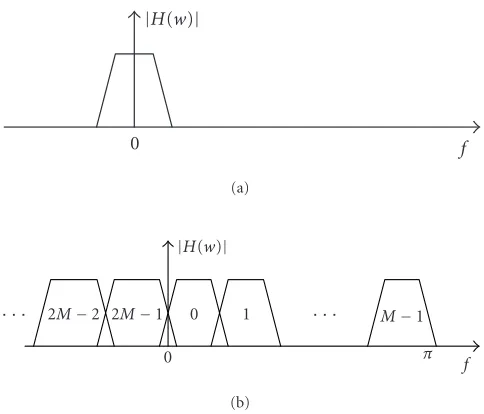
Figure1: Modulated filter bank. (a) Prototype filter. (b) Complex modulated subband filters.
Figure2: Maximally decimated 2M-channel analysis-synthesis fil-ter bank system.
2. FILTER BANKS FOR INTERFERENCE SUPPRESSION
2.1. Detection and suppression principle
The interference suppressor presented in this paper is based on a complex modulated filter bank (MFB). In a complex MFB, a prototype filterhp(n) is modulated by a complex ex-ponential function to yield 2Mbandpass filters in the form
hk(n)=hp(n)·ejn(2k+1)π/2M. (1)
As shown inFigure 1, the whole sampled frequency range can be divided into subbands by lining up consecutive filters. In the following, the terms “subchannel” and “subband” will be used interchangeably.
MFBs can be used to form analysis-synthesis filter banks that divide the received signal into several subchannels (anal-ysis part), and reconstruct the original signal from the sub-channels (synthesis part), after some optional processing. One benefit of this type of filter banks is that the process-ing can be done at a lower samplprocess-ing rate, takprocess-ing advantage
f frd
fsp
f
Figure3: Application of the filter bank to the elimination of nar-rowband interference.
of the reduced bandwidth due to the subband filtering [13].
Figure 2presents a maximally decimated filter bank, which
means that, if the filter bank consists of 2M channels, the factor by which the down- and upsampling is performed is also 2M.
If the filter design parameters are chosen correctly, the filter bank can offer PR, meaning that the output signal is just a scaled and delayed version of the input signal [13]:
ˆ
x(n)=cxn−n0
. (2)
Applying the filter banks to the narrowband interference sup-pression problem, the subbands affected by the interference are not included in the synthesis part of the filter, resulting in notch filtering, as sketched inFigure 3[2,12].
Since the FFT can also be regarded as a filter bank, it can be used as an approach to remove the interference. However, each subchannel of the FFT filter bank has strong sidelobes, the first ones at−13 dB. Thus, the power of the narrowband jammer is very likely to leak to adjacent subchannels, aff ect-ing a relatively high portion of the signal bandwidth. To fight this limitation, windowing can be applied to the signal be-fore taking the FFT [14]. Although this is an effective
M
Figure4: Realisation of the 2M-channel complex MFB using sine and cosine MFBs that can be implemented with real-valued ELTs.
2.2. Complex critically sampled PR filter bank structure
Some papers have appeared proposing complex modulated lapped transforms for different applications, such as audio processing [19] and image motion estimation [20]. However, these papers use real-valued input signals to which the trans-form is applied.
The method chosen here to implement the complex MFB for the interference detection and suppression system with complex (I/Q) input signal is illustrated inFigure 4. The in-puts are the real (I, in-phase) and imaginary (Q, quadrature) parts of the complex signals. The PR cosine and sine MFBs and the following butterfly structures effectively allow ob-taining real subband signals by separating the positive and negative parts of the spectrum corresponding to each real subband, as sketched inFigure 5. If we observe the subsam-pled signals ofFigure 4, we can see that, due to the butterfly structures, at the entrance of the synthesis banks we have, for thekth subchannel in the upper branch (CMFB),
and, in the lower branch (SMFB),
f ˆ
Q −
SMFB CMFB
f ˆI
+
2nd butterfly, interpolation, filtering, and recombination
Processing
f ck−sk −
f ck+sk +
Analysis filtering, decimation, and 1st
butterfly
f SMFB Q=Im[x]
f CMFB I=Re[x]
f x∈C
Figure5: Separating and combining the spectral components using the structure ofFigure 4.
after the second butterfly we recover the signals as they were before the first one (except for the scaling factor). Upsam-pling (spectral contraction) and recombining with the other subband signals yields ˆI and ˆQ, similar to I and Q, assuming there was no further processing of the signals involved.
In other words, the analysis subchannel filtering function is equivalent to applying the corresponding complex sub-band filter of the complex MFB to the input signal, taking the real part of the output and decimating byM. Thus, the subband signals of the basically complex bank are used in real format at the processing stage. Finally, after the synthesis bank, the filtered in-phase and quadrature high-rate signals are obtained, with perfect reconstruction if no processing has taken place.
In the proposed structure, all the operations at the pro-cessing stage take place with real instead of complex signals and arithmetic. In fact, it can be shown that perfect recon-struction can be achieved in a critically sampled system only if the subsampled signals are real. If the subsampled signals
are complex, the necessary aliasing cancellation for achieving PR cannot be obtained [16].
The implementation of the cosine and sine MFBs with efficient algorithms has been well studied; lattice, polyphase, and ELT structures can be used [17,21]. We use the ELT-based approach, ELT-based on DCT-IV and DST-IV, leading to an efficient implementation of the filter bank. In [16], it is shown that a complex PR system can be obtained from an ELT-based real PR system using the proposed ap-proach.
2.3. The excision principle
we define the signals after the first butterflies as
considering that the signalsbkhave zero mean. The subbands with higher powers are eliminated, so after the processing,
However, there might be some jammer energy present in the neighbouring subchannels that is not detected in the first sweep, so our algorithm was built out to be recursive, as sketched inFigure 6. A similar excision algorithm has been developed independently in [22].
Once the subbands with detected jammer presence are removed, the same process is repeated without the removed subchannels. This can be described by rewriting (6) into the form
whereMris the number of active subbands that has not been set to 0 and R represents the indices of the removed sub-bands. Thus, the algorithm checks if there are subchannels that could have passed the previous threshold but could still be affected by jammer power and exceed a newly set averag-ing threshold. This can happen if the jammer is very power-ful, pulling the threshold up in such a way that the leaking to the neighbouring subbands is not detected in the first sweep. A possible further jammer with lower power would also not be detected. Setting a too low threshold factor to accelerate or even avoid the recursive algorithm could be counterproduc-tive, especially if we have few signal samples at our disposal to calculate the subband signal power. In this case, there might be great variations in the subband power estimates, which would lead to wrong decisions if the threshold is low.
2.4. Mitigating transient effects in case of frequency hopping interference
We here consider mostly the case where the interference fre-quency may be changing or the interference may appear or disappear instantaneously. In such a case, it is natural to use relatively short processing blocks, the length of which is an integer multiple of the symbol interval. In this situation, one important source of errors is the transients that appear at the beginning and at the end of the processing blocks. In our work, different methods have been tried to mitigate the tran-sient effects. The most effective one from the performance point of view is the use of a guard symbol at the end of the
No Esubchannel>threshold? Yes
Excise subchannels
Remaining energy estimate and setting of new threshold
Figure6: Recursive jammer detection principle.
block, where the transients cause more errors. Nevertheless, there is a more efficient way to fight the transients and to save the last bit for information: the guard interval. In this ap-proach, the despreading of the last bit does not happen with the whole spreading code, only the last chips are discarded because of their distorted values due to the transients.
3. PERFORMANCE ANALYSIS
In a BPSK system with AWGN channel, the bit error rate (BER), as a function of the energy per bit to noise power spectral density ratio, can be estimated with the help of the Q-function as follows [1]:
In the case of a spread spectrum communication system with interference present in the channel, the BER can be estimated as
wheregpis the processing gain introduced by the despread-ing of the signal, andS,J, andNare the powers of the signal, the jammer, and the noise, respectively. The quotientS/Ncan be calculated from the energy per bit to noise power spectral density ratio as
To estimate the effect of removing some of the filter bank subbands of a BPSK signal,Eb/N0should be reduced by the factor (fsp−frd)/ fsp(seeFigure 3) [8]. Thus, the effectiveS/N
BER calculation
Detection Despreading Downsampling ×2
Filter-bank-based interference detection and
suppression
Matched filter Receiver
+ Interference
Noise
AWGN channel Pulse shaping Transmitter
Oversampling ×2 DS
spreading Antipodal
symbol generator
Figure7: Block diagram of the general baseband system model.
Equation (12) permits to predict the expected performance if the bandwidth that is removed to fight the jammer is known. The bandwidth to be removed can be estimated from the bandwidth and power of the jammer and from the spectral characteristics of the prototype filter in the filter bank, since its stopband edge and attenuation determine how much jam-mer power can leak to neighbouring subchannels.
4. SYSTEM MODEL
The system used to model the narrowband interference sup-pressor is presented inFigure 7.
The figure shows a transmitter that sends information through a channel to a receiver, modelled in the baseband domain. At the transmitter, the antipodal signal generator generates a random sequence of 1’s and−1’s. The generated binary sequence is spread by a pseudorandomm-sequence by multiplying each information bit by this sequence in the DS spreading block. Next, the sampling frequency is doubled and the obtained signal is filtered by a pulse shaping filter of the root-raised cosine type with a roll of factor of 22%.
The channel is an AWGN channel with additive interfer-ence. The signals that model the noise and the interference are both complex. The jammer is either a single tone or a 10% BPSK-type interferer, pulse shaped with a roll of fac-tor of 35%. It occupies 10% of the desired signals bandwidth and can have either a fixed spectral position or hops in the range [−fs/2,fs/2], where fsis the sampling rate, at regular intervals.
At the receiver, the signal is filtered by a digital matched filter at twice the chip rate. The interference detection and
suppression block performs an estimation of the jammer lo-cation in the frequency axis and suppresses the bands that contain it. To achieve this goal, an ELT-based filter bank is used, dividing, respectively, the real part and the imaginary part of the received signal among 2Mreal subbands.
Next, the inverse operations to the ones performed at the transmitter are completed: the jammer-free signal is down-sampled and despread following the integrate-and-dump principle. Ideal code synchronization is assumed. The re-ceived signal is converted to a sequence of bits after the deci-sions have been made at the detector. The obtained sequence is compared with the original bit sequence to obtain the BER. As an alternative to the two-times oversampled system, we consider also the case where the filter bank processing is done at the chip rate. Perfect code synchronization is as-sumed in both cases.
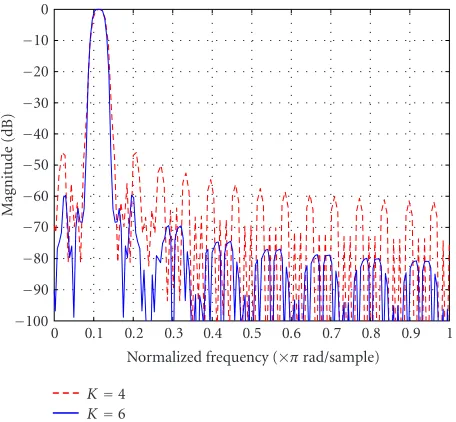
The frequency responses of the fourth subchannel filters that are used for the filter bank with 2M=64 complex chan-nels are plotted in Figure 8. The figure shows a frequency modulated ELT prototype with overlapping factorK=4 and another more frequency selective one withK = 6. In both cases, the roll-offin the filter bank design is 100%, mean-ing that each subchannel transition band is overlappmean-ing with the closest transition band and passband of the adjacent sub-channel, but not with the more distant ones.
K=4 K=6
0 0.1 0.2 0.3 0.4 0.5 0.6 0.7 0.8 0.9 1 Normalized frequency (×πrad/sample)
−100 −90 −80 −70 −60 −50 −40 −30 −20 −10 0
M
ag
nitude
(dB)
Figure8: Frequency response for the analysis and synthesis banks of one of the subchannel filters withK=4 andK=6 where 2M=
64 subbands.
the jammer. Thus, if the filter characteristics are known, the number of affected subbands can be predicted and the eff ec-tiveS/Nfrom (12) can be calculated to obtain the estimated BER for the two filter bank designs. An application of this idea is presented inFigure 13.
5. PERFORMANCE EVALUATION
Simulations with the previously described model were run with the following parameters: the spreading fac-tor/processing gain of the spread spectrum system wasgp = 127 and the spread signal was oversampled by 2. The fil-ter bank was an ELT-based complex bank with 2Mcomplex channels (M on the positive and M on the negative sides of the frequency band), decimation, and interpolation byM and perfect reconstruction. The threshold factor used in the jammer detection block was 2. For each point in the simu-lation results, at least 10000 data bits were used to check the BER. In the case of a randomly hopping jammer, the inter-ferer hopped every 16 information bits and the simulations were done withEb/N0 =7 dB. The results below extend the ones presented in [23].
Figure 9compares the results applying the recursive algo-rithm with those that do not apply it with a 10% jammer and a single tone jammer at a fixed position. The improvement in the performance using the recursive algorithm is evident.
The previously mentioned effect of the transients is stud-ied inFigure 10. The curves present the performance of a fil-ter bank with 2M =32 subbands and with different proto-type filtersK=4 andK=6. It can be seen that without miti-gating the transients, the results for both prototypes are very similar and we are not completely taking advantage of the higher stopband attenuation of the filter with higher over-lapping factorK. However, when the guard interval method
No excision, tone jammer No excision, 10% jammer One-time detection, 10% jammer One-time detection, tone jammer Recursive algorithm, 10% jammer Recursive algorithm, tone jammer
−60 −50 −40 −30 −20 −10 0 S/Jratio (dB)
10−4 10−3 10−2 10−1 100
BER
Figure 9: Performance without excision, with one-time excision, and using the proposed recursive excision algorithm.Eb/N0=7 dB,
2M=32 subbands withK=4, spreading factor=127, 10% and single tone jammers at fixed position. Guard-interval-based tran-sient mitigation is applied.
No suppression Suppression,K=4 Suppression,K=6
Suppression,K=4 and guard interval Suppression,K=6 and guard interval Suppression,K=4 and guard bit Noisefloor
−60 −50 −40 −30 −20 −10 0 S/Jratio (dB)
10−4 10−3 10−2 10−1 100
BER
Figure10: Fighting the transients with guard interval and guard bit. Filter prototypes with overlapping factorsK =4 andK =6, whereEb/N0 =7 dB, 2M=32 subbands, spreading factor=127,
No suppression 16 channels 32 channels
64 channels 128 channels Noise floor
−60 −50 −40 −30 −20 −10 0 S/Jratio (dB)
10−4 10−3 10−2 10−1 100
BER
(a)
No suppression 16 channels 32 channels
64 channels 128 channels Noise floor
−60 −50 −40 −30 −20 −10 0 S/Jratio (dB)
10−4 10−3 10−2 10−1 100
BER
(b)
No suppression 16 channels 32 channels
64 channels 128 channels Noise floor
−60 −50 −40 −30 −20 −10 0 S/Jratio (dB)
10−4 10−3 10−2 10−1 100
BER
(c)
No suppression 16 channels 32 channels
64 channels 128 channels Noise floor
−60 −50 −40 −30 −20 −10 0 S/Jratio (dB)
10−4 10−3 10−2 10−1 100
BER
(d)
Figure11: Performance with oversampled (a, c) and chip rate (b, d) processing using different filter bank sizes with 2M=16 to 128, where K =6,Eb/N0 =7 dB, spreading factor =127. (a, b) represent the single tone and (c, d) represent the 10% jammers at fixed positions.
Guard-interval-based transient mitigation is applied.
is applied, apart from an improvement in the performance in both designs, we can see that the difference between the per-formances grows. The figure also includes the guard bit ap-proach as a lower BER bound for the guard interval method. With a guard interval of 20 chips, the performance of the guard interval idea is close to the performance of the guard bit approach. In the figure we also include the noise floor, representing the performance of the system when no jammer is present.
No suppression 16 channels 32 channels
64 channels 128 channels Noise floor
−60 −50 −40 −30 −20 −10 0 S/Jratio (dB)
10−4 10−3 10−2 10−1 100
BER
(a)
No suppression 16 channels 32 channels
64 channels 128 channels Noise floor
−60 −50 −40 −30 −20 −10 0 S/Jratio (dB)
10−4 10−3 10−2 10−1 100
BER
(b)
No suppression 16 channels 32 channels
64 channels 128 channels Noise floor
−60 −50 −40 −30 −20 −10 0 S/Jratio (dB)
10−4 10−3 10−2 10−1 100
BER
(c)
No suppression 16 channels 32 channels
64 channels 128 channels Noise floor
−60 −50 −40 −30 −20 −10 0 S/Jratio (dB)
10−4 10−3 10−2 10−1 100
BER
(d)
Figure12: Performance with oversampled (a, c) and chip rate (b, d) processing using different filter bank sizes with 2M=16 to 128, where K =6,Eb/N0 =7 dB, spreading factor=127. (a, b) represent the single tone and (c, d) represent the 10% jammers at randomly hopping
positions. Guard-interval-based transient mitigation is applied.
and the difference with higher number of subchannels is es-pecially high in the case of low-to-medium power jammers. Considering the case of chip rate processing, the width of the spectrum relative to the sampling frequency at the filter bank input is doubled, and this could allow having a filter bank with fewer subbands. The processing load can thus also be reduced in two ways, first by handling half the number of samples, second by using a smaller filter bank. In this case we see that also the filter bank with 2M=16 subbands achieves
acceptable performance. Overall, using chip rate processing results only in a minor degradation in performance if the fil-ter banks size is chosen appropriately.
Simulated BER without jammer elimination Estimated BER without jammer elimination Simulated BER after jammer removal Noise floor
Estimated BER range after jammer removal
−60 −50 −40 −30 −20 −10 0
Figure13: Expected BER range and obtained BER values overS/J ratio in the optimised system with 2M=32,K=6, oversampled processing, guard bit,Eb/N0=7 dB, spreading factor=127, diff
er-ent interference parameters.
We can compare the obtained results with the expected performance of the derivations ofSection 3, taking into ac-count the filter bank design proposed inSection 4.Figure 13
shows the estimated and simulated BER performances in the cases in which the jammer is not removed and also when it is removed. For the estimation of the BER range after the jam-mer removal, the range in the numbers of removed subbands at eachS/Jratio was considered. Knowing the type of inter-ference and its power and the noise level, it is possible to pre-dict how much the interference will stick out of the uniform DS-SS signal spectrum. Based on the stopband attenuation of the filters in the filter bank, we can then estimate how many subbands will be affected by the jammer, that is, get enough jammer energy to modify the uniformity of the desired sig-nal. With the number of affected and therefore eliminated subbands and (12), we can calculate the expected degrada-tion of theEb/N0ratio and consequently the expected BER. Testing this idea on empirical measurements and counting the maximum and minimum number of affected subbands with different interference parameters, at each S/J ratio, we were able to obtain the shaded area ofFigure 13. The figure shows that the expected results match quite well with the ob-tained ones.
In another experiment, the processing was shortened into blocks of 2 to 8 information bits, instead of 16 as in the pre-vious results. Shorter processing blocks permit the tracking and elimination of more quickly hopping jammers. The aim was to see how short the blocks could be made before the per-formance of the system decreased too much. Figures14and
15reflect the results of this research. For a system ofK =6, 2M=128 subbands at chip rate processing and using guard
bits, the conclusion is that the degradation in performance is negligible for block lengths down to 6 bits, but beyond that point it starts to be significant.
The results shown in this section are clearly better than the ones presented in the reference method [8] using a 1024-point FFT, as far as a direct comparison can be made. Ap-parently, the 10% BPSK jammer in [8] did not have any kind of pulse shaping, hence resulting in a more wideband signal with sinc spectrum. We present in Figure 16a comparison between a filter bank with 32 subchannels and a 1024-point FFT (no windowing) under a 10% fixed positioned jammer.
6. CONCLUSIONS
In this paper, a filter-bank-based interference detection and excision method for a DS-SS system has been studied and evaluated. The interfered subbands were removed from the signal to eliminate the jammers. The system worked with in-terference at a fixed position and with inin-terference that ran-domly changed its position, with continuous wave interfer-ence and with BPSK type of interferinterfer-ence taking up to 10% of the desired signal bandwidth.
The main strengths of the system presented in this paper are the perfect reconstruction property of the filter bank used and its affordable complexity requirements. It was shown through simulations that the performance is close to the the-oretical limit when all aspects of the system are carefully opti-mised. The proposed system works quite well with far greater S/J ratios than any of the transform domain techniques re-ported in the literature. We can take the results of [12, Figure 3.14] as a reference. They show the performance of differ-ent frequency domain excision methods in the case of 10% jammer bandwidth and indicate best performance for the ELT-based approach. In those results, the performance de-grades drastically (BER>0.1) forS/Jratios lower than about
−45 dB. For comparison, we repeated our simulations with similar parameters (5 dBEb/N0, almost the same spreading code length, 63 instead of 64, but different spreading code). These results, with properly optimised filter bank and recur-sive jammer detection algorithm, indicate smoother degra-dation with lowS/J ratios providing tolerable performance (BER<0.1) forS/J above−75 dB withK =6 (−55 dB with K=4).
Implementing the perfect reconstruction filter bank with ELTs, an efficient system is obtained, allowing the system to work at high data rates. In [24], it was shown that the whole excision system with overlapping factorK=5 can be imple-mented with a single TMS320C6414 DSP with sampling rate in the order of 6–9 MHz, depending on the size of the filter bank.
One significant aspect when comparing with most of the other frequency domain approaches is that the needed num-ber of subchannels is very low. Even with 16 subchannels, the performance is close to the theoretical one.
−60 −50 −40 −30 −20 −10 0 S/Jratio (dB)
10−4 10−2 100
BER
8 bits
−60 −50 −40 −30 −20 −10 0 S/Jratio (dB)
10−4 10−2 100
BER
4 bits
(a)
−60 −50 −40 −30 −20 −10 0 S/Jratio (dB)
10−4 10−2 100
BER
6 bits
−60 −50 −40 −30 −20 −10 0 S/Jratio (dB)
10−4 10−2 100
BER
2 bits
(b)
−60 −50 −40 −30 −20 −10 0 S/Jratio (dB)
10−4 10−2 100
BER
8 bits
−60 −50 −40 −30 −20 −10 0 S/Jratio (dB)
10−4 10−2 100
BER
4 bits
(c)
−60 −50 −40 −30 −20 −10 0 S/Jratio (dB)
10−4 10−2 100
BER
6 bits
−60 −50 −40 −30 −20 −10 0 S/Jratio (dB)
10−4 10−2 100
BER 2 bits
(d)
Figure14: Different processing block lengths of 2 to 8 bits. Filter bank with 2M=128,K=6, chip rate processing, guard bit,Eb/N0=7 dB,
and spreading factor = 127. (a), (b) represent the single tone and (c), (d) represent the 10% jammers at fixed positions. Dashed lines represent simulated BER without jammer removal, solid lines represent simulated BER after jammer removal, and dotted lines represent noise floor.
comparing ELT, FFT, and DCT methods. Better performance at increasing jammer powers can be obtained by using proto-type filters that are more frequency selective and have higher stopband attenuation. However, the limiting factors can be at earlier stages in the receiver. For example, the resolution of the A/D converter has to be good enough to represent a desired signal that is, for instance, 70 dB weaker than the in-terfering signal that is also being sampled simultaneously.
We have studied the performance of the proposed method only in the single-user case. In multiuser CDMA
−60 −50 −40 −30 −20 −10 0 S/Jratio (dB)
10−4 10−2 100
BER
8 bits
−60 −50 −40 −30 −20 −10 0 S/Jratio (dB)
10−4 10−2 100
BER
4 bits
(a)
−60 −50 −40 −30 −20 −10 0 S/Jratio (dB)
10−4 10−2 100
BER
6 bits
−60 −50 −40 −30 −20 −10 0 S/Jratio (dB)
10−4 10−2 100
BER
2 bits
(b)
−60 −50 −40 −30 −20 −10 0 S/Jratio (dB)
10−4 10−2 100
BER
8 bits
−60 −50 −40 −30 −20 −10 0 S/Jratio (dB)
10−4 10−2 100
BER
4 bits
(c)
−60 −50 −40 −30 −20 −10 0 S/Jratio (dB)
10−4 10−2 100
BER
6 bits
−60 −50 −40 −30 −20 −10 0 S/Jratio (dB)
10−4 10−2 100
BER
2 bits
(d)
Figure15: Different processing block lengths of 2 to 8 bits. Filter bank with 2M=128,K=6, chip rate processing, guard bit,Eb/N0=7 dB,
and spreading factor = 127. (a), (b) represent the single tone and (c), (d) represent the 10% jammers at randomly hopping positions. Dashed lines represent simulated BER without jammer removal, solid lines represent simulated BER after jammer removal, and dotted lines represent noise floor.
its performance comparisons against other interference sup-pression methods are a topic for future studies. Also a more analytical study of the recursive jammer detection methods is included in the future plans.
ACKNOWLEDGMENT
No suppression
Figure 16: Comparison between a filter bank with 2M = 32, K =6 and oversampled processing and a 1024-point FFT, where Eb/N0=7 dB, spreading factor=127 and the 10% jammer is at a
fixed position. Guard-interval-based transient mitigation is applied.
REFERENCES
[1] J. G. Proakis,Digital Communications, Electrical Engineering Series. McGraw-Hill International Editions, New York, NY, USA, 4th edition, 2001.
[2] L. B. Milstein, “Interference rejection techniques in spread spectrum communications,” Proceedings of the IEEE, vol. 76, no. 6, pp. 657–671, 1988.
[3] F. Hsu and A. Giordano, “Digital whitening techniques for improving spread spectrum communications performance in the presence of narrowband jamming and interference,”IEEE Trans. Communications, vol. 26, no. 2, pp. 209–216, 1978. [4] J. W. Ketchum and J. G. Proakis, “Adaptive algorithms for
estimating and suppressing narrow-band interference in PN spread-spectrum systems,”IEEE Trans. Communications, vol. 30, no. 5, pp. 913–924, 1982.
[5] R. A. Iltis and L. B. Milstein, “Performance analysis of narrow-band interference rejection techniques in DS spread-spectrum systems,” IEEE Trans. Communications, vol. 32, no. 11, pp. 1169–1177, 1984.
[6] P. Henttu, H. Saarnisaari, and S. Aroinaa, “Interference sup-pression in DS/FH system using modified two sided adaptive filter,” inProc. IEEE Military Communications Conference, pp. 1429–1433, McLean, Va, USA, October 2001.
[7] M. J. Medley, G. J. Saulnier, and P. K. Das, “Narrow-band interference excision in spread spectrum systems using lapped transforms,”IEEE Trans. Communications, vol. 45, no. 11, pp. 1444–1455, 1997.
[8] A. Pouttu, J. K. Juntti, and T. J. Kumpum¨aki, “Adaptive trans-form domain interference suppression in a hybrid DS/FH-system,” inProc. IEEE 5th International Symposium on Spread Spectrum Techniques and Applications, pp. 351–355, Sun City, South Africa, September 1998.
[9] P. Henttu, A. Pouttu, and M. Raustia, “Performance of PIE interference suppressor using FFT, DCT and ELT transforma-tions in FH/DS communicatransforma-tions,” inProc. Information Sys-tems for Enhanced Public Safety and Security. IEEE/AFCEA, pp. 126–130, Munich, Germany, May 2000.
[10] R. A. Monzingo and T. W. Miller, Introduction to Adaptive Arrays, John Wiley & Sons, New York, NY, USA, 1980. [11] M. V. Tazebay and A. N. Akansu, “Adaptive subband
trans-forms in time-frequency excisers for DSSS communications systems,” IEEE Trans. Signal Processing, vol. 43, no. 11, pp. 2776–2782, 1995.
[12] A. N. Akansu and M. J. Medley, Wavelet, Subband, and Block Transforms in Communications and Multimedia, Kluwer Aca-demic, Boston, Mass, USA, 1999.
[13] P. P. Vaidyanathan, Multirate Systems and Filter Banks, Prentice-Hall Signal Processing Series. Prentice-Hall, Engle-wood Cliffs, NJ, USA, 1993.
[14] T. J. Kumpum¨aki, M. A. Isohookana, and J. K. Juntti, “Narrow-band interference rejection using transform domain signal processing in a hybrid DS/FH spread spectrum system,” inProc. IEEE Military Communications Conference, pp. 89–93, Monterey, Calif, USA, November 1997.
[15] T. Karp and N. J. Fliege, “Modified DFT filter banks with perfect reconstruction,” IEEE Trans. on Circuits and Systems II: Analog and Digital Signal Processing, vol. 46, no. 11, pp. 1404–1414, 1999.
[16] A. Viholainen, T. H. Stitz, J. Alhava, T. Ihalainen, and M. Ren-fors, “Complex modulated critically sampled filter banks based on cosine and sine modulation,” in Proc. IEEE Int. Symp. Circuits and Systems, pp. 833–836, Scottsdale, Ariz, USA, May 2002.
[17] H. S. Malvar,Signal Processing with Lapped Transforms, Artech House, Boston, Mass, USA, 1992.
[18] J. Alhava, A. Viholainen, and M. Renfors, “Efficient imple-mentation of complex exponentially-modulated filter banks,” inProc. IEEE Int. Symp. Circuits and Systems, pp. 157–160, Bangkok, Thailand, May 2003.
[19] H. S. Malvar, “A modulated complex lapped transform and its applications to audio processing,” in Proc. IEEE Int. Conf. Acoustics, Speech, Signal Processing, pp. 1421–1424, Phoenix, Ariz, USA, March 1999.
[20] R. W. Young and N. G. Kingsbury, “Frequency-domain mo-tion estimamo-tion using a complex lapped transform,” IEEE Trans. Image Processing, vol. 2, no. 1, pp. 2–17, 1993. [21] A. Viholainen, J. Alhava, and M. Renfors, “Implementation of
parallel cosine and sine modulated filter banks for equalized transmultiplexer systems,” inProc. IEEE Int. Conf. Acoustics, Speech, Signal Processing, pp. 3625–3628, Salt Lake City, Utah, USA, May 2001.
[22] P. Henttu, “Signaalikomponenttien erottaminen radioj¨arjes-telm¨an vastaanottimessa,” inSuomalainen Pattentihakemus nro. 20010952, Nokia Networks Oy, Finland, 2001.
[23] T. H. Stitz and M. Renfors, “Filter bank based narrowband in-terference detection and suppression in spread spectrum sys-tems,” inProc. IEEE Int. Symp. Circuits and Systems, pp. 516– 519, Phoenix-Scottsdale, Ariz, USA, May 2002.
[24] Y. Yang, T. H. Stitz, and M. Renfors, “Implementation of a filter bank based narrowband interference suppression algo-rithm on a DSP processor,” inProc. International Conference on Telecommunications, Beijing, China, June 2002.
working towards his doctoral degree there. His research interests include wireless communications based on multicarrier systems, especially focusing on filter-bank-based systems and other filter bank applications for signal processing.
Markku Renfors was born in Suoniemi, Finland, on January 21, 1953. He received the Diploma Engineer, Licentiate of Tech-nology, and Doctor of Technology degrees from Tampere University of Technology (TUT) in 1978, 1981, and 1982, respectively. He held various research and teaching po-sitions at TUT from 1976 to 1988. In the years 1988–1991, he was working as a De-sign Manager in the area of video De-signal