R E S E A R C H
Open Access
Smoothing data association for target
trajectory estimation in cluttered
environments
Sufyan Memon, Taek Lyul Song
*and Tae Han Kim
Abstract
For heavily cluttered environments with low target detection probabilities, tracking filters may fail to estimate the true number of targets and their trajectories. Smoothing may be needed to refine the estimates based on collected measurements. However, due to uncertainties in target motions, heavy clutter, and low target detection probabilities, the forward prediction and the backward prediction may not be properly matched in the smoothing algorithms, so that the smoothing algorithms may fail to detect the true target trajectories. In this paper, we propose a new
smoothing algorithm to overcome such difficulties. This algorithm employs two independent integrated probabilistic data association (IPDA) tracking filters: one running forward in time (fIPDA) and the other running backward in time (bIPDA). The proposed algorithm utilizes bIPDA multi-tracks in each fIPDA path track for fusing through data
association to obtain the smoothing innovation in a fixed-lag interval. The smoothing innovation is used to obtain the smoothing data association probabilities which update the target trajectory state and the probability of target existence. The fIPDA tracks are updated after smoothing using the smoothing data association probabilities, which makes the fIPDA path tracks robust for maneuvering target tracking in clutter. This significantly improves the target state estimation accuracy compared to the IPDA. The proposed algorithm is called fixed-lag smoothing data association based on IPDA (FLIPDA-S). A simulation study shows that the proposed algorithm improves false track discrimination performance for maneuvering target tracking in clutter.
Keywords: Smoothing data association, FLIPDA-S, False track discrimination, Target existence
1 Introduction
In target tracking, sensors detect targets as well as various unwanted objects in the surveillance area. Information about the targets’ prior existence in the surveillance area is not known. The objects’ sources are also unknown, with some possible sources being terrain reflections, thermal noise, and clouds. The unwanted objects are generally known as clutter. In a cluttered environment, the tar-get measurements are present with a low probability of detectionPDin each scan.
Tracks are initialized and updated using the measure-ments obtained in each scan. Track initialization in a cluttered environment results in both true tracks and
*Correspondence: [email protected]
Department of Electronic System Engineering, Hanyang University, Ansan, Republic of Korea
false tracks. True tracks always follow the target mea-surements, whereas false tracks do not follow the target measurements. A technique called false track discrim-ination (FTD) is used to confirm the true tracks and terminate the false tracks. Almost all target-tracking algo-rithms employ track quality measures to achieve FTD. But the standard probabilistic data association (PDA) [1] does not provide a track quality measure for FTD. The multiple hypothesis tracker (MHT) [2] uses a sequential probability ratio as a track quality measure for FTD. In [3], the authors proposed a track-oriented MHT algorithm and applied a smoothing velocity vector for reduction of the false track establishment.
Integrated probabilistic data association (IPDA) [4, 5] introduces recursive formulae for data association and employs the probability of target existence as a track
quality measure. The practical considerations for IPDA are discussed in [6]. IPDA is extended for maneuvering target tracking in [7] and [8]. The probability hypothesis density (PHD) algorithm [9, 10] estimates the number of targets and their trajectories without having the track-to-measurement association. A multi-scan data association-based integrated track splitting (ITS) algorithm [11, 12] updates the target state estimation in the current scan more accurately at the cost of increasing computational complexity. ITS also utilizes the probability of target exis-tence as a track quality measure.
For target tracking in densely populated cluttered envi-ronments with a low probability of target detection, it becomes difficult to know the number of targets and their behavior in nature. In addition, the target trackers with autonomous track management function often fail to track the true targets in such environments. Smoothing may be needed to refine the tracking results. The smooth-ing algorithms use future scan information to improve the target state estimation accuracy in the current scan, at the cost of smoothing lag. The basic techniques of smoothing estimation are described in [13, 14], and [15]. A limited number of publications focus on smoothing tar-get tracking. Augmented state fixed-lag smoothing based on the joint PDA (JPDA) algorithm is proposed in [16] for tracking multiple maneuvering targets in clutter. However, [16] does not provide a track quality measure for FTD. In [17], the authors applied IPDA to an augmented state system for fixed-lag smoothing and utilized the smooth-ing target existence probability as a track quality measure for FTD. In [18], the authors applied the fixed-interval Rauch-Tung-Striebel (RTS) [14, 15] smoothing formulae to the MHT algorithm to track a maneuvering target with-out a track quality measure for FTD. The fixed-interval smoothing IPDA (sIPDA) [19] uses the RTS smoothing formulae with the Fraser-Potter [20] approach to calculate the smoothing predictions and innovations.
In smoothing algorithms, the forward track prediction and the backward track prediction are based on mea-surements collected in a fixed-lag smoothing interval [k,N]. In the smoothing interval, the fusion of forward track prediction and backward track prediction is
per-formed at scan k. Therefore, in an environment with
densely populated clutter, low detection probabilities, and uncertain target motion, the forward predicted state and the backward predicted state may lie far away such that their contributions to establish the fused predicted state may be insignificant, which results in bad fusion per-formance. Due to this, fusion of forward prediction and backward prediction becomes a challenging issue. Thus, smoothing algorithm may fail to detect the true target tra-jectories. For such difficult environments, we propose a new smoothing algorithm called fixed-lag smoothing data association based on IPDA (FLIPDA-S). The proposed
algorithm considers a constant-velocity model to deal with the problems of tracking a maneuvering target in a cluttered environment. A constant-velocity model is a dynamic model of a tracking filter that describes the tar-get motion using a 4-dimensional state vector composed of 2-dimensional position and 2-dimensional velocity. The proposed work uses an arbitrary size of the smoothing interval [k,N], where the first scan of each smoothing interval faces fixed-lag smoothing, such that the fixed-lag of the proposed algorithm isN −k. Unlike sIPDA [19], the proposed FLIPDA-S algorithm does not use the RTS algorithm for smoothing.
The proposed FLIPDA-S algorithm employs two inde-pendent IPDA filters, where the first IPDA filter runs in the forward (fIPDA) direction and the other runs in the backward (bIPDA) direction. The FLIPDA-S algorithm utilizes bIPDA multi-track state predictions. The back-ward multi-track state predictions at each scan in the smoothing interval are obtained recursively by utilizing the sensor measurements starting from the end of the smoothing interval to the beginning of the smoothing interval. The fIPDA tracks are initialized and maintained by using the sensor measurements at each scan. At each scan in the fixed-lag interval, the forward track state prediction of FLIPDA-S is used to produce smoothing innovations associating with the multiple tracks gener-ated from bIPDA. In this fusion, each track in the forward path treats the backward path tracks as the measure-ments for data association. The smoothing data associ-ation probabilities, smoothed target trajectory state, and smoothed target existence probability are obtained by applying the smoothing innovations to the sensor mea-surements received at scank in the fixed-lag smoothing interval [k,N]. FLIPDA-S uses smoothing data associa-tion probabilities to update and propagate the existing forward tracks to the next smoothing interval. In the next fixed-lag interval, the FLIPDA-S uses each updated forward track and new forward tracks (initialized by fIPDA) to fuse with the backward path multiple tracks to smooth the target trajectory state and the probabil-ity of target existence. This procedure continues in each subsequent interval, which significantly improves both the target trajectory state estimation accuracy and the FTD. The simulation study of Section 5 shows improved FTD performance of FLIPDA-S as compared with sIPDA and IPDA for maneuvering target tracking in a cluttered environment.
2 Model dynamics
This section describes the target model and the sen-sor model. In this paper, we assume that the sensen-sor has infinite resolution.
2.1 Target model
The target existence event in scankis a random event and is denoted byχk. If the target trajectory state at scankis denoted byxk, then the target trajectory propagates by
xk=Fxk−1+vk−1 (1)
whereFis the forward state propagation matrix andvk−1
is the zero-mean white Gaussian plant noise sequence
with known covariance matrix Q. Equation (1) can be
rewritten for the backward trajectory statexτkpropagation as
xτk =Fbxk+1+vk+1 (2)
where Fb is the backward state propagation matrix and vk+1 is the zero-mean white Gaussian backward plant
noise sequence with known covariance matrixQb. These matrices are expressed below:
F =
null matrix, the scalar quantityqis the target acceleration uncertainty, andTis the sampling time.
2.2 Sensor model
The target measurement at each scankis
zk =Hxk+wk (7)
whereHis the measurement matrix, andwk is the zero-mean white Gaussian measurement noise sequence with known covariance matrixR.
In addition to target measurements, the sensor also returns clutter measurements, which follow Poisson dis-tributions [21]. The clutter measurement density ρk,i is a function of the measurement specified in the surveil-lance coordinate system, and it is assumed to be known or estimated [21].
The measurement set does not have prior knowledge about their sources.Zk is the measurement set received at scank, andmk is the number of measurements inZk
received at scank. LetZk =Zk,Zk−1
be the cumulative set of measurements from the initial scan to the current scank. The measurement setZk−1gives the measurement information from the initial scan to scank−1. bIPDA fil-ter uses sensor measurementsZk+(where superscriptk+ indicates the scan index starting from scanN to scank in the smoothing interval) for backward track estimation. LetZk+=
Zk,Zk+1+
be the cumulative set of measure-ments from scank+ 1 to the current scank. If the ith measurement ofZk iszk,i, then the clutter measurement density atzk,iisρk,i≡ρ
zk,i
.
3 Fixed-lag smoothing data association based on the IPDA algorithm (FLIPDA-S)
In this section, we propose the fixed-lag smoothing data association algorithm based on IPDA (FLIPDA-S) with an arbitrary size of the smoothing interval [k,N]. FLIPDA-S smoothens the target trajectory estimation and the tar-get existence probability at each scan in the fixed-lag smoothing interval.
The forward IPDA [4] initializes the new multiple for-ward tracks based on measurementsZk received in the first scan k of the smoothing interval. FLIPDA-S uses IPDA [4] in the backward direction. In the backward path, new multiple backward tracks are initialized and updated using measurements Zk+ received at each scan in the smoothing interval, ranging from scanN to scanksuch thatZk+ = Zk,Zk+1,. . .,ZN
. At each scan, FLIPDA-S fuses each forward track state predictionpxk|χk,Zk−1
with backward path multiple track state predictions p
xτk|χkτ,Zk+1+
τ using the data association procedure
3.1 Forward IPDA (fIPDA)
This section describes the initialization of fIPDA [4] tracks using sensor measurementZk received in the first scan of every smoothing interval. fIPDA waits bIPDA for an arbitrary lag time in each interval to initialize each new forward track based on sensor measurementsZkreceived in each fixed-lag interval. The procedure is as follows.
3.1.1 Notation
ˆ
xk−1|k−1 and Pkˆ −1|k−1 are the mean and covariance,
respectively, of the forward track state estimate for scan k−1 conditioned onZk−1.x¯k|k−1andP¯k|k−1are the mean
and covariance, respectively, of the forward track state prediction for scankconditioned onZk−1.χk is the tar-get existence event in the forward track, P
χk−1|Zk−1
is the probability of target existence for scank−1 con-ditioned on Zk−1, and Pχk|Zk−1
is the probability of
target existence for scankconditioned onZk−1.
3.1.2 Forward track initialization
Measurements of the first scan of two consecutive smoothing intervals are used to initialize new forward tracks (two point differencing [6]) with an initial probabil-ity of target existenceP
χk−1|Zk−1
. Each forward track carries a unique forward track identification number.
3.1.3 fIPDA track propagation
The fIPDA recursion at scan k starts with the
updated track probability density function (pdf )
pxk−1|χk−1,Zk−1
at scan k − 1. The fIPDA target
existence probability follows the Markov chain one model [5] and propagates by
Pχk|Zk−1
wherep1,1is the fIPDA target existence transition
proba-bility [5]. Note that in [5], the Markov chain two model is also described but it is useful for occluded target tracking, which is not the subject of this paper.
Each forward track propagates by using a Kalman filter propagation:
whereKFpis the Kalman filter propagation, and the
for-ward track state prediction and its covariance matrix are given by
¯
xk|k−1=Fxˆk−1|k−1
¯
Pk|k−1=FPˆk−1|k−1FT +Q (10)
3.2 Backward IPDA (bIPDA)
The proposed algorithm uses an IPDA [4] filter in the backward direction. The bIPDA procedure starts from the scan N of the smoothing interval [k,N], and the bIPDA tracks move backward until they reach scank. The procedure is as follows.
3.2.1 Notation
Let τ{τ1,τ2,. . .,τn} be the label of backward tracks. ˆ
xkτ+1|k+1+andPˆτk+1|k+1+are the mean and covariance of the backward track state estimate for scan k + 1 con-ditioned on Zk+1+. x¯τk|k+1+ and P¯τk|k+1+ are the mean and covariance of backward track state prediction for scan kconditioned onZk+1+. The backward track state estimate and its covariance for scan k conditioned on Zk+ are denoted by xˆτk|k+ andPˆτk|k+, respectively. χkτ is the target existence event in the backward path track, P
χτ
k+1|Zk+1+
is the backward probability of target
existence for scan k + 1 conditioned on Zk+1+, and Pχkτ|Zk+1+
is the backward probability of target
exis-tence for scankconditioned onZk+1+.
3.2.2 Backward track initialization
The backward tracks are initialized in each scan using sensor measurements. Each pair of measurements in con-secutive scans may initialize a new backward track (two point differencing [6]) with an initial backward probability of target existence,P
χkτ+1|Zk+1+
. Therefore, there are no backward tracks in the last two scans of each smooth-ing interval. Each new backward track carries a unique backward track identification number.
3.2.3 Backward track propagation
The bIPDA recursion at scan k starts with the updated track pdf,p
xτk+1|χkτ+1,Zk+1+
at scank+1. The bIPDA probability of target existence follows the Markov chain one model [5] and propagates by
P
wherepb1,1is the bIPDA target existence transition proba-bility [5]. Each backward track propagates by the Kalman filter propagation:
whereKFpis the Kalman filter propagation, and the
3.2.4 bIPDA measurement selection
At each scan k in the smoothing interval, each back-ward track selects a subset of validated measurements zbk,i from the measurement set Zk received at scank. A measurement selection procedure [5] is used to select the validated measurementszbk,ifor each backward track. The validation measurements selection criterion is given by
k+1+
i T
S−k+11+ki+1+≤g (14)
where ki+1+ and Sk+1+ denote the measurement zk,i innovation and its covariance with respect to each back-ward track:
k+1+
i =zk,i−Hx¯τk|k+1+ (15)
Sk+1+=HP¯kτ|k+1+HT+R (16)
andgis the validation selection threshold, which depends on the gating probabilityPG[6, 22]. In the 2-dimensional surveillance situation,g is selected as 9.21, which corre-sponds on the gating probability PG = 0.99. The vali-dated measurementzbk,iselected by each backward track is defined by
3.2.5 bIPDA measurement likelihood
At each scank, each backward track calculates the mea-surement likelihood of validated meamea-surementzbk,iby [4]
pbk,i=pzbk,i|k+1+,Zk+1+
3.2.6 bIPDA track update
The backward measurement likelihood ratio is expressed by
The updated bIPDA probability of target existence [4, 6] at scankis given by
At each scank, each backward track state is updated by using the validated measurements zbk,i for i ≥ 0
(i = 0 corresponds to the non-existence event). The
data association probabilities corresponding to feasible track-to-measurement association events become
βb
Each backward track state estimate is updated by apply-ingzbk,iin the Kalman filter update equation.
whereKFUis the Kalman filter estimation update defined
by
Using (21), the Gaussian mixture [19] of updated back-ward track state estimate (22) becomes
ˆ
3.3 Information fusion state prediction and innovation
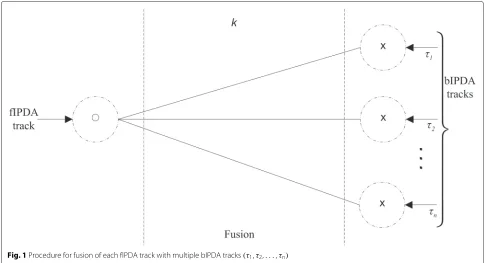
At the first scan of each fixed-lag smoothing interval, the information fusion state prediction and innovation are formed by fusing each forward track prediction with backward path multi-track predictions falling in their val-idation region, as illustrated in Fig. 1.
Figure 1 shows an example of the fusion procedure, where ◦ indicates forward track prediction and× indi-cates backward track predictions inside the validation gate created by the forward prediction. The fusion is based on the following assumptions:
• the bIPDA multi-track predictionp
xτk|χkτ,Zk+1+
(where,τis the label of a backward track) received at scank, assumes the role of a measurement to be used by the forward tracks.
Fig. 1Procedure for fusion of each fIPDA track with multiple bIPDA tracks(τ1,τ2,. . .,τn)
• (1−PD)N−k+1is the non-detection probability (probability that a track does not exist in the interval [k,N]).
• P∗D=1−(1−PD)N−k+1is the probability that the track does exist in the interval[k,N].
• The false track density of bIPDA satisfies
ρkτ,i≈ nb
A (26)
whereρkτ,iis the false track density of bIPDA,nbis the total number of backward false tracks inside the surveillance region, andAis the area of the surveillance region. The procedure is as follows.
3.3.1 Information fusion measurement selection
In the fusion, the bIPDA track predictions form a set of measurements at scan k. Each forward track prediction fuses with a subset of selected backward track predictions. A measurement selection procedure [5] is used to select the validated backward track predictions to ensure that the forward track prediction and the backward track pre-diction are properly matched. The measurement selection criterion is [5]
k i T
S−k1ki ≤g (27)
whereki andSk represent the measurement innovation and its covariance with respect to each trackτ. Here,
k
i =Hx¯τk|k+1+−Hx¯k|k−1 (28)
Sk=H
¯
Pτk|k+1++ ¯Pk|k−1
HT (29)
The backward tracks which satisfy (27) are said to be inside the validation gate and they form a set of vali-dated measurements associated with the forward track. The information fusion state prediction is obtained by using the information fusion formulae [13, 23].
¯
xηk,P¯ηk
=
⎧ ⎪ ⎪ ⎨ ⎪ ⎪ ⎩
¯
xk|k−1,P¯k|k−1
; ifτ is a false track
IFU
¯
xτk|k+1+,x¯k|k−1,P¯kτ|k+1+,P¯k|k−1,H
; ifτ is the true track
(30)
whereIFUis the information fusion filter update,ηis the
label of the fusion track, and
¯ Pηk
−1
=P¯k|k−1
−1
+P¯τk|k+1+ −1
(31)
¯
xηk = ¯PηkP¯k|k−1
−1
¯ xk|k−1+
¯
Pτk|k+1+−1x¯τk|k+1+
.
(32)
3.3.2 Measurement likelihood of selected measurement
pηk=
3.3.3 Information fusion filter update
The measurement likelihood ratio ∗k of the validated measurements satisfies
wheremτkis the number of validated backward tracks. Data association probabilities for the fusion tracks are calculated by
The Gaussian mixture [19] of (30) can be obtained by using the data association probabilities of (35) as
¯
The FLIPDA-S target existence probability for the fusion step at scankis obtained by combining the predicted for-ward existence probability and measurement likelihood ratio obtained from the validated backward tracks. Using (8) and (34), the target existence probability for the fusion step is found to be
Pχk|ZN\k
where superscriptN\k implies the interval composed of [ 0,k−1]∪[k+1,N].
3.4 Fixed-lag smoothing IPDA (FLIPDA-S)
At the first scan of the fixed-lag smoothing interval [k,N], the FLIPDA-S track update is performed with the mea-surements inside the validation gate created by the fusion track represented by (36) and (37).
3.4.1 FLIPDA-S measurement selection
The validated measurements zsk,i (where, superscript s denotes the smoothing step) are obtained by applying (36) and (37) to a validation selection criterion.
k|N\k i
T
Sk−|1N\kik|N\k ≤g (39)
whereki|N\k andSk|N\k represent the innovation ofzk,i and its covariance, respectively, such as
k|N\k
i =zk,i−Hx¯k|N\k (40)
Sk|N\k=HP¯k|N\kHT+R (41)
3.4.2 FLIPDA-S Measurement likelihood
The smoothing likelihood measurement psk,i of zsk,i for each fusion track satisfies
psk,i=pzks,i|ZN\k=
The FLIPDA-S measurement likelihood ratioskat scankis
s
wheremskis the number of the smoothing validated mea-surements.
The smoothed target existence probability [4, 6] can be obtained by using (38)
Pχk|ZN
At scan k of the fixed-lag smoothing interval [k,N], each fusion track is updated by using smoothing valida-tion measurementszsk,i, where each feasible measurement outcomei ≥ 0 generates a smoothing data association probability defined by
and the FLIPDA-S track output is a Gaussian mixture [19] of (46) and can be obtained by using (45).
ˆ
where the subscript k,N indicates that the calculated smoothed value for scankis conditioned onZN.
3.5 Forward IPDA update for the next interval
In this section, we describe how the FLIPDA-S algo-rithm uses the smoothing data association probabilities obtained in (45) to update and propagate each fIPDA track for the next smoothing interval.
3.5.1 fIPDA measurement likelihood
Each forward track calculates the measurement likelihood pk,i based on the smoothing validation measurementzsk,i selected by (39).
3.5.2 fIPDA track update
The forward track measurement likelihood ratio k is defined by
The updated fIPDA probability of target existence at scankis [4, 6]
At scankof the fixed-lag smoothing interval [k,N], each forward track state is updated by using selected smooth-ing validation measurementszsk,ifori0 such as
and the smoothing data associationβks,iobtained in (45) is used to update each forward track state estimation (52) by
ˆ
The updated forward track estimation (based on the smoothing data association probabilities) is propagated to the next smoothing interval [k+1,N+1], where the oldest target trajectory state (the first scan of a smoothing inter-val) is discarded and a new scan is appended. FLIPDA-S uses each existing updated forward track along with some new forward tracks (initialized by fIPDA) to fuse with multiple backward tracks in the next interval. Thus, the procedure is recycled to smooth the target trajectory state and the probability of target existence. This significantly improves target state estimation accuracy and FTD for smoothing maneuvering target trajectories as shown in Section 5.
4 Practical considerations
This section presents practical considerations for the proposed work and its application in the simulation of Section 5.
4.1 Smoothing delay time limit
The smoothing target tracking algorithm has some prede-fined limited smoothing delay. The amount of smoothing delay depends on the application of the algorithm. A higher smoothing delay means that more measurements are available, which significantly reduces the estimation error. In this paper, a fixed-lag sliding smoothing inter-val procedure is used to limit the smoothing delay. In this case, the fixed-lag smoothing corresponds to only the first scan of each smoothing interval and to all the scans in the last smoothing interval in the simulation.
statistics (the estimation errors and the true track confir-mation rates) are accumulated for only the first scan of each smoothing interval, as well as for all the scans in the last smoothing interval. Let the current interval includes scansl=3,. . ., 7. After the fixed-lag smoothing, the new interval contains l = 4,. . ., 8, and its fIPDA recursion starts atk = 4, by using the fIPDA predicted track state, px4|χ4,Z3
, and the forward tracks are propagated after fixed-lag smoothing to the next interval. The new smooth-ing interval does not contain the existsmooth-ing backward tracks at the beginning of the new interval, and bIPDA initializes and updates the new tracks based on the measurements Zkreceived from scanNto scank.
4.2 Track management
The FLIPDA-S employs a track management procedure. Without track management, multiple fIPDA tracks and/or bIPDA tracks might follow the same target. The track management merges close tracks (following the same tar-get) [6] and eliminates those tracks having lower probabil-ity of target existence. This approach is well defined in the literature and is omitted here.
4.3 False track discrimination (FTD)
FLIPDA-S provides the probability of target existence as a track quality measure. In the proposed algorithm, we apply the following FTD procedure:
• fIPDA tracks and bIPDA tracks are initialized for each smoothing interval.
• During the fIPDA and bIPDA procedures, each track is terminated if its updated probability of target existence falls below a predetermined termination threshold. This step eliminates the majority of false tracks.
• The updated FLIPDA-S probability of target existence is used to confirm and terminate tracks. FLIPDA-S tracks are confirmed when the updated FLIPDA-S probability of target existence exceeds a predetermined confirmation threshold and terminated when it falls below a predetermined termination threshold. The maximum smoothing is achieved at the first scan of each fixed-lag smoothing interval, once a FLIPDA-S track is confirmed. • Each confirmed FLIPDA-S track stays confirmed
until track termination.
4.4 FLIPDA-S track output
All confirmed tracks are used for output. Each output track consists of the FLIPDA-S trajectory estimatexˆk,N, defined by (47). FLIPDA-S statistics generate only the results of confirmed true tracks, which must satisfy the true track test condition [19]. In this experiment, the following true track test condition [19] is used:
k,NTP−2|12k,N <20 (55)
where k,N = ˆxk,N − xk is the difference between the FLIPDA-S track state smoother and the true target tra-jectory state at scank, andP2|2is the track initialization
covariance matrix [13];
P2|2=
R R/T
R/T 2R/T2
. (56)
In addition, each confirmed track may become a false track if it meets the following false track test condition [19],
k,NTP−2|12k,N >40 (57)
5 Simulations
In this paper, the performance of FLIPDA-S is compared with the performance of sIPDA [19] and IPDA [4]. A maneuvering target trajectory in a cluttered environment is considered in the 2-dimensional surveillance area. The surveillance area is 800 m long along thex-axis and 600 m wide along they-axis. The target trajectory state vectorxk defined in (1) consists of dimensional position and 2-dimensional velocity vectors, such thatxk =
x,y,x,˙ y˙T. A linear sensor returns the target position measurements with probability of detectionPD = 0.8 and sensor noise covarianceR=25I2m2. The clutter measurement density
is equal to 1×10⁻⁴m−2. It is anticipated that all smoothing
algorithms show similar performance for an environment with zero clutter measurement density.
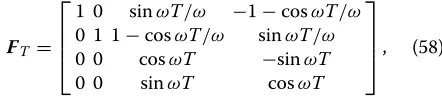
The simulation consists of 1000 runs where each run has 48 scans. The target initial position is [50 m, 200 m]T. The assumed maximum target velocity for track initialization [13] is 25 m/s. In the surveillance region, the target moves with a uniform motion of 15 m/s for the first 24 s of the running time, and then the target maneuvers with a con-stant angular velocity ofω = 0.06 rad/s, until the end of the running time. The maneuvering dynamics of the tar-get corresponding to the motion under the assumption of coordinated turn is defined by the following matrix [6].
FT = ⎡ ⎢ ⎢ ⎣
1 0 sinωT/ω −1−cosωT/ω
0 1 1−cosωT/ω sinωT/ω
0 0 cosωT −sinωT
0 0 sinωT cosωT
⎤ ⎥ ⎥ ⎦, (58)
Figure 2 shows the surveillance area and motion of the maneuvering target trajectory in clutter accumulated for one simulation run.
The FLIPDA-S uses Markov chain one model [5] of tar-get existence for track initiation and propagation with the fIPDA state transition probability ofp1,1 = 0.98 and the
bIPDA state transition probability ofpb1,1=1.
0 100 200 300 400 500 600 700 800 0
100 200 300 400 500 600
x−axis [m]
y−axis [m]
Target Trajectory Clutter measurements
Fig. 2Maneuvering target trajectory in clutter, inside the surveillance area
(Window 7, 2.8 GHz Intel core 2 duo CPU and MAT-LAB R2008a), where IPDA, sIPDA, and FLIPDA-S have average execution time of 0.03 s/scan, 0.08 sec/scan, and 0.06 sec/scan, respectively, for tracking a maneuvering tar-get. The execution time for any track depends on many factors including the probability of detection, number of tracks, clutter measurement density, area of surveillance region, and track management procedure. In this envi-ronment, false tracks consume majority of computational resources. In addition, the computational complexity
becomes twice if the number of targets and clutter mea-surements increase in the surveillance region. However, the proposed track management and FTD procedures ter-minate majority of false tracks and the efficiency of false track termination is reflected in the execution time.
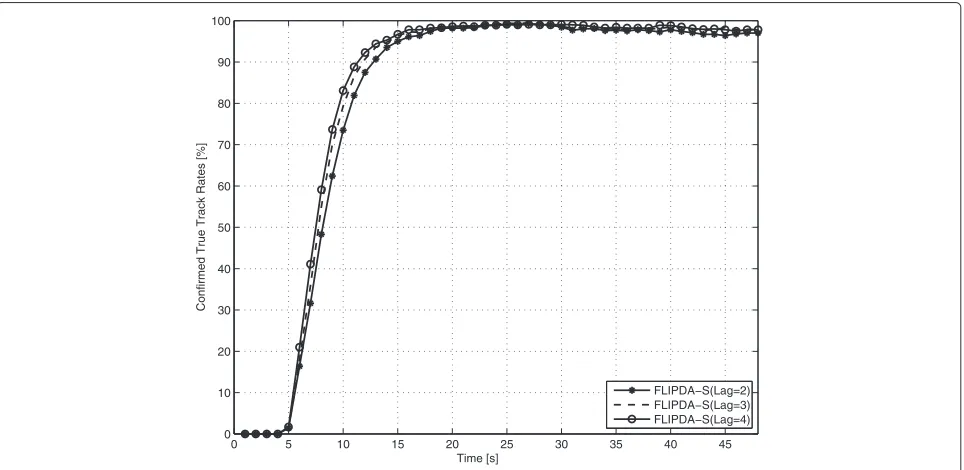
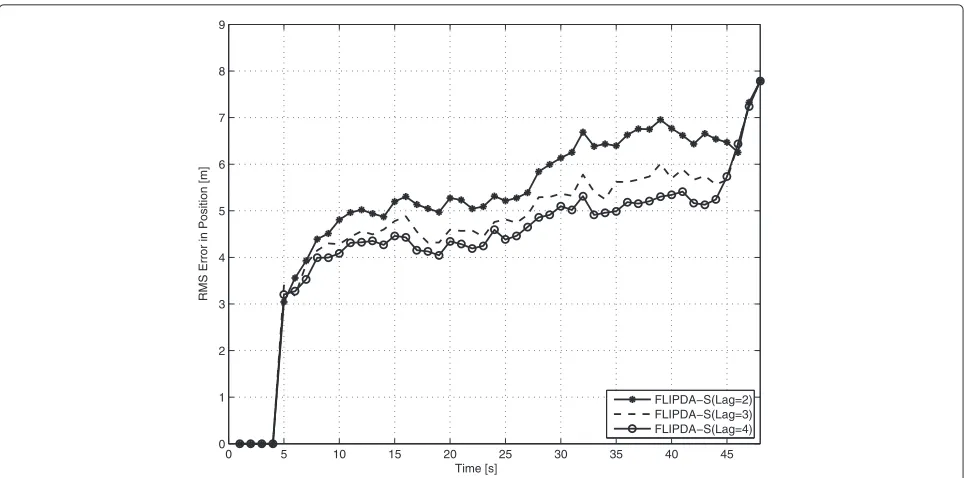
Figures 3 and 4 show the performance (confirmed true track rates and smoothing position estimation errors) of FLIPDA-S with different smoothing lags. It is obvious that increasing the lag size improves smoothing performance as seen from reduction of the RMS estimation errors
0 5 10 15 20 25 30 35 40 45
0 10 20 30 40 50 60 70 80 90 100
Time [s]
Confirmed True Track Rates [%]
FLIPDA−S(Lag=2) FLIPDA−S(Lag=3) FLIPDA−S(Lag=4)
0 5 10 15 20 25 30 35 40 45 0
1 2 3 4 5 6 7 8 9
Time [s]
RMS Error in Position [m]
FLIPDA−S(Lag=2) FLIPDA−S(Lag=3) FLIPDA−S(Lag=4)
Fig. 4Confirmed true track RMS position error of FLIPDA-S (lag=4), FLIPDA-S (lag=3), and FLIPDA-S (lag=2)
and the true track management performance depicted in Figs. 3 and 4.
Both FLIPDA-S and sIPDA have the same smoothing interval, for a fair comparison. The initial probability of target existence for the algorithms IPDA, sIPDA, and FLIPDA-S are the same and the confirmation threshold for the algorithms are tuned to get the same number of confirmed false tracks(≈68). Figure 5 shows confirmed
false track rates of FLIPDA-S, sIPDA, and IPDA. In Fig. 5, the confirmed false track rates are evaluated as the sum of confirmed false tracks per scan received from entire simulation runs.
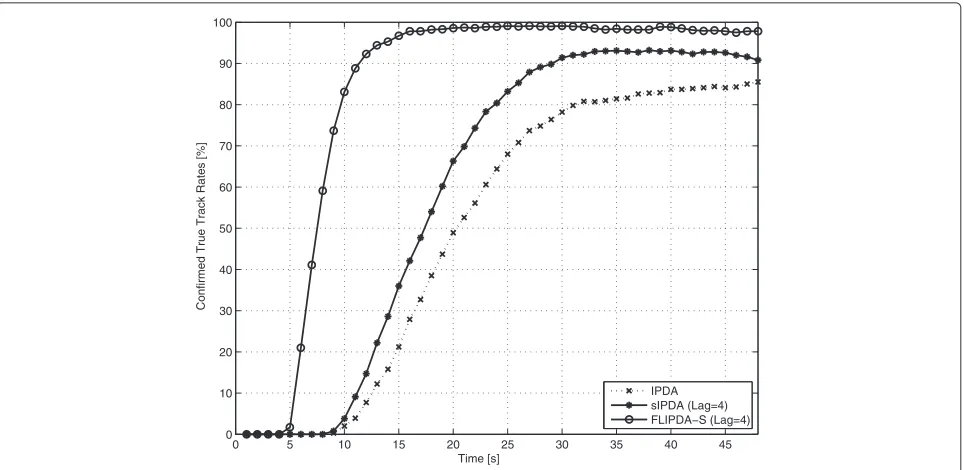
Figure 6 shows the true track confirmation rates of IPDA, sIPDA, and FLIPDA-S. Figure 6 provides a
mean-ingful FTD comparison. Whenk≤N, the FLIPDA-S and
sIPDA state estimates are based onZN, and the IPDA state
0 5 10 15 20 25 30 35 40 45
0 0.01 0.02 0.03 0.04 0.05 0.06 0.07 0.08 0.09 0.1
Time [s]
Confirmed False Track Rates [%]
IPDA sIPDA (Lag=4) FLIPDA−S (Lag=4)
0 5 10 15 20 25 30 35 40 45 0
10 20 30 40 50 60 70 80 90 100
Time [s]
Confirmed True Track Rates [%]
IPDA sIPDA (Lag=4) FLIPDA−S (Lag=4)
Fig. 6Confirmed true track rates of FLIPDA-S (lag=4), sIPDA (lag=4), and IPDA
estimate is based onZk. Therefore, FLIPDA-S and sIPDA use more measurements than IPDA and have improved performance over IPDA. The smoothing data association used by FLIPDA-S provides fast buildup of the probability of target existence and has higher confirmation rate over sIPDA and IPDA, as shown in Fig. 6.
Figure 7 show the RMS error statistics (representing the position estimation errors of the trajectory state) of the
confirmed true tracks of the algorithms in comparison. In the last scan of each simulation run, the FLIPDA-S, sIPDA, and IPDA state estimates are based on measure-mentZNand the RMS errors of the confirmed true tracks of the algorithms converge to the same value. As men-tioned in Section 3.2.2, the backward tracks do not exist in the last two scans of each smoothing interval. Note that the backward tracks of the proposed algorithm use less
0 5 10 15 20 25 30 35 40 45
0 1 2 3 4 5 6 7 8 9
Time [s]
RMS Error in Position [m]
IPDA sIPDA (Lag=4) FLIPDA−S (Lag=4)
measurement information as compared to the measure-ments available for the backward tracks of sIPDA [19] in each smoothing interval. This results in the RMS error dif-ference between FLIPDA-S and sIPDA as shown in Fig. 7. sIPDA, which is not a fixed-lag smoothing algorithm, uti-lizes the RTS equation for backward track generation, so that a backward track is generated for each forward track and it survives until the last scan of the smoothing interval. Therefore, the backward track is available from the last scan of the smoothing interval. Note also that as shown in Fig. 6, the number of confirmed true tracks of the proposed algorithm is much larger than that of sIPDA for RMS error statistics calculation in Fig. 7.
6 Conclusions
This paper presents a new smoothing algorithm called fixed-lag smoothing data association algorithm based on IPDA (FLIPDA-S) for tracking maneuvering targets in clutter using a constant-velocity model. At the first scan of each smoothing interval, the smoothing data associa-tion probabilities, the smoothing target trajectory estima-tion, and the smoothed target existence probability are obtained by using smoothing innovations. In the fusion, each fIPDA track prediction (including both the updated forward tracks based on smoothing data association prob-abilities and the new initialized forward tracks) fuses with the validated bIPDA track predictions through data asso-ciation to obtain the information fusion state predictions, which is used for calculating the smoothing innovations. The simulation study shows a significant improvement in the target state estimation accuracy and FTD as compared to the IPDA. The FTD benefit of FLIPDA-S over sIPDA and IPDA is demonstrated by the effectiveness of apply-ing smoothapply-ing data association algorithm to the trackapply-ing of maneuvering targets in clutter.
Competing interests
The authors declare that they have no competing interests.
Acknowledgments
This work was supported by the Agency for Defense Development, Korea (Grant UD130015DD).
Received: 7 September 2015 Accepted: 9 February 2016
References
1. Y Bar-Shalom, E Tse, Tracking in a cluttered environment with probabilistic data association. Automatica.11, 451–460 (1975) 2. SS Blackman, Multiple hypothesis tracking for multiple target tracking.
IEEE Trans. Aerospace Electronic Sys.19(1), 5–18 (2004)
3. Y Obata, R Maekawa, M Ito, H Kamed, Y Kosuge, inICCAS-SICE International Joint Conference. Tracking algorithm inheriting smoothing vector in splitting target tracking (IEEE, Fukuoka, 2009), pp. 3020–3025
4. D Mušicki, R Evans, S Stankovic, Integrated probabilistic data association. IEEE Trans. Autom. Control.39(6), 1237–1241 (1994)
5. D Mušicki,Automatic tracking of maneuvering targets in clutter using IPDA. PhD thesis. (University of Newcastle, Australia, 1994)
6. S Challa, R Evans, M Morelande, D Mušicki,Fundamentals of object tracking. (Cambridge University Press, New York, USA, 2011)
7. D Mušicki, S Suvorova, Tracking in clutter using IMM-IPDA-based algorithms. IEEE Trans. Aerospace Electronic Syst.1(44), 111–126 (2008) 8. D Mušicki, S Challa, S Suvorova, inAsian Control Conference. Automatic
track initiation of manoeuvring target in clutter (IEEE, Melbourne, Australia, 2004)
9. B-T Vo, B-N Vo, Bayesian filtering with random finite set observations. IEEE Trans. Signal Process.56, 1313–1326 (2008)
10. TL Song, D Mušicki, Z Radosavljevic, Gaussian mixtures in multi-target tracking: a look at Gaussian mixture probability hypothesis density and integrated track splitting. IET Radar, Sonar Navigation.6, 359–364 (2012) 11. D Mušicki, BFL Scala, RJ Evans, Integrated track splitting filter-efficient
multi-scan single-target tracking in clutter. IEEE Trans. Aerosp. Electron. Syst.43(4), 1409–1425 (2007)
12. D Mušicki, RJ Evans, Multiscan multitarget tracking in clutter with integrated track splitting filter. IEEE Trans. Aerosp. Electron. Syst.45, 1432–1447 (2009)
13. B Anderson, J Moore,Optimal filtering. (Prentice-Hall Inc, Englewood Cliffs, New Jersey, 1979)
14. Y Bar-Shalom, XR Li, T Kirubarajan,Estimation with Applications to Tracking and Navigation: Theory Algorithms and Software. (Wiley-Interscience Publication, New York, USA, 2004)
15. T Kailath, A Sayed, B Hasibi,Linear estimation. (Prentice-Hall Inc, Upper Saddle River, New Jersey, 2000)
16. C Bing, KT Jitendra, Tracking of multiple maneuvering targets in clutter using IMM/JPDA filtering and fixed-lag smoothing. Automatica.37(2), 239–249 (2001)
17. U Khan, D Mušicki, TL Song, inProceedings of 17th International Conference on Information Fusion. A fixed lag smoothing IPDA tracking in clutter (FUSION 2014, Salamanca, Spain, 2014)
18. W Koch, Fixed-interval retrodiction approach to Bayesian IMM-MHT for maneuvering multiple targets. IEEE Trans. Aerospace Electronic Sys.36(1), 2–14 (2000)
19. TL Song, D Mušicki, Smoothing innovations and data association with IPDA. Automatica.48(7), 1324–1329 (2012)
20. D Fraser, J Potter, The optimum linear smoother as a combination of two optimum linear filters. IEEE Trans. Autom. Control.14(4), 387–390 (1969) 21. TL Song, D Mušicki, Adaptive clutter measurement density estimation for
improved target tracking. IEEE Trans. Aerospace Electronic Sys.2(47), 1457–1466 (2011)
22. Y Bar-Shalom, K Chang, H Blom,Multitarget Multisensor Tracking. (Artech House, Norwood, MA, 1990)
23. D Mušicki, TL Song, TH Kim, Smoothing multi scan target tracking in clutter. IEEE Trans. Signal Process.61(19), 4740–4752 (2013)
Submit your manuscript to a
journal and benefi t from:
7Convenient online submission 7Rigorous peer review
7Immediate publication on acceptance 7Open access: articles freely available online 7High visibility within the fi eld
7Retaining the copyright to your article