PoliTa: A multitagger for Polish
Łukasz Kobyli ´nski
Institute of Computer SciencePolish Academy of Sciences ul. Jana Kazimierza 5, Warsaw, Poland
Abstract
Part-of-Speech (POS) tagging is a crucial task in Natural Language Processing (NLP). POS tags may be assigned to tokens in text manually, by trained linguists, or using algorithmic approaches. Particularly, in the case of annotated text corpora, the quantity of textual data makes it unfeasible to rely on manual tagging and automated methods are used extensively. The quality of such methods is of critical importance, as even 1% tagger error rate results in introducing millions of errors in a corpus consisting of a billion tokens. In case of Polish several POS taggers have been proposed to date, but even the best of the taggers achieves an accuracy of ca. 93%, as measured on the one million subcorpus of the National Corpus of Polish (NCP). As the task of tagging is an example of classification, in this article we introduce a new POS tagger for Polish, which is based on the idea of combining several classifiers to produce higher quality tagging results than using any of the taggers individually.
Keywords:POS tagging, combining taggers, voting ensembles
1.
Introduction
The task of Part of Speech (POS) tagging consists in as-signing POS tags to tokens (words) in text. It is a funda-mental task in Natural Language Processing (NLP) and the accuracy of the morphosyntactic annotation layer produced by POS taggers gains much attention, as most other NLP tasks rely on it. The errors in the POS annotation layer di-rectly influence the accuracy of methods used in such tasks as word sense disambiguation (WSD), sentiment analysis and many others.
For English, the task may be considered nearly solved, as taggers achieve an accuracy of over 97%. In the case of highly inflectional languages, such as Polish, there is still a large margin of tagger-made mistakes, as the authors of even the best taggers report accuracy not higher than 91% (Waszczuk, 2012). This is because the task is much harder for morphologically rich languages, as can be di-rectly seen when comparing the sets of possible POS tags in both English and Polish. For example, in the case of Brown’s tagset there are ca. 200 possible tags, while over 4000 in case of the tagset used in the National Corpus of Polish (NCP) (Przepiórkowski et al., 2011). The tagset used in the NCP project consists of tags comprised of many posi-tional attributes, separated by a colon, identifying a particu-lar part of speech (flexeme) and its grammatical categories. For example, the correct tags of the word “candidates” in both languages are:
• Brown’s tagset: candidates [candidate:NNS],
• NCP tagset: kandydaci [kandydat:subst:pl:nom:m1].
The problem of producing an accurate morphosyntactic layer of annotation is of a crucial importance in the case of text corpora. Such corpora are either annotated manually by qualified linguists, or automatically, using taggers. For large corpora, such as the National Corpus of Polish, which contains more than 1 billion tokens, relying on manual tag-ging of the whole corpus is infeasible, because of time and
cost constraints. Both manual and automated methods are thus often used, by annotating only a selected, representa-tive part of a corpus by hand and using it as a gold-standard annotation to train automated taggers. Taggers are then used to generate annotations for the remaining part of the corpus.
Several taggers for Polish have been proposed to date, par-ticularly in the last few years new algorithmic approaches to tagging Polish have been presented. The accuracy of the taggers is gradually improving: starting from around 89% in 2010 (Pantera tagger) to ca. 91% in 2012 (Concraft tag-ger). The results are still less than desired and well below the accuracy achieved for English, so the question arises whether new methods should be further explored, given the fact that the costs of creating a new tagger are usually high and several have already been developed.
To answer that question, we propose to firstly inspect more closely the characteristics of the existing taggers and their mutual relationships. The tagging accuracy statistic pro-vided by the authors of the methods does not tell us how different the taggers in fact are and where does the improve-ment in performance come from. Are the mistakes made by the taggers similar or completely different? Is the best performing tagger actually better than the others in all pos-sible contexts? Would it be beneficial to choose a different method in a particular context, to maximize the expected tagging accuracy?
“PoliTa”.
The proposed approach has been devised taking into ac-count the entire process of tagging, starting with a plain text input and ending with morphologically annotated tokens. This allows us to combine individual tagger decisions not only on the level of morphosyntactic disambiguation (the selection of one of possible POS tags for predetermined to-kens), but also on the level of segmentation and division into sentences. Consequently, we may evaluate the perfor-mance of the proposed method in the most realistic use-case scenario: tagging plain text.
2.
Previous work
There have been many attempts to create an ensemble of taggers for English and other languages, for which multi-ple tagging methods exist. In the case of English, (Brill and Wu, 1998) reported a considerable reduction (6.9%) of the number of errors produced in tagging by using a voted combination of three different taggers. (van Halteren et al., 2001) achieved a much higher, 19.1% reduction of tagging error rate in comparison to the best individual tagger. The authors have adopted a simple voting strategy, pairwise vot-ing and stackvot-ing of four different taggers: a trigram tag-ger, a transformation based learning system, a tagger built around a memory-based learning method and a maximum entropy model.
In the case of Polish, an evaluation of an ensemble of taggers has been presented by ( ´Sniatowski and Piasecki, 2012). The performance of the system has been estimated using a now outdated tagset and a smaller corpus consisting of ca. 880 000 tokens. The authors have also used a method of evaluation, which is now considered to give unfair ad-vantage to some taggers, as it measures the POS tagging disambiguation accuracy and not the accuracy of tagging plain text, which is usually the real world scenario. In an-other evaluation (Radziszewski and ´Sniatowski, 2011) have provided results of experiments of combining three taggers using the currently used tagset and a larger corpus, but still employing the approach measuring the disambiguation ac-curacy, as opposed to the accuracy of tagging plain text. The results of our own preliminary experiments concern-ing usconcern-ing votconcern-ing ensembles to increase the accuracy of POS tagging have been described in (Kobyli´nski, 2013). In this contribution we describe the architecture of an actual tool developed to use the proposed techniques, elaborate on the subject of similarities and differences between state-of-the-art taggers and propose new strategy of combining compo-nent tagger results: per-class voting.
3.
Evaluation method
As pointed by (Radziszewski and Aceda´nski, 2012), many previous Polish tagger evaluations considered only the quality of morphosyntactic disambiguation, by reporting the accuracy of the taggers trained on a gold-standard data and tested on text, for which the correct segmentation and morphological analysis was already known. Such an ap-proach artificially increased the accuracy results of the tag-gers and concealed the problem with imperfect approaches to automatic segmentation and morphological analysis used in real-world scenarios. Here, we have decided to adopt
the evaluation framework proposed by the authors of the cited work and performed an end-to-end tagger evaluation, by measuring plain-text tagging accuracy. We also report accuracy results separately for known and unknown words to indicate the differences between the performance of any word-guessing mechanisms used by the taggers.
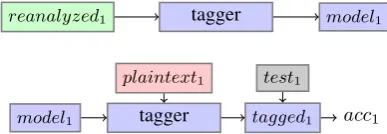
All the evaluations have been performed on the manually annotated part of the National Corpus of Polish, version 1.1, which consists of 1 215 513 tokens, manually annotated by trained linguists. We will refer to this dataset as NCP1M further on. The process of preparing the gold-standard data for training taggers has been presented in Figure 1. It fol-lows the standard ten-fold cross-validation procedure, with the addition of converting the test folds to plain text (re-moving any annotation) and by morphologically reanalyz-ing the trainreanalyz-ing folds. Morphological reanalysis is done by feeding training folds turned into plain text to a morpholog-ical analyzer and including the correct interpretation from the gold-standard data, if it has been missed by the analyzer. The aim of this procedure is to train taggers on data most similar to the real-world test data, which is expected to be produced by a morphological analysis tool.
gold
standard test
1 test2 . . . test10
plaintext1 plaintext2 plaintext10
train1 train2. . . train10
reanalyzed1 reanalyzed2 reanalyzed10
Figure 1: Processing of the gold standard data.
The actual tagger training and testing procedures are de-picted in Figure 2. Each of the taggers is trained and eval-uated ten times, each time selecting one of ten parts of the corpus for testing and the remaining parts for training. A data model is the result of training and then used in the evaluation procedure as an input data source. The final re-sults are averages calculated over ten training and testing sequences. Each of the taggers and each tagger ensemble has been trained and tested on the same cross-validation folds, so the results are directly comparable.
tagger model1
Figure 2: Training tagger model and tagger evaluation.
taggers. These are indicated as AccK
lower for known and AccU
lowerfor unknown words.
4.
Tagger performance analysis
To enable a fair comparison of tagging results, we have firstly evaluated each of the individual taggers on the same data, which has been then used for further experiments con-cerning tagger ensembles.Pantera (Aceda´nski, 2010) is an adaptation of the Brill’s al-gorithm to morphologically rich languages, such as Polish. Pantera includes several techniques of improving the tag-ging of inflectional languages, such as multi-pass tagtag-ging and transformation templates. In the experiments, we have used the learning threshold value of 6, as recommended by the author.
WMBT (Radziszewski and ´Sniatowski, 2011) is a memory based tagger, which disambiguates the set of possible tags in multiple tiers. The number of tiers is equal to the number of attributes in the tagset, including the grammatical class. Tokens in each of the individual tiers are classified using a k-Nearest Neighbour classifier. We have used the supplied
nkjp-guess.iniconfiguration file for training the tag-ger.
WCRFT (Radziszewski, 2013) is a tiered tagger, based on Conditional Random Fields (CRF), a mathematical model similar to Hidden Markov Models. A separate CRF model is used to disambiguate distinct grammatical attributes. The
nkjp_s2.iniconfiguration has been used during evalu-ation.
Concraft (Waszczuk, 2012) is another approach to adapta-tion of CRFs to the problem of POS tagging. In Concraft, the CRF layers are mutually dependent and the results of disambiguation from one of the layers may propagate to an-other. The first of the two layers used by the tagger includes tags related to POS, case and person, while the second con-tains all other grammatical categories.
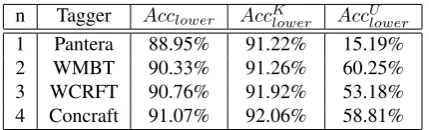
Tagging accuracy of each of the individual taggers has been presented in Table 1.
n Tagger Acclower AccKlower Acc U lower 1 Pantera 88.95% 91.22% 15.19%
2 WMBT 90.33% 91.26% 60.25%
3 WCRFT 90.76% 91.92% 53.18%
4 Concraft 91.07% 92.06% 58.81%
Table 1: The accuracy of individual state-of-the art POS taggers for Polish (evaluated on the NCP1M corpus, ten-fold cross-validation).
4.1.
Tagger agreement
As a simple means of evaluating the similarities between all of the four taggers and verifying the complexity of the problem, we have compared the outcomes of the evaluated methods and identified the cases in which one, all, or none of the taggers provided the correct tag for a particular test instance. As the results presented in Table 2 show, only 4.18% cases are not handled correctly by any of the tag-gers. This suggests that there is a great potential in com-bining several approaches to tagging, as even the best of the
individual taggers makes almost 9% mistakes on this data. It is also worth noting that in 90.73% cases all or majority of the taggers are correct, so simply selecting the answer provided by most of the taggers gives comparable results to the individual taggers, but is not enough to beat the best of them.
Tagger outcome Cases Examples
All taggers correct 82.78%
Majority correct 7.95% 3-1, 2-1-1 Correct present, no majority 2.71% 2-2, 1-1-1-1 Minority correct 2.38% 1-3, 1-2-1
All taggers wrong 4.18%
Table 2: Tagger agreement.
4.2.
Tagger complementarity
Following the approach proposed by (Brill and Wu, 1998), we have evaluated the relative differences between the sets of errors made by the individual taggers. The tagger com-plementarityComp(A, B)measures how different the mis-takes made by the two taggersAandBare. The calculated value is the percentage of time when tagger A is wrong that tagger B is correct:
Comp(A, B) = (1−eAB eA
)∗100,
whereeABis the number of common errors, both in A and B, whileeAis the number of errors made by taggerA. The results for the used taggers, as evaluated on the NCP1M corpus, are presented in Table 3.
H
Pantera WMBT WCRFT Concraft
Pantera 0.00% 42.33% 42.16% 45.22%
WMBT 34.09% 0.00% 35.30% 39.52%
WCRFT 30.78% 32.25% 0.00% 33.97% Concraft 32.21% 34.52% 31.72% 0.00%
Table 3: Tagger complementarity.
As the results in Table 3 suggest, there is a large overlap in the sets of errors made by the taggers (all values are below 50%, while for completely independent taggers the value would be 100%). There is however still hope of achieving a lower rate of mistakes, especially in the case of Pantera and Concraft taggers combination, for which the comple-mentarity value is the highest.
noting that such a theoretical upper bound rises to 95.82% in the case of an ensemble constructed on the basis of all the evaluated taggers.
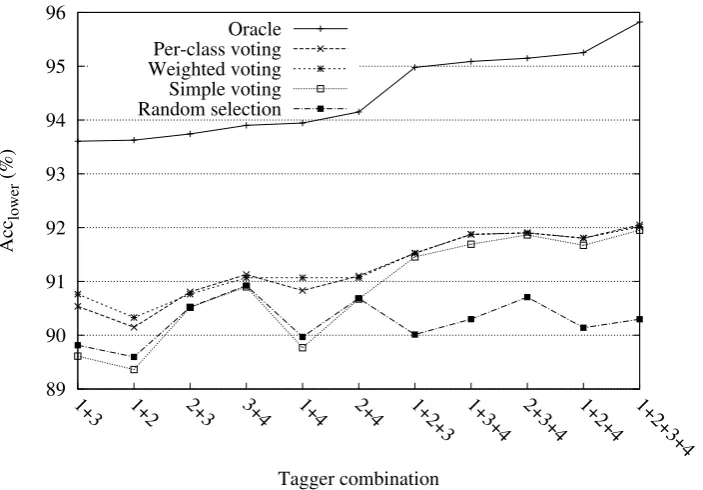
The accuracy of the best individual tagger, which is 91.07% (Concraft), is the natural lower bound, below which creat-ing an ensemble is pointless. With regard to tagger selec-tion strategy, we may think of another lower bound, such as random selection strategy, over which a more elaborate ap-proach should have a significant advantage. Both of these bounds are also presented both in Table 5 and Figure 3.
5.
PoliTa: combining component taggers
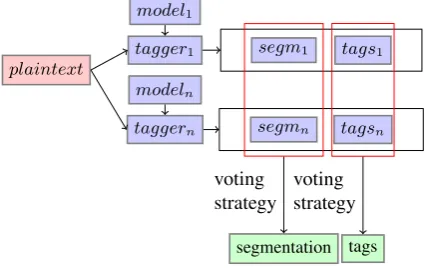
Here we present the evaluated approaches to combining the results of the individual taggers – the modes of operation of PoliTa tagger. The experiments have been conducted using an ensemble of the four component taggers in sev-eral voting scenarios. As has been the case in the experi-ments described earlier, we have performed an end-to-end tagger evaluation, using plain text as input. The general workflow of the system has been presented in Figure 4. Each of the component taggers has been used in exactly the same setup and using the same parameters, as during the individual evaluation. Taggers have been previously trained on the same set of 10 training folds. Tagging has been performed on test folds, which have been created by turning the original gold-standard data into plain text and performing morphological analysis using the Maca frame-work (Radziszewski and ´Sniatowski, 2011) and Morfeusz SGJP analyzer (Woli´nski, 2006).plaintext
tagger1 segm1 tags1
model1
taggern segmn tagsn
modeln
voting strategy
voting strategy
segmentation tags
Figure 4: PoliTa architecture.
5.1.
Combining segmentation
The consequence of the fact that we are using plain text as input to individual taggers is that there is a possibility of differences in segmentation of the annotated text produced by each of these methods. As such, we have to perform an additional segmentation disambiguation step to deal with these variations and determine the final segmentation, on which the resulting annotation will be based. The differ-ences in segmentation are common, e.g. in the case of to-kens containing periods, as shown in Figure 5.
In each case of a segmentation ambiguity, token sequences are lined up using their orthographic word forms. We then use voting to select the most widely represented segmen-tation variant. In cases in which two different segmenta-tions get the same number of votes, we select one of them
Na " pl . sci . filozofia " znajdziesz . . .
Na " pl.sci.filozofia " znajdziesz . . .
Figure 5: Segmentation differences between taggers (In “pl.sci.filozofia” you will find. . .).
randomly. The processing is thus performed token by to-ken and if a difference in segmentation appears, the results of taggers using any of the rejected segmentations are ex-cluded from further processing.
5.2.
Combining annotation
We have evaluated the accuracy of each possible configura-tion of a tagger ensemble, consisting of 2, 3 and 4 taggers. We have evaluated several approaches to combining the de-cisions of individual taggers, as described below.
Simple voting In the simplest approach, we have used voting to decide which of the proposed segmentations and POS tags is the most probable. Each of the taggers voted for their decision and the POS tag with the greatest number of votes has been selected as the output of the meta-tagger. In the cases in which no majority could be established, a random tagger has been selected as the winning one.
Weighted voting Next, we have evaluated an approach, in which greater influence is given to taggers, which achieve higher accuracy results in individual evaluations. We have thus used the accuracy lower bound metric value, calculated individually for each of the taggers, as the weight of the vote of a particular tagger. In other words, in the case of a tie in the number of votes between alternative annota-tions, the annotation provided by the group of taggers that perform better (on average) than the other groups will be selected as the winning one.
Per-class voting Finally, we have incorporated the infor-mation about the performance of each of the taggers with regard to the grammatical class of the word form under con-sideration in the voting scheme. In this approach, the votes of the taggers are weighted according to their accuracy in tagging a particular class of tokens. The idea behind this strategy is the assumption that some of the component tag-gers are better than the others in tagging a particular class of words. The accuracies of tagging tokens of the most com-mon grammatical classes for each of the individual taggers have been presented in Table 4. In cases in which the token has been identified as an unknown word form, the average accuracy of tagging unknown words of that particular tag-ger has been used as the weighting ratio.
The results of experiments using the PoliTa tagger and the approaches described above are presented in Table 5 and Figure 3.
6.
Conclusions and future work
89 90 91 92 93 94 95 96
1+3 1+2 2+3 3+4 1+4 2+4 1+2+3 1+3+4 2+3+4 1+2+4 1+2+3+4
Acc
lower
(%)
Tagger combination Oracle
Per-class voting Weighted voting Simple voting Random selection
Figure 3: The accuracy of tagger combinations. Oracle: theoretical upper bound. Random selection: a lower bound for evaluating tagger combinations. Taggers are identified by numbers, as given in Table 1.
Strategy Metric Taggers
1+2+3 1+2+4 1+3+4 2+3+4 1+2+3+4
Random Acclower 90.01% 90.14% 90.30% 90.71% 90.30%
Simple Voting
Acclower 91.46% 91.67% 91.69% 91.86% 91.95% AccK
lower 92.57% 92.74% 92.85% 92.78% 92.87% AccU
lower 55.19% 56.99% 54.02% 62.07% 62.18%
Weighted Voting
Acclower 91.53% 91.81% 91.88% 91.90% 92.01% AccK
lower 92.60% 92.81% 92.89% 92.82% 92.91% AccU
lower 56.55% 59.45% 59.08% 62.31% 62.81%
Per-Class-Voting
Acclower 91.52% 91.80% 91.87% 91.90% 92.05% AccK
lower 92.61% 92.78% 92.89% 92.82% 92.96% AccU
lower 56.47% 60.02% 59.03% 62.13% 62.65% Oracle Acclower 94.98% 95.25% 95.09% 95.15% 95.82%
Table 5: The accuracy of tagger combinations. Taggers are identified by numbers, as given in Table 1.
show, the accuracy of PoliTa tagger is one percentage point above the best-performing individual tagger.
PoliTa tagger will be made available as a web-service and included in an already existing framework for publish-ing language-related resources called Multiservice (Ogrod-niczuk and Lenart, 2013). This allows us to avoid the prob-lems concerned with packaging and distributing the tagger with its component taggers, trained models and additional libraries, often working in heterogeneous environments. It also allows us to update it with new component taggers in the future.
7.
Acknowledgements
This work has been funded by the National Science Centre project number DEC-2011/01/N/ST6/01107.
8.
References
Aceda´nski, S. (2010). A morphosyntactic Brill tagger for inflectional languages. InAdvances in Natural Lan-guage Processing, pages 3–14.
Brill, E. and Wu, J. (1998). Classifier combination for improved lexical disambiguation. InProceedings of the 17th international conference on Computational linguis-tics - Volume 1, COLING ’98, pages 191–195, Strouds-burg, PA, USA. Association for Computational Linguis-tics.
Kobyli´nski, Ł. (2013). Improving the accuracy of Polish POS tagging by using voting ensembles. In Vetulani, Z., editor, Proceedings of the 6th Language & Technology Conference: Human Language Technologies as a Chal-lenge for Computer Science and Linguistics, pages 453– 456, Pozna´n, Poland. Wydawnictwo Pozna´nskie, Fun-dacja Uniwersytetu im. Adama Mickiewicza.
Acclower(%) per tagger
Class Count 1 2 3 4
subst 331570 85.21 86.25 87.36 88.29
interp 223542 99.63 99.97 99.97 99.97 adj 128703 76.53 81.10 81.56 82.52
prep 115818 97.04 97.28 97.54 98.05
qub 68079 92.98 93.82 92.91 92.92 fin 59458 98.64 98.70 98.81 98.94
praet 53326 90.90 88.96 89.80 89.69 conj 44840 95.17 95.41 94.61 93.96 adv 42750 95.31 95.59 95.29 94.77 inf 19213 98.91 99.20 99.09 99.14 comp 17842 97.26 97.29 96.84 96.88 num 16160 33.40 56.40 60.32 55.99
Table 4: Accuracy of individual taggers per grammatical class. Count is the number of tokens, which have been assigned to the particular class in the gold-standard data. Taggers are identified by numbers, as given in Table 1.
morphosyntactic taggers. In Bouvry, P., Kłopotek, M., Leprévost, F., Marciniak, M., Mykowiecka, A., and Ry-bi´nski, H., editors, Security and Intelligent Information Systems, volume 7053 ofLecture Notes in Computer Sci-ence, pages 359–369. Springer Berlin Heidelberg. Ogrodniczuk, M. and Lenart, M. (2013). A multi-purpose
online toolset for NLP applications. In Métais, E., Meziane, F., Saraee, M., Sugumaran, V., and Vadera, S., editors, Proceedings of the 18th International Con-ference on Applications of Natural Language to Infor-mation Systems, volume 7934 ofLecture Notes in Com-puter Science, pages 392–395. Springer-Verlag, Berlin, Heidelberg.
Przepiórkowski, A., Ba´nko, M., Górski, R. L., and Lewandowska-Tomaszczyk, B., editors. (2011). Naro-dowy Korpus J˛ezyka Polskiego. Wydawnictwo Naukowe PWN, Warsaw. Forthcoming.
Radziszewski, A. and Aceda´nski, S. (2012). Taggers gonna tag: an argument against evaluating disambigua-tion capacities of morphosyntactic taggers. In Proceed-ings of TSD 2012, LNCS. Springer-Verlag.
Radziszewski, A. and ´Sniatowski, T. (2011). A Memory-Based Tagger for Polish. In Proceed-ings of the LTC 2011. Tagger available at http://nlp.pwr.wroc.pl/redmine/projects/wmbt/wiki/. Radziszewski, A. and ´Sniatowski, T. (2011). Maca — a
configurable tool to integrate Polish morphological data. InProceedings of the Second International Workshop on Free/Open-Source Rule-Based Machine Translation. Radziszewski, A. (2013). A tiered CRF tagger for Polish.
In R. Bembenik, Ł. Skonieczny, H. R. M. K. M. N., edi-tor,Intelligent Tools for Building a Scientific Information Platform: Advanced Architectures and Solutions, page to appear. Springer Verlag.
van Halteren, H., Daelemans, W., and Zavrel, J. (2001). Improving accuracy in word class tagging through the combination of machine learning systems. Comput. Lin-guist., 27(2):199–229, June.
Waszczuk, J. (2012). Harnessing the CRF complexity with domain-specific constraints. The case of morphosyntac-tic tagging of a highly inflected language. In Proceed-ings of the 24th International Conference on Compu-tational Linguistics (COLING 2012), pages 2789–2804, Mumbai, India.