The Local Maximum Clustering Method and Its
Application in Microarray Gene Expression
Data Analysis
Xiongwu Wu
Laboratory of Biophysical Chemistry, National Heart, Lung, and Blood Institute, National Institutes of Health, Bethesda, MD 20892, USA
Email:[email protected]
Yidong Chen
National Human Genome Research Institute, National Institutes of Health, Bethesda, MD 20892, USA Email:[email protected]
Bernard R. Brooks
Laboratory of Biophysical Chemistry, National Heart, Lung, and Blood Institute, National Institutes of Health, Bethesda, MD 20892, USA
Email:[email protected]
Yan A. Su
Department of Pathology, Loyola University Medical Center, Maywood, IL 60153, USA Email:[email protected]
Received 28 February 2003; Revised 25 July 2003
An unsupervised data clustering method, called the local maximum clustering (LMC) method, is proposed for identifying clusters in experiment data sets based on research interest. A magnitude property is defined according to research purposes, and data sets are clustered around each local maximum of the magnitude property. By properly defining a magnitude property, this method can overcome many difficulties in microarray data clustering such as reduced projection in similarities, noises, and arbitrary gene distribution. To critically evaluate the performance of this clustering method in comparison with other methods, we designed three model data sets with known cluster distributions and applied the LMC method as well as the hierarchic clustering method, the K-mean clustering method, and the self-organized map method to these model data sets. The results show that the LMC method produces the most accurate clustering results. As an example of application, we applied the method to cluster the leukemia samples reported in the microarray study of Golub et al. (1999).
Keywords and phrases:data cluster, clustering method, microarray, gene expression, classification, model data sets.
1. INTRODUCTION
Data analysis is a key step in obtaining information from large-scale gene expression data. Many analysis methods and algorithms have been developed for the analysis of the gene expression matrix [1,2,3,4,5,6,7,8,9]. The clustering of genes for finding coregulated and functionally related groups is particularly interesting in cases where there is a complete set of organism’s genes. A reasonable hypothesis is that genes with similar expression profiles, that is, genes that are co-expressed, may have something in common in their regula-tory mechanisms, that is, they may be coregulated. Therefore, by clustering together genes with similar expression profiles,
one can find groups of potentially coregulated genes and search for putative regulatory signals. So far, many cluster-ing methods have been developed. They can be divided into two categories: supervised and unsupervised methods. This work focuses on unsupervised data clustering. Some widely used methods in this category are the hierarchic clustering method [6], the K-mean clustering method [10], and the self-organized map clustering method [9,11].
sense. First, the “positions” of genes or samples are unknown. That is, where the data points to be clustered locate is un-known. Instead, the relations between data points (genes or samples) are probed by a series of responses (gene expres-sions). Generally, the correlation of the response series be-tween data points is used as a measure of their similarity. However, because the number of responses is limited and the responses are not independent from each other, the correla-tion can only provide a reduced descripcorrela-tion of the similarities between data points. Just like a projection of data points in a high-dimensional space to a low-dimensional space, many data points far apart may be projected together. It often hap-pens that genes that belong to very different categories are clustered together according to gene expression data. Sec-ond, there is only a small number of genes presented in a microarray that are relevant to the biological processes un-der study. All the rest become noises to the analysis, which need to be filtered out based on some criteria before cluster-ing analysis. Third, the genes chosen to array do not neces-sarily represent the functional distribution. That is, there ex-ist redundant genes of some functions while very few genes exist of some other functions. This may result in the neglect of those less-redundant gene clusters in a clustering analysis. These facts rise difficulties and uncertainties for cluster anal-ysis. Fortunately, a microarray experiment does not attempt to provide accurate cluster information of all genes being ar-rayed. Instead, besides many other purposes, a microarray experiment is designed to identify and study those groups, which seem to participate in the studied biological process. The complete gene cluster will be the job of many molecular biology experiments as well as other technologies.
With our interest focused on those functional related genes, we need to identify clusters functionally relevant to the biological process of interest. As stated above, clustering methods solely dependent on similarities may suffer from the difficulties of reduced projection, noises, and arbitrary gene distribution and may not be suitable for microarray re-search purposes. In this work, we present a general approach to clustering a data set based on research interest. A quan-tity, which is generally called magnitude, is introduced to represent a property of our interest for clustering. The fol-lowing sections explain in detail the concept and the clus-tering method, which we call the local maximum clusclus-tering (LMC) method. Additionally, for the purpose of compari-son, we worked out an approach to quantitatively calculate the agreement between two hierarchic clustering results for the same data set. Using three model systems, we compared this clustering method with several well-known clustering methods. Finally, as an example of application, we applied the method to cluster the leukemia samples reported in the microarray study of Golub et al. [12].
2. METHODS AND ALGORITHMS
2.1. Distances, magnitudes, and clusters
For a data set with unknown absolute positions, the distance matrix between data points is used to infer their relative
po-Magnitude
y
x
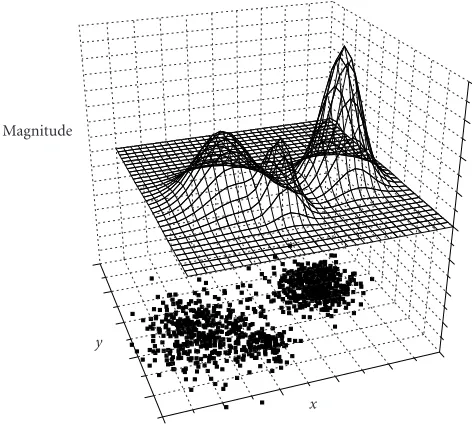
Figure1: A two-dimensional (x-y) distribution data set with the “magnitude” as the additional dimension.
sitions. For a biologically interesting data set like genes or tissue samples, the distances are not directly measurable. In-stead, the responses to a series event are used to estimate the distances or similarity. It is assumed that data points close to each other have similar responses.
For microarray gene expression data, people often use Pearson correlation function to describe the similarity be-tween genesiandj:
Ci j= 1
n
n
k=1
Xik−Xi
σi
Xjk−Xj
σj
, (1)
whereXi=(Xik)n,k=1,. . .,n, represents the data point of genei, which consists ofnresponses,Xikis thekth response of genei,Xiis the average value ofXi,Xi =(1/n)
n
k=1Xik, andσiis the standard deviation ofXi,σi=
X2
i −X
2
i. From (1), we can see thatCi j ranges from−1 to 1, with 1 representing identical responses between genesiandjand −1 the opposite responses. The distance between a pair of genes is often expressed as the following function:
magnitude used to define clusters. We should keep in mind that the magnitude property can be properties other than density; it can be gene expression levels or gene differential expressions as described later. As can be seen fromFigure 1, each cluster is represented by a peak on the magnitude sur-face. Obviously, clusters in a data set can be found out by identifying peaks on the magnitude surface. Because clusters are peaks on the magnitude surface, the number and size of clusters depend only on the surface shape.
Current existing clustering methods like the hierarchic clustering method do not explicitly use the magnitude prop-erty. These clustering methods assume clusters locate at high-density areas of a distribution. In other words, these cluster-ing methods implicitly use distribution density as the mag-nitude of clustering.
The choosing of the magnitude property determines what we want to be the cluster centers. If we want clusters to center at high-density areas, using distribution density would be a natural choice for the magnitude. A simple distribution density can be calculated as
Mi=
Equation (3) indicates the magnitude of data pointiandMi is equal to the number of data points within distancedfrom data pointi. A smallerdwill result in a more accurate local density but a larger statistic error. To make the magnitude smooth, an alternative function can be used forδ(ri j):
δri j
For microarray studies, directly clustering genes based on density may result in misleading results. The main rea-son is that we do not know the real “positions” of the genes. The relative similarities between genes are probed by their responses to an often very limited number of samples. The similarity obtained this way is a reduced projection of “real” similarities, and many very different functional genes may re-spond similarly in the limited sample set. Therefore, the den-sities estimated from the response data are not reliable and change from experiment to experiment. Further, the correla-tion funccorrela-tion captures similarity of the shapes of two expres-sion profiles, but it ignores the strength of their responses. Some noises in response measurement may cause a nonre-sponsive gene to be of high correlation with a high-response gene. Another reason is that the genes arrayed in a chip may vary in redundancy, resulting in different density distribu-tions. An extreme case is when a single gene is redundant so many times that they occupy a large portion of an array—a cluster centering at this gene would be created. Additionally, for the thousands of genes arrayed on a gene chip, generally, only a handful of genes show varying expression levels, which
we used to probe gene functions. All the rest only show unde-tectable expressions or simply noises which may result in very high correlation to some genes. Normally, only those genes with significantly varying expression levels can be of mean-ingfully functional relation, while for the rest we can draw little information from a microarray experiment. Therefore, for a microarray study, a good choice of magnitude would be a quantity measuring the variation of expression levels as in
Mi=δ2
whereRiis the expression ratio between sample and control andnis the number of samples for each gene. Equation (6) is a magnitude defined as the differential expression of genes. By this definition, the clusters are always centered at high-differential expression genes. Because this paper focuses on the presentation and evaluation of the local maximum clus-tering method, we will not discuss the application of (6) in identifying high-response gene clusters. This equation is pre-sented here only to illustrate the idea of the magnitude prop-erties.
2.2. The local maximum clustering method
Two types of properties characterize the data points: magni-tude of each data point and distance (or similarity) between a pair of data points. We define a cluster as a peak on the magnitude surface. Therefore, we can cluster a data set by identifying peaks on the magnitude surface.
There are many approaches to identifying peaks on a sur-face. Here, in this work, we use a method called the local maximum method to identify peaks. Identification of peaks on a surface can be done by searching for the local maximum point around each data point. Assume there is a data set of
Ndata points to be clustered. The local maximum of a data pointiis the data point whose magnitude is the maximum among all the data points within a certain distance from the data pointi. A peak has the maximum magnitude in its lo-cal area, therefore, its lolo-cal maximum is itself. By identify-ing all data points whose local maximum points are them-selves, we can locate all the peaks on the magnitude surface. The distance used to define the local area is called resolution. The number of peaks on a magnitude surface depends on the shape of the surface and the size of resolution. After the peaks are identified, all data points can be assigned into these peaks according to their local maximum points in the way that a data point belongs to the same peak as its local maximum point.
Figure 2shows a one-dimensional distribution of a data set along thex-axis. They-axis is the magnitude of the data set. The peaks represent cluster centers depending on the res-olution r0. Clusters can be identified by searching for the
peaks in the distribution, and all data points can be clustered into these peaks according to the local maximums of each data point. Assume thatr1,r3, andr4are the distances from
peaks 1, 3, and 4 to their nearest equal-magnitude neighbor points. With a resolutionr0< r3, four peaks, 1, 2, 3, and 4 can
r3
Figure2: Clustering a data set based on the local maximum of its magnitude. There are 4 peaks, 1, 2, 3, and 4; andr1,r3, andr4are the distances from peaks 1, 3, and 4 to their nearest equal magnitude neighbor points. Assumer3< r1< r4.
data points can be clustered into these four peaks according to their local maximum points. For example, for data point
a, if data pointbis the one that has the maximum magni-tude in all data points withinr0froma, we saybis the local
maximum point ofa. Pointawill belong to the same peak as pointb. Similarly, pointbbelongs to the same peak as its local maximum pointcand pointcbelongs to peak 4. There-fore, pointsa,b, andcall belong to peak 4.
Obviously, resolutionr0plays a crucial role in identifying
peaks. For each peakp, we define its resolution limitrpas the longest distance within which peakphas the maximum mag-nitude. For a given resolutionr0, a peakpwill be identified
as a cluster center ifrp > r0. As shown inFigure 2, there are
four peaks, 1, 2, 3, and 4. Ifr0> r1, peak 1 will not be
iden-tified and, together with all its neighbors, will be assigned to cluster 2. Similarly, cluster 3 or 4 can only be identified when
r0< r3orr0< r4, respectively.
The peaks identified can be further clustered to pro-duce a hierarchic cluster structure. For the example shown inFigure 2, if we assume thatr4 > r1 > r3, by usingr0 < r3,
we can get four clusters, while, usingr1 > r0 > r3, clusters 2
and 3 merge to cluster 5 at peak 2, withr4> r0> r1, clusters
1 and 5 merge into cluster 6 at peak 2, and withr0 > r4, all
clusters merge into a single cluster at peak 2.
The algorithm of the LMC method is described by the following steps.
(i) For a data set{i},i = 1, 2,. . .,N, calculate the dis-tances between data points {ri j} using (1) and (2). From the distance matrix, calculate the magnitude of each data point{M(i)}using (5).
(ii) Set resolutionr0=min{ri j}+δr,i=j. Here,δris the
resolution increment. Typically, setδr=0.01. (iii) Search for the local maximum pointL(i) for each data
pointi. For allj, withri j< r0, there isM(L(i))≥M(j).
(iv) Identify peak centers{p}, whereL(p)= p. Each peak represents the center of a cluster.
(v) Assign each data pointito the same cluster as its local maximum pointL(i).
(vi) If there is more than one cluster, generate higher-level clusters from the peak point data set {p}, p = 1, 2,. . .,np, following steps (ii), (iii), (iv), and (v). 2.3. Comparison of hierarchic clusters
For the same data set, different clustering methods may pro-duce different clusters. It is, in general, a nontrivial task to compare different clustering results of the same data set and many efforts have been made for such clustering comparison (e.g., [13]). For hierarchic clustering, comparison is more challenging because a hierarchic cluster is a cluster of clus-ters. To quantitatively compare hierarchic clusters from dif-ferent methods, we define the following agreement function to describe the agreement between hierarchic clustering re-sults.
We use{H1}and{H2}to represent two hierarchic
clus-tering results for the same data set. In the following discus-sions, N1 andN2 are the numbers of clusters in{H1}and
{H2}, respectively,n1iandn2jrepresent the data point num-bers in clusteriof{H1}and cluster jof{H2}, respectively,
andmi jis the number of data points existing both in cluster
iof{H1}and in clusterjof{H2}. Therefore, 2mi j/(n1i+n2j) represents how well the two clusters, cluster iof{H1}and
cluster jof{H2}, are similar to each other. A value of 1
in-dicates they are identical and a value of 0 inin-dicates they are completely different. We useM1i({H2}) to describe how well
clusteriof{H1}is clustered in{H2}. We callM1i({H2}) the
match of {H1}to{H2}in clusteri. Similarly, the match of
{H2}to{H1}in clusterjis denoted asM2j({H1}), which
de-scribes how well cluster jof{H2}is clustered in{H1}. They
are calculated using the following equations:
M1i
ter is the highest similarity between this cluster and any clus-ter of{H2}.
We use the agreement A({H1},{H2}) to describe the
overall similarity between two clustering results, which is a weighted average of all cluster matches, as
AH1
A9 (MA9=0.86) A7
(MA7=0.4)
A10 (MA10=1) A6
(MA6=0.1) A3
(MA3=0.67) A2
(MA2=0.5)
A8 (MA8=0.8) A5
(MA5=0.8)
A4 (MA4=1) A1
(MA1=1)
901–1000 601–900
501–600 301–500
101–300 1–100
(a)
B5 (MB5=0.86)
B6 (MB6=1) B3
(MB3=1)
B4 (MB4=0.89) B1
(MB1=1)
B2 (MB2=1)
1–300 301–500 501–900 901–1000
(b)
Figure3: (a) The hierarchic clustering structure{HA}with 10 clusters; the match of each cluster to the cluster structure{HB}are labeled in parentheses; (b) the hierarchic cluster structure{HB}with 6 clusters; the match of each cluster to the cluster structure{HA}are labeled in parentheses.
data points. The hierarchic clustering structure{HA}has 10 clusters and{HB}has 6 clusters. ClustersA1,A4, andA10 of {HA}have the same data points as clustersB1,B2, andB6 of {HB}, respectively. Therefore, their matches are 1 no matter
how different their subclusters are. The matches of clusters are calculated according to (7) and are labeled in the figures. The agreement between {HA}and{HB}can be calculated using (8) as follows:
AHA
,HB
=
10
i=1nAiMAi 210i=1nAi
+
6
j=1nB jMB j 26j=1nB j
= 300×1 + 100×0.5 + 200×0.67 + 700×1 + 300×0.8 + 200×0.1 + 100×0.4 + 400×0.8 + 300×0.86 + 100×1 2(300 + 100 + 200 + 700 + 300 + 200 + 100 + 400 + 300 + 100)
+300×1 + 700×1 + 200×1 + 500×0.89 + 400×0.86 + 100×1 2(300 + 700 + 200 + 500 + 400 + 100)
=0.400 + 0.475 =0.875.
Table1: The possibility parameters used to generate the three model systems. Each model has 6 clusters. The parameters (hi,wi) represent the height and width of clusteriin the possibility distribution in (10).
Model (h1,w1) (h2,w2) (h3,w3) (h4,w4) (h5,w5) (h6,w6)
1 (1, 0.05) (1, 0.02) (1, 0.02) (1, 0.05) (1, 0.02) (1, 0.02) 2 (1, 0.10) (1, 0.005) (1, 0.05) (1, 0.10) (1, 0.005) (1, 0.10) 3 (1, 0.10) (2, 0.005) (3, 0.05) (4, 0.10) (5, 0.005) (6, 0.10)
3. RESULTS AND DISCUSSIONS
The LMC method has several features. First, it is an unsu-pervised clustering method. The clustering result depends on the data set itself. Second, it allows magnitude properties to be used to identify clusters of interest. Third, it automati-cally produces a hierarchic cluster structure with a minimum amount of input. In this work, we designed three model sys-tems with known cluster distributions to evaluate the perfor-mance of the LMC method and compare it with other meth-ods. Finally, as an example of application, we use this method to cluster the leukemia samples reported by Golub et al. [12] and compare the result with experimental classification.
3.1. The model systems
Model systems with known cluster distributions have often been used in method development. The model systems used here are designed to mimic microarray gene expression data in the way that each data point is a response series of ex-pression values, and the distance or similarity between data points is measured by their correlation function. It is the cor-relation function that determines the distance between data points and the actual number of expression values in a re-sponse series, which does not affect the clustering results; for simplicity and convenience of data generation and analysis, we use only three expression values for each response series, namely, x, y, andz. The response series of geneiis repre-sented by (xi,yi,zi). The correlation function and distance between geneiand genejis calculated according to (1) and (2) withn=3.
The model systems are designed to have 6 clusters with cluster centers at (Xj,Yj,Zj), j = 1, 2, 3, 4, 5, and 6. We use the following possibility distribution to generate the expres-sion data of 1000 genes (xi,yi,zi),i=1, 2,. . ., 1000: the height and width of cluster j. The six cluster centers are genes with the following response series:
(i) (−√2/2, 0,√2/2);
Figure4: Data distribution in the three model data sets. The func-tion arctg(Ci1/Ci6)/πis used for thex-axis to show all six clusters without overlapping. Here,Ci1andCi6are the correlations of data pointiwith the centers of clusters 1 and 6, respectively. For each model, 1000 data points are generated.
(v) (2/√6,−1/√6,−1/√6); (vi) (√2/2,−√2/2, 0).
The correlation matrix between these centering genes is
Cluster 11
Cluster 10 Cluster 9
Cluster 7 Cluster 8
Cluster 5 Cluster 6
Cluster 3 Cluster 2 Cluster 1 Cluster 4
Figure5: The hierarchic cluster structure of the model data sets.
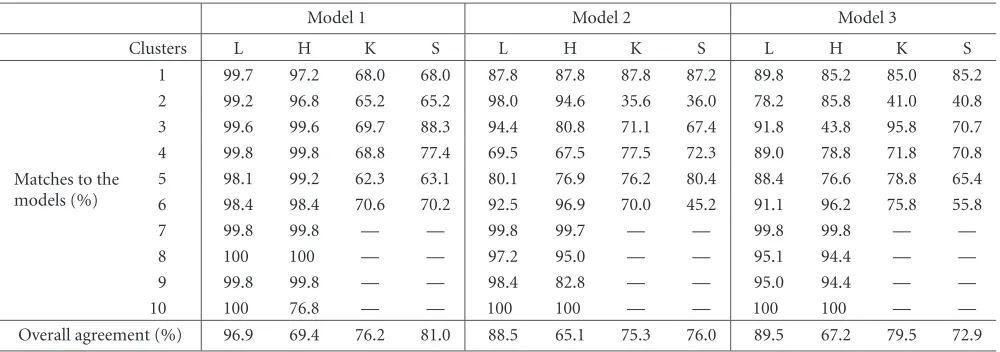
Table2: Comparison of the clustering results of different methods. The letters L, H, K, and S stand for the LMC method, the hierarchic clustering method, theK-mean clustering method, and the self-organization map clustering method, respectively.
Model 1 Model 2 Model 3
Clusters L H K S L H K S L H K S
Matches to the models (%)
1 99.7 97.2 68.0 68.0 87.8 87.8 87.8 87.2 89.8 85.2 85.0 85.2 2 99.2 96.8 65.2 65.2 98.0 94.6 35.6 36.0 78.2 85.8 41.0 40.8 3 99.6 99.6 69.7 88.3 94.4 80.8 71.1 67.4 91.8 43.8 95.8 70.7 4 99.8 99.8 68.8 77.4 69.5 67.5 77.5 72.3 89.0 78.8 71.8 70.8 5 98.1 99.2 62.3 63.1 80.1 76.9 76.2 80.4 88.4 76.6 78.8 65.4 6 98.4 98.4 70.6 70.2 92.5 96.9 70.0 45.2 91.1 96.2 75.8 55.8 7 99.8 99.8 — — 99.8 99.7 — — 99.8 99.8 — —
8 100 100 — — 97.2 95.0 — — 95.1 94.4 — —
9 99.8 99.8 — — 98.4 82.8 — — 95.0 94.4 — —
10 100 76.8 — — 100 100 — — 100 100 — —
Overall agreement (%) 96.9 69.4 76.2 81.0 88.5 65.1 75.3 76.0 89.5 67.2 79.5 72.9
by minimums between peaks, and the data points can be ac-curately assigned to their clusters. As can be seen (Figure 4) in model 1, the six clusters have equal heights and are clearly separated from each other, while in model 2, clusters 1, 3, 4, and 5 are much broader, and in model 3, their heights are different. These three model data sets present some typical cases that a clustering method would deal with.
Based on the correlations between the clusters, (11), these model data sets have a hierarchic cluster structure as shown inFigure 5. The whole data set belongs to a single cluster 11, which is split into two clusters, 7 and 10. Cluster 7 is divided into clusters 2 and 3. Cluster 10 is further divided into cluster 9, which consists of clusters 1 and 4, and cluster 8, which consists of clusters 5 and 6.
We applied the LMC method (L), the hierarchic clus-tering method [6] (H), theK-mean clustering method [10] (K), and the self-organized map clustering method [11] (S) to these three model data sets. The LMC method, as well as the hierarchic clustering method, produces a hierarchic cluster structure. The K-mean and the self-organized map methods require a predefined cluster number prior to clus-tering. For comparison purpose, we set the cluster num-ber to 6 when performing clustering using the K-mean
and the self-organized map method, and only compare the agreement between the clustering results with the bottom 6 clusters of the model data sets.Table 2listed the matches and agreements between the results from the four cluster-ing methods and the known clusters of the model data sets.
Comparing the matches and agreements between the clustering results and the known clusters of the model data sets, we can see clearly that the LMC method produces the most accurate result. The hierarchic clustering method pro-duces many tree structures, within which there exist good matches to the clusters in the models. Because it produces too many trees, the agreement between the model and re-sult from the hierarchic method is low. TheK-mean and the self-organized map methods produce worse matches to the clusters in the models than the LMC and the hierarchic clus-tering methods.
3.2. An application to microarray gene expression data
Table3: Classification of the acute lymphoblastic leukemia (ALL) and acute myeloid leukemia (AML) samples [12].
Cluster levels
Samples Type Source Lineage FAB Sex
1 2 3 4
A A1
A11 A111
4 ALL BM B-cell — —
20 ALL BM B-cell — —
5 ALL BM B-cell — —
19 ALL BM B-cell — —
A112
46 ALL BM B-cell — F
12 ALL BM B-cell — F
42 ALL BM B-cell — F
48 ALL BM B-cell — F
7 ALL BM B-cell — F
59 ALL BM B-cell — F
8 ALL BM B-cell — F
15 ALL BM B-cell — F
18 ALL BM B-cell — F
43 ALL BM B-cell — F
56 ALL BM B-cell — F
40 ALL BM B-cell — F
44 ALL BM B-cell — F
27 ALL BM B-cell — F
26 ALL BM B-cell — F
55 ALL BM B-cell — F
39 ALL BM B-cell — F
41 ALL BM B-cell — F
13 ALL BM B-cell — F
A113
17 ALL BM B-cell — M
16 ALL BM B-cell — M
21 ALL BM B-cell — M
45 ALL BM B-cell — M
22 ALL BM B-cell — M
25 ALL BM B-cell — M
24 ALL BM B-cell — M
47 ALL BM B-cell — M
1 ALL BM B-cell — M
49 ALL BM B-cell — M
A12
23 ALL BM T-cell — M
10 ALL BM T-cell — M
3 ALL BM T-cell — M
11 ALL BM T-cell — M
2 ALL BM T-cell — M
6 ALL BM T-cell — M
14 ALL BM T-cell — M
9 ALL BM T-cell — M
A2 A21
A211 72 ALL PB B-cell — —
71 ALL PB B-cell — —
A212 70 ALL PB B-cell — F
A213 68 ALL PB B-cell — M
69 ALL PB B-cell — M
Table3: Continued.
Cluster levels
Samples Type Source Lineage FAB Sex
1 2 3 4
B B1
B11 66 AML BM — — M
65 AML BM — — M
B12
35 AML BM — M1 —
38 AML BM — M1 —
61 AML BM — M1 —
32 AML BM — M1 —
B13 B131
58 AML BM — M2 —
34 AML BM — M2 —
28 AML BM — M2 —
37 AML BM — M2 —
51 AML BM — M2 —
29 AML BM — M2 —
33 AML BM — M2 —
53 AML BM — M2 —
B132 57 AML BM — M2 F
B133 60 AML BM — M2 M
B14 B141
31 AML BM — M4 —
50 AML BM — M4 —
B142 54 AML BM — M4 F
B15 36 AML BM — M5 —
30 AML BM — M5 —
B2 B21
B211 63 AML PB — — F
B212 64 AML PB — — M
62 AML PB — — M
B22 52 AML PB — M4 —
al. [12] from acute leukemia patients at the time of diagno-sis. We choose this data because experimental classification is available for comparison. Table 3 lists the clusters based on experiment classification [12]. The 72 samples contain 47 acute lymphoblastic leukemia (ALL) samples (cluster A) and 25 acute myeloid leukemia (AML) samples (cluster B). These samples are from either bone marrow (BM) (clusters A1 and B1) or peripheral blood (PB) (clusters A2 and B2). The ALL samples fall into two classes: B-lineage ALL (clusters A11 and A21) and T-lineage ALL (clusters A12 and A22), some of which are taken from known sex patients (F for female and M for male). Some of the AML samples have known FAB types, M1–M5.
The whole set of genes are filtered based on expression levels, and 1769 genes with expression levels higher than 20 in all the 72 samples are used for our clustering. That is, for each sample, its response series contains 1769 gene expression values. The logarithms of the gene expression lev-els are used in correlation function calculation to reduce the noise effect at high expression levels.
We applied the LMC method and the hierarchic cluster-ing method [6] to the 72 samples and compared the results
with the experiment clusters listed in Table 3. The magni-tude is calculated using (5) so that the cluster centers will be the peaks of local density of data points. Only with this magnitude, the two methods are comparable. The matches of each cluster and the overall agreements of the experimen-tal classification to the clustering results are listed inTable 4. As can be seen, the ALL samples (cluster A) can be better clustered by the LMC method (MA(LMC)=0.792) than by the hierarchic clustering method (MA(HC) =0.784), while the AML samples can be better described by the hierarchic clustering method (MB(HC)=0.526) than by LMC method (MB(LMC)=0.521). Overall, the experimental classification agrees better with the clustering result of the LMC method (the agreement is 0.643) than with that of the hierarchic clus-tering method (the agreement is 0.624).
Table4: Comparison of the matches and agreements of the experi-mental classification listed inTable 3to the clustering results of the LMC method and the HC method.
Clusters Matches to LMC Matches to HC
A 0.7924 0.7836
A1 0.74 0.7252
A11 0.6304 0.6506
A111 0.5 0.5
A112 0.4358 0.4706
A113 0.3158 0.353
A12 0.6666 0.6666
A2 0.4444 0.4
A21 0.5 0.421
A211 0.6666 0.3076
A213 0.8 0.25
B 0.5208 0.5264
B1 0.5 0.4652
B11 0.0816 0.25
B12 0.1818 0.2858
B13 0.353 0.3076
B131 0.4 0.3636
B14 0.4 0.2858
B141 0.4444 0.3334
B15 0.2222 0.4
B2 0.1066 0.1112
B21 0.081 0.0846
B212 0.0548 0.0572
Agreement 0.643 0.624
4. CONCLUSION
This work proposed the local maximum clustering (LMC) method and evaluated its performance as compared with some typical clustering methods through designed model data sets. This clustering method is an unsupervised one and can generate hierarchic cluster structures with minimum in-put. It allows a magnitude property of research interest to be chosen for clustering. The comparison using model data sets indicates that the local maximum method can produce more accurate cluster results than the hierarchic, theK-mean, and the self-organized map clustering methods. As an example of application, this method is applied to cluster the leukemia samples reported in the microarray study of Golub et al. [12]. The comparison shows that the experimental classification can be better described by the cluster result from the LMC method than by the hierarchic clustering method.
REFERENCES
[1] A. Brazma and J. Vilo, “Gene expression data analysis,”FEBS Letters, vol. 480, no. 1, pp. 17–24, 2000.
[2] M. P. Brown, W. N. Grundy, D. Lin, et al., “Knowledge-based analysis of microarray gene expression data by using support vector machines,”Proceedings of the National Academy of Sci-ences of the USA, vol. 97, no. 1, pp. 262–267, 2000.
[3] J. K. Burgess and Hazelton R. H., “New developments in the analysis of gene expression,”Redox Report, vol. 5, no. 2-3, pp. 63–73, 2000.
[4] J. P. Carulli, M. Artinger, P. M. Swain, et al., “High throughput analysis of differential gene expression,” Journal of Cellular Biochemistry Supplements, vol. 30-31, pp. 286–296, 1998. [5] J. M. Claverie, “Computational methods for the
identifica-tion of differential and coordinated gene expression,”Human Molecular Genetics, vol. 8, no. 10, pp. 1821–1832, 1999. [6] M. B. Eisen, P. T. Spellman, P. O. Brown, and D. Botstein,
“Cluster analysis and display of genome-wide expression pat-terns,” Proceedings of the National Academy of Sciences of the USA, vol. 95, no. 25, pp. 14863–14868, 1998.
[7] O. Ermolaeva, M. Rastogi, K. D. Pruitt, et al., “Data manage-ment and analysis for gene expression arrays,” Nature Genet-ics, vol. 20, no. 1, pp. 19–23, 1998.
[8] G. Getz, E. Levine, and E. Domany, “Coupled two-way clus-tering analysis of gene microarray data,” Proceedings of the National Academy of Sciences of the USA, vol. 97, no. 22, pp. 12079–12084, 2000.
[9] P. Toronen, M. Kolehmainen, G. Wong, and E. Castren, “Anal-ysis of gene expression data using self-organizing maps,”FEBS Letters, vol. 451, no. 2, pp. 142–146, 1999.
[10] S. Tavazoie, J. D. Hughes, M. J. Campbell, R. J. Cho, and G. M. Church, “Systematic determination of genetic network architecture,” Nature Genetics, vol. 22, no. 3, pp. 281–285, 1999.
[11] P. Tamayo, D. Slonim, J. Mesirov, et al., “Interpreting patterns of gene expression with self-organizing maps: methods and application to hematopoietic differentiation,” Proceedings of the National Academy of Sciences of the USA, vol. 96, no. 6, pp. 2907–2912, 1999.
[12] T. R. Golub, D. K. Slonim, P. Tamayo, et al., “Molecular classi-fication of cancer: class discovery and class prediction by gene expression monitoring,” Science, vol. 286, no. 5439, pp. 531– 537, 1999.
[13] M. Meila, “Comparing clusterings,” UW Statistics Tech. Rep. 418, Department of Statistics, University of Washington, Seattle, Wash, USA, 2002, http://www.stat.washington.edu/
mmp/#publications/.
Xiongwu Wureceived his B.S., M.S., and Ph.D. degrees in chemical engineering from Tsinghua University, Beijing, China. From 1993 to 1996, he was a Research Fellow in the Cleveland Clinic Foundation, Cleve-land, Ohio. Then he worked as a Research Assistant Professor in George Washington University and Georgetown University. He also held an Associate Professor position in Nanjing University of Chemical
Yidong Chenreceived his B.S. and M.S. de-grees in electrical engineering from Fudan University, Shanghai, China, in 1983 and 1986, respectively, and his Ph.D. degree in imaging science from Rochester Institute of Technology, Rochester, NY, in 1995. From 1986 to 1988, he joined the Department of Electronic Engineering of Fudan Univer-sity as an Assistant Professor. From 1988 to 1989, he was a Visiting Scholar in the
De-partment of Computer Engineering, Rochester Institute of Tech-nology. From 1995 to 1996, he joined Hewlett Packard Company as a Research Engineer, specialized in digital halftoning and color image processing. Currently, he is a StaffScientist in the Cancer Genetics Branch of National Human Genome Research Institute, National Institutes of Health, Bethesda, Md, specialized in cDNA microarray bioinformatics and gene expression data analysis. His research interests include statistical data visualization, analysis and management, microarray bioinformatics, genomic signal process-ing, genetic network modelprocess-ing, and biomedical image processing.
Bernard R. Brooks obtained his Under-graduate degree in chemistry from the Mas-sachusetts Institute of Technology in 1976 and received his Ph.D. degree in 1979 from the University of California at Berkeley with Professor Henry F. Schaefer. His research efforts at Berkeley focused on the devel-opment of methods for electronic struc-ture calculations. In 1980, Dr. Brooks joined Professor Martin Karplus at Harvard
Uni-versity as a National Science Foundation Postdoctoral Fellow where he became the primary developer of the Chemistry and Harvard Macromolecular Mechanics (CHARMM) software system, which is useful in simulating motion and evaluating energies of macro-molecular systems. In 1985, Dr. Brooks joined the staffof the Divi-sion of Computer Research and Technology at the National Insti-tutes of Health where he became the Chief of the Molecular Graph-ics and Simulation Section of the Laboratory of Structural Biology. Dr. Brooks is currently the Chief of the Computational Biophysics Section of the Laboratory of Biophysical Chemistry (LBC) at the National Heart, Lung, and Blood Institute (NHLBI) where he con-tinues to develop new methods and to apply these methods to both basic and specific problems of biomedical interest.
Yan A. Suis the Associate Professor in the Department of Pathology and a member in Cardinal Bernardin Cancer Center, Loyola University Medical Center at Chicago. He received his M.D. degree in Lanzhou Med-ical College and Ph.D. degree in Univer-sity of Michigan. He had the postdoctoral training in both of Michigan Comprehen-sive Cancer Center, University of Michigan, and the National Human Genome Research