R E S E A R C H
Open Access
Analysis of short blocklength codes for
secrecy
Willie K. Harrison
1*, Dinis Sarmento
2, João P. Vilela
3and Marco A. C. Gomes
2Abstract
In this paper, we provide secrecy metrics applicable to physical-layer coding techniques with finite blocklengths over Gaussian and fading wiretap channel models and analyze their secrecy performance over several cases of concatenated code designs. Our metrics go beyond some of the known practical secrecy measures, such as bit error rate and security gap, so as to make lower bound probabilistic guarantees on error rates over short blocklengths both preceding and following a secrecy decoder. Our techniques are especially useful in cases where application of traditional information-theoretic security measures is either impractical or simply not yet understood. The metrics can aid both practical system analysis, including cryptanalysis, and practical system design when concatenated codes are used for physical-layer security. Furthermore, these new measures fill a void in the current landscape of practical security measures for physical-layer security coding and may assist in the wide-scale adoption of physical-layer techniques for security in real-world systems. We also show how the new metrics provide techniques for reducing realistic channel models to simpler discrete memoryless wiretap channel equivalents over which existing secrecy code designs may achieve information-theoretic security.
Keywords: Physical-layer security, Security measures, Wiretap channel
1 Introduction
Physical-layer security has attracted much attention of late as a means to provide a keyless layer of security using error-control coding and other physical-layer techniques such as intentional jamming [1, 2]. While traditional information-theoretic secrecy measures have been the preferred vehicles for proving the worth of physical-layer security coding schemes, some channel models remain elusive to this type of analysis [3]. In this paper, we provide two new security metrics that apply when blocklengths are finite (and especially when they are short) and when channel models are more representative of real-world environments.
Coding techniques exist that can achieve strong secrecy and even semantic secrecy over the binary erasure wire-tap channel [4], but in the face of fading, jamming, and otherwise Gaussian noise, there remains a dearth of use-ful secrecy metrics beyond simple bit error rates (BER). The one exception is the security gap [5], which provides
*Correspondence:[email protected]
1Department of Electrical and Computer Engineering, Brigham Young
University, Provo, UT, USA
Full list of author information is available at the end of the article
a measure on the required signal-to-noise ratio (SNR) advantage over an eavesdropper to operate at acceptable error rates for friendly parties with an acceptable amount of security over illegitimate receivers.
In this paper, we present metrics for secrecy and relia-bility within a general framework of concatenated coding. These metrics were originally presented in [6], but with reference to only one specific coding scheme. In this work, we introduce a general framework of concatenated codes for which our metrics apply. This enables the application of our metrics to general coding schemes, of which the scheme presented in [6] is one specific use-case. Other examples are given throughout this paper to show the broader applicability of the new metrics. Furthermore, in this paper, we discuss the landscape of security met-rics for physical-layer security and justify the existence of the new practical measures by highlighting their pros and cons with reference to existing metrics. Our met-rics go beyond security gap, so as to identify operable regions of SNR for which bit error rates, even over a short number of bits, are guaranteed to be near 0.5. The basic premise of our techniques is to evaluatethe distribution of error rates over a small number of bits, such as might
be transmitted over a single packet, or within a single coded word, and to make guarantees not only on the mean of the distribution, but rather on, e.g., the 10th percentile or even the 1st percentile of the distribution. For very large blocklength codes, laws of large numbers guarantee performance near the mean, but for shorter blocklengths, we need to consider the entire distribution to make security guarantees. A proper tool that allows us to make these claims is the well-known cumulative distribution function (CDF) of the error rate over short blocklengths. As one considers percentiles closer to zero, the guarantees of our secrecy metrics are such that every small block of transmitted data either fails to be decoded (for the first metric) or achieves decoder output bit error rates greater than 0.5 − δ for some δ in the range of [ 0, 0.5] (for the second metric). These metrics fill a void in the current landscape of security measures for secrecy codes and find immediate application in real-world environments.
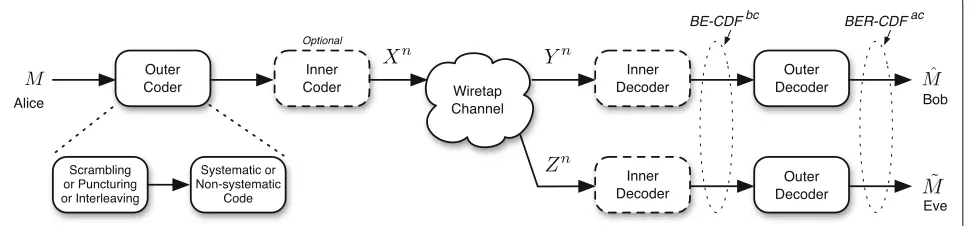
Consider the wiretap setup as depicted in Fig.1, where the receiver chains for both a legitimate receiver Bob and an eavesdropper Eve are pictured. We consider here a pos-sibly concatenated coding system, where the outer code is for security (and may consist of any number of cod-ing operations as indicated) and the inner code is for reliability. Based on early work over the wiretap chan-nel [7, 8], we know that there exists a supremum of achievable rates such that both security and reliability can be attained. This rate is called the secrecy capac-ity Cs. The first explicit code constructions to achieve information-theoretic security can be found in [9], and several variants soon followed, such as [10–12]. Many of these early works achieve security but only at cod-ing rates belowCs and often in isolation from achieving any reliability constraint for friendly parties. In fact, many techniques require the legitimate receiver’s channel to be noiseless. Other techniques specify that the eavesdrop-per’s channel be physically or stochastically degraded [13] with respect to the main legitimate receiver’s channel, and
all known information-theoretically secure coding tech-niques achieve security guarantees only for cases where all channels are discrete memoryless channels [1,4].
One possible framework for extending these results is to employ a concatenated coding scheme as we illus-trate in Fig.1. It should be noted that the inner code in this figure is marked as optional, and if it is removed, then the model reduces to the traditional wiretap chan-nel model [7]. Thus, although we are considering our new metrics in cases where concatenated codes are used, they remain applicable to the general wiretap case. We note the transmitter Alice encodes a message through all stages of the encoder to produce a length-n codeword Xn, which is transmitted over the wiretap channel. Bob and Eve observe their respective signals Yn andZn, and both attempt to decode the message, perhaps producing respective message estimatesMˆ andM˜.
1.1 An example
As a simple example, consider the case where the outer code is just a scrambler, implemented by multiplying the binary length-kmessageMby ak×kbinary matrix that is invertible inGF(2)at the encoder and its inverse at the decoder (note that scrambling for physical-layer security was first studied in [14, 15], and many other works on the subject exist). Let us assume that the inner code is a t-error correcting code, such as a BCH code. If the channel is a Gaussian or a fading channel, then an information-theoretic security analysis may prove difficult. The alter-native is to simulate the concatenated coding scheme at the decoder so as to obtain some guarantee on BER. When this is done, simulations are typically averaged over thou-sands of runs to obtain an average BER, and although the analysis is simulation driven, the results still only hold asymptotically as blocklengths become very large, just as in an information-theoretic analysis (if it is even possible). We wish to provide probabilistic guarantees of decoder failure and guarantees of low statistical dependence between the messageM and an eavesdropper’s decoder
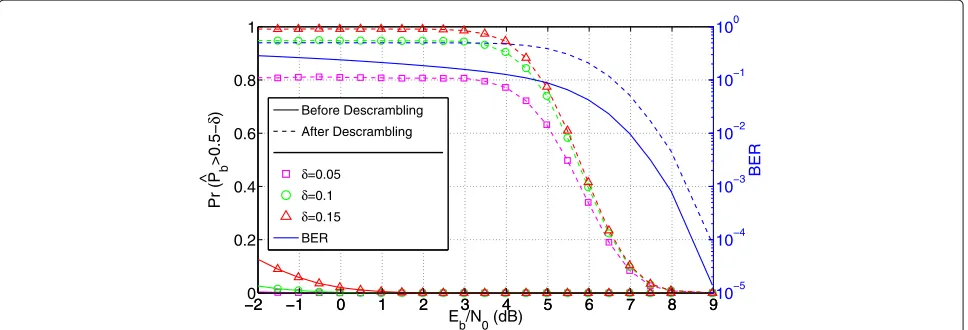
output messageM˜. Despite the fact that BER has several shortcomings as a security metric, it can still be used effec-tively to estimate decoder outputs when the eavesdrop-per’s attack strategy is known. Our metrics strengthen this approach by considering the entire distribution of possi-ble error rates. In Fig.2, we show the BER both before and after the scrambler in a receiver, and as expected, the descrambling operation propagates errors into the mes-sage estimate. However, if we would like to guarantee error rates close to 0.5 in all k-bit message estimates at the eavesdropper, it is necessary to consider the entire dis-tribution of error rates over a blocklength of data. We see curves for Pr(Pˆb > 0.5−δ) in the figure, wherePˆb can be used to model the proportion of bits in error over one block of k bits either at the input or at the output of the outer decoder and is a point estimator of the true bit error ratePb. To be more specific, letBbe a random variable that represents the number of bits in error overk bits either at the input or the output of the outer decoder. Then,
ˆ Pb=
B
k, (1)
and is coincidentally the maximum likelihood estimator for the bit error ratePbgivenkindependent observations [16]. While the errors inkreceived bits comprising a sin-gle transmitted codeword are likely not independent at the output of a decoder, we will address this concern later in Section3.2. Notice in Fig.2 that if we want Pr(Pˆb > 0.5−δ) after the decoder to get close to one, then we need to allow δ > 0.15 for this scheme and somehow ensure that Eve’sEb/N0is no better than 3 dB. These two facts together indicate that the scheme under investiga-tion may not be appropriate for secure communicainvestiga-tions. Restricting Eve’s Eb/N0 may be possible for controlled
physical environments, butδ >0.15 may not be accept-able, as it indicates that some blocks of data will exist at the output of the decoder with only 35% bit error rate, even as Eve’s channel continues to degrade in quality. We use this simple example to showcase the general applica-bility of the new metrics, as comparing distributions of error rates before and after the outer decoder for fixed blocklength schemes gives one method for quantifying the security contribution of a code. Furthermore, we see that the metrics allow system designers to identify ranges of values that are achievable for δ and Pb, which then imply bounds on worst-case error rates in any single block of data.
1.2 Outline
Throughout this paper, we will let SNR designate the signal-to-noise ratio as measured by the channel, mean-ing the energy per transmitted bit over the noise power spectral density N0.Eb/N0will be the energy per infor-mation bit divided by N0. The two are related by the overall rateRof the concatenated coding scheme so that SNR = REb/N0 for binary phase shift keying (BPSK) transmission.
The rest of the paper is organized as follows. First, we survey the landscape of secrecy metrics for physical-layer security coding schemes in Section2. We then point out some shortcomings and motivate the need for additional practical metrics, and finally highlight the cases for which our metrics are superior to both information-theoretic and BER-based existing metrics, while also pointing out their limitations. Section 3 discusses the methodology behind our new metrics BE-CDFbcand BER-CDFac, with definitions and clarifying examples. We show a use case of these metrics in a more complicated concatenated coding scheme in Section 4 and indicate how the scheme may
−20 −1 0 1 2 3 4 5 6 7 8 9
0.2 0.4 0.6 0.8 1
Eb/N0 (dB)
Pr (P
b
>0.5−
δ
)
^
−2 −1 0 1 2 3 4 5 6 7 8 910
−5 10−4 10−3 10−2 10−1 100
BER
Before Descrambling After Descrambling
δ=0.05
δ=0.1
δ=0.15 BER
Fig. 2New security metrics for a simple system where the outer code is a scrambler and the inner code is a BCH(127, 64) code. BER curves are given in blue with no markers, and PrPˆb>0.5−δ
be used directly for secrecy or used to provide a discrete memoryless wiretap channel equivalent over which addi-tional secrecy codes may be used to achieve information-theoretic security. The scheme in this section uses a friendly jammer and illustrates the broad utility of the new metrics. We also compare and contrast our new metrics with traditional cryptographic strength and perform basic cryptanalysis both before and after the outer decoder for the nested coding framework. We offer some comments by way of conclusion in Section5.
2 Discussion
2.1 Secrecy metrics
The secrecy metric space has progressively become more dense, particularly over the last few decades. The initial secrecy coding metric posed by Shannon in the late 1940s was that ofperfect secrecy[17]. A code is said to achieve perfect secrecy if
I(M;Xn)=0, (2)
or, alternatively, if the equivocationH(M|Xn)is equal to the entropy of the message H(M). Perfect secrecy indi-cates that the coded message tells you nothing about the message itself. Shannon introduced the notion through the coding scheme of the one-time pad and promptly proved that it was impossible to achieve perfect secrecy in a scheme where the entropy of a secret key is not at least as much as the entropy of the message itself. Thus, it is known that perfect secrecy is completely impractical.
In the mid-1970s, Wyner [7] introduced an additional metric for secrecy that is known today asweak secrecy. A scheme is said to achieve weak secrecy if
lim n→∞
1 nI(M;Z
n)=0. (3)
This metric introduced the idea of coding for secrecy in earnest because the results indicated that it was actu-ally possible to achieve weak secrecy in a practical system. After all, this criterion does not require that the coded message Xn leaks no information about M, but rather that the eavesdropper’s observation Zn must leak a suf-ficiently small amount of information aboutMsuch that the 1/n factor can still drive the quantity to zero. With this new notion of secrecy came the idea of secrecy capac-ity Cs which was originally defined as the supremum of coding rates that can achieve weak secrecy against a pas-sive eavesdropper as a function of the wiretap channel parameters, while maintaining arbitrarily low probability of decoding error at the legitimate receiver. As long as the legitimate parties are able to leverage an advantage over the eavesdropper so that the effective main chan-nel isless noisy[8] than the eavesdropper’s channel, then Cs > 0, which indicates that private communications are theoretically possible.
Weak secrecy was shown to be insufficient in many cases [13], and Maurer later defined a stronger metric known as strong secrecy[18], where a scheme is said to achieve strong secrecy if
lim n→∞I(M;Z
n)=0. (4)
It was recently noted in [19] that even strong secrecy may not be sufficient for some applications because the assumption is often made that message symbols are ran-dom and uniformly distributed over the message alphabet. Of course, in cryptographic scenarios, the messages are never perfectly random and uniform, and it is known that in practice there really is no universal compression algorithm that can provide such messages at the input of secrecy encoders. Thus, we have an even stronger notion of secrecy called mutual information security which is achieved if
lim n→∞maxpM {
I(M;Zn)} =0. (5)
Here, we maximizeI(M;Zn)over all possible message distributionspM. It is also shown in [19] that this notion of secrecy is equivalent to distinguishing security and semantic security.
Although it took over 30 years after Wyner introduced weak secrecy for an explicit code design to emerge that could achieve it [9], it has already been shown that codes exist that can achieve both strong and semantic secrecy, albeit over simple wiretap channel models [4, 19]. Sur-prisingly, the secrecy capacity defined using strong or semantic security is provably the same as that defined by the weak secrecy metric [20].
Authors in [22] studied coding mechanisms that pro-vided degrees of freedom in an eavesdropper’s decoder output, where no information about certain bits could be obtained, forcing an attacker to guess the bits asso-ciated with the degrees of freedom in the decoder. This notion was similar to an information-theoretic security approach in the sense that the information could not be attained through any degree of processing but was also very much unlike an information-theoretic security approach because it restricted an attacker to a specific attack strategy.
2.2 Shortcomings of current security metrics
The metrics of the previous section give many tech-niques for analyzing the security achieved by specific coding schemes. Developing wiretap codes that are able to reach the envisioned secrecy capacity for more practical channel models remains a formidable challenge, and per-forming the information-theoretic analysis is oftentimes deemed intractable. The information-theoretic measures are still the most desirable where possible to apply, but they also have another weakness in the sense that they lead to codes that are designed to meet a secrecy criterion in an asymptotic blocklength regime only, thus limiting their applicability in real systems that require short block-length codes. Some work has been done recently in an attempt to expand information-theoretic security mea-sures to finite blocklengths, but thus far, these attempts are either directed only at discrete memoryless channel models [23] or provide only bounds on the informa-tion leakage that are very loose for short blocklength codes [24,25].
One should be careful when performing security anal-ysis that relies only on BER-based measures, because high error rates do not necessarily indicate that some information has not been leaked. On the other hand, modern cryptography is based on computational security that does leak the information about the message. These systems work not because of an information-theoretic guarantee, but rather due to there being no known com-putationally efficient algorithm that can find the solu-tion in any reasonable amount of time with any realistic amount of computing power unless the key is known. Thus, we see that despite not achieving an information-theoretic security measure, cryptosystems remain useful because they attain security in a more practical/applied sense. In a similar way, BER security analysis assumes the best known decoder/attack and makes calculations assuming an eavesdropper uses that attack. While BER may provide some useful information about the quality of the received data or the decoder output at the eaves-dropper, BER calculations are still made by averaging large amounts of data and are therefore only reliable as blocklengths get large.
The metrics we introduce over the next two sections of this paper take a BER approach but rather than calculating simple averages, make use of our knowledge of the CDF of bit error rates over small blocks of data to provide lower bounds on error rates through the receiver decoder chain, where the highest BER considered is 0.5. Making this fun-damental change in how BER is used to analyze security in a system allows us to make stronger guarantees about the performance of secrecy codes in the short blocklength regime without the need for laws of large numbers. This is something that none of the metrics in Section2.1can provide due to the way the analysis is completed either as blocklength goes to infinity or as simulations are aver-aged over thousands of independent runs. Using the new metrics, we also maintain the ease of simulation-based characterization of security (which is particularly helpful when realistic channel models are considered, where it is not known how to provide an information-theoretic anal-ysis). Table1outlines the utility of each currently known physical-layer security metric [1,4] and indicates the con-tribution of our new metrics lies in ease of computation and providing the strongest guarantee yet for analyzing finite blocklength code designs.
3 Methods
3.1 The bit error cumulative distribution function
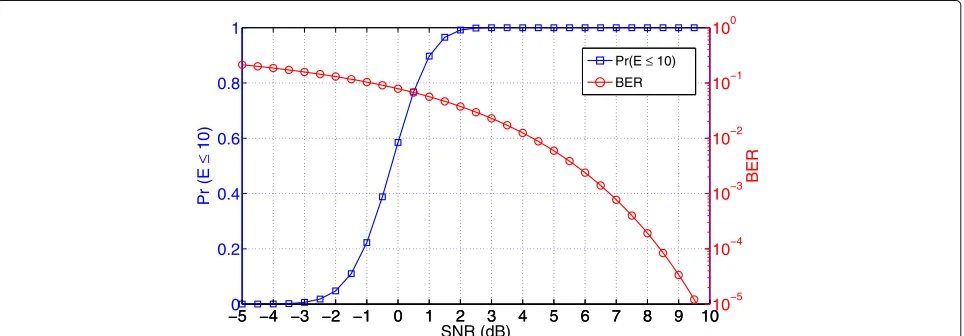
Let us consider an additive white Gaussian noise (AWGN) channel with BPSK modulation, for which the BER (depicted in Fig.3) is given by [26]
At-error correcting code of length 127 that is able to correct up to 10 errors can recover from a BER of 12710 ≈ 0.079 assuming uniform error distribution, but errors over short blocks of data are not guaranteed to occur so uni-formly. LetEbe the number of bit errors in a block ofn bits. For a transmitted word of sizenwith independent bit errors, the probability of having fewer than or equal tot errors Pr(E ≤ t)can be straightforwardly obtained from (6) as
Table 1Summary of current physical-layer security metrics, highlighting some of their pros and cons
Class Metric Directly applicable
to short codes
Easily computable in general
Information-theoretic secrecy guarantees
Strongest in class
Known how to achieve in practice
Impractical Perfect secrecy Yes No Yes Yes No
Info-theoretic Weak secrecy No No Yes No Yes (only for DMCs)
Info-theoretic Strong secrecy No No Yes No Yes (only for DMCs)
Info-theoretic Semantic secrecy No No Yes Yes Yes (only for DMCs)
Error rate BER No Yes No No Yes (BER≈0.5)
Error rate Security gap No Yes No No Yes (security gap
<0 dB)
Error rate BE-CDFbc Yes Yes No No Yes (decoder failure
w. p.≈1)
Error rate BER-CDFac Yes Yes No Yes Yes (high error rates
w. p.≈1)
Here we see that although our new metrics cannot provide information-theoretic security, they are best in class among the error-rate secrecy metrics. Note: w.p. meanswith probability
the BER still far from the idealized 0.5 value. With this in mind, the question arises of how close to BER = 0.5 is close enough for security purposes.
To address this issue, we look to the distribution of errors of transmitted data and propose the first of two new secrecy metrics.
Definition 1 (Bit error cumulative distribution func-tion) The bit error cumulative distribution function, BE-CDFbc(t, SNR,Sm,Ci), gives us the probability of having t or less errors,Pr(E ≤ t), as a function of the SNR for a message of sizeSm, encoded with a codeCi (refers to the optional inner code).
From this metric, we can deduce the probability of having more thanterrors in a block of data, giving us the power to predict the likelihood of decoder failure when
the code is a t-error correcting code such as a Bose-Chaudhuri-Hocquenghem (BCH) code. This information is useful for identifying acceptable SNR operating points for both friendly parties and eavesdroppers [6]. Notice from Fig.1that we measure this metricbeforethe outer code(hence the superscriptbc) in a concatenated coding scheme, i.e., prior to the secrecy code. Because of this, we choose to use SNR, rather thanEb/N0to show the results, although the conversion can be made if desired.
3.1.1 Analysis
This metric can also be used to fine-tune the security and reliability levels of a coding scheme that relies on t-error correcting codes. For example, if we assume no inner code and set the outer code to a BCH(127, 64) code that corrects up to 10 errors, and if we want a reliability level of Pr(E ≤10) >0.99, Bob would have to operate at
−5 −4 −3 −2 −10 0 1 2 3 4 5 6 7 8 9 10 0.2
0.4 0.6 0.8 1
SNR (dB)
Pr (E
≤
10)
−5 −4 −3 −2 −1 0 1 2 3 4 5 6 7 8 9 1010
−5
10−4 10−3 10−2 10−1 100
BER
Pr(E ≤ 10) BER
an SNR above 1.95 dB as indicated in Fig.3. For a confi-dentiality level of 0.99, i.e., Pr(E≤10) <0.01, Eve would need to operate at SNR below−2.78 dB.
While relevant reliability and confidentiality levels with a reasonable SNR gap between Bob and Eve may seem illu-sive with simple coding schemes such as the mentioned BCH code, this metric enables the selection of t-error correcting codes that can be used in more evolved con-catenated coding schemes combined with the generation of interference [6] to provide desired levels of reliability and confidentiality, as will be described in Section4.1.
3.2 The bit error rate cumulative distribution function
The BE-CDFbc allows us to guarantee failed decoding with high probability over certain SNR regions fort-error correcting codes. However, a failed decoder does not nec-essarily imply that the eavesdropper cannot obtain most of the message bits at the output. Hence, in this section, we introduce a metric that can guarantee decoder fail-ure with BER close to 0.5 in the estimated message bits to strengthen the security guarantee. For this section, let
ˆ
Pbbe the measured proportion of bit errors at the output of an error-correcting decoder measured overSbdecoded message bits. For the case where the code being used is a block (n,k) code, it makes sense to letSbbe an integer multiple ofk. The metric we propose in this section allows a user to specify a required error rate at the output of the eavesdropper’s error-control decoder over Sb bits using the probability thatPˆb>0.5−δfor anyδdesired.
Definition 2 (Bit error rate cumulative distribution function)The bit error rate cumulative distribution func-tion, BER-CDFac(δ, Eb/N0,Sb,C) is the quantity
calculated overSbestimated message bits for a codeCas a function of Eb/N0, whereCmay be the concatenation of an (optional) inner codeCiand an outer codeCo.
We note that theacexponent indicates that the metric is measuredafter the code. Since the inner code is shown to be optional in Fig.1, this is referring to the outer (secrecy) code. Also, because we are calculating this metric after the decoder, it makes sense to useEb/N0, rather than SNR. Finally, we should note that this metric is actually the com-plement to the CDF, but we choose to use a consistent nomenclature to that of the BE-CDFbc. These two metrics packaged in a pair provide valuable design information so as to achieve both reliability and secrecy.
3.2.1 Analysis
The BER-CDFac allows us to guarantee decoder failure with high probability in addition to high BER (near 0.5) over short blocks ofSbbits at the output of the decoder.
Although the metric is not information-theoretic, it comes much closer to the information-theoretic defini-tions of secrecy than the BE-CDFbcby limiting the amount of useful information to an eavesdropper (as tends to hap-pen with high BER). That is, for a scheme that guarantees high BER using the BER-CDFac metric, it is unlikely that the decoder will fail and yet provide small BER at the out-put. Notice that this metric is also much more robust than simply considering the average BER, and examples are shown in the following section of the paper. Similarly as with our BE-CDFbcmetric, we now ensure that the entire distribution of BER values for a specific length of textSb is within an acceptable security region.
Recall that Pˆb is the estimator of the error rate Pb at the output of the final decoder over a short blocklength of Sb bits. If we assume that each bit at the output of the decoder is in error independently with probabilityPb, then the random variablePn =SbPˆbmodels the number of errors in a block ofSbbits and is distributed accord-ing to the binomial distribution with parametersμ = Pb andσ2= SbPb(1−Pb). This means we can calculate the
Although the exact expression can be derived in this case, the assumption of i.i.d. errors is not likely to hold in practice,Pbmay be unknown, and the calculation itself would be time intensive or require approximation using the Gaussian distribution [16]. Thus, in practice, it makes more sense to calculate the metric using straightforward Monte Carlo simulations.
By way of example, consider Pr
ˆ
Pb>0.5−δ
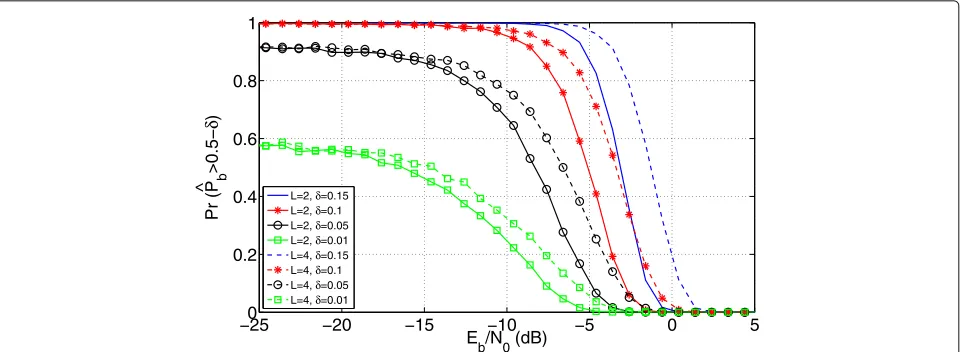
as plot-ted for a BCH(127, 92) code as the outer code with several varying sets of parameters as portrayed in Fig.4. Each case presented uses Sb = 92×2 = 184 so as to allow an L = 4 order modulation scheme without zero padding. The modulation scheme was chosen arbitrarily to be dif-ferential phase shift keying (DPSK) and is either binary or quaternary as indicated in the legend. Beyond this, we consider differentδ values as shown. Although there existEb/N0values for which the decoder fails with prob-ability close to one, unless the resultant BER is greater than(0.5−δ)with high probability, the metric will not approach one in the limit asEb/N0→ −∞.
−250 −20 −15 −10 −5 0 5
Notice that for someδvalues, the BER-CDFacapproaches one, where other curves appear to be bounded away from one
BER-CDFac can be made to go to one asEb/N0 → −∞. Also notice in Fig. 4 that increasing the order of the digital modulation scheme can bring about an effective shift towards better security. When PrPˆb>0.5−δ
is bounded away from one, we are viewing the random cor-rective capabilities of the code even when the signal is completely overwhelmed by noise. Certainly, we can do better by increasing Sb or the dimensions of the code as well, but the utility of this metric is that we can get a clear picture for what happens whenSb is small, thus providing small blocklength security analysis in practical physical-layer security system designs.
Exploring the metric in the limit as channel quality deteriorates is accomplished in the following lemma.
Lemma 1 The limiting value of the BER-CDFac (δ, Eb/N0,Sb,C) as Eb/N0→ −∞is
lim Eb/N0→−∞
Pr(Pˆb>0.5−δ)=Q−2δSb. (10)
ProofClearly this quantity is a function ofδandSband can be calculated by recognizing thatPˆbis a sample mean of Bernoulli random variablesXiwhere
Xi=
1 if bitiis in error,
0 otherwise. (11)
Since we are evaluating the BER-CDFacasEb/N0→ −∞, we can assume that all of the Xi random variables are effectively independent. In essence, the independence of the relatively high-power noise masks any potential dependence of the underlying data as channel quality deteriorates. Let Pr(Xi = 1) = Pb as before. Then Clearly, this is true in the limit asSbgets large, but even for small and moderate blocklength sizes, the central limit theorem still provides a good approximate distribution. In the limit as Eb/N0 → −∞, we also havePb → 0.5
. Using the classic Gaussian stan-dardization technique [16], we find that the lemma is proved.
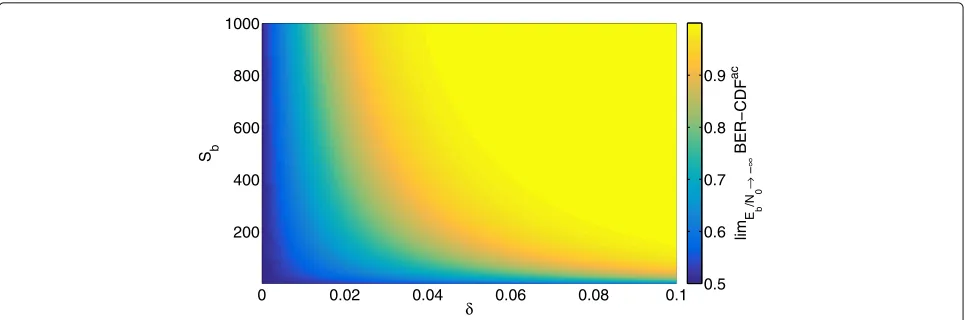
This limiting value of the BER-CDFacis shown in Fig.5 over a range of δ and Sb values. These results can aid system designers in choosing Sb (or k) in outer codes appropriately so as to supply a desired BER-CDFac. Once Sb is chosen, we also have a best possible value for the metric over which any coding scheme can be compared. One characteristic of good secrecy codes is that they will transition from zero to the limiting value in this metric over a very short range ofEb/N0.
0 0.02 0.04 0.06 0.08 0.1 200
400 600 800 1000
δ
S b
lim
E b
/N
0
→
−
∞
BER−CDF
ac
0.5 0.6 0.7 0.8 0.9
Fig. 5Limiting value of the BER-CDFacmetric asE
b/N0goes to−∞as a function ofδandSb
of log-likelihood ratios (LLRs) in determining error loca-tions at the output of an iterative decoder and perform simple cryptanalysis to accompany the use of our metrics in a more complex coding scheme.
4 Results
4.1 Application
In this section, we show how the concatenated coding sys-tem from [6] measures up using the two new metrics and discuss the utility of the system as a result of its BE-CDFbc and its BER-CDFac curves. It should also be noted that [6] goes through a design process based on the BE-CDFbc for this coding scheme. Although we do briefly outline the scheme and one possible design process here, the inter-ested reader is directed to the original work for further details. It is of note that the scheme highlighted in this section requires a friendly jammer, and the scheme is cho-sen for precho-sentation partly for this reason. Although the simpler examples shown in the previous sections of the paper apply to the general wiretap channel (Fig. 1), our framework, and our metrics, are broad enough to con-sider more complicated cases as shown with this use case. For an additional concatenated coding example without the use of a friendly jammer, the reader is directed to [27]. Finally, we indicate how our new metrics may be com-bined with this coding scheme to provideeffectivediscrete memoryless wiretap channel equivalents over which other secrecy coding schemes may be implemented to achieve information-theoretic security.
4.1.1 System setup
The system analyzed in this section follows the general concatenated coding framework outlined in Fig. 1. The outer code can actually be considered as two encodings, where the message is interleaved according to a secret key K(drawn at random from the space of possible permuta-tions onSminput message bits), and the key is encoded
separately from the message using a BCH(127, 64) code that is capable of correcting 10 errors. The interleaved message and the encoded key are then appended together, and this constitutes the outer code. An LDPC(1056, 880) code is then used as the inner code, which is applied to the appended message and key to form a codeword suit-able for transmission over a noisy channel. Recall from Fig. 1 that the general concatenated framework is such that the outer code is intended to achieve the secrecy requirements of the system, while the inner code is used to achieve reliability for Bob.
In this system, however, there is more at play than just the coding schemes. When the encoded data that are asso-ciated with the keyK are transmitted over the channel, they are intentionally jammed by some friendly network user with jamming power equal to a fractionαof Alice’s transmit power. The idea is to give Bob an advantage because of his location or knowledge of the jamming sig-nal so that the jamming affects him only minimally, while an eavesdropper has no information about the jamming signal and/or is positioned in a geographic location that does not afford her the same advantage as Bob [6,28,29]. Since the jamming is only applied to the encoded bits associated with the interleaving key, reliability in the sys-tem also ssys-tems from Bob being able to recover the key for deinterleaving, while security in the system depends on Eve being unable to recover the interleaving key. Data are transmitted over a Gaussian wiretap channel using BPSK modulation.
decoder. The mapping of keys to interleavers is such that any errors in the estimated key result in high error rates in the deinterleaved message, even when the interleaved message bits are recovered exactly [6].
4.1.2 Direct results
Our two new metrics paint a complete picture of how this system will respond for both Bob and Eve, thus provid-ing security analysis and system design constraints. The BE-CDFbc will show us the operating point for Bob to attain any desired level of reliability and will also show us how Eve’s decoding capability breaks down. The BER-CDFacwill then further enlighten us as to where we truly wish Eve to operate so as to guarantee (with probabil-ity essentially one) high BER near 0.5 at the output of her decoder. Coincidentally, this analysis also allows us to identify the jamming power advantage required dur-ing key transmission for the system to be successfully deployed [6].
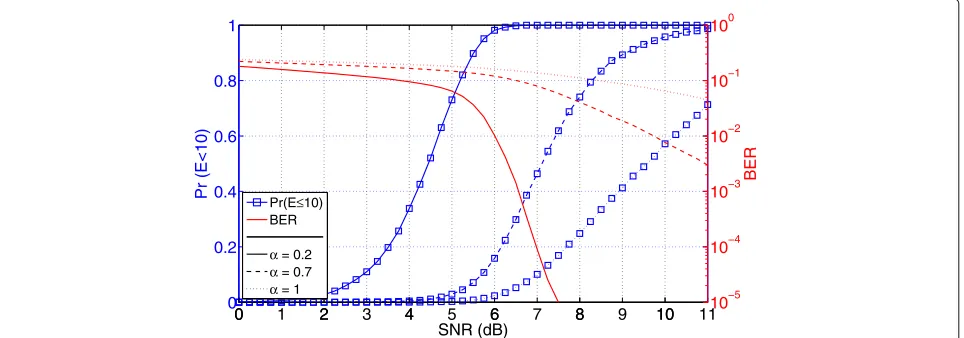
Let us assume that the effective jamming to Bob isαB=0.2, while the effective jamming to Eve isαE = 0.7 (we also includeα = 1 in the figures for instructional purposes). The BE-CDFbcresults apply to the BCH-encoded key bits and are given in Fig.6, where we see that if Bob wishes to attain an overall BER around 10−3, the system must be designed to guarantee a BE-CDFbc value no lower than 0.9975. The interpretation of this value is that less than one fourth of 1% of the transmitted key blocks should be decoded in error for Bob. Also according to Fig. 6, Bob achieves this performance if the SNR over his Gaus-sian channel is 6.5 dB or greater. We also note that the BE-CDFbc for Eve at an SNR of 4 dB is equal to 0.0048, meaning less than one half of 1% of the time Eve will receive a key block for which she can correct all the errors if this BE-CDFbcvalue can be maintained.
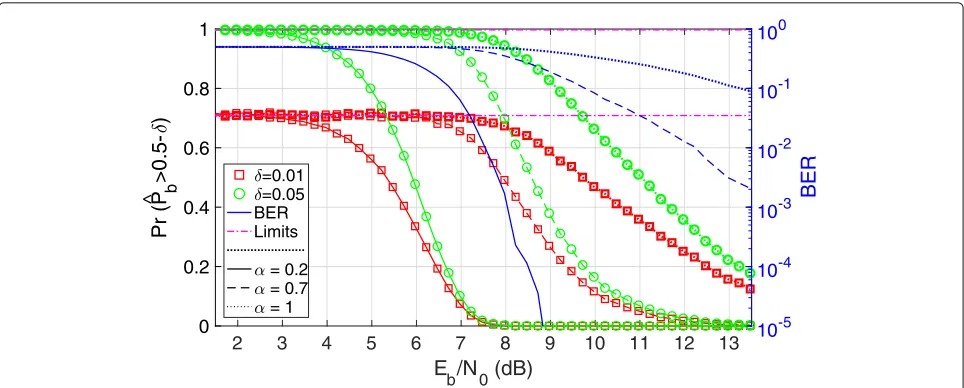
To get the true feel for how Eve is affected by this scheme, however, we need to track the distribution of error proportion in Eve’s guess of the message bits as a function of Eb/N0 using the BER-CDFac as depicted in Fig. 7. Here we see that for δ = 0.05, we can attain Pr
ˆ
Pb>0.5−δ
= 0.995 at roughly Eb/N0 = 4.7 dB, which corresponds to an SNR value of approximately 4 dB. The limiting values of the BER-CDFac are also shown in the figure, as given by (10). These results indicate that for this scheme, insuring that Eve cannot correct all errors in the key is in fact sufficient for insuring a high propor-tion of errors in Eve’s estimate of each short blocklength of message bits at the output of her decoder, which is exactly what we’d like to see in a practical physical-layer security scheme. For the sake of referring back to Fig.5for the lim-iting value of the BER-CDFac metricS
b for this scheme is the dimension of the LDPC code (880 bits) minus the blocklength of the BCH code (127 bits), because the BCH code only encodes the key bits, and the remainder of the bits in the dimension of the LDPC code are dedicated to the message. This yieldsSb=753 bits.
4.1.3 Creating a discrete memoryless channel
Explicit secrecy code constructions exist that can provide information-theoretic security, however, only for discrete memoryless wiretap channels [1, 4]. As mentioned pre-viously, some of these currently known designs require either a noiseless main channel for legitimate communica-tion or a degraded wiretap channel for the eavesdropper. Thus, we have two possible research directions for mak-ing information-theoretically secure codmak-ing designs more practical to real end users. First, effort can be placed to design secrecy codes that operate over more realistic channels [3], and second, coding and/or signaling tech-niques may be leveraged to produce aneffectivewiretap
0 1 2 3 4 5 6 7 8 9 10 11
0 0.2 0.4 0.6 0.8 1
SNR (dB)
Pr (E<10)
0 2 4 6 8 10 10
−5
10−4 10−3 10−2 10−1 100
BER
Pr(E≤10) BER
α = 0.2
α = 0.7
α = 1
Fig. 6BE-CDFbccalculated whent=10 for three different effective jamming powers. These results anticipate the likelihood of decoder failure for
2 3 4 5 6 7 8 9 10 11 12 13
E
b/N0 (dB) 0
0.2 0.4 0.6 0.8 1
Pr (P
b
>0.5-)
^
10-5
10-4
10-3
10-2
10-1
100
BER
=0.01 =0.05 BER Limits
= 0.2 = 0.7 = 1
Fig. 7BER-CDFacgiven for two delta values along with the BER. These three curves are given for three different effective jamming powers and show
that if Eve experiences jamming powerαE=0.7, then her BER over 753 message bits is guaranteed to be withinδ=0.05 of 0.5 with high
probability as long as herEb/N0is no greater than 4.7 dB. This corresponds to an SNR value of approximately 4 dB. The lines marked aslimitsare the
limiting expressions given from (10) for the two differentδvalues
channel [30] over which we already know how to code for information-theoretic security. In this section, we outline how our new metrics and the coding scheme explained in Section4.1.1can be used to produce an effective discrete memoryless wiretap channel.
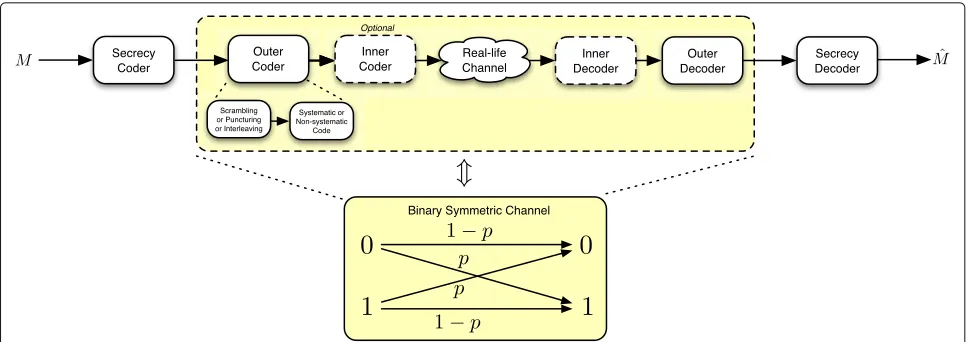
Consider again the results shown in Fig.7that indicate an eavesdropper experiencing jamming powerαE = 0.7 andEb/N0 = 4.7 dB over a Gaussian channel can expect error rates over 753-bit messages to have BER greater than 0.45 with probability very close to one. Since the analysis was conducted over short blocklengths, we offer not just an average BER, but rather a low estimate of the BER over the channel. We now consider applying one more code on the outside of the entire scheme described in Section4.1.1, as depicted in Fig.8, and modeling the remaining blocks as an effective binary symmetric channel (BSC). The addi-tional code added is one that can leverage this effective channel to bring about an information-theoretic security result (e.g., [31]).
In order to claim that the interior blocks in Fig.8can truly be modeled as a BSC, we need to verify three main properties of the BSC in our system: (1) each bit should be flipped independently from all other bits, (2) the prob-abilitypof flipping each bit over the channel should be identical and we need to identify its value, and (3) we need to ensure that soft information about the bit is either not available or impossible to use at the secrecy decoder.
To ensure that bits within message blocks retain their independence of being in error, as required by the BSC model, we need to apply an inter-block interleaver as the first subcode in the outer coder block in Fig.8to spread information around as in [22,30] and many other works.
Although there may exist some correlations between flipped bits over the same transmitted packet, since all bits from every secrecy codeword are transmitted in different packets over the channel, we effectively deliver indepen-dence between the bits at the secrecy codeword level, which is where we need independence for the secrecy code to work properly.
In terms of identifying the probability p that corre-sponds to the flipping of each bit over the channel, we will use the lower bound given by BER-CDFacas indicated above. By so doing, we provide an even stronger guarantee than identifying an average probability, since even short blocklengths maintain this probability of bit error with probability close to one. Bit error locations within secrecy codewords are kept uniformly random as a byproduct of the inter-codeword interleaving at the output of the secrecy encoder.
Fig. 8A concatenated coding scheme may be utilized to provide an effective discrete memoryless wiretap channel, over which known explicit secrecy codes may operate for information-theoretic security
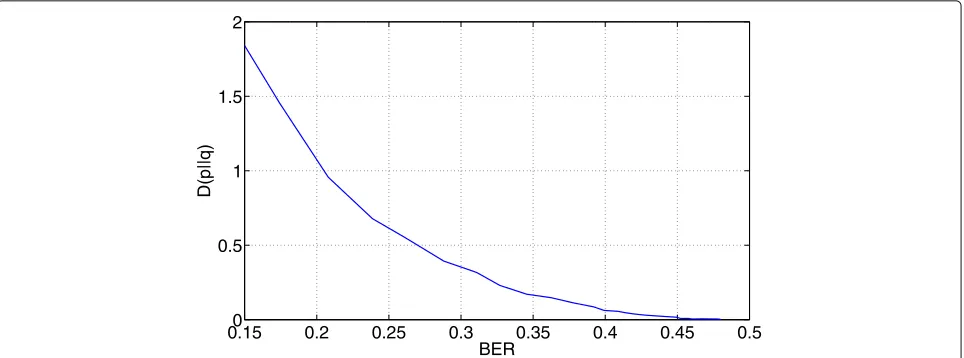
end of the soft iterative decoding algorithm is positioned directly between the distributions of LLRs correspond-ing to differcorrespond-ing bit values. When the SNR is small enough that the code does not correct all the errors, distribu-tions corresponding to bits in error and correct bits start to look very similar. In fact, when the noise completely overwhelms the coding scheme, each of these distribu-tions tends to an approximate Gaussian distribution with mean zero and identical variances. It is this property that supplies an effective decoding threshold for iteratively decodable codes [26]. Finally, as the BER approaches 0.5, the statistical difference between the distributions of LLRs for correct bits and bits in error becomes negligible. To demonstrate this, we show through simulation that the Kullback-Leibler (K-L) divergence [33] between the two distributions approaches 0 as the BER approaches 0.5, where the K-L divergence is given as
D(p||q)=
x
p(x)log2p(x)
q(x)dx, (13)
andp(x) represents the distribution of LLRs for correct bits while q(x) represents the distribution of LLRs for bits in error at the output of a soft-information LDPC decoder. These results are given in Fig. 9, where we observeD(p||q)going to zero with increasing BER. Rec-ognize thatD(p||q)=0 implies that there is no statistical difference between p(x) and q(x) or that the distance between the two distributions is zero. It can be argued then, that as long asD(p||q)is small enough, soft infor-mation at the output of an iterative decoder is unusable as it does not accurately depict any type of relationship between a bit’s likelihood of being correct or in error.
The end result is that our new metrics mixed with the scheme from [6] can provide the effective channel model
necessary for these information-theoretic designs to suc-ceed. We see in [1] that one type of secrecy code that may be able to offer secrecy over this channel is that given in [31], where known advantageous (good for Bob and bad for Eve) polarizations of synthesized bit chan-nels in polar codes are used to transmit secret information over a symmetric eavesdropper’s channel. This coding scheme is known to achieve strong secrecy at information rates approaching the secrecy capacity when the legiti-mate channel can be modeled as noiseless. For our case (where we have assumed thatαE = 0.7,αB = 0.2, Bob’s SNR≥ 6.5 dB and Eve’s SNR≤4 dB), supplying a prob-ability of a flipped bitp ≥ 0.45 over an effective BSC to an eavesdropper while maintaining an effectively noise-less main channel results in secrecy capacityCs = Cm− Cw = pbits per channel use, where Cm andCwsignify the channel capacities of the main and wiretap channel, respectively [7,8,33].
The approach outlined here, where we manufacture a wiretap channel over which additional secrecy codes can be utilized, can be extended to produce other effective dis-crete memoryless wiretap channels as well that may form ideal backdrops for other code designs to operate in more realistic environments.
4.2 Cryptographic strength of new metrics
0.150 0.2 0.25 0.3 0.35 0.4 0.45 0.5 0.5
1 1.5 2
BER
D(p||q)
Fig. 9Kullback-Leibler divergence between distributions of LLRs that correspond to bits in error and LLRs that correspond to correct bits at the output of an LDPC soft decoder, as a function of the hard-decision BER at the output of the decoder. As the BER approaches 0.5, the distributions become more alike, to the point where detecting a correct bit or a bit in error is impossible, even with soft information
that is communicated over wireless links may only be required to be encrypted using algorithms deemed to achieve cryptographic strength at the 112-bit level, while high-impact information would require the 192-bit level [34]. The cryptographic strength of an algorithm can be measured in many ways, including the length of any secret keys used during encryption/decryption and the com-plexity/running time of the best known attack against the algorithm [34,35]. Algorithms that achieveN bits of security are those where all known attacks require effort equivalent to a brute-force attack for guessing a key of lengthNbits.
When considering the new security metrics presented in this paper in light of cryptographic strength, we note that the metrics cannot adequately classify algo-rithms without additional cryptanalysis; however, we also note that physical-layer security has been shown to improve cryptographic strength when the two techniques (physical-layer security and cryptography) are used in tandem [36–38]. In cases like these, the role of physical-layer security is to introduce confusion regarding the true values of bits of ciphertext, thus requiring attackers to consider a noisy ciphertext model when formulating an attack [38].
If we assume that a nested coding technique as illus-trated in Fig.1is used without cryptography at the appli-cation layer of the communiappli-cation protocol stack, then parameters for both new metrics should be chosen to deliver the desired amount of security. In other words, cryptanalysis at the input to the outer decoder (see Fig.1) would require us to calculate BE-CDFbc(t∗, SNR,S
m,Ci), wheret∗ is no longer the threshold of correct decoding for codeCi, but rather the threshold that guarantees com-putational complexity in the attack to be at least at the
level ofN bits. If N bits of security are not possible at an acceptable value of SNR for the eavesdropper, then the message sizeSmand codeCiwould need to be changed to allow the desired level of security.
Cryptanalysis at the output of the outer decoder could be achieved by considering BER-CDFac(δ,Eb/N0,Sb,C) forδsmall enough to render attacks at this stage ineffec-tive. An upper bound on the strength of the outer code can be calculated by considering(0.5−δ)as the proportion of bits in error ofSbtotal bits at the eavesdropper’s oper-atingEb/N0point. If we assume the eavesdropper knows the number of errors
Ne≈(0.5−δ)Sb, (14)
then the eavesdropper would still have to cycle through
Sb
Ne
possible combinations of error locations to guess the plaintext, assuming there is no additional statistical infor-mation about the message the eavesdropper can leverage. Thus, in the absence of a smarter attack at the decoder’s output, to achieveN-bit security at this stage for every block of data, a sufficient condition is that
log2
S
b Ne
≥N. (15)
5 Conclusions
In this paper, we have discussed the landscape of physical-layer security coding metrics. We note that most measures in use today rely on information-theoretic analysis as blocklengths tend to infinity or use mean BER, both of which give asymptotic results that have limited mean-ing for short blocklength codes. We have proposed two new metrics that effectively employ CDFs to provide a lower bound on the security levels based on BER. Such an approach provides a stronger guarantee of secrecy over realistic channel models than simply using mean BER to estimate performance, and yet, our metrics retain their simplicity of calculation making them directly adapt-able to real-world communication systems. The metrics apply generally to cases where concatenated codes are used to provide confidentiality, which includes as a spe-cial case the generic wiretap channel model. We have also shown how these new metrics may be used to reduce realistic channel model environments to simpler models over which known secrecy codes may be implemented to achieve information-theoretic security and have used them in performing basic cryptanalysis to aid system design.
Abbreviations
AWGN: Additive white Gaussian noise; BCH: Bose-Chaudhuri-Hocquenghem; BE-CDFbc: Bit error cumulative distribution function; BER: Bit error rate; BER-CDFac: Bit error rate cumulative distribution function; BPSK: Binary phase shift keying; BSC: Binary symmetric channel; CDF: Cumulative distribution function; DMC: Discrete memoryless channel; DPSK: Differential phase shift keying; LDPC: Low-density parity-check; LLRs: Log-likelihood ratios; NIST: National Institute of Standards and Technology; SNR: Signal-to-noise ratio
Funding
This work was partially funded by the following entities and projects: the US National Science Foundation (Grant Award Number 1460085/1761280), the FLAD project INCISE (Interference and Coding for Secrecy), project SWING2 (PTDC/EEI-TEL/3684/2014), funded by Fundos Europeus Estruturais e de Investimento (FEEI) through Programa Operacional Competitividade e Internacionalização COMPETE 2020 and by National Funds from FCT -Fundação para a Ciência e a Tecnologia, through projects
POCI-01-0145-FEDER-016753 and UID/EEA/50008/2013.
Availability of data and materials
Data sharing is not applicable to this article as no datasets were generated or analyzed during the current study.
Authors’ contributions
WKH conducted the review of existing research metrics, devised the second new metric, and drafted the manuscript. DS conducted the numerical studies in the Results section. JPV and MACG devised the first new metric, designed the scheme tested in the application section, and together with WKH considered the possibility that such a scheme may provide an effective BSC to eavesdroppers. All authors took an active role in the writing process of the document, and read and approved the final manuscript.
Competing interests
The authors declare that they have no competing interests.
Publisher’s Note
Springer Nature remains neutral with regard to jurisdictional claims in published maps and institutional affiliations.
Author details
1Department of Electrical and Computer Engineering, Brigham Young
University, Provo, UT, USA.2Instituto de Telecomunicações, Department of Electrical and Computer Engineering, University of Coimbra, Coimbra, Portugal.3CISUC and Department of Informatics Engineering, University of Coimbra, Coimbra, Portugal.
Received: 6 June 2018 Accepted: 11 October 2018
References
1. W.K. Harrison, J. Almeida, M.R. Bloch, S.W. McLaughlin, J. Barros, Coding for secrecy: an overview of error-control coding techniques for physical-layer security. IEEE Signal Process. Mag.30(5), 41–50 (2013)
2. A. Mukherjee, S.A.A. Fakoorian, J. Huang, A.L. Swindlehurst, Principles of physical layer security in multiuser wireless networks: a survey. IEEE Commun. Surv. Tuts.16(3), 1550–1573 (2014)
3. C. Ling, L. Luzzi, J.-C. Belfiore, D. Stehle, Semantically secure lattice codes for the Gaussian wiretap channel. IEEE Trans. Inf. Theory.60(10), 6399–6416 (2014)
4. M. Bloch, M. Hayashi, A. Thangaraj, Error-control coding for physical-layer secrecy. Proc. IEEE.103(10), 1725–1746 (2015)
5. D. Klinc, J. Ha, S.W. McLaughlin, J. Barros, B.-J. Kwak, LDPC codes for the Gaussian wiretap channel. IEEE Trans. Inf. Forensics Secur.6(3), 532–540 (2011)
6. J.P. Vilela, M. Gomes, W.K. Harrison, D. Sarmento, F. Dias, Interleaved concatenated coding for secrecy in the finite blocklength regime. IEEE Sig. Process. Lett.23(3), 356–360 (2016)
7. A.D. Wyner, The wire-tap channel. Bell Syst. Tech. J.54(8), 1355–1387 (1975)
8. I. Csiszar, J. Korner, Broadcast channels with confidential messages. IEEE Trans. Inf. Theory.24(3), 339–348 (1978)
9. A. Thangaraj, S. Dihidar, A.R. Calderbank, S.W. McLaughlin, J.-M. Merolla, Applications of LDPC codes to the wiretap channel. IEEE Trans. Inf. Theory. 53(8), 2933–2945 (2007)
10. A.T. Suresh, A. Subramanian, A. Thangaraj, M. Bloch, S.W. McLaughlin, in Proc. IEEE Information Theory Workshop (ITW). Strong secrecy for erasure wiretap channels, (2010), pp. 1–5
11. A. Subramanian, A. Thangaraj, M. Bloch, S.W. McLaughlin, Strong secrecy on the binary erasure wiretap channel using large-girth LDPC codes. IEEE Trans. Inf. Forensics Secur.6(3), 585–594 (2011)
12. A.K. Pradhan, A. Subramanian, A. Thangaraj, inProc. IEEE Int. Symp. Information Theory (ISIT). Deterministic constructions for large girth protograph LDPC codes, (2013), pp. 1680–1684
13. M. Bloch, J. Barros,Physical Layer Security: From Information Theory to Security Engineering. (Cambridge University Press, 2011)
14. M. Baldi, M. Bianchi, F. Chiaraluce, inProc. IEEE Information Theory Workshop (ITW). Non-systematic codes for physical layer security, (2010), pp. 1–5 15. M. Baldi, M. Bianchi, F. Chiaraluce, Coding with scrambling,
concatenation, and HARQ for the AWGN wire-tap channel: a security gap analysis. IEEE Trans. Inf. Forensic Secur.7(3), 883–894 (2012)
16. D.C. Montgomery, G.C. Runger,Applied Statistics and Probability for Engineers, 5th edn. (Wiley, Hoboken, 2011)
17. C.E. Shannon, Communication theory of secrecy systems. Bell Syst. Tech. J.28, 656–715 (1949)
18. U.M. Maurer, inCommunications and Cryptography: Two Sides of One Tapestry. The strong secret key rate of discrete random triples (Kluwer Academic Publishers, 1994), pp. 271–285
19. M. Bellare, S. Tessaro, A. Vardy, inAdvances in Cryptology – CRYPTO 2012, ed. by R. Safavi-Naini, R. Canetti. Lecture Notes in Computer Science, vol 7417. Semantic security for the wiretap channel (Springer, 2012), pp. 294–311 20. U. Maure, S. Wolf, inAdvances in Cryptology — EUROCRYPT 2000, ed. by B.
Preneel. Lecture Notes in Computer Science, vol 1807.
Information-theoretic key agreement: From weak to strong secrecy for free (Springer, 2000), pp. 351–368
22. W.K. Harrison, J. Almeida, S.W. McLaughlin, J. Barros, Coding for cryptographic security enhancement using stopping sets. IEEE Trans. Inf. Forens. Security.6(3), 575–584 (2011)
23. J. Pfister, M.A.C. Gomes, J.P. Vilela, W.K. Harrison, inProc. IEEE International Conference on Communications (ICC). Quantifying equivocation for finite blocklength wiretap codes, (2017), pp. 1–6
24. C.W. Wong, T.F. Wong, J.M. Shea, inProc. IEEE GLOBECOM Workshops (GC Wkshps). LDPC code design for the BPSK-constrained Gaussian wiretap channel, (2011), pp. 898–902
25. M. Baldi, G. Ricciutelli, N. Maturo, F. Chiaraluce, inProc. IEEE International Conference on Communication Workshop (ICCW). Performance assessment and design of finite length LDPC codes for the Gaussian wiretap channel, (2015), pp. 435–440
26. T.K. Moon,Error Correction Coding: Mathematical Methods and Algorithms. (Wiley, Hoboken, 2005)
27. D. Sarmento, J. Vilela, W.K. Harrison, M. Gomes, inProc. IEEE Global Telecommunications Conference (GLOBECOM). Interleaved coding for secrecy with a hidden key, (2015), pp. 1–6
28. J.P. Vilela, P.C. Pinto, J. Barros, Position-based jamming for enhanced wireless secrecy. IEEE Trans. Inf. Forensic Secur.6(3), 616–627 (2011) 29. J.P. Vilela, J. Barros, inProc. IEEE International Workshop on Data Security
and PrivAcy in Wireless Networks (held Jointly with IEEE WoWMoM). Collision-free jamming for enhanced wireless secrecy, (Madrid, 2013) 30. Y. Liang, H.V. Poor, L. Ying, Secrecy throughput of MANETs under passive
and active attacks. IEEE Trans. Inf. Theory.57(10), 6692–6702 (2011) 31. H. Mahdavifar, A. Vardy, Achieving the secrecy capacity of wiretap
channels using polar codes. IEEE Trans. Inf. Theory.57(10), 6428–6443 (2011)
32. H. Zheng, W. Mav, Y. Choi, S. Zhang, Link performance abstraction for ML receivers based on RBIR metrics. Google Patents. US Patent App. 12/207,497 (2010).http://www.google.com/patents/US20100064185. Accessed Apr 2018
33. T. M. Cover, J.A. Thomas,Elements of Information Theory. (Wiley, Hoboken, 2006)
34. E. Barker, Guideline for using cryptographic standards in the federal government: cryptographic mechanisms. Technical report, National Institute of Standards and Technology (NIST) (2016).https://doi.org/10. 6028/NIST.SP.800-175B. Accessed Apr 2018
35. N.D. Jorstad, L.T. Smith Jr., Cryptographic algorithm metrics. Technical report, Institute for Defense Analyses (IDA): Science and Technology Division (1997)
36. W.K. Harrison, S.W. McLaughlin, inProc. IEEE Int. Conf. Communications (ICC). Physical-layer security: combining error control coding and cryptography, (2009), pp. 1–5
37. W.K. Harrison, S.W. McLaughlin, inProc. IEEE Int. Symp. Information Theory (ISIT). Tandem coding and cryptography on wiretap channels: EXIT chart analysis, (2009), pp. 1939–1943