R E S E A R C H
Open Access
Compressive sensing based random access
for machine type communications
considering tradeoff between link
performance and latency
Yujing He, Wan Chen, Ishtiaq Ahmad, Lin Shi and Kyung Hi Chang
*Abstract
Machine type communications (MTC) in the next generation of mobile communication systems require a new random access scheme to handle massive access with low signaling overhead and latency. The recently developed compressive sensing multi-user detection (CS-MUD) supports joint activity and data detection by exploiting the sparsity of device activity. In this paper, we adopt the CS-based random access scheme by assigning the unique identification sequences to distinguish the different sensor nodes and employ group orthogonal matching pursuit least square (GOMP-LS) and weighted iteration (WI) GOMP algorithms based on the conventional GOMP with respect to high-reliability and low-latency applications. In addition, to further reduce computational complexity and latency, we introduce a low complexity WIGOMP with inverse Cholesky factorization (WIGOMP-ICF). Based on the simulation results and analysis, we can observe that the proposed three algorithms are promising to support different services requirements for MTC by considering high reliability, low latency, and computational complexity.
Keywords: Random access, Compressive sensing, Machine type communication, Latency
1 Introduction
In order to support a number of devices for the inter-net of things (IoT), there has been a growing interest in machine type communications (MTC). MTC is also a critical issue in next generation of mobile commu-nication systems [1]. The applications of MTC are diverse from health care to smart grid, where a huge number of devices exist in the system, but only a few of them are active at a particular timing instance [2,3]. In LTE, establishing a connection requires a relatively com-plex handshaking procedure [4, 5]. Such an approach is suitable for a system serving only a few high-activity users, but it becomes very cumbersome for MTC traffic, where large amounts of low-activity users intermittently transmit a small number of packets [6, 7]. Since traf-fics in MTC are sporadic, the CS-based random ac-cess has been widely considered to support a number
of devices with low-signaling overhead and low la-tency for MTC [8, 9].
CS is an alternative approach to Shannon/Nyquist sampling, where a sparse or compressible signal can be sampled at a rate much less than the Nyquist rate [10, 11]. In [8], a CS-based random access scheme was proposed to exploit the sparsity of active devices for multi-user detection (MUD), where sensor nodes directly transmit their data to an access point (AP) without going through the request–grant procedure. The AP can not only detect the signals from active devices, but also identify them (through their unique signature sequences) simultaneously. To further im-prove performance, a CS-based random access scheme with multiple-sequence spreading was pro-posed by Abebe and Kang [12], and two novel ap-proaches were also proposed by Schepker et al. [13], who introduced a channel decoder into the CS detector.
© The Author(s). 2019Open AccessThis article is distributed under the terms of the Creative Commons Attribution 4.0 International License (http://creativecommons.org/licenses/by/4.0/), which permits unrestricted use, distribution, and reproduction in any medium, provided you give appropriate credit to the original author(s) and the source, provide a link to the Creative Commons license, and indicate if changes were made.
* Correspondence:[email protected]
In this paper, we utilize the unique identification sequences to distinguish the different sensor nodes, which is attractive for MTC due to its flexibility in supporting various data rates as well as the quality of service. In [14, 15], the number of users is greater than the processing gains in an overloaded communication system, if there are a few active users, CS-based MUD can effectively detect their signals. In addition, we consider the quality of ser-vice (QoS) requirements of different applications in our proposed algorithms. First, we propose GOMP-LS as an improved GOMP algorithm to enhance link performance for high-reliability applications. However, GOMP-LS introduces additional process-ing delay, which is not suitable for low-latency ap-plications. To satisfy low-latency applications requirements, WIGOMP algorithm is proposed as a tradeoff. In WIGOMP, the link performance is infer-ior to GOMP-LS, but complexity and latency are obviously lower than GOMP-LS. In addition, WIGOMP-ICF is proposed to further reduce the com-plexity by applying inverse Cholesky factorization.
The rest of this paper is organized as follows. In Section 2, the system model of CS-based random access for MTC is presented. In Section 3, the con-ventional GOMP algorithm is introduced and three improved GOMP algorithms considering a tradeoff between link performance and latency for various applications are proposed. Section 4 gives the simu-lation results and analyzes the latency and complex-ity of each algorithm and the simulation results for link performance are also discussed in detail. Fi-nally, Section 5 concludes the paper.
2 System methodology for CS-based random access model
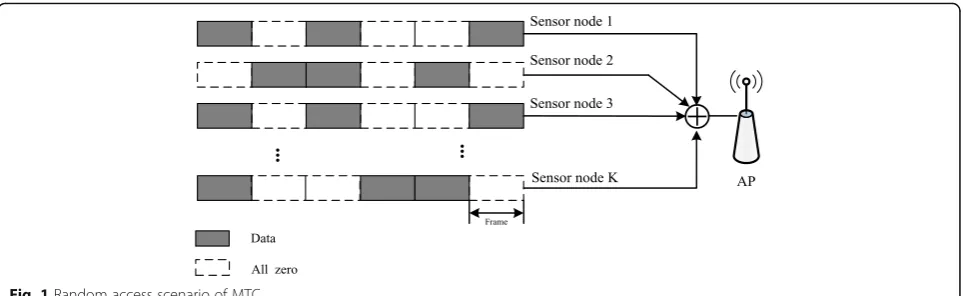
In this paper, we consider a random access MTC system that consists of one AP and K sensor nodes. Each sensor sends small packets independently to the AP with a certain low-active probability. We employ the proposed CS-based random access scheme to reconstruct the original signals at the AP. The proposed scheme reduces the signaling over-head and latency compared to the conventional LTE Fig. 1Random access scenario of MTC
random access scheme. Moreover, we utilize a unique spreading sequence to distinguish the sensor nodes. Thus, the sensor nodes can efficiently utilize the re-sources by transmitting the data on the same resource block. Furthermore, we divide the original problem into several sub-problems in order to reduce the computational complexity of the CS-based random access model.
2.1 CS method details
CS is an emerging theory based on the fact that the salient information of a signal can be recovered from much fewer samples than the requirements of the Nyquist rate. Accord-ing to CS theory, considerAccord-ing a real-valued discrete time signal z with a finite length N,z can be expressed on an orthonormal basis Ψ= [ψ1,ψ2,…,ψN] as
z¼XN
i¼1
αiψi¼Ψx ð1Þ
where x is the coefficient sequence of z, xi=〈z,ψi〉.
When onlyS of the coefficientsxiare nonzero, andS≪
N, the signal z is compressible and has a sparse
representation, calledS‐sparse, andxis the sparse repre-sentation ofz[16].
The sparse signal z can be a compact measurement under M×N (M<N) measurement matrix Φ, and the sampled vectorycan be expressed as
y¼Φz¼ΦΨx¼Ax ð2Þ
where A=ΦΨis called the sensing matrix. In general, be-causeM is less thanN, it is impossible to recoverxfromy in this underdetermined equation. However, ifxisS‐sparse and S<M, it can be recovered by the followingl1−norm minimization:
x¼ arg min
x k kx l1 s:t: y¼Ax ð3Þ
Several algorithms, which can exactly recover a sparse sig-nal with high probability, have been proposed to solve this convex problem, including matching pursuit (MP) [17], or-thogonal matching pursuit (OMP) [18], GOMP [19], and chaining pursuit (CP) [20]. OMP is an efficient iterative greedy algorithm that can recover the support set of a sparse signal by selecting the column most correlated with the current residuals in each iteration.
Fig. 3Block diagram of GOMP-LS
2.2 CS-based random access model
In this paper, we consider a frame-synchronized system with one AP andKsensor nodes. In this system, the AP is cap-able of sophisticated signal processing, while sensor nodes with a simple structure produce small packets occasionally and send them to the AP in the recent frame starting time, as shown in Fig. 1. We assume that each sensor node has data to send in a frame independently, with a certain prob-ability,pa, called the activity probability [21,22] (in practical
communications system, especially a massive MTC system, pa≪1).
We assume there areNcsymbols in a frame. The
trans-mitted signal of thekth (k= 1, 2, …, K) sensor node is xk¼ ½xð1kÞ; x
ðkÞ
2 ; …; x
ðkÞ
Nc∈ℜ
Nc1. xðkÞ
n is the nth(n= 1, 2, …, Nc) transmission symbol of the kth sensor node.
Furthermore, the inactive sensor nodes that do not have data to send seem that all the transmitting data are 0, while the active sensor nodes, which have data Fig. 5BER performance of GOMP and GOMP-LS algorithms varying group size
to send, transmit symbols from the discrete finite modulation alphabet Q. Therefore, on the receiver side, the detected symbols are from the augmented modulation alphabet, i.e., xðnkÞ⊂fQ∪0g.
In this random access system, all the sensor nodes trans-mit their data in the same time-frequency resource block. To identify all the sensor nodes, a unique spreading se-quence is assigned permanently to each sensor node. The spreading sequence for the kth sensor node is s(k)∈ℜM, where M is the spreading factor. After modulation and spreading, transmitted signals are distorted by the frequency-selective fading channel and are received by the AP. We assume that the channel, with lengthL, is invariable for a whole frame, and perfectly known by the receiver. Therefore, the ith received symbol at the AP can be expressed as
where Hk is the convolution matrix for the channel of
thekth sensor node, and
Hk¼
The received signal in one frame can be expressed as
y¼XK
is the spreading matrix of the kth sensor node, andnis
the additive white Gaussian noise.y¼ ½yT1; y2T; …; yTNc
∈ℜMNcis the received signal at the AP. For simplicity, Eq. (6) can be rewritten as
y¼Axþn ð8Þ
where x¼ ½xT
1; xT2; …; xTK∈ℜKNc is a stacked vector
containing all the symbols from all Ksensor nodes in one frame, and the measurement matrix of the transmitted sig-nal A¼ ½circðh1ÞSð1Þ; circðh2ÞSð2Þ; …; circðhKÞSðKÞ∈
ℜMNcKNc combines the influence of spreading matrixS(k)
and channel matrixHk.
By solving problem (8) withl1−norm minimization of (3) via the CS algorithm, the non-zero values, as well as their positions forx, are estimated [23]. The positions with non-zero values forxcorrespond to the indexes of the active sen-sor nodes. The non-zero values are the data transmitted by active sensor nodes.
In this system model,x is a sparse vector; that is, only a few elements ofxare non-zero because of the fact that the activity probability of each sensor node, pa, is much less than 1. On the receiver side, the sparse vectorxcan be esti-mated from the under-determined Eq. (8) via CS theory. Unfortunately, the computational complexity of CS algo-rithms keeps increasing exponentially with the length ofx. In Eq. (8), the length ofxisKNc, which is too large to esti-mate using the CS algorithm. Therefore, to decrease complexity, the original problem can be divided intoβ=Nc/ vsub-problems [24]. The number of consecutive transmis-sion symbols in each sub-problem is v, called the group size. The computational complexity increases with group size, but the performance of CS algorithms decreases simultan-eously. Each sub-problem uses the same measurement matrix,A′∈ℜMv ×Kv, which is the sub-matrix of the original measurement matrixA. To simplify the model, we neglect the inter-symbol interference (ISI) between adjacent sub-problems [25]. Theith (i = 1, 2, …, β) sub-problem of the original problem (8) can be expressed as
y0i¼A
Mv is composed of the
(v(i−1) + 1)th to (vi)th vectors ofy, andx0i¼ ½xT
3.1 Conventional GOMP algorithm procedure
In the CS-based random access system for MTC, the stacked vectorxcontains whole signals transmitted from all the sensor nodes. If a sensor node is inactive in a frame, it is seen as transmitting all zeros to the AP. Consequently, in the transmitted signalx, we need to estimate block sparse, because the symbols belonging to a single sensor node are all non-zero or zero in a frame. Exploiting the block sparsity ofx, Majumdar and Ward [26] proposed a low-complexity CS algorithm, GOMP, as shown in Algorithm 1. In GOMP, the indexes of the entire group containing the highest cor-relation to residual are selected (Step 2.2) in each iteration, instead of only one index with the highest correlations se-lected in OMP. In Algorithm 1, K is the total number of groups, andvis the number of elements in one group. The iteration stop criterion is decided by maximal iteration time Tand minimum residual coefficientζ.A:nis thenth column
ofA.AΓt is a sub-matrix ofAcontaining only the columns
ofAwith indexes inΓt. As mentioned before, in a CS-based random access system, to decrease the complexity, the com-plicated problem in Eq. (8) is divided into several sub-problems, as shown in Eq. (9). Each sub-problem,x0i, which contains a part of the elements in x, is also block sparse. Solving each sub-problem via GOMP, the signal transmitted by sensor nodes is estimated by the AP.
performance for high-reliability applications, as shown in Fig. 3. Similar to conventional GOMP for CS-based random access, on the receiver side, the problem is divided into several sub-problems, and each sub-problem is solved by GOMP. After these processes, the support sets of all the sub-problems are combined using equal gain combining (EGC) in order to get the support set with maximum likelihood. Since x is sparse, according to CS theory, when the support set of x is known, the value of non-zero elements in x can be estimated using LS estimation.
3.3 Proposed WIGOMP algorithm procedure for low-latency applications
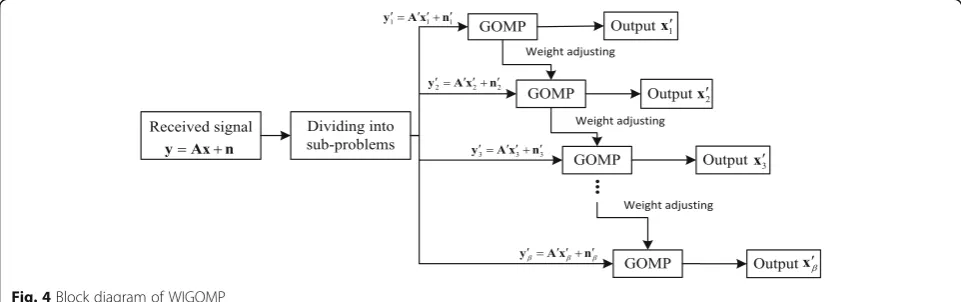
In GOMP-LS, we combine the support set of all the sub-problems to improve link performance, but add-itional latency is simultaneously introduced. To sat-isfy the requirements of low-latency applications in the next-generation mobile communications, WIGOMP, another improved GOMP algorithm is proposed, as shown in Fig. 4. In this algorithm, link performance is improved by adjusting weight with-out introducing additional latency. The solution can be directly output, once the sub-problem is solved, and there is no need to wait until all the sub-problems are solved, as with GOMP-LS. The pos-ition of the non-zero elements in the previous sub-problems can be employed to improve estimation accuracy for posterior sub-problems. Therefore, a critical signal can be transmitted in the posterior symbols in a frame, because the incorrect estimation probability of the symbols in the posterior sub-problems is smaller.
The pseudo code of WIGOMP is shown in Algo-rithm 3, where wi is the weight vector in the ith it-eration, and wij is the jth element in wi. All the weights are initialized to 1 in Step 1. Because of the iterations, to restrain the influence of errors occur-ring previously, in Step 2.2, we keep the weights in the previous (Ithr−1) sub-problems equal to 1. From the Ithrth sub-problem, the weights in the ith sub-problem are adjusted by the sum of the 2-norm of solutions in the previous (i−1) sub-problems.
3.4 Proposed low-complexity WIGOMP-ICF algorithm procedure
In OMP and its extending algorithms, including GOMP and WIGOMP, the computational complexity grows expo-nentially with the number of non-zero elements in the sparse solution. To solve this problem by avoiding matrix versions, efficient implementations of OMP based on in-verse Cholesky factorization are proposed [27]. Therefore, based on WIGOMP, a low-complexity algorithm called WIGOMP-ICF is proposed by employing inverse Cholesky factorization, as shown in Algorithm 4.
To calculateðA0Γt H
A0ΓtÞ −1
in Step. 2.3.4 of Algorithm 3, we
assume GΓt ¼A0ΓtHA 0
Γt. The inverse Cholesky factor GΓt is Ft, which satisfies
FtFtH¼GΓt‐1¼ A0Γt
H A0Γt
−1
ð10Þ
4 Performance evaluation of proposed CS-based random access model
In this section, we describe the simulation results of the performance of the proposed three algorithms. To evaluate the link performance of the proposed algorithms, Monte Carlo simulations with different parameters are performed. We consider scenarios with K= 128 sensor nodes. In a frame, there are Nc= 120 symbols, with binary phase shift keying
(BPSK) modulation and spread via pseudo-noise (PN) sequence with length M= 32.
4.1 Simulation results and discussion
4.1.1 Link performance evaluation
Figure 5 shows the BER performance of GOMP and GOMP-LS algorithms under various group sizes, v, with activity probability pa= 0.02. First, in both
GOMP and GOMP-LS, BER is decreasing while group size v is increasing, which is due to the ex-ploitation of block sparsity. When Eb/N0= 16, the
BER of GOMP decreases from 2.2 × 10⁻⁴ to 3 × 10⁻⁵, with group sizes increasing from 2 to 8. Compared with GOMP, GOMP-LS obviously achieves better BER performance. Even the BER of GOMP-LS with v= 2 is lower than the BER of GOMP with v= 8;
i.e., to meet the same BER requirements, we can use GOMP-LS with a smaller group size, instead of GOMP with a larger group size, to decrease the computational complexity. In addition, we note that when the group size is decreased from 8 to 2, the BER increase in GOMP is much larger than in GOMP-LS. Since in GOMP-LS, we consider the re-lationship between each sub-problem that when the group size is smaller, the number of sub-problems is larger, which introduces more sub-problem diversity gain in GOMP-LS. In addition, we compare the BER performance of the proposed algorithms with GOMP when group size v equals to 8.
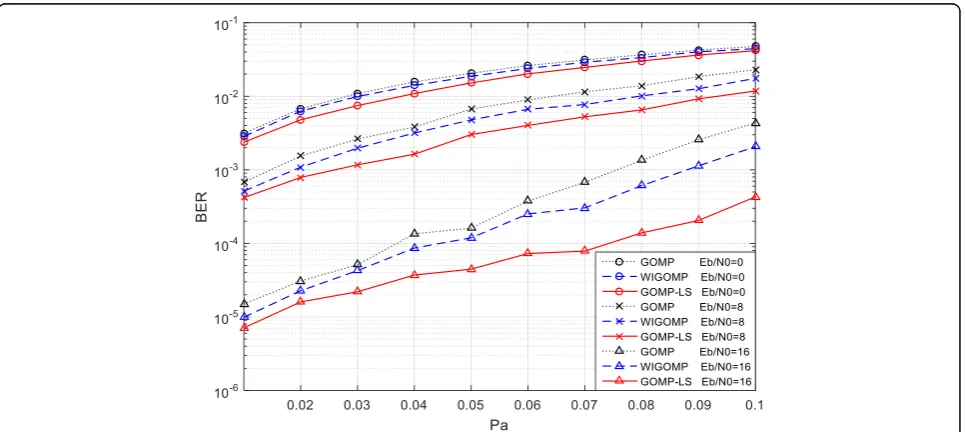
Figure 6 shows the performance of GOMP-LS is the best, since it exploits the relationship between sub-problems and gets more diversity gain, which greatly de-creases the BER. The performance of WIGOMP is better than GOMP, because the diversity gain is achieved in the posterior sub-problem by introducing the weights of each user according to the solution of the previous sub-problem. The performance of WIGOMP is worse than GOMP-LS, because it can only improve the BER per-formance of posterior sub-problems, whereas, in GOMP-LS, the performance of all the sub-problems is improved. When Eb/N0= 16 and pa= 0.04, the BER of
Fig. 7Number of symbols per frame versus latency
Table 1Comparison of computational complexity and latency
GOMP, WIGOMP, and GOMP-LS is 1.6 × 10⁻⁴, 9 × 10⁻⁵, and 4 × 10⁻⁵, respectively. Moreover, it is noted that there is more gain for BER performance using GOMP-LS or WIGOMP instead of GOMP when Eb/N0 be-comes high. Under the condition of high Eb/N0, the number of error data becomes small, so it is easier to correct error bits by EGC or weighted iteration. Because WIGOMP-ICF only decreases the complex-ity of WIGOMP by avoiding the matrix inverse, the BER performance of WIGOMP-ICF, which is the same as WIGOMP, is not shown here.
4.1.2 Latency and complexity performance evaluation
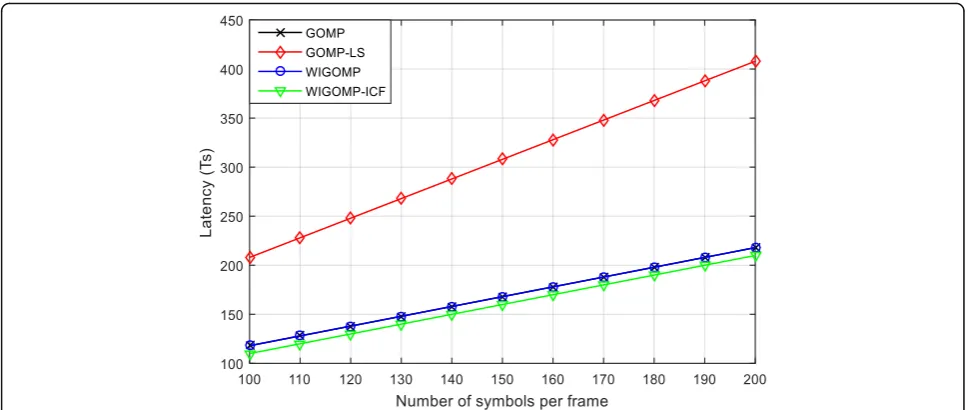
In Fig.7, the latencies varying frame lengths of the pro-posed algorithms are shown. Latency linearly increases with an increase in the number of symbols per frame. The latency of GOMP and GOMP-LS is almost the same, and the latency of WIGOMP-ICF is 7% lower than GOMP. The latency of GOMP-LS is almost twice that of the other algorithms.
In Table 1, we compare the computational complexity and latency of GOMP and the proposed algorithms. The computational complexity is the number of complex
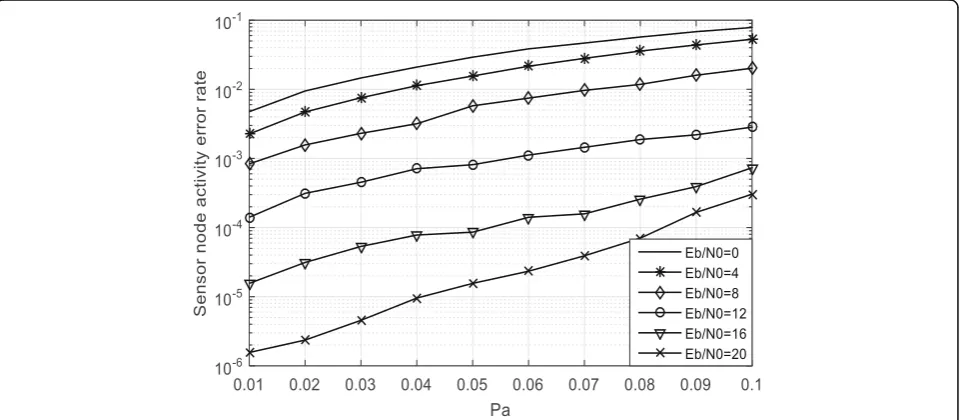
Fig. 9Activity probability versus sensor node activity error rate withv= 8
ð Þ
Figure 8 shows the computational complexity varying the activity probability of the four algorithms in Table1. The value of the parameters in Table 1 are as follows: number of sensor nodesK= 128, spreading factorM= 32, number of symbols per frame Nc= 120, group size v= 8,
and the number of sub-problemsβ=Nc/v= 15. The
com-putational complexity of GOMP and WIGOMP are al-most the same, which is larger than WIGOMP-ICF and smaller than GOMP-LS. With the increasing activity probability, the computational complexity of WIGOMP-ICF is almost invariable, whereas the computational com-plexity of other algorithms increases exponentially, espe-cially GOMP-LS. When pa= 0.04, the computational
complexity of GOMP is around five times that of WIGOMP-ICF, and the computational complexity of GOMP-LS is around eight times of WIGOMP-ICF’s. To compare the latency of the proposed algorithms with GOMP, we assume the processing time for various com-putational complexities areT0= 10Ts,T1= 16Ts,T2= 10Ts,
and T3= 2Ts.
4.1.3 Activity error rate performance evaluation
Figure9shows the sensor node activity error rate with a varying activity probability for group size v= 8. In CS-based random access, both the activity of the sensor nodes and the transmitted data are detected on the re-ceiver side. The sensor node activity error rate decreases while Eb/N0is increasing. Sensor node activity error
cludes a case where an active node is detected as in-active, and vice versa. Moreover, the high-activity probability results in more detection errors. In terms of CS theory, the high-activity probability corresponds to the overall high sparsity, and the sparsity is destroyed gradually with the activity probability increasing, which leads to performance degradation in CS algorithms. At Eb/N0= 12, the sensor node activity error rate increases
from 1.5 × 10⁻⁴ to 2 × 10⁻³when activity probability in-creases from 0.01 to 0.1.
5 Conclusions
In this paper, we employ CS-based random access scheme with unique identification sequences for MTC
plications. To achieve relatively high reliability without increasing latency, WIGOMP is proposed. While keep-ing the same computational complexity and latency as GOMP, under the same conditions mentioned above, the BER of WIGOMP decreases to 9 × 10⁻⁵, which is better than GOMP, but worse than GOMP-LS. More-over, WIGOMP-ICF, which has the same BER perform-ance as WIGOMP, is proposed, combining WIGOMP with matrix decomposition, and the latency of this algo-rithm is 7% lower than GOMP. Hence, WIGOMP is more suitable for low latency applications. In addition, we analyze the sensor node activity performance of the proposed CS-based random access scheme which results in better activity error rate.
Abbreviation
AP:Access point; BER: Bit error rate; BPSK: Binary phase shift keying; CP: Chaining pursuit; CS: Compressive sensing; EGC: Equal gain combining; GOMP: Group orthogonal matching pursuit; GOMP-ICF: Group orthogonal matching pursuit with inverse Cholesky factorization; GOMP-LS: Group orthogonal matching pursuit least square; IoT: Internet of things; LTE: Long - term evolution; MP: Matching pursuit; MTC: Machine type communication; MUD: Multi-user detection; OMP: Orthogonal matching pursuit; PN: Pseudo -noise; QoS: Quality of service; WIGOMP: Weighted iteration group orthogonal matching pursuit
Acknowledgements
This research was supported by the MSIT (Ministry of Science, ICT), Korea, under the ITRC (Information Technology Research Center) support program (IITP-2019-2014-1-00729) supervised by the IITP (Institute of Information & communications Technology Planning & Evaluation).
Authors’contributions
simulation methodology of this manuscript and also corrected all the mistakes in the simulation environment as well as in the structure of overall manuscript. All authors read and approved the final manuscript.
Funding
This research was supported by the MSIT (Ministry of Science, ICT), Korea, under the ITRC (Information Technology Research Center) support program (IITP-2019-2014-1-00729) supervised by the IITP (Institute for Information and Communications Technology Promotion).
Availability of data and materials Not applicable
Competing interests
The authors declare that they have no competing interests.
Received: 17 September 2016 Accepted: 4 July 2019
References
1. M. Hasan, E. Hossain, D. Niyato, Random access for machine-to-machine communication in LTE-advanced networks: issues and approaches.IEEE Communications Magazine.51(6), 86–93 (2013)
2. KD Lee, S Kim, B Yi, Throughput comparison of random access methods for M2M service over LTE networks, in Proc. of IEEE Globecom Workshops, (Houston, TX, Dec. 2011), pp. 373–377.
3. D. Niyato, P. Wang, D.I. Kim, Performance modeling and analysis of heterogeneous machine type communications.IEEE Transactions on Wireless Communications.13(1), 2836–2849 (2014)
4. S.Y. Lien, K.C. Chen, Y. Lin, Toward ubiquitous massive accesses in 3GPP machine-to-machine communications.IEEE Communications Magazine.49(4), 66–74 (2011) 5. K Au, L Zhang, P Zhu, Uplink contention based SCMA for 5G radio access, in
Proc. of IEEE Globecom Workshops, (Austin, TX, Dec. 2014), pp. 900-905. 6. A. Laya, L. Alonso, J.A. Zarate, Is the random access channel of LTE and
LTE-A suitable for M2M communications? LTE-A survey of alternatives.IEEE Communications Surveys & Tutorials.16(1), 4–16 (2014)
7. G.P. Fettweis, The tactile internet: Applications and challenges.IEEE Vehicular Technology Magazine.9(1), 64–70 (2014)
8. C. Bockelmann, H.F. Schepker, Compressive sensing based multi-user detection for machine-to-machine communication.Transaction on Emerging Telecommunications Technologies.24(44), 384–400 (2013)
9. F Monsees, M Woltering, C Bockelmann, A Dekorsy, Compressive sensing multi-user detection for multicarrier systems in sporadic machine type communication, in Proc. of IEEE 81st Vehicular Technology Conference (VTC Spring), (Glasgow, UK, May 2015), pp. 1-5.
10. D.L. Donoho, Compressed sensing.IEEE Transactions on Information Theory. 52(4), 1289–1306 (2006)
11. E.J. Candes, M.B. Wakin, An introduction to compressive sampling.IEEE Signal Processing Magazine.25(2), 21–30 (2008)
12. AT Abebe, CG Kang, Compressive sensing-based random access with multiple-sequence spreading for MTC, in Proc. of IEEE Globecom Workshops, (San Diego, CA, Dec. 2015), pp. 1-6.
13. H.F. Schepker, C. Bockelmann, A. Dekorsy, Efficient detectors for joint compressed sensing detection and channel decoding.IEEE Transactions on Communications.63(6), 2249–2260 (2015)
14. HF Schepker, C Bockelmann, Coping with CDMA asynchronicity in compressive sensing multi-user detection, in Proc. of IEEE 77th Vehicular Technology Conference, (Dresden,German, Jun. 2013), pp. 1-5. 15. HF Schepker, A Dekorsy, Compressive sensing multi-user detection with
block-wise orthogonal least squares, in Proc. of IEEE 75th Vehicular Technology Conference, (Yokohama, Japan, May 2012), pp. 1-5. 16. HF Schepker, Sparse multi-user detection for CDMA transmission using
greedy algorithms, in Proc. of 8th International Symposium on Wireless Communication Systems, (Aachen, German, Nov. 2011), pp. 291-295. 17. S.G. Mallat, Z. Zhang, Matching pursuits with time-frequency dictionaries.
IEEE Transactions on Signal Processing.41(12), 3397–3415 (1993) 18. J.A. Tropp, A.C. Gilbert, Signal recovery from random measurements via
orthogonal matching pursuit.IEEE Transactions on Information Theory. 53(12), 4655–4666 (2007)
19. X Wang, Z Zhao, N Zhao, H Zhang, On the application of compressed sensing in communication networks, in Proc. of 5th International ICST
Conference on Communications and Networking in China (CHINACOM), (Beijing, China, Aug. 2010), pp. 1-7.
20. MA Khajehnejad, J Yoo, A Anandkumar, B Hassibi, Summary based structures with improved sublinear recovery for compressed sensing, in Proc. of IEEE International Symposium on Information Theory Proceedings (ISIT), (St. Petersburg, Russia, Aug. 2011), pp. 1427-1431.
21. Y Beyene, C Boyd, K Ruttik, C Bockelmann, R Jäntti, Compressive sensing for MTC in new LTE uplink multi-user random access channel, in Proc. of IEEE International Conference on Green Innovation For African Renaissance (AFRICON), (Addis Ababa, Abyssinia, Sept. 2015), pp. 1-5.
22. J Liu, HY Cheng, CC Liao, AYA Wu, Scalable compressive sensing-based multi-user detection scheme for Internet-of-Things applications, in Proc. of IEEE Workshop on Signal Processing Systems (SiPS), (Hangzhou, China, Oct. 2015), pp. 1-6.
23. H. Zhu, G.B. Giannakis, Exploiting sparse user activity in multiuser detection.
IEEE Transactions on Communications.59(2), 454–465 (2011)
24. A.T. Abebe, C.G. Kang, Iterative order recursive least square estimation for exploiting frame-wise sparsity in compressive sensing-based MTC.IEEE Communications Letters.20(5), 1018–1021 (2016)
25. Y Ji, C Bockelmann, A Dekorsy, Compressed sensing based multi-user detection with modified sphere detection in machine-to-machine communications, inProc. of 10th International ITG Conference on Systems, Communications and Coding, (Hamburg, Germany, Feb. 2015), pp. 1-6. 26. A. Majumdar, R.K. Ward, Fast group sparse classification.Canadian Journal of
Electrical and Computer Engineering.34(4), 136–144 (2009) 27. H Zhu, G Yang, W Chen, Efficient Implementations of Orthogonal
Matching Pursuit Based on Inverse Cholesky Factorization, inProc. of IEEE 78th Vehicular Technology Conference (VTC Fall), (Las Vegas, NV, Sept. 2013), pp. 1-5.
28. H. Zhu, W. Chen, B. Li, F. Gao, An improved square-root algorithm for V-BLAST based on efficient inverse Cholesky factorization.IEEE Transactions on Wireless Communications.10(1), 43–48 (2011)
6 Publisher’s Note