Simulation of gigantic jets propagating from the top of thunderclouds
to the ionosphere
Lizhu Tong1, Kenichi Nanbu1, and Hiroshi Fukunishi2
1Institute of Fluid Science, Tohoku University, Sendai 980-8577, Japan 2Department of Geophysics, Tohoku University, Sendai 980-8578, Japan
(Received November 12, 2004; Revised May 12, 2005; Accepted May 12, 2005)
A randomly stepped leader propagation model is developed to study gigantic jets, a new type of lightning, connecting thunderclouds to the ionosphere. The thundercloud is considered as one electrode igniting gigantic jets and the ionosphere is assumed as the other. The propagation of stepped leader is considered as a field controlled random growth process. The electric field is produced due to the thundercloud charges and the self-consistently propagating leader. A leader propagation probability is proposed to determine whether the leader grows at the next step and what the step direction of the leader is in case of growth. The results show that leader propagation spans∼72 km from igniting position to the ionosphere. The simulation of leader propagation appears to be in agreement with the structure of observed gigantic jets.
Key words:Lightning, gigantic jet, leader modeling, thundercloud, ionosphere.
1.
Introduction
The breakdown of air in long gaps, e.g., several tens of meters, occurs via a growth of a leader from one elec-trode to the other with a high electrical conductivity (Raizer, 1991). One of the most important features of lightning dis-charge consists of the random behavior of its trajectory, which is the behavior of leader discharge (Uman, 2001). Niemeyeret al.(1984) have proposed that discharge pat-terns have fractal dimension. On the basis of this concept, many investigators have developed the fractal models to study streamer and leader discharges in gaseous dielectrics, cloud-to-ground (CG) lightning, lightning above thunder-clouds, and so on (e.g., Niemeyeret al., 1989; Femiaet al., 1993; Paskoet al., 2000, 2001; Pasko and George, 2002; Petrov and Petrova, 1993, 1999; Petrovet al., 2003; Tong et al., 2005). Pasko and George (2002) have developed a streamer model to study blue jets and blue starters which are considered as positive streamer coronas expanding from the streamer zones of conventional lightning leaders. Petrov and Petrova (1993, 1999) and Petrovet al.(2003) have pro-posed a leader model to study intra-cloud, cloud-to-ground (CG), and cloud-to-ionosphere (CI) lightning discharges. In the study of CI discharges, they used a simplified spherical thundercloud charge to calculate the electric field generated by a thundercloud.
Gigantic jet is a new type of lightning between the thun-dercloud and the ionosphere (Suet al., 2003). It is a rare discharge phenomenon because the conditions igniting such a giant discharge are not easy to be satisfied, but it is of in-terest to theoretically study discharge characteristics of gi-gantic jets. Based on observational data, Suet al. (2003)
Copy right cThe Society of Geomagnetism and Earth, Planetary and Space Sci-ences (SGEPSS); The Seismological Society of Japan; The Volcanological Society of Japan; The Geodetic Society of Japan; The Japanese Society for Planetary Sci-ences; TERRAPUB.
suggested that gigantic jets might be negative cloud-to-ionosphere (NCI) discharges. In a preceding paper (Tong et al., 2004a, hereafter referred to as R1), the initiation of gigantic jets has been analyzed and regarded as negative streamers. This is different from the previous assumption of blue jets which are considered initiated by positive stream-ers. Research (Pasko and George, 2002) on blue jets have also shown that the simulation results from the fractal model based on negative streamers are not consistent with observa-tions. In the present work it is assumed that the propagation of gigantic jet is a leader discharge process.
In the present work, the thundercloud is considered as one electrode igniting gigantic jets and the ionosphere is assumed as the other. Lightning formation is described by a random growth of leader discharge channels, which is de-termined by the electrostatic field produced due to thun-dercloud charges and leader discharge channels. A leader propagation probability is proposed to determine whether the leader grows at next step and what the step direction of the leader is in case of growth. The results yield a three-dimensional overall picture of leader propagation, which appears to be in agreement with the structure of observed gigantic jets.
2.
Leader Mechanism of Gigantic Jets
2.1 Critical field for a leader
Extensive experimental data have been acquired in lab-oratory situations to support the electrical nature of the formation and development of a leader discharge (Raizer, 1991). The physical processes underlying leader break-down consist of igniting electrons, leading an avalanche to streamer corona criterion, and evolving streamer corona to leader channel. The formation and development of streamer corona is a part of the leader process. The electric field for ionization threshold can be estimated byEk=E0·(N/N0),
whereE0=3.14×10⁶V·m−1,N0=2.688×1025m−3, and
N is the neutral atmospheric density (Raizeret al., 1998), taken from US Standard Atmosphere (1976). It should, however, be noted that the field Ek is required to ignite a
streamer discharge or an avalanche-streamer transition but not for streamer propagation. Research in R1 has indi-cated that gigantic jets are initiated by negative streamers. The streamer corona is known that in spite of its internal structural complexity involving multiple highly branched streamer channels, its macroscopic characteristics remain relatively stable under a variety of external conditions. The minimum field –Ec required for propagation of negative
streamers in air at atmospheric pressure is∼–12.5 kV/cm (Babaeva and Naidis, 1997), which is regarded as a crite-rion to sustain the propagation of a streamer in the present work.
It is known that the leader process itself is quite com-plex, and its initiation mechanism and internal physics are not yet fully understood (e.g., Uman, 2001; Raizer 1991). In the present work, we accept the perspective of Petrov and Petrova (1993, 1999) and Petrov et al. (2003). The critical field E* governing a leader in air is considered to be equal to the field over the streamer zone in the leader. This can be deduced by such a fact that the development of a streamer discharge precedes the formation of a leader. The condition for a streamer-leader transition can be satis-fied if the electric field over the length of the streamer zone in a leader exceeds the critical value (Petrov and Petrova, 1999). Since the electric field decreasing with upper dis-tance from the thundercloud is lower than the exponential decrease of the pressure with height, the condition for a streamer-leader transition can be substantially satisfied to ignite an upper lightning discharge. Thus, the critical field for a leader is estimated by the minimum electric field re-quired for streamer propagation (e.g., Petrov and Petrova, 1999; Petrovet al., 2003), i.e.,E* =Ecin this work, which
can be simply scaled with height proportionally to the neu-tral atmospheric density (e.g., Pasko and George, 2002). It is assumed that as soon as the electric field around leader tip reaches theE* field, the leader process is developed. The complex process of streamer-to-leader transition is omitted in the present model. The transition from an avalanche to streamer corona refers to R1.
2.2 Electric field in leader channel
We note that the electric field in leader channel cannot be simply scaled with height proportionally to the neutral atmospheric density due to its high electrical conductiv-ity. In stepped leaders, a leader channel is formed from the strongest streamer in the corona at leader tip by a com-plicated transition process which involves heating and ion-ization of gas. It is well known that a streamer corona is formed when the field of the space charge increases to the level of the external field, which will occur when a critical number of electrons,Ne∼108-109at atmospheric pressure
(Raizer, 1991, p. 336; Bazelyan and Raizer, 1998, p. 77), is produced in an avalanche. The critical condition can also be represented by an empirical relation (Raizer, 1991, p. 336)
αx≈20, (1)
k
j
leader tip
i
l
m
leader step
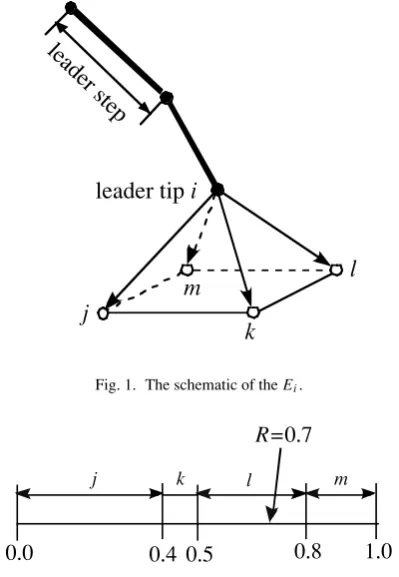
Fig. 1. The schematic of theEi.
0.0
0.4
0.5
0.8
1.0
j k l m
R=
0.7
Fig. 2. The method to sample a growth point for leader propagation.
wherex is the length of streamer corona andαis the ion-ization coefficient which can be given by another empirical formula (Raizer, 1991, p. 57)
α/p=1.17×10−4(E/p−32.2)2cm−1·Torr−1 for E/p≈44−176V·cm−1·Torr−1, (2)
where p is the gas pressure. Once E/p is given, e.g., in the case of the critical situations to form a streamer corona, we haveα ∼pfrom Eq. (2). It is known that the change in density with height is approximately exponen-tial, i.e., N(z) = N(0)e−γz, where γ (=1.25×10⁻⁴)is the scaling parameter and z is the height above sea level in meters (Petrov and Petrova, 1999). By Eq. (1), the streamer corona(x)under the critical situations becomes longer whenαreduces with the decrease of pressure with height, i.e.,x∼α−1. The leader length is, however, longer than streamer zone for long leaders. Bazelyan and Raizer (1998) showed some examples of long leaders, e.g., a leader with the length of 11.4 m consists of streamer zone of 3.6 m. Thus, in the present work we consider the lengthL of leader channel by L(z) = L(0)ec·γz, where c is the
pa-rameter that characterizes the variation of leader channel, which is determined by the electric field in leader chan-nel discussed below. It is assumed that the change of the electric field in leader channel with leader length is linear for long leaders, i.e., linearly decreasing as the increase of leader length, such as the experimental data shown in Table 6.1 of Bazelyan and Raizer (1998). Thus, we have El(z)=El(0)[L(0)/L(z)] =El(0)e−c·γz. Assigningβ= cγ,
we obtainEl(z) = El(0)e−βz, whereEl(0) =∼1 kV/cm
thunder-0 0.5 1 1.5 2 2.5
E(
k
V
/c
m
)
-50 -25 0 25
50 r (k
m)
0 20
40 60
80
z (km)
(a)
(b)
Fig. 3. Electric field distribution at the time that the ionization threshold is reached. (a) Electric field onr−zplane, and (b) Electric field on the axis (r= 0).
clouds is consistent with those obtained from the research of intracloud lightning discharges, e.g., Petrov and Petrova (1993). In the present research,cis set 0.8, which corre-sponds to the electric field 0.2 kV/cm in the leader chan-nel in intra-cloud lightning discharges (Petrov and Petrova, 1993). As described above, we propose the method estimat-ing the electric field in leader channel from experimental data obtained in laboratory situations. The estimated field is used to replace the electric field in streamer channel for the original fractal model of Niemeyer et al.(1984). Al-though the extrapolation exists somewhat risky, to our best knowledge, it is a reasonable compromise of the lack of ac-tual measurements of the electric field in gigantic jets.
3.
Leader Model
The propagation of the lightning can be considered as a field controlled random growth process, which is a dis-crete process (Petrov and Petrova, 1999). We schematize the leader propagation as a sequence of connections be-tween the points of a spatial Cartesian lattice. The solution of electric field is divided into two stages: one is for the ac-cumulation of the thundercloud charge and the other is for the propagation of the leader. The former is calculated until the arrival of ionization threshold. The point at which field value reaches ionization threshold is considered as the ignit-ing point of a leader. The potential of this ignitignit-ing point is then fixed and the discharge is propagated by adding addi-tional links. The continuity equation on the basis of charge conservation law is (Tonget al., 2004b)
∂ρ
∂t + ∇σ·E+ρσ/0=0, (3) whereρis the charge density,σis the conductivity, andtis the time.Eis electrostatic field governed by
∇ ·E=(ρ+ρs)/0, (4)
0 20 40 60 80
H
e
ight
(km)
-50 0 50
x (k
m)
0 -5050
y (
km
)
Fig. 4. Leader discharge under the condition that the critical field is reached.
whereρsis the thundercloud source charge density, i.e.ρs
=ρ−, such as that in R1. We consider the electrostatic field at this stage to be axisymmetrical. In the cylindrical coordi-nate system (r,z), the charge densityρ−(r,z,t)is assumed to be a Gaussian spatial distribution given byρ−(r,z,t)=
ρ(t)e−[(z−z−)2+r2]/a2
, where z− is the mean height of neg-ative thundercloud charges and ρ(t)is the charge density corresponding to Q(t) = Q0[tanh(t/τ) /tanh(1)], where
du-0 20 40 60 80
H
eight
(km)
-50 0 50
x (km)
0 -5050
y (
km
)
(a)
(b)
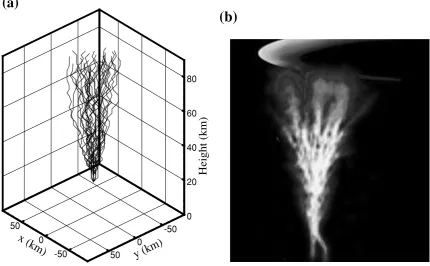
Fig. 5. Leader propagation between thundercloud and the ionosphere. (a) The simulation result based on the present model. (b) Image of a gigantic jet.
ration for the accumulation of thundercloud charge. The de-tailed discussion related to the charge distribution of thun-dercloud has been reported in R1. In this work, we setz−
= 16 km anda = 2 km. Before the ionization threshold is reached, electron conductivity below 60 km height is low. Therefore the total conductivityσ is dominated by ion con-ductivity, taken byσ = 5×10⁻¹⁴ez/6 kmS/m
(Dejnakarin-tra and Park, 1974). The ordinary finite difference method (Potter, 1973) is used to solve Eq. (3). The Fourier trans-form method and Thomas algorithm (Hockney and East-wood, 1988) are used to solve Eq. (4).
From the start of the ignition of the leader we solve three-dimensional electrostatic field to satisfy random spa-tial trajectories of leader propagation. The equation gov-erning three-dimensional electrostatic field is Laplace equa-tion. The field consists of moving boundaries, following leader propagation, which is determined at each growth step of the leader. A three-dimensional isoparametric finite ele-ment method (Kagawa, 1994) is used to solve the Laplace equation. At every growth step, a new grid point is linked with the leader channel, which is regarded as an imposed boundary for the recalculation of the electrostatic field. The grid points located in leader channels are assumed to re-tain the potential which they have acquired until the end of the simulation. The potential drop along leader chan-nels is determined by the electric fieldElof leader channel.
Next growth point of the leader is randomly chosen from the neighboring points around the leader tip. We parame-terize the probability pi for the formation of a leader step
as
pi =Ei−E∗η/ K
i=1
Ei−E∗η,
(5)
whereE* is the critical field for a leader, i.e., E* =Ecin
this work, K is the total number of the neighboring points around the leader tip, andEi is the average field along the
growth direction of the leader.
As seen in Fig. 1, theEi between the pointsi and j is
calculated by Ei = (Ui −Uj)/d, whereUi andUj are
the potentials at the pointsi and j, andd is the distance betweeni and j. We assumeη=1, following the previous research (Niemeyeret al., 1984; Paskoet al., 2000). Thus,
we have
K
i=1
pi =1 for K
i=1
|Ei−E∗| >0. It is presumed
that at each leader step only one point from the neighboring points around the leader tip can become the growth point of the leader. A uniform random number R between 0 and 1 is introduced to choose the growth point (Tong et al., 1998, 2005). As shown in Fig. 1, if there are four possible growth points at the leader tipi, i.e., points j,k, l,m, their relative bond direction probabilities are 0.4, 0.1, 0.3, 0.2, andR=0.7, as shown in Fig. 2, the pointlwill be considered as next leader growth point. The growth of the leader stops self-consistently when all probabilities become zero.
Since the electric fieldEl(= ∼1 kV/cm at atmospheric
pressure) in leader channel is an order of magnitude lower than the critical field E* (=∼12.5 kV/m). The potential at leader tip sustains a relative higher value by Uk+1 =
Uk −El ·lk, whereUk is the potential at leader tip, lk is
4.
Results and Discussion
We calculate the quasi-electrostatic field during the accu-mulation of thundercloud charge on the basis of the solu-tion of Eqs. (3) and (4). Figure 3 shows the distribusolu-tion of the electric field at the time that the ionization threshold is reached. The thundercloud charge required to reach the ion-ization threshold is 203.57 C. The electric field generated by thundercloud charges just exceeds the critical field Ek
for ionization, which is much larger than the critical field E*(=Ec)for a leader, as shown in Fig. 3(b).
The simulation of leader propagation starts from the time that the ionization threshold is reached. Because the field produced by thundercloud charges is larger than the criti-cal fieldE*(=Ec)for a leader, a leader discharge starts to
propagate upwards from the position of ionization threshold around the top of thundercloud. The calculation shows that most of the leader discharges terminate below the height of∼40 km, as seen in Fig. 4. Only a few of them propa-gate over the height and arrive at the ionosphere. Once the leader starts its propagation, the charges will be transported upwards. The accumulation of thundercloud charge can be suppressed not enough to support the leader discharge reaching at the ionosphere. In the present work we use a simple charge distribution of thundercloud in consideration of the effect of the intracloud (IC) discharge or the positive cloud to ground (+CG) discharge. Under the situation the accumulation of thundercloud charge could be maintained. Figure 5(a) gives the calculated result when the thunder-cloud charge is accumulated up to be 300 C. The prevail-ing leader discharges span the long distance (= ∼72 km) from the igniting position around the top of thundercloud to the ionosphere. The leader propagation appears a three-dimensional overall picture in agreement with the observed gigantic jets, as shown in Fig. 5(b).
5.
Conclusion
We develop a randomly stepped leader propagation model to study gigantic jets connecting thunderclouds to the ionosphere. The critical field for a leader and the electric field in leader channel in upper atmosphere are estimated on the basis of experimental data in laboratory situations to compensate for the lack of the measurements. A leader propagation probability is introduced to determine if the leader grows at next step and what the step direction of the leader is in case of growth. The results show that the leader propagation can span∼72 km from igniting position to the ionosphere. The simulation presents a three-dimensional overall picture of leader propagation, which appears to be in agreement with the structure of observed gigantic jets.
Acknowledgments. The vector computer SX5 at the Institute of Fluid Science of Tohoku University is used in the present simula-tion. We would like to express our gratitude to Mr. Jean-Claude V´erit´e ofElectricit´e de Francefor helpful discussion for this re-search.
References
Babaeva, N. Yu. and G. V. Naidis, Dynamics of positive and negative streamers in air in weak uniform electric fields,IEEE Trans. Plasma Sci.,25, 375–379, 1997.
Bazelyan, E. M. and Yu. P. Raizer,Spark Discharge, CRC Press, Florida, 1998.
Dejnakarintra, M. and C. G. Park, Lightning-induced electric fields in the ionosphere,J. Geophys. Res.,79, 1903–1910, 1974.
Femia, N., L. Niemeyer, and V. Tucci, Fractal characteristics of electrical discharges: experiments and simulation,J. Phys. D: Appl. Phys.,26, 619–627, 1993.
Hockney, R. W. and J. W. Eastwood,Computer Simulation using Particles, IOP Publishing Ltd, Bristol, 1988.
Kagawa, Y.,FEM Program 1, Morikita Shuppan Co., Tokyo, 1994 (in Japanese).
Niemeyer, L., L. Pietronero, and H. J. Wiesmann, Fractal dimension of dielectric breakdown,Phys. Rev. Lett.,52, 1033–1036, 1984. Niemeyer, L., L. Ullrich, and N. Wiegart, The mechanism of leader
break-down in electronegative gases,IEEE Tran. Electr. Insul.,24, 309–324, 1989.
Pasko, V. P., U. S. Inan, and T. F. Bell, Fractal structure of sprites,Geophys. Res. Lett.,27, 497–500, 2000.
Pasko, V. P., U. S. Inan, and T. F. Bell, Mesosphere-troposphere coupling due to sprites,Geophys. Res. Lett.,28, 3821–3824, 2001.
Pasko, V. P. and J. J. George, Three-dimensional modeling of blue jet and blue starters,J. Geophys. Res.,107, 1458, doi:1029/2002JA009473, 2002.
Petrov, N. I. and G. N. Petrova, Physical mechanisms for intra-cloud light-ning discharges,Tech. Phys.,38,287–290, 1993.
Petrov, N. I. and G. N. Petrova, Physical mechanisms for the development of lightning discharges between a thundercloud and the ionosphere,
Tech. Phys.,44, 472–475, 1999.
Petrov, N. I., G. N. Petrova, and F. D’Alessandro, Quantification of the probability of lightning strikes to structures using a fractal approach,
IEEE Trans. Diele. Electr. Insul.,10, 641–654, 2003. Potter, D.,Computational Physics, John Wiley, New York, 1973. Raizer, Yu. P.,Gas Discharge Physics, Springer-Verlag, Heidelberg, 1991. Raizer, Yu. P., G. M. Milikh, M. N. Shneider, and S. V. Novakovski, Long streamers in the upper atmposphere above thundercloud,J. Phys. D: Appl. Phys.,31, 3255–3264, 1998.
Rowland, H. L., Theories and simulations of elves, sprites and blue jets,J. Atmos. Terr. Phys.,60, 831–844, 1998.
Su, H. T., R. R. Hsu, A. B. Chen, Y. C. Wang, W. S. Hsiao, W. C. Lai, L. C. Lee, M. Sato, and H. Fukunishi, Gigantic jets between a thunder-cloud and the ionosphere,Nature,423, 974–976, 2003.
Tong, L., F. X. Zgainski, J. C. V´erit´e, P. Thomas, and A. Comte, Discharge simulation in SF6,Proc. of the XIIIth Int. Symposium on Physics of Switching Arc, Brno, Czech Republic,1, 29–32, 1998.
Tong, L., K. Nanbu, and H. Fukunishi, Numerical analysis of initiation of gigantic jets connecting thunderclouds to the ionosphere,Earth Planets Space,56, 1059–1065, 2004a.
Tong, L., K. Nanbu, Y. Hiraki, and H. Fukunishi, Particle modeling of the electrical discharge in the upper atmosphere above thundercloud,J. Phys. Soc. Jpn.,73, 2438–2443, 2004b.
Tong, L., K. Nanbu, and H. Fukunishi, Randomly stepped model for up-ward electrical discharge from the top of thundercloud, J. Phys. Soc. Jpn.,74, 1093–1095, 2005.
Uman, M. A.,The Lightning Discharge, Dover, Mineola, N. Y., 2001. US Standard Atmosphere 1976, NOAA-S/T 76-1562, US Government
Printing Office, Washington, DC, 1976.