Cost Optimization of Two Way Slab Using
Artificial Neural Network
Varsha G. Jadhav, Sneha R. Magar, Bhise Geetika A, Sarade Urmila S.
Assistant Professor, Department of Civil Engineering, MGM’s Jawaharlal Nehru Engineering College, N-6, CIDCO, Aurangabad, Maharashtra, India
ABSTRACT: The design of two way slabs involves many constraints like different edge condition, loading, geometry, IS-456-2000 codal provisions. The design has to satisfy all the constraints. This paper demonstrates the applicability of Artificial Neural Network for the design of one long edge continuous two way slab so as to satisfy all design constraints. Feed forward back propagation neural network is used for training of ANN. The program for the design of Two way slab is prepared in MS- Excel 2003 and at the end of the program cost evaluated is optimized using solver tool likewise design data set of 680 problems with different combinations of grade of steel and concrete is developed for training network. The program is developed using MATLAB 6.0 and design data is trained for given training cycles with different trail network. After successful learning, network predicted the depth, reinforcement along short and long span, optimized cost for new problems satisfying IS 456-2000. Then results of the new 81 problems by the trial network are compared with the results of optimizer, and an optimized network is to be found out. The results obtained from ANN are good in comparison with results of test samples.
KEYWORDS: MATLAB 6.0, ANN, Slab, Optimization.
I. INTRODUCTION
Structural Engineering involves understanding and modelling of natural phenomenon, material behavior, laws of mechanics, intuition, past experience or expertise and analysis techniques (Rao and Babu 2006). The structural design process starts with the initial design. While designing the structure various parameters are taken into consideration such as properties of cross section, Grades of materials to be used as per the code provisions, availability of materials, importance of structure, etc. A good initial design model is very important in structural design because it can substantially reduce the number of subsequent analysis and design cycles. The programming for initial design is very difficult using the procedural or declarative languages, the use of an artificial neural network seems to be a promising alternative (Mukharjee and Deshpande 1995). In recent years, there has been growing interest in a class of computing devices that operate in a manner analogous to that of biological nervous systems. These devices, known as Artificial Neural Network (ANN), or connectionist systems, are finding applications in almost all branches of science and engineering (Flood and Kartam 1994). The ANN can learn through designs created by experts. The network architecture can store an expert’s knowledge in the form of various network parameters. Therefore, ANN can able to capture the expert’s knowledge, intuition, and past experience in a generalized form. Subsequently, they are able to apply this knowledge to solve a problem (Mukharjee and Deshpande 1995).
In the design process, the use of human intelligence plays a very important role. It is well known that, in the structural analysis and design, the uncertain problem definition and the large number of constraints make it virtually impossible to program a machine for computerization of the total design process. ANN is suitable for the modeling initial design process. Such a network is Usually implemented by using electronic components or is simulated using software on a digital computer.(Adeli and Balasubramanyam 1988)
new variations of a problem (Flood and Kartam 1994).
II. OBJECTIVES OF THE INVESTIGATIONS
The design of two- way slab with one long edge continuous condition as per provisions of I.S 456-2000 contains several constraints. The present paper proposes an alternative method for the easy design of two –way slabs using the principle of Neural Networks. Thus the objective of the present work is to demonstrate the applicability of Artificial Neural Networks for the structural design of two-way slabs, to develop an optimal design of one long edge continuous slab spanning in two directions satisfying all the limit states prescribed in IS 456:2000 and to compare the results obtained using the optimizer and ANN.
III. ARCHITECTURE OF ANN
Network Layers
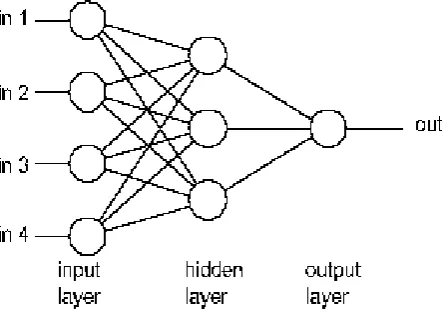
The commonest type of artificial neural network shown in fig 1 consist of three groups or layers of units, a layer of “input” units is connected to a layer of “hidden” units, which is connected to a layer of “output” units. The activity of the input units represents the row information that is fed into the network. The activity of each hidden unit is determined by the activities of the input units and the weight on the connections between the input and the hidden units. The behavior of the output units depends on the activity of the hidden units and the weights between the hidden and output units. The simple type of network is interesting because the hidden units are free to construct their own representations of the input(Flood and Kartam 1994).
Figure 1: Multilayer Feed forward Neural Network
Feed Forward Networks
Feed forward ANNs (fig 1)allow signals to travel one way only. The signal will be from the input layer to the hidden layer and to the output layer. The connection does not have feedback loops. There may be one or more hidden layers in between the first and the last layer. The number of nodes in each layer need not be same. Signal propagations between node within the same layer or from the input layer directly to the output layer is not permitted.
Feed BackNetworks
IV. SYSTEM DEVELOPMENTS
An attempt is made to develop a model for cost optimization of one long edge continuous slab spanning in two directions satisfying the constraints given in IS 456:2000. ANN is applied for modeling initial design process of one long edge continuous slab spanning in two directions. The worksheet is developed in MS-office Excel 2003 for the design of one long edge continuous slab spanning in two directions. Two worksheets are developed, one for effective length along X direction less than 3.5m. and second for effective length along X direction greater than 3.5m.While designing the inputs given to the program such as
1. Effective lengths along X directions : 3m, 3.5m, 4m
2. Aspect ratio i.e. (Ly/Lx) : 1.1, 1.2, 1.3, 1.4, 1.5, 1.6, 1.7, 1.8, 1.9 and 2 3. Live load :1.5 KN/m2, 2.5 KN/m2, 3.5 KN/m2
4. Finish load 2.85 KN/m2,1 KN/m2
5. Grades of concrete: M20, M25 6. Grades of steel : Fe250, Fe415
After considering these values the slab should be designed for the different combinations such as 3-3.3-1.5-2.85-20-250 in which Lx = 3m, Ly = 3.3m, LL = 1.5 KN/m2 , FF = 2.85 KN/m2 ,
Fck = 20N/mm2, Fy = 250N/mm2 and 3.5-7-2.5-1-20-250 ,4-4.4-1.5-2.85-25-250. Likewise the slab is
designed for different combinations. Program is developed for designs of slab in excel 2003 which satisfies all the constraints as per IS 456:2000. By considering 680 different cases the slab are designed. The outputs are depth of slab (D), Area of steel required at support in short direction (Astx1), Area of steel required at mid-span in short direction
(Astx2), Area of steel required at mid-span in long direction (Asty2), cost of slab. After satisfying all the constraints the
Microsoft Excel Solver tool is used for optimization.
The total input and output data is collected to develop the training data set. The program is developed using MATLAB 6.0 to train data set. Whatever the input given to the trained network in which the material grades are considered as 0 and 1. for e.g. the material grades considered are M20 and Fe415, for these two values considered it as 1 and for the other grades the value is 0, now this data set is ready to train the network. By defining the input matrix ‘a’ in which the inputs from the sample cases are taken. The matrix ‘a’ is of 680x8 size and defining the target matrix ‘b’ in which the outputs given by the optimizer are taken. The matrix ‘b’ is of 680x5 size. After defining the input and output matrix creating a neural network and then run the network and that network is used to run for the unseen cases. Such as 3.2-6-2-1-20-250, 4-7.5-3.2-2.85-25-415, 3-5-2-1-20-250. Likewise 81 unseen cases are carried out for which the neural network gives the output. Also the cost coefficients are calculated in Indian currency.
ANN Tool box in MATLAB 6.0
The feed forward back propagation neural network is used to develop program for Two way slab. TANSIG transfer function used for input and output layer. LOGSIG transfer function used for hidden layer. The original input and output data are given in the matrices for training. Before training; it is often useful to scale the inputs and target’s so that they always fall within a specified range. Therefore the function for normalization of training data is used in program. Then to convert the network output back into the original units function for un-normalization of output is used. One more program is developed for testing new problems which were not included in the training data set , using normalization and un-normalization function (Flood and Kartam 1994).
The number of hidden layers in the second network is taken as 2 and by trial and error number of hidden layer neurons is decided as 125. The satisfactory performance of this artificial neural network is found at architecture of 8-125-125-5.
ANN with network architecture as below are developed. Network 1 : 8-100-5
Network 2 : 8-125-125-5
Network 3 : 8-100-100-100-100-5 Network 4 : 8-150-150-150-150-5 Network 5 : 8-35-45-65-75-85-5.
The results obtained from all these networks are compared and discussed in detail
V. DEVELOPMENT OF ANN ARCHITECTURE
Parameters for the design of Two way slab like effective length of slab along X-direction in meters, effective length of slab along Y-direction in meters, Live load on slab in kN/m2, Finish load on slab in kN/m2, concrete grade viz.M20, M25 and two nodes to define grade of steel viz. Fe250, Fe415 is taken as input parameters. Depth of slab (D) in mm, Area of steel required at support in short direction (Astx1), Area of steel required at mid-span in short direction
(Astx2), Area of steel required at mid-span in long direction (Asty2) , cost of slab is taken as output parameters. So
assigning one neuron each, number of input neuron is 8 and output neuron is 5.
There are no rules and fixed guidelines available in the literature regarding the choice of number of hidden layers, number of neurons in the hidden layer and other network tuning parameters such as learning rate and momentum coefficient etc. The number of hidden neuron was taken by trial and error.
The training of network is carried out for 680 data sets and testing is done for 81 data sets. During training the network updates its connection weights and biases until the goals are achieved and then training is finished. Training is done by taking one hidden layer. But performance goal was not met. So numbers of layers are increased for comparison of the tendency of network for good convergence.
VI. RESULTS AND DISCUSSIONS Trial Network 1
The network architecture in trial network 1 is 8-100-5. In this network, it is observed that the time and number of epochs required for the convergence and reaching the desired performance goal during training is quite high. The performance goal of 1 x 10⁻⁵ is not reached after completion of 1,20,000 epochs. Time required for processing the data was about 10 hours. Hence, the results of unseen problems presented to this network are not considered for the comparison.
The performance of trial network 2 to trial network 5 is shown in Table 1 which gives number of epochs required for the training of network to meet performance goal of 1 x 10⁻⁵, time required for completion of the training, range of error in prediction of depth of slab, range of error in prediction of cost of the slab, the average error in prediction of depth of slab and cost of slab for 81 cases presented to the trained network.
Graph 1 :- Comparison between Output of Optimiser And Trained ANN of Overall Depth of Slab (mm).
Graph 2 :- Comparison between Output of Optimiser And Trained ANN of Overall Cost of Slab, (Rs.)
50 60 70 80 90 100 110 120 130 140 150
1 10 19 28 37 46 55 64 73 82
De
p
th,
D (
m
m
)
Unsolved Example Nos.
Output Given By Optimiser
2000 4000 6000 8000 10000 12000 14000 16000 18000 20000 22000 24000
1 10 19 28 37 46 55 64 73 82
Cost
of
S
lab
(R
s.)
Unsolved Example Nos.
Table-1: Comparison of Average percentage Error in Values Predicted by Different Trial Networks
VII. CONCLUSIONS
Based on the performance of various trial networks considered in the present work it is observed that performance of the trial network 5 is satisfactory. It is observed from the predicted values of networks that, in trial network 5 of architecture 8-35-45-65-75-85-5, average percentage error in prediction of overall depth of the slab, and cost of the slab is -6.71 and -80.15 respectively. Out of 81 unseen problems presented to the network, in trial network 5, the number of instances for which percentage error in prediction of overall depth exceeds 10 percent is 9 and the cost of the slab exceeds 10 percent is 0.It is observed that, the predicted values of overall depth and the cost of slab obtained from optimizer and artificial neural network are approximately same. Therefore, it can be concluded that artificial
neural network can be applied effectively for design of one long edge continuous two way slab.
REFERENCES
1. Chakraborty B. K. (1992) “A Model for Optimal Design of Reinforced Concrete Beam”, Journal of Structural Engineering, No. 11, Vol. 118, 3238 to 3242.
2. Chen H.M., Tasi K. H., Qi G.Z. and Yang J.C.S. (1995) “Neural Network for Structure Control”. Journal of computing in Civil Engineering, No.2, Vol.9, 168 to 176.
3. Gupta Rajiv, Kewalramani M.A., and Goel Amit (2006), “Prediction of Concrete Strength Using Neural-Expert System.” Journal of Materials in Civil Engineering, No.3, Vol. 18, 462 to 466.
4. Ian Flood and Nabil Kartam (1994), “Neural Networks in Civil Engineering I : Principles and Understanding”, Journal of Computing in Civil Engineering, No. 2, Vol. 8, 131-148
5. Ian Flood and Nabil Kartam (1994), “Neural Networks in Civil Engineering II : Systems and Application”, Journal of Computing in Civil Engineering, No. 2, Vol. 8, 149-162.
6. Janusz Kasperkiewicz, Janusz Racz, and Artur Dubrawski (1995), “HPC strength prediction using Artificial Neural Network”. Journal of Computing In Civil Engineering, No. 4, Vol. 9, 279-284.
7. Mukharjee Abhijit and Deshpande Jayant (1995), “Modeling Initial Design Process Using Artificial Neural Network”, Journal of Computing in Civil Engineering, No.3, ,Vol.09, 194 to 200.
8. Mukharjee Abhijit, Deshpande J.M., Anmala J. (1996), “Prediction of Buckling Load of Columns Using Artificial Neural Networks”, Journal of Structural Engineering, No.11, Vol. 122, , 1385 to 1387.
9. Muralikrishna N. and Gangadharam D. (1999), “Analysis of Infilled Frames- a Study Using Neural Network”, Journal of Structural Engineering, No.3, Vol. 26, 173 to 178.
10. Rajasekaran S. and Amalraj R. (2004), “Simulated Annealing Technique to Determine Optimal Mix for High Performance Concrete”, Journal
Trial Network number and architecture Number of Epoch's required Time required for training in hrs.
% Error in D % Error in Cost
Average % Error in prediction of
No of instances of 81 cases when error exceeds 10 % Max Min Max Min D Cost D Cost Trial Network
2 : 8-125-125-5
30350 2:40 -0.94 -42.19 194.34 35.28
-21.39 68.40 0 67
Trial Network 3 : 8-100-100-100-100-5
20250 2:00 76.33 -0.18 -70.88 -93.09 35.86 -86.58 76 0
Trial Network 4 : 8-150-150-150-150-5
3595 1:00 -3.28 -0.18 490.30 7.11
-23.71 121.51 0 79
Trial Network 5 :
8-35-45-65-75-85-5
12. Sanad A. and Saka M.P. (2001), “Prediction of Ultimate Shear Strength of reinforced Concrete Deep Beams Using Neural Networks.” Journal of Structural Engineering, No. 7 ,Vol. 127, 818 to 828.
13. SC Patodi (1992), “Applications of Artificial Intelligence in Structural Engineering”, Journal of Computing in Civil Engineering, No. 5, Vol. 6, 17-22