A preliminary version of this paper appears in TCC 2016-A. This is the full version appearing as IACR ePrint Archive Report 2015/487.
Contention in Cryptoland:
Obfuscation, Leakage and UCE
Mihir Bellare1 Igors Stepanovs2 Stefano Tessaro3
October 2015
Abstract
This paper addresses the fundamental question of whether or not different, exciting primitives now being considered actually exist. We show that we, unfortunately, cannot have them all. We provide results of the form¬A∨ ¬B, meaning one of the primitivesA,Bcannot exist. (But we don’t know which.) Specifically, we show that: (1)VGBO(Virtual Grey Box Obfuscation) for all circuits, which has been conjectured to be achieved by candidate constructions, cannot co-exist with Canetti’s 1997AI-DHI(auxiliary input DH inversion) assumption, which has been used to achieve many goals including point-function obfuscation (2) iO (indistinguishability obfuscation) for all circuits cannot co-exist with KM-LR-SE (key-message leakage-resilient symmetric encryption) (3) iO cannot co-exist with hash functions that are UCE secure for computationally unpredictable split sources.
1Department of Computer Science & Engineering, University of California San Diego, 9500 Gilman Drive, La
Jolla, California 92093, USA. Email: [email protected]. URL:http://cseweb.ucsd.edu/~mihir/. Supported in part by NSF grants CNS-1116800, CNS-1228890 and CNS-1526801. This work was done in part while the author was visiting the Simons Institute for the Theory of Computing, supported by the Simons Foundation and by the DIMACS/Simons Collaboration in Cryptography through NSF grant CNS-1523467.
2
Department of Computer Science & Engineering, University of California San Diego, 9500 Gilman Drive, La Jolla, California 92093, USA. Email: [email protected]. Supported in part by NSF grants CNS-1116800 and CNS-1228890.
3
Contents
1 Introduction 2
1.1 VGBO and AI-DHI . . . 2
1.2 Key-message leakage resilience . . . 3
1.3 UCE for split sources . . . 3
1.4 Discussion and related work . . . 4
2 Preliminaries 5
3 VGBO and the AI-DHI assumption 7
4 KM-leakage resilient encryption 11
5 UCE for split sources 13
1
Introduction
Cryptographic theory is being increasingly bold with regard to assumptions and conjectures. This is particularly true in the area of obfuscation, where candidate constructions have been provided whose claim to achieve a certain form of obfuscation is either itself an assumption [31] or is justified under other, new and strong assumptions [41, 12, 34]. This is attractive and exciting because we gain new capabilities and applications. But it behoves us also to be cautious and try to ascertain, not just whether the assumptions are true, but whether the goals are even achievable.
But how are we to determine this? The direct route is cryptanalysis, and we have indeed seen some success [39, 27, 33, 28]. But cryptanalysis can be difficult and runs into major open complexity-theoretic questions. There is another rewarding route, that we pursue here. This is to seek and establish relations that we callcontentions. These take the form¬A∨ ¬B where A,B are different primitives or assumptions. This shows that A,B are not both achievable, meaning they cannot co-exist. We may not know which of the two fails, but at least one of the two must, which is valuable and sometimes surprising information. Indeed, many intriguing contentions of this form have been provided in recent work [14, 32, 20, 22, 11, 21, 5, 36]. For example, we know that the following cannot co-exist: “Special-purpose obfuscation” and diO [32]; Multi-bit point function obfuscation and iO [22]; extractable one-way functions and iO [14].
In this paper we begin by addressing the question of whether VGBO (Virtual Grey Box Obfus-cation) for all circuits is possible, as conjectured by BCKP [13, Section 1.1]. We show that this is in contention with the AI-DHI assumption of [25, 15]. We go on to show that iO is in contention with certain forms of leakage resilient encryption and UCE.
1.1 VGBO and AI-DHI
We show that ¬VGBO∨ ¬AI-DHI. That is, Virtual Grey Box Obfuscation (VGBO) of all circuits is in contention with Canetti’s 1997 AI-DHI (Auxiliary-Input Diffie-Hellman Inversion) assump-tion [25, 15]. One of the two (or both) must fail. Let us now back up to provide more informaassump-tion on the objects involved and the proof.
The study of obfuscation began with VBBO (Virtual Black Box Obfuscation) [37, 4], which asks that for any PT adversaryAgiven the obfuscated circuit, there is a PT simulatorSgiven an oracle for the original circuit, such that the two have about the same probability of returning 1. The impossibility of VBBO [4, 35, 16] has lead to efforts to define and achieve weaker forms of obfusca-tion. VGBO [10] is a natural relaxation of VBBO allowing the simulatorS to be computationally unbounded but restricted to polynomially-many oracle queries. This bypasses known VBBO im-possibility results while still allowing interesting applications. Furthermore BCKP [12, 13] show that VGBO for NC1 is achievable (under a novel assumption). They then say “existing candidate indistinguishability obfuscators for all circuits [31, 19, 3] may also be considered as candidates for VGB obfuscation, for all circuits” [13, Section 1.1]. This would mean, in particular, that VGBO for all circuits is achievable. In this paper we ask if this “VGB conjecture” is true.
The AI-DHI assumption [25, 15] says that there is an ensemble G = {Gλ : λ∈ N} of
prime-order groups such that, for r, s chosen at random from Gλ, no polynomial-time adversary can
distinguish between (r, rx) and (r, s), even when given auxiliary informationaabout x, as long as this information ais “x-prediction-precluding,” meaning does not allow one to just computex in polynomial time. The assumption has been used for oracle hashing [25], AIPO (auxiliary-input point-function obfuscation) [15] and zero-knowledge proofs [15].
groups. For random x, we define a way of picking the auxiliary information a such that (1) a is
x-prediction-precluding, but (2) there is a polynomial-time adversary that, givena, can distinguish between (r, rx) and (r, s) for random r, s. Consider the circuit Cx that on input u, v returns 1 if v=ux and 0 otherwise. The auxiliary information awill be a VGB obfuscation C of Cx. Now (2)
is easy to see: the adversary, given challenge (u, v), can win by returning C(u, v). But why is (1) true? We use the assumed VGB security of the obfuscator to reduce (1) to showing that no, even unbounded, simulator, given an oracle for Cx, can extract x in a polynomial number of queries.
This is shown through an information-theoretic argument that exploits the group structure. The natural question about which one would be curious is, which of VGBO and AI-DHI is it that fails? This is an intriguing question and we do not know the answer at this point.
1.2 Key-message leakage resilience
DKL [30] and CKVW [26] provide key leakage resilient symmetric encryption (K-LR-SE) schemes. This means they retain security even when the adversary has auxiliary information about the key, as long as this information is key-prediction-precluding, meaning does not allow one to compute the key. We consider a generalization that we call key-message leakage resilient symmetric encryption (KM-LR-SE). Here the auxiliary information is allowed to depend not just on the key but also on the message, the requirement however still being that it is key-prediction-precluding, meaning one cannot compute the key from the auxiliary information. The enhancement would appear to be innocuous, because the strong semantic-security style formalizations of encryption that we employ in any case allow the adversary to have a priori information about the message. However, we show that this goal is impossible to achieve if iO for all circuits is possible. That is, we show in Theorem 4.1 that¬iO∨ ¬KM-LR-SE. Since iO seems to be growing to be more broadly accepted, this indicates that KM-LR-SE is not likely to exist. We think this may be of direct interest from the perspective of leakage resilience, but its main importance for us is as a tool to establish new negative results for UCE as discussed in Section 1.3 below. The proof of Theorem 4.1 is a minor adaptation of the proof of BM [22] ruling out MB-AIPO under iO.
1.3 UCE for split sources
UCE is a class of assumptions for function families introduced in BHK [6] with the goal of instan-tiating random oracles. For a class S of algorithms called sources, BHK define UCE[S] security of a family of functions. The parameterization is necessary because security is not achievable for the class of all sources. BHK and subsequent work [6, 20, 23, 40, 5, 29] have considered several restricted classes of sources and, based on the assumption of UCE security for these, been able to instantiate random oracles to obtain secure, efficient instantiations for primitives including de-terministic public-key encryption, message-locked encryption, encryption secure for key-dependent messages, encryption secure under related-key attacks, adaptive garbling, hardcore functions and IND-CCA public-key encryption.
∩Ssplt] appeared plausible even in the presence of iO. However in this paper we show ¬iO∨ ¬UCE[Scup∩Ssplt], meaning iO and UCE[Scup∩Ssplt] security cannot co-exist. The interpretation is that UCE[Scup ∩ Ssplt]-secure function families are unlikely to exist. We obtain our ¬iO ∨ ¬UCE[Scup ∩Ssplt] result by showing that UCE[Scup ∩Ssplt] ⇒ KM-LR-SE, meaning we can build a key-message leakage resilient symmetric encryption scheme given any UCE[Scup∩Ssplt ]-secure function family. But we saw above that ¬iO∨ ¬KM-LR-SE and can thus conclude that ¬iO∨ ¬UCE[Scup∩Ssplt].
BM2 [23] show that UCE[Scup∩Ssplt∩S1] security —Scup∩Ssplt∩Sq is the class of compu-tationally unpredictable split sources making q oracle queries— is achievable. (They assume iO and AIPO.) Our ¬iO∨ ¬UCE[Scup∩Ssplt] result does not contradict this since our source makes a polynomial number of oracle queries. Indeed our result complements the BM2 one to show that a bound on the number of source oracle queries is necessary for a positive result. Together these results give a close to complete picture of the achievability of UCE for split sources, the remaining open question being achievability of UCE[Scup∩Ssplt∩Sq] for constantq >1.
We note that we are not aware of any applications assuming UCE[Scup∩Ssplt]. Prior applications have used either UCE[Scup∩Ssplt∩S1] or quite different classes like UCE[Ssup] —Ssupis the class of statistically unpredictable sources [6, 20]— and neither of these is at risk from our results. However our¬iO∨ ¬UCE[Scup∩Ssplt] result is of interest towards understanding the achievability of UCE assumptions and the effectiveness of different kinds of restrictions (in this case, splitting) on sources. The achievability of UCE[Scup∩Ssplt] security was an open problem from prior work.
1.4 Discussion and related work
The idea of using an obfuscated circuit as an auxiliary input to obtain contention results has ap-peared in many prior works [14, 32, 20, 22, 11, 21, 5, 36]. Some of the contentions so established are between “Special-purpose obfuscation” and diO [32], between MB-AIPO and iO [22] and between extractable one-way functions and iO [14]. Our work follows in these footsteps.
KM-LR-SE can be viewed as a symmetric encryption re-formulation of MB-AIPO following the connection of the latter to symmetric encryption established by CKVW [26]. The main change is in the correctness condition. We formulate a weak correctness condition, which is important for our application to UCE. In its absence, our negative result for split-source UCE would only be for injective functions, which is much weaker. With this connection in mind, the proof of Theorem 4.1, as we have indicated above, is a minor adaptation of the proof of BM [22] ruling out MB-AIPO under iO. Our result about KM-LR-SE is thus not of technical novelty or interest but we think this symmetric encryption re-formulation of BM [22] is of interest from the leakage resilience perspective and as a tool to obtain more negative results, as exemplified by our application to UCE.
In independent and concurrent work, BM3 [24] show ¬iO∨ ¬UCE[Ss-cup], where Ss-cup is the class ofstrongly computationally unpredictable sources as defined in [22]. But the latter show that Scup∩Ssplt is a strict subset of Ss-cup. This means that our ¬iO∨ ¬UCE[Scup∩Ssplt] result is strictly stronger than the¬iO∨ ¬UCE[Ss-cup] result of [24]. (Under iO, our result rules out UCE security for a smaller, more restricted class of sources.)
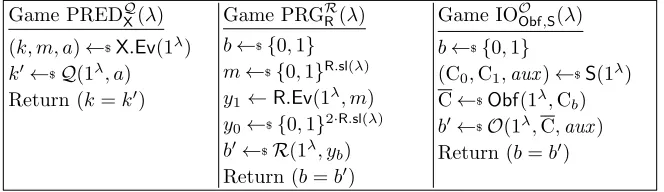
Game PREDQX(λ)
(k, m, a)←$X.Ev(1λ) k′←$Q(1λ, a) Return (k=k′)
Game PRGRR(λ)
b←${0,1} m←${0,1}R.sl(λ) y1←R.Ev(1λ, m)
y0←${0,1}2·R.sl(λ) b′←$R(1λ, yb) Return (b=b′)
Game IOOObf,S(λ)
b←${0,1}
(C0,C1,aux)←$S(1λ) C←$Obf(1λ,Cb) b′←$O(1λ,C,aux) Return (b=b′)
Figure 1: Games defining unpredictabilty of auxiliary information generator X, PR-security of pseudorandom generatorRand iO-security of obfuscator Obf relative to circuit samplerS.
2
Preliminaries
Notation. We denote by λ ∈ N the security parameter and by 1λ its unary representation. If
x∈ {0,1}∗ is a string then|x|denotes its length, x[i] denotes its i-th bit, andx[i..j] =x[i]. . . x[j] for 1 ≤ i ≤ j ≤ |x|. We let ε denote the empty string. If s is an integer then Pads(C) denotes
circuit C padded to have sizes. We say that circuits C0,C1are equivalent, written C0 ≡C1, if they agree on all inputs. If xis a vector then|x|denotes the number of its coordinates andx[i] denotes its i-th coordinate. IfX is a finite set, we letx←$X denote picking an element ofX uniformly at
random and assigning it tox. Algorithms may be randomized unless otherwise indicated. Running time is worst case. “PT” stands for “polynomial-time,” whether for randomized algorithms or deterministic ones. If A is an algorithm, we let y ←A(x1, . . .;r) denote running A with random coins r on inputs x1, . . . and assigning the output to y. We let y←$A(x1, . . .) be the result of
pickingr at random and lettingy←A(x1, . . .;r). We let [A(x1, . . .)] denote the set of all possible outputs of A when invoked with inputs x1, . . .. We say that f: N → R is negligible if for every positive polynomial p, there exists λp ∈ N such that f(λ) < 1/p(λ) for all λ > λp. We use the
code based game playing framework of [7]. (See Fig. 1 for an example.) By GA(λ) we denote the event that the execution of game G with adversaryAand security parameterλresults in the game returning true.
Auxiliary information generators. Many of the notions we consider involve the
computa-tional unpredictability of some quantity even given “auxiliary information” about it. We abstract this out via our definition of an auxiliary information generator X. The latter specifies a PT al-gorithm X.Ev that takes 1λ to return a target k ∈ {0,1}X.tl(λ), a payload m ∈ {0,1}X.pl(λ) and an auxiliary information a, where X.tl,X.pl: N → N are the target and payload length functions associated to X, respectively. Consider game PRED of Fig. 1 associated to X and a predictor ad-versaryQ. Forλ∈Nlet AdvpredX,Q(λ) = Pr[PREDXQ(λ)]. We say that Xisunpredictable ifAdvpredX,Q(·) is negligible for every PT adversary Q. We say that X is uniform if X.Ev(1λ) picks the target
k ∈ {0,1}X.tl(λ) and the payload m ∈ {0,1}X.pl(λ) uniformly and independently. Note that the auxiliary information amay depend on both the targetkand the payloadm, but unpredictability refers to recovery of the target kalone.
PRGs. A pseudorandom generator R [17, 44] specifies a deterministic PT algorithm R.Ev where
R.sl: N→N is the seed length function ofRsuch that R.Ev(1λ,·): {0,1}R.sl(λ) → {0,1}2·R.sl(λ) for allλ∈N. We say thatRis PR-secure if the functionAdvprR,R(·) is negligible for every PT adversary R, where forλ∈Nwe let AdvprR,R(λ) = 2 Pr[PRGRR(λ)]−1 and game PRG is specified in Fig. 1.
Obfuscators. An obfuscator is a PT algorithm Obf that on input 1λ and a circuit C returns a
Game UCESH,D(λ)
b←${0,1}; hk←$H.Kg(1λ) L←$SHASH(1λ)
b′←$D(1λ,hk, L) Return (b′ =b)
HASH(x) IfT[x] =⊥then
Ifb= 0 thenT[x]←${0,1}H.ol(λ) ElseT[x]←H.Ev(1λ,hk, x) ReturnT[x]
Game PREDPS(λ)
X ← ∅
L←$SHASH(1λ) x′←$P(1λ, L) Return (x′∈X)
HASH(x) IfT[x] =⊥then
T[x]←${0,1}H.ol(λ) X ←X∪ {x}
ReturnT[x]
Source SHASH(1λ)
(L0,x)←$S0(1λ) Fori= 1, . . . ,|x|do
y[i]←$HASH(x[i]) L1←$S1(1λ,y) L←(L0, L1)
ReturnL
Figure 2: Games defining UCE security of function family H, unpredictability of source S, and the split source S=Splt[S0,S1] associated to S0,S1.
condition. We will consider various notions of security for obfuscators, including VGBO and iO.
Indistinguishability obfuscation. We use the BST [9] definitional framework which
param-eterizes security via classes of circuit samplers. Let Obf be an obfuscator. A sampler in this context is a PT algorithm S that on input 1λ returns a triple (C0,C1,aux) where C0,C1 are cir-cuits of the same size, number of inputs and number of outputs, and aux is a string. If O is an adversary and λ ∈ N we let AdvioObf,S,O(λ) = 2 Pr[IOOObf,S(λ)]−1 where game IOOObf,S(λ) is defined in Fig. 1. Now let S be a class (set) of circuit samplers. We say that Obf is S-secure if AdvioObf,S,O(·) is negligible for every PT adversary O and every circuit sampler S ∈ S. We say that circuit sampler S produces equivalent circuits if there exists a negligible functionν such that Pr[C0≡C1 : (C0,C1,aux)←$S(1λ)
]
≥1−ν(λ) for allλ∈N. Let Seq be the class of all circuit samplers that produce equivalent circuits. We say thatObf is an indistinguishability obfuscator if it is Seq-secure [4, 31, 42].
Function families. A family of functionsF specifies the following. PT key generation algorithm
F.Kg takes 1λ to return a key fk ∈ {0,1}F.kl(λ), where F.kl: N → N is the key length function associated to F. Deterministic, PT evaluation algorithm F.Ev takes 1λ, key fk ∈ [F.Kg(1λ)] and an input x ∈ {0,1}F.il(λ) to return an output F.Ev(1λ,fk, x) ∈ {0,1}F.ol(λ), where F.il,F.ol: N→N are the input and output length functions associated to F, respectively. We say thatF is injective if the function F.Ev(1λ,fk,·): {0,1}F.il(λ) → {0,1}F.ol(λ) is injective for every λ ∈ N and every
fk∈[F.Kg(1λ)].
UCE security.Let us recall the Universal Computational Extractor (UCE) framework of BHK [6].
LetHbe a family of functions. LetS be an adversary called thesource andD an adversary called the distinguisher. We associate to them and H the game UCESH,D(λ) in the left panel of Fig. 2. The source has access to an oracle HASH and we require that any query x made to this oracle
have length H.il(λ). When the challenge bit b is 1 (the “real” case) the oracle responds viaH.Ev
under a key hk that is chosen by the game and not given to the source. When b = 0 (the “ran-dom” case) it responds as a random oracle. The source then leaks a string L to its accomplice distinguisher. The latter does get the key hk as input and must now return its guess b′ ∈ {0,1} for b. The game returns true iff b′ = b, and the uce-advantage of (S,D) is defined for λ ∈ N via
It is easy to see that UCE[S]-security is not achievable if S is the class of all PT sources [6]. To obtain meaningful notions of security, BHK [6] impose restrictions on the source. A central restriction is unpredictability. A source is unpredictable if it is hard to guess the source’s HASH
queries even given the leakage, in the random case of the UCE game. Formally, letS be a source andP an adversary called a predictor and consider game PREDPS(λ) in the middle panel of Fig. 2. For λ∈N we letAdvpredS,P(λ) = Pr[PREDPS(λ)]. We say that S is computationally unpredictable if
AdvpredS,P(·) is negligible for all PT predictorsP, and letScupbe the class of all PT computationally unpredictable sources. We say that S is statistically unpredictable if AdvpredS,P(·) is negligible for all (not necessarily PT) predictors P, and let Ssup ⊆ Scup be the class of all PT statistically unpredictable sources.
BFM [20] show that UCE[Scup]-security is not achievable assuming that indistinguishability obfuscation is possible. This has lead applications to either be based on UCE[Ssup] or on subsets of UCE[Scup], meaning to impose further restrictions on the source. UCE[Ssup], introduced in [6, 20], seems at this point to be a viable assumption. In order to restrict the computational case, one can consider split sources as defined in BHK [6]. LetS0,S1 be algorithms, neither of which have access to any oracles. Thesplit source S =Splt[S0,S1] associated toS0,S1 is defined in the right panel of Fig. 2. Algorithm S0 returns a pair (L0,x). Here xis a vector over{0,1}H.il(λ) all of whose entries are required to be distinct. (If the entries are not required to be distinct, collisions can be used to communicate information between the two components of the source, and the BFM [20] attack continues to apply, as pointed out in [23].) The first adversary creates the oracle queries for the sourceS, the latter making these queries and passing the replies to the second adversary to get the leakage. In this way, neither S0 nor S1 have an input-output pair from the oracle, limiting their ability to create leakage useful to the distinguisher. A sourceS is said to belong to the classSspltif there exist PT S0,S1 such thatS =Splt[S0,S1], meaning is defined as above. The class of interest is now UCE[Scup∩Ssplt], meaning UCE-security for computationally unpredictable, split sources.
Another way to restrict a UCE source is by limiting the number of queries it can make. Let Sq be the class of sources making q(·) oracle queries. This allows to consider Scup∩Ssplt∩S1, a class of computationally unpredictable split sources that make a single query. BM2 [23] show that UCE[Scup∩Ssplt∩S1]-security is achievable assuming iO and AIPO.
3
VGBO and the AI-DHI assumption
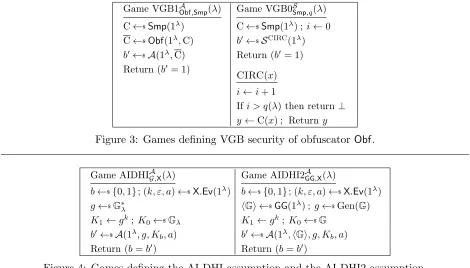
BCKP [12, 13] conjecture that existing candidate constructions of iO also achieve VGBO and thus in particular that VGB obfuscation for all circuits is possible. Here we explore the plausibility of this “VGB conjecture.” We show that it implies the failure of Canetti’s AI-DHI assumption. Either this assumption is false or VGBO for all circuits is not possible. (In fact, our result refers to an even weaker VGBO assumption.) That is, the long-standing AI-DHI assumption and VGBO are in contention; at most one of these can exist. We start by defining VGBO and recalling the AI-DHI assumption, and then give our result and its proof. We then suggest a weakening of AI-DHI that we call AI-DHI2 that is parameterized by a group generator. We show that our attack on AI-DHI extends to rule out AI-DHI2 for group generators satisfying a property we call verifiability. However there may be group generators that do not appear to be verifiable, making AI-DHI2 a potential alternative to AI-DHI.
VGBO. Let Obf be an obfuscator as defined in Section 2. We define what it means for it to be a
Game VGB1AObf,Smp(λ)
C←$Smp(1λ) C←$Obf(1λ,C)
b′←$A(1λ,C) Return (b′ = 1)
Game VGB0SSmp,q(λ)
C←$Smp(1λ) ; i←0 b′←$SCIRC(1λ)
Return (b′ = 1)
CIRC(x)
i←i+ 1
Ifi > q(λ) then return⊥
y←C(x) ; Returny
Figure 3: Games defining VGB security of obfuscator Obf.
Game AIDHIAG,X(λ)
b←${0,1}; (k, ε, a)←$X.Ev(1λ)
g←$G∗λ
K1←gk; K0←$Gλ
b′←$A(1λ, g, Kb, a) Return (b=b′)
Game AIDHI2AGG,X(λ)
b←${0,1}; (k, ε, a)←$X.Ev(1λ) ⟨G⟩ ←$GG(1λ) ; g←$Gen(G) K1←gk; K0←$G
b′←$A(1λ,⟨G⟩, g, Kb, a) Return (b=b′)
Figure 4: Games defining the AI-DHI assumption and the AI-DHI2 assumption.
A sampler Smp in this context is an algorithm that takes 1λ to return a circuit C. Let q be a polynomial,A an adversary andS a (not necessarily PT) algorithm called a simulator. For λ∈N
let
AdvvgbObf,Smp,q,A,S(λ) =Pr[VGB1ObfA ,Smp(λ)]−Pr[VGB0SSmp,q(λ)]
where the games are in Fig. 3. Let SAMP be a set of samplers. We say that Obf is a VGB obfuscator for SAMPif for every PT adversary A there exists a (not necessarily PT) simulator S and a polynomialq such that AdvvgbObf,Smp,q,A,S(·) is negligible for all Smp∈SAMP.
We note that [12] use a VGB variant stronger than the above where the advantage measures the difference in probabilities of Aand S guessing a predicateπ(C), rather than just the probabilities of outputting one, which is all we need here. Also note that our VGB definition is vacuously achievable whenever |SAMP|= 1, since S can simulate game VGB1AObf,Smp(λ) for any fixed choice of Aand Smp. Our applications however use aSAMPof size 2.
The AI-DHI assumption.LetG ={Gλ:λ∈N}be an ensemble of groups where for everyλ∈N
the order p(λ) of group Gλ is a prime in the range 2λ−1 < p(λ) <2λ. We assume that relevant
operations are computable in time polynomial inλ, including computingp(·), testing membership inGλ and performing operations inGλ. By G∗λ we denote the non-identity members of the group,
which is the set of generators since the group has prime order. An auxiliary information generator
X for G is an auxiliary information generator as per Section 2 with the additional property that the target k returned by X.Ev(1λ) is in Zp(λ) (i.e. is an exponent) and the payload m is ε (i.e. is effectively absent).
Now consider game AIDHI of Fig. 4 associated to G,X and an adversary A. For λ ∈ N let
¬VGBO∨ ¬AI-DHI.The following says if VGB obfuscation is possible then the AI-DHI assumption is false: there existsnofamily of groupsGthat is AI-DHI secure. Our theorem only assumes a very weak form of VGB obfuscation for a class with two samplers (given in the proof).
Theorem 3.1 LetG be a family of groups. Then there is a pairSmp,Smp0 of PT samplers (defined in the proof ) such that if there exists a VGB-secure obfuscator for the class SAMP={Smp,Smp0}, thenG is not AI-DHI-secure.
Proof of Theorem 3.1: LetObf be the assumed obfuscator. LetXbe the auxiliary information generator for G defined as follows:
Algorithm X.Ev(1λ)
k←$Zp(λ)
C←$Obf(1λ,C1λ,k)
Return (k, ε,C)
Circuit C1λ,k(g, K)
If (g̸∈G∗λ orK̸∈Gλ) then return 0
If (gk =K) then return 1
Else return 0
The auxiliary information a = C produced by X is an obfuscation of the circuit C1λ,k shown on
the right above. The circuit has 1λ and the target value k embedded inside. The circuit takes inputs g, K and checks that the first is a group element different from the identity —and thus a generator— and the second is a group element. It then returns 1 if gk equals K, and 0 otherwise. We first construct a PT adversaryA∗such thatAdvaidhiG,X,A∗(·) is non-negligible. On input 1λ, g, Kb,C,
it simply returns C(g, Kb). That is, it runs the obfuscated circuit C on g and Kb and returns its
outcome. If the challenge bit b in game AIDHIAG,∗X(λ) is 1 then the adversary always outputs
b′ = 1. Otherwise, the adversary outputs b′ = 1 with probability 1/p(λ). We have AdvaidhiG,X,A∗(λ) = 1−1/p(λ)≥1−21−λ, which is not negligible.
We now show that the constructed auxiliary information generatorXis unpredictable. In particular, for any PT adversaryQwe construct a PT adversary Aand samplersSmp,Smp0 such that for all simulators S and all polynomials q,
AdvpredX,Q(λ)≤AdvvgbObf,Smp,q,A,S(λ) +AdvvgbObf,Smp
0,q,A,S(λ) + q(λ)
2λ−1 . (1)
Concretely, the adversaryAand the samplers Smp,Smp0 operate as follows: AdversaryA(1λ,C)
k′←$Q(1λ,C)
¯
g←$G∗ λ
Return C(¯g,g¯k′)
Algorithm Smp(1λ) k←$Zp(λ)
Return C1λ,k
AlgorithmSmp0(1λ)
Return C0
InSmp0, the circuitC0 takes as input a pair of group elementsg, g′ from Gλ and always returns 0.
To show Equation (1), we first note that by construction
obfuscated circuit C. Now, for all simulatorsS and polynomialsq, we can rewrite Equation (2) as
AdvpredX,Q(λ) = Pr[VGB1AObf,Smp(λ)]−Pr[VGB0SSmp,q(λ)] + Pr[VGB0SSmp,q(λ)]−Pr
[
VGB0SSmp
0,q(λ)
]
+ Pr
[
VGB0SSmp
0,q(λ)
]
−Pr
[
VGB1AObf,Smp
0(λ)
]
+ Pr
[
VGB1AObf,Smp
0(λ)
]
.
To upper boundAdvpredX,Q(λ), we first note that
Pr[VGB1AObf,Smp(λ)]−Pr[VGB0SSmp,q(λ)]≤AdvvgbObf,Smp,q,A,S(λ) and
Pr
[
VGB0SSmp
0,q(λ)
]
−Pr
[
VGB1AObf,Smp
0(λ)
]
≤AdvvgbObf,Smp
0,q,A,S(λ).
Moreover, we have Pr
[
VGB1AObf,Smp
0(λ)
]
= 0 by constructon. Namely, adversaryAnever outputs 1 in game VGB1AObf,Smp
0(λ), since it is given an obfuscation of the constant zero circuit C0.
We are left with upper bounding the difference between Pr
[
VGB0SSmp,q(λ)
]
and Pr
[
VGB0SSmp
0,q(λ)
]
. Note thatS is allowed to issue at mostq(λ) queries to the given circuit, which is either C1λ,k for a
randomk←$Zp(λ) or C0. Denote byHit the event thatS makes a query (g, K) in VGB0S
Smp,q(λ)
such thatgk=K. Then, by a standard argument, Pr[VGB0SSmp,q(λ)]−Pr
[
VGB0SSmp
0,q(λ)
]
≤Pr [Hit].
To compute Pr [Hit], we move from VGB0SSmp,q(λ) to the simpler VGB0SSmp
0,q(λ), where all ofS’s
queries are answered with 0. We extend the latter game to sample a random key k←$Zp(λ), and
we defineHit′ as the event in this game that for one ofS’s queries (g, K) we havegk=K. It is not hard to see that Pr[Hit′] and Pr [Hit] are equal, as both games are identical as long as none of such queries occur. Since there are at mostq(λ) queries, and exactly onekcan produce the answer 1 for these queries, the union bound yields
Pr [Hit] = Pr[Hit′]≤ q(λ)
p(λ) ≤
q(λ) 2λ−1 , which concludes the proof.
The AI-DHI2 assumption. We now suggest a relaxation AI-DHI2 of the AI-DHI assumption
given above. The idea is that for each value of λ there is not one, but many possible groups. Formally, a group generator is a PT algorithm GG that on input 1λ returns a description ⟨G⟩ of a cyclic group G whose order |G|is in the range 2λ−1 <|G|<2λ. We assume that given 1λ,⟨G⟩,
relevant operations are computable in time polynomial inλ, including performing group operations in G and picking at random from G and from the set Gen(G) of generators of G. An auxiliary information generator X for GG is an auxiliary information generator as per Section 2 with the additional property that the target k returned by X.Ev(1λ) is in Z2λ−1 —this makes it a valid
exponent for any group G such that ⟨G⟩ ∈ [GG(1λ)]— and the payload m is ε (i.e. is effectively absent).
let Advaidhi2GG,X,A(λ) = 2 Pr[AIDHI2AGG,X(λ)]−1. We say that GG is AI-DHI2-secure if Advaidhi2GG,X,A(·) is negligible for every unpredictable X for GG and every PT adversary A. The (new) AI-DHI2 assumption is that there exists a group generatorGG which is AI-DHI2 secure.
BP [15] give a simple construction of AIPO from AI-DHI. It is easy to extend this to use AI-DHI2.
Averifierfor group generatorGGis a deterministic, PT algorithmGG.Vfthat can check whether a given string dis a valid description of a group generated by the generator GG. Formally, GG.Vf
on input 1λ, dreturnstrueifd∈[GG(1λ)] andfalseotherwise, for alld∈ {0,1}∗. We say thatGGis verifiable if it has a verifier and additionally, in time polynomial in 1λ,⟨G⟩, where ⟨G⟩ ∈[GG(1λ)], one can test membership in G and in the set Gen(G) of generators of G. The following extends Theorem 3.1 to say that if VGBO is possible then no verifiable group generator is AI-DHI2 secure. Theorem 3.2 Let GG be a verifiable group generator. Then there is a pair Smp, Smp0 of PT samplers such that if there exists a VGB-secure obfuscator for the class SAMP = {Smp,Smp0}, thenGG is not AI-DHI2-secure.
We omit a full proof, as it is very similar to the one of Theorem 3.1. We only note that to adapt the proof, we require X.Ev(1λ) to output a random k in Z2λ−1 together with the obfuscation of
the following circuit C1λ,k. The circuit C1λ,k takes as input a string d expected to be a group
description, together with two stringsgand K. It first runsGG.Vf on input 1λ, dto check whether
d∈ [GG(1λ)], returning 0 if the check fails. If the check succeeds, so that we can write d= ⟨G⟩, it further checks that g∈Gen(G) and K ∈G, returning 0 if this fails. Finally the circuit returns 1 if and only if gk =K in the groupG. The crucial point is that for every valid input (d, g, K), there is at most onek ∈Z2λ−1 which satisfies gk =K in the group described by d. This uses the
assumption thatGis cyclic.
Many group generators are cyclic and verifiable. For example, consider a generator GGthat on input 1λ returns a description ofG=Z∗p for a safe prime p= 2q−1. (That is,q is also a prime.) The verifier can extractp, qfrom⟨G⟩and check their primality in PT. For such generators, we may prefer not to assume AI-DHI2-security, due to Theorem 3.2. However there are group generators that do not appear to be verifiable and where Theorem 3.2 thus does not apply. One must be careful to note that this doesnot mean that VGBO would not rule out AI-DHI2 security for these group generators. It just means that our current proof method may not work. Still at this point, the AI-DHI2 assumption, which only says there is some group generator that is AI-DHI2-secure, seems plausible.
Discussion.As we indicated, one of the main applications of AI-DHI was AIPO [15], and
further-more this connection is very direct. If VGB is in contention with AI-DHI, it is thus natural to ask whether it is also in contention with AIPO. We do not know whether or not this is true. One can also ask whether VGB is in contention with other, particular AIPO constructions, in particular the one of BP [15] based on the construction of Wee [43]. Again, we do not know the answer. We note that alternative constructions of AIPO and other forms of point-function obfuscation are provided in [8].
4
KM-leakage resilient encryption
Game INDASE,X(λ)
b←${0,1}
(k, m1, a)←$X.Ev(1λ)
m0←${0,1}SE.ml(λ) c←$SE.Enc(1λ, k, mb)
b′←$A(1λ, a, c) Return (b=b′)
Game DECSE(λ)
k←${0,1}SE.kl(λ) m←${0,1}SE.ml(λ)
c←$SE.Enc(1λ, k, m) m′ ←SE.Dec(1λ, k, c)
Return (m=m′)
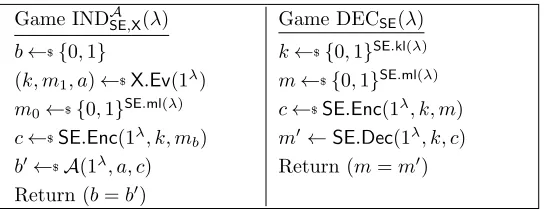
Figure 5: Games definingX-KM-leakage resilience of symmetric encryption schemeSEand decryp-tion correctness of symmetric encrypdecryp-tion schemeSE.
not just on the key but also on the message, still leaving the key computationally unpredictable. The extension seems innocuous, since the indistinguishability style formalizations used here already capture the adversary having some information about the message. But Theorem 4.1 shows that KM-leakage-resilience is in contention with iO. The interpretation is KM-leakage-resilience is not achievable.
Theorem 4.1 is of direct interest with regard to understanding what is and is not achievable in leakage-resilient cryptography. But for us its main importance will be as a tool to rule out UCE for computationally unpredictable split sources assuming iO in Section 5.
We use standard definitions of indistinguishability obfuscation [4, 31, 42, 18, 2] and pseudo-random generators [17, 44], as recalled in Section 2. We now start by formalizing KM-leakage resilience.
KM-leakage resilient encryption. Let a symmetric encryption scheme SE specify the
fol-lowing. PT encryption algorithm SE.Enc takes 1λ, a key k ∈ {0,1}SE.kl(λ) and a message m ∈
{0,1}SE.ml(λ) to return a ciphertext c, where SE.kl,SE.ml: N → N are the key length and mes-sage length functions of SE, respectively. Deterministic PT decryption algorithm SE.Dec takes 1λ, k, c to return a plaintextm ∈ {0,1}SE.ml(λ). Note that there is a key length but no prescribed key-generation algorithm.
For security, let X be an auxiliary information generator with X.tl= SE.kl and X.pl = SE.ml. Consider game INDASE,X(λ) of Fig. 5 associated toSE,Xand adversaryA. The messagem0 is picked uniformly at random. The adversary A must determine which message has been encrypted, given not just the ciphertext but auxiliary information a on the key and message m1. For λ ∈ N we let AdvindSE,X,A(λ) = 2 Pr[INDSEA,X(λ)]−1. We say that SEis X-KM-leakage resilient if the function
AdvindSE,X,A(·) is negligible for all PT adversariesA. This is of course not achievable ifaallowed the adversary to compute k, so we restrict attention to unpredictable X. Furthermore, weakening the definition, we restrict attention to uniformX, meaningk andm1 are uniformly and independently distributed. Thus we say that SE is KM-leakage-resilient if it is X-KM-leakage resilient for all unpredictable, uniform X.
The above requirement is strong in that security is required in the presence of (unpredictable) leakage on the key and first message. But beyond that, in other ways, it has been made weak, because this strengthens our negative results. Namely, we are only requiring security on random messages, not chosen ones, with the key being uniformly distributed, and the key and the two mes-sages all being independently distributed. Furthermore, in contrast to a typical indistinguishability definition, the adversary does not get the messages as input.
The standard correctness condition would ask that SE.Dec(1λ, k,SE.Enc(1λ, k, m)) =m for all
and use a weaker correctness condition because we can show un-achievability even under this and the weakening is crucial to our applications building KM-leakage-resilient encryption schemes to obtain further impossibility results. Specifically, we require correctness only for random messages and random keys with non-negligible probability. Formally, consider game DECSE(λ) of Fig. 5 associated to SE, and for λ ∈ N let AdvdecSE(λ) = Pr[DECSE(λ)] be the decryption correctness function of SE. We require thatAdvdecSE(·) be non-negligible.
¬iO∨ ¬KM-LR-SE. The following says that KM-leakage-resilient symmetric encryption is not achievable if iO and PRGs (which can be obtained from one-way functions [38]) exist:
Theorem 4.1 Let SE be a symmetric encryption scheme. Let Obf be an indistinguishability ob-fuscator. Let R be a PR-secure PRG with R.sl = SE.ml. Assume that 2−SE.kl(·) and 2−R.sl(·) are negligible. Then there exists a uniform auxiliary information generator X such that the following holds: (1) X is unpredictable, but (2) SEis not X-KM-leakage resilient.
The proof is a minor adaptation of the proof of BM [22] ruling out MB-AIPO under iO. Following BM [22], the idea is that the auxiliary information generator X picks a key k and message m
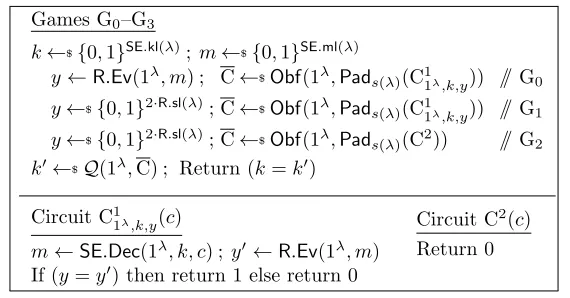
uniformly and independently at random and lets C be the circuit that embedskand the resulty of the PRG onm. On input a ciphertextc, circuit C decrypts it underkand then checks that the PRG applied to the result equals y. The auxiliary information is an obfuscation C of C. The attack showing claim (2) of Theorem 4.1 is straightforward but its analysis is more work and exploits the security of the PRG. Next one shows that iO-security of the obfuscator coupled with security of the PRG implies claim (1), namely the unpredictability of X. For completeness we provide a self-contained proof in Appendix A. A consequence of Theorem 4.1 is the following.
Corollary 4.2 Let SE be a symmetric encryption scheme such that SE.ml(·) ∈ Ω((·)ϵ) for some constant ϵ >0. Assume the existence of an indistinguishability obfuscator and a one-way function. Then SEis not KM-leakage resilient.
Proof of Corollary 4.2: The assumption on SE.ml implies that there exists a PR-secure PRG
RwithR.sl=SE.ml[38]. To conclude we apply Theorem 4.1.
Related work.CKVW [26] show that symmetric encryption with weak keys satisfying a wrong
key detection property is equivalent to MB-AIPO. Wrong key detection, a form of robustness [1], asks that, if you decrypt, under a certain key, a ciphertext created under a different key, then the result is⊥. This is not a requirement for KM-LR-SE. However, implicit in the proof of Theorem 4.1 is a connection between KM-LR-SE and a form of MB-AIPO with a relaxed correctness condition.
5
UCE for split sources
AlgorithmSE.Enc(1λ, k, m)
hk←$H.Kg(1λ)
Fori= 1, . . . ,|m|do
y[i]←H.Ev(1λ,hk, k∥m[i]∥⟨i⟩ℓ(λ)) Return (hk,y)
Algorithm SE.Dec(1λ, k,(hk,y)) Fori= 1, . . . ,|y|do
If (H.Ev(1λ,hk, k∥1∥⟨i⟩ℓ(λ)) =y[i]) Then m[i]←1 elsem[i]←0 Return m
Here ⟨i⟩ℓ(λ) = 1i0ℓ(λ)−i denotes a particular, convenient encoding of integeri ∈ {1, . . . , ℓ(λ)} as a string ofℓ(λ) bits, and m[i] denotes the i-th bit of m. The ciphertext (hk,y) consists of a keyhk
forH chosen randomly and anew at each encryption, together with the vector y whosei-th entry is the hash of the i-th message bit along with the key and index i. This scheme will have perfect correctness if His injective, but we do not want to assume this. The following theorem says that the scheme is KM-leakage resilient and also has (somewhat better than) weak correctness under UCE-security ofH.
Theorem 5.1 Let H be a family of functions that is UCE[Scup∩Ssplt]-secure. Assume H.il(·) ∈ Ω((·)ϵ) for some constant ϵ >0 and 2−H.ol(·) is negligible. LetSE=H&C[H]. Then (1) symmetric encryption scheme SE is KM-leakage resilient, and (2) 1−AdvdecSE(·) is negligible.
Proof of Theorem 5.1: Assuming for simplicity as in the construction that H.il is odd, let
ℓ(·) = (H.il(·) −1)/2. We now prove part (1). Let X be an unpredictable, uniform auxiliary information generator. Let Abe a PT adversary. We build a PT sourceS ∈Scup∩Sspltand a PT distinguisher Dsuch that
AdvindSE,X,A(λ) ≤ 2·AdvuceH,S,D(λ) (3) for all λ ∈ N. The assumption that H is UCE[Scup∩Ssplt]-secure now implies part (1) of the theorem.
We proceed to build S,D. We let S be the split source S = Splt[S0,S1], where algorithms S0,S1 are shown below, along with distinguisherD:
Algorithm S0(1λ) (k, m1, a)←$X.Ev(1λ) m0←${0,1}ℓ(λ); d←${0,1}
For i= 1, . . . , ℓ(λ) do x[i]←k∥md[i]∥⟨i⟩ℓ(λ) Return ((d, a),x)
Algorithm S1(1λ,y) Return y
DistinguisherD(1λ,hk, L) ((d, a),y)←L; c←(hk,y)
d′←$A(1λ, a, c)
If (d=d′) then b′←1 Else b′←0
Returnb′
Here S0 calls the auxiliary information generator Xto produce a key, a plaintext message and the corresponding auxiliary input. It then picks another plaintext message and the challenge bit dat random, and letsxconsist of the inputs on which the hash function would be applied to create the challenge ciphertext. It leaks the challenge bit and auxiliary information. Algorithm S1 takes as input the resulty of oracleHASH onx, and leaks the entire vector y. The distinguisher gets the
leakage from both stages, together with the keyhk. Using the latter, it can create the ciphertext
c, which it passes to Ato get back a decision. Its output reflects whether Awins its game. Lettingb denote the challenge bit in game UCESH,D(λ), we claim that
Pr[b′ = 1|b= 1 ] = 1 2 +
1 2Adv
ind
SE,X,A(λ) and Pr[b′ = 1|b= 0 ] =
1 2 ,
distinct, due to the ⟨i⟩ℓ(λ) components. So the entries of y are uniform and independent, and in particular independent of the challenge bitd.
This however does not end the proof: We still need to show thatS ∈Scup∩Ssplt. We have ensured that S ∈ Ssplt by construction. The crucial remainig step is to show that S ∈ Scup. This will exploit the assumed unpredictability of X. Let P be a PT predictor. We build PT adversary Q such that
AdvpredS,P(λ) ≤ AdvpredX,Q(λ) (4) for allλ∈N. The assumption thatXis unpredictable now implies thatS ∈Scup. The construction of Qis as follows:
AdversaryQ(1λ, a)
Fori= 1, . . . , ℓ(λ) doy[i]←${0,1}H.ol(λ)
d←${0,1}; x′←$P(1λ,((d, a),y)) ; k←x′[1..ℓ(λ)] ; Return k
Adversary Q computes leakage ((d, a),y) distributed exactly as it would be in game PREDPS(λ), whereHASHis a random oracle. It then runsP to get a predictionx′of some oracle query ofS. If
game PREDPS(λ) returnstrue, thenx′ must have the formk∥md[i]∥⟨i⟩ℓ(λ)for somei∈ {1, . . . , ℓ(λ)}, where k, dare the key and challenge bit, respectively, chosen by S. Adversary Q can then win its PREDQX(λ) game by simply returningk, which establishes Equation (4).
This completes the proof of part (1) of the theorem. We prove part (2) by building a PT source S ∈Ssup∩Ssplt and a PT distinguisherD such that
1−AdvdecSE(λ) ≤ AdvHuce,S,D(λ) + ℓ(λ)
2H.ol(λ) (5)
for allλ∈N. But we have assumed thatHis UCE[Scup∩Ssplt]-secure, so it is also UCE[Ssup∩Ssplt ]-secure. We have also assumed 2−H.ol(·) is negligible. Part (2) of the theorem follows.
We proceed to build S,D. We let S be the split source S = Splt[S0,S1], where algorithms S0,S1 are shown below, along with distinguisherD:
AlgorithmS0(1λ)
k←${0,1}ℓ(λ)
Fori= 1, . . . , ℓ(λ) do x[2i−1]←k∥1∥⟨i⟩ℓ(λ)
x[2i]←k∥0∥⟨i⟩ℓ(λ) Return (ε,x)
Algorithm S1(1λ,y) Return y
DistinguisherD(1λ,hk,(ε,y)) b′ ←0
Fori= 1, . . . , ℓ(λ) do If (y[2i−1] =y[2i]) Then b′ ←1
Return b′
Lettingb denote the challenge bit in game UCESH,D(λ), we claim that
Pr[b′ = 1|b= 1 ]≥1−AdvdecSE(λ) and Pr[b′= 1|b= 0 ]≤ ℓ(λ) 2H.ol(λ) ,
from which Equation (5) follows. The first equation above is true because decryption errors only happen when hash outputs collide for different values of the message bit. For the second, when
b= 0, we know thatHASHis a random oracle. But the entries ofxare all distinct. So the entries
S is a split source by construction. To conclude the proof we need to show that S ∈Ssup. In the case HASH is a random oracle, the distinctness of the oracle queries of S means that the entries
of yare uniformly and independently distributed. Since there is no leakage beyond y, the leakage gives the predictor P no extra information about the entries of x. The uniform choice ofk by S means that AdvpredS,P(·)≤2−ℓ(·), even if P is not restricted to PT. But our assumption on H.il(·) in
the theorem statement implies that 2−ℓ(·) is negligible.
¬iO∨ ¬UCE[Scup∩Ssplt]. In the BFM [20] iO-based attack on UCE[Scup], the source builds a
circuit which embeds an oracle queryxand its answer y, and outputs an obfuscation of this circuit in the leakage. Splitting is a restriction on sources introduced in BHK [6] with the aim of preventing such attacks. A split source cannot build the BFM circuit because the split structure denies it the ability to leak information that depends both on a query and its answer. Thus, the BFM attack does not work for UCE[Scup∩Ssplt]. However, we show that in fact UCE[Scup∩Ssplt]-security is still not achievable assuming iO. This is now a simple corollary of Theorems 4.1 and 5.1 that in particular was the motivation for the latter:
Theorem 5.2 Let H be a family of functions such that H.il(·) ∈ Ω((·)ϵ) for some constant ϵ > 0 and2−H.ol(·) is negligible. Assume the existence of an indistinguishability obfuscator and a one-way function. Then His not UCE[Scup∩Ssplt]-secure.
BM2 [23] show that UCE[Scup ∩Ssplt∩S1]-security is achievable assuming iO and AIPO. Our negative result of Theorem 5.2 does not contradict this, and in fact complements it to give a full picture of the achievability of UCE security for split sources.
Acknowledgments
We thank Huijia Lin for discussions and insights. We thank the TCC 2016-A reviewers for extensive and insightful comments.
References
[1] M. Abdalla, M. Bellare, and G. Neven. Robust encryption. In D. Micciancio, editor,TCC 2010, volume 5978 ofLNCS, pages 480–497. Springer, Heidelberg, Feb. 2010. 13
[2] P. Ananth, D. Boneh, S. Garg, A. Sahai, and M. Zhandry. Differing-inputs obfuscation and applications. Cryptology ePrint Archive, Report 2013/689, 2013. http://eprint.iacr.org/2013/689. 12
[3] B. Barak, S. Garg, Y. T. Kalai, O. Paneth, and A. Sahai. Protecting obfuscation against algebraic attacks. In P. Q. Nguyen and E. Oswald, editors, EUROCRYPT 2014, volume 8441 of LNCS, pages 221–238. Springer, Heidelberg, May 2014. 2
[4] B. Barak, O. Goldreich, R. Impagliazzo, S. Rudich, A. Sahai, S. P. Vadhan, and K. Yang. On the (im)possibility of obfuscating programs. In J. Kilian, editor, CRYPTO 2001, volume 2139 ofLNCS, pages 1–18. Springer, Heidelberg, Aug. 2001. 2, 6, 12
[5] M. Bellare and V. T. Hoang. Resisting randomness subversion: Fast deterministic and hedged public-key encryption in the standard model. In E. Oswald and M. Fischlin, editors,EUROCRYPT 2015, Part II, volume 9057 ofLNCS, pages 627–656. Springer, Heidelberg, Apr. 2015. 2, 3, 4
[7] M. Bellare and P. Rogaway. The security of triple encryption and a framework for code-based game-playing proofs. In S. Vaudenay, editor, EUROCRYPT 2006, volume 4004 of LNCS, pages 409–426. Springer, Heidelberg, May / June 2006. 5
[8] M. Bellare and I. Stepanovs. Point-function obfuscation: A framework and generic constructions. In
Theory of Cryptography, TCC 2016-A. Springer, 2016. 4, 11
[9] M. Bellare, I. Stepanovs, and S. Tessaro. Poly-many hardcore bits for any one-way function and a framework for differing-inputs obfuscation. In P. Sarkar and T. Iwata, editors,ASIACRYPT 2014, Part II, volume 8874 ofLNCS, pages 102–121. Springer, Heidelberg, Dec. 2014. 6
[10] N. Bitansky and R. Canetti. On strong simulation and composable point obfuscation. In T. Rabin, editor, CRYPTO 2010, volume 6223 ofLNCS, pages 520–537. Springer, Heidelberg, Aug. 2010. 2, 7
[11] N. Bitansky, R. Canetti, H. Cohn, S. Goldwasser, Y. T. Kalai, O. Paneth, and A. Rosen. The impos-sibility of obfuscation with auxiliary input or a universal simulator. In J. A. Garay and R. Gennaro, editors, CRYPTO 2014, Part II, volume 8617 ofLNCS, pages 71–89. Springer, Heidelberg, Aug. 2014. 2, 4
[12] N. Bitansky, R. Canetti, Y. T. Kalai, and O. Paneth. On virtual grey box obfuscation for general circuits. In J. A. Garay and R. Gennaro, editors,CRYPTO 2014, Part II, volume 8617 ofLNCS, pages 108–125. Springer, Heidelberg, Aug. 2014. 2, 7, 8
[13] N. Bitansky, R. Canetti, Y. T. Kalai, and O. Paneth. On virtual grey box obfuscation for general circuits. Cryptology ePrint Archive, Report 2014/554, 2014. http://eprint.iacr.org/2014/554. 2, 7
[14] N. Bitansky, R. Canetti, O. Paneth, and A. Rosen. On the existence of extractable one-way functions. In D. B. Shmoys, editor, 46th ACM STOC, pages 505–514. ACM Press, May / June 2014. 2, 4
[15] N. Bitansky and O. Paneth. Point obfuscation and 3-round zero-knowledge. In R. Cramer, editor,
TCC 2012, volume 7194 ofLNCS, pages 190–208. Springer, Heidelberg, Mar. 2012. 2, 8, 11
[16] N. Bitansky and O. Paneth. On the impossibility of approximate obfuscation and applications to resettable cryptography. In D. Boneh, T. Roughgarden, and J. Feigenbaum, editors,45th ACM STOC, pages 241–250. ACM Press, June 2013. 2
[17] M. Blum and S. Micali. How to generate cryptographically strong sequences of pseudorandom bits.
SIAM Journal on Computing, 13(4):850–864, 1984. 5, 12
[18] E. Boyle, K.-M. Chung, and R. Pass. On extractability obfuscation. In Y. Lindell, editor, TCC 2014, volume 8349 of LNCS, pages 52–73. Springer, Heidelberg, Feb. 2014. 12
[19] Z. Brakerski and G. N. Rothblum. Virtual black-box obfuscation for all circuits via generic graded encoding. In Y. Lindell, editor, TCC 2014, volume 8349 of LNCS, pages 1–25. Springer, Heidelberg, Feb. 2014. 2
[20] C. Brzuska, P. Farshim, and A. Mittelbach. Indistinguishability obfuscation and UCEs: The case of computationally unpredictable sources. In J. A. Garay and R. Gennaro, editors,CRYPTO 2014, Part I, volume 8616 ofLNCS, pages 188–205. Springer, Heidelberg, Aug. 2014. 2, 3, 4, 7, 13, 16
[21] C. Brzuska, P. Farshim, and A. Mittelbach. Random-oracle uninstantiability from indistinguishability obfuscation. In Y. Dodis and J. B. Nielsen, editors, TCC 2015, Part II, volume 9015 ofLNCS, pages 428–455. Springer, Heidelberg, Mar. 2015. 2, 4
[22] C. Brzuska and A. Mittelbach. Indistinguishability obfuscation versus multi-bit point obfuscation with auxiliary input. In P. Sarkar and T. Iwata, editors,ASIACRYPT 2014, Part II, volume 8874 ofLNCS, pages 142–161. Springer, Heidelberg, Dec. 2014. 2, 3, 4, 13, 19
[24] C. Brzuska and A. Mittelbach. Universal computational extractors and the superfluous padding as-sumption for indistinguishability obfuscation. Cryptology ePrint Archive, Report 2015/581, 2015. http://eprint.iacr.org/2015/581. 4
[25] R. Canetti. Towards realizing random oracles: Hash functions that hide all partial information. In B. S. Kaliski Jr., editor,CRYPTO’97, volume 1294 ofLNCS, pages 455–469. Springer, Heidelberg, Aug. 1997. 2, 8
[26] R. Canetti, Y. T. Kalai, M. Varia, and D. Wichs. On symmetric encryption and point obfuscation. In D. Micciancio, editor,TCC 2010, volume 5978 ofLNCS, pages 52–71. Springer, Heidelberg, Feb. 2010. 3, 4, 11, 13
[27] J. H. Cheon, K. Han, C. Lee, H. Ryu, and D. Stehl´e. Cryptanalysis of the multilinear map over the integers. In E. Oswald and M. Fischlin, editors, EUROCRYPT 2015, Part I, volume 9056 of LNCS, pages 3–12. Springer, Heidelberg, Apr. 2015. 2
[28] J.-S. Coron, T. Lepoint, and M. Tibouchi. Cryptanalysis of two candidate fixes of multilinear maps over the integers. Cryptology ePrint Archive, Report 2014/975, 2014. http://eprint.iacr.org/2014/975. 2
[29] Y. Dodis, C. Ganesh, A. Golovnev, A. Juels, and T. Ristenpart. A formal treatment of backdoored pseudorandom generators. In E. Oswald and M. Fischlin, editors,EUROCRYPT 2015, Part I, volume 9056 ofLNCS, pages 101–126. Springer, Heidelberg, Apr. 2015. 3
[30] Y. Dodis, Y. T. Kalai, and S. Lovett. On cryptography with auxiliary input. In M. Mitzenmacher, editor, 41st ACM STOC, pages 621–630. ACM Press, May / June 2009. 3, 11
[31] S. Garg, C. Gentry, S. Halevi, M. Raykova, A. Sahai, and B. Waters. Candidate indistinguishability obfuscation and functional encryption for all circuits. In 54th FOCS, pages 40–49. IEEE Computer Society Press, Oct. 2013. 2, 6, 12
[32] S. Garg, C. Gentry, S. Halevi, and D. Wichs. On the implausibility of differing-inputs obfuscation and extractable witness encryption with auxiliary input. In J. A. Garay and R. Gennaro, editors,
CRYPTO 2014, Part I, volume 8616 ofLNCS, pages 518–535. Springer, Heidelberg, Aug. 2014. 2, 4
[33] C. Gentry, S. Halevi, H. K. Maji, and A. Sahai. Zeroizing without zeroes: Cryptanalyzing multilinear maps without encodings of zero. Cryptology ePrint Archive, Report 2014/929, 2014. http://eprint. iacr.org/2014/929. 2
[34] C. Gentry, A. Lewko, A. Sahai, and B. Waters. Indistinguishability obfuscation from the multilinear subgroup elimination assumption. Cryptology ePrint Archive, Report 2014/309, 2014.http://eprint. iacr.org/2014/309. 2
[35] S. Goldwasser and Y. T. Kalai. On the impossibility of obfuscation with auxiliary input. In46th FOCS, pages 553–562. IEEE Computer Society Press, Oct. 2005. 2
[36] M. D. Green, J. Katz, A. J. Malozemoff, and H.-S. Zhou. A unified approach to idealized model separations via indistinguishability obfuscation. Cryptology ePrint Archive, Report 2014/863, 2014. http://eprint.iacr.org/2014/863. 2, 4
[37] S. Hada. Zero-knowledge and code obfuscation. In T. Okamoto, editor, ASIACRYPT 2000, volume 1976 ofLNCS, pages 443–457. Springer, Heidelberg, Dec. 2000. 2
[38] J. H˚astad, R. Impagliazzo, L. A. Levin, and M. Luby. A pseudorandom generator from any one-way function. SIAM Journal on Computing, 28(4):1364–1396, 1999. 13
[39] H. T. Lee and J. H. Seo. Security analysis of multilinear maps over the integers. In J. A. Garay and R. Gennaro, editors,CRYPTO 2014, Part I, volume 8616 ofLNCS, pages 224–240. Springer, Heidelberg, Aug. 2014. 2
![Figure 2:Games defining UCE security of function family H, unpredictability of source S, andthe split source S = Splt[S0, S1] associated to S0, S1.](https://thumb-us.123doks.com/thumbv2/123dok_us/7935030.1317474/7.612.93.514.70.223/figure-games-dening-security-function-unpredictability-source-associated.webp)