A Study on Optical Switching: An Efficient
Switching Tool for Optical Communication
Network
Reji Thomas, Piyush Kumar Sharma
M.Tech Students, Department of ECE, ASET, Amity University, Noida, Uttar Pradesh, India
ABSTRACT: Optical communication network promises to deliver an unmatched data transmission speed with high capacity and bandwidth. However, one could never fully exploit the astonishing speed of light in communication as modern day electronic devices, installed in optical networks, could never stand up to the requirements of the light speed transmission. The optical systems have some serious limitations which include its inability for bit-level optical processing, slow switching and lack of efficient all-optical memory. Switching in optical networks are carried out by electronic devices. These devices rely on repeated O-E-O conversion of incoming data for switching activities, which adversely affect the optical speed. The electronic devices also act as a hurdle during optical system up-gradation as each time it needs to be replaced or upgraded. If the optical switching could be done in optical domain without the need for unwanted conversions, the use of electronic devices could be eliminated. This would not only bolster the speed of optical network but will also reduce the cost of optical system.
KEYWORDS: Switching, Optical Packet switching, Burst Switching, Optical networks
I. INTRODUCTION
During the past few years, there has been a huge burst in data traffic in telecommunication. The rapid surge in the use of multimedia devices and applications, all laid over the wide common platform of internet, has led to the increase in demand for transmission mediums with increased capacity and performance. The era of low bandwidth and low capacity transmission mediums like coaxial and twisted pair cables is almost in its exit route and has now paved way for faster and better communication mediums like optical fibers. The advantages of optical fibers include very large bandwidth, high speed, immune to external noise and interference, small size, low cost, etc. and thus meet the basic requirements of an ideal transmission medium. The optical fiber capacity can be further enhanced by the use of various technologies like WDM and DWDM, which allows multiple signals to be transmitted over a single fiber. However, despite all these appealing features of optical fibers, deployment of optical networks in large scale is far from reality. Optical communication systems have some serious limitations which include its inability for bit-level optical processing, all-optical memory and slow switching. Until now, the switching in optical systems was entirely dependent on electronic devices. In each switching node, the optical signal is first converted to electrical signal, buffered, processed and then retransmitted to the next node, after reconverting the signal into optical form. The repeated conversion of signal at each switching node, introduces a lot of delay in the transmission system. Also, the electronics devices employed are costly and bulky compared to optical components. To overcome, these drawbacks, an efficient all-optical switching technology is required. By developing optical switches, the unwanted conversion and hence, the delay could be easily avoided, thereby increasing the speed of the optical system. Various optical switching techniques [1] like optical packet switching (OPS), Optical Burst Switching (OBS), Optical Label Switching (OLS), etc. [2] [3] have been developed and promise to solve the switching problems in optics.
II. OPTICAL SWITCHING TECHNIQUES
A. Optical Packet Switching (OPS)
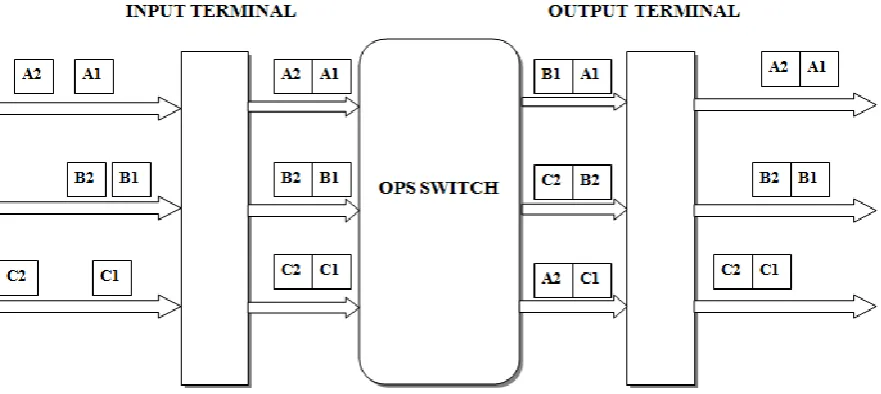
packets. These packets include headers and payloads. Headers consist of vital information including the destination address, payload length, data rate, etc. On reaching the input interface of the optical switch, the header information is extracted and processed and based on this information the packets are stored and switched to appropriate destination through a switching matrix. All these are done electronically with the help of switch controller. The advantages of OPS technique include increased speed, flexibility, high capacity, configurability and data rate transparency. Also, with OPS, the bandwidth can be efficiently used by multiplexing different streams of packets through WDM or DWDM multiplexing. However, OPS has two main limitations. First, the processing of header information cannot be done in optical domain and thus have to be converted to electrical form, Secondly, for buffering of packets, an efficient all optical memory is not available. Electronic memory and RAM are available but it adds to the delay and cost. Another drawback with OPS is that the packets travelling over the same fiber may reach the destination at different time due to different delay undergone by each packet. This delay can caused due to various parameters affecting the transmission of packets including chromatic dispersion, length of transmitting medium i.e. fiber or temperature.
Fig. 1 Schematic for Constant length synchronous OPS switch
B. Optical Burst Switching (OBS)
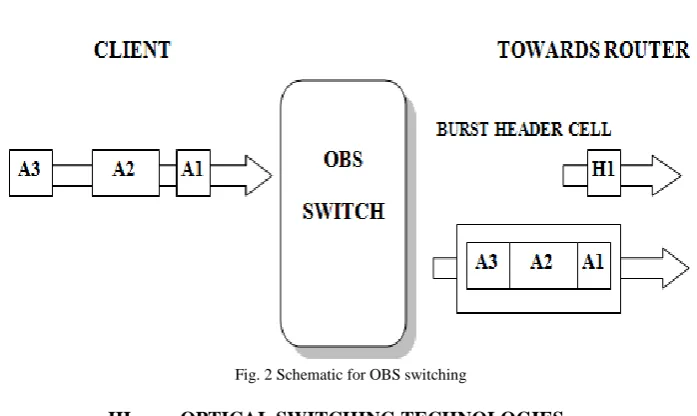
Fig. 2 Schematic for OBS switching
III. OPTICAL SWITCHING TECHNOLOGIES
A number of optical switched have been developed [4] and these can be weighed based on its speed, loss, granularity, port size, etc. Further, the optical switches will be described based on various application technologies.
A. Liquid-Crystal Optical Switches
Liquid crystals are matters that posses properties of both liquid as well as solid crystals. Such properties are inhibited by a number of organic materials. The molecules of such solid crystals can flow like liquid and these molecules can have any orientation. Liquid crystals have the property of permanent dipole moment. When an electric voltage is applied, the molecules orient themselves in particular form and this property is employed in liquid crystal optical switches. In the switch, a polarizing beam splitter is used to split the optical signals into two polarizing modes. The two polarized signal components are then focussed into active cells. These active cells are filled with liquid crystal elements. These elements change the polarization of the incoming light based on the applied voltage. The polarized light is combined or left unaffected and transmitted over the output port.
B. MEMS Optical Switch
In MEMS switches, micro sized mirrors are employed and it is used to reflect and deflect the optical signals into desired output ports. The switches can be rotated to deflect the signals as per required Using MEMS technology, the optical switches can be fabricated in varying sizes.
C. Thermo Optic Switch
The basic principle of operation of thermo-optic switch [7] is the thermo optic effect i.e. when the temperature is increased or decreased, the refractive index of the medium also varies. The thermo optic switches can be classified into two – digital optical switch and Interferometric switch. The digital optical switch is driven by the threshold voltage applied to the switch while the interferometric switches need a specific driving voltage to perform switching.
D. Bubble Switch
The bubble switch has same operation principle as that of ink jet printers. It consists of 2 layers. The upper layer is made of silicon and houses the ink jet technology and the layer beneath it made of silica and over this top layer the optical signals propagate. This layer consists of 2 different series of optical waveguides making and an angle of 120° with each other. At the junction of each of the two angularly connected waveguides a small hollow is provided and is filled with a liquid of same refractive index as that of the silica so that the optical signal may propagate without any diversion. The liquid acts as a bubble at the hollow.
When an optical signal propagates through the waveguide, it moves in a straight path unaltered until n unless it intersects with the bubble at the cross junction. This bubble is created by the electrodes housed in the upper layer of the material and heats the liquid till the liquid is gasified. When an optical signals intersects with this bubble, its path is changed and it is directed towards another adjoining waveguide. The main advantage of this technology is its high scalability.
IV. OPTICAL SWITCH APPLICATIONS
A. Optical Protection Switch:
The optical protection switch is used to secure the data transmission in case of network failure or system errors. It makes sure that no data is lost and the transmission is completed. Such protection switch generally employs switches of small size, i.e. of 1 x 2 or 2 x 2. The optical switch protection includes many steps hence adds to the total transmission time. These switches are very reliable.
B. Add / Drop Multiplexers
While transmitting multiple wavelengths over a single channel, it may be required to add or drop certain signals of particular wavelength over the transmission line. The optical add / drop multiplexers provide the same purpose. Using OADMS, a particular wavelength could be added to the transmission line or particular wavelength could be dropped or prevented from transmitting further over the line. Fiber Bragg Grating is generally employed to serve the purpose. Recently, reconfigurable OADMS have also been developed.
C. Optical Cross-Connects:
One of the most significant contribution of optical switches is in optical cross connects. (OXC). OXCs are used to reconfigure the light path i.e. the path over which the light propagates via optical fiber or medium. It is used to switch or connect the high speed optical signals into the optical fibers. There are various types of optical cross connects which are used in optical networks. They are
i. Opaque Optical Cross Connects – In this device, the switching activity takes place in electronic domain. The incoming optical signal to the switch is first converted to electrical signal, it is then switched electronically via electronic modules and then it is converted back to optical signal before transmitting it over the optical fiber. It employs O-E-O conversion i.e. optical – electrical – optical conversion and adds huge delay to optical transmission.
ii. Translucent Optical Cross Connects – Such a device employs both optical as well as electronic modules for optical signal switching. The signals may be switched with the help of optical modules, without any conversions, or with electronic modules, with O-E-O conversion.
D. Optical Spectral Monitoring (OSM):
The Optical spectral monitoring, also known as optical signal monitoring, is used to examine the optical signal wavelength for its accuracy, cross talks, interference and power level, etc. In OSM, the optical signal transmitting together is separated as per wavelength and each wavelength is examined or monitored separately.
V. SUMMARY
As technology advances, more and more challenges sprout up. Exploiting the speed of light i.e. 3 x 10⁸ m/s was once a dream which has now become reality. However, one could never take full advantage of this astonishing speed in communication as modern day devices couldn’t stand up to the requirements of this speedy light transmission. Many devices and modules have been developed to enhance the long distance optical communication. Until now, many electronic devices were used in optical networks. These devices employed O-E-O conversion i.e. light was converted again and again over the same link. This not only lead to huge transmission loss but added a huge yoke over the fast optical transmission. The quality of optical transmission speed was deteriorated due to the enormous delay introduced by electronic devices. To overcome this setback, all optical devices have been introduced.. These devices require no optical to electrical conversion and hence eliminate the unwanted delay. However, installing these devices into existing optical networks is far from reality as it is very costly. Also the size of the optical switches is another concern as it is difficult to realize switches with large number of ports. Researchers are trying hard to bring down the cost and are finding ways to fabricate switches with many ports. Nevertheless, the days are not far when the all optical switching networks will be a reality and installed throughout the world for light speed communication.
REFERENCES
[1] M. Kaleem Iqbal, M. Bilal Iqbal, M. Usman Iqbal and M. Hassan Iqbal, “Optical Fiber Switches”, International Conference Open Source Systems and Technologies (ICOSST), 2012
[2] Abid Abdelouahab, F. M. Abbou and H,T. Ewe, “Parallel Optical Burst Switching (POBS) for Ultra-Dense WDM Systems”, International Conference on IT & Multimedia, 2011
[3] S. J. Ben Yoo, “Optical Packet and Burst Switching Technologies for the Future Photonic Internet”, Journal of Lighhtwave Technology, Vol. 24, No. 12, December 2006
[4] Georgios I. Papadimitriou, Chrisoula Papazoglou, and Andreas S. Pomportsis, Member, “ Optical Switching: Switch Fabrics, Techniques and applications”, Journal Of Lightwave Technology, Vol. 21, No. 2, February 2003
[5] M. Neuts, Z. Rosberg, H. L. Vu, J. White, and M. Zukerman, “Performance analysis of optical composite burst switching,” IEEE Commun. Lett., vol. 6, pp. 346–348, Aug. 2002.
[6] M. Murata and K. Kitayama, “Ultrafast photonic label switch for asynchronous packets of variable length,” IEEE INFOCOM 2002, New York, June 23–27, 2002.
[7] M. Hoffman, P.Kopka, and E. Voges, "Thermooptical digital switch arrays in silica on silicon with defined zero voltage state", IEEE Journal of Lightwave Technology, vol. 16, no. 3, March 1998, pp. 395–400.