ISSN(Online): 2320-9801
ISSN (Print): 2320-9798
I
nternational
J
ournal of
I
nnovative
R
esearch in
C
omputer
and
C
ommunication
E
ngineering
(An ISO 3297: 2007 Certified Organization)
Vol. 3, Issue 5, May 2015
Smart Highway Electronic Toll Collection
System
Ganesh K. Andurkar, Vidya R. Ramteke,
Assistant Professor, Dept. of Electronics and Telecommunication, Govt. College of Engineering, Jalgaon, North
Maharashtra University, Maharashtra, India
Student of Fourth Sem M.E., Dept. of Electronics and Telecommunication, Government College of Engineering,
Jalgaon, North Maharashtra University, Maharashtra, India
ABSTRACT: This paper is based on RFID technology, the RFID system uses RFID tag and RFID reader which collects information of vehicle passing through the toll plaza and automatically debits the toll amount from prepaid account of vehicle owner, which in return reduces the traffic congestion and human errors. The vehicle owner has to register his vehicle with provided RFID tag, creating a rechargeable account. When the vehicle will pass through toll gate the amount of toll will automatically be reduced from its account. The system produced is microcontroller based system with embedded c coding, and the hardware is interfaced with java base coding. The softwares used are netbeans and jdk for hardware, mysql for database and mikro c for interfacing microcontroller. The basic advantages of the system is trvalling time is decreased, congestion free network, less emissions in toll area and no infrastructure cost is required. This gives a win win condition for both toll authorities and toll customers.
KEYWORDS: electronic toll collection; radio frequency identification; microcontroller; mickroC; netbeans; jdk java kit.
I. INTRODUCTION
In our day to day life, we pay certain amount of tax through toll plaza to the government. The toll gates are mostly found on national highways and bridges etc., and we pay standing over a queue in the form of cash, although, the mobility of vehicles gets interrupted by this method which takes longer travel time, more consumption of fuel and also pollution level get increased in that region, instead of that the method commonly used by industries and in advanced countries is the Electronic Toll Collection System.
Electronic toll collection system is the technology that enables the automatic electronic toll collection from the prepaid account registered on the name of vehicle owner, determining whether the vehicle is registered or not and informs the toll authorities avoiding toll violations. Over last decades, electronic toll collection system have been implemented in united states and many other countries with a new improvement in it.
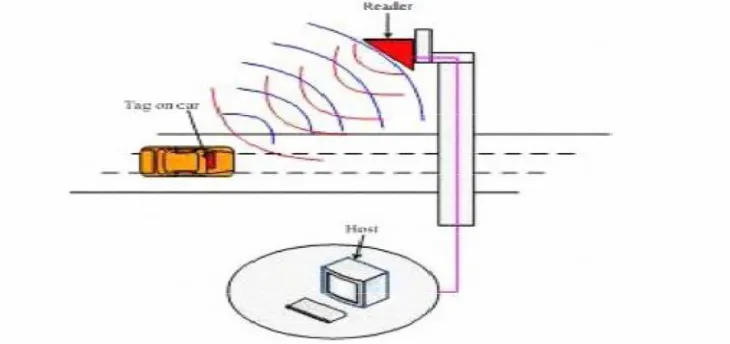
By this we don’t have to carry a handsome amount of cash with us relates to security as well. This system does not require any manual operation of toll barriers and collection of toll amounts, it is completely automated toll collection system. The vehicle owners are registered with their vehicles proper information and their account is created, where they can recharge their account with required amount. When the vehicle passes through the toll gate, the information is shared between RFID tag and RFID reader and the amount is deducted from the owners account. This method reduces the traffic congestion problems, also reduces the travel time and reduces the fuel consumption.
II. LITERATURE REVIEW
ISSN(Online): 2320-9801
ISSN (Print): 2320-9798
I
nternational
J
ournal of
I
nnovative
R
esearch in
C
omputer
and
C
ommunication
E
ngineering
(An ISO 3297: 2007 Certified Organization)
Vol. 3, Issue 5, May 2015
Norway wide spread implementation of this transponder and reader technology. This system was first introduced in Bergen (1986). World’s first use of completely unaided full speed electronic toll system was introduced by Trondheim (1991). Norway has electronic fee collection EFC. Single, universal system was applied firstly by Portugal (1995). Next The United States was another country used ETC system in several states. In Garden State Parkway, California, Texas and Pennsylvania, Delaware and Florida, vehicles can travel at full speed through electronic lanes.
If the lengths in electronic lanes are same as in manual lanes, e-toll saves the vehicle time which has been registered, eliminates the stoppage at toll machine. Toll gates are very typically wider than the rest of the highway that reduced the need for them made it possible to fit toll roads into tight corridors.
Despite of these limitations, if delay at the gate is reduced, however, throughput increases. The greater the throughput is increased the fewer the lanes were required and the greater the fraction of automated lanes, the lower was the cost of operation was required for the short term, but for long term, the greater the registering and turning one’s vehicle into e-toll, the faster vehicles were converted from manual toll.
In Australia, many organizations which includes Roads and Maritime Services, Roam and E-toll. Some operators including Sydney’s Sydney Harbour Tunnel, Lane Cove Tunnel and Westlink M7, Melbournes Citylink and Eastlink and Brisbane’s Gateway Motorway.
Liber-T for light vehicles and TIS-PL for high vehicles are used in some states of France. The Sem Para/Via-Facil system in Brazil in the states Sao Paulo, Paran, Santa Catarina, Rio Grande do Sul, Bahia and Rio de Janerio allows clients to pass through tolls in 1000+ lanes.
The National Database and registration authority implemented ETC system using RFID in Pakistan. Santiago, Chile implemented first world’s 100% full speed e-tolling with trandponders between 2004 and 2005. In 2007 rtc in Dubai was implemented by The UAE called Salik. Congestion pricing and Urban toll schemes were also implemented using ETC and cameras for number plate recognition.
III.PROPOSED ALGORITHM
A. Design Considerations:
ISSN(Online): 2320-9801
ISSN (Print): 2320-9798
I
nternational
J
ournal of
I
nnovative
R
esearch in
C
omputer
and
C
ommunication
E
ngineering
(An ISO 3297: 2007 Certified Organization)
Vol. 3, Issue 5, May 2015
1. RFID Tag
The RFID tag is simply transceiver, the simple difference between transceiver and tag is that there is no dc voltage supply to a chip, therefore we needed a rectifier which rectifies input RF signal and generates dc voltage that powers the other blocks. It consist demodulator that detects command sent by RF reader and it also extracts the clock from received RF signal for synchronization of RFID and RFID reader, a control logic i.e. digital part that controls all other blocks in a tag which decides when to receive, when to transmit and when to stay idle, an internal clock that supplies internally generated clock to digital part, and a modulator that transmits the tag id.
2. RFID Reader
A simple low cost reader which is used as an educational tool. It consist of an envelop detector, analog comparator based on data slicer and a low power transmitter based on off-the shell IC. The reader has power consumption of 60 mW, average current is 15 mA at 4V battery voltage and can operate for %0 hrs on single charge.
3. Microcontroller
This unit is the main block of the system, which is actually responsible for each and every process being executed. It controls and also monitors each component connected to the system and also controls the peripheral devices. The working of microcontroller resides in the software code embedded in it.
4. Power Supply
It supplies various voltages as per requirement to each unit. This portion consist of transformer, rectifier, regulator and capacitors for filter. The rectifier is used as a bridge rectifier which converts 230V to desired 5V/12V DC.
5. Stepper Motor
It is for opening and closing of a barrier on the toll gate. It is done when the customer successfully performs the billing operation through RFID with sufficient balance.
6. Buzzer
Buzzer will ring when there will be insufficient balance in customer account.
B. Description of the Technology, Programming Languages and Softwares:
Following are the technologies and Programming languages which are used in the system.
Embeded Technology
Atmega Family based on Microcontroller
Embeded C, MikroC
Express PCB for PCB designing
Netbeans-7.1-ml-javaee-windows
Jdk-6u16-windows-i586
Mysql-%_2.1.40-win32 based Database
IV.EXPERIMENTAL RESULTS
In this part the GUI is shown using netbeans and mysql in given fig below.
ISSN(Online): 2320-9801
ISSN (Print): 2320-9798
I
nternational
J
ournal of
I
nnovative
R
esearch in
C
omputer
and
C
ommunication
E
ngineering
(An ISO 3297: 2007 Certified Organization)
Vol. 3, Issue 5, May 2015
Fig 2. Admin > Run
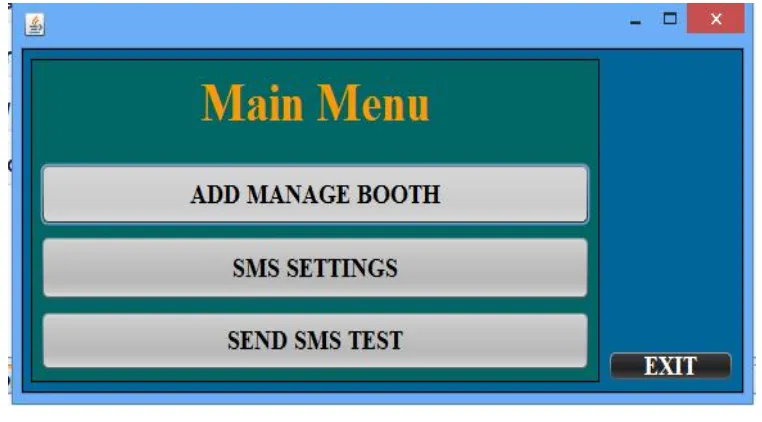
As the Electronic Toll Collection Systems home page arrives, click to continue. The Main Menu page will be seen as shown in fig. 3. It consist of 3 sections. Add Manage Booth for the registry of new authority of toll plaza, Sms Settings and Send Sms Test for adding customers contact details and sending the sms for account information.
Fig 3. Main Menu
ISSN(Online): 2320-9801
ISSN (Print): 2320-9798
I
nternational
J
ournal of
I
nnovative
R
esearch in
C
omputer
and
C
ommunication
E
ngineering
(An ISO 3297: 2007 Certified Organization)
Vol. 3, Issue 5, May 2015
Fig 4. Registration of Toll Authorities
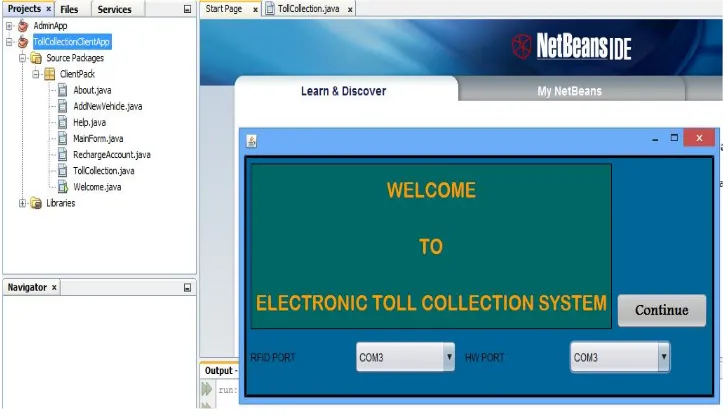
Now Right Click on Toll Collection App, build and run the project. You will see a Welcome window of Electronic Toll Collection System as shown in fig. 5. Check your ports connected to the RFID reader and hardware from manage devices in My Computer, assign proper RFID reader and hardware ports to their own, and Continue.
Fig 5. Toll Collection Client App > Run
ISSN(Online): 2320-9801
ISSN (Print): 2320-9798
I
nternational
J
ournal of
I
nnovative
R
esearch in
C
omputer
and
C
ommunication
E
ngineering
(An ISO 3297: 2007 Certified Organization)
Vol. 3, Issue 5, May 2015
Fig 6. Login to Toll Authorities
The same Main Menu window will have 3 more options, of Add New Vehicle, Recharge Account and Start Toll Collection. If you want to procceed further select the option needed else Exit.
Fig 7. Add New Vehicle
ISSN(Online): 2320-9801
ISSN (Print): 2320-9798
I
nternational
J
ournal of
I
nnovative
R
esearch in
C
omputer
and
C
ommunication
E
ngineering
(An ISO 3297: 2007 Certified Organization)
Vol. 3, Issue 5, May 2015
Select Recharge Account option for proper journey and in case of low balance. Search for the vehicle by vehicle number, owners name or by RF id number, enter recharge amount and click Recharge. For any updates in information of vehicle Update option is given, shown in fig. 8.
Fig 8. Recharge Account
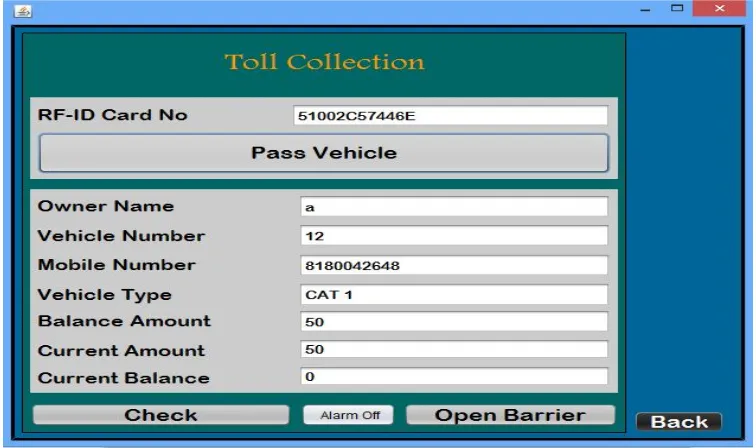
The final stage is Toll Collection, when the vehicle passes through toll plaza RFID tag exchange information with RFID reader and the vehicle information is verified and after successful verification balance is deducted from the account, for this Pass Vehicle option and Open Barrier option is given. In case of low balance, buzzer alarm will indicate and alarm off option is given.
ISSN(Online): 2320-9801
ISSN (Print): 2320-9798
I
nternational
J
ournal of
I
nnovative
R
esearch in
C
omputer
and
C
ommunication
E
ngineering
(An ISO 3297: 2007 Certified Organization)
Vol. 3, Issue 5, May 2015
The hardware will glowing LED indicates the working project.
Fig 10. Hardware
V. CONCLUSION
RFID is one of the new technology emerged in ETC applications. This paper tells us about the application of ETC system on toll gates. This paper gives many advantages, such as waiting time of the vehicles, no traffic congestion, assured and accurate collection of toll amount, free from cash, minimum emissions which are harmful for living.
This paper investigates how to use GUI for collection of toll, the real time management and monitoring is done. It has expanded capacity for vehicle without building the big infrastructures. It has improved efficiency and reliability of toll plazas and traffic abilities of Highways.
REFERENCES
1. Ning Huansheng, Zhang Yan, “RFID and Internet of Things”, Beijing, Electronic Industry Press, @008, pp.18-26 (China). 2. L. Jerry, C. Barbara “shrouds of Time: The History of RFID”. AIM Publication, ver.1.0,2001.
3. M. Avoub Khan, S. Manoj and R.B. Prabhu “A Survey of RFID Tags”, International Journal of Recents in Engineering, vol 1, no 4, May 2009.
4. W.C. Tang, T.V. Ho, “Electronic Toll Collection System”, US Patent, US 7233260 B2, June 2007.
5. Radhika et al, “Electronic Toll Collection System”, UNIASCIT, Vol 1 (1), 2011, 05-08.
6. Pavel V. Nikitin, hashi Ramamurthy, Rene Martinez, “Simple Low Cost RFID UHF Reader”. IEEE International Conference on RFID, 2013.