HydRand: Efficient Continuous Distributed Randomness
Philipp Schindler
∗, Aljosha Judmayer
∗, Nicholas Stifter
∗†, Edgar Weippl
∗†∗SBA Research †
Christian Doppler Laboratory for Security and Quality Improvement in the Production System Lifecycle (CDL-SQI), TU Wien Email: (firstletterfirstname)(lastname)@sba-research.org
Abstract—A reliable source of randomness is not only an essential building block in various cryptographic, security, and distributed systems protocols, but also plays an integral part in the design of many new blockchain proposals. Consequently, the topic of publicly-verifiable, bias-resistant and unpredictable randomness has recently enjoyed increased attention. In partic-ular random beacon protocols, aimed at continuous operation, can be a vital component for current Proof-of-Stake based distributed ledger proposals. We improve upon previous random beacon approaches with HydRand, a novel distributed protocol based on publicly-verifiable secret sharing (PVSS) to ensure unpredictability, bias-resistance, and public-verifiability of a continuous sequence of random beacon values. Furthermore, HydRand provides guaranteed output delivery of randomness at regular and predictable intervals in the presence of adversarial behavior and does not rely on a trusted dealer for the initial setup. Compared to existing PVSS based approaches that strive to achieve similar properties, our solution improves scalability by lowering the communication complexity fromO(n3)toO(n2). Furthermore, we are the first to present a detailed comparison of recently described schemes and protocols that can be used for implementing random beacons.
I. INTRODUCTION
The question of how to generate trustworthy random val-ues among a set of mutually distrusting participants over a message passing network was first addressed by Blum in 1983, thereby introducing the notion ofcoin tossing protocols
[10]. Distributed randomness also forms a key component of
asynchronousconsensus protocols in the form of local [6] and
common coindesigns [38], [20].
Lately, coin tossing protocols have received increased atten-tion, in part because generating shared randomness is proving to be a vital component of most distributed ledger approaches (e.g. [8], [22], [33]) that aim to replace the computationally intensiveProof-of-Work(PoW) mechanism as found in Bitcoin [36] and similar cryptocurrencies. Specifically, Proof-of-Stake
(PoS) blockchain proposals, which rely on virtual resources in the form of digital assets, call for manipulation resistant and unpredictable leader election as part of a secure protocol design [33]. The distributed generation of trustworthy random values can hence be considered a complementary problem to the development of such protocols.
Random beacon protocols aim to generate publicly-verifiable, bias-resistant and unpredictable randomness in dis-tributed environments. The concept of a random beacon was first formalized by Rabin [39], where a service that emits a fresh random number at regular intervals is proposed. Potential application areas for random beacons are broad and, as described in [44], [21], [15], include:
• the secure generation of protocol parameters for crypto-graphic schemes [4], [34]
• privacy preserving messaging services [49], [47], [30]
• protocols for anonymous browsing, including Tor hidden services [46], [31], [28]
• electronic voting protocols [1]
• publicly-auditable selections [15]
• gambling and lottery services [15]
With the emergence of blockchain protocols additional areas that demand secure sources of public randomness, such as sharding approaches [23], were formed. In particular smart contracts often draw upon insecure sources of randomness or trusted third parties [2], [17] such as the NIST random beacon, Random.org or Oraclize.it.
The revealed backdoor in the Dual Elliptic Curve PRNG [9], the unreliability of proprietary beacons [15], and the pos-sibility of a centralized provider buffering, manipulating, and benefiting from prior knowledge of the provided randomness [15] are only a few of many reasons in favor of distributed randomness beacons where trust is spread among participants. Considering distributed approaches, the following proper-ties, as outlined in [3], [15], [44], are desiderata of a random beacon protocol:
1) Availability/Liveness:
Any single participant or colluding adversary should not be able to prevent progress.
2) Unpredictability:Correct, as well as adversarial nodes,
should not be able to predict (precompute) future ran-dom beacon values.
3) Bias-Resistance: Any single participant or colluding
adversary should not be able to influence future random beacon values to their advantage.
4) Public-Verifiability: Third parties not directly
partic-ipating in the protocol should also be able to verify generated values. As soon as a new random beacon value becomes available, all parties can verify the correctness of the new value using public information only.
Additionally, we follow the notion of [33], [21] where
guar-anteed output delivery (G.O.D.) [40] i.e., the inability for
if an application is able to receive the output before a certain time or not.
Another particular desirable property for random beacons in the context of (permissionless) distributed ledgers is the avoid-ance of an initial trusted setup, e.g. a trusted dealer, [44].
Current random beacon protocols aim to provide solutions by employing different techniques, reaching from Proof-of-Delay [17], [19] and incentive based solutions [18], [41] over publicly-verifiable secret sharing (PVSS) [3], [21], [33], [44] and unique signatures [22], [25] to utilizing Bitcoin itself as a source of randomness [7], [15]. The diversity of these approaches, as well as the differences in their underlying as-sumptions and characteristics, make them difficult to compare and not equally suited for all use-cases. Furthermore, various recently described (PoS) blockchain schemes utilize or provide a random beacon as part of their protocol design and are therefore not easily comparable or deployable as a stand-alone protocol.
A. Contribution
We present HydRand, a PVSS based distributed random beacon protocol geared towards the continuous provision of randomness at regular intervals in a Byzantine failure setting. HydRand provides guaranteed output delivery, i.e., it guar-antees the generation of new, bias-resistant randomness in every round of the protocol. As a hybrid approach, HydRand provides both a probabilistic guarantee for unpredictability, which ensures that a successful prediction of future random beacon values becomes exponentially unlikely, as well as unpredictability with absolute certainty for applications which wait for at least f + 1rounds before using a future protocol output. The protocol assumes a synchronous system model and
n = 3f + 1 participants. In respect to previous approaches based on PVSS, the communication complexity is hereby lowered from O(n3) toO(n2) as HydRand only requires at
most one PVSS distribution/recovery operation per round. Our protocol is described in a self contained manner and neither relies on a trusted dealer nor on a distributed key generation (DKG) protocol.
Moreover, to the best of our knowledge, we are the first to provide an extensive comparison of state of the art random beacon protocols in this field that considers and analyses a variety of key characteristics and assumptions.
B. Paper Structure
The assumed system model is presented in section II. Section III provides a high level overview of the HydRand protocol and highlights the employed variant of PVSS, which constitutes one of the main cryptographic primitives that is utilized. The protocol construction is outlined in detail in section IV. An extensive analysis including proofs showing that HydRand achieves the desired properties is presented in section V. Section VI compares HydRand to other related schemes, while sections VII and VIII discuss and conclude the paper. The presentation of our evaluation results, an execution example highlighting the protocol functionality and its phases,
as well as a quick reference for utilized symbols and notations can be found in the appendix.
II. SYSTEM ANDTHREATMODEL
We assume a fixed set of known participants, hereby referred to as nodes, of size n= 3f + 1, of which at most f nodes may exhibit Byzantine failures and can deviate arbitrarily from the specified protocol. A node is considered to becorrectif it does not engage in any incorrect behavior during the entirety of the protocol execution, else it is considered to be faulty. The terms Byzantine or malicious are used synonymously to refer to faulty nodes. The set of all nodes is denoted by P = {1,2, ..., n} and each node i ∈ P is assumed to have a private/public key pair hski, pkii. The public keys of these keypairs are known to all participants. A synchronous system model with a fully connected network of authenticated and reliable bidirectional point-to-point messaging channels is assumed. We argue that the chosen timing model is reasonable for a small to moderate set of participants, and defer an analysis of our protocol in other system models to future work. Further, for many application areas of random beacons, e.g, in the context of cryptocurrencies, partially synchronous and synchronous system models are prevalent. Here, a synchronous random beacon protocol that also provides guaranteed output delivery may be necessary if strong notions of bias-resistance are a requirement.
III. PROTOCOLOVERVIEW
The aim of HydRand is to provide a bias-resistant, publicly-verifiable and unpredictable stand-alone random beacon which emits random values at a regular interval. We target HydRand at a permissioned setting with a fixed set of participants and assume a known upper bound1 on both computation and message transmission times.
For the protocol setup it is assumed that all participants ex-changed their public keys and prepared an initial commitment using publicly-verifiable secret sharing (PVSS). The protocol operation itself is separated into rounds, where each round consists of three distinctphases – propose, acknowledge and voting. We describe these phases in detail in section IV. In each round, the previously generated random value is used for uniquely determining the current roundleader. This leader has two choices: (i) The leader reveals the correct secret value he has committed himself to the last time2 he was leader and attaches his next commitment. (ii) The leader does not reveal his secret value and therefore cannot attach another commitment. In the latter case, the previously committed secret value isreconstructedbyf+1other nodes, including at least one correct participant. The properties of the underlying PVSS scheme ensure that the random beacon value obtained by reconstruction is always equal to the value that is obtained when a leader reveals his secret – this establishes bias-resistance. Additionally, guaranteed output delivery follows
1We assume that a message sent at the beginning of one phase is received
within that same phase.
because the protocol outputs a random beacon value at each round, independent of the actions of the (potentially adversar-ial) leader and other faulty nodes.
In case the leader’s previous commitment is reconstructed, the leader is excluded from being eligible as leader in future rounds since no new valid commitment was provided. How-ever, the presented protocol could also be adapted to facilitate that temporarily failed nodes may rejoin f + 1 rounds after a fresh commitment is provided and agreed upon. A correct leader constructs a newdataset, which includes: (i) the secret value they previously committed themselves to, (ii) a new commitment to a uniformly random sampled value and (iii) a reference to the dataset of the previous round. The leader signs this dataset using their private key and broadcasts this message and signature to all other nodes in the network. After receiving and verifying the dataset, each node can compute the new random value of the beacon.
In case a leader is faulty and does not broadcast any data, other participants can collaborate to reconstruct the missing secret value, i.e. the value the leader has previously committed himself to in (ii). The reconstructed value can be used by any node to obtain the new random beacon value and thereby advance the protocol to the next round and leader. This process is repeated until eventually a correct leader is selected that creates a new dataset that accounts for all reconstructed datasets in between.
To ensure that a correct node is selected as leader after (at most) f+ 1rounds, all previously selected leaders of the lastf rounds are exempt from becoming leader in the current round. Since malicious nodes are unable to determine how an unrevealed commitment of an honest leader will influence future random beacon values, they cannot precompute any fu-ture output once a correct node is selected as leader. Moreover, correct participants converge on a single history after a correct node is selected as leader, because correct leaders are required to build on top of a single dataset and never sign different datasets in the same round. The correct node acts as a barrier for unpredictabilityand anchor for agreement on the protocol state. Unpredictability is thereby ensured with certainty for any round afterf+ 1rounds in the future.Public-verifiability
is established by leveraging the properties of the underlying PVSS scheme.
A. Publicly-Verifiable Secret Sharing
We rely on PVSS as a primary building block in the HydRand protocol. More specifically, we make use of Scrape’s PVSS protocol [21], which is an optimization of Schoen-makers’ PVSS scheme [43], and allows a node (dealer) to efficiently share a secret value s ∈ Zq among a set of n
recipients, such that any subset of at least t recipients is able to recover/reconstruct the value hs ∈ Gq, where h is
one of two independent generators of the group Gq and the
prime q denotes the order of this group. The value of the reconstruction thresholdtis set in a way that does not enable a colluding adversary to successfully recover a shared secret without requiring the collaboration of at least one correct node,
i.e. t=f + 1. A key property of apublicly-verifiable secret sharing protocol is that, upon receiving the secret shares, not only the recipients but any third party with access to the public keys of the participants can verify the correctness of the shares prior to reconstruction of the secret. We use the term PVSS commitment, denoted byCom(s), to refer to the result of the share distribution process of Scrape’s PVSS. To form a PVSS commitment, a dealer provides:
• The encrypted shares for a secret s, i.e. one encrypted share siˆ for each node i, encrypted with the receiver’s public key.
• The commitments v1, v2, ..., vn to the shares for each
node.
• A non-interactive zero-knowledge (NIZK) proof ensuring the correctness of the encrypted shares
For additional details regarding Scrape we refer the reader to [21].
B. Design Rationale
A malicious leader can try to construct and send different commitments, and hence different datasets, to other partici-pants of the protocol or selectively withhold information to bias the resulting sequence of random beacon values. Hence, some form of (Byzantine)consensus protocolis necessary for participants to agree either on a single, valid commitment or the fact that the leader was faulty. In this respect, HydRand leverages on its intended application as a continuousrandom beacon to amortize the communication overhead of Byzantine agreement (BA) that is incurred at each round. Specifically, HydRand introduces a variant of repeated Byzantine agree-ment that defers consensus decisions for up tof+ 1rounds, and combines data from multiple consensus instances that are executed with every consecutive new round of the HydRand protocol. By exempting a current leader to be re-elected within the nextf rounds, enough time is given to reach agreement if the leader was faulty or not. Thereby, the overall communica-tion (bit) complexity in regard to PVSS based random beacon schemes with comparable guarantees is reduced from O(n3)
toO(n2).
IV. PROTOCOLDETAILS
HydRand proceeds in rounds, where each round r ≥ 1
consists of three phases: propose, acknowledge and vote. Further, each round has a uniquely associated leader `r ∈ P
that is selected through the randomness generated by the protocol. When referring to the current round’s leader, we may omit the subscript and simply denote the leader by`.
Each round,`ris selected uniformly at random from the set of all nodes thatwere not leaderduring the lastf+ 1rounds3. At the end of a round all nodes learn a new random beacon valueRr. For simplicity, we hereby assume that correct nodes agree on the initial random beacon valueR0used to select the
leader of round1, as well as the set of initial commitments of
all nodes. R0 becomes public knowledge only after the set of
initial commitments was defined during setup.4
To simplify our notation, we assume that the sender of a broadcast is also a recipient of that message. Similarly, the dealer in the PVSS protocol also provides a share for himself. We usehmii to denote the messagema nodei
cryptograph-ically signed with its private key ski. We further assume, that each correct node discards invalidly signed messages and processes only messages for the current round and phase.
A. Propose Phase
During this phase the round leader ` reveals his previ-ously committed value s` and provides a new commitment
Com(s?`). For this purpose, it is the leader’s task to propose a new dataset Dr for the current roundr. As a performance optimization, we split a dataset into two parts: a header and a body. For certain operations, we only require sending the header of the dataset. The header header(Dr)of dataset Dr
contains:
• the hash of the dataset’s body H(body(Dr))
• the current round index r
• the round’s random beacon value Rr
• the revealed secret value s`
• the round index ~r of the previous datasetD ~r
• the hash H(D ~r)of the previous datasetD ~r if ~r >0 • a list of random beacon values {Rk, Rk+1, ...} for all
recovered rounds between ~r andr(if any)
• the Merkle tree root hash Mr over all encrypted shares in the new commitmentCom(s?`)
We use H(Dr) = H(header(Dr)) to denote the crypto-graphic hash of the datasetDr. The bodybody(Dr)of dataset
Dr contains:
• a confirmation certificate CC(D ~r), which confirms that
D ~r was previously accepted as a valid dataset
• a recovery certificate RC(k) for all rounds k ∈ { ~r + 1, ~r + 2, ..., r−1}, which confirms that there exists a recovery for all rounds between ~r and r If ~r = r−1
then no such intermediate round exists and this value is omitted.
• the commitment Com(s?`) to a new randomly chosen secret s?
`
The leader selects ~r < ras the most recent regular round, for which the leader is not aware of any successful recovery. As we prove in section V-A, such a round always exists and the leader is in possession of the confirmation certificateCC(D ~r)
required for the dataset’s body.
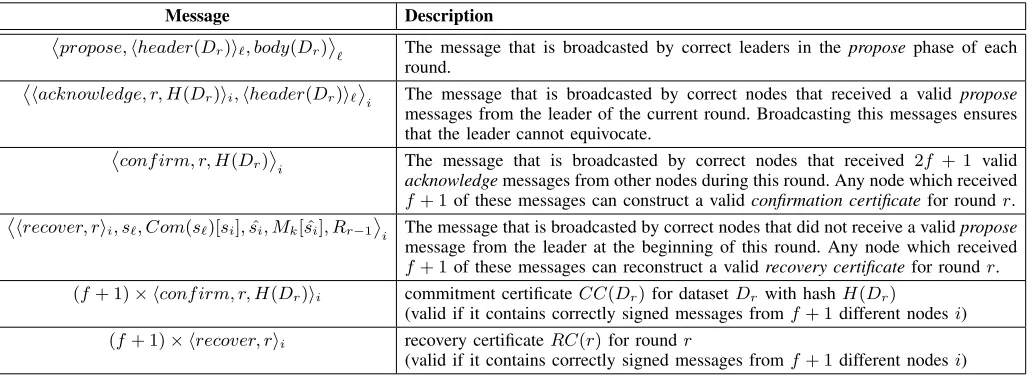
After the construction of the above dataset, a cor-rect leader ` broadcasts a signed propose message
propose,hheader(Dr)i`, body(Dr)` to all nodes. Each nodei, which receives such a message from the leader before the end of the propose phase, checks the validity of the dataset Dr. For this purpose i verifies thatDr is constructed as previously defined and properly signed. This includes a
4 In practice this initial random value can, for example, be obtained via
Proof-of-Delay[17] or aProof-of-Work[7].
check that the revealed secrets` corresponds to the previous commitment Com(s`) of the current leader. Additionally, the validity of the confirmation and recovery certificates is checked. A confirmation certificateCC(D ~r)for datasetD ~r is valid iff it consists of f + 1 signed messages of the form hconf irm, ~r , H(D ~r)ii fromf+1different sendersi.
Similarly, arecovery certificateRC(k)for some roundkis a collection off+ 1signed messages of the formhrecover, kii
fromf+ 1 different senders.
B. Acknowledge Phase
If a node i receives a valid dataset Dr from the round’s leader ` during the propose phase, it con-structs and broadcasts a signed acknowledge message
hacknowledge, r, H(Dr)ii,hheader(Dr)i`
i thereby also
forwarding the revealed secret values` as part of the header.
Further, each nodeicollects and validates acknowledge mes-sages from other nodes.
C. Vote Phase
Each nodei checks the following conditions:
• During the current propose phase a valid datasetDrwas received.
• During the current acknowledge phase at least 2f + 1 valid acknowledge messages from different senders have been received.
• All acknowledge messages received refer to the dataset’s hashH(Dr). Valid acknowledge messages for more than one value ofH(Dr)form a cryptographic proof of leader equivocation.5
If all conditions are met, node i broadcasts a signed confirmation message: hconf irm, r, H(Dr)ii
Otherwise node i, broadcasts a recover message:
hrecover, rii, s`, Com(s`)[si],si, Mk[ ˆˆ si], Rr−1i Here, Com(s`)[si] denotes i’s decrypted share si and its share decryption proof according to Scrape’s PVSS, which cryptographically proves that si is a valid decryption of siˆ
under i’s secret key. Round k denotes the round in which
` has provided the commitment Com(s`) and a Merkle tree root hash Mk. The Merkle branch Mk[ ˆsi] proves that the encrypted share siˆ was previously distributed as part of
Com(s`)and therefore also ofDk. The valuessiˆ andMk[ ˆsi]
are required to enable nodes which are not in possession of
Com(s`)to verify the share decryption proof forsi.Rr−1 is
included for efficient external verification.
Correct nodes always include values fors`,Com(s`)[si],sˆi
and Mk[ ˆsi] if they are in possession of the required data.
Otherwise the unknown value(s) are omitted. This can happen if an adversary selectively sent the previous dataset Dk to a subset of nodes. Therefore, upon receiving recovery messages from other nodes, correct nodes accept messages with omitted values. The protocol guarantees that at leastf+1correct nodes have received the dataset with a valid confirmation certificate,
5 In a (PoS) cryptocurrency setting, the protocol could be extended such
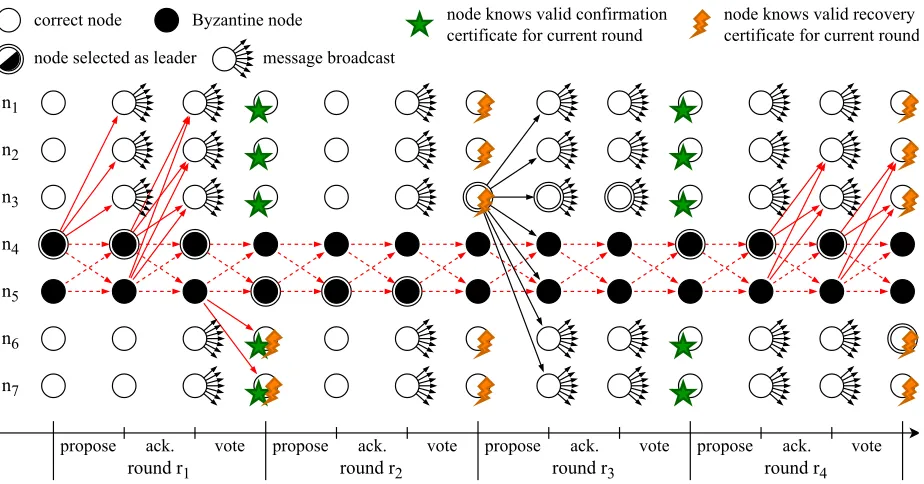
and hence are able to provide the necessary shares required for reconstructing the respective secret. An example is presented in appendix B.
At the end of this phase each node i can obtain the round’s random beacon value Rr. We distinguish between the following two cases: (i) node i already knows the secret values`, because it received the datasetDror an acknowledge message forDr, and (ii) nodeihas received at leastf+1valid
recover messages which include at leastf+1decrypted secret shares for s`. In the latter case the reconstruction procedure
of Scrape’s PVSS can be executed to produce the value hs`.
In both cases Rr is then obtained by computing:
Rr←H(Rr−1||hs`) (Definition 1)
D. Leader selection
At the beginning of each round r≥1, a nodeidetermines the round’s leader `rbased on the available local information
it gathered so far. For this purpose nodeiuses the randomness
Rr−1 of the previous round to deterministically select `r
from the setLrof potential leaders. We denote the canonical
representation of Lr as hl0, l1, ..., l|Lr|−1i and obtain `r as
follows:
`r←l(Rr−1 mod|Lr|) (Definition 2)
Let D ~r denote the most recent valid dataset, for which node
i is not in possession of a corresponding recovery certificate
RC( ~r). If no such dataset exists we set ~r = 0. Now we introduce a method to determine the set of recovered nodes rn(·)as a component needed for the definition of Lr.
Intuitively, the set rn(·) contains all nodes, which have not provided valid datasets for some round where the node was selected as leader. We define the set of all leaders that were recovered in some round up to a referenced dataset as follows:
rn(Dx) =
(
∅ ifx= 0
{`k |RC(k)∈Dx} ∪rn(D ~x) otherwise (Definition 3)
HereD ~x denotes the previous dataset referenced byDx. This
function is used to construct the set of available nodes Pr for
round r recursively by excluding all nodes which have been selected as leader in a round for which a valid reconstruction certificate exists:
Pr=P \rn(D ~r) (Definition 4)
Based on this notion, the definition of the set of potential leaders Lr for roundrfollows:
Lr=Pr\ {`r−f, `r−f+1, ..., `r−1} (Definition 5)
Intuitively, the set Lr only includes nodes that were not
selected as leader for at least f rounds in the past and have not been reconstructed in any previous round, i.e., nodes that distributed valid datasets for all rounds in which they were selected as leader.
V. PROTOCOLPROPERTIES
In the following, we show that HydRand achieves the desirable properties of a random beacon protocol as outlined in section I:liveness,guaranteed output delivery, unpredictabil-ity, bias-resistance, and public-verifiability. We furthermore show that our protocol also achievesuniform agreement. In our proofs we may refer to the definitions introduced in section IV.
A. Liveness and Guaranteed Output Delivery
To show that HydRand satisfies liveness and guaranteed output delivery, we first introduce and prove several primary lemmas. We show that (i) correct nodes are always able to provide a valid dataset if they are selected as leader, (ii) correct nodes can never be recovered and (iii) the set of potential leaders always contains at least f + 1 correct nodes. Using these results, we infer that correct nodes can always output the round’s random beacon value by the end of the round, given that they know the value for the previous round. Finally, we use an inductive argument to prove liveness and guaranteed output delivery of our protocol.
Lemma 1. (Possibility of construction of valid datasets) For
each roundra correct leader`rcan construct a valid dataset Dr.
Proof. Implicit agreement by all correct nodes on the current round numberr follows from the synchronous system model and fixed duration of phases. A correct leader is in possession of its own secret s` and thus knows Rr. Furthermore, the
leader can always construct a new PVSS commitment for a new secretCom(s?
`)and is able to provide a valid value for Mr. Therefore, it only remains to be shown that each correct
node is able to provide the required confirmation certificate
CC(·)and recovery certificatesRC(·). During the vote phase of every previous round, correct nodes have either broadcast a recover or confirm message. As there are at least2f+1correct nodes, each node is guaranteed to receive at leastf+1recover messages or at leastf+ 1confirm messages (or both) for each of these rounds. Asf+ 1recover messages form a recovery certificate and f + 1 confirm messages form a confirmation certificate, each node is in possession of a recovery certificate or a confirmation certificate (or both) for every previous round, and is hence able to provide the required certificates for Dr.
Lemma 2. (No recovery of correct leaders) If leader `r is
correct, there does not exist a node i, which is in possession of a valid recovery certificateRC(r).
Proof. A correct leader `r sends valid proposal Dr to all nodes during the propose phase. By lemma 1, `r can always construct such a dataset. As all correct nodes considerDr as valid, at least2f + 1nodes broadcast acknowledge messages for Dr during the acknowledge phase. All 2f + 1 correct
nodes therefore receive at least 2f + 1 valid acknowledge messages forDr. Since there cannot exist a valid acknowledge
signature forDr) all correct nodes broadcastconfirmmessages during the vote phase. As correct nodes only broadcast either confirm or recover messages, there are at most f recover messages (from Byzantine nodes). A valid recovery certificate
RC(r)however requires at leastf+ 1recover messages from different nodes, and therefore cannot exist.
Lemma 3. (Availability of leaders) For each round r ≥ 1,
the set of potential leaders Lr contains at leastf+ 1correct nodes.
Proof. We first show that for each roundr, the set of available nodesPrcontains at least2f+ 1correct nodes. By Definition
3 and Definition 4 (see section IV-D), we ensure that only leaders `k for some round k, in which a recovery certificate
RC(k)exists, are excluded from the setP to formPr. As we
have shown in lemma 2 there are no recovery certificates for rounds with correct leaders. Therefore correct nodes cannot be excluded fromP to formPr, and thusPrcontains at least 2f+ 1 correct nodes.
Using the above result and Definition 5, which excludes at most f + 1 nodes from Pr to form Lr,Lr contains at least f + 1correct nodes.
Lemma 4. (Liveness) If a correct node knows the random
beacon value Rr−1, it can output the random beacon value
Rr by the end of round r (independent of the actions of the round’s leader`r).
Proof. Following lemma 3 we guarantee the existence of a leader `r. Since `r ∈ Lr andLr ⊂ Pr, we know that `r ∈ Pr. By applying Definition 4 we get `r 6∈ rn(D ~r). Hence,
there exists some history of datasets with head D ~r, in which there does not exist a recovery certificateRC(k)for any round
k < ~r in which `r was also leader. Such a history for any valid dataset Dk can only exist if at least one correct node confirmed thatDk was correctly distributed and acknowledged by 2f+ 1nodes by providing a confirm message. Hence, at least f + 1 correct nodes know a common dataset Dk for all rounds k where `r was previously selected as leader. In addition, all nodes know the shares for `r’s first commitment
as defined in the protocol setup. Thus, at least f+ 1 correct nodes can broadcast the decrypted share in case a recovery of the leader `r in round r is necessary. Hence all nodes learn
the valuehs` corresponding to`
r’s last commitmentCom(s`),
and thus obtain Rr usinghs` andRr
−1 via Definition 1.
Theorem 1. (Guaranteed Output Delivery) For each roundr
all correct nodes output a new random beacon value Rr.
Proof. We use lemmas 3 and 4 and prove the theorem by induction on the round index r. For the base case we have an agreed random beacon value R0 as given by the protocol
setup. For the induction step, we assume thatRr−1 is known
by all correct nodes. Lemma 3 ensures that the set of potential leaders Lr contains at least f + 1 correct nodes. Therefore,
Definition 2 can always be applied to a selected leader`rusing Lr andRr−1. Hence, we can use lemma 4, to show that by
the end of roundreach correct node outputs a valueRr.
B. Agreement
In the following, we show that all correct nodes agree on a common sequence of random beacon values. We start by showing that (i) withinf+ 1rounds a correct node is selected as leader and (ii) all correct nodes agree on a common set of potential leaders and use this two results to prove that uniform agreement is satisfied for the random beacon values in HydRand.
Lemma 5. (Selection of correct leaders) In each interval
{k, k+ 1, k+ 2, ..., k+f}off+ 1 consecutive rounds there is at least one round ~k ∈ {k, k+ 1, k+ 2, ..., k+f}, such that the leader` ~
k of that round is correct.
Proof. We assume that there is no correct leader in
{`k, `k+1, `k+2, ..., `k+f}and derive a contradiction. We apply
the definition of the set of potential leaders for round k+f:
Lk+f =Pk+f\ {`k, `k+1, ..., `k+f−1}
Notice that{`k, `k+1, ..., `k+f−1}denotes a set off Byzantine nodes. As there are only f Byzantine nodes in total, Lk+f
cannot contain any Byzantine nodes. However, the Byzantine node`k+fis assumed to be leader of roundk+fand therefore `k+f ∈ Lk+f, which completes the contradiction.
Lemma 6. (Agreement on potential leaders) If a node
con-structs a valid set of potential leaders Lr in round r, then every correct node constructs the same value forLr.
Proof. Using lemma 5, for the interval{r−f−1, r−f, ..., r− 1}, we know that there is some round ~r with a correct leader
` ~r in this interval. Using lemma 1, we know that ` ~r is able to construct a valid datasetD ~r in round ~r. As` ~r is correct, it has distributed this dataset to all nodes during the propose phase of round ~r. All correct nodes therefore acknowledge
D ~r in the acknowledge phase of round ~r. Since there are at least 2f + 1 correct nodes, all correct nodes receive at least
2f+ 1valid acknowledge messages forD ~r by the end of the acknowledge phase. No node can receive a valid acknowledge for some different datasetD0
~r, because the correct leader` ~r
does not provide a signature for a different value. Therefore, all correct nodes broadcast confirm messages for D ~r. As all correct nodes broadcast either one confirm or one recovery message, there are at mostf recover messages (by Byzantine nodes). Therefore, no valid recovery certificateRC( ~r)exists for round ~r. Thus, any valid future dataset needs to (indirectly) reference the common and unique datasetD ~r. Consequently, we established agreement on D ~r and its common history provided by the references to the predecessor datasets.
As the set of available nodes P ~r for round ~r is defined using only the agreed set of all nodesP andD ~r,P ~r is also agreed upon. Since the definition of Lr does not depended
on whether or not leaders are recovered during the rounds
Theorem 2. (Uniform Agreement) If a node outputs a valid random beacon value Rr in round r, then every node that outputs a valid beacon value in round routputs the sameRr.
Proof. We prove the theorem by induction on the round index
r. For the base case we have an agreed common random beacon valueR0 as defined by the protocol setup.
For the induction step, we assume that every node that outputs a valid beacon value in round r −1 outputs the same Rr−1. We have agreement on Rr−1 by the induction
hypothesis and show agreement on the set of potential leaders
Lr in lemma 6. As the leader selection mechanism given
in Definition 2 only depends on those two arguments, all correct nodes agree on a common unique leader `r. By applying lemma 4 we obtain that each correct node learns the leader’s previously committed secret hs`. By either checking
the revealed value of s` against the leaders commitment or
verifying the validity of the share decryption proof according to Scrape’s PVSS description [21], uniqueness of a valid hs`
and consequently of Rr is ensured.
C. Unpredictability
Intuitively, the prediction of a future random beacon value by the adversary is only possible if the adversary is selected as leader for that particular round, as well as all rounds before that point, because each round’s random beacon value depends on a secret value only known to the round leader. As we prove below, this is impossible forf + 1consecutive rounds.
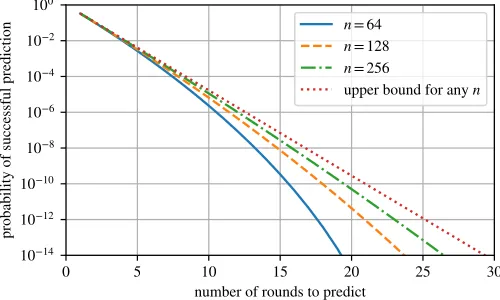
However, even before this bound is reached, the possibility of successful prediction decreases exponentially in the number of rounds to predict. The probability of successful prediction of ω future random beacon values, whereω < f+ 1, can be characterized by a hypergeometric distribution with population sizen,ωdraws (the number of values to predict) andfsuccess states (adversarial nodes) in the population. The prediction is possible, iff all of theω draws pick one of the success states. Figure 1 shows the probabilities for different values ofn, under then= 3f+ 1security assumption. For large values ofn, the probability converges to a geometric distribution.
0 5 10 15 20 25 30
number of rounds to predict
10 14
10 12
10 10
108
106
104
102
100
probability of successful prediction
n=64 n=128 n=256
upper bound for any n
Fig. 1: Unpredictability guarantees for different numbers of nodesn, assuming a 33%adversary, i.e. f =dn
3e- 1
Theorem 3. (Unpredictability) At the beginning of round r,
no node can predict the outcomeRr+f of the random beacon protocol in roundr+f.
Proof. By applying lemma 5 we show that there is at least one correct leader during the interval of f + 1 consecutive rounds {r, r+ 1, r+ 2, ..., r+f}. Let k denote any round during this interval in which the leader `k is correct. As `k
follows the protocol, it has not distributed its secret value
s`k to any node at the beginning of round r. Additionally,
no correct node will provide a decrypted secret share, which could be used in the recovery process of the secret value. Therefore onlyf secret shares are available for an adversary to try and recover the secret in order to compute Rk (and potentially consecutive random beacon values). However, the protocol defines the reconstruction threshold t used by the PVSS scheme to be f + 1. Therefore, an adversary cannot obtain the underlying secret before it is revealed or recovered during roundk. Consequently,Rkand all consecutive random beacon values (includingRr+f) are unpredictable at the start
of roundr.
D. Bias-Resistance
Theorem 4. (Bias-Resistance) No nodei can, for any round
r, influence the valueRrof the random beacon protocol in a meaningful (i.e. predictable) way.
Proof. This property follows from unpredictability and the fact that the protocol is constructed in a way that ensures that any action a (Byzantine) nodes takes in some round r, can only influence the value of the random beacon at round r+ f+ 1 or later. In theorem 3 we have shown that the random beacon value at roundr+fis unpredictable at the beginning of roundr. Therefore, a node cannot influence the random beacon values for rounds rtor+f , and may only influence values at roundr+f+ 1or later in an unpredictable manner.
E. Public-Verifiability
Theorem 5. (Public-Verifiability) For each roundr, an
exter-nal verifier can check the correctness of the random beacon value Rr, at the end of roundr.
Proof. The external verifier receives from any correct node (i.e. after querying at mostf+ 1nodes) its history up to and including roundr. The verifier can, by following the protocol rules, only obtain a random beacon valueRr iff the provided
data is correct. Additionally, an external verifier can obtain and verify recovered random beacon values between the last valid dataset D ~r and the current dataset Dr for all rounds k∈ { ~r + 1, ~r + 2, ..., r−1}.
Lemma 7. (Efficient-Verification) For each roundr, an
exter-nal verifier can check the correctness of the random beacon value Rr inO(n), at the end of round r(without validation of all previous rounds).
Proof. We distinguish two cases: (i) the leader of round
r provided a valid dataset Dr in time. The confirmation
r and can be used to verify the correctness of Dr (and hence the included Rr) by verifying f + 1 signatures; (ii) the leader of roundrwas recovered. In this case, an external verifier requests the necessary information to simulate a node’s execution of the recovery step of round r, i.e.f+ 1 recover messages from round r as well as the header header(Dr0) and confirmation certificate CC(Dr0) of the failed leader’s previously distributed datasetDr0. The simulation of a node’s recovery requiresf+ 1validations of decrypted PVSS shares, combining the shares via Lagrange interpolation, and checking
f+1signatures to verifyCC(Dr0), and can thus be performed inO(n).
VI. COMPARISON OFRANDOMBEACONPROTOCOLS
Recent years have seen a substantial amount of new research related to the generation of publicly-verifiable (distributed) randomness being published in academia as well as the in-dustry. Thereof, we distinguish between the following types of protocols:
1) Stand-alone protocols, that are specifically designed to provide randomness. This includes the approach de-scribed within the first Ouroboros Proof-of-Stake pro-tocol [33], the Scrape propro-tocol [21], the Rand* propro-tocol family [44], as well as our HydRand protocol.
2) Protocols designed for the purpose of generating ran-domness, leveraging resources of existing systems, namely Caucus [3] and Proof-of-Delay [17], [19]. 3) Protocols that produce randomness as a byproduct of
their operation, including Algorand [22], the BA proto-col by Cachin et al., Dfinity [32] and Ouroboros Praos [24].
Additionally, we include Proof-of-Work blockchains, as first described by S. Nakamoto [36], as a source of public-verifiable randomness [16] in our comparison.
Proof-of-Work and Proof-of-Delay inherently require a sub-stantial amount of computational resources to ensure secu-rity. When directly relying on the block hashes of a PoW blockchain as a source of randomness, bias-resistance can generally not be ensured. A miner can, with non-negligible probability, pick/reject random beacon values which suit him by choosing to withhold a valid PoW solution in favor of some other block(s). Hence, random beacon values derived by this mechanism may not be guaranteed to be uniformly distributed. Proof-of-Delay, as described by B¨unz et al. [17], addresses this problem by employing a delay function on top of the PoW block hash. Here, a cryptographic hash function or symmetric encryption algorithm is applied iteratively to the block hash to produce the randomness. The number of iterations ∆ is a security parameter of the protocol and must be selected in a way that ensures that no adversary can finish this inherently sequential computation within the typical confirmation time of a block. While the adversary can still withhold its value and influence the protocol’s output, they can only do so blindly without knowing the effects at the time of the decision, which ensures bias-resistance. However, full verification of a
random beacon value is slow, as it requires the same sequential recomputing.
Algorand [22], Ouroboros Praos [24] and Caucus [3] are comparable in their approach of combining the previous public randomness with a (verifiable) source of private randomness, i.e., in the form of a VRF or hash chain, from an eligible leader to form the next random value. However, leader uniqueness by itself is not guaranteed and additional consensus rules are necessary to reach agreement. In this respect Algorand imple-ments a Byzantine agreement protocol with finality, whereas Ouroboros Praos is a Proof-of-Stake blockchain protocol with eventual agreement, and Caucus is implemented within a smart contract that leverages the consensus protocol provided by the underlying Ethereum blockchain.
Cachin et al. [20] and Dfinity [32] both employ unique
threshold signatures as a core primitive in their construction. The BLS signature scheme of Boneh et al. [14], [13], is a suitable candidate as its signatures are unique and both the signing process as well as the aggregation process are non-interactive. The main idea is that all nodes (i) provide a signature share on some common value (e.g. a round number), (ii) verify the received signatures shares and (iii) combine the valid shares to obtain the next random beacon value. As long as a threshold of nodes contributes valid signature shares the aggregation succeeds. Both approaches require the secure distribution of a shared private key as a precondition. While a trusted dealer is assumed in [20], Dfinity uses a distributed key generation protocol to establish this key.
The approaches described in the initial Ouroboros protocol [33], Scrape [21] and RandShare [44] all rely on PVSS as an underlying primitive. The general idea is that each node first privately generates a random secret value, and then sends out a publicly-verifiable commitment and shares of this secret using PVSS to all nodes. After verification and filtering out invalid commitments, the nodes begin to reveal their respective secrets. If a node fails to reveal or maliciously withholds its value, the other nodes step in and collectively recover the secret from the shares they received previously. Finally, all revealed/reconstructed secrets are combined to form the randomness.
RandHound [44] and RandHerd [44] are also protocols based on PVSS, but operate in a different manner. RandHound is a one-shot protocol, where a client divides nodes into mul-tiple smaller groups and combines the randomness generated by these groups to form a random beacon value, whereas RandHerd is tailored towards continuous operation. The latter uses RandHound to establish a fair division of nodes, executes a distributed key generation protocol within these groups, and leverages oncollective signing[45] to produce a sequence of random beacon values.
A. Comparison Overview
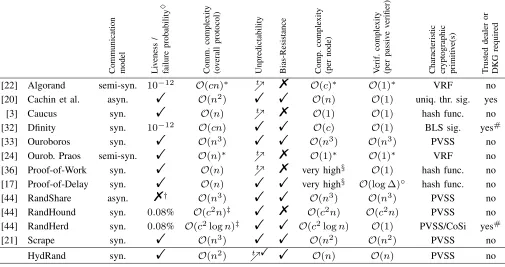
TABLE I: Comparison of approaches for generating publicly-verifiable randomness
Communication model Liv
eness
/
failure
probability
♦
Comm.
comple
xity
(o
v
erall
protocol)
Unpredictability Bias-Resistance Comp.
comple
xity
(per
node)
V
erif.
comple
xity
(per
passi
v
e
v
erifier)
Characteristic cryptographic primiti
v
e(s)
T
rusted
dealer
or
DKG
required
[22] Algorand semi-syn. 10−12 O(cn)∗ %t % O(c)∗ O(1)∗ VRF no
[20] Cachin et al. asyn. ! O(n2) ! ! O(n) O(1) uniq. thr. sig. yes
[3] Caucus syn. ! O(n) %t % O(1) O(1) hash func. no
[32] Dfinity syn. 10−12 O(cn) ! ! O(c) O(1) BLS sig. yes#
[33] Ouroboros syn. ! O(n3) ! ! O(n3) O(n3) PVSS no
[24] Ourob. Praos semi-syn. ! O(n)∗ %t % O(1)∗ O(1)∗ VRF no
[36] Proof-of-Work syn. ! O(n) %t % very high§ O(1) hash func. no
[17] Proof-of-Delay syn. ! O(n) ! ! very high§ O(log ∆)◦ hash func. no
[44] RandShare asyn. %† O(n3) ! ! O(n3) O(n3) PVSS no
[44] RandHound syn. 0.08% O(c2n)‡ ! % O(c2n) O(c2n) PVSS no
[44] RandHerd syn. 0.08% O(c2logn)‡ ! ! O(c2logn) O(1) PVSS/CoSi yes#
[21] Scrape syn. ! O(n3) ! ! O(n2) O(n2) PVSS no
HydRand syn. ! O(n2) %t ! ! O(n) O(n) PVSS no
♦For the failure probability we give the upper bound for the parameterization
of the protocol as suggested by the respective authors.
∗The approach for generating randomness is not described in a standalone
matter and requires additional communication and verification steps for the underlying consensus protocol or the implementation of e.g. a bulletin board. The herein presented values do not account for this additional complexity.
‡ In contrast to Algorand and Dfinity, the parameter c in
Rand-Hound/RandHerd actually depends on nand is thus not constant. This is a direct consequence of sharding nnodes into groups of size c, as the protocols fail to provide availability if any single group fails. Keeping c
constant while increasing nleads to a higher number of groups m, and thus increases the probability of a lifeness failure. To counter this effect requires a security/performance tradeoff wherecalso has to be increased as
ngrows. In section VI-C we further outline that cis a relevant factor in practice, in particular if one wants to achieve a similar liveness guarantee as e.g. Algorand or Dfinity.
† The protocol only provides liveness with additional synchrony
assump-tions. See section VI-C for a detailed discussion.
§ The complexity is not dependent on the number of nodes n, but the
involved of-Work is inherently computationally demanding. For Proof-of-Delay the computational complexity depends on the chosen input for the delay function. For the typical choice of using the blockhashes of the underlying Proof-of-Work system as inputs, the cost of the mining process is inherited.
#In Dfinity’s and RandHerd’s approach nodes are split into smaller groups.
Within each of these groups a distributed key generation protocol is run. t
%The protocols provide probabilistic guarantees for unpredictability, which quickly (exponentially in the waiting time) get stronger the longer a client waits after it commits to use a future protocol output. For HydRand, we indicate that unpredictability with absolute certainty is reached afterfrounds using the additional!symbol.
◦ We refer to the verification executed within the Smart Contract via an
interactivechallenge/response protocol. It has logarithmic complexityO(∆)
in the security parameter∆, which describes how many iterations of the hash function are applied to the seed.
that a broad comparison was performed by not only consid-ering protocols specifically targeted at implementing random beacons, but also by including approaches that can readily provide a random beacon functionality as a byproduct of their intended application, such as the provision of a distributed public ledger. Consequently, the underlying models, assump-tions, notaassump-tions, as well as the context differ from protocol to protocol and render an evaluation of the herein presented approaches a non-trivial task. We conducted the comparison to the best of our knowledge, contacted the respective protocol authors to try and clarify ambiguities and explicitly state whenever we were unable to adequately determine certain properties or had to estimate them.
The main results are presented in table I and the various protocol properties are discussed in greater detail in the fol-lowing subsections. For the presented complexity evaluations,
nrefers to the number of protocol participants, andcdenotes the size of some subset of nodes, if one is assumed in the specific protocol. Notice that the subset size c is protocol dependent and, although typically constant, a non-negligible factor for the resulting communication complexity in practice (see section VI-D for a more detailed discussion).
B. Communication Model
we informally use the term semi-synchronous. This applies for instance to Algorand and Ouroboros Praos, where the underlying assumptions are outlined in detail, but are not readily comparable to other definitions of partial-synchrony, such as those first established in the context of distributed consensus [26], [27].
Dfinity [32] is aimed at a semi-synchronous setting, however security proofs are currently only published for the syn-chronous case.
We inferred the synchrony assumption from the protocol description or the underlying protocol whenever they have not been stated explicitly. Currently deployed Proof-of-Work blockchains such as Bitcoin and Ethereum assume a syn-chronous communication model. As Proof-of-Delay [17] and Caucus [3] are built on top of such Proof-of-Work blockchains, these protocols are also classified as synchronous. In [44], RandShare is described within an asynchronous setting6. For RandHound and RandHerd synchrony is indicated in various paragraphs, e.g. III. A. for RandHound and IV. B. 1) for RandHerd [44].
C. Liveness/Availability
In regard to liveness, we distinguish between three different protocol types:
1) protocols which achieve liveness unconditionally (in the respective system model)
2) protocols which have a (configurable) but non-zero probability of a liveness failure
3) protocols which do not provide liveness (in the respec-tive system model)
We mark protocols of the first type with a ! symbol in our comparison table. This category also includes HydRand, which achieves liveness and guaranteed output delivery in the respective system model unconditionally. For protocols of the second type, namely Algorand, Dfinity, RandHound and RandHerd, we give a typical failure probability as described by the respective authors. The authors of Algorand and Dfinity consider failure probabilities of at most 10−12 [22] and 2−40 ≈ 10−12 [32] as suitable for the respective setting,
whereas a typical failure probability of0.08%[44] is stated for the exemplary configuration in the RandHound and RandHerd protocols.
For all of the above protocols, the failure probability can be adjusted through a security parameter. For example, to lower the failure probability of RandHound and RandHerd to a level of 10−12, the group size c can be increased. By
applying the formula given in Syta et al. [44], we observe an increase in group size from c = 32 to c = 125 to achieve this failure rate against an adversary controlling less than 1/3
of the nodes. Consequently, performance is decreased, as the communication complexities of both protocols contain c as a quadratic factor.
The RandShare protocol is described in an asynchronous communication model (under a n = 3f + 1 adversary
as-6see section VI-C for detailed discussion on liveness problems in this setting
sumption). However, a closer analysis of the protocol shows that further synchrony assumptions are required and therefore RandShare does not guarantee liveness under full asynchrony. The problem arises in paragraph II. D. 2. 1) [44], wheresj(i)
is used to denote the secret share of the secret sj(0), which nodej sends privately to node i.
Initialize a bit-vector Vi= (vi1, ..., vin)to zero,
to keep track of valid secrets sj(0) received. Then
wait until a message with sharesj(i)from eachj6= ihas arrived.
In an asynchronous setting a nodei cannot wait to receive a message from each other node j, as Byzantine nodes might never send such a message. Similarly, a node should not broadcast a negative vote in case no value Ajˆ is received, as described in paragraph II. D. 2. 3), because this would imply a time bound for being able to send valid votes.7
D. Communication Complexity
In Table I, we outline the communication complexity of different approaches that provide randomness either as a stand-alone service or by deriving it from the characteristics of the underlying protocol. Thereby we consider the overall bits transmitted for all nodes per round, i.e. per produced random beacon value.
The different approaches exhibit a wide range of communi-cation complexities. In the simplest scenario, where a Proof-of-Work blockchain forms the basis for the random beacon, a successful miner only has to perform one broadcast, leading to a complexity of O(n). This also applies for the Proof-of-Delay approach. Caucus also provides a low communication complexity ofO(n)by leveraging the properties of the under-lying Smart Contract platform.
For the Algorand and Ouroboros Praos protocols, an anal-ysis of the communication complexity is not provided in the respective publications [22], [24]. We infer that Ouroboros Praos has a communication complexity in O(n), because the protocol only provides guarantees for eventual consensus and is based upon many of the design principles of Proof-of-Work blockchains, whereas protocols like Algorand, which provide consensus finality, generally operate at a higher per round communication cost. Both protocols use a similar approach based on private randomness, where a verifiable random function (VRF) is used to compute and verify a local source of randomness. The leader’s local randomness is then combined with the previous global randomness to obtain the next global randomness. Used in this way, the communication complexity is only dependent on the underlying agreement protocol and does not incur any additional overhead.
To optimize the amount of data transmitted, the Algorand and Dfinity protocols perform certain communication-heavy
7Even if this issue is corrected, i.e., by modifying the protocol to only wait
operations only within a single subset of nodes. RandHound and RandHerd employ sharding to split nodes into multiple smaller groups, where some operations are performed inde-pendently within all groups, and the results from individual groups are then combined in a final step. The required sizes for these subgroups typically depend on the assumptions in regard to the adversarial power and the described failure probability. Algorand is designed for a very large number of nodes, and the group size isc≈1000[29]. Dfinity outlines a group size of c = 405 under a n = 3f + 1 security assumption and a failure probability of2−40≈10−12. As the authors outline, for
small values ofn, Dfinity’s random beacon protocol may also be executed by all nodes, i.e. without selecting a committee as a subset of all nodes. In this casennodes broadcast a signature share to all other nodes, leading to a complexity of O(n2).
For RandHound and RandHerd, group sizes of 16,24, 32
and40are considered by the authors. As we outline in section VI-C, a group size ofc≥125is required to establish a failure probability similar to Algorand or Dfinity.
The approaches employed by Ouroboros, RandShare and Scrape are similar, where each node in the protocol employs a PVSS scheme to commit to a secret value. This involves the distribution of the PVSS shares, i.e. each node has to broadcast a message of size O(n) to all other nodes. The resulting communication complexity of O(n3)is a major drawback of
these approaches, however in this context (P)VSS can also help to achieve guaranteed output delivery [39].
HydRand is similar in this respect, as it also uses PVSS as an underlying primitive, but improves efficiency by a factor of O(n) because only a single node has to perform the distribution of PVSS shares per round. HydRand’s commu-nication complexity of O(n2) includes all messages required
to establish Byzantine agreement. The communication com-plexity is reduced by shifting the transmission of messages of size n to the leader and employing cryptographically signed
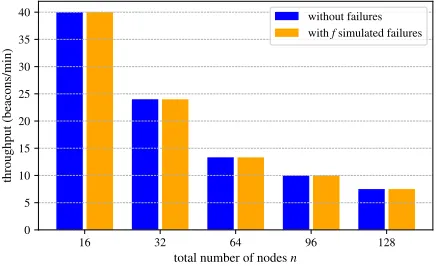
conformation/recovery certificatesto converge on a history of datasets. Messages that need to be broadcast by all nodes are always of constant size. In our evaluation (see appendix A), we provide information on the produced network traffic for different numbers of nodes (n) in practice.
E. Unpredictability
Unpredictability is a key property related to randomness that is provided by all compared protocols. We distinguish between the following two types of unpredictability that the protocols achieve:
1) all future random beacon values are fully unpredictable for all participants
2) the probability of predicting future random beacon val-ues decreases exponentially with the number of rounds to predict
Protocols, where each round’s random beacon is dependent on the input of a (Byzantine) quorum of participants, namely the protocols by Cachin et al., Ouroboros, Dfinity, RandShare, RandHound, RandHerd and Scrape, fall into the first category. For Proof-of-Work, Algorand, Caucus, Ouroboros Praos this is
not the case and the next random beacon depends on a single node’s (i.e. the miner’s or the leader’s) secret value. Clearly, since this node knows the next random number in advance it is able to predict the next random beacon value. In case adversarial nodes mine a sequence of blocks or are selected repeatedly as leader, prediction of more than one value is possible if they collude. This issue is typically addressed by a random selection of the respective leader, rendering prediction unlikely quickly. As long as the leader selection process ensures that honest nodes are selected with non-negligible probability, the probability of successful prediction decreases exponentially with the number of rounds to predict.
Proof-of-Delay can, in principle, achieve full unpredictabil-ity or unpredictabilunpredictabil-ity with high probabilunpredictabil-ity even though the next random beacon value depends on the output of a single node, because the leader (e.g. the miner who finds a valid PoW) does not immediately know the resulting random number that is derived from their output. If the leader tries to predict a future value, it has to withhold their output until it is able to finish the sequential computation required for the delay function. Depending on the underlying synchrony assumptions and consensus protocol, withholding the solution (e.g. block) for too long will either exclude the leader’s output with certainty or high probability, as the delay parameter can be set much greater than the time bounds used for consensus. In the context of unpredictability, HydRand offers both unpredictability with exponentially increasing probability for at most f rounds, as well as full unpredictability afterf + 1
rounds. We provide a detailed analysis in section V-C, out-lining the necessary waiting times to achieve an error margin of 10−12 for different participant numbers when waiting less
thanf+ 1 rounds to achieve guaranteed unpredictability.
F. Bias-Resistance
Bias-resistance is the property that ensures a protocol’s output cannot be manipulated by a (colluding) adversary, i.e. each random beacon value should be uniformly drawn from the set of possible values. Following the work in Cascudo at el. [21], we observe that bias-resistance is closely related to the property of guaranteed output delivery. In case an adversary can learn a candidate output and subsequently prevent the random beacon protocol from producing that output, the resulting beacon values are no longer guaranteed to be uniformly distributed. Even if an adversary is only able to prevent the output of a random beacon value to be available at some specific time, without having previously gained knowledge of the candidate value itself, bias resistance may not be guaranteed. Here, the synchrony requirements of the application(s) toward the delivery of new random beacon values determine biasability. In either cases, further security assumptions and additional primitives (e.g. PVSS or threshold signatures and n > 2 participants) are necessary if bias-resistance is to be guaranteed.
necessarily imply that an adversary can arbitrarily manipulate the probability distribution or, even worse, select a specific output. For example, the respective publications for Algorand and Ouroboros Praos show techniques to efficiently use this somewhat biasable form of randomness for the purpose of leader selection.8 However, if the specific application requires a true uniform distribution of random beacon values, only protocols that provide the previously outlined strong notion of bias-resistance should be considered, namely the protocols by Cachin et al., Dfinity, Ouroboros, Proof-of-Delay, RandShare, RandHerd, Scrape and HydRand.
G. Computation and Verification Complexity
For our analysis we distinguish between (i) computation complexity, which describes the amount of operations an active protocol participant has to perform during one round of the protocol, and (ii) verification complexity, referring to the amount of computation an external (passive) observer of the protocol has to perform in order to verify the correctness of one random beacon value.
A main drawback of using Work and Proof-of-Delay as a source of randomness is the high computational complexity, as both approaches inherently rely on solving cryptographic puzzles as part of their security model. The other protocols herein considered have a computational com-plexity of at most O(n3). The protocols RandShare and Ouroboros, which require O(n3) due to the involved PVSS
instances, may be optimized by updating the employed PVSS scheme to the variant introduced by Scrape [21]. The VRF based approaches from Algorand, Ouroboros Praos as well as Caucus (after the initial setup) are very efficient, because they only require the verification of a VRF or hash preim-age. In regard to verification complexity, when applying the optimization of the PVSS protocol introduced by Scrape, all protocol outputs can be verified reasonably efficiently, i.e. within O(n2).
For Proof-of-Delay, the drawbacks of a high verification complexity, and consequently the disadvantages of an inter-active verification process for the use within Smart Contracts, may also be addressed by employing verifiable delay functions (VDF) [11], [48], [37], [12]. While VDFs are not sufficient to provide the functionally of a random beacon on their own, they enable efficient verification of the involved sequential computation steps and can be used in combination with a consensus protocol for agreement on the VDF inputs to form a random beacon. On the contrary, the high computation complexity is inherent in Proof-of-Delay protocols and cannot be reduced using VDFs.
The most efficient protocols in regard to computation and verification complexity are based on threshold signatures, VRFs and Proof-of-Work. We consider these approaches most suitable for verification within smart contracts or embedded
8 Both publications are aware of, and analyze the fact that the distribution
of random numbers produced by their approaches is not uniform and consider the potential implications [22], [24].
devices, if fast implementations of the required cryptographic primitives are available within the specific platform.
VII. DISCUSSION
The comparison in section VI outlines that there exist a variety of different approaches for implementing random beacon protocols. Improvements in one characteristic or aspect are often met with negative trade-offs in others, providing no clear candidate that is suitable for all applications. In the following, we discuss defining characteristics of the herein considered protocol designs, to aid in the selection process for particular use case scenarios.
A. Key Characteristics of Existing Protocol Designs
Both Proof-of-Work [36] and Proof-of-Delay [17] based random beacon approaches are well suited for larger and dynamic sets of participants and can easily leverage on existing Proof-of-Work blockchains. While Proof-of-Work alone is not sufficient to establish bias-resistance, Proof-of-Delay can serve as an augmentation to achieve this guarantee with high probability. However, both approaches require a very high amount of computational resources. Proof-of-Delay may also serve as a suitable bootstrapping mechanism for generating an initial random value to be used in other protocols.
Ouroboros [33], RandShare [44], and Scrape [21] are PVSS based protocols. While the produced randomness of these ap-proaches satisfies strong notions of unpredictability and bias-resistance, their high communication overhead significantly impacts scalability. Consequently, these protocols seem most suitable for a small scale setting (e.g. a private/consortium blockchain) or as an alternative for a Proof-of-Delay boot-strapping mechanism without the computational requirements. Caucus [3] is an approach that can be deployed and ef-ficiently verified within Smart Contracts but unfortunately cannot ensure bias-resistance.
Algorand [22] targets a large set of nodes while still being able to provide consensus finality without requiring strong synchrony assumptions. As a trade-off, the protocol can not ensure a strong notion of bias-resistance. In this regard Ouroboros Praos [24] makes a similar trade-off to achieve better scalability at the cost of consensus finality and also weakening bias-resistance.
The randomness produced by the threshold signature based protocols of Cachin et al. [20] and Dfinity [32] provide strong bias-resistance. Additionally, Cachin et al. is the only protocol in our comparison that is proven secure in an asynchronous communication model. Dfinity’s approach scales to a larger number of nodes, but security is only proven in a synchronous system model. The drawback of both protocols is their reliance on cryptographic primitives that are based on elliptic curve pairings, which are not yet well-established. E.g. Menezes et al. [35] and subsequently Barbulescu et al. [5] showed the security level of a commonly used pairing-friendly curve is in fact 2110 or 2100 instead of the targeted2128. Also these
RandHound [44] and RandHerd [44] employ a sharding approach to achieve good scalability for a large number of participants. RandHound does not provide a strong notion of bias-resistance while RandHerd requires additional view-change and agreement protocols when a leader is Byzantine or non-available.
B. Advantages and Limitations of HydRand
HydRand is a dedicated random beacon protocol tailored towards continuous operation and assumes a small to medium set of nodes. The protocol provides strong properties that are comparable to other PVSS-based approaches, while reducing the communication overhead by O(n). A resulting trade-off is the need to wait for f + 1 rounds for guaranteed unpredictability, however strong probabilistic unpredictability is ensured within a few rounds (see figure 1), and bias-resistance is always achieved.
An evaluation (see appendix A) of our open-source Python implementation of the HydRand protocol outlines the practi-cability for a wide range of participant configurations, while requiring minimal hardware resources. The protocol design is simple, and its design goals are achieved without requiring a trusted dealer or DKG in the initial setup, thereby avoiding the introduction of additional security assumptions and im-plementation complexity. Moreover, a detailed analysis and security proofs of the protocol’s properties and guarantees are provided.
HydRand furthermore ensures guaranteed output delivery: A new random beacon value is guaranteed to be produced at each round, i.e. in regular intervals, regardless of the adver-sary’s actions. This is of particular importance for application scenarios in which strong synchrony requirements or gapless delivery of new random beacon values is required. To achieve the design goal of producing random beacon values at regular intervals, HydRand implicitly requires synchronous round-to-round communication. A resulting drawback is that any leader which (temporarily) fails to deliver required messages is excluded from further participation. Consequently, in systems where synchrony guarantees may have a probability of being temporarily violated, the round duration parameter has to be carefully selected to avoid any resulting liveness failures. In future work, we envision an extension of the HydRand protocol to also consider and tolerate crash-recovery failures, which may be able to address the current limitations in this regard.
Requiring strong synchrony can also prove advantageous for a public randomness beacon, as an external validator with knowledge of the setup parameters and the protocol start time cannot be tricked into accepting outdated random beacon values. Further, unlike protocols aimed at a dynamic set of participants (e.g. Algorand, Dfinity or Ouroboros Praos), a static set can also render the validation of random beacon values simpler. For a static validator set, no additional proofs need to be provided to convince any third party, which has not observed the entire protocol execution, that the current
set of validators has legitimately evolved from some initial configuration.
Although excellent performance results were obtained when testing our implementation with up to 128 globally distributed nodes, scalability to a much larger set of participants is limited due the inherent communication complexity ofO(n2). In such a scenario, approaches where the consensus algorithm is only executed by a subset of the participating nodes, or Proof-of-Delay based protocols may prove advantageous.
VIII. CONCLUSION
We present HydRand, a synchronous random beacon proto-col that tolerates up to one third Byzantine failures and show that it provides liveness, public-verifiability, bias-resistance, and probabilistic as well as hard bounds for unpredictabil-ity. HydRand ensures guaranteed output delivery, namely that randomness is produced at regular intervals, even under adversarial conditions. The protocol is designed for stand-alone use, but could also find utility in the context of current and future Proof-of-Stake and permissioned blockchain or consensus protocols.
Additionally, we provide the first in-depth comparison and discussion of novel approaches for generating publicly-verifiable randomness, which enables researchers to compare current as well as future designs objectively with each other. Thereby, we highlight that HydRand achieves various desirable properties in a unique way without incurring major drawbacks: (i) it is a stand-alone protocol that can be readily adapted for different use-cases, (ii) it neither requires a trusted dealer nor a distributed key generation protocol, and (iii) it offers strong guarantees for the produced randomness while improving upon the performance and scalability of previous solutions with comparable guarantees.
Furthermore, we develop and evaluate a fully functional protocol prototype in Python to demonstrate the feasibility and practicability of HydRand. The source code and additional in-formation on the implementation details are publicly available on Github [42].
ACKNOWLEDGMENTS