Finding Small Solutions of the Equation
Bx
−
Ay
=
z
and Its Applications to
Cryptanalysis of the RSA Cryptosystem
?Shixiong Wang1, Longjiang Qu1,2, Chao Li1,3, Shaojing Fu2,3, and Hao Chen4
1 College of Liberal Arts and Sciences, National University of Defense Technology, Changsha 410073, China
2 State Key Laboratory of Cryptology, Beijing 100878, China 3 College of Computer, National University of Defense Technology,
Changsha 410073, China
4 College of Information Science and Technology/Collage of Cyber Security, Jinan University, Guangzhou 510632, China
[email protected],[email protected],[email protected], [email protected],[email protected]
Abstract. In this paper, we study the condition of finding small solu-tions (x, y, z) = (x0, y0, z0) of the equationBx−Ay=z. The framework
is derived from Wiener’s small private exponent attack on RSA and May-Ritzenhofen’s investigation about the implicit factorization prob-lem, both of which can be generalized to solve the above equation. We show that these two methods, together with Coppersmith’s method, are equivalent for solving Bx−Ay = z in the general case. Then based on Coppersmith’s method, we present two improvements for solving
Bx−Ay = z in some special cases. The first improvement pays at-tention to the case where either gcd(x0, z0, A) or gcd(y0, z0, B) is large
enough. As the applications of this improvement, we propose some new cryptanalysis of RSA, such as new results about the generalized implic-it factorization problem, attacks wimplic-ith known bimplic-its of the prime factor, and so on. The motivation of these applications comes from oracle based complexity of factorization problems. The second improvement assumes that the value ofC≡z0 (modx0) is known. We present two attacks on
RSA as its applications. One focuses on the case with known bits of the private exponent together with the prime factor, and the other considers the case with a small difference of the two prime factors. Our new attacks on RSA improve the previous corresponding results respectively, and the correctness of the approach is verified by experiments.
Keywords: RSA, Cryptanalysis, Lattice, Coppersmith’s method
Mathematics Subject Classification:11Y05(Primary); 94A60(Secondary)
?
1
Introduction
Background Since RSA was proposed by Rivest, Shamir, and Adleman [33], much effort has been made to evaluate the security of this public key cryptosys-tem due to its wide variety of applications. For example, RSA is vulnerable in the case of either a small public exponent [5, 7] or a small private exponent [3, 40]. Some attacks were also presented when a portion of the private exponent is exposed [1, 2, 4, 11, 34, 35, 38, 39], or some bits of the prime factor are known [6, 7, 16]. From the work of [9, 24], it was proved that recovering the private expo-nent and factoring the modulus are determinately equivalent in polynomial time. In addition, there were also some investigations about the implicit factorization problem (IFP) [12, 20, 21, 25, 31, 32, 37], which aims to factor two (or more) RSA moduli if unknown prime factors of these moduli share a certain number of bits. In this paper, we show that some of the above cryptanalysis of RSA can be summarized into one framework, namely, finding small solutions (x, y, z) = (x0, y0, z0) of the equation Bx−Ay = z, where A, B, x0, y0, z0 are integers
and Bx0, Ay0 have the same bit size. Without loss of generality, we assume
A, B, x0, y0, z0∈Z+ and gcd(A, B) = 1, gcd(x0, y0) = 1.
In 1990, based on approximations using continued fractions, Wiener [40] p-resented the first small private exponent attack. For an RSA modulusN =pq, suppose p, q are of the same bit size, and the public exponente ≈N. Wiener showed that one can factor N = pq if the private exponent d < N0.25. Since
e·d≡1(modϕ(N)), there exists a positive integerksuch thatkϕ(N) =ed−1, which is equivalent to N k−ed =k(p+q−1)−1. After taking B =N, x0 =
k, A=e, y0=d, z0=k(p+q−1)−1, we obtainBx0−Ay0=z0. And the RSA
modulusN=pqcan be factored according to the knowledge ofx0, y0, z0.
There-fore, Wiener’s attack is essentially finding the solution (x, y, z) = (x0, y0, z0) of
the equationBx−Ay=zifx0, y0, z0 are small enough. The best small private
exponent attack was later given by Boneh and Durfee [3] in 1999, which showed that it is possible to factorN =pq ifd < N0.292. And the proof was simplified by Herrmann and May [14] in 2010.
In 2009, May and Ritzenhofen [25] firstly introduced the IFP, namely, the implicit factorization problem. The motivation of this problem comes from oracle based complexity of factorization problems. Namely, it allows for an oracle that on input an RSA modulus N1 =p1q1 outputs another different RSA modulus
N2 =p2q2 such thatp1, p2 share some bits. Note that the oracle only gives an
implicit information about p1, p2, since the actual values of the shared bits are
not known. Denote “most significant bits” by MSBs, and “least significant bits” by LSBs. Let N1=p1q1, N2=p2q2 be n-bit RSA moduli, andp1, p2 be αn-bit
prime integers. Then suppose thatp1, p2sharetnLSBs. By finding the shortest
non-zero vector in a two-dimensional lattice, May and Ritzenhofen [25] claimed that N1, N2 can be factored if t >2(1−α). Later in 2010, Faug`ere et al. [12]
analyzed the case where αn-bit p1, p2 share tn MSBs, and they got the same
boundt >2(1−α). For simplicity, here we only consider the latter case, namely, we have p1−p2 = p,e 0 < p <e 2
αn−tn, where
e
B=N1, x0=q2, A=N2, y0=q1, z0=pqe1q2, one can also getBx0−Ay0=z0.
And the knowledge of x0, y0, z0 is sufficient to factor N1 = p1q1, N2 = p2q2.
Therefore, the above IFP can be also regarded as finding the solution (x, y, z) = (x0, y0, z0) of the equationBx−Ay=z ifx0, y0, z0are small enough. Since the
methods in [25] and [12] are similar, in this paper we only consider the method in [25] for simplicity. Besides the work in [25] and [12], later the bounds for the cases of shared MSBs and shared LSBs were simultaneously improved several times [20, 21, 32, 37] by means of lattice-based methods. And the optimal bound was given by Lu et al. [20] in 2015, which claimed thatN1, N2 can be factored
ift >2α(1−α).
Both Wiener’s attack in [40] and May-Ritzenhofen’s attack in [25], can be generalized to solve the equationBx−Ay=z. Besides, there is another lattice-based method, called Coppersmith’s method, which is widely adopted by re-searchers for cryptanalysis of RSA. Coppersmith’s method is used to find small roots ofv-variate modular polynomial equations or (v+ 1)-variate integer poly-nomial equations in polypoly-nomial time based on lattice basis reduction. Initially in 1996, Coppersmith [5, 6] obtained results for the case of v = 1. Later the methods of [5] and [6] were reformulated by Howgrave-Graham[15] and Coron[8] respectively in simpler ways. The aforementioned two reformulations can also be extended to the case of v>2. In general, the reformulations are used when we refer to Coppersmith’s method.
Our Contributions In this paper, we are devoted to making improvements for solving the equationBx−Ay=zin some special cases, together with obtaining some new applications to cryptanalysis of RSA.
First of all, we present the condition for solving the equationBx−Ay=zin the general case as Result 1 in Section 2. We regard it as a known result, which can be obtained by generalizing either Wiener’s small private exponent attack in [40] or May-Ritzenhofen’s investigation about implicit factorization problem in [25]. Besides, Coppersmith’s method can also be used to prove Result 1. As a conclusion, these three methods are equivalent for solving Bx−Ay=z in the general case.
Moreover, Coppersmith’s method is much powerful. It can not only obtain the same result in the general case, but also perform better than the two methods in [40] and [25] under some circumstance. The optimal bound for the IFP [20] and the best small private exponent attack [3], are both obtained according to Coppersmith’s method. Based on Coppersmith’s method, this paper then presents two improvements for solving the equationBx−Ay=zin some special cases.
(1) The first improvement considers the case where either gcd(x0, z0, A) or
gcd(y0, z0, B) is large enough. It is stated as our Theorem 1 together with
Theo-rem 2 in Section 4. Based on the first improvement, we present some applications to cryptanalysis of RSA as follows.
generalization allows for an oracle that on input an RSA modulus N1 =p1q1
outputs another different RSA modulus N2 = p2q2 such that some unknown
multiples a1p1 and a2p2 of the prime factors p1 and p2 share an amount of
MSBs or LSBs. Whena1=a2= 1, it is exactly the case of the IFP introduced
by May and Ritzenhofen in [25]. Moreover, since gcd(p1, p2) = 1, there must
exist unknown a∗
1, a∗2 ∈ Z+ such that a∗1p1−a2∗p2 = 1 (or a∗2p2−a∗1p1 = 1).
It implies that a∗
1p1 and a∗2p2 share nearly all of their bits beginning from the
most significant bit, which may apply for the generalized IFP. Applying our Theorem 1 to this generalized IFP for the case of shared MSBs, we can get a better result than [28]. While our Theorem 2 can be used to improve the attack in [28] for the case of shared LSBs.
(1.2) In 1996, Coppersmith [6] claimed that given 0.25nMSBs of p, one can factorn-bitN =pq for 0.5n-bitpandq. Later [7, 16] showed thatN can also be factored if one knows 0.25nLSBs ofp. The motivation of their attacks is exactly from the original oracle based complexity of factorization problems. As opposed to the (generalized) IFP where the oracle only gives an implicit information, their attacks [6, 7, 16] allow for an oracle that explicitly outputs the bits of the prime factor p. Considering implementations in practice, the bits of pmay be obtained via side channel attacks. As an application of the theorems in Section 4, our new attacks improve the results in [6, 7, 16] if some greatest common divisor is large enough, and we also consider the case of unbalancedp, q.
(1.3) Similarly, according to Theorem 1, we can improve the result of partial-ly approximate common divisor problem (PACDP) in [16] under some circum-stance. And the same improvement also applies to the attacks in [29, 22], which focus on solvingex+y≡0 (modp) to factor the RSA modulus N =pq.
(2) The second improvement assumes that the value of C ≡ z0 (mod x0)
is known. It is stated as our Theorem 3 in Section 5. And its applications to cryptanalysis of RSA are as follows.
(2.1) In 2005, Ernst et al. [11] proposed the attack on RSA when a portion of the private exponentdis exposed due to side channel attacks. Their result is the first one that works up to full size public or private exponent. Later in 2008, Sarkar and Maitra [36] improved the result of [11] by guessing a few MSBs of the prime factorpof the RSA modulusN. The total amount of bits ofd, pto be known as presented in [36], is less than the number of bits ofdto be known as reported in [11]. According to our Theorem 3, we present a new attack on RSA when some LSBs ofdtogether with some MSBs ofpare exposed. Similar to the motivation of [36], we may obtain only a few bits of pby exhaustive search to reduce the requirement of more bits ofdto be known. Our attack combines the results in [30] and [39], and is better than Sarkar and Maitra [36] under some circumstance.
As the application of our second improvement, our new attack needs a weaker condition, which implies that our result is better than that in [10, 18].
Organization The rest of this paper is organized as follows. In Section 2, the condition of solving the equation Bx−Ay=z in the general case is given as a known result. Section 3 introduces Coppersmith’s method for finding the small roots of modular polynomial equations, which is used to prove the results in this paper. In Section 4, we present our first improvement. And based on this improvement, we obtain many applications to cryptanalysis of RSA, such as new results about the generalized IFP, attacks with known bits of the prime factor, analysis of the PACDP, and so on. Section 5 is our second improvement. And in this section, we propose two attacks on RSA, which consider either the case with known bits of the private exponent together with the prime factor, or the case with a small difference of the two prime factors. In Section 6, we implement several experiments to examine the justification of our approach and thus verify the correctness of our results. Finally we conclude this paper in Section 7.
2
Known Result for Solving
Bx
−
Ay
=
z
In this section, we show the condition of finding the small solutions (x, y, z) = (x0, y0, z0) of the equation Bx−Ay = z in the general case. We present it
as the following Result 1, and regard it as a known result. It can be obtained by generalizing either Wiener’s attack in [40] or May-Ritzenhofen’s attack in [25]. We briefly present the proof using Wiener’s method [40] in Appendix A, and the proof using May-Ritzenhofen’s method [25] in Appendix B. Section 3 will introduce Coppersmith’s method by showing another proof of Result 1 as an example. As a conclusion, these three methods are equivalent for solving
Bx−Ay=z in the general case.
Result 1 Suppose there exists unknown (x0, y0, z0)∈(Z+)3 satisfying
Bx0−Ay0=z0, |x0|< X, |y0|< Y, |z0|< Z,
where gcd(A, B) = 1, gcd(x0, y0) = 1. HereA, B, X, Y, Z are known large
posi-tive integers, and for some known large posiposi-tive integerM we have
X=Mα1, A=Mα2, Y =Mβ1, B=Mβ2, Z =Mγ.
X, Y, Z are usually selected to satisfy x0 ≈ X, y0 ≈Y, z0 ≈Z, thus we also
assumeβ2+α1≈α2+β1 holds such thatz0Bx0, Ay0. Then one can find all
such solutions (x, y, z) = (x0, y0, z0) of the equationBx−Ay=z in polynomial
time if
γ+α1−α2 (≈γ+β1−β2)<0. (1)
applications to cryptanalysis of RSA, these large positive integers may have the magnitudes such as that of an RSA modulus. We usually have known the rough bit sizes of desired x0, y0, z0∈Z+, thus we are able to selectX, Y, Z satisfying
x0 ≈X, y0 ≈ Y, z0 ≈ Z. Besides, β2+α1 ≈ α2+β1 implies that Bx0 and
Ay0 have the same bit size. And one can check that Inequality (1) also implies
z0 Bx0, Ay0. Finally, we assume x0, y0, z0 ∈Z+ just for simplicity, and the
result also holds for the case ofx0, y0, z0∈Z. This is why we use |x0|,|y0|,|z0|
instead of x0, y0, z0 in Result 1. The same applies to our two improvements in
Sections 4, 5.
3
Coppersmith’s Method
In this section, we introduce Coppersmith’s method for finding the small roots of modular polynomial equations, which will be used in the proofs of our two improvements in Sections 4, 5 in this paper. We will first give some preliminaries about lattice in Section 3.1, and then present Coppersmith’s method by showing a new proof of Result 1 as an example in Section 3.2. The proof can be regarded as a preparation for our proofs of the two improvements in Sections 4, 5.
3.1 Preliminaries about Lattice
First of all, let us recall the definition of (integer) lattice.
Definition 1. Let b1,b2,· · ·,bω∈Zs be linearly independent (row) vectors for
ω 6 s. A lattice Λ generated by b1,b2,· · ·,bω is the set of all integral linear
combinations of these vectors:
Λ= spanZ(b1,b2,· · ·,bω) =
( ω X
i=1
xibi
x1, x2,· · ·, xω∈Z )
.
We call s the dimension ofΛ and ω its rank. Row vectors b1,b2,· · ·,bω are a basis ofΛ, and we denote the basis as a matrix, called the basis matrix ofΛ:
B=
b1
b2 .. .
bω
∈Zω×s.
The determinant ofΛis defined as det(Λ) =pdet(BBT), which is independent of the choice of the basis and only determined byΛ. In this paper, we only consider lattices for the case ofω=s. ThusBis a square matrix and det(Λ) =|detB|.
In 1982, Lenstra et al. [19] proposed the famous LLL algorithm for lattice basis reduction, which allows one to find short vectors in polynomial time. The proof of the following lemma can be found in [23]. The norm of a vector vi = (vi1, vi2,· · ·, vis) is defined askvik=
p
Lemma 1. (LLL)Letsbe the dimension (and the rank) of the latticeΛ. Given a basis (square) matrixB of Λ, the LLL algorithm outputs a LLL-reduced basis
v1,v2,· · ·,vs satisfying
kv1k,kv2k,· · ·,kvik62s(s−1)/4(s−i+1)det(Λ)1/(s−i+1), 16i6s
in polynomial time insand in the bit size of the entries of the basis matrixB.
Finally we introduce the following useful lemma due to Howgrave-Graham [15]. The norm of a polynomial h(x1,· · ·, xn) = Pat1,···,tnx
t1
1 · · ·xtnn is defined as
kh(x1,· · ·, xn)k=pP|at1,···,tn|
2.
Lemma 2. (Howgrave-Graham)Let h(x1,· · ·, xv)∈Z[x1,· · ·, xv]be a
poly-nomial that consists of at mostsmonomials. Suppose that there exists(x(0)1 ,· · ·, x(0)v )∈Zv satisfying
h(x(0)1 ,· · ·, x(0)v )≡0 (modV), |x(0)1 |< X1,· · ·,|x (0)
v |< Xv,
kh(X1x1,· · ·, Xvxv)k< V /
√
s.
Thenh(x(0)1 ,· · ·, x(0)v ) = 0holds over the integers.
3.2 Coppersmith’s Method to Prove Result 1
Here we present Coppersmith’s method by showing a new proof of Result 1, which is a preparation for our proofs of the two improvements in Sections 4, 5.
Recall the notations in Result 1. Definef(x, z) :=−Bx+z, and fromBx0−
Ay0=z0 we obtain
f(x0, z0)≡0 (mod A).
Letmbe a positive integer, and then define
gk(x, z) :=xm−k[f(x, z)]kAm−k, k= 0,1,· · ·, m,
Λ∗:=nPm
k=0lkgk(x, z)
l0, l1, · · ·, lm∈Z o
.
For two monomialsxm−k1zk1 andxm−k2zk2, the monomial order “≺” is defined
such that xm−k1zk1 ≺ xm−k2zk2 if and only if k
1 < k2. Then there is a
one-to-one correspondence between a polynomial g(x, z) inΛ∗ and a vector g in a subsetΛ ofZm+1, where the components of g are the coefficients ofg(Xx, Zz)
in the order of “≺”. Denote the corresponding vector ofgk(x, z) bygk, and we have
Λ=nPm
k=0lkgk
l0, l1, · · ·, lm∈Z o
.
One can check thatg0,g1,· · ·,gm are linearly independent, thus Λis indeed a lattice, whose dimension iss:=m+ 1. Andg0,g1,· · ·,gm form a basis matrix
Bof the lattice Λ. For example, whenm= 2, we have
Then one can obtain the basis vectorsg0,g1,g2, which form the basis matrix
B=
A2X2 0 0
−ABX2 AXZ 0
B2X2 −2BXZ Z2 .
From f(x0, z0)≡ 0 (modA), we know gk(x0, z0)≡0 (mod Am), and thus
g(x0, z0)≡ 0 (modAm) holds for any g(x, z)∈ Λ∗. According to Lemma 2, if kg(Xx, Zz)k< Am/√sholds, we haveg(x
0, z0) = 0 holds over the integers.
Suppose such a polynomial g(x, z) ∈ Λ∗ with g(x0, z0) = 0 is obtained.
Sinceg(x, z) is homogeneous, letζ:=x/z and one getsh(ζ) :=g(x, z)/zmwith
h(x0/z0) = 0. Thenx0/z0can be easily found by extracting the rational roots of
h(ζ) with classical methods (the discussions about extracting the small rational roots can be found on page 413 of Joux’s book [17]). Letu0:= gcd(x0, z0), x00:=
x0/u0, z00 := z0/u0, and we have u0/y0 = A/(Bx00 −z00). From the value of
x00/z00=x0/z0, we know the values ofx00, z00 since gcd(x00, z00) = 1. ThusBx00−z00
is known, and so is the value of u0/y0 = A/(Bx00 −z00). Since u0 | x0 and
gcd(x0, y0) = 1, we know gcd(u0, y0) = 1. Hence the values ofu0, y0are known,
together with the knownx00, z00, we obtain (x0, y0, z0).
As a conclusion, in order to find (x0, y0, z0), we only need to find a polynomial
g(x, z) in Λ∗ with the condition kg(Xx, Zz)k < Am/√s. This is equivalent to finding a vectorginΛwith the conditionkgk< Am/√s. According to Lemma 1 (takei= 1), by running LLL algorithm one can find a vectorginΛwithkgk6
2(s−1)/4det(Λ)1/s. From the above, to find (x
0, y0, z0), the following condition is
sufficient:
2(s−1)/4det(Λ)1/s< Am/√s.
It is equivalent to 2s(s−1)/4ss/2det(Λ) < (Am)s. Note that researchers often ignore terms that do not depend on the large integerA. Thus, we obtain
det(Λ)<(Am)s.
The basis matrixBof the latticeΛis a lower triangular square matrix, thus we can compute
det(Λ) = detB=Qm
k=0X
m−kZkAm−k= (AXZ)m(m+1)/2
.
Substitute the value of det(Λ) ands=m+ 1 in det(Λ)<(Am)s
, and we have
(AXZ)m(m+1)/2< Am(m+1) ⇔ XZ < A ⇔ γ+α1< α2,
which completes the proof of Result 1.
4
First Improvement for Solving
Bx
−
Ay
=
z
In this section, we present the first improvement for solving the equationBx−
in Section 4.1. Then based on the first improvement, Section 4.2 shows some applications to cryptanalysis of RSA, such as the generalized IFP with shared MSBs or LSBs, attacks with known MSBs or LSBs of the prime factor, and so on. Similar to the previous results, the motivation of our applications in Section 4.2 comes from oracle based complexity of factorization problems.
4.1 Our Main Result
Our first improvement pays attention to gcd(x0, z0, A), gcd(y0, z0, B). And it
can improve Result 1 when either of these two great common divisors is large enough. We present it as follows.
Theorem 1. Suppose there exists unknown (x0, y0, z0) ∈ (Z+)3 and unknown
u0, v0∈Z+ satisfying
Bx0−Ay0=z0, |x0|< X, |y0|< Y, |z0|< Z,
u0= gcd(x0, z0, A), v0= gcd(y0, z0, B), |u0|> U, |v0|> V,
where gcd(A, B) = 1, gcd(x0, y0) = 1. HereA, B, X, Y, Z, U, V are known large
positive integers, and for some known large positive integerM we have
X =Mα1, A=Mα2, U =Mα, Y =Mβ1, B=Mβ2, V =Mβ, Z =Mγ.
X, Y, Z, U, V are usually selected to satisfy x0 ≈ X, y0 ≈ Y, z0 ≈ Z, u0 ≈
U, v0 ≈ V, thus we also assume β2+α1 ≈ α2+β1 holds such that z0
Bx0, Ay0. Then one can find all such solutions (x, y, z) = (x0, y0, z0) of the
equation Bx−Ay=z in polynomial time if
γ+α1−α2 (≈γ+β1−β2)<
α2
α2
+β
2
β2
. (2)
In Theorem 1, we emphasize that u0 = gcd(x0, z0, A) = gcd(x0, z0) =
gcd(x0, A) = gcd(z0, A) and v0 = gcd(y0, z0, B) = gcd(y0, z0) = gcd(y0, B) =
gcd(z0, B) according toBx0−Ay0 =z0 and gcd(A, B) = 1, gcd(x0, y0) = 1.
Besides, in consideration of the applications to cryptanalysis of RSA, we may also need to deal with the equationBx0−Ay0=Cz0. The corresponding result
is described as follows.
Theorem 2. For Theorem 1, suppose unknown (x0, y0, z0) ∈ (Z+)3 satisfies
Bx0−Ay0=Cz0instead ofBx0−Ay0=z0, whereCis a known positive integer
satisfyinggcd(C, A) = 1orgcd(C, B) = 1. Here we still assumeβ2+α1≈α2+β1
together with z0 Bx0, Ay0, while Cz0 Bx0, Ay0 is unnecessary. Then the
condition to find (x, y, z) = (x0, y0, z0) in Theorem 1, namely, Inequality (2),
The Sketch of Proof Here we use Coppersmith’s method to construct the desired lattice and thus give the sketch proof of Theorem 1. Theorem 2 can be proved in a similar manner. The detailed proofs of Theorem 1, 2 are given in Appendix C.
Set x00 := x0/u0, a00 := A/u0, y00 := y0/v0, b00 := B/v0, z∗0 := z0/(u0v0)
and definef(b0, x0, z∗) :=−b0x0+z∗∈
Z[b0, x0, z∗]. Let mbe a positive integer,
and set τ :=dα2−α α
2 me, i:=d
β2−β
β2 me. Then for k= 0,1,· · ·, m, we define the
following polynomials inZ[b0, x0, z∗, v]:
gk(b0, x0, z∗, v) :=Emin{i,m−k}vi(b0x0)m−k[f(b0, x0, z∗)]kAmax{τ−k,0},
whereE is the inverse ofB moduloAτ (suchEmust exit since gcd(A, B) = 1). From Bx0−Ay0=z0 one can checkf(b00, x00, z0∗)≡0 (mod a00). Then together
withA≡0 (moda00), we obtain
gk(b00, x 0 0, z
∗
0, v0)≡0 (mod (a00)
τ
), k= 0,1,· · ·, m. (3)
Besides, for every polynomialgk(b0, x0, z∗, v), we replace each occurrence of the monomial b0v by B and each occurrence ofEB by 1, according to the relation
b00v0=B and the factEB ≡1 (mod (a00)
τ ).
Next we defineΛ∗:=nPm
k=0lkgk(b
0, x0, z∗, v)
l0, l1, · · ·, lm∈Z o
.
Simi-lar to Section 3.2,Λ∗corresponds to an latticeΛ, whose dimension iss:=m+ 1. And according to Lemmas 1, 2, one can check that the condition det(Λ) <
[(a00)τ]s
is sufficient to obtain the desired (x0, y0, z0). Finally, after some
calcula-tion withm→ ∞, we know that det(Λ)<[(a00)τ]s
is equivalent to Inequality (2), which completes the proof of Theorem 1.
4.2 Applications to Cryptanalysis of RSA
Generalized IFP with Shared MSBs or LSBs Since finding small so-lutions of the equation Bx−Ay= z can be derived from the IFP introduced in [25], one important application of our first improvement is the generalized IFP proposed in [28]. We present our result for the generalized IFP with shared MSBs as follows.
Proposition 1. Suppose that there are two RSA moduli N1 =p1q1 andN2 =
p2q2, wherea1p1anda2p2sharetmost significant bits for some unknown positive
integers a1 anda2. And for some large positive integer M (one can take M =
max{N1, N2} for example), we have
2t=Mt∗, p1=Mα
∗
1, p
2=Mα
∗
2, q 1=Mβ
∗
1, q 2=Mβ
∗
2, a 1=Mδ
∗
1, a 2=Mδ
∗
2,
where α∗1+δ1∗ ≈ α∗2+δ∗2. For simplicity, we also assume gcd(a1, a2) = 1 and
gcd(ai, pj) = gcd(ai, qj) = 1 for i, j= 1,2. Then N1 andN2 can be factored in
polynomial time if
t∗> α
∗ 1β1∗
α∗1+β∗1 + α∗2β2∗ α∗2+β2∗ +δ
∗
Proof. Since a1p1 and a2p2 share t MSBs, we have a1p1 −a2p2 = p,e |pe| <
Mα∗1+δ
∗
1−t
∗
.Without loss of generality, we can assumep >e 0 here, otherwise we can takepe=a2p2−a1p1. It is easy to obtain
N1·a1q2−N2·a2q1=pqe1q2.
Take B = N1, x0 = a1q2, A = N2, y0 = a2q1, z0 = pqe1q2 in Theorem 1.
Then we have gcd(A, B) = 1, gcd(x0, y0) = 1, u0 = gcd(x0, z0, A) =q2, v0 =
gcd(y0, z0, B) =q1andα1≈δ∗1+β2∗, α2=α∗2+β∗2, α≈β2∗, β1≈δ2∗+β1∗, β2=
α∗1+β1∗, β≈β1∗, γ≈α∗1+δ∗1−t∗+β∗1+β2∗.Next from Inequality (2), one gets
(α∗
1+δ1∗−t∗+β∗1+β2∗) + (δ∗1+β2∗)−(α∗2+β2∗)< (β∗2)2
α∗
2+β2∗
+ (β1∗)2
α∗
1+β∗1
,which finally
reduces to Inequality (4) according to α∗1+δ∗1≈α∗2+δ2∗. Thus if Inequality (4)
holds, one can obtain the values ofx0=a1q2, y0=a2q1, z0=pqe 1q2 efficiently.
Then q1 =v0 = gcd(y0, z0, N1), q2 = u0 = gcd(x0, z0, N2) are computed and
N1, N2 are easily factored. And thus Proposition 1 follows.
In Proposition 1, the condition gcd(a1, a2) = 1 is natural. Otherwise, one can
supposea:= gcd(a1, a2) = gcd(a1, a2,pe) =M
θ∗, and get (a
1/a)p1−(a2/a)p2=
e
p/a, which reduces to N1·(a1/a)q2−N2·(a2/a)q1= (p/ae )q1q2. And the final
corresponding result is changed tot∗> α∗1β
∗
1
α∗
1+β
∗
1
+ α∗2β
∗
2
α∗
2+β
∗
2
+ (δ1∗−θ∗) + (δ∗2−θ∗). As for the condition gcd(ai, pj) = gcd(ai, qj) = 1 (i, j = 1,2), it is used to make gcd(x0, y0) = 1, gcd(x0, z0, A) =q2, gcd(y0, z0, B) =q1 hold in the proof
of Proposition 1. In fact the condition gcd(a1, p2) = gcd(a1, q1) = gcd(a2, p1) =
gcd(a2, q2) = 1 is sufficient. Besides, we should assume gcd(A, B) = gcd(N2, N1) =
1, otherwiseN1, N2have already been factored.
As is known to all, there must exist unknowna∗1, a∗2∈Z+ such that a∗1p1−
a∗2p2 = 1 (or a2∗p2−a∗1p1 = 1) due to gcd(p1, p2) = 1. And a∗1p1−a∗2p2 = 1
means thata∗1p1anda∗2p2 share nearly all of their bits beginning from the most
significant bit. Therefore, our attack of Proposition 1 may apply to the case when unknowna∗
1, a∗2 are small enough for a∗1p1−a∗2p2= 1.
Proposition 1 is obtained according to Theorem 1. Similarly, from Theorem 2 we have the following result for the generalized IFP with shared LSBs.
Proposition 2. For Proposition 1, supposea1p1 anda2p2 sharet least
signifi-cant bits, instead oft most significant bits. Then the condition to factorN1 and
N2 in polynomial time, namely, Inequality (4), remains unchanged.
Proof. Since a1p1 and a2p2 share t LSBs, we have a1p1−a2p2 = 2tep, |ep| <
Mα∗1+δ∗1−t∗. Then one obtains N
1·a1q2−N2·a2q1 = 2t·pqe1q2. Similarly, take
B=N1, x0=a1q2, A=N2, y0=a2q1, C = 2t, z0=pqe1q2in Theorem 2, and
finally we know Inequality (4) is sufficient to factorN1 and N2 efficiently. And
thus Proposition 2 follows.
Table 1.Results for IFP and generalized IFP
IFP with shared MSBs or LSBs Generalized IFP with shared MSBs or LSBs (Forα∗1≈α∗2, β1∗≈β2∗, δ1∗=δ2∗= 0) (For anyα∗1, α∗2, β1∗, β2∗, δ∗1, δ∗2)
Results in [25] and [12]: t∗>2β1∗ Results in [28]: t∗> β1∗+β∗2+δ∗1+δ∗2
Results in [20]: t∗> 2α∗1β∗1
α∗1+β1∗ Our results: t ∗
> α∗1β1∗ α∗1+β1∗+
α∗2β2∗ α∗2+β∗2 +δ
∗
1+δ
∗
2
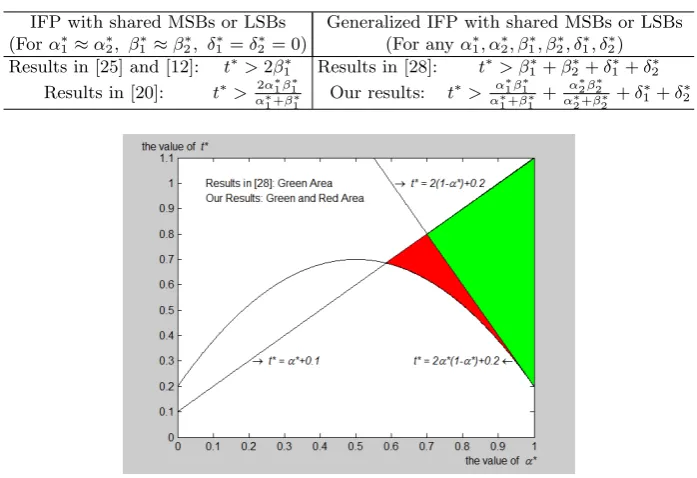
Fig. 1. Comparison between our results and those in [28] for generalized IFP with shared MSBs or LSBs whenα∗1 ≈α∗2≈α∗, β1∗≈β2∗≈1−α∗, δ1∗≈δ2∗≈0.1
the generalized IFP. And just as [20] improves the results of [12, 25], our results are also better than those in [28].
LetN1 ≈ N2 ≈M and α∗1 ≈α∗2 ≈ α∗, β1∗ ≈β2∗ ≈1−α∗, δ∗1 ≈δ∗2 ≈0.1
in Proposition 1 and Proposition 2. Then Inequality (4) turns out to be t∗ >
2α∗(1−α∗) + 0.2, while results given in [28] implyt∗>2(1−α∗) + 0.2. Besides, there is another conditiont∗< α∗1+δ∗1 ≈α∗+ 0.1 since a1p1 and a2p2 sharet
bits. For this example, Figure 1 illustrates the comparison between our results and those in [28]. And our new improvement is denoted by the Red Area in Figure 1.
Given MSBs or LSBs of the Prime Factor Ann-bit RSA modulusN=pq
with balancedp, qcan be factored, if 0.25nMSBs or LSBs ofpare exposed. This important result was proposed in [6, 7, 16] and is state-of-the-art up to now. Our new attacks, stated as the following two propositions, will improve the results in [6, 7, 16] if some greatest common divisor is large enough. We also consider the general case where p, qare not necessarily balanced.
Proposition 3. For RSA modulus N = pq with p = Nα∗, suppose we have known t most significant bits of p with 2t = Nt∗. Namely, pm is exposed for
p=pm·W+pl with W ≈Nα
∗
−t∗. Besides, we set gcd(p
l, kq+ 1) =Nθ
∗
some known small positive integerk (one can takek= 1 for example). ThenN can be factored in polynomial time if
t∗> α∗(1−α∗)−(θ∗)2. (5)
Proof. From p=pm·W +pl, we obtainN =W pmq+plq, which is equivalent to
N·(kq+ 1)−(kN+W pm)·q=plq,
with known N, pm, W, k. TakeB =N, x0 =kq+ 1, A = kN +W pm, y0 =
q, z0=plqin Theorem 1, and one can get gcd(A, B) = 1, gcd(x0, y0) = 1, u0=
gcd(x0, z0, A) = gcd(pl, kq+ 1), v0 = gcd(y0, z0, B) = q. Since the positive
integer k is small enough, we obtain α1 ≈ 1−α∗, α2 ≈ 1, α ≈ θ∗, β1 ≈
1−α∗, β2 = 1, β ≈ 1−α∗, γ ≈ 1−t∗. Next from Inequality (2), one gets
(1−t∗) + (1−α∗)−1<(θ∗)2+ (1−α∗)2, which finally reduces to Inequality (5).
ThenNis factored after we obtain the values ofx0, y0, z0. And thus Proposition 3
follows.
Proposition 4. For RSA modulus N = pq with p = Nα∗, suppose we have known t least significant bits of p with 2t = Nt∗. Namely, p
l is exposed for
p=pm·2t+pl. Besides, we set gcd(pm, kq+ 1) =Nθ
∗
for some known small positive integer k(one can take k= 1 for example). ThenN can be factored in polynomial time if
t∗> α∗(1−α∗)−(θ∗)2. (6)
Proof. From p=pm·2t+pl, we obtain N = 2tpmq+plq, which is equivalent to N ·(kq+ 1)−(kN +pl)·q = 2tp
mq with known N, pl, t, k. Similarly, take
B =N, x0 =kq+ 1, A=kN+pl, y0=q, C = 2t, z0 =pmq in Theorem 2, and finally we know Inequality (6) is sufficient to factorN efficiently. And thus Proposition 4 follows.
For the case ofα∗= 0.5, we obtaint∗>0.25−(θ∗)2from both Inequality (5) in Proposition 3 and Inequality (6) in Proposition 4. As mentioned before, the best known result ist∗>0.25 for exposed MSBs ofp(due to [6, 7, 16]) or exposed
LSBs ofp(due to [7, 16]). Thus we make improvement ifθ∗>0.
Actually, we first generalize the resultt∗>0.25 in [6, 7, 16] tot∗> α∗(1−α∗) for 0< α∗<1, then present an improvementt∗> α∗(1−α∗)−(θ∗)2 ifθ∗>0.
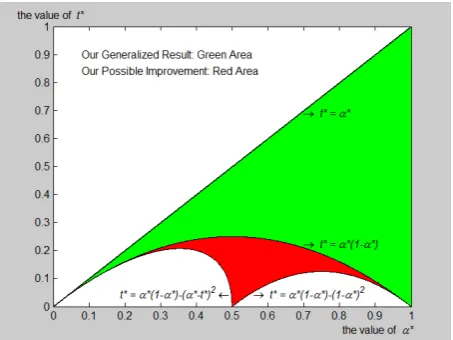
Besides, there is another condition t∗ < α∗ since t bits of p are exposed. In Figure 2, we use the Green Area to denote our generalized resultt∗> α∗(1−α∗), and the Red Area to illustrate the possible improvement t∗ > α∗(1−α∗)−
(min{α∗−t∗,1−α∗})2 for the extreme case ofθ∗= min{α∗−t∗,1−α∗}. One
can check thatt∗> α∗(1−α∗)−(min{α∗−t∗,1−α∗})2 is equivalent tot∗>
α∗(1−α∗)−(α∗−t∗)2, 0< α∗
60.5 ort∗> α∗(1−α∗)−(1−α∗)2, 0.5< α∗<1.
Fig. 2.Our generalized result and possible improvement for the attack on RSA with known MSBs or LSBs of the prime factor
gcd(pm, q+ 1) =pm hold, and it impliesθ∗ ≈0.5−t∗. Then p=pm·2t+pl is generated, where pl is randomly selected until p is a prime integer. Let θ∗ approximate 0.5, and one can make t∗ ≈ 0.5−θ∗ small enough such that the bits ofplcan be easily obtained by side channel attacks together with exhaustive search. Notice that Inequality (6) in Proposition 4 turns out to bet∗≈0.5−θ∗>
0.25−(θ∗)2, which always holds ifθ∗6= 0.5. As a conclusion, this circumstance
satisfies the condition to implement our attack and then factorN =pq.
Other Cryptanalysis of RSA We present some other cryptanalysis as the applications of our improvement to solveBx−Ay=z. These results, together with the proofs, are similar to Proposition 3, which is obtained based on our Theorem 1.
First let us consider the partially approximate common divisor problem (PACDP), which was proposed by Howgrave-Graham [16] in 2001. And this problem plays an important role in the area of cryptanalysis of RSA.
Suppose there exist known A, B ∈ Z+ and unknown d0 ∈ Z+, a0 ∈ Z,
sat-isfying gcd((A+a0), B) =d0, gcd(A, B) = 1 and A=Mα
∗
, B=Mβ∗, d
0 >
Mδ∗, |a
0| < Mγ
∗
Mα∗ for some known M ∈
Z+. Howgrave-Graham [16]
claimed that one can obtain such a0, d0 in polynomial time under the
condi-tion γ∗ < (δ∗)2/β∗. Based on our Theorem 1, we can obtain a new condition
γ∗ < (δ∗)2/β∗+ (θ∗)2/α∗, where θ∗ := log
M[gcd(A,|a0|)]. Thus our result is
better ifθ∗>0.
For RSA modulusN =pq with p, q ≈N0.5 and public exponente=Nα∗, suppose there exist x0, y0 ∈ Z with gcd(x0, y0) = 1 such that ex0 +y0 ≡
0 (modp), ex0+y06≡0 (modN) and|x0|< Nγ
∗
1, |y0|< Nγ2∗. Nitaj [29] claimed
that N can be factored in polynomial time if γ1∗+γ2∗ < ( √
2−1)/2 ≈ 0.207 holds. Later Lu et al. [22] gave a better result γ∗1+γ2∗ < 0.25. Based on our
Theorem 1, we can obtain a new condition γ∗
1 +γ2∗ < 0.25 + (θ∗)2/α∗, where
θ∗:= log
N[gcd(e,|y0|)]. In the same way, we can make improvement for the case
ofθ∗>0. And if one supposesp=Nδ∗instead ofp, q≈N0.5, our new condition
can be generalized toγ1∗+γ2∗<(δ∗)2+ (θ∗)2/α∗.
Besides, Nitaj also presented a similar attack on CRT-RSA in [29], which is again improved by Lu et al. in [22]. And we note that from our Theorem 1, one can also get a better result if some greatest common divisor is large enough.
5
Second Improvement for Solving
Bx
−
Ay
=
z
In this section, we present the second improvement for solving the equation
Bx−Ay = z. The main result is stated as Theorem 3 in Section 5.1. Then as an application of the second improvement, Section 5.2 shows an attack on RSA when some LSBs of the private exponent together with some MSBs of the prime factor are exposed. Subsequently, another attack aimed to factor an RSA modulus with a small difference of its prime factors is also proposed in Section 5.2.
5.1 Our Main Result
Our second improvement relies on another condition. Namely, it assumes that we have known the integerCsatisfyingz0≡C(modx0), z0'z0−C. Herez0'
z0−Cmeans thatz0andz0−Chave the same bit size. Different from Theorem 1,
this improvement does not need the condition gcd(A, B) = 1, gcd(x0, y0) = 1
in the proof. We present the second improvement as Theorem 3 below, together with an assumption on which Theorem 3 relies.
Assumption 1 The resultant computations for the polynomials obtained by Cop-persmith’s method yield non-zero polynomials.
Theorem 3. Suppose there exists unknown(x0, y0, z0)∈(Z+)3 satisfying
Bx0−Ay0=z0, |x0|< X, |y0|< Y, |z0|< Z,
z0≡C (mod x0), z0'z0−C.
Here the integerCis known, andA, B, X, Y, Zare known large positive integers, and for some known large positive integerM we have
X, Y, Z are usually selected to satisfy x0 ≈ X, y0 ≈Y, z0 ≈Z, thus we also
assume β2+α1 ≈ α2+β1 holds such that z0 Bx0, Ay0. Then under
As-sumption 1, one can find all such solutions(x, y, z) = (x0, y0, z0)of the equation
Bx−Ay=z in polynomial time ifα1< α2, 4α1+α264γ and
γ+α1−α2 (≈γ+β1−β2)<
α2 1
α2
. (7)
Since Assumption 1 is heuristic, we need to perform experiments to examine it, which is done in Section 6. And the successful experimental results in Section 6 justify the validity of Theorem 3 and its applications to cryptanalysis of RSA.
The Sketch of Proof Based on Coppersmith’s method, here we present the construction of the desired lattice and thus give the sketch proof of Theorem 3. And one can refer to Appendix D for the detailed proof.
From z0 ≡C (mod x0) we know that there exists an integer w0 satisfying
x0w0=z0−C. Definef(x, z) :=−Bx+z∈Z[x, z], and letm, τ be two positive
integers. Then we define the following polynomials inZ[x, z, w]:
gt,j(x, z) :=xt−j[f(x, z)]jAm−j, j= 0,1,· · ·, t, t= 0,1,· · ·, m, hi,j(x, z, w) :=wi[f(x, z)]jAm−j, j=θi, θi+ 1,· · ·, m, i= 1,2,· · ·, τ,
where θi :=dηiefor an undetermined parameterη. From Bx0−Ay0=z0 one
getsf(x0, z0)≡0 (modA). Thus we obtain
gt,j(x0, z0)≡0 (mod Am), j= 0,1,· · ·, t, t= 0,1,· · ·, m,
hi,j(x0, z0, w0)≡0 (modAm), j=θi, θi+ 1,· · ·, m, i= 1,2,· · ·, τ.
Besides, for every polynomial hi,j(x, z, w), we replace each occurrence of the monomialxw byz−C according to the relationx0w0=z0−C.
Next we define Λ∗ as the set of all integral linear combinations of these
gt,j(x, z) and hi,j(x, z, w). Similar to Section 3.2, Λ∗ corresponds to an lattice
Λ, and we denote its dimension by s. According to Lemmas 1, 2 and under Assumption 1, one can check that the condition det(Λ)<(Am)s−1 is sufficient
to obtain the desired (x0, y0, z0). Then takeη =mτ = √
γ−α1 √
α2−√γ−α1 andm→ ∞,
and after some calculation we know that det(Λ) < (Am)s−1 is equivalent to
Inequality (7).
For the proof of Theorem 3, we also have to make the basis matrix ofΛ a square matrix and a lower triangular matrix. And for this purpose the condition
θi+1 >θi+ 1 is sufficient. Finally in order to make θi+1 >θi+ 1 hold, we also need another two conditions α1< α2, 4α1+α264γ besides Inequality (7).
5.2 Applications to Cryptanalysis of RSA
Proposition 5. Given the RSA modulus N =pq with p, q ≈ N0.5, the public
exponent e≈N, and the private exponent d=Nβ∗. Suppose we have known t1
most significant bits of p with 2t1 =Nt∗1, and t2 least significant bits of d with
2t2 =Nt∗2. Namely,pm is exposed forp=pm·W +pl with W ≈N0.5−t
∗
1, and
dl is exposed ford=dm·2t2+dl. Then under Assumption 1, one can factorN
in polynomial time ifdl< Nβ
∗
−t∗1−0.5, 4t∗
1+t∗261and
β∗<1 +t∗2−q(1 +t∗
2)(0.5−t∗1). (8)
Proof. Sincepmis exposed forp=pm·W +pl, one can get the value ofqmfor
q=qm·W+ql. According toe·d≡1 (modϕ(N)), we know there existsk∈Z+
withk≈Nβ∗ such that 1 =ed−kϕ(N) =e·(d
m·2t2+dl)−k·[N−(pm·W+
pl)−(qmW +ql) + 1], which is equivalent to
(N−W pm−W qm+ 1)·k−2t2e·dm= (pl+ql)k+edl−1,
where only (pl+ql), dm, kare unknown. TakeB=N−W pm−W qm+ 1, x0=
k, A= 2t2e, y
0=dm, z0= (pl+ql)k+edl−1 in Theorem 3, and one can get
C=edl−1 satisfies z0≡C (modx0) andz0'z0−Cdue to dl< Nβ
∗−t∗
1−0.5.
Besides, we haveα1≈β∗, α2≈1 +t∗2, β1≈β∗−t∗2, β2≈1, γ≈β∗+ 0.5−t∗1,
where α1 < α2 already holds, and 4α1 +α2 6 4γ ⇔ 4t∗1 +t∗2 6 1. Then
from Inequality (7), we obtain (β∗+ 0.5−t∗
1) +β∗−(1 +t∗2) < (β∗)2
1+t∗
2
, which
finally reduces to Inequality (8). ThenN is factored after we obtain the values ofx0, y0, z0. And thus Proposition 5 follows.
In 2008, Sarkar and Maitra [36] obtained the resultt∗2> g(β∗, t∗1) := 13(0.5−
t∗1) + 23p(0.5−t∗1)2+ 3β∗(0.5−t∗
1) +β∗ −1, with the notations β∗, t∗1, t∗2
de-fined in Proposition 5. On the other hand, Inequality (8) is equivalent to t∗2 > h(β∗, t∗1) :=21(0.5−t∗1) +21p(0.5−t∗1)2+ 4β∗(0.5−t∗
1) +β∗−1. One can check
thatg(β∗, t∗1)> h(β∗, t∗1) always holds forβ∗>0. Thus the result of our Propo-sition 5 is better than that of Sarkar and Maitra [36] under the extra condition
dl< Nβ
∗−t∗
1−0.5, 4t∗
1+t∗261.
The comparison between the two results of Proposition 5 and [36] forβ∗= 0.700,0.650,0.600 is illustrated by Table 2. For example, suppose that log2N ≈
1000 and β∗ = 0.600, the result of Sarkar and Maitra [36] shows that if 20
Table 2.Comparison between the result of our Proposition 5 (i.e.t∗2> h(β
∗
, t∗1)) and
that in [36] (i.e.t∗2> g(β∗, t∗1)) forβ∗= 0.700,0.650,0.600
t∗1 0.000 0.010 0.020 0.030 0.040 0.050 0.060 0.070 0.080
g(0.700, t∗1) 0.627 0.614 0.602 0.589 0.577 0.564 0.551 0.539 0.526
h(0.700, t∗1) 0.592 0.580 0.567 0.555 0.542 0.530 0.517 0.504 0.491
g(0.650, t∗1) 0.555 0.542 0.530 0.518 0.505 0.493 0.480 0.468 0.455
h(0.650, t∗1) 0.522 0.510 0.498 0.486 0.473 0.461 0.448 0.436 0.423
g(0.600, t∗1) 0.482 0.470 0.457 0.445 0.433 0.421 0.409 0.396 0.384
Table 3.Attacks on RSA related to Proposition 5
t∗1= 0 t∗1>0
t∗2= 0
Result in [3, 14]: Result in [30]:
β∗<1−√0.5≈0.292 β∗<1−p
0.5−t∗
1
(No extra conditions) (t∗160.25)
t∗2 >0
Result in [39]: Our result:
β∗<1 +t∗2−
p
0.5(1 +t∗
2) β
∗
<1 +t∗2−
p
(1 +t∗
2)(0.5−t
∗
1)
(dl< Nβ
∗−0.5
) (dl< Nβ
∗−t∗
1−0.5, 4t∗
1+t∗261)
bits (the MSBs) of p are obtained (i.e. t∗1 = 0.020) by exhaustive search (or side channel attacks), one needs more than 457 known bits (the LSBs) of d
to factor the RSA modulus N = pq. While according to our Proposition 5, more than 428 known bits (the LSBs) of d are sufficient for the case of dl <
Nβ∗−t∗1−0.5, 4t∗
1+t∗261.
Note that usually one has dl ≈ Nt
∗
2 at random, thus the condition dl <
Nβ∗−t∗1−0.5 implies that we assume some MSBs of the exposedd
lare all 0 bits. When it comes to implementation of RSA, one may choose a private exponent
dconsisting of many 0 bits in order to improve the performance by lowering the Hamming weight of d and thus reducing the total number of multiplications. And the conditiondl< Nβ
∗−t∗
1−0.5may hold for this case.
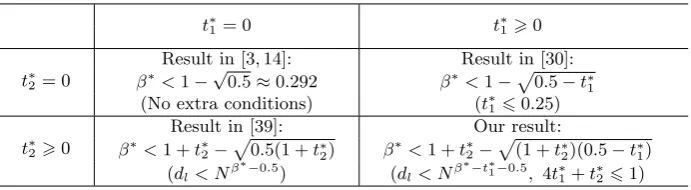
Besides, let us consider several special cases for Proposition 5. (I) For the case of t∗
1 = 0, the condition 4t∗1+t∗2 6 1 naturally holds. Thus to factor N
we only need dl < Nβ
∗−0.5
and β∗ < 1 +t∗2−p
0.5(1 +t∗
2). This is exactly
the result in [39]. (II) For the case of t∗2 = 0, we know there are no exposed bits in d. Therefore, we should take dl= 0 and the condition dl < Nβ
∗−t∗
1−0.5
also naturally holds. In order to factor N, now we only need t∗1 6 0.25 and
β∗ <1−p
0.5−t∗1, which is presented in [30]. Here we note that ift∗1 >0.25, one can also successfully factor N according to Proposition 3 for p, q ≈ N0.5.
(III) As for the case of t∗1 = t∗2 = 0, from above analysis we know both the conditiondl< Nβ
∗−t∗
1−0.5and the condition 4t∗
1+t∗261 already hold. And one
can obtain the best small private exponent attack resultβ∗<1−√0.5≈0.292 shown in [3] and [14]. All the above cases have been summarized in Table 3.
Finally, we present another attack based on Theorem 3. It considers an RSA modulus with a small difference of its prime factors.
Proposition 6. Given the RSA modulus N =pq with p, q ≈ N0.5, the public exponent e≈N, and the private exponent d=Nβ∗. Suppose p, q share t most significant bits with 2t=Nt∗, namely, we have |p−q|< N0.5−t∗. Then under Assumption 1, one can factor N in polynomial time if
t∗60.125, β∗<1−√0.5−2t∗. (9)
Proof. From|p−q|< N0.5−t∗ and (p−q)2= (p+q)2−4N = (p+q+ 2N0.5)(p+
Fig. 3.Comparison between the result of our Proposition 6 and that in [10, 18] for the attack on RSA with a small difference of prime factors
q)2/4N0.5<(1/4)·N0.5−2t∗. TakeD :=d2N0.5e, and omit the constant factor
1/4. Then roughly we have|p+q−D|< N0.5−2t∗. Frome·d≡1 (modϕ(N)), we know there exists k ∈ Z+ with k ≈ Nβ
∗
such that 1 = ed−kϕ(N) =
e·d−k·[(N−D+ 1)−(p+q−D)]. It is equivalent toBx0−Ay0=z0, where
B := N−D+ 1 ≈N, x0 :=k ≈ Nβ
∗
, A:= e ≈N, y0 := d =Nβ
∗
, z0 :=
(p+q−D)k−1 < Nβ∗+0.5−2t∗ with z0 ≡ −1 (mod x0). According to the
conditionsα1< α2, 4α1+α264γ, γ+α1−α2< α21/α2 in Theorem 3, we can
obtain Inequality (9) and complete the proof of Proposition 6 as before.
In 2002, by generalizing the best small private exponent attack result d < N0.292 [3], Weger [10] obtained the condition 4t∗
6β∗, β∗<1−√0.5−2t∗ for
factoring an RSA modulus with a small difference of its prime factors. Another proof of Weger’s result can also be found in [18]. Since 4t∗ 6 β∗, β∗ < 1− √
0.5−2t∗ ⇒4t∗ <1−√0.5−2t∗, β∗ <1−√0.5−2t∗ ⇒t∗
60.125, β∗ <
1−√0.5−2t∗, the condition of our Proposition 6 is weaker than that in [10, 18],
which implies that our result is better. It is also illustrated by Figure 3, where the Red Area denotes our new improvement.
6
Experiments
6.1 Experimental Examples for Our First Improvement
Table 4 shows experiments for our results of generalized IFP with shared MSBs or LSBs. The notationsM, N1, N2, t∗, α∗1, α∗2, β1∗, β2∗, δ1∗, δ∗2 are already defined in
Proposition 1 or 2. And in Section 4.1 (or Appendix C) we have defined the nota-tionsm, τ, i, which are used for the construction of the latticeΛand the proof of Theorem 1 or 2. Besides, dim(Λ) denotes the dimension ofΛ, and “Time(LLL)” denotes the time used for LLL algorithm for each experimental example. As for “Bit size”, we just means log2{[det(Λ)]1/dim(Λ)}. LetBdenote the basis matrix
of Λ and we know Bis a lower triangular matrix from Appendix C. Note that det(Λ) =pdet(BBT) =|detB|= detB. Thus [det(Λ)]1/dim(Λ) is the geometric
mean of the diagonal entries of the basis matrixB, and one can roughly regard log2{[det(Λ)]1/dim(Λ)}as the bit size of the entries ofB. According to Lemma 1,
the time for the LLL algorithm is related to both dim(Λ) and the bit size of the entries ofB.
The experimental examples of Table 5 are about our results when some MSBs or LSBs of the prime factor are given. The definition of the notations
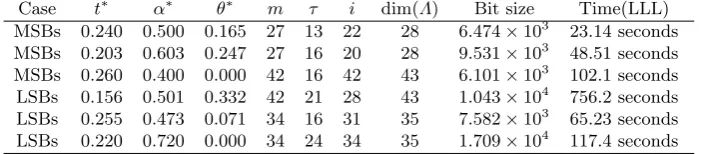
N, k, t∗, α∗, θ∗ can be found in Proposition 3 or 4. And again Section 4.1 (or Appendix C) defines the notations m, τ, ifor the construction of the latticeΛ. The experimental examples for other cryptanalysis of RSA in Section 4.2 are similar to those for Proposition 3.
Table 4.Some experimental examples for Proposition 1 (the case of MSBs) and Propo-sition 2 (the case of LSBs) with β1∗≈1−α
∗
1, β
∗
2 ≈1−α
∗
2 and log2M ≈log2N1 ≈
log2N2≈1500
Case t∗ α∗1 α
∗
2 δ
∗
1 δ
∗
2 m τ i dim(Λ) Bit size Time(LLL)
MSBs 0.606 0.679 0.684 0.066 0.061 15 10 10 16 1.008×10⁴ 6.596 seconds MSBs 0.533 0.666 0.799 0.133 0.000 15 11 9 16 1.198×10⁴ 7.649 seconds MSBs 0.687 0.733 0.500 0.000 0.233 23 16 11 24 1.725×10⁴ 116.3 seconds LSBs 0.529 0.580 0.579 0.000 0.000 23 13 13 24 1.093×10⁴ 27.73 seconds LSBs 0.433 0.752 0.805 0.053 0.000 19 15 14 20 1.782×10⁴ 35.12 seconds
LSBs 0.756 0.803 0.479 0.000 0.324 19 15 9 20 1.802×10⁴ 88.97 seconds
Table 5.Some experimental examples for Proposition 3 (the case of MSBs) and Propo-sition 4 (the case of LSBs) withk= 1 and log2N ≈1000
Case t∗ α∗ θ∗ m τ i dim(Λ) Bit size Time(LLL)
MSBs 0.240 0.500 0.165 27 13 22 28 6.474×10³ 23.14 seconds MSBs 0.203 0.603 0.247 27 16 20 28 9.531×10³ 48.51 seconds
MSBs 0.260 0.400 0.000 42 16 42 43 6.101×10³ 102.1 seconds LSBs 0.156 0.501 0.332 42 21 28 43 1.043×10⁴ 756.2 seconds
Table 6. Some experimental examples for Proposition 5 (under the extra condition
dl< Nβ
∗−t∗
1−0.5, 4t∗
1+t
∗
2 61) with log2N≈2000
β∗ t∗1 t
∗
2 m τ θ1, θ2,· · ·, θτ dim(Λ) Bit size Time(LLL)
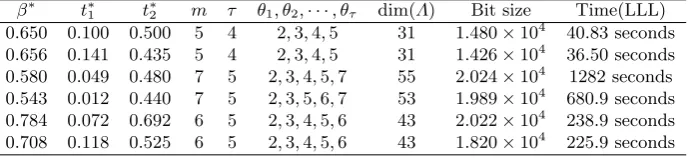
0.650 0.100 0.500 5 4 2,3,4,5 31 1.480×10⁴ 40.83 seconds
0.656 0.141 0.435 5 4 2,3,4,5 31 1.426×10⁴ 36.50 seconds 0.580 0.049 0.480 7 5 2,3,4,5,7 55 2.024×10⁴ 1282 seconds
0.543 0.012 0.440 7 5 2,3,5,6,7 53 1.989×10⁴ 680.9 seconds 0.784 0.072 0.692 6 5 2,3,4,5,6 43 2.022×10⁴ 238.9 seconds
0.708 0.118 0.525 6 5 2,3,4,5,6 43 1.820×10⁴ 225.9 seconds
6.2 Experimental Examples for Our Second Improvement
As for our results obtained by the second improvement for solving the equation
Bx−Ay = z, they all rely on Assumption 1. Here we point out that in all of our experiments for Propositions 5, 6, Assumption 1 always holds and RSA modulusNcan always be successfully factored. Table 6 gives some experimental examples for Proposition 5. Similar to Tables 4, 5, the notations N, dl, β∗, t∗1, t∗2
are defined in Proposition 5, while in Section 5.1 (or Appendix D) one can find the definition of the notationsm, τ, θ1, θ2,· · ·, θτ, which are used to constructΛ
and prove Theorem 3. The experimental examples for Proposition 6 are similar to those for Proposition 5.
7
Conclusion
In this paper, we revisit some cryptanalysis of RSA, which are summarized into one framework, namely, finding small solutions (x, y, z) = (x0, y0, z0) of the
equationBx−Ay=z. For the general case of solving this equation, we show that Wiener’s method, May-Ritzenhofen’s method and Coppersmith’s method are equivalent, and they give the same result after omitting some negligible terms. For some special cases, we present two improvements for solving Bx−Ay=z
based on Coppersmith’s method. And according to these two improvements, we obtain some new applications to cryptanalysis of RSA, such as new results about the generalized IFP, attacks with known bits of the prime factor, an attack on RSA when some bits of the private exponent together with the prime factor are exposed, and so on. The justification of our approach is also examined through experiments. Moreover, we believe that our two improvements to solve
Bx−Ay=z may find other new applications to cryptanalysis of RSA.
References
1. Aono Y. A new lattice construction for partial key exposure attack for RSA. Public Key Cryptography-PKC 2009. Springer Berlin Heidelberg, 2009: 34-53.
3. Boneh D, Durfee G. Cryptanalysis of RSA with private key d less than N0.292. Advances in Cryptology-EUROCRYPT 1999. Springer Berlin Heidelberg, 1999: 1-11.
4. Boneh D, Durfee G, Frankel Y. An attack on RSA given a small fraction of the private key bits. Advances in Cryptology-ASIACRYPT 1998. Springer Berlin Hei-delberg, 1998: 25-34.
5. Coppersmith D. Finding a small root of a univariate modular equation. Advances in Cryptology-EUROCRYPT 1996. Springer Berlin Heidelberg, 1996: 155-165. 6. Coppersmith D. Finding a small root of a bivariate integer equation; factoring with
high bits known. Advances in Cryptology-EUROCRYPT 1996. Springer Berlin Hei-delberg, 1996: 178-189.
7. Coppersmith D. Small solutions to polynomial equations, and low exponent RSA vulnerabilities. Journal of Cryptology, 1997, 10(4): 233-260.
8. Coron J S. Finding small roots of bivariate integer polynomial equations revisited. Advances in Cryptology-EUROCRYPT 2004. Springer Berlin Heidelberg, 2004: 492-505.
9. Coron J S, May A. Deterministic polynomial-time equivalence of computing the RSA secret key and factoring. Journal of Cryptology, 2007, 20(1): 39-50.
10. De Weger B. Cryptanalysis of RSA with small prime difference. Applicable Algebra in Engineering, Communication and Computing, 2002, 13(1): 17-28.
11. Ernst M, Jochemsz E, May A, et al. Partial key exposure attacks on RSA up to full size exponents. Advances in Cryptology-EUROCRYPT 2005. Springer Berlin Heidelberg, 2005: 371-386.
12. Faug`ere J C, Marinier R, Renault G. Implicit factoring with shared most significant and middle bits. Public Key Cryptography-PKC 2010. Springer Berlin Heidelberg, 2010: 70-87.
13. Hardy G H, Wright E M. An introduction to the theory of numbers. Oxford Uni-versity Press, 1979.
14. Herrmann M, May A. Maximizing small root bounds by linearization and applica-tions to small secret exponent RSA. Public Key Cryptography-PKC 2010. Springer Berlin Heidelberg, 2010: 53-69.
15. Howgrave-Graham N. Finding small roots of univariate modular equations revis-ited. Crytography and Coding. Springer Berlin Heidelberg, 1997: 131-142.
16. Howgrave-Graham N. Approximate integer common divisors. Cryptography and Lattices. Springer Berlin Heidelberg, 2001: 51-66.
17. Joux A. Algorithmic cryptanalysis. CRC Press, 2009.
18. Kumar S, Narasimham C. Cryptanalysis of RSA with small prime difference us-ing unravelled linearization. International Journal of Computer Applications, 2013, 61(3).
19. Lenstra A K, Lenstra H W, Lov´asz L. Factoring polynomials with rational coeffi-cients. Mathematische Annalen, 1982, 261(4): 515-534.
20. Lu Y, Peng L, Zhang R, et al. Towards optimal bounds for implicit factorization problem. International Conference on Selected Areas in Cryptography-SAC 2015. Springer International Publishing, 2015: 462-476.
21. Lu Y, Zhang R, Lin D. Improved bounds for the implicit factorization problem. Advances in Mathematics of Communications, 2013, 7(3): 243-251.
22. Lu Y, Zhang R, Peng L, et al. Solving linear equations modulo unknown divisors: revisited. Advances in Cryptology-ASIACRYPT 2015. Springer Berlin Heidelberg, 2015: 189-213.
24. May A. Computing the RSA secret key is deterministic polynomial time equivalent to factoring. Advances in Cryptology-CRYPTO 2004. Springer Berlin Heidelberg, 2004: 213-219.
25. May A, Ritzenhofen M. Implicit factoring: on polynomial time factoring given only an implicit hint. Public Key Cryptography-PKC 2009. Springer Berlin Heidelberg, 2009: 1-14.
26. Meyer C D. Matrix analysis and applied linear algebra. Cambridge University Press, Cambridge, 2000.
27. Minkowski H. Geometrie der Zahlen. Teubner-Verlag, 1896.
28. Nitaj A, Ariffin M R K. Implicit factorization of unbalanced RSA moduli. Journal of Applied Mathematics and Computing, 2015, 48(1-2): 349-363.
29. Nitaj A. A new attack on RSA and CRT-RSA. Progress in Cryptology-AFRICACRYPT 2012. Springer International Publishing, 2012: 221-233.
30. Peng L, Hu L, Huang Z, et al. Partial prime factor exposure attacks on RSA and its Takagi’s variant. International Conference on Information Security Practice and Experience-ISPEC 2015. Springer International Publishing, 2015: 96-108.
31. Peng L, Hu L, Lu Y, et al. Implicit factorization of RSA moduli revisited (short paper). International Workshop on Security-IWSEC 2015. Springer International Publishing, 2015: 67-76.
32. Peng L, Hu L, Xu J, et al. Further improvement of factoring RSA moduli with implicit hint. Progress in Cryptology-AFRICACRYPT 2014. Springer International Publishing, 2014: 165-177.
33. Rivest R L, Shamir A, Adleman L. A method for obtaining digital signatures and public-key cryptosystems. Communications of the ACM, 1978, 21(2): 120-126. 34. Sarkar S. Partial key exposure: generalized framework to attack RSA. Progress in
Cryptology-INDOCRYPT 2011. Springer Berlin Heidelberg, 2011: 76-92.
35. Sarkar S, Gupta S S, Maitra S. Partial key exposure attack on RSA - improvements for limited lattice dimensions. Progress in Cryptology-INDOCRYPT 2010. Springer Berlin Heidelberg, 2010: 2-16.
36. Sarkar S, Maitra S. Improved partial key exposure attacks on RSA by guessing a few bits of one of the prime factors. International Conference on Information Security and Cryptology. Springer, Berlin, Heidelberg, 2008: 37-51.
37. Sarkar S, Maitra S. Approximate integer common divisor problem relates to implic-it factorization. IEEE Transactions on Information Theory, 2011, 57(6): 4002-4013. 38. Takayasu A, Kunihiro N. Partial key exposure attacks on RSA: achieving the boneh-durfee bound. International Workshop on Selected Areas in Cryptography-SAC 2014. Springer International Publishing 2014: 345-362.
39. Wang S, Qu L, Li C, et al. Generalized framework to attack RSA with special exposed bits of the private key. IEICE Transactions on Fundamentals of Electronics, Communications and Computer Sciences, 2017, 100(10): 2113-2122.
40. Wiener M J. Cryptanalysis of short RSA secret exponents. IEEE Transactions on Information theory, 1990, 36(3): 553-558.
Appendix A: Wiener’s Method to Prove Result 1
Letη =η0 be a positive rational number. Fori= 0,1,2· · ·, defineai=bηic andηi+1= 1/(ηi−ai) unlessηn is an integer for somen>0 (there must exists such annsinceη is a rational number). Thenη can be expressed as a continued fraction, namely,
η =< a0, a1,· · ·, an−1, an>:=a0+ 1/(a1+ 1/(· · ·+ 1/(an−1+ 1/an)· · ·)).
Fori>0,Ai/Bi :=< a0, a1,· · ·, ai>are called the convergents ofη=An/Bn, where gcd(An, Bn) = 1. And we note that the total number of convergents is polynomial in log(Bn). The related lemma [13, Theorem 184] is stated as follows:
Lemma 3. (Legendre)Let η be a positive rational number. Suppose
η−x0
y0
< 1
2y2 0
andgcd(x0, y0) = 1. Then xy00 is one of the convergents ofη.
One can generalize the original method of Wiener’s attack in [40] to get the proof of Result 1. For simplicity, here we use Lemma 3 to directly prove it. And the method is almost the same as Wiener’s original method.
From Bx0−Ay0 = z0 we have
A B −
x0
y0 =
x0
y0 −
A B =
z0
By0. According to
Lemma 3, if z0
By0 < 1 2y2
0
holds, x0
y0 is one of the convergents of
A
B. The total number of convergents is polynomial in logB. Thus we try every convergent of
A
B as the value of x0
y0 and compute z0. Then from them we will obtain small
solutions (x0, y0, z0) satisfying |x0| < X, |y0| < Y, |z0| < Z. As a conclusion,
the only condition to find (x0, y0, z0) is
z0
By0 < 1 2y2
0
⇔ 2y0z0< B ⇔ logM2 + logMy0+ logMz0<logMB.
Omitting logM2, we know the condition γ+β1−β2 < 0 is sufficient, which
completes the proof of Result 1.
If one considers Wiener’s original method, the final condition obtained is
3
2y0z0< B, instead of 2y0z0< B. At last, we note that Wiener’s resultd < N 0.25
for small private exponent attack, can be directly obtained from Result 1.
Appendix B: May-Ritzenhofen’s Method to Prove Result 1
Lemma 4. (Hadamard) LetB=
b1
b2 .. .
bs
∈Zs×s be an arbitrary non-singular
matrix. Then
det(B)6 n
Y
i=1 kbik.
The successive minimaλi(Λ) of the latticeΛare defined as the minimal radius of a ball containingilinearly independent lattice vectors ofΛ. The shortest non-zero vectorvof a latticeΛmust have the normkvk=λ1(Λ), and it also satisfies
the Minkowski bound [27].
Lemma 5. (Minkowski) Let sbe the dimension (and the rank) of the lattice Λ. ThenΛ contains a non-zero vector v satisfying
kvk=λ1(Λ)6 √
s[det(Λ)]1/s.
For a two-dimensional latticeΛ, the basis vectorsv1,v2with normskv1k= λ1(Λ),kv2k=λ2(Λ) can be efficiently computable by means of Gaussian
reduc-tion. Namely, we have the following lemma [26].
Lemma 6. (Gauss) Given a basis (square) matrix B of a two-dimensional latticeΛ, the Gauss-reduced lattice basis vectorsv1,v2, where
kv1k=λ1(Λ), kv2k=λ2(Λ),
can be determined in timeO(log2(max{kv1k,kv2k})).
Now we can generalize May and Ritzenhofen’s attack in [25] to get another proof of Result 1. It includes two cases, namely,γ>α1 andγ < α1.
(I) Supposeγ >α1, and select a positive integerC satisfying C≈Mγ−α1.
We construct a two-dimensional latticeΛ whose basis (square) matrixBis
C B
0 A
.
FromBx0−Ay0=z0we know thatu:= (Cx0, z0)∈Λ. Then according to
Lem-ma 6, we can obtain the basis vectors v1,v2 with normskv1k =λ1(Λ),kv2k= λ2(Λ). And there exista1, a2∈Z, such thatu=a1v1+a2v2.
If kuk < λ2(Λ) holds, from the definition of λ2(Λ) one can obtain a2 = 0
andu=a1v1⇔v1=u/a1= (C·x0/a1, z0/a1). FromB·x0/a1−A·y0/a1=
z0/a1 and the fact thatv1 is generated from the basis matrixB, we havev1= (C·x0/a1, z0/a1) = x0/a1·(C, B)−y0/a1·(0, A). Thus x0/a1,−y0/a1 ∈ Z,
and we have a1|x0, a1|y0. Since gcd(x0, y0) = 1, finally one gets a1 =±1 and v1 =±u =±(Cx0, z0). The vector v1 is already obtained, thus we can easily get the values ofx0, z0 and then the value ofy0.
As a conclusion, the only condition to find (x0, y0, z0) iskuk< λ2(Λ).
Lem-ma 5 tells λ1(Λ) 6 √
kv1kkv2k = λ1(Λ)λ2(Λ). Thus we obtain λ2(Λ) > det(λ Λ) 1(Λ) >
det(Λ) √
2[det(Λ)]1/2 = 1
√ 2(AC)
1/2 ≈ M(γ−α1+α2)/2. Roughly we have kuk 6 max{ √
2Cx0, √
2z0} <
max{√2CX,√2Z} ≈Mγ. Hence to makekuk< λ2(Λ) hold, it is sufficient that
Mγ < M(γ−α1+α2)/2 ⇔ γ <(γ−α1+α2)/2 ⇔ γ+α1−α2<0.
(II) For the case of γ < α1, we will select a positive integer D satisfying
D≈Mα1−γ, and the basis (square) matrixB is changed to
1 D·B
0 D·A
.
The rest of the proof is almost the same as the former case and we omit it. From the above, we know Result 1 follows. Finally, we note that May and Ritzenhofen’s result for the IFP, can be directly obtained from Result 1.
Appendix C: Detailed Proofs of Theorems 1, 2
Firstly, based on Coppersmith’s method we present the detailed proof of The-orem 1. We may again give the same definitions for some notations which are already introduced in the sketch of proof in Section 4.1. That allows us to show an integrated proof, which makes it unnecessary to review the sketch of proof a-gain. Secondly, we mainly introduce the polynomials for the lattice construction to prove a lemma which is similar to Theorem 1. Finally, the proof of Theorem 2 is given directly as a consequence of this lemma.
(I) Setx00 :=x0/u0, a00 :=A/u0, y00 :=y0/v0, b00:=B/v0, z0∗:=z0/(u0v0)
and B0 := dB/Ve, X0 := dX/Ue, Z∗ := dZ/(U V)e. Then we have |b00| < B0, |x00|< X0, |z0∗|< Z∗.
Definef(b0, x0, z∗) :=−b0x0+z∗∈Z[b0, x0, z∗]. From
Bx0−Ay0=z0 ⇔ b00v0x00u0−a00u0y00v0=z∗0u0v0 ⇔ b00x 0 0−a
0 0y
0 0=z
∗ 0,
we obtain
f(b00, x00, z0∗)≡0 (moda00).
Besides the above three variables b0, x0, z∗, we also introduce another variablev
forv0.
Let the positive integersm, τ and the non-negative integeribe undetermined parameters. Then for k= 0,1,· · ·, m, we define
gk(b0, x0, z∗, v) :=Emin{i,m−k}vi(b0x0) m−k
[f(b0, x0, z∗)]kAmax{τ−k,0},
where E is the inverse of B modulo Aτ, namely, EB ≡ 1 (mod Aτ). Such
E must exit since gcd(A, B) = 1. Recall that f(b0
0, x00, z∗0) ≡ 0 (mod a00) and
A≡0 (moda00), thus we obtain
gk(b00, x00, z0∗, v0)≡0 (mod (a00)
τ
![Table 2. Comparison between the result of our Proposition 5 (i.e. t∗2 > hβ(∗, t∗1)) andthat in [36] (i.e](https://thumb-us.123doks.com/thumbv2/123dok_us/7979806.1323483/17.595.133.483.586.664/table-comparison-result-proposition-i-e-hb-andthat.webp)
![Fig. 3. Comparison between the result of our Proposition 6 and that in [10, 18] for theattack on RSA with a small difference of prime factors](https://thumb-us.123doks.com/thumbv2/123dok_us/7979806.1323483/19.595.194.423.115.287/comparison-result-proposition-theattack-small-dierence-prime-factors.webp)