The South Needs Range Men1
of study designed to assist with WAYNE J. CLOWARD the problems of the West. Today Assistant Regional Forester, Forest all 17 institutions offering cur- Service, USDA, Atlanta, Georgia. riculums in range managementare west of the Mississippi River.
Highlight What is more, most people
Fore& range is an imporfanf trained in range management source of forage for fhe big and prefer to work out West. Al- arowinu business of livesfock nro- though the South in the past has ducfiocin fhe Soufh. People frained recruited western-trained DeoDle in managemenf of souihern ranges -~
are needed for effecfive ufilizafion and attempted to get on ioplof of fhe Soufh’s grazing resource buf the range job, few have stayed fhe supply is foo limifed. The Soufh
needs a range curriculum. long enough to recognize the dif- ference between the range job Livestock production is a big
and growing industry in the South. In 1964 southern states produced about one-third of the total national production of beef cattle. With a growing season of 5 to 12 months and plenty of rain, the South can produce the neces- sary forage and will play a major part in meeting future demands for beef. Forest range is an im- portant source of this forage.
But for effective utilization of the South’s grazing resources, there’s a definite need for people trained in the management of southern ranges. Unfortunately, the supply is too limited. For ex- ample, we have 115 rangers on the 33 National Forests in the 13 southern states and only one has a degree in range management. Of the total of some 4,700 Forest Service employees in the Region, fewer than 10 have a background of formalized training in range management. And all but two of these are western born, western trained and western oriented.
Although formal range educa- tion began in the East at Yale University and Iowa State Col- lege, the hard core science of range management was largely developed in and for the West. By 1917 the University of Idaho and Montana State University were offering formal training in range management with a course
needed in the South and that practiced in the West. At the first opportunity they are gone, leaving behind foresters who by training and choice are not pre- pared for, or interested in, the range job.
The two Forest Service em- ployees in the Southern Region who are native southerners and have training in range manage- ment are excelling in perform- ance and accomplishment. How- ever, they are lacking in several areas of formalized training de- sirable and eventually necessary for working with ranges in the South. On the 115 Ranger Dis- tricts, 61 rangers are involved in analyzing the grazing resource and designing plans and pro- grams for managing this re- source. All of them recognize their lack of training in the range management disciplines. All are begging for trained help.
Although we have an intensive on-the-job training program to try to help compensate for their lack of formal range training and experience, we are a long way from scientific range manage- ment. Apparently, we also are still further away from getting the type of trained people we need to do the southern range job.
There are several areas pecu- liar to the South that require certain disciplines or emphasis
IPresented at Nineteenth Annual not stressed in western-oriented Meeting, American Society of Range range schools. I realize that in Management. New Orleans. Louisi- adjusting curricula to Regional ana, February l-4,1966. ’ needs, graduates of the baccalau-
reate program may not be pro- fessional range men in the strict- est sense of the word. They can be, but it may take five years in- stead of four. Let’s look at some of the areas where Regional em- phasis in training is needed to do the southern range job.
Most of the grazing in the South that is not on improved pasture is under a commercial forest canopy. Here both the overstory and understory are kept in a vigorous subclimax condition by short cutting cycles, prescribed burning and exten- sive ground preparation for re- generation. These are normal silvicultural practices for the southern forest types. Not only does volume of forage follow these changes in overstory but dynamic changes occur in under- story composition over relatively short periods of time. It is within this rapidly changing environ- ment that our range program is conducted.
Analysis and interpretation of understory condition and trend is a delicately complex job. Com- monly used systems for measur- ing these changes and for inter- preting them with reference to grazing programs are not satis- factory for use in the South since they do not take into considera- tion the suppressive effects of tree crown density and related factors. The short range vegeta- tional changes in the forest cover create problems in developing and coordinating practical range programs in the South that are uncommon in the West. Because of the influence of the timber overstory and its management on the range resource and the deli- cate timber-range coordination job, the southern range man should have a background in for- estry, oriented toward silvics and silviculture.
The South has never been fully botanized and much is still un- known about species composition and relative forage values of many native ranges and range
30 CLOWARD
plants in the South. Southern- trained foresters know their trees and most of them know the principal browse and some field and pasture plants. However, agrostology is completely foreign to most. True, western schools include some southern species in botany and agrostology courses. But the emphasis is regional. Range management requires a complete knowledge of native forage species and their relative value and importance. The ex- pansion and improvement of the range livestock industry pro- vides a need and a reason for southern regional emphasis on agrostology, including both na- tive and introduced species. Un- til there is a southern-oriented range curriculum developed, knowledge of range forage plants by southern range men will gen- erally be less than satisfactory.
One big factor in an argument for a southern-oriented range curriculum is the ‘social and
economic structure of the South. There are sharp contrasts in this structure and regional differ- ences of the southern individual and the southern society. Range- trained people working in the South must have a knowledge of and feeling for these .differences. The southern range man must be able to interpret the social, po- litical, and economic environ- ment in which his company or agency operates. Computer and research techniques will help but in the final decision, the southern range man must draw from his imagination, training, and ‘ex- perience in the areas of human behavior where scientific predic- tions are highly fallible.
There are a number of other regional differences that require regionally-oriented techniques. Such things as animal breeds and breeding, woodland ecology, plant and animal pathology, plant and animal nutrition, and many others have their best training effectiveness when taught in the area where they are
to function. Regional training is mandatory in programs where knowledge of the physical and social environment is necessary to success. To be most effective in the South, the southern range man must be generally southern- raised, southern-trained, and ori- ented in southern physical, socio- political, and economic discip- lines.
In 1952 a standard range cur- riculum was developed by a committee in the American Soci- ety of Range Management for guidance of schools interested in establishing a range curriculum. These standards were divided into three groups: (1) basic courses in English, mathematics, chemistry, economics, etc., (2) technical courses for all profes- sional range managers, and (3) elective courses for broader preparation for range managers in certain fields or certain agen- cies. To these should be added the importance of recognizing regional differences to fully meet the needs of various agencies and various fields of range man- agement. The entire standard curriculum-basic, technical and elective-should be geared, when possible, to the conditions and needs of the region in question.
I contacted 10 major colleges and universities in the South sometime ago, exploring their attitude toward establishing a range curriculum in their schools. In making these inquiries, I listed generally the standard or core requirements as outlined by ASRM, called special attention to those needing regional em- phasis, and added several subject areas particularly needed for re- gional application in range man- agement. Four of the 10 con- tacted were enthusiastic and could orient subjects in all three categories-basic, technical and elective - toward a southern range curriculum without major adjustments in their program. Three stressed adding range at the elective and graduate level
only and three were skeptical though encouraging. Of course, all were interested if there was a market for their students once they were trained in range man- agement. Clemson University said it could justify a range cur- riculum if it could be assured that 10 graduates each year would be absorbed into the pro- fession. Louisiana State suggest- ed that 50 a year would be neces- sary for it to justify a curricu- lum.
A brief analysis of the market for southern-oriented range stu- dents was quite enlightening. In my own agency, the U. S. Forest Service, we have 73 positions where range training either is mandatory now or will be nec- essary eventually. The salary for these jobs ranges from a low of $5,100 a year to as high as $14,600. The average tenure is three years with about 26 positions to be filled each year where a range management background is de- sirable or mandatory.
The U.S. Soil Conservation Service needs range-trained peo- ple in the South and 11 large timber companies have re- quested aid in planning and carrying out range programs on their lands. All could use range- trained people and all expressed the desirability of these range- trained people being southern oriented.
SOUTH - RANGE MEN 31
help break the ice and get some of us going in the training of men in this field.”
A committee of the American Society of Range Management is needed to analyze the need for a range curriculum and to make its analysis available to the major schools of forestry in the South. If such a curriculum is es- tablished it should follow the recommendations of the Range Education Council as to specific disciplines needed for maintain- ing high professional standards.
The South, in my opinion, cer- tainly needs a southern range school.
Season
ofBurning Affects
Herbage Qualify and Yield
on Pine-Blue&em Range
H. E. GRELEN AND E. A. EPPS, JR. Associate Range Scientist, Southern Forest Experiment Station, Forest Service, U.S.D.A., Alexan&ia, Louisi- ana; and Head, Feed and Fertilizer Laboratory, Louisiana Agricultural Experiment Station, Baton Rouge.Highlight
Burning differenf portions of a range in wider, spring, and summer provided adequate protein in herb- age for a much longer period fhan winier burning alone. . Phosphorus was deficient the year round, regard- less of burning schedule.
Herbage on unburned pine- bluestem range is generally de- ficient in protein after early summer and in phosphorus all year (Campbell and Cassady, 1951). The widespread practice of burning in late winter in- creases protein and phosphorus in new growth, but the benefit endures only until May, when the young-leaf stage ends (Campbell et al., 1954). Heavy grazing in spring prolongs the young-leaf stage, but herbage on winter burns contains appreci- ably less protein and phosphorus from summer to early fall than in spring, regardless of harvest- ing intensity (Cassady, 1953; Duvall and Whitaker, 1964).
The nutrient content on range burned in late spring or summer has not previously been studied in the longleaf pine-bluestem type. On Kansas bluestem pas- ture, protein content in June was higher following a late- spring burn than earlier burns (Aldous, 1934). This result in- dicated that burning different segments of a range at intervals from winter until midsummer might furnish forage high in nutrient content throughout the growing season. This paper com- pares herbage quality and quan- tity following winter fire with that following spring and sum- mer fires.
Procedure
A well-drained, sandy upland site on the Palustris Experi- mental Forest in central Louisi- ana was chosen for the experi- ment. The site is typical of much of the longleaf pine-bluestem range. The area had been logged and was burned in 1961. It was not grazed. Ground cover con- sisted mainly of grasses, pre- dominately pinehill bluestem (Andropogon ckergens (Hack.) Anderss. ex Hitchc.) and slen- der bluestem (A. tener (Nees)
Kunth). The soil is Ruston fine sandy loam. Rainfall in the area averages 58 inches/year and more than 4 inches/month in every month except October.,
In 1962, plots 100 ft sq;are were burned on March 1 (win-
ter) , May 1 (spring), or July 15 (summer). The winter burn was considered the control, because most burning is done in the South at this time. Burning treatments were replicated four times in a randomized block de- sign. The burns were repeated on the same plots in 1963, ex- cept that the summer plots failed to burn uniformly and hence were not measured.
Nine 1.55-ft-square quadrats were systematically located on each plot after burning. To simulate grazing, the quadrats were clipped monthly during the
growing season. In 1962, two clippings were omitted because growth was negligible. Herbage was clipped 2 inches above the ground except on the last har- vest of each year, when it was clipped to 1 inch. In February
1963, a sample of vegetation that had remained undisturbed since burning was taken adjacent to every quadrat. Samples were oven-dried at 75C, weighed, ground in a Wiley mill, and analyzed for crude protein and phosphorus.
Results
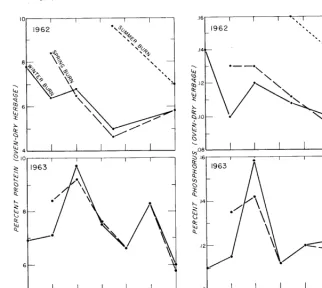
Protein Content.-On June 1,
protein content of herbage was significantly higher (0.05 level) on spring-burned than on win- ter-burned plots (Fig. 1). In both years, protein content was 8.4% on spring-burned plots, whereas the winter-burned av- eraged 6.4% in 1962 and 7.1% in 1963. On July 1, and on all subsequent sampling dates, values for winter and spring treatments were not statistically different.
On August 15, herbage on summer-burned range contained 9.7% protein, or about twice the average of earlier treatments. Thereafter, the protein content on the summer burn diminished sharply; in November, it was not significantly higher than on winter or spring burns.
Because summer fire was evaluated during only 1 year, its effects on protein content were difficult to assess. Drought dur- ing the month after burning may have influenced results. Indica- tions are, however, that sum- mer-burned range will supply adequate protein in late summer when grass on earlier burns averages considerably less than 8%)-the minimum required by dry cows (Duncan and Epps, 1958).
32 GRELEN AND EPPS
bage collected in February 1963 from plots burned during the previous July averaged 3.8% protein-significantly more than the 2.4 and 2.6’j: values for win- ter and spring treatments.
Phosphorus Content. - Phos- phorus content was improved by late burning in 1962 but not in 1963 (Fig. 1). June 1962 sam- ples from spring-burned plots averaged 0.13% phosphorus, compared with O.lO(] on winter- burned plots. Thereafter, values for the two treatments were similar. A month after summer fire, herbage averaged 0.16% phosphorus-significantly more than the 0.11 ‘i: on winter and spring burns. By November, phosphorus on summer burns dropped to 0.1370, and treatment differences were not significant. In February 1963, undisturbed herbage on plots burned the previous summer averaged 0.1370 phosphorus; both the win- ter and spring burns averaged 0.12%.
6-
5-
MAY JUNE JULY AUG SEPT OCT FIG. 1. Nutrient content
Phosphorus content was unaf- fected by date of burning in
1963.
herbage was produced by mid- July. With pre-burn yield in- cluded, total herbage on the summer burn was significantly higher than that on the two earlier burns.
At no time during the study did the phosphorus content reach 0.18%, the minimum re- quired by cows nursing calves
(Duncan and Epps, 1958).
Herbage Yield .-Even though
650 lb/acre of new herbage was destroyed by the May fire (Ta- ble l), post-treatment yields on spring-burned plots were not significantly less than on win- ter-burned plots in either year. Total production-combined pre- and post-treatment yields- was significantly greater on spring-burned than on winter- burned range in 1963.
Conclusions
Herbage produced after sum- mer fire averaged 382 lb/acre, substantially less than post- treatment yields on winter- or spring-burned range. Relatively low yield after summer fire was expected; Cassady (1953) re- ported that, on plots harvested periodically, about 80%; of the
Burning different parts of a range unit at intervals from late winter until midsummer appears to provide herbage of relatively high quality during most of the growing season. A combination of winter and spring fires looks particularly promising. Burning in spring materially improved protein content in June without loss of yield. Further study is needed to fully. evaluate effects of summer fire, but l-year find- ings indicate that range burned in mid-July will yield substan- tial quantities of high-protein herbage.
Table 1. Herbage yields on plots burned in winier, spring, and summer (in lb/acre, oven-dry).
Winter burn
Yield 1962 1963 1962 1963 1962
Pre-burn 412 887 1365
Post-burn 1226 1526 1000 1070 382
Total 1226 1526 1412 1957 1747
16 I I , \, I
1962 ‘\ .
‘\ ‘. . _-
.I0
MAY JUNE JULY AUG SEPT. OCT of herbage after burns.
Burning in midsummer and deferring use until after growth ceases could improve winter for- age. Mature herbage on sum- mer-burned range, though de- ficient in protein, contains sub- stantially more than herbage on winter or spring burns. Cattle would require supplemental phosphorus all year, and protein supplements during winter, re- gardless of burning treatment. Cattle grazing summer-burned range would require appreciably less supplemental protein, how- ever, than those on range burned earlier.
LITERATURE CITED ALDOUS, A. E. 1934. Effect of burning
on Kansas bluestem pastures. Kans. Agr. Exp. Sta. Tech. Bull. 38. 65 p.
CAMPBELL, R. S., AND J. T. CASSADY. 1951. Grazing values for cattle on pine forest ranges in Louisiana.
SEASON OF BURNING 33
Louisiana Agr. EXD. Sta. Bull. 452. unavailable for slant use and obtained 10 months after the burn, 31p. - - may remain so uitil the litter is immediately before the summer CAMPBELL, R. S., E. A. EPPS, JR., C. C.
MORELAND, J. L. FARR, AND FRANCES decomposed by soi1 microorga_ rainy season. Composited samples
nisms. Burning hastens litter de- were collected from each of three
BONNER. 1954. Nutritive values of
native plants on forest range in composition, but forms nitrogen- unburned and three burned treat-
central Louisiana. Louisiana Agr. ments. Surface litter or ash, 0- to
Exp. Sta. Bull. 488. 18 p. ous compounds which may be 1.5-inch and 1.5- to 4-inch mineral CASSADY, J. T. 1953. Herbage produc- lost by volatilization, and total soil depths were sampled separately. tion on bluestem range in central nitrogen in the biosphere may be In addition, samples were taken from Louisiana. J. Range Manage. 6: 38- expected to decrease as a result the 0- to 1.5-inch depth on bare,areas
43. of burning. On the other hand, on both burned and unburned treat-
DUNCAN, D. A., AND E. A. EPPS., JR. total nitro;en in the mineral soil ments where little or no vegetation 1958. Minor mineral elements and
other nutrients on forest ranges in may be increased as a combined had grown. The latter represented result of burning litter and about 5% of the total area and, central Louisiana. Louisiana Agr.
Exp. Sta. Bull. 516. 19 p. standing vegetation and leaching statistically, was treated as a fourth
DUVALL, V. L., AND L. B. WHITAKER. depth.
1964. Rotation burning: A forage of nitrogen-containing com- The soil samples were air dried management system for longleaf pounds. The relative availability and passed through a 2-mm sieve. pine-bluestem ranges. J. Range of soil nutr*ients, especially nitro- Saturated soil paste pH was deter- Manage. 17: 322-326. gen, may be enhanced as a result mined by use of a glass electrode.
of burning (Kucera and Ehren- Total soil and plant nitrogen was
* reich, 1962; Sampson, 1944). determined by the Kjeldahl proce-
Fire effect on nitrogen, phos- dure using a selenium catalyst, but
not modified to include nitrate nitro-
Nitrogen Availability on Fall-
phorus, and sulfur availabilityBurned Oak-Mounfainmahog-
has been evaluated on soils under burned and unburned California gen’ Nitrogen availability was deter-any Chaparral’
chamise (Adenostoma fascicula- mined using the Stanford-DeMent-Hunt (1959) technique with Arivat H. F. MAYLAND
Research Soil Scientist, Snake River Conservation Research Center, Soil and Water Conservation Res. Div., ARS, USDA, Kimberly, Idaho.
Highlight
Nitrogen availability. as shown by short-term upfake by barley, was significantly higher on soils from burned than from unburned areas 10 months after burning. . Increased soil-nitrogen concentrations were ob- served af all depths on the burned as compared with fhe unburned treatment.
Management practices of chap-
arral vegetation in the South-
western U. S. A. have included burning as a means to alter den- sity and, to some extent, coti- position of chaparral stands. Chemical and physical properties of soils also may be altered by
burning. The extent of such
changes is generally related to
the fire intensity.
Nitrogen in litter is generally
1 Journal Paper No. 1124 of the Ari- zona Agr. Exp. Sta., Tucson. ZFormerZy graduate assistant, De-
partment of Agricultural Chemistry and Soils, Azizona Agr. Exp. Sta., Tucson.
turn and Ceanothus cuneatus) by Vlamis and Gowans (1961). The soil, sampled shortly after burn- ing, gave a higher bioassay to all
three elements on the burned
than on an adjacent unburned
area. Miller and Fitzpatrick
(1959) have shown that this in-
creased availability of nutrients
may be temporary however.
Nitrogen performs an impor-
tant role in forage production.
Its availability may mean the
difference between success or
failure in a revegetation pro-
gram. The present study deter-
mined nitrogen availability one
season after burning of defoli-
ated Arizona chaparral.
Experimental Methods and Materials
The study site was on the Sierra Ancha Experimental Forest near Globe, Arizona at 5300-foot eleva- tion. The chaparral type was shrub liveoak (Quercus turbinella) and true mountainmahogany (Ceroco- carpus montanus). Alternate 50-foot strips across a small watershed were treated with a defoliant in August 1961, and 6 weeks later subjected to controlled burning (Pase and Glen- dening, 1965).
Soil and litter or ash samples were
barley (92% germination) as the in- dicator crop. One hundred seeds were planted in 12-0~ cartons con- taining 400 g of coarse, acid-washed sand. Deionized water was added as necessary and growth continued for 3 weeks, at which time the plants were well rooted. The previously prepared false barley-pot bottoms were removed and the pots stacked on similar containers having 50 g of soil to be tested in triplicate. The barley, then in contact with the test soil, was watered with a minus- nitrogen nutrient solution. Soil water was maintained between % and 5 bars. The plants were grown in con- tact with the test soil for 20 days. Above-ground portions were har- vested and analyzed for total nitro- gen.
The experimental design of N- availability included four depths on three burned and three unburned plots. The analysis of variance for a three-factor experiment with 3 rep- lications was used to analyze the ni- trogen yield data.
Rdsulfs
Total nitrogen. - Total nitro-
gen concentration in ash and
mineral soil increased as a result
of burning chaparral (Table 1).
Litter on unburned strips con-