Updates on Sorting of Fully Homomorphic
Encrypted Data
Nitesh Emmadi
∗, Praveen Gauravaram
$†, Harika Narumanchi
∗, Habeeb Syed
∗ ∗TCS Innovation Labs, IndiaEmail:{nitesh.emmadi1,h.narumanchi,habeeb.syed}@tcs.com †Queensland University of Technology, Australia
Email: [email protected]
Abstract—In this paper, we show implementation results of
various algorithms that sort data encrypted with Fully Ho-momorphic Encryption scheme based on Integers. We analyze the complexities of sorting algorithms over encrypted data by considering Bubble Sort, Insertion Sort, Bitonic Sort and Odd-Even Merge sort. Our complexity analysis together with imple-mentation results show that Odd-Even Merge Sort has better performance than the other sorting techniques. We observe that complexity of sorting in homomorphic domain will always have worst case complexity independent of the nature of input. In addition, we show that combining different sorting algorithms to sort encrypted data does not give any performance gain when compared to the application of sorting algorithms individually.
I. Introduction
Since the invention of Fully Homomorphic Encryption (FHE) by Gentry in 2009 [11], cryptographic applications to secure data stored and managed on the cloud environment have been gaining significant importance. With FHE algorithms it is possible to perform arbitrary computations on the encrypted data and still preserve the confidentiality of the data. Also, there has been consistent research on designing efficient FHE algorithms [10], [8], [9] and their analysis [22], [16]. However, the practical viability of FHE, in general, has not seen a similar level of progress, which is the prime motivation for our research work.
In this paper we focus on applying sorting techniques to sort ciphertexts encrypted using the FHE scheme proposed by Smart and Vercauteren [18]. Sorting is an important cloud computing operation and sorting of ciphertexts stored on cloud managed by a cloud service provider is required whenever sort-ing has to be computed on the plaintexts and these plaintexts need to be encrypted. For example, on an encrypted Relational Database Management System (RDBMS), the ability to sort on encrypted records is possible, for example, by supporting ORDER BY SQL query on the encrypted records. Sorting over encrypted data through FHE could be useful for real-world cloud service offerings such as Protonmail [2] and Ciphercloud [1] once such techniques are feasible to deploy in practice. This paper focuses on how far we can reach on sorting data in the encrypted domain with the sorting algorithms used to sort plaintexts.
$Praveen Gauravaram is supported by Australian Research Council Discov-ery Project grant number DP130104304.
A. Our Contributions
We observe that sorting over data encrypted with a FHE algorithm has worst case complexity irrespective of the nature of input data with respect to the sorting order. We note that even some efficient sorting algorithms such as Merge sort that have O(n log(n)) complexity in the worst case to sort n plaintext integers, would have O(n2) complexity in the FHE domain to sort n ciphertext integers. As a result, algorithms that are efficient in sorting plaintext integers would become less efficient when applied to sort encrypted integers. Therefore, it is interesting to investigate on the complexity of the sorting algorithms on the encrypted data and analyze which ones have lower worst case complexity. In this di-rection, we have analyzed some popular sorting algorithms on the FHE encrypted data and found that Odd-Even Merge Sort(OEMS) outperforms Bitonic, Insertion and Bubble sorting algorithms. We implemented these algorithms to sort arrays of ciphertext integers whose corresponding plaintext integers are 32 bits each. We ran our implementations on a 3.4GHz Intel QuadCore Processor with 16GB RAM running a Ubuntu 14.04 operating system. We compared running times of sorting techniques together with some optimizations. Our experiments show that Odd-Even Merge sort takes significantly less time when compared to the other sorting techniques.
Chatterjee et al. [6] described a sorting technique over encrypted data called LazySort that combines Bubble sort and Insertion sort to sort homomorphic data. In this technique initially input data is fed to the Bubble sort algorithm to produce a partially sorted array. This partially sorted array is given as input to the Insertion sort to produce a sorted array in linear time [6, Section 4]. We observe that applying Insertion sort on a partially sorted array doesn’t take linear time for partially sorted array, thus, contradicting the claims of Chatterjee et al. [6]. Finally, we discuss our ongoing work in this research direction.
B. Related Work
library was programmed in C and is based on FHE scheme proposed by Smart and Verteceuran [18], which has relatively smaller key and ciphertext sizes and yet, following Gentry’s bootstrapping blueprint[11] of developing a FHE scheme from a Somewhat Homomorphic Encryption scheme. Chatterjeeet al. [6] also proposed a sorting technique called LazySort
which claims a substantial performance improvement com-pared to the classical Bubble and Insertion sorting techniques. Most recently, C¸ etinet al.[5] proposed techniques to sort en-crypted data focused more on reducing the multiplicative depth that effects the performance of such sorting algorithms. Their new algorithms called the Direct sort and Greedy sort have O(log(N)+log(l)) multiplicative depth but still they require O(n2) pre-computed comparisons. We note that observations were similar to ours’ on the equivalence between worst case and average case complexity of FHE sorting algorithms was independently made by C¸ etinet al..
II. Sorting ofEncryptedData
A. Brief Overview of a FHE scheme
A public key FHE schemeξ:M−→Cis described by a tuple of four polynomial time algorithms i.e.
ξ=(KeyGen,Enc,Dec,Eval)
whereKeyGen,Enc,Decdenote the key generation, encryption and decryption functions ofξrespectively.Evalis the evalu-ation algorithm used for computevalu-ation on encrypted data. This algorithm takes as input a polynomial expressionPand a set of ciphertextsc={C0,C1, . . . ,Cn}which are needed to compute P. The input output ofEvalsatisfies following equation:
Dec(Eval(P,c,pk),sk)=P(Dec(c,sk)) (1) In the above expressionpkdenotes keys that are public, like encryption keys or ReCryptkeys andsk denotes private or decryption key which is secret and known only to the generator of the keys. For the sake of brevity, we omit mentioning these keys in our work unless it is essential to use them. To illustrate
Eval, consider polynomial expression P(X,Y) = X + Y which adds two ciphertexts X and Y and results in addition of corresponding plaintexts. According to Equation (1), for ciphertext inputs (A,B), we have
Dec(Eval(P,A,B))=Dec(P(A,B)) =P(Dec(A)+Dec(B)) B. Smart-Vercauteren FHE scheme
The Smart-Vercauteren FHE scheme [18] consists of four algorithms:{KeyGen, Enc, Dec, ReCrypt}parametrized by three values {N,η, µ} which are typically taken as {N,2√N,√N
}. This scheme supports two operations: {Add,
Mul}.
KeyGen():
– Set the plaintext space to beP={0,1}.
– Choose a monic irreducible polynomial F(x)∈ Z[x] of degree N.
– Repeat until pis prime.
•S(x)←−RB∞,N(η/2).
•G(x)←−1+2.S(x).
• p←−resultant(G(x),F(x)). –D(x)←− gcd(G(x),F(x)) overFp[x].
– Letα∈Fp denote the unique root ofD(x).
– Apply the XGCD-algorithm overQ[x] to obtainZ(x)=
ΣN−i=01zixi∈Z[x] such thatZ(x).G(x)=p mod F(x).
–B←−z0 (mod 2p).
– The public key is pk = (p,α) and the private key is
sk=(p,B).
For fully homomorphic encryption scheme a new algorithm called ReCrypt is defined that takes a ciphertextc and re-encrypts to a new ciphertextcnew. This is done by extending the
above steps ofKeyGenwith the following additional operations and two integer parameterss1 and s2.
– Generates1uniformly random integersBiin [−p, . . . ,p] such that there exists a subset S of s2 elements with
!
j∈S
Bj=Bover the integers.
– Defineski =1 if i∈S and 0 otherwise.Only s2 of the bits{ski}are set to 1.
– Encrypt the bitsski=1 under the encryption operation to obtainci=Enc(ski,pk).
– The public key is (p,α,s1,s2,{ci,Bi}is=11 ).
ReCrypt(c,pk):
– Write down the firsttbits of thes1floating point numbers (c.Bi) (mod2p)/pas ans1×tmatrix (bi,j).
– Encrypt each of the bitsbi,junder the public key pkto obtain ans1×tmatrix of clean ciphertexts (ci,j).
– Multiply each row of the matrix by the corresponding encryptionciofskito obtain (ci.ci,j)mod p. As such we obtain the encryption of a matrix with only s2 non-zero rows.
– Compute the sum of each column as the Hamming weight using symmetric polynomials and hence reduce the sum ofs1 floating point values to the sum oftfloating point values oft bits of precision. More precisely, denote by hi,jthe j-th bit of the Hamming weight of thei-th column fori=1, . . . ,tand j=1, . . . ,sand form thet×tmatrix (Hi,j) withHi,j=hi,i−j+swhenever the right hand side is defined and zero otherwise.
– Merge rows of the matrix H, so as to obtain an s×t matrixH such that the sum of the rows ofH equals the sum of the rows ofH.
– Apply carry-save-adders to progressively reduce the ma-trix to one with two rows. Each set of three rows is reduced to two, and then this procedure is repeated.
Enc(M,pk): – Parsepkas (p,α). – if M ! {0,1}abort.
–R(x)←−RB∞,N(µ/2).
–C(x)←−M+2.R(x).
–c←−C(α) (mod p).
– Outputc.
Dec(c,sk):
– Parsepkas (p,B). –M←−(c− ⌊c.B/p⌋).
– OutputM.
Add(c1,c2,pk): – Parsepkas (p,α). –c3←−(c1+c2) (mod p).
– Outputc3.
Mul(c1,c2,pk): – Parsepkas (p,α). –c3←−(c1.c2) (mod p).
– Outputc3.
C. Sorting of Encrypted Integers
In this section we describe the mathematical model of sorting algorithm over encrypted data developed by Chatterjee et al.[6]. Leta,bbe any two integers. Using arithmetic based on 2’s compliment we have
a−b=a+(2′scompliment of b)
"!!!!!!!!!!!!!!!!!!!!!!!!!!!!#$!!!!!!!!!!!!!!!!!!!!!!!!!!!!% (⋆)
(2)
We denote Most Significant Bit (MSB) of (⋆) byβ. According to bit-wise arithmetic, the value of β is 1 if the subtraction result is negative and 0 otherwise i.e.
a≥b ⇐⇒ β==0
To swapaandbusing the MSBβ, we perform the following operations:
temp=β∗a+(1−β)∗b;
b=(1−β)∗a+β∗b;
a=temp;
Based on above observations FHE SWAP circuit 1 [6] is evaluated as follows: Let A,B be two ciphertext integers which are encryptions ofa,brespectively. FHE SWAP circuit takesA,Bas input and return another pair of ciphertexts (X,Y) such thatDec(X)≤Dec(Y) (assuming that we are sorting in ascending order).
In other words,
(X,Y)←−FHE SWAP(A,B)⇐⇒Dec(X)≤Dec(Y) (3) Using FHE SWAP as the building block, Bubble sort and In-sertion sort algorithms for sorting encrypted data were applied wherein classical swapping of plaintext integers is replaced by FHE SWAP.
1Circuit is the term used in FHE parlance to denote a function which is computable on encrypted data.
D. FHE SWAPand Security of Encryption Scheme
It is well known that any public-key encryption scheme which supports comparison based operations is not secure against ciphertext only attacks. For any such scheme one can recover plaintext of a target ciphertext by following binary searchmethod [17]. In this section, we explain the relevance of this result to sorting algorithms applied on the encrypted data and more specifically to the FHE SWAP circuit and discuss security implications on the underlying encryption scheme ξ. Recall that the semantic security definition of a public key FHE scheme is the same as that of any public key encryption scheme [12]. In particular,semantic security orIndistinguishability against Choosen Plaintext Attack (IND-CPA) is independent ofEvalalgorithm [19, Definition 3.1] and every FHE scheme must satisfy IND-CPA security under the assumption that the adversary has access toEval algorithm. For an FHE schemeξ=(KeyGen,Enc,Dec,Eval), the notion of IND-CPA security can be described as follows: Suppose that Ais a polynomial time adversary and C is a ciphertext such thatC∈{Enc(m0),Enc(m1)}for a pair of given plaintexts (m0,m1) if
Pr[A(Enc(mb))→mb]= 1
2+ϵ b∈{0,1} (4) thenϵ is theadvantage of the adversaryA. The schemeξis said to be semantically secure if the advantageϵ isnegligible for any polynomial adversaryA.
Now we focus on FHE SWAP and analyze how semantic security of FHE scheme ξ is affected. Note that the binary search attack [17] is not applicable to FHE schemes because although FHE SWAP supports comparison based operations it does not reveal output of comparison operation. Consider the FHE SWAP circuit which takes as input a pair of ci-phertext integers (A,B) and outputs another distinct pair of ciphertexts (X,Y). The connection between input and output is thatDec(X),Dec(Y)∈{Dec(A),Dec(B)}but there is no way of knowing ifDec(X)=Dec(A) orDec(Y)=Dec(A). In other words for any polynomial time adversaryAif
Pr[A(A,X)→Dec(X)=Dec(A)])=1 2+ϵ
′ (5)
then ϵ′ is advantage of A. Note that this advantage ϵ′ can be defined for every possible pair (X,B),(Y,A),(Y,B) and not just (X,A). For any pair (A,B) ifϵ′ is non-negligible then by considering m0 = A,m1 = B in (4) we getϵ non-negligible, thus breaking semantic security of ξ. The output (X,Y) of FHE SWAP(A,B) is the result of addition, subtraction and multiplication operations over the input (A,B). Since ξ is assumed to be FHE scheme (X,Y) are indistinguishable from (A,B). Thus, we conclude that although FHE SWAP opera-tion supports comparison based operaopera-tions it does not disturb semantic security ofξ.
III. Complexity ofSortingEncryptedIntegers
LetA={A1, . . .An}be a set whereAi=Enc(ai) for some plaintext integeraithat we need to sort (in ascending order). Fundamental difference between sorting of plaintext data and encrypted data is described in Table I.
TABLE I. Algorithms for sorting encrypted and unencrypted data
Swap on Unencrypted Data Swap on Encrypted Data
1. For every pair with indicesi,jwith
i<j
1. For every pair with indicesi,jwith
i<j
2. Compare (ai,aj) 2.(Xi,Yj)←−FHE SWAP(Ai,Aj)
3. Swap (ai,aj) if necessary
case of encrypted inputs, both comparison and swap are combined together inside the FHE SWAP circuit. Note that the output of FHE SWAP(Ai,Aj) is encrypted and with-out decryption there is no way of knowing if inputs are swapped. Thus, to sort the set A, it is necessary to call FHE SWAP(Ai,Aj) for every pair with indices i,j (i < j). Unlike sorting plaintext integers, we cannot skip unnecessary comparisons and swaps while sorting encrypted integers. This shows that for any data dependent sorting algorithm like Bubble sort, Insertion sort, Quick sort and Merge sort that depend on FHE SWAP we have
Average Case Complexity=Worst Case Complexity (6)
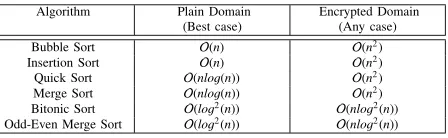
The complexities of various sorting algorithms in the encrypted domain and the plaintext domain are given in Table II.
TABLE II. Sorting algorithms and their complexities in plain and encrypted domains.
Algorithm Plain Domain
(Best case)
Encrypted Domain (Any case)
Bubble Sort O(n) O(n2)
Insertion Sort O(n) O(n2)
Quick Sort O(nlog(n)) O(n2)
Merge Sort O(nlog(n)) O(n2)
Bitonic Sort O(log2(n)) O(nlog2(n))
Odd-Even Merge Sort O(log2(n)) O(nlog2(n))
IV. BoostingPerformance ofSorting
We considered several sorting techniques for FHE sorting including Bubble sort, Insertion sort, Merge sort, Quick sort, BIS and OEMS and analyzed them in terms of number of comparisons. BIS and OEMS algorithms are defined in Algo-rithms 1,2,3,4. For any sorting algorithm, time taken for sorting depends on the number of comparisons. For FHE sorting, comparison of ciphertext integers in an array is the most expen-sive operation. Therefore, complexity of FHE sorting directly depends on the number of comparisons. For sorting an array ofn elements using Merge sort, the array is subdivided into sub-arrays of size 1. These sub-arrays are repeatedly merged to generate sorted sub-arrays until there are no sub-arrays to merge. In FHE Merge sort, as we do not have the knowledge of the input elements, we cannot avoid comparisons of ciphertexts and FHE SWAP calls as in the case of un-encrypted integers until we have a single merged list. Therefore, FHE Merge sort requiresO(n2) comparisons.
For sorting an array of n elements using Quick sort, we pick an element called pivot from the array and divide the array such that the elements smaller than the pivot are in the left partition and the elements greater than the pivot are in the right partition. We recursively pick the pivot element for the sub-arrays with smaller values and greater values to produce a sorted array. Therefore, as in the case of Merge sort, FHE Quick sort also requires O(n2) comparisons. In contrast to Merge sort, the Odd-Even Merge sort is data independent i.e. the number of comparisons are constant independent of the
Algorithm 1:BitonicSort
Input: An array of encrypted sequencesencarr, Public Key pk, Lower Indexlo, Array Sizen
Output: Sorted sequences in ascending order or descending order
1 ifn>1then 2 k←n/2
3 BITONIC SORT(encarr,lo,k,1); 4 BITONIC SORT(encarr,lo+k,k,0); 5 BITONIC MERGE(encarr,pk,lo,n,b);
Algorithm 2:BitonicMerge
Input: An array of encrypted sequencesencarr, Public Key pk, Lower Indexlo, Array Sizen, bit value b1 for ascending 0 for descending
1 fori←lotolo+k do
2 FHE SUB(encarri,encarri+1,MSB,pk); 3 FHE SWAP(encarri,encarri+1,MSB,pk);
4 BITONIC MERGE(encarr,pk,lo,k,b); BITONIC MERGE(encarr,pk,lo+k,k,b);
Algorithm 3:Oem Sort
Input: An array of encrypted sequencesencarr, Public Key pk, Lower Indexlo, Array Sizen,bit value b1 for ascending 0 for descending
Output: Sorted sequences in ascending order or descending order
1 ifn>1then
2 k←n/2
3 OEM SORT(encarr,pk,lo,k,b); 4 OEM SORT(encarr,pk,lo+k,k,b); 5 OEM MERGE(encarr,pk,lo,n,b);
Algorithm 4:Oem Merge
Input: An array of encrypted sequencesencarr, Public Key pk, Lower Indexlo, Array Sizen, bit value b1 for ascending 0 for descending
1 m←b∗2ifm < nthen
2 fori←(lo+b)to(lo+n−b)do
3 FHE SUB(encarri,encarri+b,MSB,pk); 4 FHE SWAP(encarri,encarri+b,MSB,pk);
5 else
6 FHE SUB(encarri,encarri+b,MSB,pk); 7 FHE SWAP(encarri,encarri+b,MSB,pk);
input. Odd-Even Merge sort divides the input array into two halves containing even index positions (even sub-sequence) and odd index positions (odd sub-sequence). The even and odd sub-sequences are recursively compared and merged to produce a sorted array. LetT(n) be the number of comparisons performed by Odd-Even Merge sort. Forn > 2, we have T(n) = 2T(n/2) +n/2−1. Since T(2) = 1, we have T(n) =(n/2)(log(n)−1) + 1∈ O(n log(n)). Therefore, the number of comparisons in Odd-Even Merge sort defined in Algorithm 3 isO(n log2(n)). Similarly, Bitonic sort is another data independent algorithm that sorts two sub-sequences where first sequence is smaller or equal than the second sub-sequence. Each sub-sequence is sorted recursively by applying Bitonic sort Algorithm 1. To produce a sorted array of lengthn from two sorted sub-arrays of lengthn/2,log(n) comparisons are required. The number of comparisons for sorting entire array is given byT(n) = log(n)+T(n/2) = log(n)(log(n)+ 1)/2. Therefore, Bitonic sort algorithm requiresO(n log2(n)) comparisons.
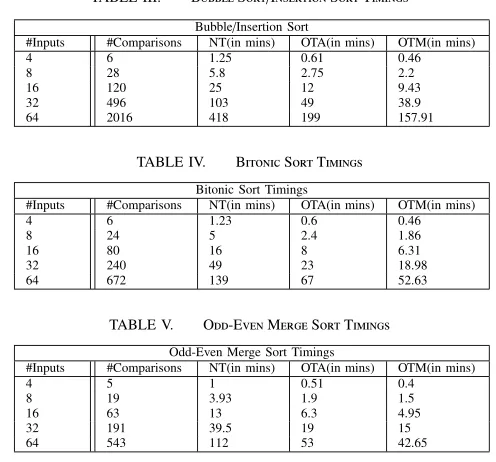
Based on this analysis we implemented Bubble sort, In-sertion sort, Bitonic sort and Odd-Even Merge sort in C on encrypted data forl-bit integers withl=32 by using the hcrypt library [15] and evaluated algorithm performance for various array sizes. The execution times for FHE sorting based on these algorithms are shown in Tables III,IV and V where NT refers to the time taken for sorting without optimizations, OTA refers to the time taken for sorting after removal of ReCrypt
in homomorphic addition function of subtraction and swap modules, OTM refers to sorting time after removal ofReCrypt
from addition operations in the subtract module and from multiplication operation in the swap module. Even though the size of the ciphertext increases during the multiplication in the swap module, the successiveReCryptoperations present in the addition operations would control the size of ciphertexts. This gives us an advantage of suppressing 4∗lReCryptoperations per swap in OTM instead of suppressing 2 ∗l ReCrypt
operations per swap in OTA forl-bit inputs. Our experiments show that OEMS takes about 73% less comparisons and hence 73% less execution time when compared to Bubble sort or Insertion sort. In addition, OEMS takes 19% less comparisons and execution time when compared to BIS. Time taken for sorting n elements is given as the product of number of comparisons and the time taken for each comparison. Time taken for each comparison in the case of NT is 12.5 seconds, for OTA is 6 seconds and in the case of OTM it is 4.7 seconds. We ran all our experiments on a 3.4GHz Intel Quad-core Processor with 16GB RAM running a Ubuntu 14.04 operating system.
Remark 1: Chatterjee et al. [6] provide Bubble sort and Insertion sort statistics of 5-40 elements without any details of the system on which the experiments were conducted. As shown in this paper, it is possible to do practical FHE sorting for an array of more than 40 elements. Nevertheless, our experiments show that while sorting an array of 128 integers, sorting algorithms hit a maximum RAM limit of 16GB and consequently sorting aborts. This demonstrates the impracticality of FHE sorting techniques for reasonable array sizes, thus leaving prospects for further research to design more efficient FHE schemes as well as developing techniques to improve sorting efficiency.
Remark 2: As shown in Tables III, IV and V, the input sizes for the Bubble sort, Insertion sort, Bitonic sort and Odd-Even Merge sort need not be a power of 2. These implementations can be adapted for arbitrary input sizes.
TABLE III. BubbleSort/InsertionSortTimings
Bubble/Insertion Sort
#Inputs #Comparisons NT(in mins) OTA(in mins) OTM(in mins)
4 6 1.25 0.61 0.46
8 28 5.8 2.75 2.2
16 120 25 12 9.43
32 496 103 49 38.9
64 2016 418 199 157.91
TABLE IV. BitonicSortTimings
Bitonic Sort Timings
#Inputs #Comparisons NT(in mins) OTA(in mins) OTM(in mins)
4 6 1.23 0.6 0.46
8 24 5 2.4 1.86
16 80 16 8 6.31
32 240 49 23 18.98
64 672 139 67 52.63
TABLE V. Odd-EvenMergeSortTimings
Odd-Even Merge Sort Timings
#Inputs #Comparisons NT(in mins) OTA(in mins) OTM(in mins)
4 5 1 0.51 0.4
8 19 3.93 1.9 1.5
16 63 13 6.3 4.95
32 191 39.5 19 15
64 543 112 53 42.65
V. On the performance claims of combining sorting techniques
Chatterjee et al. [6, Section 4] proposed a new sorting technique called LazySort. In this technique, input array is first sorted using the Bubble sorting without ReCrypt to produce a partially sorted array. This partially sorted array is then fed to Insertion sort to yield a complete sorted array. Consider the initial input setA={A1, . . . ,An}which is sorted by Bubble sort algorithm giving outputB={B1, . . . ,Bn}which is then sent to Insertion sort for further sorting. It was reported that applying Insertion sort on a partially sorted array works in linear time. However, this is not true. For Insertion sort there is no difference between sendingAorBas input because the algorithm cannot identify the difference between partially sorted array and unsorted array leading to the same number of comparisons for both the arrays. Therefore, time taken for sorting by combining sorting algorithms is the sum of time taken by all algorithms for sorting the data.
Remark 3: The timings of LazySort [6] do not follow a consistent pattern of variation i.e. for the input size 10 the improvement is around 36% whereas for 40 elements the improvement is about 93%. However our experiments show a consistent improvement of about 51%.
VI. Discussion andFuture work
FHE scheme is to minimize calls to ReCryptwhich can be achieved by using modulus switching [10] or relinearization [4] methods. Our ongoing work is focused on using these optimizations to sorting algorithms to make FHE sorting more efficient.
Acknowledgment
Praveen Gauravaram thanks Xavier Boyen, Douglas Stebila and Qinyi Li from QUT and Georg Lippold from Telstra, Australia for discussions on this subject.
References
[1] Ciphercloud. The official website is accessible at http://www.ciphercloud.com/(Accessed on 01/06/2015).
[2] Protonmail. The official website is accessible at https://protonmail.ch/
(Accessed on 01/06/2015).
[3] C. Aguilar-Melchor, S. Fau, C. Fontaine, G. Gogniat, and R. Sirdey. Recent advances in homomorphic encryption: A possible future for signal processing in the encrypted domain.Signal Processing Magazine, IEEE, 30(2):108–117, 2013.
[4] Zvika Brakerski and Vinod Vaikuntanathan. Efficient fully homomor-phic encryption from (standard) LWE.IACR Cryptology ePrint Archive, page 344, 2011.
[5] Gizem S. C¸ etin, Yarkin Dor¨oz, Berk Sunar, and Erkay Savas. Depth optimized efficient homomorphic sorting. In Progress in Cryptology - LATINCRYPT 2015, volume 9230 ofLecture Notes in Computer Science, pages 61–80. Springer, 2015.
[6] Ayantika Chatterjee, Manish Kaushal, and Indranil Sengupta. Acceler-ating sorting of fully homomorphic encrypted data. In INDOCRYPT, volume 8250 ofLecture Notes in Computer Science, pages 262–273. Springer, 2013.
[7] Kai-Min Chung, Yael Kalai, and Salil Vadhan. Improved delegation of computation using fully homomorphic encryption. InAdvances in Cryptology–CRYPTO 2010, pages 483–501. Springer, 2010. [8] Jean-S´ebastien Coron, Tancr`ede Lepoint, and Mehdi Tibouchi. Batch
fully homomorphic encryption over the integers. In Advances in Cryptology EUROCRYPT 2013, volume 7881 of Lecture Notes in Computer Science, page 36, 2013.
[9] Jean-S´ebastien Coron, Tancr`ede Lepoint, and Mehdi Tibouchi. Scale-invariant fully homomorphic encryption over the integers. IACR Cryptology ePrint Archive, 2014:32, 2014.
[10] Jean-S´ebastien Coron, David Naccache, and Mehdi Tibouchi. Public key compression and modulus switching for fully homomorphic en-cryption over the integers. InEUROCRYPT, volume 7237 ofLecture Notes in Computer Science, pages 446–464. Springer, 2012. [11] Craig Gentry. A fully homomorphic encryption scheme. Ph.d. thesis,
2009.
[12] Craig Gentry. Computing arbitrary functions of encrypted data. Com-mun. ACM, 53(3):97–105, 2010.
[13] Adriana L ´opez-Alt, Eran Tromer, and Vinod Vaikuntanathan. On-the-fly multiparty computation on the cloud via multikey fully homomorphic encryption. InProceedings of the forty-fourth annual ACM symposium on Theory of computing, pages 1219–1234. ACM, 2012.
[14] Michael Naehrig, Kristin Lauter, and Vinod Vaikuntanathan. Can homomorphic encryption be practical? In Proceedings of the 3rd ACM workshop on Cloud computing security workshop, pages 113– 124. ACM, 2011.
[15] Henning Perl. hcrypt project. This library is accessible at https://github.com/hcrypt-project/libScarab (Accessed on 28/05/2015). [16] Thomas Plantard, Willy Susilo, and Zhenfei Zhang. Lll for ideal lattices:
re-evaluation of the security of gentryhalevis fhe scheme. volume 76, pages 325–344. Springer US, 2015.
[17] R. L. Rivest, L. Adleman, and M. L. Dertouzos. On data banks and privacy homomorphisms. Foundations of Secure Computation, 1978. [18] Nigel Smart and Fre Vercauteren. Fully homomorphic encryption with
relatively small key and ciphertext sizes. InPublic Key Cryptography - PKC 2010, pages 420–443. Springer LNCS 6056, 2010.
[19] Vinod Vaikuntanathan. Computing blindfolded: New developments in fully homomorphic encryption. InFOCS, pages 5–16. IEEE Computer Society, 2011.
[20] Marten Van Dijk and Ari Juels. On the impossibility of cryptography alone for privacy-preserving cloud computing.HotSec, 10:1–8, 2010. [21] Masaya Yasuda, Takeshi Shimoyama, Jun Kogure, Kazuhiro Yokoyama,
and Takeshi Koshiba. Practical packing method in somewhat homo-morphic encryption. InDPM/SETOP, volume 8247 ofLecture Notes in Computer Science, pages 34–50. Springer, 2013.