Efficient Key Authentication Service for Secure End-to-end
Communications
Mohammad Etemad
Alptekin K¨upc¸¨u
Crypto Group, Koc¸ University, Istanbul, Turkey
{
metemad, akupcu
}
@ku.edu.tr
Abstract
After four decades of public key cryptography, both the industry and academia seek better solutions for the public key infrastructure. A recent proposal, thecertificate transparencyconcept, tries to enable
untrusted servers act as public key servers, such that any key owner can verify that her key is kept properly at those servers. Unfortunately, due to high computation and communication requirements, existing certificate transparency proposals fail to address the problem as a whole.
We propose a new efficientkey authentication service (KAS). It uses server-side gossiping as the source of trust, and assumes servers are not all colluding. KAS stores all keys of each user in a separate hash chain, and always shares the last ring of the chain among the servers, ensuring the users that all servers provide the same view about them (i.e., no equivocation takes place). Storing users’ keys separately reduces the server and client computation and communication dramatically, making our KAS a very efficient way of public key authentication. The KAS handles a key registration/change operation inO(1)time using onlyO(1)proof size; independent of the number of users. While the previous best proposal, CONIKS, requires the client to download 100 KB of proof per day, our proposal needs less than 1 KB of proof per key lifetime, while obtaining the same probabilistic guarantees as CONIKS.
Keywords: Certificate transparency, End-to-end encryption, Key authentication.
1
Introduction
Many online services, ranging from financial services to health and social services, process sensitive data. Most of the sensitive information is transferred through the network, unencrypted or point-to-point en-crypted [9]. The former reveals the data to everyone while the latter reveals the data only to those who perform decryption and encryption on the path to the destination. One of the breakthroughs to this re-gard was the invention of public key cryptography [2, 11]. It is employed in end-to-end secure email and end-to-end encryption (E2EE). To provide security and prevent misuse, the data should be encrypted by the sender, transmitted encrypted, and decrypted by the receiver.
As the networking technologies progress, more and more useful and interesting applications and ser-vices, ranging from financial services to health services to social serser-vices, are offered online, and hence, more and more people are incentivized to use those services. Most of these service require sensitive in-formation that is transferred through the network, unencrypted or point-to-point encrypted [9]. The former reveals the data to everyone while the latter reveals the data only to those who perform decryption and re-encryption on the path to the destination. To provide security and prevent misuse, the data should be encrypted by the sender, transmitted encrypted, and decrypted by the receiver.
End-to-end secure email. Email is one of the oldest IT services for fast communication. Most people
use free email services offered by different email providers such as Google (Gmail) or Yahoo. Gmail initially launched with HTTPS support and uses an encrypted connection for sending and receiving emails, but the encryption is not end-to-end, i.e., the Gmail server has access to the plaintext of all emails that are not encrypted explicitly by the sender.
End-to-end encryption(E2EE) is required to solve the above-mentioned problem. Having easy access to the target’s key, a party can encrypt a message directly with it. E2EE is being considered as an important building block in many recent schemes. Weber [13] used attribute-based encryption for secure end-to-end one-to-many mobile communication. Snake [1] is proposed as an end-to-end encrypted online social net-working scheme, relying on establishment of shared keys between users at the start phase of friendship. E2EE is also used in several messaging service such as Apple iMessage and BlackBerry protected messen-ger [9]. PGP is an end-to-end secure email method which did not get enough traction due to hardness of use and complicated setup requirements. The main problem with all these schemes iskey management.
One caveat of public key cryptography is that it requires the communicating parties to obtain genuine
keys of each other. If the communicating parties had a secure physical channel (i.e., they could physically meet), then they could have exchanged their public keys. Unfortunately, in the online world, atrustedparty calledcertificate authority(CA) is required. A CA ensures the parties via issuing unforgeable cryptographic evidences (certificates) that the public key contained in the certificate does indeed belong to the party stated in the certificate. However, a main problem with CAs is that they must be trusted, and sometimes this trust is broken [12]. Moreover, there are other applicability and usage problems such as storage, revocation, and distribution [10]. CAs are also valuable targets for adversaries through which they can attack the whole system. We need a new source of trust that cannot easily be compromised legally or under pressure [5], without being detected and revealed.
Certificate transparencyis recently proposed to substitute the existing certificate authorities [7]. There is no single source of trust and all users and servers contribute to provide a web of trust among themselves. Following (efficient) schemes [12, 9] added key revocation support, and used it as a general key manage-ment scheme for different applications such as end-to-end encrypted email. However, all these schemes impose a heavy computation and communication burden on both clients and servers, preventing its mass application. We propose an efficient key authentication service that performs key registration/change oper-ations optimally (i.e., withO(1)computation and communication).
Our contributionsare as follows:
• We give thefirst security definition of a key authentication service, and prove our construction’s security formally.
• Our KAS scheme performs key registration/change operationsoptimallywithO(1)server and client computation andO(1)communication. Hence, we reduce the computation and communication costs of the existing schemes [7, 12, 9] for each key registration/change operation by a factor of logn, wherenis the number of users.
• The total cost of the server in the previous schemes isO(nlogn), since they compute the proof for all users on each key registration/change [7, 12] or on each epoch [9]. A similar audit operation costs
O(n)in our KAS.
• Our scheme isperfectly privacy-preserving, i.e., proof of a key (of a user) does not depend on any other key (of another user), and hence, does not reveal any information about other users.
• For the first time, we considernon-repudiationfor both client and server. In our scheme, a malicious client cannot frame an honest server.
1.1
Related Work
Laurieet al.[7] proposedcertificate transparencyfor preventing certificate misuse by publishing the is-sued TLS certificates through publicly-auditable logs. The clients and some special entities (calledmonitors
Later, Laurie and Kasper [6] proposedrevocation transparency, similar to certificate transparency, as a transparent mechanism for providing the list of revoked certificates and showing that all clients see the same list of revoked certificates. However, it is not efficient due to its space and time complexity that is
linearin the number of revocations.
Ryan [12] proposed enhanced certificate transparency (ECT) that can also be used for secure end-to-end email or messaging without requiring a trusted certificate authority. ECT also solves the certificate revocation problem efficiently. There is an append-only Merkle tree as in [7] for handling certificate trans-parency, but in addition, there is another lexicographically ordered hash tree storing a constant number of revoked keys for each client, reducing the revocation complexity from O(n) to O(logn), where n is the number of users.
Melaraet al.[9] proposedCONIKSas an automated key management system. It consists of a number of key providers storing user-to-key bindings of users. The users can detect equivocations or unexpected key changes made by malicious providers. CONIKS provides the following security properties: non-equivocation, binding consistency, privacy-preserving bindings, and security with human-readable names. The following consistency proofs are also provided: proofs of binding consistency, proofs of absence, and checks for non-equivocation.
Laurie et al. [7] and ECT [12] use client-side gossiping, which requires all clients to gossip with each other. This is very inefficient as it is required on each key change. Moreover, it requires a fully connected graph over all users during the gossiping. If the user are partitioned during gossiping, the server can equivocate since the others has no idea about the change that happened. CONIKS [9] uses
server-side gossiping, which is much more efficient than the client-side gossiping, especially assuming a constant
number of servers.
A problem with these schemes is the lack offormal security definitions and proofs. Moreover, orga-nizing the keys in a tree data structure ties them altogether, which means that even if only one key changes, all users (except the one whose key has been changed) need to check the resulting new tree to make sure they are not affected. We store the user-to-key bindings separately, thus decreasing provider and client computation while increasing the privacy-preservation level. Another problem is that thenon-repudiation
property for all parties was not considered previously: one cannot show the origin of any potential incon-sistency. A malicious client can try to frame an honest server, and neither party could provide evidence of honest behavior. We also address this issue. A comparison of these schemes is given in Table 1.
Table 1: A comparison of certificate transparency schemes. NR and PP stand for non-repudiation and privacy-preserving, respectively, and ‘×’ means not fully supported.
Scheme Update Audit Revocation Gossiping NR PP
Laurieet al.[7] O(logn) O(nlogn) O(n) Client-side -
-ECT [12] O(logn) O(nlogn) O(logn) Client-side -
-CONIKS [9] O(logn) O(nlogn) O(logn) Server-side × ×
Our KAS O(1) O(n) O(1) Server-side + +
On a separate line of work, Wendlandt et al. [14] proposed Perspectives for authenticating a server’s public key. It uses a number of (semi-)trusted hosts namednetwork notaries that probe most of network services (e.g., SSH) and keep a history of their public keys over time. On receipt of an unauthenticated public key from a service, the client asks the notaries the history of keys used by that service to help her decide on whether to accept or reject it. Perspectives differs from the certificate transparency as it requires all notaries to be trusted.
1.2
Model
man-ages a distinct set of clients1, and shares information about them with other providers by gossiping, through a specific PKI.
P
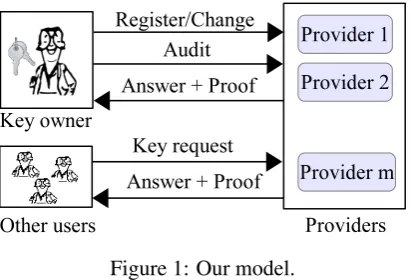
represents the set of all providers. We use the termsproviderandserverinterchangeably. For easier presentation,home provideris the provider a user registers her keys with.Figure 1: Our model.
Theclient(or her device on her behalf) registers her (pub-lic) key in a provider and can access the keys of other clients through the (same or other) provider(s). We use the terms
clientanduserinterchangeably. We also differentiate between two kinds of users when they execute our protocols: The
key owner registers, updates, and audits her own key, while the other users request the key of some key owner from the providers. In our scenarios, hereafter, we assume that Alice
is the key owner, and Bob is some other user who wants to communicate with Alice, hence, requests her key from the providers. Our model is depicted in Figure 1.
Adversarial model. We assume that the providers may be malicious, but not all providers collude
(though some may). They may try to attack the integrity of the name-to-key bindings they store, or to equivocate and show different results for the same query coming from different users, while trying to be undetected. We assume honest behavior of the usersonlyduring the first key registration. But, they arenot
trusted for later key changes in the sense that they may later try to frame an honest provider. Our scheme provides non-repudiation for both the user and the provider, i.e., they cannot deny what they have already done, and helps find the origin of any inconsistency or misbehavior and provides cryptographic proofs to be used as evidence.
1.3
Overview
Public logs are proposed as an alternative to CAs that are not required to be trusted. Either client-side or server-side gossiping is used as the source of trust. The high level idea is that instead of trusting on only one entity, it is better to rely of a group of entities, hoping that not all of them misbehave simultaneously.
The existing solutions store keys of all users in an authenticated data structure, and hence, tie all keys together. This requires all users to check for their keys on any key registration/change. Instead, we store all keys of each user in a separate hash chain and remove the dependence between keys of different users. Each time a user registers a new key, the new key and the previous hash chain digest is hashed to obtain an new hash chain digest. Then, the home provider signs and shares this new digest with all other providers, i.e., we follow the server-side gossiping. This helps all providers keep the same view about the users.
To request a key, a user contacts a number of providers, and accepts the obtained key if they all provide the same view. She cannot rely on only one provider due to the possibility of equivocation.
2
Key Authentication Service
2.1
Preliminaries
Notation. We use||for concatenation, and|X|to show the number of items in X. PPT means probabilistic
polynomial time, and λ is the security parameter. A functionν(λ):Z+ →[0,1] is callednegligible if ∀
positive polynomials p,∃ a constant c such that ∀ λ>c, ν(λ)<1/p(λ). Overwhelming probability is
greater than or equal to 1−ν(λ)for some negligible functionν(λ). Byefficient algorithms, we mean those
with expected running time polynomial inλ.
Interactive protocols. We present our key authentication scheme as a set of interactive protocols
be-tween stateful clients and stateful servers, instead of separately-executed algorithms. Each protocol may
receive inputs from both parties and may output some data at both parties. Hence, we represent a protocol asprotocolName(out putclient)(out putserver)←(inputclient)(inputserver).
Hash functionsare functions that take arbitrary-length strings, and output strings of some fixed length.
Let h:
K
∗M
→C
be a family of hash functions, whose members are identified by k ∈K
. A hash function family is collision resistant if∀PPT adversariesA
,∃a negligible functionν(λ)such that: Pr[k←K
;(x,x0)←A
(h,k):(x06=x)∧(hk(x) =hk(x0))]≤ν(λ)for security parameterλ.Asignature schemeused for preserving message integrity, includes the following PPT algorithms [4]:
• (sk,vk)←Gen(1λ): Generates a pair of signing and verification keys (sk,vk) using the security
pa-rameterλas input.
• σ←Sign(sk,m): Generates a signatureσon a messagemusing the keysk.
• {accept/reject} ←Verify(vk,m,σ): Checks whether σis a correct signature on a message m,
using the verification keyvk, and outputs an acceptance or a rejection signal, accordingly.
2.2
Key Authentication Service Scheme
Definition 2.1 (KAS scheme) A KAS scheme is composed of the following interactive protocols between a
stateful user and a stateful provider:
• (vkp)(skp,vkp)←Setup(1λ)(1λ). The provider starts up this protocol to generate the signing and
verification keys (skp,vkp), given as input the security parameter λ, and shares the verification key
with all users and providers. Essentially, we assume the providers’ verification keys are part of some other well-established PKI.
• (σui,accept/reject)(rvkui−1,vkui,σui)←Register(idu,skui−1,skiu,vkiu,vkp)(skp,vkp). The user
reg-isters/changes her key via a provider, given her ID idu, her previous key skui−1 (empty for the first time), and her new key pair (skui,vkui) as input. For a key change, she should provide a revoca-tion statementrvkui−1signed with her previous signing keyski−u 1. The provider receives his key pair (skp,vkp)as input, stores user’s key, computes a signatureσui on the result, and transfers it to the user.
The user verifies it and outputs an acceptance or a rejection signal based on the result.
• (vkui,accept/reject)()←Audit(idu,{vkp}p∈P)(in f ou): A user initiates this protocol to retrieve
the (latest) key of a useridu. She specifies a subset of providersP⊆
P
at random and challenges them about the useridu. The providers send back their latest view about the useridu given the user information in f ou. If all challenged providers gave the same answer, she accepts and outputs thereceived keyvkui as the correct (latest) key ofidu, andaccept. Otherwise, she outputs⊥andreject. Both users and providers keep their own local states during execution of the protocols. Each user stores her latest key and the respective provider’s signature (and the previous ones if she has enough resources). The providers also store all keys received from the users along with the signatures they have computed. The key owner runsAuditto see if the providers keep a correct view about her. IfAuditreturnsacceptand the obtained key matches the locally-stored key, she outputsaccept. Otherwise, she outputsreject.
2.3
Security Definitions of the Key Authentication Service
Definition 2.2 (Correctness) considers the honest behavior of providers and users in a protocol execution.
A key authentication scheme is correct if the following is satisfied with probability1over the randomness of the users and providers:
Each execution of theAuditprotocol results in a key vku, which is the latest key registered by the key owner through theRegisterprotocol. If such a user does not exist, it returns⊥.
Security game. If the providers deviate from honest behavior by providing different answers to the
same query for different users, the users should detect this with high probability. The security game
AuthGameA(λ) between a challenger
C
who plays the role of all users (key owners and others) and allnon-adversarial providers2, and the adversary
A
acting as the malicious providers, is defined as:• Initialization.
C
runs theSetupprotocol to initialize the environment on behalf of all non-adversarial providers, and shares their verification keys withA
. He stores the verification keys of malicious providers given byA
.• Adaptively Chosen Queries.
A
asks the challenger to start a Register or an Auditprotocol byproviding the required information. For the Register protocol, he specifies a user and a provider that the user will register her key with. If the specified provider is a malicious one,
C
acts as the user in the corresponding registration protocol withA
. He also stores the signatures coming fromA
. Otherwise,C
registers the key locally (acting as both the user and a non-adversarial provider) and shares the resulting signature withA
. For theAuditprotocol,A
requests a user ID, andC
performs the associated audit and verifies the answer, and notifiesA
about the result. The queries can be repeated polynomially-many times, in any order, adaptively.• Challenge.
A
specifies a user and sends an audit request toC
, who initiates anAuditprotocol, giving the specified user ID as input. He outputs the obtained key andacceptifAuditaccepts, and⊥andrejectotherwise.
A
wins the game ifC
accepts while the obtained key differs from the latest keyC
successfully registered on behalf of that user. The output of the game is defined to be 1 in this case.Definition 2.3 (ε-Security) A key authentication service scheme isε-secure if Pr[AuthGameA(λ) =1]≤ε
for any efficient adversary
A
.3
Construction
Problems with Previous Proposals. Laurieet al.[7] builds an append-only Merkle hash tree and appends
the new keys as they arrive. To be secure, after each new key registration/change, they distribute the root of the updated tree to the users who will gossip it among themselves to ensure that they all keep thesame
latest view of the keys registered in the log. This requires all users to connect and contribute in gossiping. In case of any partitioning among the users, the server can easily equivocate. In addition, all users need to verify the new tree. The key owner wants to check that her key is correctly registered/changed, while the other users want to make sure that they are not affected by this key registration/change. This poses an unacceptably heavy burden on users.
To alleviate the problem, CONIKS [9] uses server-side gossiping. Although this relieves the users from gossiping, they still need heavy and frequent verifications. CONIKS goes further and divides the time into
epochs, accumulates all key registration/change requests during each epoch, and applies them all at the beginning of the next epoch. Ift key registration/change requests arrive in an epoch, instead of performing
t consistency checks, a client performs only one consistency check. However, this comes at the cost of giving outdated keys for users whose keys are changed in an epoch, until the beginning of the next epoch.
Our Observations and Solution. A problem common to all existing solutions [6, 7, 9, 12] is that they
put all user-to-key bindings in a single data structure (i.e., a Merkle tree) on each provider. This ties all users together, and hence, forces all users to check whether or not any change in the data structure affects them, regardless of who initiated the change, which is a costly process. Instead, we store each user’s data separately, preventing unwanted costly checks due to changes on other users. Even though on the surface it seems that we are gossiping more than just a root, the number of gossiping operations in our strategy is the same as in [6, 7, 12], since one value is gossiped on every key change (although we can also gossip per epoch as in CONIKS, leaving some vulnerability window). However, they need to update the Merkle tree withO(logn)cost, while we only add a new value into the corresponding hash chain with onlyO(1)cost.
Storing users’ data separately brings other important advantages: the resulting scheme is perfectly
privacy-preserving, since the proof for the a user’s key does not contain any information about other
LetS=(Gen,Sign,Verify)be a secure signature scheme andh:{0,1}∗→ {0,1}lbe a collision resistant hash function modeled
as a random oracle. Construct a key authentication service schemeKAS=(Setup,Register,Audit)as:
• Setup(1λ)(1λ):
– Each provider runs(skp,vkp) =S.Gen(1λ)and sharesvkpwith his users and the other providers.
– Each user storesvkpof her home provider.
• Register(idu,skui−1,skui,vkui,vkp)(skp,vkp):
The key owner:
– Ifi>1, setsrvku
i−1=S.Sign(skiu−1,‘revocation statement’)
– Sendsvkui andrvkui−1to her home provider.
The home provider:
– Finds the last registered key,vkui−1, and the last computed hash,hui−1, for useridu.
– IfS.Verify(vkui−1, ‘revocation statement’,rvkiu−1) ==reject, outputsrejectand exits.
– Otherwise, computeshui =h(idu||hui−1||rvkiu−1||vkui)andσui =S.Sign(skp,hui).
– Sendshui andσui to the respective user and all other providers.
Other providers:
– Each other providerptfirst checks ifS.Verify(vkp,hui,σui) ==accept. If so, he computesσ
u,t
i =S.Sign(skpt,hui),
storeshui andσiu,tlocally, and sendsσui,tto the home provider.
The home provider:
– On receipt the acknowledgmentsσui,t, the home provider checks ifS.Verify(vkpt,hui,σ
u,t
i ) ==acceptfor all other
providerspt. He stores the correct ones, and reveals the incorrect ones.
The key owner:
– The key owner checks ifhui ==h(idu||hui−1||rvkui||vkiu)andS.Verify(vkp,hui,σui) ==accept. If so, she stores
hui andσui locally and outputsaccept. Otherwise, she outputsrejectand publishes misbehavior of the provider
together with the correspondinghui andσui as the proof, through public social networks.
• Audit(idu,{vkp}p∈P)(in f ou):
– The user selects a random subset of providersP⊆P, and sends them theAudit(idu)request.
– The home provider replies with the latest information about the user being queried:(hu
i−1,rvkui−1,vkui,hui).
– The other providers reply with the latest hash value,hui,it, received from the home provider about that user.
– On receipt(hui−1,rvkui−1,vkui,hui)from the home provider andhui,ij from other providers, the user checks if:
* h(idu||hui−1||rvkiu−1||vkui) ==hui. If not, misbehavior of the home provider is detected. She outputs⊥and
reject, publishes the misbehavior, and exits.
* hui ==h
u,i1
i ==h
u,i2
i ==...==h
u,it
i , ∀ij∈P. If so, she outputsvkui andaccept. Otherwise, she outputs⊥
andreject, publishes the misbehavior, and starts the misbehaving detection process.
– (Owner Only) If the user audits for the key she owns, she also checks if the received key vkui is the one she
last registered. If so, outputsaccept. Otherwise, she uses it with the signature she received during registration,
publishes the misbehavior case, outputsreject, and exits.
Figure 2: Construction of our key authentication service.
the provider updates the tree and distributes a new commitment. Then,allother owners should check the tree and ensure that their keys have not been changed.
3.1
Description of the Operations
Register. When a user registers her key for the first time, she provides the home provider with her id,idu,
and her key, vku1. (The user is assumed to be trusted for this operation.) The provider computes hash of this key as hu1=h(idu||vk1u), signs it as σu1=Sign(skp,hu1), and returns back both values. When the user is registering a key change (i.e., the previous key, the(i−1)th key, is revoked and she is providing a new one, theith key), she should also prepare a revocation statementrvkui−1 signed with her previous key and give it to the provider along withiduandvkui. On receipt, the provider verifiesrvki−u 1, and if it is accepted, computeshui =h(idu||hi−u 1||rvkui−1||vkiu)andσui =Sign(skp,hui). In both cases, the provider returnshui and
σui to the user for verification. In addition, he distributes both values to all other providers, who will verify
correctness of the signature and acknowledge by signing it if it is accepted. The home provider keeps the acknowledgments for detecting the source of later inconsistencies. The data structure for a key owner, Alice, on her home provider is a table as shown in Table 2. It contains all keys registered by Alice, all her key revocation statements, the home provider’s signatures, and the other providers’ acknowledgments.
Table 2: The data structure for a key owner, Alice, on her home provider.
Alice’s keys vk1Alice vkAlice2 , rvk1 ... vkAlicei , rvki−1 Provider’s signatures hAlice1 ,σAlice1 hAlice2 ,σAlice2 ... hAlicei ,σAlicei
P2’s acknowledgments σAlice1 ,2 σ2Alice,2 ... σAlicei ,2
... ... ... ... ...
Pm’s acknowledgments σAlice1 ,m σ2Alice,m ... σAlicei ,m
Each provider stores the hash values and signatures he receives about users of the other providers in a similar table, as presented in Table 3. The information in these tables are used for answering the audit queries, which if passed, ensure the auditing user that all providers have the same view about the queried user, meaning that there is no equivocation, with high probability. In other words, the providers help to make a web of trust through ensuring the auditing user that they all confirm binding of the provided key (hash value) to the queried user.
Table 3: The information providerPt keeps about Alice, a user of providerPj.
Pj’s signatures hAlice1 ,σAlice1 h2Alice,σAlice2 ... hAlicei ,σAlicei
Pt’s acknowledgments σAlice1 ,t σ2Alice,t ... σAlicei ,t
On receipt the answer, the key owner verifies the received signature to see if the home provider has correctly registered her key. She can compute eitherh01u=h(idu||vku1)orh0iu=h(idu||hui−1||rvkui−1||vkiu)(she knows all required information) and compare it with what received from the home provider:h01u==hu1for the first key registration orh0iu==hui for the subsequent key changes. If the test passed, she verifies the signature. If it is verified successfully too, she ensures that her key is correctly registered. Then, she can run anAudit protocol to see if the key registration is correctly reflected on the other providers.
Audit. From time to time, the key owner, Alice, checks if the providers keep storing her key and hash value intact. This is because other users cannot check authenticity of her keys. Hence, they rely on regular checks of Alice. If Alice detects equivocation or any other misbehavior, in addition to going to arbitration, she should somehow inform the other users about the misbehavior (e.g., via publishing in social networks [9]) and prevent them from using the fake or outdated keys registered in her name.
When another user, Bob, wants to communicate with Alice, he asks for Alice’s key from the providers. If Bob requests Alice’s key only from her home provider, the home provider may equivocate and give a fake or an outdated key. He needs to make sure, with high probability, that he retrieves a genuine key. Moreover, prior to obtaining the key, he should first check and ensure that there is no equivocation report by Alice.
returns the last registered key, as well as information required to recompute the last hash in the chain. Bob then checks whether all received hash values are the same (otherwise an equivocation is detected). He also re-hashes the values provided by Alice’s home provider. If everything verifies, he returns the obtained key
andaccept. Otherwise, he outputs⊥andreject, and starts the misbehavior detection process.
Alice, as the owner of the key, in addition, checks whether the obtained key matches the one she already registered. If so, she outputs accept, and reject otherwise. In case of any mismatch, Alice announces the misbehavior through the social networks with the home provider’s signature received during the regis-tration as the proof. The misbehavior detection probabilities are discussed in more detail in Appendix A. Essentially, we obtain similar probabilities as in CONIKS [9].
Misbehavior detection. When the key owner or another user discovers a misbehavior, she can trace and
find the source of that misbehavior. This is due to the non-repudiation property of our scheme. Remember that the key is distributed by the home provider only, and the other providers distribute the hash values. Therefore, if the given key does not match the given hash value (all users can detect it), this can be used as the witness of home provider’s misbehavior. If the given key matches the given hash value but it is not the genuine key (only the key owner can detect it), the home provider is misbehaving, and the key owner can use these values together with the home provider’s signature received during the registration as the cryptographic proof of the misbehavior. However, she cannot claim that a given key is fake if she has already registered the key. The home provider can show this case using the signed revocation statement he received from the key owner.
Whenever the received hash values does not match each other (all users can detect it), a subset of providers are equivocating. The user (or any authority) asks the home provider acknowledgments of the other challenged providers, and asks the other challenged providers the signature they have received from the home provider. Verifying the signatures will reveal the misbehaving provider(s).
4
Analysis
4.1
KAS Security Proof
Correctnessfollows from the correctness of the hash function used by the providers. If the key owner has
already been registered, the hash function guarantees that whenever her key is requested, the requesting party receives the correct key. If not,⊥together with non-membership proof will be returned.
Theorem 4.1 Our KAS scheme is secure according to Definition 2.3 provided that the underlying hash
function is collision-resistant.
Proof 4.1 We reduce the security of our KAS scheme to that of the underlying hash function. If a PPT
adversary
A
wins the security game of our KAS scheme with non-negligible probability, we use it to con-struct another PPT algorithmB
who breaks collision-resistance of the hash function, with non-negligible probability.B
acts as the adversary in the hash function security game with the challengerC
. In parallel,B
plays the role of the challenger in the KAS game withA
.Initialization.
B
receives a hash function h(.) fromC
, and shares it withA
. The signature keys aregenerated and shared.
Adaptively Chosen Queries.
A
sendsB
a request to start a protocol, with the required information:• For a Register protocol, a user ID, idu, and a provider ID are given.
B
generates key pair(skui,vkiu)and the revocation statement rvki−1for the given user and stores them locally. If the given
provider is non-adversarial,
B
computes hui =h(idu||hui−1||rvki−u 1||vkui), signs it asσui, stores hui and σui locally, sends them toA
, and keeps the acknowledgments coming back. If the given provider ismalicious,
B
asksA
to register the key for the user, and stores and acknowledges the potential hashes and signatures coming back.non-adversarial,
B
himself provides the answer, while the answer of the malicious ones are given byA
. On receipt all answers,B
performs the verification as in the protocol. He informsA
about the result.Challenge. The adversary specifies a user idu and asks
B
to challenge him about this user.B
runstheAuditprotocol as described. If
B
acceptsA
’s answer while the obtained key disagrees with his local knowledge, we consider two cases:• The returned hash value(s) is the same as the locally-stored one. In this case, a collision is found. If
B
acceptsA
’s answer with probability ε1, we can use it to break security of the hash functionwith probabilityε1. Since the hash function is collision-resistant by assumption, ε1 must be
negli-gible, which means that
A
has negligible chance to passB
’s verification successfully and win the game. Hence, our KAS scheme is secure in this regard assuming that the underlying hash function is collision-resistant.• The returned hash values differ from the locally-stored one: that is an indication of an equivocation. The equivocation of providers is discussed in more detail in Appendix A. According to the discussion, we can approximate the provider equivocation probability with(1−f)kagainst the key owner and fk against the other users, where f is the fraction of providers distributing fake hash values, and k=|P|
is the size of the challenged subset of providers.
Overall, the discussion reveals that when f is large, the key owner will detect the misbehavior with high probability. When f =1/2, the other users have a higher probability of misbehavior detec-tion. The figures in Appendices A.1 and A.2 confirm this statement. Moreover, they will detect the equivocation with probability1−(f−f2)k as discussed in Appendix A.3.
Hence, our scheme is(f− f2)k-equivocal, which means that the equivocation detection probability increases very fast as we increase k. This is maximized when f =1/2. Interestingly, increasing f (from1/2) decreases the detection probability (except if f =1where all providers are colluding).
– When f is very small, the probability of misbehavior detection by Alice is not very high (e.g., when f =0.01, k=50 leads to detection probability1−(1−0.01)50=0.395). But, this means that theAuditprotocol will select all honest providers for audit with high probability, and hence, the obtained key will be the correct key with high probability.
– When f is close to 1, the key owner’s probability of misbehavior detection is very high (e.g., when f =0.99, k=50 leads to detection probability 1−(1−0.99)50, which is almost 1). Note that in this case, the other users’ probability of misbehavior detection is not high, i.e., 0.395. In other words, they will accept the given (fake) key with probability 0.605. But, in this case, the key owner can detect the equivocation with probability almost 1 and notify the other users.
– These computations show only the results of one audit. But, the key owner audits regularly over the time. If the Auditprotocol selects the providers uniformly, it is expected that after
|
P
|/|P|audits, all providers will be challenged at least once. This means that the key owner will eventually detect the misbehavior.– To obtain this detection probability, we do not need all the providers to be home providers. Essentially, maybe only a few providers actually store the keys and have registered users, but other providers just participate in the gossip of the hash values. This means, we can add such independent ‘dummy’ providers to the system to increase overall security. This is expected to ease the deployment of our system.
To sum up, our proposed KAS scheme isε= (ε1,ε2)-secure, i.e., the adversary can break it with
prob-abilityε1, which is negligible in the security parameter if the underlying hash function is secure, and it is
(ε2=(f−f2)k)-equivocal meaning that the adversary can equivocate with a very small probability.
4.2
Discussion
Privacy-preservingmeans that auditing or requesting a user’s key should not reveal any information about
users (i.e., the path from the leaf node storing the requested key to the root, in a Merkle tree). This means that privacy of other users is not fully preserved and one can gain some information from the proof about other users [9]. Our scheme stores keys of each user separately, and the proofs are only based on her own data. Therefore, it revealsnothingabout the other users.
No need for a consistency proof. In a tree-based approach where all users’ data are tied together, a key
registration/change updates the tree. Hence, all other users should check that they have not been affected in an unwanted manner. They receive a proof on each change (or on the beginning of each epoch in CONIKS), and verify it. Considering that the proof is of sizeO(logn), wherenis the number of registered users, and there arerkey registrations/changes per day, each client receives and verifies proofs of sizeO(rlogn)per day. But, there is no consistency check in our KAS as the users’ data are stored separately.
Proof of absence. On receipt of a key request, if a key has already been registered for the requested
user, the home provider returns the registered key and his signature on the key, as the proof of registration. The proof serves as the proof of presence. On the other hand, if the requested user has no registered key, our scheme returns⊥, which servers as the proof of absence. This is a result of equation detection in our schemes: if it returns⊥for a registered user, this will be caught with high probability.
Non-repudiation. A common problem among the existing schemes is that one cannot show the origin
of any potential inconsistency. In our KAS scheme, each party commits to all her work or acknowledges others’, and stores commitments or acknowledgments form other parties during the key registration/change. The key owner commits to all her key changes via revocation statements (following the first key). The home provider also commits to all keys he registers for his users. The other providers also acknowledge all signatures received form the home providers. Therefore, no party can later deny his work during the key registration protocol.
Moreover, in case of any misbehavior, it is easy to track and find the source of that misbehavior. Then, one can use it as a cryptographic proof about the misbehavior, and take the specified actions, i.e., going to arbitration or publishing it through social networks to inform others.
4.3
Asymptotic Comparison to Previous Work
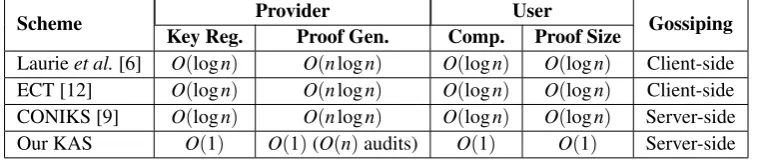
We compare operation complexities of our KAS against the existing schemes. They all use gossiping as a means of providing trust. The schemes given in [6, 12] use client-side gossiping, while CONIKS [9] and ours use server-side gossiping. The comparisons show the case where a single or a constant number of operations are performed.
Key registration/change. Since all users’ data are tied together in the existing schemes, a key
reg-istration/change (or an epoch in CONIKS) forces the provider to generate proofs of size O(logn)for all users and send them to the respective users (consistency proofs). This requires totalO(nlogn)computation and communication cost at the provider, which are not taken into account in the previous work. This is anO(1)operation in our KAS since the provider performs a constant number of operations and distributes constant-size proofs over the network on each update. However, the key owners of KAS audit the providers once in a time, roughly like an epoch in CONIKS. The providers reply only with the latest keys and hash values without any computation, which accounts forO(n)server computation and communication, in total.
Gossiping. In CONIKS and our scheme, there is a gossiping at the provider side, whereas in the other
two schemes gossiping is done at the client side. Note that in practice, we expect maybe only hundreds of providers whereas many millions of clients will take place in the system.Table 4 presents the comparison, showing anO(logn)decrease in all operations in our KAS.
Key revocation. The scheme given in [6] has no an efficient way for key revocation, hence, it needs
Table 4: A comparison of key registration/change costs.nis the number of users.
Scheme Provider User Gossiping Key Reg. Proof Gen. Comp. Proof Size
Laurieet al.[6] O(logn) O(nlogn) O(logn) O(logn) Client-side
ECT [12] O(logn) O(nlogn) O(logn) O(logn) Client-side
CONIKS [9] O(logn) O(nlogn) O(logn) O(logn) Server-side
Our KAS O(1) O(1)(O(n)audits) O(1) O(1) Server-side
Audit. This operation is only needed in CONIKS and our scheme. Similarly, it requires O(nlogn)
andO(n)server computation and communication in CONIKS and KAS, respectively. Moreover, the client computation and proof size areO(logn)andO(1)in CONIKS and KAS, respectively.
4.4
Performance Analysis
Setup. To evaluate our scheme, we implemented a prototype using the Cashlib library [8]. All
experi-ments were performed on a 2.50 GHz machine with 24 cores (using a single core), with 16 GB RAM and Ubuntu 12.04 LTS operating system, hosting all our providers. Hence, the inter-provider communications were performed as loopback. The clients were deployed on a dualcore 2.5GHz laptop machine with 4 GB RAM, running Ubuntu 14.04 LTS, connected to the same LAN. We used settings similar to CONIKS: each provider hasn=10M registered users, and a user changes her key once a year, which accounts for∼27,400 changes per day. The security parameterλ=128, and we use SHA-256 as the hash function and the DSA
signature scheme with key pair size (2048,256) bits according to [3]. The numbers are averages of 50 runs.
Key registration/change. The client sends the home provider her new key (and revocation statement of
the previous key), which has a fixed size. The provider computes hash of the key (32 B), signs the result (64 B), and shares the hash values and the signature with other providers, as well as the key owner. Therefore, the inter-provider communication is 96 KB in total when|
P
|=1000, and the provider-user communication is only 96 B.This happens for each client once per key lifetime, not per epoch as in CONIKS.The previous schemes require the provider to generate and send a consistency proof to each user on each key registration/change [6, 12] (each epoch in CONIKS [9]). Considering that the proof is of sizeO(logn), wherenis the number of users, and there arerkey registrations/changes per day, each client receives and verifiesO(rlogn) proofs per day. This is ∼800 MB (for 109 users) in ECT and 100 KB (for 107 users) using the compressed proofs in CONIKS, per day.
TheO(nlogn)proof that the provider prepares and distributes over the network each time is more than 3.11 GB in total in CONIKS. Assuming 27,400 key changes and 288 epochs per day, the providers prepare and distribute more than 895 GB proof per day in CONIKS. The others [6, 12] perform even worse. In our scheme, the providers perform a constant number of operations and distributes constant-size proofs, leading to a total of∼2.5 MB of proof per day. This is a great out-performance over the existing schemes.
Computation time. It takes∼0.5msfor the provider in KAS to perform the key registration and send
back the proof, while it takes∼2.6sin CONIKS.
Audit. Assuming the key owners perform audit operations once in a time equal to a CONIKS epoch (i.e.,
Table 5: A comparison of audit proof sizes in our KAS and CONIKS,k=50.
Scheme Provider User
Complexity One epoch Per day Complexity One Audit Per day
CONIKS O(nlogn) 915 MB 257.5 GB O(1) 4.68 KB 1.31 MB
Our KAS O(n) 305 MB 85 GB O(1) 1.56 KB 450 KB
References
[1] A. Barenghi, M. Beretta, A. D. Federico, and G. Pelosi. Snake: An end-to-end encrypted online social network. InHigh Performance Computing and Communications, pages 763–770. IEEE, 2014. [2] W. Diffie and M. E. Hellman. New directions in cryptography.Information Theory, IEEE Transactions
on, 22(6):644–654, 1976.
[3] P. Gallagher and C. Kerry. Digital signature standard (dss). NIST, 2013. FIPS PUB 186-4.
[4] S. Goldwasser, S. Micali, and R. L. Rivest. A digital signature scheme secure against adaptive chosen-message attacks. SIAM, 17(2):281–308, 1988.
[5] G. Greenwald and E. MacAskill. Nsa prism program taps in to user data of apple, google and others. http://www.theguardian.com/world/2013/ jun/06/us-tech-giants-nsa-data, 2013. Ac-cessed: 26/03/2015.
[6] B. Laurie and E. Kasper. Revocation transparency. Google Research, 2012.
[7] B. Laurie, A. Langley, and E. Kasper. Rfc 6962: Certificate transparency, 2013.
[8] S. Meiklejohn, C. Erway, A. K¨upc¸¨u, T. Hinkle, and A. Lysyanskaya. Zkpdl: A language-based system for efficient zero-knowledge proofs and electronic cash. InUSENIX Security Symposium, 2010.
[9] M. S. Melara, A. Blankstein, J. Bonneau, M. J. Freedman, and E. W. Felten. Coniks: A privacy-preserving consistent key service for secure end-to-end communication. 2014.
[10] M. Naor and K. Nissim. Certificate revocation and certificate update. Selected Areas in Communica-tions, IEEE Journal on, 18(4):561–570, 2000.
[11] R. L. Rivest, A. Shamir, and L. Adleman. A method for obtaining digital signatures and public-key cryptosystems. Communications of the ACM, 21(2):120–126, 1978.
[12] M. D. Ryan. Enhanced certificate transparency and end-to-end encrypted mail. Proceedings of NDSS. The Internet Society, 2014.
[13] S. G. Weber. Enabling end-to-end secure communication with anonymous and mobile receivers - an attribute-based messaging approach. Cryptology ePrint Archive, Report 2013/478, 2013.
A
Equivocation Detection
Setup. Alice is the key owner that knows her (latest) key and signature. Bob is another user who wants to
obtain Alice’s key. We assume that there are 1000 providers (i.e.,m=|
P
|=1000), of which k are selected randomly and challenged each time.eportion of providers are equivocating, i.e., they give the correct signa-tures to Alice while giving fake signasigna-tures (about Alice) to other users and f portion of other providers. We consider misbehavior detection by either the key owner or other users and equivocation detection separately.A.1
Misbehavior Detection by Owner
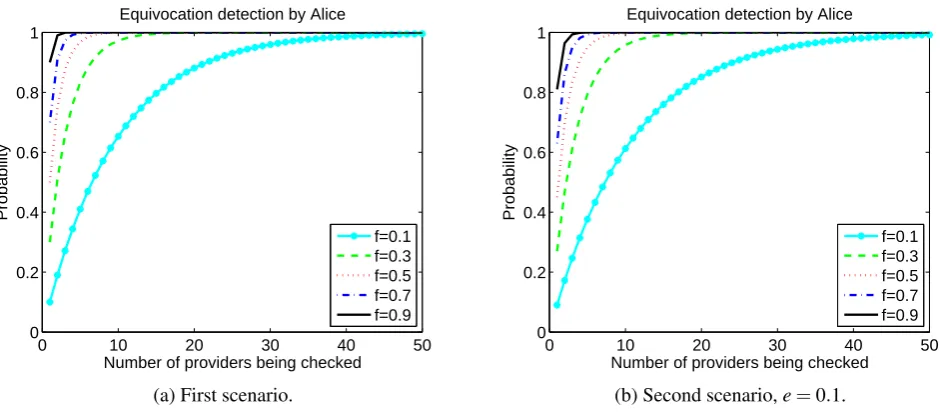
These tests are done by the key owner, Alice. Since there is no trusted party in the scheme, Alice should regularly audit and make sure all providers maintain the same view about her. Since the audit is done regularly, each one verifying a random subset of providers, Alice will detect any misbehavior over the time, with high probability. We consider two scenarios:
0 10 20 30 40 50
0 0.2 0.4 0.6 0.8 1
Number of providers being checked
Probability
Equivocation detection by Alice
f=0.1 f=0.3 f=0.5 f=0.7 f=0.9
(a) First scenario.
0 10 20 30 40 50
0 0.2 0.4 0.6 0.8 1
Number of providers being checked
Probability
Equivocation detection by Alice
f=0.1 f=0.3 f=0.5 f=0.7 f=0.9
(b) Second scenario,e=0.1.
Figure 3: Misbehavior detection by Alice.
First scenario: only Alice’s home provider is equivocating. The home provider gives the correct key
and hash value, while f portion of providers will give fake hash value. With probabilityΠk−i=01(1−m−if)m−i, all
providers selected for challenge are from the set of those that are given correct hash values and the home provider, in which case, there is no misbehavior. After converting the probability formula toΠk−i=01(1−m−if m)
and a variable change, we can approximate it with (1− f)k, leading to misbehavior detection probabil-ity 1−(1− f)k. The probability she detects an equivocation is then 1−Πk−i=01(1−m−if)m−i '1−(1− f)k.
This is represented in Figure 3a for different values of k and f. It shows that the bigger the portion of providers receiving and distributing fake keys and hash values (the larger value of f), the less the probabil-ity of misbehavior, and the bigger the misbehavior detection probabilprobabil-ity. This is because the probabilprobabil-ity of auditing misbehaving providers increases. For example, when f=0.5 (i.e., 50% of providers are distribut-ing fake values), with k=20 and k=50, Alice can detect the misbehavior with probability 0.999,999 and 0.999,999,999,999,999, respectively.
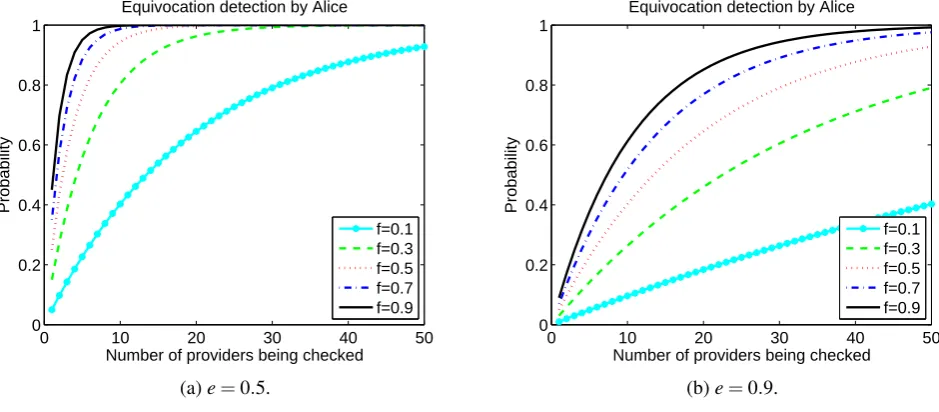
Second scenario: eportion of providers are equivocating. Similarly, Alice can detect misbehavior
with probability 1−Πk−i=01(e+(1−em−i)(1−f))m−i, which can be approximated as above by 1−(1−f(1−e))k.
0 10 20 30 40 50 0 0.2 0.4 0.6 0.8 1
Number of providers being checked
Probability
Equivocation detection by Alice
f=0.1 f=0.3 f=0.5 f=0.7 f=0.9
(a)e=0.5.
0 10 20 30 40 50
0 0.2 0.4 0.6 0.8 1
Number of providers being checked
Probability
Equivocation detection by Alice
f=0.1 f=0.3 f=0.5 f=0.7 f=0.9
(b)e=0.9.
Figure 4: Equivocation detection by Alice, second scenario.
0 10 20 30 40 50
0 0.2 0.4 0.6 0.8 1
Number of providers being checked
Probability
Equivocation detection by Bob
f=0.1 f=0.3 f=0.5 f=0.7 f=0.9
(a) First scenario.
0 10 20 30 40 50
0 0.2 0.4 0.6 0.8 1
Number of providers being checked
Probability
Equivocation detection by Bob
f=0.1 f=0.3 f=0.5 f=0.7 f=0.9
(b) Second scenario,e=0.1.
Figure 5: Misbehavior detection by Bob.
A.2
Misbehavior Detection by Other Users
These tests are done by Bob who is trying to obtain Alice’s key. To make sure the obtained key is a genuine key, he checks whether a randomly-selected subset of providers give the same view about Alice, hoping she would have already detected and published any inconsistency about her. We investigate two scenarios:
First scenario: only Alice’s home provider is equivocating. He returns the correct key to Alice, but
fake key and hash value (for Alice) to Bob. Moreover, he gives f portion of the other providers fake hash value for Alice, and 1−f portion of them the genuine hash value of Alice. Bob receives the genuine hash value (and key) from all challenged providers with probabilityΠk−i=01(1−m−if)m−i (that can be approximated by
(1−f)k)and a fake hash value (and key) from all challenged providers with probabilityΠik−=01m fm−i−i(that can
be approximated by fk). Hence, he can detect a misbehavior with probability 1−Πk−i=01(1−m−if)m−i−Πk−i=01m fm−i−i
0 10 20 30 40 50 0
0.2 0.4 0.6 0.8 1
Number of providers being checked
Probability
Equivocation detection by Bob
f=0.1 f=0.3 f=0.5 f=0.7 f=0.9
(a)e=0.5.
0 10 20 30 40 50
0 0.2 0.4 0.6 0.8 1
Number of providers being checked
Probability
Equivocation detection by Bob
f=0.1 f=0.3 f=0.5 f=0.7 f=0.9
(b)e=0.9.
Figure 6: Misbehavior detection by Bob, second scenario.
probability of misbehavior detection is small. When f=0.5, both the providers distributing fake and genuine hash values will be selected with high probability, and hence the probability of misbehavior detection is high. In this case, with k=10, k=20 and k=50, Bob can detect the misbehavior with probability 0.998, 0.999,998 and 0.999,999,999,999,998, respectively.
Second scenario: e portion of providers are equivocating. They give fake hash values and keys
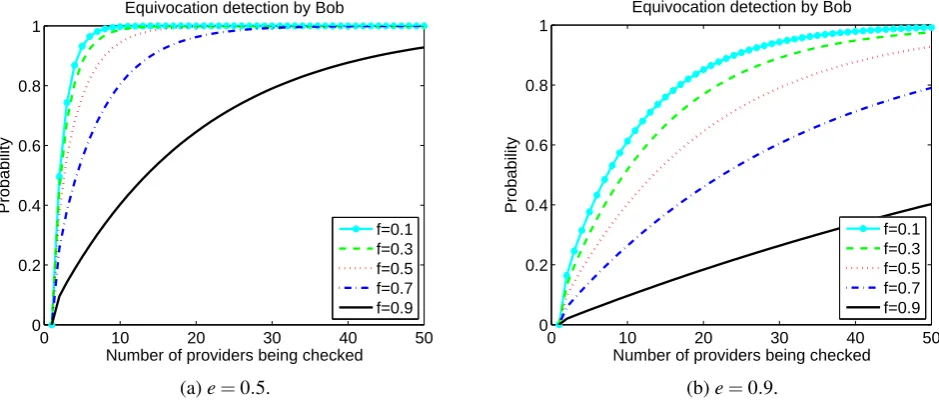
(for Alice) to Bob andf portion of non-equivocating (i.e.,(1−e)portion of) providers, and the real hash values (and keys) to the remaining ones. Bob, similarly, can detect equivocation only if he receives different hash values for Alice in the same query. e+ (1−e)f portion of providers will all give fake hash values, while(1−e)(1−f)portion of them will return genuine hash values. Hence, Bob can detect misbehavior with (approximated) probability 1−Πk−i=01(e+(1−em−i)(1−f))m−i−Πk−i=01((1−em−i)f)m−i (that can be approximated
by 1−(1−(1−e)f)k−((1−e)f)k). This is represented for different values of e, f, and kin Figures 5b (e=0.1), 6a (e=0.5), and 6b (e=0.9). These figures show that wheneis fixed, the probability of misbehavior detection decreases as f increases. This is for the fact that more and more providers help equivocating providers by giving fake hash values that makes the detection hard. The same fact holds as e increases. These figures state that, in general, Bob does not have a good chance of misbehavior detection by himself. But, since Alice has a very high probability of misbehavior detection, she will help Bob in this regard.
A.3
Equivocation Detection
An equivocation occurs if 1) the key owner receives and accepts the correct key and 2) another user receives and accepts a fake key. This means that the providers successfully gave a fake key for Alice to Bob while Alice is regularly checking her key. We consider two scenarios:
First scenario: only Alice’s home provider is equivocating. Using the above computations, Alice
accepts the obtained (correct) key with probability(1− f)k. Moreover, Bob will accept a fake key with probability fk. Since these two events need to happen together, an equivocation occurs with probability
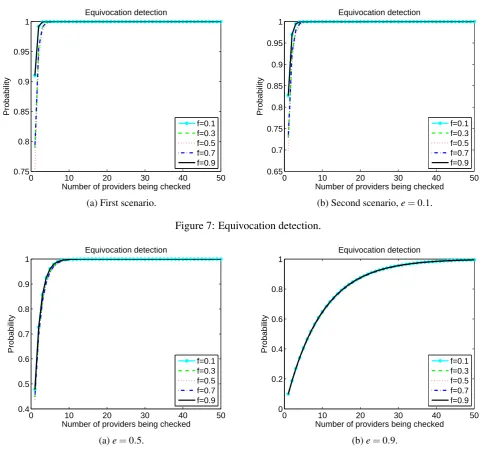
fk(1− f)k = (f − f2)k, and the probability of detection is 1−(f− f2)k. This is represented in Figure 7a for different values of k and f. It shows that when f =1/2, the equivocation detection probability is minimum, and it increases vary fast as f approaches either 0 or 1. When f=0.3 or f=0.7, withk=10 and
k=20, the equivocation detection probability is 0.999,999,833 and 0.999,999,999,999,972, respectively.
Second scenario: eportion of providers are equivocating. Similarly, Alice will accept the correct key
0 10 20 30 40 50 0.75
0.8 0.85 0.9 0.95 1
Number of providers being checked
Probability
Equivocation detection
f=0.1 f=0.3 f=0.5 f=0.7 f=0.9
(a) First scenario.
0 10 20 30 40 50
0.65 0.7 0.75 0.8 0.85 0.9 0.95 1
Number of providers being checked
Probability
Equivocation detection
f=0.1 f=0.3 f=0.5 f=0.7 f=0.9
(b) Second scenario,e=0.1.
Figure 7: Equivocation detection.
0 10 20 30 40 50
0.4 0.5 0.6 0.7 0.8 0.9 1
Number of providers being checked
Probability
Equivocation detection
f=0.1 f=0.3 f=0.5 f=0.7 f=0.9
(a)e=0.5.
0 10 20 30 40 50
0 0.2 0.4 0.6 0.8 1
Number of providers being checked
Probability
Equivocation detection
f=0.1 f=0.3 f=0.5 f=0.7 f=0.9
(b)e=0.9.
Figure 8: Equivocation detection, second scenario.
that increasing the portion of equivocating providers, decreases the probability of equivocation detection. However, whene=0.9, Alice and Bob can detect the equivocation with probability 0.9946 by challenging